

Evaluation of the Cochrane tool for assessing risk of bias in randomized clinical trials: overview of published comments and analysis of user practice in Cochrane and non-Cochrane reviews
Open accessThe DOI matches its Crossref record; 28 of the 28 references it cites were found in a registry or an index.
Abstract
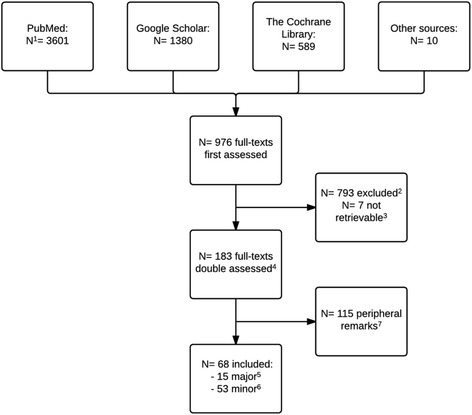
BACKGROUND: The Cochrane risk of bias tool for randomized clinical trials was introduced in 2008 and has frequently been commented on and used in systematic reviews. We wanted to evaluate the tool by reviewing published comments on its strengths and challenges and by describing and analysing how the tool is applied to both Cochrane and non-Cochrane systematic reviews. METHODS: A review of published comments (searches in PubMed, The Cochrane Methodology Register and Google Scholar) and an observational study (100 Cochrane and 100 non-Cochrane reviews from 2014). RESULTS: Our review included 68 comments, 15 of which were categorised as major. The main strengths of the tool were considered to be its aim (to assess trial conduct and not reporting), its developmental basis (wide consultation, empirical and theoretical evidence) and its transparent procedures. The challenges of the tool were mainly considered to be its choice of core bias domains (e.g. not involving funding/conflicts of interest) and issues to do with implementation (i.e. modest inter-rater agreement) and terminology. Our observational study found that the tool was used in all Cochrane reviews (100/100) and was the preferred tool in non-Cochrane reviews (31/100). Both types of reviews frequently implemented the tool in non-recommended ways. Most Cochrane reviews planned to use risk of bias assessments as basis for sensitivity analyses (70 %), but only a minority conducted such analyses (19 %) because, in many cases, few trials were assessed as having "low" risk of bias for all standard domains (6 %). The judgement of at least one risk of bias domain as "unclear" was found in 89 % of included randomized clinical trials (1103/1242). CONCLUSIONS: The Cochrane tool has become the standard approach to assess risk of bias in randomized clinical trials but is frequently implemented in a non-recommended way. Based on published comments and how it is applied in practice in systematic reviews, the tool may be further improved by a revised structure and more focused guidance.
Overview
The claims and statistics of this paper haven’t been checked yet.
Free: it reads the open-access text and checks the first 5 claims that cite a source we can check. Create a free account to check every claim.
Integrity signals
Registry
Cites
Statistics
Figures
Verification
Claims the paper makes
The claims and statistics of this paper haven’t been checked yet.
Free: it reads the open-access text and checks the first 5 claims that cite a source we can check. Create a free account to check every claim.
Claims other papers make about this one
Each is checked against this paper’s own text: does it say what the citing paper says it does?
The cited source says what the claim attributes to it.
In the citing paper
“Few trials are assessed as at low risk of bias, and judgments of unclear risk of bias are common. 6 7”
From RoB 2: a revised tool for assessing risk of bias in randomised trials (2019) · cites this paper as [6]
The cited source says what the claim attributes to it.
In the citing paper
“A review of comments and user practice found that both Cochrane and nonCochrane systematic reviews often implemented the RoB tool in non-standard ways. 6”
From RoB 2: a revised tool for assessing risk of bias in randomised trials (2019) · cites this paper as [6]
Self-check
Percentages, sums and reported differences re-computed from the paper’s own numbers.
The self-check needs the paper’s full text.
Citations
Cites
The Cochrane Collaboration's tool for assessing risk of bias in randomised trials
Higgins, J. P. T., Altman, D. G., Gotzsche, P. C., Juni, P., Moher, D., Oxman, A. D., Savovic, J., Schulz, K. F., Weeks, L., Sterne, J. A. C., et al. (2011) · BMJ · doi:10.1136/bmj.d5928 · Cited by 33,817
Self-citationDermyshi, E., Wang, Y., Yan, C., Hong, W., Qiu, G., Gong, X., & Zhang, T. (2017) · Neonatology · doi:10.1159/000454668 · Cited by 24,451
Assessing the quality of reports of randomized clinical trials: Is blinding necessary?
Jadad, A. R., Moore, R. A., Carroll, D., Jenkinson, C., Reynolds, D. J. M., Gavaghan, D. J., & McQuay, H. J. (1996) · Controlled Clinical Trials · doi:10.1016/0197-2456(95)00134-4 · Cited by 17,582 · cited 1×
“Other tools and scales used to assess risk of bias included the Jadad Quality Assessment Scale (19/80, 24 %) [13] and the Physiotherapy Evidence Database (short PEDro) scale (5/80, 6 %) [14] (Table 4).”
MethodZhang, Q., Wang, C., Zheng, M., Li, Y., Li, J., Zhang, L., Shang, X., & Yan, C. (2015) · Cerebrovascular Diseases · doi:10.1159/000369778 · Cited by 11,533
Dong, Y., Hao, L., Shi, Z., Wang, G., Zhang, Z., & Han, C. (2013) · Urologia Internationalis · doi:10.1159/000351405 · Cited by 4,540
Industry sponsorship and research outcome
Lundh, A., Lexchin, J., Mintzes, B., Schroll, J. B., & Bero, L. (2017) · Cochrane Database of Systematic Reviews · doi:10.1002/14651858.mr000033.pub3 · Cited by 1,697
Bassler, D. (2010) · JAMA · doi:10.1001/jama.2010.310 · Cited by 611
Industry sponsorship and research outcome
Lundh, A., Sismondo, S., Lexchin, J., Busuioc, O. A., & Bero, L. (2012) · Cochrane Database of Systematic Reviews · doi:10.1002/14651858.mr000033.pub2 · Cited by 605
Influence of trial sample size on treatment effect estimates: meta-epidemiological study
Dechartres, A., Trinquart, L., Boutron, I., & Ravaud, P. (2013) · BMJ · doi:10.1136/bmj.f2304 · Cited by 544 · cited 1×
“Several design features of randomized clinical trials have been reported in meta-epidemiological studies to be associated with exaggerated treatment effects, such as sample size [25], development country status [26], single centre status [27] and stopping a trial early [28].”
BackgroundSelf-citationRisk of bias versus quality assessment of randomised controlled trials: cross sectional study
Hartling, L., Ospina, M., Liang, Y., Dryden, D. M., Hooton, N., Krebs Seida, J., & Klassen, T. P. (2009) · BMJ · doi:10.1136/bmj.b4012 · Cited by 348 · cited 3×
“Over this period, the tool has been used in numerous systematic reviews, the scientific debate on risk of bias has proceeded (for example, reflecting on the role of source of funding [3–6] or other “meta-biases” [7]) and research publications have analysed user experience [8] and inter-agreement rates [9–11].”
BackgroundMethodResult
Cited by
Items 301–400 of 437
Iatrogenic Duodenal Perforation After Surgery: a Systematic Review
Reddavid, R., Ballauri, E., Resendiz, A., Cardile, M., Marchiori, G., Sbuelz, F., & Degiuli, M. (2023) · Indian Journal of Surgery · doi:10.1007/s12262-023-03718-y · Cited by 2
“We conducted both the literature search and the systematic review according with the Cochrane Collaboration guidance to seek bias minimizing [20].”
Bilimsel Araştırma Makalesinde Giriş Bölümü Yazımı
Yeldan, İ., & Türkmen, E. (2024) · doi:10.5152/6905 · Cited by 2
Warda, G. (2024) · Academic Medicine & Surgery · doi:10.62186/001c.120231 · Cited by 2
Kim, M. K., Choi, J. H., Cho, I. R., Lee, S. H., Ryu, J. K., Kim, Y., & Paik, W. H. (2024) · Hepatobiliary & pancreatic diseases international · doi:10.1016/j.hbpd.2024.07.002 · Cited by 2
Systematic Review of Volume and Methodological Quality of Randomized Trials in Acute Pancreatitis
Joseph, N., Liu, G. X. H., Varghese, C., Lim, W. B., Xu, W., Wells, C. I., Tobias, S., Capurso, G., de‐Madaria, E., Drewes, A. M., et al. (2024) · Pancreas · doi:10.1097/mpa.0000000000002397 · Cited by 2
“30 The relative subjectivity of certain fields is thought to be responsible for this.”
Lin, Z., Du, H., Cheng, J., Han, X., Wang, D., Liu, Z., & Huang, Y. (2025) · Journal of Back and Musculoskeletal Rehabilitation · doi:10.1177/10538127251337689 · Cited by 2
“28 The risk of bias assessment form includes the following seven items: (1) random sequence generation; (2 ) allocation concealment; (3) blinding of subjects and staff; (4) blinding of outcome assessment; (5) incomplete outcome data; (6) selective outcome reporting; and (7) other sources of bias.”
Oshomoji, O. I., Ajiroba, J. O., Semudara, S. O., Olayemi, M. A., Adeoye, S. O., Ugwu, O. C., & Ojo, L. I. (2025) · Discover Public Health · doi:10.1186/s12982-025-00682-8 · Cited by 2
“…the following tools: the Newcastle–Ottawa Scale for observational studies [46], the Cochrane Risk of Bias tool for randomized controlled trials [34], the Measurement Tool to Assess Systematic Reviews (AMSTAR 2) [67] for evaluating systematic reviews of randomised trials, and CARE Guideline for…”
Public availability of randomized clinical trial protocols: a repeated meta-research study
Schönenberger, C., Chiaborelli, M., Heravi, A. T., Kübler, L., Gandhi, P., Kontár, Z. N., Hüllstrung, J., Elalfy, M., Glasstetter, J., Gryaznov, D., et al. (2025) · Journal of Clinical Epidemiology · doi:10.1016/j.jclinepi.2025.111865 · Cited by 2
Rivas, N. G., Escuela de Ciencias de la Actividad Física, E. D. Y. L. S., Jara, A., Montalva-Valenzuela, F., Farías‐Valenzuela, C., Ferrari, G., Hernández, P. A. F., Castillo-Paredes, A., Laboratorio de Fisiología del Ejercicio y Metabolismo (LABFEM), E. D. K., Facultad de Ciencias de la Salud, U. A. D. C., et al. (2025) · AIMS Medical Science · doi:10.3934/medsci.2025017 · Cited by 2
Nunzio, G. M. D. (2025) · Machine Learning and Knowledge Extraction · doi:10.3390/make7030104 · Cited by 2
“In practice, systematic reviews, particularly in medicine, operate under strict resource constraints: reviewers must balance the goal of achieving high recall with the reality of limited budgets and tight timelines [6,7].”
The effect of robot-assisted training on burn rehabilitation: A systematic review and meta-analysis
Huang, D., Zheng, Y., Xu, M., & Huang, W. (2025) · Burns · doi:10.1016/j.burns.2025.107786 · Cited by 2
Murewanhema, G., Malisheni, M., & Takah, N. F. (2021) · Pan African Medical Journal · doi:10.11604/pamj.2021.38.308.26014 · Cited by 3
“collaboration tool for assessing the risk of bias in RCTs was used [12,15].”
MethodThe principles of evidence-based medicine
Johnson, M. J., & Currow, D. C. (2021) · doi:10.1093/med/9780198821328.003.0120 · Cited by 2
Ashkar, M., Razeghinezhad, R., Chevinlee, H. M., Tavakoli, B., & Cham, M. B. (2022) · Multiple Sclerosis and Related Disorders · doi:10.1016/j.msard.2022.104005 · Cited by 2
The Efficacy and Safety of Ivabradine in Arrhythmias: A Systematic Review
Aly, Y., Beshir, S. A., & Gillani, S. W. (2023) · Pharmacy Practice · doi:10.18549/pharmpract.2023.3.2803 · Cited by 2
Stubbs, P. W., Mehta, P., Bryant, L., Pinto, R. Z., Verhagen, A. P., & McCambridge, A. B. (2020) · Physical Therapy Reviews · doi:10.1080/10833196.2020.1832708 · Cited by 2
“For example, checklists are frequently used to assess risk of bias of randomised trials (Cochrane tool [15]) and research on systematic reviews of healthcare randomised and non-randomised trials (AMSTAR-2 [16]).”
MethodAlashram, A. R. (2024) · Archives of Physical Medicine and Rehabilitation · doi:10.1016/j.apmr.2024.01.012 · Cited by 2
Nikoobakht, M., Shamshiripour, P., Zadeh, S. M. M., Rahnama, M., Hajiahmadi, F., Ramezani, A., Rad, V. F., Nazari, E., Moradi, A., Akbarpour, M., et al. (2023) · BMJ Open · doi:10.1136/bmjopen-2023-072484 · Cited by 1
Bilimsel Araştırma Makalesinde Metot Bölümü Yazımı
Mutlu, E. K., & Şenel, A. (2024) · doi:10.5152/6906 · Cited by 1
Clinical Outcomes of PCI in Hospitals With or Without Surgical Backup: A Meta-analysis
Haddad, T. A., Toubasi, A. A., Fahmawi, A., & Zaid, A. (2025) · Angiology · doi:10.1177/00033197251326354 · Cited by 1
“Publication bias funnel plot showed asymmetry, while the DOI plot demonstrated minor asymmetry indicating minor possibility of publication bias (Supplemental Figures 13 and 14).”
Alchami, H. T., Alomar, M. J., & Palaian, S. (2025) · Pharmacy Practice · doi:10.18549/pharmpract.2025.1.2992 · Cited by 2
Wang, B., Xiong, Y., Lin, N., Shi, J., Zou, B., Ma, X., Zeng, K., & Kang, C. (2025) · Frontiers in Nutrition · doi:10.3389/fnut.2025.1658950 · Cited by 1
Oladunmoye, T. B., Priharjo, R., Odubia, J. S., Amosu, O. J., & Consult., D. (2026) · Journal of Nursing Midwifery and Allied Health Sciences · doi:10.54117/jnmahs.v4i1.56 · Cited by 1
Batarbekova, S., Derbissalina, G., Bekbergenova, Z., & Zhunussova, D. (2025) · Медицинский журнал Западного Казахстана · doi:10.4103/wkmj.wkmj_11_26 · Cited by 1
Zhang, H., Ren, K., & Wang, S. (2026) · BMJ Supportive & Palliative Care · doi:10.1136/spcare-2025-006052 · Cited by 1
“Two researchers, HZ and KR, assessed the quality and risk of bias (RoB) of the included studies using the modified Jadad scale 26 27 for quality and the Cochrane Risk of Bias Tool, Version 2.0 28 for RoB, respectively.”
InfluentialHuang, Y., Chen, L., Ding, M., Huang, Z., Chen, X., Li, K., Li, S., Lo, W. L. A., & Leng, Y. (2026) · Journal of Neurology · doi:10.1007/s00415-026-13912-z · Cited by 1
“The methodological quality of the included RCTs was evaluated using the risk-of-bias assessment tool recommended by the Cochrane Collaboration [25].”
Meta-analysis of rare diseases in occupational epidemiology
McElvenny, D. (2017) · LSHTM Research Online (London School of Hygiene and Tropical Medicine) · doi:10.17037/pubs.03894558 · Cited by 1
Giacomino, K., Hilfiker, R., Magnin, T., & Allet, L. (2021) · F1000Research · doi:10.12688/f1000research.27833.1 · Cited by 1
Patil, S. R., & Bhide, S. S. (2021) · Perspectives in Clinical Research · doi:10.4103/picr.picr_19_21 · Cited by 1
“It is used more widely for assessment of RoB as compared to other tools.[3,10]”
MethodPanorama del riesgo de sesgo en ensayos clínicos aleatorizados de acupuntura
Argueta‐Figueroa, L. (2022) · Revista Internacional de Acupuntura · doi:10.1016/j.acu.2022.100215 · Cited by 2
Cohort Studies, Meta-analyses, and Clinical Trials in Childhood Hypertension
Larkins, N., & Craig, J. C. (2023) · Springer eBooks · doi:10.1007/978-3-031-06231-5_54 · Cited by 1
Çavdar, F. A., & Mustafaoğlu, R. (2024) · doi:10.5152/6913 · Cited by 1
Budak, M. İ. (2024) · doi:10.5152/6914 · Cited by 1
Bilimsel Araştırma Makalesinde Tartışma Bölümü Yazımı
Güzeldere, H. K. B. (2024) · doi:10.5152/6910 · Cited by 1
Bilimsel Araştırma Makalesinde Bulgular Bölümü Yazımı
Gülüstan, F. (2024) · doi:10.5152/6909 · Cited by 1
Singh, A., Mishra, A., Rani, M., Sharma, B., & Sharma, A. (2025) · AIP conference proceedings · doi:10.1063/5.0241740 · Cited by 1
Mishra, A., Singh, A., & Sharma, B. (2025) · European Journal of Physiotherapy · doi:10.1080/21679169.2025.2493048 · Cited by 1
“These questions identified three categories of studies: low, medium, and high risk of bias [12].”
Muthuka, J. K., Fondo, D., Wambura, F. M., Nzioki, J. M., Kelly, O. J., & Nabaweesi, R. (2025) · Journal of the National Medical Association · doi:10.1016/j.jnma.2025.08.079 · Cited by 1
Mosley, A. J., & Roberts, E. R. (2026) · Journal of Evaluation in Clinical Practice · doi:10.1111/jep.70458 · Cited by 1
Acceptability and feasibility of fabric orthoses for movement control in multiple sclerosis
Snowdon, N. (2019) · Sheffield Hallam University · doi:10.7190/shu-thesis-00263 · Cited by 3
Murewanhema, G., Malisheni, M., & Fongwen, N. T. (2021) · Research Square · doi:10.21203/rs.3.rs-65554/v1 · Cited by 1
Alashram, A. R. (2022) · Archives of Physical Medicine and Rehabilitation · doi:10.1016/j.apmr.2022.11.013 · Cited by 1
Alashram, A. R. (2023) · Archives of Physical Medicine and Rehabilitation · doi:10.1016/j.apmr.2023.07.021 · Cited by 1
GPT's Performance in Identifying Outcome Changes on ClinicalTrials.govPreprint
Ying, X., Vorland, C. J., Qureshı, R., Brown, A. W., Kilicoglu, H., Saldanha, I. J., DeVito, N., & Mayo‐Wilson, E. (2024) · MetArXiv (OSF Preprints) · doi:10.31222/osf.io/npvwr · Cited by 3
Bunce, C., Lawrenson, J. G., Wormald, R., & Virgili, G. (2017) · Ophthalmic and Physiological Optics · doi:10.1111/opo.12394
Solo, K. (2017) · Scholarship@Western (Western University)
Adib‐Hajbaghery, M., Nabizadeh‐Gharghozar, Z., & Nasirpour, P. (2019) · Journal of Family Medicine and Primary Care · doi:10.4103/jfmpc.jfmpc_186_19
“[12] Previous studies on the RCTs show that a large number of them have some types of biases.[13,14]”
Rafeeque, A., & Alam, M. F. (2020) · University of the Future: Re-Imagining Research and Higher Education · doi:10.29117/quarfe.2020.0162
Authors' reply to Eckert et al.
Sadeghian, M., & Sadeghi, O. (2020) · Nutrition Metabolism and Cardiovascular Diseases · doi:10.1016/j.numecd.2020.04.025
The effect of phospholipid supplementation on cognitive performance across the lifespan
Champ, C. (2019) · White Rose eTheses Online (University of Leeds, The University of Sheffield, University of York)
Ultrasonido para la valoración del contenido gástrico: revisión sistemática de la literatura
Vallejo, D. F. O., Erazo-Narváez, A. F., Chamorro, L. S. D., Rodríguez, D. S., Sánchez, J. A. C., López, L. F. O., Villarreal, L. M. V., & Rivera, K. A. (2020) · Revista Chilena de Anestesia · doi:10.25237/revchilanestv49n04-05
“La calidad de los ensayos clínicos fue evaluada mediante la herramienta para la valoración del riesgo de sesgo Cochrane (HRSC)[5], mientras que los estudios de cohorte y de casos y controles fueron valorados a través de la escala Newcastle-Otawa (NO)[6].”
BackgroundAlashram, A. R., & Annino, G. (2020) · Archives of Physical Medicine and Rehabilitation · doi:10.1016/j.apmr.2020.05.029
Rieth, A. J., Hamm, C. W., Wanner, C., Mitrović, V. L., & Keller, T. (2020) · Herz · doi:10.1007/s00059-020-04994-0
Wang, J., Wang, N., & Gong, F. (2020) · Otorhinolaryngology-Head and Neck Surgery · doi:10.15761/ohns.1000241
“The risk of bias in the included studies was assessed by Cochrane risk of bias assessment tool for randomized controlled trials [38].”
Alashram, A. R., & Annino, G. (2022) · Archives of Physical Medicine and Rehabilitation · doi:10.1016/j.apmr.2022.01.144
Benziane, R., & Ibrahim, B. (2022) · Journal of Pharmaceutical Research and Reviews · doi:10.28933/jprr-2021-09-2805
Cohort Studies, Meta-analyses, and Clinical Trials in Childhood Hypertension
Larkins, N., & Craig, J. C. (2022) · Springer eBooks · doi:10.1007/978-3-319-31420-4_54-2
Ibrahim, M., Páez, A., Yu, J., Vasey, B., Horovitz, J., & McCulloch, P. G. (2022) · BMJ Surgery Interventions & Health Technologies · doi:10.1136/bmjsit-2021-000120
“19 These features make the C-ROB tool a less suitable option for our study.”
Jeem, Y. A., Andriani, R. N., Nabila, R., Emelia, D. D., Lazuardi, L., & Josef, H. K. (2022) · doi:10.2196/preprints.45439
Youssef, E. M. E., Mohamed, S. H., Alsadek, A. A., & Morsy, A. A. (2023) · The Egyptian Journal of Hospital Medicine · doi:10.21608/ejhm.2023.280199
7450 Summit Cir, D., & Alnaher, S. (2023) · Journal of Sociology Psychology & Religious Studies · doi:10.53819/81018102t4237
Sutrisno, S., & Widowati, A. R. (2023) · Asian Journal of Health Research · doi:10.55561/ajhr.v2i3.134
“The domains were split into three categories based on the study's quality: low, moderate, and high risk of bias [27].”
Insights from a Decade of ‘Cutting Edge Research in Homeopathy’
Roberts, E. R., Mosley, A. J., & Tournier, A. (2024) · Homeopathy · doi:10.1055/s-0043-1777309
Suboptimal reporting practices in biomedical research
Ghannad, M. (2021) · theses.fr (ABES) · doi:10.70675/a6b7cb44z6076z445fz80f4z8d9c1b47b38a
Improving risk of bias assessment and quality of reporting in clinical research
Bertizzolo, L. (2021) · theses.fr (ABES) · doi:10.70675/7c89a3e9zfac2z4b5bza6a5z77fb27b5a29b
Bilimsel Araştırma Makalesinde Başlık Seçimi ve Özet Bölümü Yazımı
Kaya, H. D., & Duman, R. (2024) · doi:10.5152/6904
Argut, S. K., & Sayın, İ. (2024) · doi:10.5152/6902
Veer, P. V. D., & Akgül, A. (2024) · doi:10.5152/6901
Klinik Çalışmalarda Örneklem Belirleme Süreci ve Güç Analizi Uygulaması
Boz, C., & Çalgi, B. (2024) · doi:10.5152/6907
Bilimsel Araştırma Makalesi İçin Dergi Seçimi
Tarakçı, E. (2024) · doi:10.5152/6911
Bilimsel Araştırma Makalesinde Bulunması Gereken Standartlar
Doğan, E. N. K., & Birinci, T. (2024) · doi:10.5152/6903
Bilimsel Araştırma ve Yayın Etiği
Altınay, M. (2024) · doi:10.5152/6915
Libwea, J. N., Esso, L., Njoh, A. A., Ngwa, C. H., Ngomba, A. V., Ndongo, C. B., Mballa, G. A. E., Nwaru, B. I., Weinberger, D. M., Njouom, R., et al. (2024) · PLoS ONE · doi:10.1371/journal.pone.0303468
“Quality assessment of included studies will be performed independently by at least two co-authors using the Cochrane Risk of Bias tool for randomized controlled trials and the Newcastle-Ottawa Quality Assessment Scale for nonrandomized studies [20, 21].”
MethodThe Effect of Inhaled Oxygen on Postpartum Hemorrhage: A Systematic Review and Meta-Analysis
Ghezelhesari, E. M., Abdollahpour, S., Hosseini, S. J., Hoseini, B. L., Yas, A., Hajmollarezaei, E., & Khadivzadeh, T. (2024) · Iranian Journal of Nursing and Midwifery Research · doi:10.4103/ijnmr.ijnmr_118_23
“[15]”
Beyond Boundaries Uniting Internal Medicine and Surgery in Patient Care - A Narrative Synthesis
Alay, D. M. V., Vallejo, L. R. C., Cevallos, V. L. B., Alemán, V. N. J., Herrera, G. A. M., Pinos, D. I. A., Medina, L. M. D., & Coronel, M. G. S. (2024) · Salud Ciencia y Tecnología · doi:10.56294/saludcyt20241259
Hajimirzaei, P., Paydar, R., Razmgir, M., Rajabinasab, F., Tabatabaei, F. S. A., Hamblin, M. R., Janzadeh, A., & Taherkhani, S. (2024) · Research Square · doi:10.21203/rs.3.rs-4854221/v1
Fernández‐Castilla, B., & Noortgate, W. V. D. (2023) · Bulletin of pioneering researches of medical and clinical science · doi:10.51847/vtz6kk3cer
Meneses, C. G., Guzmán-Muñoz, E., Salazar‐Méndez, J., Valdés-Badilla, P. A., & Vásquez-Muñoz, M. (2025) · Retos · doi:10.47197/retos.v66.111857
Empitu, M. A., Jayanthi, R., Yasin, M. N., & Bouqoufi, A. (2025) · BMJ Open · doi:10.1136/bmjopen-2025-100159
“16 For observational studies, the Newcastle-Ottawa Scale will be used to evaluate study selection, comparability of cohorts and outcome assessment.”
Updates on Safety and Efficacy of Robotic Distal Gastrectomy for Gastric Cancer: A Systematic Review
Mehmood, Y., Shafiq, P., Almiglad, G. A., Alruwaili, D. A., Alenezi, A. S., Alruwaili, A. K., Alanazi, I. M., Almotrafi, D. S. M., & Alrawili, M. F. G. (2025) · Journal of Pioneering Medical Science · doi:10.47310/jpms2025140601
Sachdev, J. B., Mokashi, P. R., Subhadra, N. H., & Katre, A. N. (2025) · International Journal of Clinical Pediatric Dentistry · doi:10.5005/jp-journals-10005-3184 · Cited by 1
“The difference was statistically significant ( p 0.001) in all the analyses of non-RCTs.”
InfluentialMorros, R., Moragas, A., García-Sangenís, A., Monfà, R., Miravitlles, M., Vallejo‐Torres, L., Jarca, C. I., & Llor, C. (2025) · JMIR Research Protocols · doi:10.2196/75453
Domínguez‐Navarro, F., Hernández‐Guillén, D., García-Gomáriz, C., Díaz-Díaz, B., Roig‐Casasús, S., Pérez-Maletzki, J., & Blasco, J. (2025) · Disability and Rehabilitation · doi:10.1080/09638288.2025.2566274
“Two researchers independently conducted the risk of bias assessment using the Cochrane Risk of Bias Tool [26].”
Osman, M., Saad, A., Venkatachalapathi, S., Ali, S. E. R., Abouelsadat, M. K., Ali, K., Majeed, N., Kaur, K., Mumtaz, M., & Khan, S. A. (2025) · Cureus · doi:10.7759/cureus.94341
“For systematic reviews, the Cochrane Risk of Bias Tool was employed, assessing methodological soundness and heterogeneity of included evidence [9].”
Khedkar, P., Balasubramanian, H., Pai, A. S., Ananthan, A., Anne, R. P., Mohan, D., Kabra, N. S., Rao, S. C., & Patole, S. (2025) · The Journal of Pediatrics · doi:10.1016/j.jpeds.2025.114871
Rampengan, D. D. C. H., Surya, S. C., Tjandra, K. C., Lele, J., Rampengan, S. H., Kadariswantiningsih, I. N., Idrisov, B. T., Idrisova, A., & Empitu, M. A. (2025) · Biomedical Reports · doi:10.3892/br.2025.2096
“To evaluate the risk of bias of each eligible study, two investigators independently conducted a methodological quality assessment using the Cochrane Collaboration's Risk of Bias 2 (RoB 2) tool (17).”
Tran, L., Tam, D. N. H., Elshafay, A., Dang, T., Hirayama, K., & Huy, N. T. (2021) · Figshare · doi:10.6084/m9.figshare.14561348
Barčot, O., Borić, M., Došenović, S., & Puljak, L. (2021) · Figshare · doi:10.6084/m9.figshare.15001293
Baťalík, L., Chamradova, K., Winnige, P., Dosbaba, F., Batalikova, K., Vlažná, D., Janíková, A., Pepera, G., Abu‐Odah, H., & Su, J. J. (2024) · Figshare · doi:10.6084/m9.figshare.26721981
Hamre, H. J., Glockmann, A., von Ammon, K., Riley, D. S., & Kiene, H. (2024) · Figshare · doi:10.6084/m9.figshare.26624407
Hamre, H. J., Glockmann, A., von Ammon, K., Riley, D. S., & Kiene, H. (2024) · Figshare · doi:10.6084/m9.figshare.26624404
Hamre, H. J., Glockmann, A., von Ammon, K., Riley, D. S., & Kiene, H. (2024) · Figshare · doi:10.6084/m9.figshare.26624398
Hamre, H. J., Glockmann, A., von Ammon, K., Riley, D. S., & Kiene, H. (2024) · Figshare · doi:10.6084/m9.figshare.26624395
Tran, L., Tam, D. N. H., Elshafay, A., Dang, T., Hirayama, K., & Huy, N. T. (2021) · Figshare · doi:10.6084/m9.figshare.14561351
Tran, L., Tam, D. N. H., Elshafay, A., Dang, T., Hirayama, K., & Huy, N. T. (2021) · Figshare · doi:10.6084/m9.figshare.14561339
Increasing Latino Participation in Cancer Research: Feasibility of the Promotora Model
Serrano, M. (2023) · Carolina Digital Repository (University of North Carolina at Chapel Hill) · doi:10.17615/gsq9-0595
Barčot, O., Borić, M., Došenović, S., & Puljak, L. (2021) · Figshare · doi:10.6084/m9.figshare.15001296
Tran, L., Tam, D. N. H., Elshafay, A., Dang, T., Hirayama, K., & Huy, N. T. (2021) · Figshare · doi:10.6084/m9.figshare.14561345
Metadata
- Authors
- Jørgensen, L., Paludan-Müller, A. S., Laursen, D. R. T., Savović, J., Boutron, I., Sterne, J. A. C., Higgins, J. P. T., & Hróbjartsson, A.
- Affiliations
- Rigshospitalet (DK)
- University Hospitals Bristol NHS Foundation Trust (GB)
- Inserm (FR)
- University of Southern Denmark (DK)
- Corresponding author
- Jørgensen, Lars
- ORCID
- Venue
- Systematic Reviews
- Published
- 2016-05-10
- Volume
- 5
- Issue
- 1
- Pages
- 80-80
- ISSN
- 2046-4053 (ISSN-L)
- PMC
- PMC4862216
- OpenAlex
- W2346262725
- Cited by
- 396
- References
- 28
- Citations by year
- 2026: 27 · 2025: 59 · 2024: 75 · 2023: 48 · 2022: 41 · 2021: 42 · 2020: 35 · 2019: 35 · 2018: 20 · 2017: 12 · 2016: 2
- FWCI
- 21.48
- Type
- journal article
- Language
- en
- Open access
- gold
- doi.org
- Licence
- cc-by
- Locations
- Systematic Reviews (publishedVersion, cc-by)
- PubMed Central (publishedVersion, cc-by)
- PubMed (publishedVersion)
- Bristol Research (University of Bristol) (publishedVersion, cc-by)
- Explore Bristol Research (submittedVersion, cc-by)
- University of Southern Denmark Research Portal (University of Southern Denmark) (submittedVersion, cc-by)
- Funders
- Rigshospitalet
- Topics
- Social Sciences › Decision Sciences › Statistics, Probability and Uncertainty › Meta-analysis and systematic reviews
- Social Sciences › Sociology and Political Science › Delphi Technique in Research
- Health Sciences › Nursing › Issues, ethics and legal aspects › Pharmaceutical industry and healthcare
- Keywords
- Cochrane risk of bias tool, risk of bias assessment, randomized controlled trials, interobserver agreement, sensitivity analysis, tool implementation, online comments
- MeSH terms
- Systematic Reviews as Topic, Humans, Bias, Randomized Controlled Trials as Topic, Risk Assessment
About these checks
Registry, retraction, Cites and statistics results are computed, not judged, with one exception: a printed reference that no index lists is read once by a model before it counts as a citation error. Claims are extracted by a model and kept only when their quote appears verbatim in the text; each cited source is then checked, with a model’s help, for whether it says what the claim relies on. Those verdicts can be wrong — read the claim’s quote and the cited source before relying on one.
Statistics and arithmetic are recomputed, not judged.
Confidence bands are shown only for fields calibrated on our annotated test set. None is calibrated yet, so no band is shown.
What counts as a claim ›How we measure confidence ›How we check this ›
Are you an author, or do you see a problem with this page? Request a review
Data sources
Bibliographic data: Semantic Scholar, OpenAlex, Crossref.
Contains information from the Semantic Scholar Academic Graph Datasets, made available under the ODC Attribution License (ODC-BY 1.0).
Semantic Scholar’s data is described in: Kinney, R., et al. (2023). The Semantic Scholar Open Data Platform. arXiv:2301.10140.
