

Evaluation of the Cochrane tool for assessing risk of bias in randomized clinical trials: overview of published comments and analysis of user practice in Cochrane and non-Cochrane reviews
Open accessThe DOI matches its Crossref record; 28 of the 28 references it cites were found in a registry or an index.
Abstract
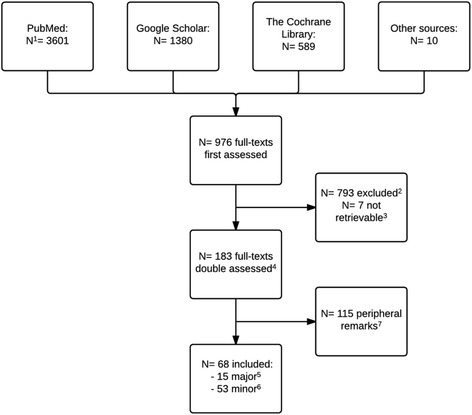
BACKGROUND: The Cochrane risk of bias tool for randomized clinical trials was introduced in 2008 and has frequently been commented on and used in systematic reviews. We wanted to evaluate the tool by reviewing published comments on its strengths and challenges and by describing and analysing how the tool is applied to both Cochrane and non-Cochrane systematic reviews. METHODS: A review of published comments (searches in PubMed, The Cochrane Methodology Register and Google Scholar) and an observational study (100 Cochrane and 100 non-Cochrane reviews from 2014). RESULTS: Our review included 68 comments, 15 of which were categorised as major. The main strengths of the tool were considered to be its aim (to assess trial conduct and not reporting), its developmental basis (wide consultation, empirical and theoretical evidence) and its transparent procedures. The challenges of the tool were mainly considered to be its choice of core bias domains (e.g. not involving funding/conflicts of interest) and issues to do with implementation (i.e. modest inter-rater agreement) and terminology. Our observational study found that the tool was used in all Cochrane reviews (100/100) and was the preferred tool in non-Cochrane reviews (31/100). Both types of reviews frequently implemented the tool in non-recommended ways. Most Cochrane reviews planned to use risk of bias assessments as basis for sensitivity analyses (70 %), but only a minority conducted such analyses (19 %) because, in many cases, few trials were assessed as having "low" risk of bias for all standard domains (6 %). The judgement of at least one risk of bias domain as "unclear" was found in 89 % of included randomized clinical trials (1103/1242). CONCLUSIONS: The Cochrane tool has become the standard approach to assess risk of bias in randomized clinical trials but is frequently implemented in a non-recommended way. Based on published comments and how it is applied in practice in systematic reviews, the tool may be further improved by a revised structure and more focused guidance.
Overview
The claims and statistics of this paper haven’t been checked yet.
Free: it reads the open-access text and checks the first 5 claims that cite a source we can check. Create a free account to check every claim.
Integrity signals
Registry
Cites
Statistics
Figures
Verification
Claims the paper makes
The claims and statistics of this paper haven’t been checked yet.
Free: it reads the open-access text and checks the first 5 claims that cite a source we can check. Create a free account to check every claim.
Claims other papers make about this one
Each is checked against this paper’s own text: does it say what the citing paper says it does?
The cited source says what the claim attributes to it.
In the citing paper
“Few trials are assessed as at low risk of bias, and judgments of unclear risk of bias are common. 6 7”
From RoB 2: a revised tool for assessing risk of bias in randomised trials (2019) · cites this paper as [6]
The cited source says what the claim attributes to it.
In the citing paper
“A review of comments and user practice found that both Cochrane and nonCochrane systematic reviews often implemented the RoB tool in non-standard ways. 6”
From RoB 2: a revised tool for assessing risk of bias in randomised trials (2019) · cites this paper as [6]
Self-check
Percentages, sums and reported differences re-computed from the paper’s own numbers.
The self-check needs the paper’s full text.
Citations
Cites
The Cochrane Collaboration's tool for assessing risk of bias in randomised trials
Higgins, J. P. T., Altman, D. G., Gotzsche, P. C., Juni, P., Moher, D., Oxman, A. D., Savovic, J., Schulz, K. F., Weeks, L., Sterne, J. A. C., et al. (2011) · BMJ · doi:10.1136/bmj.d5928 · Cited by 33,817
Self-citationDermyshi, E., Wang, Y., Yan, C., Hong, W., Qiu, G., Gong, X., & Zhang, T. (2017) · Neonatology · doi:10.1159/000454668 · Cited by 24,451
Assessing the quality of reports of randomized clinical trials: Is blinding necessary?
Jadad, A. R., Moore, R. A., Carroll, D., Jenkinson, C., Reynolds, D. J. M., Gavaghan, D. J., & McQuay, H. J. (1996) · Controlled Clinical Trials · doi:10.1016/0197-2456(95)00134-4 · Cited by 17,582 · cited 1×
“Other tools and scales used to assess risk of bias included the Jadad Quality Assessment Scale (19/80, 24 %) [13] and the Physiotherapy Evidence Database (short PEDro) scale (5/80, 6 %) [14] (Table 4).”
MethodZhang, Q., Wang, C., Zheng, M., Li, Y., Li, J., Zhang, L., Shang, X., & Yan, C. (2015) · Cerebrovascular Diseases · doi:10.1159/000369778 · Cited by 11,533
Dong, Y., Hao, L., Shi, Z., Wang, G., Zhang, Z., & Han, C. (2013) · Urologia Internationalis · doi:10.1159/000351405 · Cited by 4,540
Industry sponsorship and research outcome
Lundh, A., Lexchin, J., Mintzes, B., Schroll, J. B., & Bero, L. (2017) · Cochrane Database of Systematic Reviews · doi:10.1002/14651858.mr000033.pub3 · Cited by 1,697
Bassler, D. (2010) · JAMA · doi:10.1001/jama.2010.310 · Cited by 611
Industry sponsorship and research outcome
Lundh, A., Sismondo, S., Lexchin, J., Busuioc, O. A., & Bero, L. (2012) · Cochrane Database of Systematic Reviews · doi:10.1002/14651858.mr000033.pub2 · Cited by 605
Influence of trial sample size on treatment effect estimates: meta-epidemiological study
Dechartres, A., Trinquart, L., Boutron, I., & Ravaud, P. (2013) · BMJ · doi:10.1136/bmj.f2304 · Cited by 544 · cited 1×
“Several design features of randomized clinical trials have been reported in meta-epidemiological studies to be associated with exaggerated treatment effects, such as sample size [25], development country status [26], single centre status [27] and stopping a trial early [28].”
BackgroundSelf-citationRisk of bias versus quality assessment of randomised controlled trials: cross sectional study
Hartling, L., Ospina, M., Liang, Y., Dryden, D. M., Hooton, N., Krebs Seida, J., & Klassen, T. P. (2009) · BMJ · doi:10.1136/bmj.b4012 · Cited by 348 · cited 3×
“Over this period, the tool has been used in numerous systematic reviews, the scientific debate on risk of bias has proceeded (for example, reflecting on the role of source of funding [3–6] or other “meta-biases” [7]) and research publications have analysed user experience [8] and inter-agreement rates [9–11].”
BackgroundMethodResult
Cited by
Items 401–437 of 437
Hamre, H. J., Glockmann, A., von Ammon, K., Riley, D. S., & Kiene, H. (2024) · Figshare · doi:10.6084/m9.figshare.26624401
Tran, L., Tam, D. N. H., Elshafay, A., Dang, T., Hirayama, K., & Huy, N. T. (2021) · Figshare · doi:10.6084/m9.figshare.14561342
Investigation of Virtual Reality as a new model of delivery for evidence-based stroke rehabilitation
Ellis, F. (2020) · UEA Digital Repository (University of East Anglia) · Cited by 1
La tablette électronique et le développpement occupationnel des enfants : une revue systématique
Vincent, K. (2019) · Le dépôt institutionnel (Université du Québec à Trois-Rivières)
Martins, L., Collet, P., Lafrance, S., & Demont, A. (2026) · Annals of Physical and Rehabilitation Medicine · doi:10.1016/j.rehab.2025.102070 · Cited by 1
Muthuka, J. K., Muthoni, A. B., Ng’eno, L., Chebungei, L., Mbari, D., & Nabaweesi, R. (2026) · Journal of Health Care for the Poor and Underserved · doi:10.1353/hpu.2026.a982955
(3ie), I. I. F. I. E. (2026) · doi:10.23846/b/wp/202602
“…in other sectors: for example, across 100 Cochrane reviews, just 6% of randomised controlled trials were rated as low risk of bias, while 61% of trials were rated as high risk of bias (Jørgensen et al. 2016), and 10% of non-randomised studies were rated as low risk of bias (Igelström et al. 2021).”
(3ie), I. I. F. I. E., Lwamba, E., Storhaug, I., Pande, S., Marion, P., Córdova-Aráuz, D. B., (3ie), I. I. F. I. E., Shisler, S., (3ie), I. I. F. I. E., Quiñones, E. J., et al. (2026) · doi:10.23846/wp0068
Somaa, F. A., Khan, A., & Arafah, A. M. (2026) · Advances in Human Biology · doi:10.4103/aihb.aihb_156_25
Parkinsono ligos prodromo nemotorinių simptomų apžvalga
Seedat, J. M. (2024) · Lithuanian University of Health Sciences
Plessis, C. D., Beer-Brandon, R. D., Mothabeng, J., & Human, A. (2026) · Canadian Journal of Respiratory Therapy · doi:10.29390/001c.156353
Kadariswantiningsih, I. N., Empitu, M. A., Danardono, E., Rahmatullah, I., Widya, A., Koendhori, E. B., Rampengan, D. D. C. H., Arima, E., & Endraswari, P. D. (2026) · Biomedical Reports · doi:10.3892/br.2026.2135
“…assessed using the Cochrane Risk of Bias 2.0 tool, which evaluates five domains: Bias arising from the randomization process, bias due to deviations from intended interventions, bias due to missing outcome data, bias in measurement of the outcome and bias in selection of the reported result (14).”
InfluentialZhou, Z., Li, Y., Tu, Y., He, M., Liao, D., He, Z., 刘志仁, Li, B., 周祖刚, & 艾双春 (2026) · Frontiers in Pharmacology · doi:10.3389/fphar.2026.1761301
“Two blinded independent researchers employed the Cochrane Risk of Bias Tool (ROB) 2.0 (Jørgensen et al., 2016), to scrutinize the quality of included studies.”
InfluentialTaccardi, D., Gowdy, H. G. M., Sharp, E. V., Adya, P., Cupido, T., Pagé, M. G., & Ghasemlou, N. (2026) · EBioMedicine · doi:10.1016/j.ebiom.2026.106251
“For clinical studies, the risk of bias was assessed using the Cochrane risk assessment tool, 39 and six domains were evaluated: random sequence generation, allocation concealment, blinding, incomplete outcome data, selective reporting, and other sources of bias.”
Exploring the Role of Exercise in Hypertension and Blood Pressure Variability
(2026) · Frontiers research topics · doi:10.3389/978-2-8325-7915-2
Tu, Y., Zhou, Z., Li, Y., He, Z., Liao, D., Li, B., Li, B., 周祖刚, & Ai, S. (2026) · Frontiers in Medicine · doi:10.3389/fmed.2026.1759161
“Two researchers (TYY and ZZH) independently evaluated the methodological quality of the included studies using the Cochrane Risk of Bias Assessment tool (23).”
Current Evidence of Acetyl-L-Carnitine Use in Mood Disorders-: A Systematic Review and Meta-Analysis
Kumar, R., Hashempour, Z., Shahriarirad, S., Shahriarirad, R., Hassett, L. C., Singh, B., Croarkin, P. E., Veldić, M., Frye, M. A., & Pagali, S. R. (2026) · Neuropsychiatric Disease and Treatment · doi:10.2147/ndt.s586506
“We used the Cochrane Risk of Bias 2 (RoB 2) tool (crossover extension where applicable) for assessing the risk of bias to evaluate the methodological quality of RCTs. 20 We assessed the risk of bias for randomization process, deviations from intended interventions, missing outcome data, measurement of outcome, selecti…”
InfluentialShafiq, S. S., Razzak, M. J., Ahmed, M., Khan, G. T., Siddiqi, A. M., Bilal, A. R., Mansoor, K., Sohaib, A., Khan, M. A., Majid, M., et al. (2026) · Cardiology in Review · doi:10.1097/crd.0000000000001350
Addressing Conflicts of Interest in Clinical Trials
Lundh, A., & Hróbjartsson, A. (2026) · Springer eBooks · doi:10.1007/978-3-032-27479-3_6
Self-citationLundh, A., Boutron, I., Stewart, L. A., & Hróbjartsson, A. (2026) · Journal of Clinical Epidemiology · doi:10.1016/j.jclinepi.2026.112415
Self-citationKarimi, F. Z., Abdollahi, M., & Yas, A. (2026) · Holistic Nursing Practice · doi:10.1097/hnp.0000000000000785
Davis, S. (2026) · White Rose eTheses Online (University of Leeds, The University of Sheffield, University of York)
Cheng, Q., Qinming, Z., Cao, J., Wang, J., Jiang, L., & Zhou, X. (2026) · Annals of Vascular Surgery · doi:10.1016/j.avsg.2026.07.016
Venketasubramanian, N., Lee, T. H., Chiu, H. C., Guo, L., & Chen, C. (2026) · Neurology International · doi:10.3390/neurolint18080141
“Each included study was independently evaluated by these reviewers using the Cochrane Risk of Bias (RoB) 1.0 tool [24].”
InfluentialLv, Y., Xu, L., Li, M., Cai, X., Ye, L., Wang, X., Wang, X., & Chen, Y. (2026) · European journal of medical research · doi:10.1186/s40001-026-05041-0
Kampman, S. L., Braun, K. P. J., & Otte, W. M. (2026) · medRxiv · doi:10.64898/2026.09.09.26362643
Fu, J., Zhang, Y., & Cheng, Z. (2026) · Frontiers in Psychology · doi:10.3389/fpsyg.2026.1898808 · Cited by 1
“For randomized controlled trials, the Cochrane Risk of Bias Assessment Tool was used (Jørgensen et al., 2016).”
Zhang, Y., Zhu, K., & Ma, G. (2026) · Frontiers in Psychology · doi:10.3389/fpsyg.2026.1937157
“Cochrane is no longer described as assigning a uniform quality score to all studies, but rather as a standardized framework used to systematically identify potential sources of bias (Jørgensen et al., 2016).”
Sharifi‐Zahabi, E., Pashaei, M. R., & Hajizadeh‐Sharafabad, F. (2026) · Nutrition Reviews · doi:10.1093/nutrit/nuag125
Fan, X., Dai, X., Peng, Q., Dai, W., Yin, X., & Hou, S. (2026) · British Journal of Hospital Medicine · doi:10.31083/bjhm58254
Meng, Y., Yang, W., Lu, S., An, Y., Zheng, X., Sun, T., You, H., Xue, Y., & Zhang, X. (2026) · Journal of Sports Sciences · doi:10.1080/02640414.2026.2740976
Non-Pharmacological Interventions for Primary Stroke Prevention: A Systematic Review
Hamdoni K. Pangandaman, M. A. A. H. (2025) · Frontiers in Health Informatics
Association of the Serum Uric Acid to Creatinine Ratio with Metabolic Syndrome: Meta-analysis
Aljameel, S. S., & Elkelish, A. (2026) · Bratislavské lekárske listy/Bratislava medical journal · doi:10.1007/s44411-026-00915-5
Patil, S., Sabu, S., Bhandi, S., Thomas, S., Shah, A., Dehoyos, H., Licari, F. W., & Miller, C. (2026) · The Cleft Palate-Craniofacial Journal · doi:10.1177/10556656261499561
A historical review of risk of bias assessment tools for randomised controlled trials
Pacheco, R. L., & Riera, R. (2026) · Journal of the Royal Society of Medicine · doi:10.1177/01410768261494841
Wen, L., Wu, S., Sheng, X., & Li, H. (2026) · European Geriatric Medicine · doi:10.1007/s41999-026-01586-9
Fauz, M. M. (2026) · BIO Web of Conferences · doi:10.1051/bioconf/202626208007
Metadata
- Authors
- Jørgensen, L., Paludan-Müller, A. S., Laursen, D. R. T., Savović, J., Boutron, I., Sterne, J. A. C., Higgins, J. P. T., & Hróbjartsson, A.
- Affiliations
- Rigshospitalet (DK)
- University Hospitals Bristol NHS Foundation Trust (GB)
- Inserm (FR)
- University of Southern Denmark (DK)
- Corresponding author
- Jørgensen, Lars
- ORCID
- Venue
- Systematic Reviews
- Published
- 2016-05-10
- Volume
- 5
- Issue
- 1
- Pages
- 80-80
- ISSN
- 2046-4053 (ISSN-L)
- PMC
- PMC4862216
- OpenAlex
- W2346262725
- Cited by
- 396
- References
- 28
- Citations by year
- 2026: 27 · 2025: 59 · 2024: 75 · 2023: 48 · 2022: 41 · 2021: 42 · 2020: 35 · 2019: 35 · 2018: 20 · 2017: 12 · 2016: 2
- FWCI
- 21.48
- Type
- journal article
- Language
- en
- Open access
- gold
- doi.org
- Licence
- cc-by
- Locations
- Systematic Reviews (publishedVersion, cc-by)
- PubMed Central (publishedVersion, cc-by)
- PubMed (publishedVersion)
- Bristol Research (University of Bristol) (publishedVersion, cc-by)
- Explore Bristol Research (submittedVersion, cc-by)
- University of Southern Denmark Research Portal (University of Southern Denmark) (submittedVersion, cc-by)
- Funders
- Rigshospitalet
- Topics
- Social Sciences › Decision Sciences › Statistics, Probability and Uncertainty › Meta-analysis and systematic reviews
- Social Sciences › Sociology and Political Science › Delphi Technique in Research
- Health Sciences › Nursing › Issues, ethics and legal aspects › Pharmaceutical industry and healthcare
- Keywords
- Cochrane risk of bias tool, risk of bias assessment, randomized controlled trials, interobserver agreement, sensitivity analysis, tool implementation, online comments
- MeSH terms
- Systematic Reviews as Topic, Humans, Bias, Randomized Controlled Trials as Topic, Risk Assessment
About these checks
Registry, retraction, Cites and statistics results are computed, not judged, with one exception: a printed reference that no index lists is read once by a model before it counts as a citation error. Claims are extracted by a model and kept only when their quote appears verbatim in the text; each cited source is then checked, with a model’s help, for whether it says what the claim relies on. Those verdicts can be wrong — read the claim’s quote and the cited source before relying on one.
Statistics and arithmetic are recomputed, not judged.
Confidence bands are shown only for fields calibrated on our annotated test set. None is calibrated yet, so no band is shown.
What counts as a claim ›How we measure confidence ›How we check this ›
Are you an author, or do you see a problem with this page? Request a review
Data sources
Bibliographic data: Semantic Scholar, OpenAlex, Crossref.
Contains information from the Semantic Scholar Academic Graph Datasets, made available under the ODC Attribution License (ODC-BY 1.0).
Semantic Scholar’s data is described in: Kinney, R., et al. (2023). The Semantic Scholar Open Data Platform. arXiv:2301.10140.
