

Optimal database combinations for literature searches in systematic reviews: a prospective exploratory study
Open accessThe DOI matches its Crossref record; 27 of the 27 references it cites were found in a registry or an index; 3 of the 22 sources its claims cite were checked for support.
Abstract
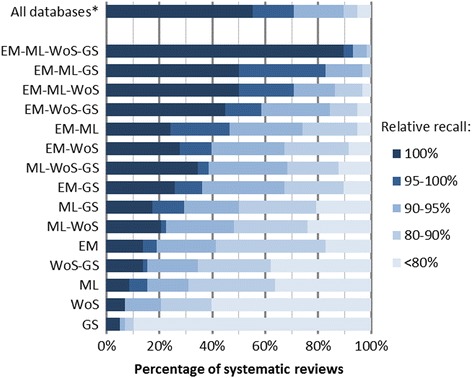
BACKGROUND: Within systematic reviews, when searching for relevant references, it is advisable to use multiple databases. However, searching databases is laborious and time-consuming, as syntax of search strategies are database specific. We aimed to determine the optimal combination of databases needed to conduct efficient searches in systematic reviews and whether the current practice in published reviews is appropriate. While previous studies determined the coverage of databases, we analyzed the actual retrieval from the original searches for systematic reviews. METHODS: Since May 2013, the first author prospectively recorded results from systematic review searches that he performed at his institution. PubMed was used to identify systematic reviews published using our search strategy results. For each published systematic review, we extracted the references of the included studies. Using the prospectively recorded results and the studies included in the publications, we calculated recall, precision, and number needed to read for single databases and databases in combination. We assessed the frequency at which databases and combinations would achieve varying levels of recall (i.e., 95%). For a sample of 200 recently published systematic reviews, we calculated how many had used enough databases to ensure 95% recall. RESULTS: A total of 58 published systematic reviews were included, totaling 1746 relevant references identified by our database searches, while 84 included references had been retrieved by other search methods. Sixteen percent of the included references (291 articles) were only found in a single database; Embase produced the most unique references (n = 132). The combination of Embase, MEDLINE, Web of Science Core Collection, and Google Scholar performed best, achieving an overall recall of 98.3 and 100% recall in 72% of systematic reviews. We estimate that 60% of published systematic reviews do not retrieve 95% of all available relevant references as many fail to search important databases. Other specialized databases, such as CINAHL or PsycINFO, add unique references to some reviews where the topic of the review is related to the focus of the database. CONCLUSIONS: Optimal searches in systematic reviews should search at least Embase, MEDLINE, Web of Science, and Google Scholar as a minimum requirement to guarantee adequate and efficient coverage.
Overview
CoChat Summary
TL;DR
This prospective exploratory study analyzed actual database retrieval for 58 published systematic reviews and found that searching Embase, MEDLINE, Web of Science Core Collection, and Google Scholar together achieved the best recall. The authors estimate that many published systematic reviews fail to retrieve 95% of relevant references because they omit key databases.
Key findings
- Among 1,746 relevant references identified by database searches, 292 (17%) were found by only one database; Embase retrieved the most unique references (n = 132), followed by MEDLINE, Web of Science, and Google Scholar.
- The combination of Embase, MEDLINE, Web of Science Core Collection, and Google Scholar achieved an overall recall of 98.3% and retrieved all included references in 72% of the studied systematic reviews.
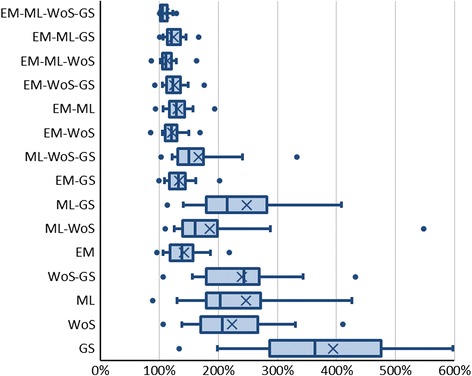
- Searching only Embase produced an average number needed to read (NNR) of 57, whereas the optimal four-database combination had an NNR of 73.
- In a sample of 200 recent systematic reviews, 97% searched MEDLINE, 61% searched Embase, 35% searched Web of Science, and only 10% used Google Scholar; the authors estimate that 60% of published systematic reviews do not retrieve 95% of all available relevant references.
Methods
- Since May 2013, the first author prospectively recorded results from systematic review searches performed at Erasmus MC; PubMed was searched in July 2016 for reviews published since 2014 with Erasmus MC first authors, yielding 58 included reviews.
- Included reviews had documented search strategies and results and had used at least Embase, MEDLINE, Cochrane CENTRAL, Web of Science, and Google Scholar; included references were extracted and located in original EndNote libraries to determine which database retrieved them.
- Recall, precision, and number needed to read were calculated for single databases and combinations in Excel; a separate sample of 200 recent PubMed systematic reviews was analyzed to assess current database selection practice.
Limitations
- The authors state they did not investigate whether missing references changed review conclusions, and because the finding that Web of Science and Google Scholar improve recall is novel, they cannot conclude whether it is due to their dataset or is generalizable.
- The authors note that all searches were performed by one experienced biomedical information specialist, that searcher skill strongly affects search effectiveness, and that their searches still missed some relevant references; they also state that Scopus as a replacement for Embase or Web of Science remains uncertain.
- The text makes evident additional constraints: the study is exploratory, based at a single institution, and relies on a relatively small set of 58 systematic reviews, with specialized databases such as CINAHL and PsycINFO used only when topic-appropriate.
Model-written summary. Check it against the paper before relying on it.
Integrity signals
Registry
Cites
Statistics
Figures

Verification
Claims the paper makes
2 Valid · 1 Not valid · 6 Not checked · 91 Own results and interpretations
A result the paper reports from its own data — it cites no other source for it, so there is none to check. The quote shows it is in the paper.
In the paper
“Using that combination, 93% of the systematic reviews in our study obtained levels of recall that could be considered acceptable (> 95%).”
§ Optimal database combinations for literature searches in systematic reviews: a prospective exploratory study > Discussion
plainstates a cause- Asserted: passes — The authors put it forward as true.
- Checkable: passes — It can be checked against evidence.
- Load-bearing: passes — The paper’s conclusions depend on it.
- Based: passes — The paper gives a reason why it holds.
A result the paper reports from its own data — it cites no other source for it, so there is none to check. The quote shows it is in the paper.
In the paper
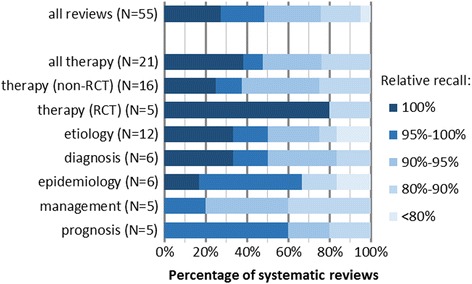
“For all but one domain, the traditional combination of Embase, MEDLINE, and Cochrane CENTRAL did not retrieve enough included references.”
§ Optimal database combinations for literature searches in systematic reviews: a prospective exploratory study > Results > Differences between domains of reviews
plain- Asserted: passes — The authors put it forward as true.
- Checkable: passes — It can be checked against evidence.
- Load-bearing: passes — The paper’s conclusions depend on it.
- Based: passes — The paper gives a reason why it holds.
A result the paper reports from its own data — it cites no other source for it, so there is none to check. The quote shows it is in the paper.
In the paper
“Embase was searched in 61% and Web of Science in 35%, and Google Scholar was only used in 10% of all reviews.”
§ Optimal database combinations for literature searches in systematic reviews: a prospective exploratory study > Results > Status of current practice of database selection
plain- Asserted: passes — The authors put it forward as true.
- Checkable: passes — It can be checked against evidence.
- Load-bearing: unclear — It is unclear whether the paper’s conclusions depend on it.
- Based: passes — The paper gives a reason why it holds.
A result the paper reports from its own data — it cites no other source for it, so there is none to check. The quote shows it is in the paper.
In the paper
“Of the five reviews that included only RCTs, four reached 100% recall if MEDLINE, Web of Science, and Google Scholar combined were complemented with Cochrane CENTRAL.”
§ Optimal database combinations for literature searches in systematic reviews: a prospective exploratory study > Discussion
plainstates a cause- Asserted: passes — The authors put it forward as true.
- Checkable: passes — It can be checked against evidence.
- Load-bearing: passes — The paper’s conclusions depend on it.
- Based: passes — The paper gives a reason why it holds.
A result the paper reports from its own data — it cites no other source for it, so there is none to check. The quote shows it is in the paper.
In the paper
“Based on our findings, this combination achieves acceptable recall about half the time (47%).”
§ Optimal database combinations for literature searches in systematic reviews: a prospective exploratory study > Results > Status of current practice of database selection
plainstates a cause- Asserted: passes — The authors put it forward as true.
- Checkable: passes — It can be checked against evidence.
- Load-bearing: passes — The paper’s conclusions depend on it.
- Based: passes — The paper gives a reason why it holds.
51 more claims
Create a free account to see all 100 claims and every source verdict.
- Probably not a substantial claim. 26
- It may state two separate claims as one. 24
- The quote only partly states this claim. 2
Claims other papers make about this one
Each is checked against this paper’s own text: does it say what the citing paper says it does?
The source backs part of the claim, not all of it — or backs it for a different population, condition or comparison.
In the citing paper
“although deduplication of references is essential to ensure the quality of SRs, there is currently no universal method to do so”
From Reducing systematic review burden using Deduklick: a novel, automated, reliable, and explainable deduplication algorithm to foster medical research (2022) · cites this paper as [5]
Experimental — accuracy not yet measuredThe source backs part of the claim, not all of it — or backs it for a different population, condition or comparison.
In the citing paper
“Although this database is one of the largest academic databases, offers extensive multidisciplinary coverage, and is widely used in bibliometric analyses, relevant publications indexed elsewhere or published in regional and non-indexed outlets may not have been captured [130].”
From Toward Holistic Aging in Lebanon: A Mapping of Gerontology and Geriatrics Research Trends, Gaps, and Future Directions (2026) · cites this paper as [130]
Experimental — accuracy not yet measuredThe source backs part of the claim, not all of it — or backs it for a different population, condition or comparison.
In the citing paper
“Meanwhile, others are highly specialized (e.g., PubMed, Medline, Compendix, etc.), which makes them unsuitable for more inclusive tasks, in particular, for the wide scope analysis and evaluation of multidisciplinary units [42,43].”
From Web of Science (WoS) and Scopus: The Titans of Bibliographic Information in Today’s Academic World (2021) · cites this paper as [43]
Experimental — accuracy not yet measuredThe source backs part of the claim, not all of it — or backs it for a different population, condition or comparison.
In the citing paper
“These databases are widely used in review studies and the majority of them are included in the optimal database combination search19 which guarantee an adequate and efficient coverage of the scientific literature.”
From Occupational therapy interventions for adults with severe mental illness: a scoping review (2021) · cites this paper as [19]
Experimental — accuracy not yet measuredThe cited source says what the claim attributes to it.
In the citing paper
“These differences have led to recommendations that systematic review teams search multiple databases to maximize the likelihood of finding relevant studies [6, 39, 40].”
From PRISMA-S: an extension to the PRISMA Statement for Reporting Literature Searches in Systematic Reviews (2021) · cites this paper as [40]
5 more claims about this paper
Create a free account to see every claim other papers make about this one.
Self-check
Percentages, sums and reported differences re-computed from the paper’s own numbers.
Each contradiction between two passages listed here was confirmed by an independent check.
Rated minor: it would not touch a result — a value no result rests on, a p-value that stays on the same side of the significance level, or a conflict that is clerical, resolved elsewhere in the paper, or outside its own findings.
In the paper
§ Optimal database combinations for literature searches in systematic reviews: a prospective exploratory study > Abstract > Results
“Sixteen percent of the included references (291 articles) were only found in a single database;”
§ Optimal database combinations for literature searches in systematic reviews: a prospective exploratory study > Results > Unique references per database
“A total of 292 (17%) references were found by only one database.”
Citations
Cites
Cochrane Handbook for Systematic Reviews of Interventions Version 5.0.1. The Cochrane Collaboration
Higgins, J. P. T., Green, S. R., & Higgins, J. P. T. (2008) · Cited by 7,171
A systematic approach to searching: an efficient and complete method to develop literature searches
Bramer, W. M., De Jonge, G. B., Rethlefsen, M. L., Mast, F., & Kleijnen, J. (2018) · Journal of the Medical Library Association · doi:10.5195/jmla.2018.283 · Cited by 863
Self-citationComparing two sampling methods to engage hard-to-reach communities in research priority setting
Valerio, M. A., Rodriguez, N., Winkler, P., Lopez, J., Dennison, M., Liang, Y., & Turner, B. J. (2016) · BMC Medical Research Methodology · doi:10.1186/s12874-016-0242-z · Cited by 543
Rethlefsen, M. L., Farrell, A. M., Osterhaus Trzasko, L. C., & Brigham, T. J. (2015) · Journal of Clinical Epidemiology · doi:10.1016/j.jclinepi.2014.11.025 · Cited by 331
Self-citationSystematic reviews need systematic searchers.
(2005) · Europe PMC (PubMed Central) · Cited by 257
Bramer, W. M., Giustini, D., & Kramer, B. M. R. (2016) · Systematic Reviews · doi:10.1186/s13643-016-0215-7 · Cited by 202
Self-citationHalladay, C. W., Trikalinos, T. A., Schmid, I. T., Schmid, C. H., & Dahabreh, I. J. (2015) · Journal of Clinical Epidemiology · doi:10.1016/j.jclinepi.2014.12.017 · Cited by 166 · cited 1×
“Prior research on database importance for systematic reviews has looked primarily at whether included references could have theoretically been found in a certain database, but most have been unable to ascertain whether the researchers actually found the articles in those databases [10, 12, 16, 17, 26].”
BackgroundSearching multiple databases for systematic reviews: added value or diminishing returns?
Stevinson, C., & Lawlor, D. A. (2004) · Complementary Therapies in Medicine · doi:10.1016/j.ctim.2004.09.003 · Cited by 143
Bramer, W. M., Giustini, D., Kramer, B. M., & Anderson, P. (2013) · Systematic Reviews · doi:10.1186/2046-4053-2-115 · Cited by 139 · cited 1×
“Nevertheless others have concluded that a single database is not sufficient to retrieve all references for systematic reviews [18, 19].”
BackgroundSelf-citationSearching one or two databases was insufficient for meta-analysis of observational studies
Lemeshow, A. R., Blum, R. E., Berlin, J. A., Stoto, M. A., & Colditz, G. A. (2005) · Journal of Clinical Epidemiology · doi:10.1016/j.jclinepi.2005.03.004 · Cited by 137
Cited by
Items 101–200 of 2,083
Gottlieb, M. A., Avila, J. O., Chottiner, M., & Peksa, G. D. (2020) · Annals of Emergency Medicine · doi:10.1016/j.annemergmed.2020.01.004 · Cited by 88
Umbrella review and Delphi study on modifiable factors for dementia risk reduction
Rosenau, C., Köhler, S., Soons, L. M., Anstey, K. J., Brayne, C., Brodaty, H., Engedal, K., Farina, F. R., Ganguli, M., Livingston, G., et al. (2024) · Alzheimer's & Dementia · doi:10.1002/alz.13577 · Cited by 74
Loprinzi, P. D. (2018) · Health Promotion Perspectives · doi:10.15171/hpp.2018.36 · Cited by 78
Assessing the hospital volume-outcome relationship in surgery: a scoping review
Levaillant, M., Marcilly, R., Levaillant, L., Michel, P., Hamel, J., Vallet, B., & Lamer, A. (2021) · BMC Medical Research Methodology · doi:10.1186/s12874-021-01396-6 · Cited by 80
Guerra, O., & Eboreime, E. (2021) · Behavioral Sciences · doi:10.3390/bs11090119 · Cited by 105
Improving mental health of student and novice nurses to prevent dropout: A systematic review
Bakker, E. J. M., Kox, J. H. A. M., Boot, C. R. L., Francke, A. L., van der Beek, A. J., & Roelofs, P. D. D. M. (2020) · Journal of Advanced Nursing · doi:10.1111/jan.14453 · Cited by 71
Alexander, K. A., & Haward, M. (2018) · Marine Policy · doi:10.1016/j.marpol.2018.12.019 · Cited by 86
Woldeamanuel, Y. W., & Oliveira, A. B. (2022) · The Journal of Headache and Pain · doi:10.1186/s10194-022-01503-y · Cited by 100
Day, S., Laver, K., Jeon, Y., Radford, K. A., & Low, L. (2023) · Dementia · doi:10.1177/14713012231192360 · Cited by 93
Mancin, S., Sguanci, M. E., Andreoli, D., Soekeland, F., Anastasi, G., Piredda, M., & Marinis, M. G. D. (2023) · MethodsX · doi:10.1016/j.mex.2023.102532 · Cited by 107
“Bibliographic biomedical databases, such as PubMed, Embase, CINAHL, Scopus or Web of Science, form the backbone of scientific information access, ag-gregating bibliographic records from a wide range of biomedical journals [1] .”
BackgroundHow Intersectional Are Mental Health Interventions for Sexual Minority People? A Systematic Review
Huang, Y.-T., Ma, Y. T., Craig, S. L., Wong, D. F. K., & Forth, M. W. (2020) · LGBT Health · doi:10.1089/lgbt.2019.0328 · Cited by 67
The State of the Art in Methodologies of Course Recommender Systems—A Review of Recent Research
Guruge, D. B., Kadel, R., & Halder, S. J. (2021) · Data · doi:10.3390/data6020018 · Cited by 94
Water security in sub‐Saharan Africa: Understanding the status of sustainable development goal 6
Nkiaka, E., Bryant, R. G., Okumah, M., & Gomo, F. F. (2021) · Wiley Interdisciplinary Reviews Water · doi:10.1002/wat2.1552 · Cited by 100
A meta-analysis of factors driving the adoption of precision agriculture
Tey, Y. S., & Brindal, M. (2021) · Precision Agriculture · doi:10.1007/s11119-021-09840-9 · Cited by 86
Mohr, W., Rädke, A., Afi, A., Edvardsson, D., Mühlichen, F., Platen, M., Roes, M., Michalowsky, B., & Hoffmann, W. U. (2021) · Journal of Alzheimer s Disease · doi:10.3233/jad-210647 · Cited by 83
Galli, C., Donos, N., & Calciolari, E. (2024) · Information · doi:10.3390/info15020068 · Cited by 100
Limited evidence of physical therapy on balance after stroke: A systematic review and meta-analysis
Hugues, A., Marco, J. D., Ribault, S., Ardaillon, H., Janiaud, P., Xue, Y., Zhu, J., Pires, J., Khademi, H., Rubio-Martínez, L., et al. (2019) · PLoS ONE · doi:10.1371/journal.pone.0221700 · Cited by 82
Serie de Redacción Científica: Revisiones Sistemáticas
Quispe, A. M., Hinojosa-Ticona, Y., Miranda, H. A., & Sedano, C. A. (2021) · Revista del Cuerpo Médico Hospital Nacional Almanzor Aguinaga Asenjo · doi:10.35434/rcmhnaaa.2021.141.906 · Cited by 217
A Review of Experimental Research on Embodied Creativity: Revisiting the Mind–Body Connection
Frith, E., Miller, S. E., & Loprinzi, P. D. (2019) · The Journal of Creative Behavior · doi:10.1002/jocb.406 · Cited by 84
Lott, B. E., Okusanya, B. O., Anderson, E. J., Kram, N., Rodriguez, M. L., Thomson, C. A., Rosales, C., & Ehiri, J. E. (2020) · Preventive Medicine Reports · doi:10.1016/j.pmedr.2020.101163 · Cited by 73
Montiel, H., & Zermeño, M. G. G. (2021) · Computers · doi:10.3390/computers10060069 · Cited by 115
Budhwani, S., Fujioka, J. K., Thomas-Jacques, T., Vera, K. D., Challa, P., de Silva, R., Fuller, K., Shahid, S., Hogeveen, S. E., Chandra, S., et al. (2022) · Journal of the American Medical Informatics Association · doi:10.1093/jamia/ocac022 · Cited by 68
Destination image: A review from 2012 to 2023
Wang, Z., Udomwong, P., Fu, J., & Onpium, P. (2023) · Cogent Social Sciences · doi:10.1080/23311886.2023.2240569 · Cited by 136
Jabir, A. I., Lin, X., Martinengo, L., Sharp, G., Theng, Y.-L., & Tudor Car, L. (2024) · Journal of Medical Internet Research · doi:10.2196/48168 · Cited by 66
Evaluation and Management of Acute Compartment Syndrome in the Emergency Department
Long, B., Koyfman, A., & Gottlieb, M. A. (2019) · Journal of Emergency Medicine · doi:10.1016/j.jemermed.2018.12.021 · Cited by 79
Gottlieb, M. A., Palter, J. S., Westrick, J. C., & Peksa, G. D. (2020) · Annals of Emergency Medicine · doi:10.1016/j.annemergmed.2020.07.031 · Cited by 79
Momtazmanesh, S., Shobeiri, P., Hanaei, S., Mahmoud-Elsayed, H. M., Dalvi, B. V., & Rad, E. M. (2020) · The Egyptian Heart Journal · doi:10.1186/s43044-020-00075-z · Cited by 72
Ali, M., Prakash, K., Hossain, M. A., & Pota, H. R. (2021) · Journal of Cleaner Production · doi:10.1016/j.jclepro.2021.127904 · Cited by 80
Transfer Learning With Time Series Data: A Systematic Mapping Study
Weber, M., Auch, M., Doblander, C., Mandl, P., & Jacobsen, H. (2021) · IEEE Access · doi:10.1109/access.2021.3134628 · Cited by 86
Turosz, N., Chęcińska, K., Chęciński, M. A., Brzozowska, A., Nowak, Z., & Sikora, M. (2023) · Dentomaxillofacial Radiology · doi:10.1259/dmfr.20230284 · Cited by 92
Lambregts, T. R., & Schut, E. (2020) · The Journal of the Economics of Ageing · doi:10.1016/j.jeoa.2020.100236 · Cited by 66
Christ, A. A., Sieber, V., Grob, U., & Praetorius, A. (2022) · Studies In Educational Evaluation · doi:10.1016/j.stueduc.2022.101209 · Cited by 117
Nyadanu, S. D., Dunne, J., Tessema, G. A., Mullins, B. J., Kumi-Boateng, B., Bell, M. L., Duko, B., & Pereira, G. F. (2024) · The Science of The Total Environment · doi:10.1016/j.scitotenv.2024.170236 · Cited by 74
A scoping review and expert consensus on digital determinants of health
van Kessel, R., Seghers, L.-E., Anderson, M., Schutte, N. M., Monti, G., Haig, M., Schmidt, J., Wharton, G., Román-Urrestarazu, A., Larrain, B., et al. (2025) · Bulletin of the World Health Organization · doi:10.2471/blt.24.292057 · Cited by 73
“27 We synthesized keywords related to the social, 28,29 commercial and economic 7 and political determinants 30 of health from systematic literature reviews.”
Ćurković, M., & Košec, A. (2018) · BMC Medical Research Methodology · doi:10.1186/s12874-018-0599-2 · Cited by 62
Resting State EEG in Exercise Intervention Studies: A Systematic Review of Effects and Methods
Gramkow, M. H., Hasselbalch, S. G., Waldemar, G., & Frederiksen, K. S. (2020) · Frontiers in Human Neuroscience · doi:10.3389/fnhum.2020.00155 · Cited by 71
Amit, N., İsmail, R., Zumrah, A. R., Nizah, M. A. M., Muda, T. E. A. T., Meng, E. C. T., Ibrahim, N., & Din, N. C. (2020) · Frontiers in Psychology · doi:10.3389/fpsyg.2020.01336 · Cited by 91
Using Embase as a supplement to PubMed in Cochrane reviews differed across fields
Frandsen, T. F., Eriksen, M. B., Hammer, D. M. G., Christensen, J. B., & Wallin, J. A. (2021) · Journal of Clinical Epidemiology · doi:10.1016/j.jclinepi.2020.12.022 · Cited by 61
Eye tracking technology for examining cognitive processes in education: a systematic review
Liu, X., & Cui, Y. (2025) · Computers & Education · doi:10.1016/j.compedu.2025.105263 · Cited by 59
Effects of climate change on health and wellbeing: A systematic review
Liu, F., Chang-Richards, A. Y., Wang, K. I., & Dirks, K. N. (2023) · Sustainable Development · doi:10.1002/sd.2513 · Cited by 67
Csathó, Á., van der Linden, D., & Matuz, A. (2023) · Biological Psychology · doi:10.1016/j.biopsycho.2023.108727 · Cited by 80
“Following recommendations and previous systematic review studies, in the cases of Google Scholar and Scopus the 600 most relevant results were reviewed for eligibility (Haddaway et al., 2015; Bramer et al., 2017).”
MethodChan, H. H.-K., Kwong, H. Y. C., Shu, G. L. F., Ting, C. Y., & Lai, F. H. (2021) · Frontiers in Psychology · doi:10.3389/fpsyg.2021.709699 · Cited by 118
Dokhanchi, M., Pakravan, K., Zareian, S., Hussen, B. M., Farid, M., Razmara, E., Mohammadi, M. M., Cho, W. C. S., & Babashah, S. (2021) · Life Sciences · doi:10.1016/j.lfs.2021.119937 · Cited by 63
Stokes, K., Castaldo, R., Federici, C., Pagliara, S. M., Maccaro, A., Cappuccio, F. P., Fico, G., Salvatore, M., Franzese, M., & Pecchia, L. (2021) · Biomedical Signal Processing and Control · doi:10.1016/j.bspc.2021.103325 · Cited by 72
Rabiu, M. K., & Jaeger‐Erben, M. (2022) · Cleaner and Responsible Consumption · doi:10.1016/j.clrc.2022.100081 · Cited by 83
Know to Predict, Forecast to Warn: A Review of Flood Risk Prediction Tools
Antwi-Agyakwa, K. T., Afenyo, M., & Angnuureng, D. B. (2023) · Water · doi:10.3390/w15030427 · Cited by 77
(EFSA), E. F. S. A., Devos, Y., Guajardo, I. M., Glanville, J., & Waigmann, E. (2017) · EFSA Supporting Publications · doi:10.2903/sp.efsa.2017.en-1207 · Cited by 58
Radford, S. J., McGing, J., Czuber-Dochan, W., & Moran, G. (2021) · Frontline Gastroenterology · doi:10.1136/flgastro-2019-101355 · Cited by 55
Bevilacqua, C., Calabrò, F., & Spina, L. D. (2020) · Smart innovation, systems and technologies · doi:10.1007/978-3-030-52869-0 · Cited by 56
Co-Design Practices in Diet and Nutrition Research: An Integrative Review
Tay, B. S. J., Cox, D. N., Brinkworth, G. D., Davis, A., Edney, S. M., Gwilt, I., & Ryan, J. C. (2021) · Nutrients · doi:10.3390/nu13103593 · Cited by 66
Pedrosa, L. F. C., Barros, A. N. A. B., & Leite-Lais, L. (2021) · Clinical Nutrition ESPEN · doi:10.1016/j.clnesp.2021.11.003 · Cited by 65
A new framework of firm-level innovation capability: A propensity–ability perspective
Daronco, E. L., Silva, D. S., Seibel, M. K., & Cortimiglia, M. N. (2022) · European Management Journal · doi:10.1016/j.emj.2022.02.002 · Cited by 85
Serrurier, A., Neuschaefer‐Rube, C., & Röhrig, R. (2022) · Sensors · doi:10.3390/s22082896 · Cited by 65
Petrova, D., Špacírová, Z., Fernández‐Martínez, N. F., Ching-López, A., Garrido, D., Rodríguez‐Barranco, M., Pollán, M., Redondo‐Sánchez, D., Espina, C., Callejón, C. H., et al. (2022) · PLoS Medicine · doi:10.1371/journal.pmed.1004110 · Cited by 54
(EFSA), E. F. S. A., Devos, Y., Muñoz‐Guajardo, I., Álvarez, F., & Glanville, J. (2019) · EFSA Supporting Publications · doi:10.2903/sp.efsa.2019.en-1614 · Cited by 80
Low-fat diets and testosterone in men: Systematic review and meta-analysis of intervention studies
Whittaker, J., & Wu, K. (2021) · The Journal of Steroid Biochemistry and Molecular Biology · doi:10.1016/j.jsbmb.2021.105878 · Cited by 68
Brito, H., Carraça, E. V., Palmeira, A. L., Ferreira, J. P., Vleck, V. E., & Araújo, D. (2021) · Environmental Science & Technology · doi:10.1021/acs.est.1c05151 · Cited by 71
A systematic review of the outcomes of sustained environmental collective action
Gulliver, R., Star, C., Fielding, K. S., & Louis, W. R. (2022) · Environmental Science & Policy · doi:10.1016/j.envsci.2022.03.020 · Cited by 62
Manfredi, C., García‐Gómez, B., Arcaniolo, D., Rojo, E. G., Crocerossa, F., Autorino, R., Gratzke, C., SIO, M. D., & Otero, J. (2022) · European Urology Focus · doi:10.1016/j.euf.2022.06.007 · Cited by 67
Management of hydrogen mobility challenges: A systematic literature review
Calandra, D., Wang, T., Cane, M., & Alfiero, S. (2023) · Journal of Cleaner Production · doi:10.1016/j.jclepro.2023.137305 · Cited by 59
Meta-Analysis of Differential miRNA Expression after Bariatric Surgery
Langi, G., Szczerbiński, Ł., & Kretowski, A. J. (2019) · Journal of Clinical Medicine · doi:10.3390/jcm8081220 · Cited by 56
Holczer, A., Németh, V. L., Vékony, T., Vécsei, L., Klivényi, P., & Must, A. (2020) · Frontiers in Human Neuroscience · doi:10.3389/fnhum.2020.00179 · Cited by 52
Pfund, R. A., Peter, S. C., McAfee, N. W., Ginley, M. K., Whelan, J., & Meyers, A. W. (2021) · Psychology of Addictive Behaviors · doi:10.1037/adb0000710 · Cited by 59
Bogusz, K., Kopera, M., Jakubczyk, A., Trucco, E. M., Kucharska, K., Walenda, A., & Wojnar, M. (2020) · Addiction · doi:10.1111/add.15155 · Cited by 59
Bunaciu, A., Bliuc, A., Best, D. W., Hennessy, E. A., Belanger, M. J., & Benwell, C. (2023) · Addiction Research & Theory · doi:10.1080/16066359.2023.2245323 · Cited by 67
Nair, B., & Otaki, F. (2021) · Frontiers in Public Health · doi:10.3389/fpubh.2021.699030 · Cited by 82
Using Lean tools to reduce patient waiting time
Lot, L. T., Sarantopoulos, A., Min, L. L., Perales, S. R., Boin, I. D. F. S. F., & Ataide, E. C. D. (2018) · Leadership in Health Services · doi:10.1108/lhs-03-2018-0016 · Cited by 50
A comprehensive overview of oncogenic pathways in human cancer
Li, F., Wu, T., Xu, Y., Dong, Q., Xiao, J., Xu, Y., Li, Q., Zhang, C., Gao, J., Liu, L., et al. (2019) · Briefings in Bioinformatics · doi:10.1093/bib/bbz046 · Cited by 62
Nurse managers' perceptions of the competence of newly graduated nurses: A scoping review
Kukkonen, P., Leino‐Kilpi, H., Koskinen, S., Salminen, L., & Strandell‐Laine, C. (2019) · Journal of Nursing Management · doi:10.1111/jonm.12891 · Cited by 50
Oudshoorn, C. E. M., Frielink, N., Nijs, S. L. P., & Embregts, P. J. C. M. (2020) · Journal of Applied Research in Intellectual Disabilities · doi:10.1111/jar.12758 · Cited by 52
Devonport, T. J., Ward, G., Morrissey, H., Burt, C., Harris, J., Burt, S., Patel, R., Manning, R. M., Paredes, R., & Nicholls, W. (2022) · Journal of Racial and Ethnic Health Disparities · doi:10.1007/s40615-022-01352-0 · Cited by 80
Alawadhi, M., Al-Mazrouie, J. R., Kamil, M., & Khalil, K. A. (2020) · International Journal of Systems Assurance Engineering and Management · doi:10.1007/s13198-020-00978-9 · Cited by 68
Faiman, I., Smith, S. D. W., Hodsoll, J. P., Young, A. H., & Shotbolt, P. (2021) · Epilepsy & Behavior · doi:10.1016/j.yebeh.2021.108047 · Cited by 52
Oliveira Silva, G., Oliveira, F. S. E., Coelho, A. S. G., Fonseca, L. M. M., Vieira, F. V. M., Campbell, S. H., & Aredes, N. D. A. (2023) · Journal of Clinical Nursing · doi:10.1111/jocn.16681 · Cited by 47
Evaluation and Management of the Critically Ill Adult With Diabetic Ketoacidosis
Long, B., Willis, G. C., Lentz, S. A., Koyfman, A., & Gottlieb, M. A. (2020) · Journal of Emergency Medicine · doi:10.1016/j.jemermed.2020.06.059 · Cited by 57
A Scoping Review of the Effect of Content Marketing on Online Consumer Behavior
Plessis, C. D. (2022) · SAGE Open · doi:10.1177/21582440221093042 · Cited by 146
Ramachandran, H. J., Oh, J. L., Cheong, Y. K., Jiang, Y., Teo, J. Y. C., Seah, A. C. W., Yu, M., & Wang, W. (2023) · Heart & Lung · doi:10.1016/j.hrtlng.2023.02.004 · Cited by 62
Gruel, Y., Vayne, C., Rollin, J., Weber, P., Faille, D., Bauters, A., Macchi, L., Alhenc‐Gelas, M., Lebreton, A., de Maistre, E., et al. (2020) · Thrombosis and Haemostasis · doi:10.1055/s-0040-1712957 · Cited by 54
The Educational Efficacy of Humane Teaching Methods: A Systematic Review of the Evidence
Zemanova, M. A., & Knight, A. (2021) · Animals · doi:10.3390/ani11010114 · Cited by 67
Onuoha, E. N., Leff, J. A., Schackman, B. R., McCollister, K. E., Polsky, D. E., & Murphy, S. M. (2021) · Value in Health · doi:10.1016/j.jval.2020.12.023 · Cited by 49
Cannabis dosing and administration for sleep: a systematic review
Velzeboer, R., Malas, A., Boerkoel, P., Cullen, K., Hawkins, M., Roesler, J., & Lai, W. W.-K. (2022) · SLEEP · doi:10.1093/sleep/zsac218 · Cited by 62
Stubbs, A., Baidawi, S., & Mendes, P. (2022) · Children and Youth Services Review · doi:10.1016/j.childyouth.2022.106735 · Cited by 62
Gottlieb, M. A., Holladay, D., & Peksa, G. D. (2019) · The American Journal of Emergency Medicine · doi:10.1016/j.ajem.2019.02.024 · Cited by 47
Lin‐Martore, M., Kornblith, A. E., Kohn, M. A., & Gottlieb, M. A. (2020) · Western Journal of Emergency Medicine · doi:10.5811/westjem.2020.4.46241 · Cited by 50
Use of a search summary table to improve systematic review search methods, results, and efficiency
Bethel, A. C., Rogers, M., & Abbott, R. A. (2021) · Journal of the Medical Library Association JMLA · doi:10.5195/jmla.2021.809 · Cited by 59
Questions and answers about conducting systematic reviews in sport and exercise psychology
Gunnell, K., Poitras, V. J., & Tod, D. (2020) · International Review of Sport and Exercise Psychology · doi:10.1080/1750984x.2019.1695141 · Cited by 45
Datta, K., & Tripathi, M. (2021) · Neurology India · doi:10.4103/0028-3886.310073 · Cited by 51
Meta-analyses of cognitive functions in early-treated adults with phenylketonuria
Romani, C., Olson, A., Aitkenhead, L., Baker, L., Patel, D., van Spronsen, F. J., MacDonald, A., van Wegberg, A. M. J., & Huijbregts, S. C. J. (2022) · Neuroscience & Biobehavioral Reviews · doi:10.1016/j.neubiorev.2022.104925 · Cited by 51
Wang, W., Schweickle, M. J., Arnold, E. R., & Vella, S. A. (2025) · Sports Medicine · doi:10.1007/s40279-024-02173-3 · Cited by 90
“Using the three keywords (intervention, wellbeing, athletes), the first 200 results (sorted by relevance) [44] on Google Scholar were included (conducted on 3 August 2023 and updated on 3 May 2024).”
Desideri, L., Lancioni, G. E., Malavasi, M., Gherardini, A., & Cesario, L. (2020) · Journal of Developmental and Physical Disabilities · doi:10.1007/s10882-020-09781-7 · Cited by 58
Frandsen, T. F., Eriksen, M. B., Hammer, D. M. G., & Christensen, J. B. (2019) · Journal of Clinical Epidemiology · doi:10.1016/j.jclinepi.2019.04.015 · Cited by 44
Alami, A., Krewski, D., Farhat, N., Mattison, D., Wilson, K., Gravel, C. A., Farrell, P. J., Crispo, J. A. G., Haddad, N., Perez-Lloret, S., et al. (2023) · BMJ Open · doi:10.1136/bmjopen-2022-065687 · Cited by 44
Occupational therapy interventions for adults with severe mental illness: a scoping review
Rocamora-Montenegro, M., Compañ-Gabucio, L.-M., & Garcia de la Hera, M. (2021) · BMJ Open · doi:10.1136/bmjopen-2020-047467 · Cited by 45
“These databases are widely used in review studies and the majority of them are included in the optimal database combination search 19 which guarantee an adequate and efficient coverage of the scientific literature.”
Taylor, C. S., Ekert, J. O., Sefcikova, V., Fersht, N. L., & Samandouras, G. (2022) · Scientific Reports · doi:10.1038/s41598-022-16726-x · Cited by 49
Bougioukas, K. I., Bouras, E., Avgerinos, K. I., Dardavessis, T., & Haidich, A. (2020) · Health Information & Libraries Journal · doi:10.1111/hir.12318 · Cited by 57
Hidalgo, D. M., Nunn, P. D., & Beazley, H. (2021) · Environmental Science & Policy · doi:10.1016/j.envsci.2021.07.017 · Cited by 50
Zemanova, M. A. (2021) · Genes · doi:10.3390/genes12111672 · Cited by 51
Heath, A., Levay, P., & Tuvey, D. (2021) · Health Information & Libraries Journal · doi:10.1111/hir.12414 · Cited by 67
A Systematic Review of Crohn’s Disease Case Definitions in Administrative or Claims Databases
Hutfless, S. M., Jasper, R. A., Tilak, A., Ghosh, T., Kedia, S., Liu, S., Urrunaga, N. H., Josephson, M., Narang, A., Miller, S. P., et al. (2022) · Inflammatory Bowel Diseases · doi:10.1093/ibd/izac131 · Cited by 50
Haig, S., & Hallett, N. (2022) · International Journal of Mental Health Nursing · doi:10.1111/inm.13065 · Cited by 43
Metadata
- Authors
- Bramer, W. M., Rethlefsen, M. L., Kleijnen, J., & Franco, O. H.
- Affiliations
- Erasmus MC (NL)
- University of Utah (US)
- Maastricht University (NL)
- Corresponding author
- Bramer, Wichor M.
- Venue
- Systematic Reviews
- Published
- 2017-12
- Volume
- 6
- Issue
- 1
- Pages
- 245-245
- ISSN
- 2046-4053 (ISSN-L)
- PMC
- PMC5718002
- OpenAlex
- W2774587119
- Cited by
- 2,114
- References
- 27
- Citations by year
- 2026: 373 · 2025: 411 · 2024: 332 · 2023: 292 · 2022: 252 · 2021: 231 · 2020: 145 · 2019: 64 · 2018: 12 · 2017: 2
- FWCI
- 14.94
- Type
- journal article
- Language
- en
- Open access
- gold
- doi.org
- Licence
- cc-by
- creativecommons.org/licenses/by/4.0/ (tdm)
- creativecommons.org/licenses/by/4.0/ (vor, 5 d)
- Locations
- Systematic Reviews (publishedVersion, cc-by)
- Europe PMC (PubMed Central) (publishedVersion, cc-by)
- PubMed Central (publishedVersion, cc-by)
- PubMed (publishedVersion)
- Research Publications (Maastricht University) (publishedVersion, cc-by)
- EUR Research Repository (Erasmus University Rotterdam) (publishedVersion, other-oa)
- EUR Research Repository (Erasmus University Rotterdam) (submittedVersion, other-oa)
- RePub (Erasmus University Rotterdam) (submittedVersion, other-oa)
- DOAJ (DOAJ: Directory of Open Access Journals) (submittedVersion, cc-by-sa)
- Research Publications (Maastricht University) (submittedVersion, other-oa)
- Funders
- National Center for Advancing Translational Sciences (UL1TR001067)
- Topics
- Social Sciences › Decision Sciences › Statistics, Probability and Uncertainty › Meta-analysis and systematic reviews
- Social Sciences › Library and Information Sciences › scientometrics and bibliometrics research
- Physical Sciences › Computer Science › Information Systems › Information Retrieval and Search Behavior
- Keywords
- literature search strategies, search recall, search precision, database coverage, Embase, MEDLINE, Web of Science, Google Scholar, CINAHL, PsycINFO, number needed to read
- MeSH terms
- Humans, Prospective Studies, Review Literature as Topic, Databases, Bibliographic, Information Storage and Retrieval
About these checks
Registry, retraction, Cites and statistics results are computed, not judged, with one exception: a printed reference that no index lists is read once by a model before it counts as a citation error. Claims are extracted by a model and kept only when their quote appears verbatim in the text; each cited source is then checked, with a model’s help, for whether it says what the claim relies on. Those verdicts can be wrong — read the claim’s quote and the cited source before relying on one.
A language model drew the claims from the paper on 2026-09-29, under version 3 of the claim definition (model deepseek-v4.1-flash, prompt extract-v3).
A second model labelled each claim on 2026-09-29 (model jev-1.13-20260917, definition revision gold-guideline-v0.2).
Statistics and arithmetic are recomputed, not judged.
Confidence bands are shown only for fields calibrated on our annotated test set. None is calibrated yet, so no band is shown.
What counts as a claim ›How we measure confidence ›How we check this ›
Are you an author, or do you see a problem with this page? Request a review
Data sources
Bibliographic data: Semantic Scholar, OpenAlex, Crossref.
Contains information from the Semantic Scholar Academic Graph Datasets, made available under the ODC Attribution License (ODC-BY 1.0).
Semantic Scholar’s data is described in: Kinney, R., et al. (2023). The Semantic Scholar Open Data Platform. arXiv:2301.10140.
