

Optimal database combinations for literature searches in systematic reviews: a prospective exploratory study
Open accessThe DOI matches its Crossref record; 27 of the 27 references it cites were found in a registry or an index; 3 of the 22 sources its claims cite were checked for support.
Abstract
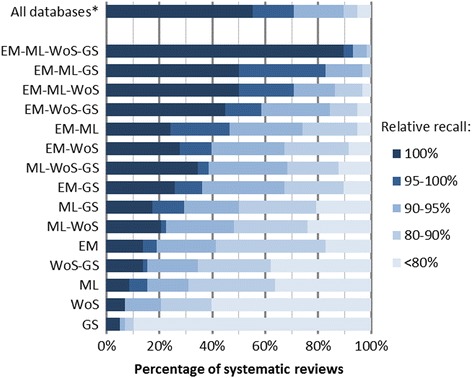
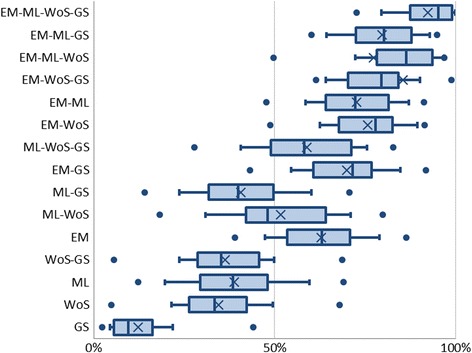
BACKGROUND: Within systematic reviews, when searching for relevant references, it is advisable to use multiple databases. However, searching databases is laborious and time-consuming, as syntax of search strategies are database specific. We aimed to determine the optimal combination of databases needed to conduct efficient searches in systematic reviews and whether the current practice in published reviews is appropriate. While previous studies determined the coverage of databases, we analyzed the actual retrieval from the original searches for systematic reviews. METHODS: Since May 2013, the first author prospectively recorded results from systematic review searches that he performed at his institution. PubMed was used to identify systematic reviews published using our search strategy results. For each published systematic review, we extracted the references of the included studies. Using the prospectively recorded results and the studies included in the publications, we calculated recall, precision, and number needed to read for single databases and databases in combination. We assessed the frequency at which databases and combinations would achieve varying levels of recall (i.e., 95%). For a sample of 200 recently published systematic reviews, we calculated how many had used enough databases to ensure 95% recall. RESULTS: A total of 58 published systematic reviews were included, totaling 1746 relevant references identified by our database searches, while 84 included references had been retrieved by other search methods. Sixteen percent of the included references (291 articles) were only found in a single database; Embase produced the most unique references (n = 132). The combination of Embase, MEDLINE, Web of Science Core Collection, and Google Scholar performed best, achieving an overall recall of 98.3 and 100% recall in 72% of systematic reviews. We estimate that 60% of published systematic reviews do not retrieve 95% of all available relevant references as many fail to search important databases. Other specialized databases, such as CINAHL or PsycINFO, add unique references to some reviews where the topic of the review is related to the focus of the database. CONCLUSIONS: Optimal searches in systematic reviews should search at least Embase, MEDLINE, Web of Science, and Google Scholar as a minimum requirement to guarantee adequate and efficient coverage.
Overview
CoChat Summary
TL;DR
This prospective exploratory study analyzed actual database retrieval for 58 published systematic reviews and found that searching Embase, MEDLINE, Web of Science Core Collection, and Google Scholar together achieved the best recall. The authors estimate that many published systematic reviews fail to retrieve 95% of relevant references because they omit key databases.
Key findings
- Among 1,746 relevant references identified by database searches, 292 (17%) were found by only one database; Embase retrieved the most unique references (n = 132), followed by MEDLINE, Web of Science, and Google Scholar.
- The combination of Embase, MEDLINE, Web of Science Core Collection, and Google Scholar achieved an overall recall of 98.3% and retrieved all included references in 72% of the studied systematic reviews.
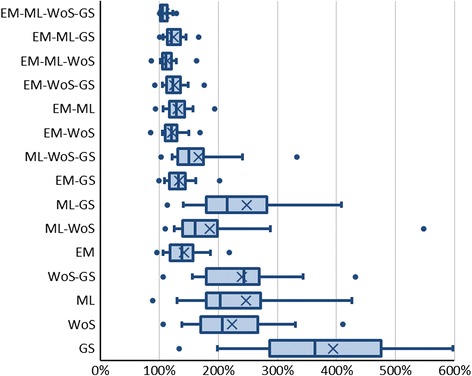
- Searching only Embase produced an average number needed to read (NNR) of 57, whereas the optimal four-database combination had an NNR of 73.
- In a sample of 200 recent systematic reviews, 97% searched MEDLINE, 61% searched Embase, 35% searched Web of Science, and only 10% used Google Scholar; the authors estimate that 60% of published systematic reviews do not retrieve 95% of all available relevant references.
Methods
- Since May 2013, the first author prospectively recorded results from systematic review searches performed at Erasmus MC; PubMed was searched in July 2016 for reviews published since 2014 with Erasmus MC first authors, yielding 58 included reviews.
- Included reviews had documented search strategies and results and had used at least Embase, MEDLINE, Cochrane CENTRAL, Web of Science, and Google Scholar; included references were extracted and located in original EndNote libraries to determine which database retrieved them.
- Recall, precision, and number needed to read were calculated for single databases and combinations in Excel; a separate sample of 200 recent PubMed systematic reviews was analyzed to assess current database selection practice.
Limitations
- The authors state they did not investigate whether missing references changed review conclusions, and because the finding that Web of Science and Google Scholar improve recall is novel, they cannot conclude whether it is due to their dataset or is generalizable.
- The authors note that all searches were performed by one experienced biomedical information specialist, that searcher skill strongly affects search effectiveness, and that their searches still missed some relevant references; they also state that Scopus as a replacement for Embase or Web of Science remains uncertain.
- The text makes evident additional constraints: the study is exploratory, based at a single institution, and relies on a relatively small set of 58 systematic reviews, with specialized databases such as CINAHL and PsycINFO used only when topic-appropriate.
Model-written summary. Check it against the paper before relying on it.
Integrity signals
Registry
Cites
Statistics
Figures

Verification
Claims the paper makes
2 Valid · 1 Not valid · 6 Not checked · 91 Own results and interpretations
A result the paper reports from its own data — it cites no other source for it, so there is none to check. The quote shows it is in the paper.
In the paper
“Using that combination, 93% of the systematic reviews in our study obtained levels of recall that could be considered acceptable (> 95%).”
§ Optimal database combinations for literature searches in systematic reviews: a prospective exploratory study > Discussion
plainstates a cause- Asserted: passes — The authors put it forward as true.
- Checkable: passes — It can be checked against evidence.
- Load-bearing: passes — The paper’s conclusions depend on it.
- Based: passes — The paper gives a reason why it holds.
A result the paper reports from its own data — it cites no other source for it, so there is none to check. The quote shows it is in the paper.
In the paper
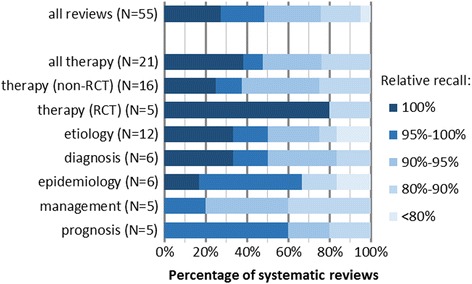
“For all but one domain, the traditional combination of Embase, MEDLINE, and Cochrane CENTRAL did not retrieve enough included references.”
§ Optimal database combinations for literature searches in systematic reviews: a prospective exploratory study > Results > Differences between domains of reviews
plain- Asserted: passes — The authors put it forward as true.
- Checkable: passes — It can be checked against evidence.
- Load-bearing: passes — The paper’s conclusions depend on it.
- Based: passes — The paper gives a reason why it holds.
A result the paper reports from its own data — it cites no other source for it, so there is none to check. The quote shows it is in the paper.
In the paper
“Embase was searched in 61% and Web of Science in 35%, and Google Scholar was only used in 10% of all reviews.”
§ Optimal database combinations for literature searches in systematic reviews: a prospective exploratory study > Results > Status of current practice of database selection
plain- Asserted: passes — The authors put it forward as true.
- Checkable: passes — It can be checked against evidence.
- Load-bearing: unclear — It is unclear whether the paper’s conclusions depend on it.
- Based: passes — The paper gives a reason why it holds.
A result the paper reports from its own data — it cites no other source for it, so there is none to check. The quote shows it is in the paper.
In the paper
“Of the five reviews that included only RCTs, four reached 100% recall if MEDLINE, Web of Science, and Google Scholar combined were complemented with Cochrane CENTRAL.”
§ Optimal database combinations for literature searches in systematic reviews: a prospective exploratory study > Discussion
plainstates a cause- Asserted: passes — The authors put it forward as true.
- Checkable: passes — It can be checked against evidence.
- Load-bearing: passes — The paper’s conclusions depend on it.
- Based: passes — The paper gives a reason why it holds.
A result the paper reports from its own data — it cites no other source for it, so there is none to check. The quote shows it is in the paper.
In the paper
“Based on our findings, this combination achieves acceptable recall about half the time (47%).”
§ Optimal database combinations for literature searches in systematic reviews: a prospective exploratory study > Results > Status of current practice of database selection
plainstates a cause- Asserted: passes — The authors put it forward as true.
- Checkable: passes — It can be checked against evidence.
- Load-bearing: passes — The paper’s conclusions depend on it.
- Based: passes — The paper gives a reason why it holds.
51 more claims
Create a free account to see all 100 claims and every source verdict.
- Probably not a substantial claim. 26
- It may state two separate claims as one. 24
- The quote only partly states this claim. 2
Claims other papers make about this one
Each is checked against this paper’s own text: does it say what the citing paper says it does?
The source backs part of the claim, not all of it — or backs it for a different population, condition or comparison.
In the citing paper
“although deduplication of references is essential to ensure the quality of SRs, there is currently no universal method to do so”
From Reducing systematic review burden using Deduklick: a novel, automated, reliable, and explainable deduplication algorithm to foster medical research (2022) · cites this paper as [5]
Experimental — accuracy not yet measuredThe source backs part of the claim, not all of it — or backs it for a different population, condition or comparison.
In the citing paper
“Although this database is one of the largest academic databases, offers extensive multidisciplinary coverage, and is widely used in bibliometric analyses, relevant publications indexed elsewhere or published in regional and non-indexed outlets may not have been captured [130].”
From Toward Holistic Aging in Lebanon: A Mapping of Gerontology and Geriatrics Research Trends, Gaps, and Future Directions (2026) · cites this paper as [130]
Experimental — accuracy not yet measuredThe source backs part of the claim, not all of it — or backs it for a different population, condition or comparison.
In the citing paper
“Meanwhile, others are highly specialized (e.g., PubMed, Medline, Compendix, etc.), which makes them unsuitable for more inclusive tasks, in particular, for the wide scope analysis and evaluation of multidisciplinary units [42,43].”
From Web of Science (WoS) and Scopus: The Titans of Bibliographic Information in Today’s Academic World (2021) · cites this paper as [43]
Experimental — accuracy not yet measuredThe source backs part of the claim, not all of it — or backs it for a different population, condition or comparison.
In the citing paper
“These databases are widely used in review studies and the majority of them are included in the optimal database combination search19 which guarantee an adequate and efficient coverage of the scientific literature.”
From Occupational therapy interventions for adults with severe mental illness: a scoping review (2021) · cites this paper as [19]
Experimental — accuracy not yet measuredThe cited source says what the claim attributes to it.
In the citing paper
“These differences have led to recommendations that systematic review teams search multiple databases to maximize the likelihood of finding relevant studies [6, 39, 40].”
From PRISMA-S: an extension to the PRISMA Statement for Reporting Literature Searches in Systematic Reviews (2021) · cites this paper as [40]
5 more claims about this paper
Create a free account to see every claim other papers make about this one.
Self-check
Percentages, sums and reported differences re-computed from the paper’s own numbers.
Each contradiction between two passages listed here was confirmed by an independent check.
Rated minor: it would not touch a result — a value no result rests on, a p-value that stays on the same side of the significance level, or a conflict that is clerical, resolved elsewhere in the paper, or outside its own findings.
In the paper
§ Optimal database combinations for literature searches in systematic reviews: a prospective exploratory study > Abstract > Results
“Sixteen percent of the included references (291 articles) were only found in a single database;”
§ Optimal database combinations for literature searches in systematic reviews: a prospective exploratory study > Results > Unique references per database
“A total of 292 (17%) references were found by only one database.”
Citations
Cites
Cochrane Handbook for Systematic Reviews of Interventions Version 5.0.1. The Cochrane Collaboration
Higgins, J. P. T., Green, S. R., & Higgins, J. P. T. (2008) · Cited by 7,171
A systematic approach to searching: an efficient and complete method to develop literature searches
Bramer, W. M., De Jonge, G. B., Rethlefsen, M. L., Mast, F., & Kleijnen, J. (2018) · Journal of the Medical Library Association · doi:10.5195/jmla.2018.283 · Cited by 863
Self-citationComparing two sampling methods to engage hard-to-reach communities in research priority setting
Valerio, M. A., Rodriguez, N., Winkler, P., Lopez, J., Dennison, M., Liang, Y., & Turner, B. J. (2016) · BMC Medical Research Methodology · doi:10.1186/s12874-016-0242-z · Cited by 543
Rethlefsen, M. L., Farrell, A. M., Osterhaus Trzasko, L. C., & Brigham, T. J. (2015) · Journal of Clinical Epidemiology · doi:10.1016/j.jclinepi.2014.11.025 · Cited by 331
Self-citationSystematic reviews need systematic searchers.
(2005) · Europe PMC (PubMed Central) · Cited by 257
Bramer, W. M., Giustini, D., & Kramer, B. M. R. (2016) · Systematic Reviews · doi:10.1186/s13643-016-0215-7 · Cited by 202
Self-citationHalladay, C. W., Trikalinos, T. A., Schmid, I. T., Schmid, C. H., & Dahabreh, I. J. (2015) · Journal of Clinical Epidemiology · doi:10.1016/j.jclinepi.2014.12.017 · Cited by 166 · cited 1×
“Prior research on database importance for systematic reviews has looked primarily at whether included references could have theoretically been found in a certain database, but most have been unable to ascertain whether the researchers actually found the articles in those databases [10, 12, 16, 17, 26].”
BackgroundSearching multiple databases for systematic reviews: added value or diminishing returns?
Stevinson, C., & Lawlor, D. A. (2004) · Complementary Therapies in Medicine · doi:10.1016/j.ctim.2004.09.003 · Cited by 143
Bramer, W. M., Giustini, D., Kramer, B. M., & Anderson, P. (2013) · Systematic Reviews · doi:10.1186/2046-4053-2-115 · Cited by 139 · cited 1×
“Nevertheless others have concluded that a single database is not sufficient to retrieve all references for systematic reviews [18, 19].”
BackgroundSelf-citationSearching one or two databases was insufficient for meta-analysis of observational studies
Lemeshow, A. R., Blum, R. E., Berlin, J. A., Stoto, M. A., & Colditz, G. A. (2005) · Journal of Clinical Epidemiology · doi:10.1016/j.jclinepi.2005.03.004 · Cited by 137
Cited by
Items 501–600 of 2,083
Minarti, M., Rahmah, M. N., Khalilurrahman, K., Samsir, S., & Mardiana, M. (2023) · Nidhomul Haq Jurnal Manajemen Pendidikan Islam · doi:10.31538/ndh.v8i2.3930 · Cited by 59
Barrington, M. J., D'Souza, R. S., Mascha, E. J., Narouze, S., & Kelley, G. A. (2023) · Anesthesia & Analgesia · doi:10.1213/ane.0000000000006573 · Cited by 24
Patalas‐Maliszewska, J., & Łosyk, H. (2024) · Sustainability · doi:10.3390/su16020717 · Cited by 29
Highly Superior Autobiographical Memory (HSAM): A Systematic Review
Talbot, J., Convertino, G., Marco, M. D., Venneri, A., & Mazzoni, G. A. L. (2024) · Neuropsychology Review · doi:10.1007/s11065-024-09632-8 · Cited by 22
“Multiple databases were chosen as this allows literature searches to be thorough (Bramer et al., 2017) and is recommended by gold-standard systematic review guidelines (Lefebvre et al., 2022).”
Public Support for Tobacco Endgame Policies: A Systematic Review and Meta-Analysis
Kim, H., GARTNER, C. E., Edwards, R., Puljević, C., Morphett, K., Kim, D. H., Chun, H.-R., Ekdahl, M., & Kang, H. (2024) · Nicotine & Tobacco Research · doi:10.1093/ntr/ntae149 · Cited by 22
A Visual Approach to Query Formulation for Systematic Search
Russell‐Rose, T., Chamberlain, J., & Shokraneh, F. (2019) · Conference on Human Information Interaction and Retrieval · doi:10.1145/3295750.3298919 · Cited by 21
Enfermedad por coronavirus 2019 (COVID-19) y edadismo: revisión narrativa de la literatura
Tarazona‐Santabalbina, F. J., Heras, J. M. D. L. C. D. L., Vidán, M. T., & Navarro, J. A. G. (2020) · Revista Española de Geriatría y Gerontología · doi:10.1016/j.regg.2020.08.002 · Cited by 40
Privratsky, A. A., Bush, K., Bach, D. R., Hahn, E. M., & Cisler, J. M. (2020) · International Journal of Psychophysiology · doi:10.1016/j.ijpsycho.2020.09.015 · Cited by 23
Falls in people living with HIV: a scoping review
Charumbira, M. Y., Berner, K., & Louw, Q. A. (2020) · BMJ Open · doi:10.1136/bmjopen-2019-034872 · Cited by 19
Lancioni, G. E., Desideri, L., Singh, N. N., O’Reilly, M. F., & Sigafoos, J. (2021) · Journal of Enabling Technologies · doi:10.1108/jet-11-2020-0048 · Cited by 23
Ionescu, A., de Jong, P. G. M., Drop, S. L. S., & van Kampen, S. C. (2021) · Journal of the American Medical Informatics Association · doi:10.1093/jamia/ocab271 · Cited by 24
Zhao, J., Liu, J., Love, P. E. D., Greenwood, D. J., & Sing, M. C. P. (2023) · Developments in the Built Environment · doi:10.1016/j.dibe.2023.100246 · Cited by 37
Koonrungsesomboon, N., Sakuludomkan, W., Takuathung, M. N., Klinjan, P., Sawong, S., & Perera, P. K. (2024) · BMC Complementary Medicine and Therapies · doi:10.1186/s12906-024-04697-7 · Cited by 26
Decolonising social work practice field education: A scoping review
Jones, M., Anka, A., Segev, E., Alhuzail, N. A., Mohamed, O., Wallengren-Lynch, M., Cantley, L., Berg, N. M. V., Laver, S., Hammond, L., et al. (2025) · International Social Work · doi:10.1177/00208728241303596 · Cited by 18
“The databases were selected based on a combination of evidence (Bramer et al., 2017) and research librarian advice regarding local Australian collections.”
Mills, F., Drury, J., Hall, C. E., Weston, D., Symons, C., Amlôt, R., & Carter, H. (2025) · Communications Psychology · doi:10.1038/s44271-025-00217-6 · Cited by 28
“In line with recommendations 30 , the following databases were searched for peer-reviewed publications on September 11th, 2024: (cid:129) Embase 1974 to September 11, 2024 Grey literature searches were also conducted to identify any eligible reports not published via academic publishers, to ensure…”
Advancing deep learning for automated stroke detection: a review
Adablanu, S., Barman, U., & Das, D. (2025) · Brain Hemorrhages · doi:10.1016/j.hest.2025.07.002 · Cited by 20
The State of Evidence in Digital Hate Research: An Umbrella Review
Matthes, J., Koban, K., Bührer, S., Kirchmair, T., Weiß, P., Khaleghipour, M., Saumer, M., & Meerson, R. (2025) · Communication Research · doi:10.1177/00936502251365724 · Cited by 22
“This WoS search was later complemented by a Scopus search, as a combination of both databases is said to provide the best results (Bramer et al., 2017).”
Chan, A., Rahimi‐Ardabili, H., Rogers, W., & Coiera, E. W. (2025) · Journal of the American Medical Informatics Association · doi:10.1093/jamia/ocaf167 · Cited by 28
“We searched 4 traditional medical and multidisciplinary databases, Google, and Google Scholar to identify peer-reviewed articles and grey literature on the topic. sorted by relevance, following Bramer et al, 24 on February 4, 2025 for supplementary sources and to capture preprints.”
Burke, E. P., Harkins, P., Moriarty, F., et al. (2021) · Surgery Research and Practice · doi:10.1155/2021/1570121 · Cited by 17
Esgunoglu, L., Jennings, A., Connole, E. S., Murphy, K. J., & Minihane, A. M. (2021) · British Journal Of Nutrition · doi:10.1017/s0007114521002567 · Cited by 21
Guerra, O., Agyapong, V. I. O., & Nkire, N. (2022) · International Journal of Environmental Research and Public Health · doi:10.3390/ijerph19105937 · Cited by 27
Selected trends in psychotherapy research: An index analysis of RCTs
Rief, W., Kopp, M., Awarzamani, R., & Weise, C. (2022) · Clinical Psychology in Europe · doi:10.32872/cpe.7921 · Cited by 17
Teo, W. Z., See, J. Y., Ramazanu, S., Chan, J. C. Y., & Wu, X. V. (2022) · Critical Reviews in Food Science and Nutrition · doi:10.1080/10408398.2022.2128032 · Cited by 19
Smart City: Sharing of Financial Services
Popova, Y., & Černiševs, O. (2022) · Social Sciences · doi:10.3390/socsci12010008 · Cited by 21
Krivicich, L. M., Rice, M. W., Sivasundaram, L., & Nho, S. (2022) · Journal of the American Academy of Orthopaedic Surgeons · doi:10.5435/jaaos-d-22-00302 · Cited by 14
Tabor, R., Almhawish, N., Aladhan, I., Tarnas, M. C., Sullivan, R. J., Karah, N., Zeitoun, M., Ratnayake, R., & Abbara, A. (2023) · Conflict and Health · doi:10.1186/s13031-023-00502-3 · Cited by 24
Chaves, V. M., Rocha, C., Gomes, S. M., Jacob, M. C. M., & da Costa, J. B. A. (2023) · Sustainability · doi:10.3390/su15042863 · Cited by 17
Recommendations for Next-Generation Sequencing Germline Variant Confirmation
Crooks, K., Hagman, K. D. F., Mandelker, D. L., Santani, A., Schmidt, R. J., Temple‐Smolkin, R., & Lincoln, S. E. (2023) · Journal of Molecular Diagnostics · doi:10.1016/j.jmoldx.2023.03.012 · Cited by 19
Kalakou, F. T., Wiig, S., & Aase, K. (2023) · BMC Health Services Research · doi:10.1186/s12913-023-09698-9 · Cited by 27
Kim, E. Y. Y., Nelson, L. E., Pereira, T. L., & Shorey, S. (2023) · Trauma Violence & Abuse · doi:10.1177/15248380231209435 · Cited by 34
Clinical features and comorbidity in very early-onset schizophrenia: a systematic review
Luzio, M. D., Pontillo, M., Villa, M., Attardi, A. G., Bellantoni, D., Vincenzo, C. D., & Vicari, S. (2023) · Frontiers in Psychiatry · doi:10.3389/fpsyt.2023.1270799 · Cited by 38
Giunti, G., & Doherty, C. P. (2024) · JMIR Medical Education · doi:10.2196/48949 · Cited by 22
DeMott, J. M., Slocum, G. W., Gottlieb, M. A., & Peksa, G. D. (2020) · Epilepsy & Behavior · doi:10.1016/j.yebeh.2020.107286 · Cited by 20
Short or long intramedullary devices for hip fracture? A systematic review of the evidence
Page, P. R. J., Poole, W. E. C., Shah, K., & Upadhyay, P. (2020) · Journal of Orthopaedics · doi:10.1016/j.jor.2020.08.030 · Cited by 18
Brück, K., Jacobi, K., & Schmidt, T. (2021) · Journal of Back and Musculoskeletal Rehabilitation · doi:10.3233/bmr-191731 · Cited by 20
Mutono, N., Wright, J., Mutembei, H. M., Muema, J., Thomas, M., Mutunga, M., & Thumbi, S. M. (2020) · AAS Open Research · doi:10.12688/aasopenres.13063.2 · Cited by 25
Bertoli, D., Steinkohl, E., Mark, E. B., Brock, C., Drewes, A. M., & Frøkjær, J. B. (2022) · Neurogastroenterology & Motility · doi:10.1111/nmo.14371 · Cited by 19
Mapping the characteristics of meta-analyses of pharmacy services: a systematic review
Bonetti, A. D. F., Rocca, A. M. D., Lucchetta, R. C., Tonin, F. S., Fernández-Llimós, F., & Pontarolo, R. (2020) · International Journal of Clinical Pharmacy · doi:10.1007/s11096-020-01058-5 · Cited by 18
The influence of social media on student nurses: A systematic mixed-studies review
Tan, M. Y. N., Ni, Z., Liu, A. S. H., & Shorey, S. (2023) · Nurse Education Today · doi:10.1016/j.nedt.2023.106000 · Cited by 26
Ableism and Employment: A Scoping Review of the Literature
Sharma, R. H., Asselin, R., Stainton, T., & Hole, R. (2025) · Social Sciences · doi:10.3390/socsci14020067 · Cited by 33
Fianko, S. K., Dzogbewu, T., Agbamava, E., & de Beer, D. (2025) · Processes · doi:10.3390/pr13061855 · Cited by 17
Ward, M. A., Kuttab, H. I., & Badgett, R. G. (2025) · Critical Care Medicine · doi:10.1097/ccm.0000000000006769 · Cited by 20
Singh, H., Armas, A., Law, S., Tang, T., Gray, C. S., Cunningham, H., Thombs, R., Ellen, M., Sritharan, J., Nie, J. X., et al. (2021) · BMJ Open · doi:10.1136/bmjopen-2020-045596 · Cited by 18
Mapping and Visualization of Cancer Research in Indonesia: A Scientometric Analysis
Puspitaningtyas, H., Espressivo, A., Hutajulu, S. H., Fuad, A., & Allsop, M. J. (2021) · Cancer Control · doi:10.1177/10732748211053464 · Cited by 25
Maroufi, H., Mortazavi, S. H., Sahraian, M. A., & Eskandarieh, S. (2021) · Current Journal of Neurology · doi:10.18502/cjn.v20i3.7693 · Cited by 23
Mirzyńska, A., Kosch, O., Schieg, M., Šuhajda, K., & Szarucki, M. (2021) · Technological and Economic Development of Economy · doi:10.3846/tede.2021.15801 · Cited by 18
Workplace violence in the Australian and New Zealand midwifery workforce: A scoping review
Capper, T. S., Thorn, M. M., & Muurlink, O. T. (2022) · Journal of Nursing Management · doi:10.1111/jonm.13766 · Cited by 17
Is rumination associated with psychological distress after a cancer diagnosis? A systematic review
Beck, S., Whitaker, K. L., & Cropley, M. (2023) · Journal of Psychosocial Oncology · doi:10.1080/07347332.2022.2145925 · Cited by 20
Positive psychological well-being and clinical characteristics in IBS: A systematic review
Madva, E. N., Sadlonova, M., Harnedy, L. E., Longley, R. M., Amonoo, H. L., Feig, E. H., Millstein, R. A., Zambrano, J., Amaris, A. R., Jurayj, J., et al. (2023) · General Hospital Psychiatry · doi:10.1016/j.genhosppsych.2023.01.004 · Cited by 21
Epidemiology of Injuries during Judo Tournaments
Mooren, J., von Gerhardt, A. L., Hendriks, I. T. J., Tol, J. L., & Koëter, S. (2023) · Translational Sports Medicine · doi:10.1155/2023/2713614 · Cited by 17
A Systematic Review of Gamification and Its Assessment in EFL Teaching
Helvich, J., Novák, L., Mikoška, P., & Hubálovský, Š. (2023) · International Journal of Computer-Assisted Language Learning and Teaching · doi:10.4018/ijcallt.322394 · Cited by 38
Ebola virus disease: A review for the emergency medicine clinician
Chavez, S., Koyfman, A., Gottlieb, M. A., Brady, W. J., Carius, B. M., Liang, S. Y., & Long, B. (2023) · The American Journal of Emergency Medicine · doi:10.1016/j.ajem.2023.04.037 · Cited by 18
Neurosurgical skills analysis by machine learning models: systematic review
Titov, O., Bykanov, A., & Pitskhelauri, D. I. (2023) · Neurosurgical Review · doi:10.1007/s10143-023-02028-x · Cited by 21
Comparison of laryngeal mask airway and endotracheal tube in general anesthesia in children
Dong, W. L., Zhang, W., Er, J., Liu, J., & Han, J. (2023) · Experimental and Therapeutic Medicine · doi:10.3892/etm.2023.12253 · Cited by 16
Slater, D. M., Venning, A., Matthews, L. R., Iles, R., & Redpath, P. (2023) · Health Psychology Open · doi:10.1177/20551029231217840 · Cited by 19
Schmidt-Stiedenroth, K., Mambrey, V., Dreher, A., & Loerbroks, A. (2024) · BMC Public Health · doi:10.1186/s12889-024-17798-2 · Cited by 17
“For Google Scholar, we followed the recommendation to only consider the first 200 references [28].”
MethodAlmahayni, O., & Hammond, L. E. (2024) · PLoS ONE · doi:10.1371/journal.pone.0286933 · Cited by 21
Ayoubi, N. K. E., Ismail, A., Fahd, F., Younes, L., Chakra, N. A., & Khoury, S. J. (2024) · Annals of Clinical and Translational Neurology · doi:10.1002/acn3.52165 · Cited by 20
Gusenbauer, M. (2024) · Research Synthesis Methods · doi:10.1002/jrsm.1746 · Cited by 38
Untari, I., Subijanto, A. A., Mirawati, D. K., Probandari, A. N., & Sanusi, R. (2019) · Journal of Health Research · doi:10.1108/jhr-11-2018-0135 · Cited by 24
EURO-MUSCULUS/USPRM Global Report on Musculoskeletal Ultrasound Publications
Kara, M., Gürçay, E., Ekiz, T., et al. (2020) · American Journal of Physical Medicine & Rehabilitation · doi:10.1097/phm.0000000000001390 · Cited by 16
Kosch, O., & Szarucki, M. (2020) · Journal of Business Economics and Management · doi:10.3846/jbem.2020.12395 · Cited by 16
Messina, C., Vitale, J. A., Anchora, L. P., Chianca, V., Vicentin, I., Albano, D., Gitto, S., & Sconfienza, L. M. (2020) · European Journal of Clinical Nutrition · doi:10.1038/s41430-020-0638-z · Cited by 19
Gottlieb, M. A., Schmitz, G., & Peksa, G. D. (2020) · Academic Emergency Medicine · doi:10.1111/acem.14151 · Cited by 16
The burden they bear: A scoping review of physician empathy in the intensive care unit
Bunin, J. L., Shohfi, E. E., Meyer, H. S., Ely, E. W., & Varpio, L. (2021) · Journal of Critical Care · doi:10.1016/j.jcrc.2021.05.014 · Cited by 18
Hirt, J., Bergmann, J. M., & Karrer, M. (2021) · Journal of the Medical Library Association JMLA · doi:10.5195/jmla.2021.1129 · Cited by 18
Kaihara, T., Intan-Goey, V., Scherrenberg, M., Falter, M., Frederix, I., & Dendale, P. (2021) · European Journal of Preventive Cardiology · doi:10.1093/eurjpc/zwab146 · Cited by 20
Derks, S. D. M., Willemen, A. M., Wouda, M., Meekel, M., & Sterkenburg, P. S. (2021) · Behaviour and Information Technology · doi:10.1080/0144929x.2021.1968034 · Cited by 20
Feature extractions and selection of bot detection on Twitter A systematic literature review
Al-azawi, R., & Al‐Mamory, S. O. (2022) · INTELIGENCIA ARTIFICIAL · doi:10.4114/intartif.vol25iss69pp57-86 · Cited by 17
Forsyth, F., Soh, C. L., Elks, N., Lin, H., Bailey, K., Rowbotham, S. J., Mant, J., Hartley, P., & Deaton, C. (2024) · The Journal of Frailty & Aging · doi:10.14283/jfa.2024.28 · Cited by 18
“Database selection was based on recommendations described by Bramer et al (26); and searches spanned the period from database inception to 16 November 2020.”
Impacts of the EU Taxonomy implementation: a systematic literature review
Brabec, J., & Macháč, J. (2025) · Climate Policy · doi:10.1080/14693062.2025.2526683 · Cited by 28
“As suggested by Bramer et al. (2017), the first 200 references sorted by relevance were used for this article.”
Scotti, K. L., Young, S. M. N., Gainey, M. A., & Lan, H. (2025) · Cochrane Evidence Synthesis and Methods · doi:10.1002/cesm.70046 · Cited by 37
Abbasi, E. (2025) · BMC Infectious Diseases · doi:10.1186/s12879-025-11627-6 · Cited by 18
Luo, Z., Wang, Y., Zhang, T., & Wang, J. (2025) · Frontiers in Bioengineering and Biotechnology · doi:10.3389/fbioe.2025.1660524 · Cited by 34
Mavroeides, G., & Koutra, K. (2021) · Journal of Affective Disorders Reports · doi:10.1016/j.jadr.2021.100099 · Cited by 20
Environmental and contextual factors influencing e-health use among older adults: A rapid review
Sharkiya, S. H., & Hag, A. M. (2024) · International Journal of Medical Informatics · doi:10.1016/j.ijmedinf.2024.105448 · Cited by 16
Hernández‐Vásquez, A., Chavez‐Ecos, F. A., Barrenechea-Pulache, A., Comandé, D., & Bendezú-Quispe, G. (2021) · PeerJ · doi:10.7717/peerj.12552 · Cited by 13
Witjes, B., Ottenheym, L. A., Huygen, F., & de Vos, C. D. (2022) · Neuromodulation (Malden, Mass.) · doi:10.1016/j.neurom.2022.04.036 · Cited by 16
Yung, M., Du, B., Gruber, J., Hackney, A., & Yazdani, A. (2022) · Safety Science · doi:10.1016/j.ssci.2022.105839 · Cited by 23
Dort, B. A. V., Carland, J. E., Penm, J. H.-D., Ritchie, A., & Baysari, M. T. (2022) · Journal of the American Medical Informatics Association · doi:10.1093/jamia/ocac125 · Cited by 15
Social Relationships: The Secret Ingredient of Synergistic Venture Cooperation
Czernek, K., Klimas, P., Juszczyk, P., & Wójcik, D. (2023) · Emerald Group Publishing Limited eBooks · doi:10.1108/s2040-724620230000016005 · Cited by 18
Social sustainability assessment of road infrastructure: a systematic literature review
Vijayakumar, A., Mahmood, M. N., Gurmu, A. T., Kamardeen, I., & Alam, S. (2023) · Quality & Quantity · doi:10.1007/s11135-023-01683-y · Cited by 24
Heritability of dental arches and occlusal characteristics: a systematic review and meta-analysis
Giri, J., Bockmann, M. R., Brook, A. H., Farook, T. H., Meade, M. J., & Hughes, T. E. (2023) · European Journal of Orthodontics · doi:10.1093/ejo/cjad061 · Cited by 19
Literature search in systematic reviews: How much is good enough?
Mathew, M. J. (2023) · Clinical Epidemiology and Global Health · doi:10.1016/j.cegh.2023.101485 · Cited by 29
“38 This was endorsed by other Universities also.”
BackgroundTilli, G., Ngom, R. V., Ferreira, H. C. D. C., et al. (2024) · Poultry Science · doi:10.1016/j.psj.2024.103955 · Cited by 15
“Bibliographic databases that provided a high level of article recall across biomedical articles were used (Bramer et al., 2017).”
Cannabis Use Variations and Myocardial Infarction: A Systematic Review
van Amsterdam, J., & van den Brink, W. (2024) · Journal of Clinical Medicine · doi:10.3390/jcm13185620 · Cited by 18
Almeida, F. L., Guimarães, C. M., & Amorim, E. V. (2024) · Sustainability · doi:10.3390/su16208890 · Cited by 24
Effectiveness of yoga on arterial stiffness: A systematic review
Patil, S. G., Biradar, M. S., Khode, V., Vadiraja, H. S., Patil, N. G., & Raghavendra, R. M. (2020) · Complementary Therapies in Medicine · doi:10.1016/j.ctim.2020.102484 · Cited by 17
Bruun, C. F., Arnbjerg, C. J., & Kessing, L. V. (2021) · Frontiers in Psychiatry · doi:10.3389/fpsyt.2021.648713 · Cited by 19
Ofosu, R., Far, A. H., & Sarwar, D. (2022) · Advanced sciences and technologies for security applications · doi:10.1007/978-3-030-98225-6_5 · Cited by 19
Paratuberculosis control strategies in dairy cattle: A systematic review
Tuberquia‐López, B. C., Correa‐Valencia, N. M., ndez, J., Fernández-Silva, J. A., & squez, N. (2022) · Open Veterinary Journal · doi:10.5455/ovj.2022.v12.i4.16 · Cited by 16
Langen, G., Sandau, I., Ueberschär, O., Nosaka, K., & Behringer, M. (2022) · Journal of Electromyography and Kinesiology · doi:10.1016/j.jelekin.2022.102702 · Cited by 17
Alshaikhmubarak, F. Q., Keers, R. N., & Lewis, P. J. (2022) · Drug Safety · doi:10.1007/s40264-022-01249-1 · Cited by 22
Lentinan for Integrative Cancer Treatment: An Umbrella Review
Antonelli, M., Donelli, D., & Firenzuoli, F. (2020) · doi:10.3390/iecbm2020-08733 · Cited by 17
Supplementary databases increased literature search coverage beyond PubMed and Embase
Frandsen, T. F., Moos, C. M., Marino, C. I. L. H., & Eriksen, M. B. (2025) · Journal of Clinical Epidemiology · doi:10.1016/j.jclinepi.2025.111704 · Cited by 23
Dhir, A. M., Singh, A., Solomon, S. S., & Farley, J. E. (2025) · PLOS Global Public Health · doi:10.1371/journal.pgph.0004604 · Cited by 32
Parambil-Peedika, A., Laing, A. M., Gathala, M. K., Cariappa, A. G. A., & Krishna, V. V. (2025) · The Science of The Total Environment · doi:10.1016/j.scitotenv.2025.179963 · Cited by 21
Du, Y., & Reynolds, B. L. (2025) · Acta Psychologica · doi:10.1016/j.actpsy.2025.105307 · Cited by 27
Lista, A., de Pinho, L. G., Correia, T., Afonso, C. I. C., Cardoso, I. C. F., & da Fonseca, C. J. V. (2025) · International Journal of Nursing Studies · doi:10.1016/j.ijnurstu.2025.105219 · Cited by 19
Cannabis and sleep architecture: A systematic review and meta-analysis
Velzeboer, R., Malas, A., Wei, S., Berger, R., Parmar, V., & Lai, W. W.-K. (2025) · Sleep Medicine Reviews · doi:10.1016/j.smrv.2025.102164 · Cited by 24
Metadata
- Authors
- Bramer, W. M., Rethlefsen, M. L., Kleijnen, J., & Franco, O. H.
- Affiliations
- Erasmus MC (NL)
- University of Utah (US)
- Maastricht University (NL)
- Corresponding author
- Bramer, Wichor M.
- Venue
- Systematic Reviews
- Published
- 2017-12
- Volume
- 6
- Issue
- 1
- Pages
- 245-245
- ISSN
- 2046-4053 (ISSN-L)
- PMC
- PMC5718002
- OpenAlex
- W2774587119
- Cited by
- 2,114
- References
- 27
- Citations by year
- 2026: 373 · 2025: 411 · 2024: 332 · 2023: 292 · 2022: 252 · 2021: 231 · 2020: 145 · 2019: 64 · 2018: 12 · 2017: 2
- FWCI
- 14.94
- Type
- journal article
- Language
- en
- Open access
- gold
- doi.org
- Licence
- cc-by
- creativecommons.org/licenses/by/4.0/ (tdm)
- creativecommons.org/licenses/by/4.0/ (vor, 5 d)
- Locations
- Systematic Reviews (publishedVersion, cc-by)
- Europe PMC (PubMed Central) (publishedVersion, cc-by)
- PubMed Central (publishedVersion, cc-by)
- PubMed (publishedVersion)
- Research Publications (Maastricht University) (publishedVersion, cc-by)
- EUR Research Repository (Erasmus University Rotterdam) (publishedVersion, other-oa)
- EUR Research Repository (Erasmus University Rotterdam) (submittedVersion, other-oa)
- RePub (Erasmus University Rotterdam) (submittedVersion, other-oa)
- DOAJ (DOAJ: Directory of Open Access Journals) (submittedVersion, cc-by-sa)
- Research Publications (Maastricht University) (submittedVersion, other-oa)
- Funders
- National Center for Advancing Translational Sciences (UL1TR001067)
- Topics
- Social Sciences › Decision Sciences › Statistics, Probability and Uncertainty › Meta-analysis and systematic reviews
- Social Sciences › Library and Information Sciences › scientometrics and bibliometrics research
- Physical Sciences › Computer Science › Information Systems › Information Retrieval and Search Behavior
- Keywords
- literature search strategies, search recall, search precision, database coverage, Embase, MEDLINE, Web of Science, Google Scholar, CINAHL, PsycINFO, number needed to read
- MeSH terms
- Humans, Prospective Studies, Review Literature as Topic, Databases, Bibliographic, Information Storage and Retrieval
About these checks
Registry, retraction, Cites and statistics results are computed, not judged, with one exception: a printed reference that no index lists is read once by a model before it counts as a citation error. Claims are extracted by a model and kept only when their quote appears verbatim in the text; each cited source is then checked, with a model’s help, for whether it says what the claim relies on. Those verdicts can be wrong — read the claim’s quote and the cited source before relying on one.
A language model drew the claims from the paper on 2026-09-29, under version 3 of the claim definition (model deepseek-v4.1-flash, prompt extract-v3).
A second model labelled each claim on 2026-09-29 (model jev-1.13-20260917, definition revision gold-guideline-v0.2).
Statistics and arithmetic are recomputed, not judged.
Confidence bands are shown only for fields calibrated on our annotated test set. None is calibrated yet, so no band is shown.
What counts as a claim ›How we measure confidence ›How we check this ›
Are you an author, or do you see a problem with this page? Request a review
Data sources
Bibliographic data: Semantic Scholar, OpenAlex, Crossref.
Contains information from the Semantic Scholar Academic Graph Datasets, made available under the ODC Attribution License (ODC-BY 1.0).
Semantic Scholar’s data is described in: Kinney, R., et al. (2023). The Semantic Scholar Open Data Platform. arXiv:2301.10140.
