

Optimal database combinations for literature searches in systematic reviews: a prospective exploratory study
Open accessThe DOI matches its Crossref record; 27 of the 27 references it cites were found in a registry or an index; 3 of the 22 sources its claims cite were checked for support.
Abstract
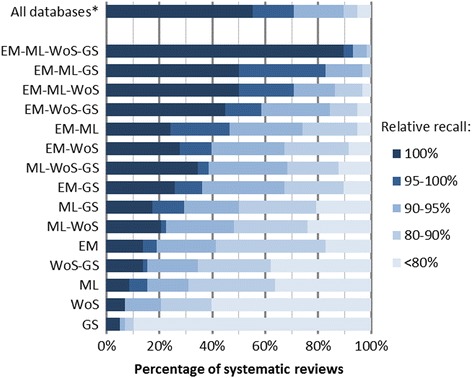
BACKGROUND: Within systematic reviews, when searching for relevant references, it is advisable to use multiple databases. However, searching databases is laborious and time-consuming, as syntax of search strategies are database specific. We aimed to determine the optimal combination of databases needed to conduct efficient searches in systematic reviews and whether the current practice in published reviews is appropriate. While previous studies determined the coverage of databases, we analyzed the actual retrieval from the original searches for systematic reviews. METHODS: Since May 2013, the first author prospectively recorded results from systematic review searches that he performed at his institution. PubMed was used to identify systematic reviews published using our search strategy results. For each published systematic review, we extracted the references of the included studies. Using the prospectively recorded results and the studies included in the publications, we calculated recall, precision, and number needed to read for single databases and databases in combination. We assessed the frequency at which databases and combinations would achieve varying levels of recall (i.e., 95%). For a sample of 200 recently published systematic reviews, we calculated how many had used enough databases to ensure 95% recall. RESULTS: A total of 58 published systematic reviews were included, totaling 1746 relevant references identified by our database searches, while 84 included references had been retrieved by other search methods. Sixteen percent of the included references (291 articles) were only found in a single database; Embase produced the most unique references (n = 132). The combination of Embase, MEDLINE, Web of Science Core Collection, and Google Scholar performed best, achieving an overall recall of 98.3 and 100% recall in 72% of systematic reviews. We estimate that 60% of published systematic reviews do not retrieve 95% of all available relevant references as many fail to search important databases. Other specialized databases, such as CINAHL or PsycINFO, add unique references to some reviews where the topic of the review is related to the focus of the database. CONCLUSIONS: Optimal searches in systematic reviews should search at least Embase, MEDLINE, Web of Science, and Google Scholar as a minimum requirement to guarantee adequate and efficient coverage.
Overview
CoChat Summary
TL;DR
This prospective exploratory study analyzed actual database retrieval for 58 published systematic reviews and found that searching Embase, MEDLINE, Web of Science Core Collection, and Google Scholar together achieved the best recall. The authors estimate that many published systematic reviews fail to retrieve 95% of relevant references because they omit key databases.
Key findings
- Among 1,746 relevant references identified by database searches, 292 (17%) were found by only one database; Embase retrieved the most unique references (n = 132), followed by MEDLINE, Web of Science, and Google Scholar.
- The combination of Embase, MEDLINE, Web of Science Core Collection, and Google Scholar achieved an overall recall of 98.3% and retrieved all included references in 72% of the studied systematic reviews.
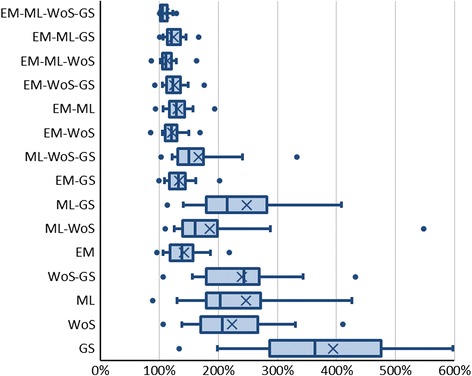
- Searching only Embase produced an average number needed to read (NNR) of 57, whereas the optimal four-database combination had an NNR of 73.
- In a sample of 200 recent systematic reviews, 97% searched MEDLINE, 61% searched Embase, 35% searched Web of Science, and only 10% used Google Scholar; the authors estimate that 60% of published systematic reviews do not retrieve 95% of all available relevant references.
Methods
- Since May 2013, the first author prospectively recorded results from systematic review searches performed at Erasmus MC; PubMed was searched in July 2016 for reviews published since 2014 with Erasmus MC first authors, yielding 58 included reviews.
- Included reviews had documented search strategies and results and had used at least Embase, MEDLINE, Cochrane CENTRAL, Web of Science, and Google Scholar; included references were extracted and located in original EndNote libraries to determine which database retrieved them.
- Recall, precision, and number needed to read were calculated for single databases and combinations in Excel; a separate sample of 200 recent PubMed systematic reviews was analyzed to assess current database selection practice.
Limitations
- The authors state they did not investigate whether missing references changed review conclusions, and because the finding that Web of Science and Google Scholar improve recall is novel, they cannot conclude whether it is due to their dataset or is generalizable.
- The authors note that all searches were performed by one experienced biomedical information specialist, that searcher skill strongly affects search effectiveness, and that their searches still missed some relevant references; they also state that Scopus as a replacement for Embase or Web of Science remains uncertain.
- The text makes evident additional constraints: the study is exploratory, based at a single institution, and relies on a relatively small set of 58 systematic reviews, with specialized databases such as CINAHL and PsycINFO used only when topic-appropriate.
Model-written summary. Check it against the paper before relying on it.
Integrity signals
Registry
Cites
Statistics
Figures

Verification
Claims the paper makes
2 Valid · 1 Not valid · 6 Not checked · 91 Own results and interpretations
A result the paper reports from its own data — it cites no other source for it, so there is none to check. The quote shows it is in the paper.
In the paper
“Using that combination, 93% of the systematic reviews in our study obtained levels of recall that could be considered acceptable (> 95%).”
§ Optimal database combinations for literature searches in systematic reviews: a prospective exploratory study > Discussion
plainstates a cause- Asserted: passes — The authors put it forward as true.
- Checkable: passes — It can be checked against evidence.
- Load-bearing: passes — The paper’s conclusions depend on it.
- Based: passes — The paper gives a reason why it holds.
A result the paper reports from its own data — it cites no other source for it, so there is none to check. The quote shows it is in the paper.
In the paper
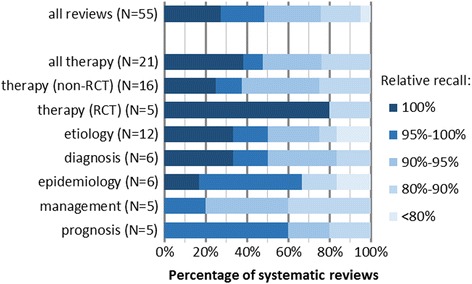
“For all but one domain, the traditional combination of Embase, MEDLINE, and Cochrane CENTRAL did not retrieve enough included references.”
§ Optimal database combinations for literature searches in systematic reviews: a prospective exploratory study > Results > Differences between domains of reviews
plain- Asserted: passes — The authors put it forward as true.
- Checkable: passes — It can be checked against evidence.
- Load-bearing: passes — The paper’s conclusions depend on it.
- Based: passes — The paper gives a reason why it holds.
A result the paper reports from its own data — it cites no other source for it, so there is none to check. The quote shows it is in the paper.
In the paper
“Embase was searched in 61% and Web of Science in 35%, and Google Scholar was only used in 10% of all reviews.”
§ Optimal database combinations for literature searches in systematic reviews: a prospective exploratory study > Results > Status of current practice of database selection
plain- Asserted: passes — The authors put it forward as true.
- Checkable: passes — It can be checked against evidence.
- Load-bearing: unclear — It is unclear whether the paper’s conclusions depend on it.
- Based: passes — The paper gives a reason why it holds.
A result the paper reports from its own data — it cites no other source for it, so there is none to check. The quote shows it is in the paper.
In the paper
“Of the five reviews that included only RCTs, four reached 100% recall if MEDLINE, Web of Science, and Google Scholar combined were complemented with Cochrane CENTRAL.”
§ Optimal database combinations for literature searches in systematic reviews: a prospective exploratory study > Discussion
plainstates a cause- Asserted: passes — The authors put it forward as true.
- Checkable: passes — It can be checked against evidence.
- Load-bearing: passes — The paper’s conclusions depend on it.
- Based: passes — The paper gives a reason why it holds.
A result the paper reports from its own data — it cites no other source for it, so there is none to check. The quote shows it is in the paper.
In the paper
“Based on our findings, this combination achieves acceptable recall about half the time (47%).”
§ Optimal database combinations for literature searches in systematic reviews: a prospective exploratory study > Results > Status of current practice of database selection
plainstates a cause- Asserted: passes — The authors put it forward as true.
- Checkable: passes — It can be checked against evidence.
- Load-bearing: passes — The paper’s conclusions depend on it.
- Based: passes — The paper gives a reason why it holds.
51 more claims
Create a free account to see all 100 claims and every source verdict.
- Probably not a substantial claim. 26
- It may state two separate claims as one. 24
- The quote only partly states this claim. 2
Claims other papers make about this one
Each is checked against this paper’s own text: does it say what the citing paper says it does?
The source backs part of the claim, not all of it — or backs it for a different population, condition or comparison.
In the citing paper
“although deduplication of references is essential to ensure the quality of SRs, there is currently no universal method to do so”
From Reducing systematic review burden using Deduklick: a novel, automated, reliable, and explainable deduplication algorithm to foster medical research (2022) · cites this paper as [5]
Experimental — accuracy not yet measuredThe source backs part of the claim, not all of it — or backs it for a different population, condition or comparison.
In the citing paper
“Although this database is one of the largest academic databases, offers extensive multidisciplinary coverage, and is widely used in bibliometric analyses, relevant publications indexed elsewhere or published in regional and non-indexed outlets may not have been captured [130].”
From Toward Holistic Aging in Lebanon: A Mapping of Gerontology and Geriatrics Research Trends, Gaps, and Future Directions (2026) · cites this paper as [130]
Experimental — accuracy not yet measuredThe source backs part of the claim, not all of it — or backs it for a different population, condition or comparison.
In the citing paper
“Meanwhile, others are highly specialized (e.g., PubMed, Medline, Compendix, etc.), which makes them unsuitable for more inclusive tasks, in particular, for the wide scope analysis and evaluation of multidisciplinary units [42,43].”
From Web of Science (WoS) and Scopus: The Titans of Bibliographic Information in Today’s Academic World (2021) · cites this paper as [43]
Experimental — accuracy not yet measuredThe source backs part of the claim, not all of it — or backs it for a different population, condition or comparison.
In the citing paper
“These databases are widely used in review studies and the majority of them are included in the optimal database combination search19 which guarantee an adequate and efficient coverage of the scientific literature.”
From Occupational therapy interventions for adults with severe mental illness: a scoping review (2021) · cites this paper as [19]
Experimental — accuracy not yet measuredThe cited source says what the claim attributes to it.
In the citing paper
“These differences have led to recommendations that systematic review teams search multiple databases to maximize the likelihood of finding relevant studies [6, 39, 40].”
From PRISMA-S: an extension to the PRISMA Statement for Reporting Literature Searches in Systematic Reviews (2021) · cites this paper as [40]
5 more claims about this paper
Create a free account to see every claim other papers make about this one.
Self-check
Percentages, sums and reported differences re-computed from the paper’s own numbers.
Each contradiction between two passages listed here was confirmed by an independent check.
Rated minor: it would not touch a result — a value no result rests on, a p-value that stays on the same side of the significance level, or a conflict that is clerical, resolved elsewhere in the paper, or outside its own findings.
In the paper
§ Optimal database combinations for literature searches in systematic reviews: a prospective exploratory study > Abstract > Results
“Sixteen percent of the included references (291 articles) were only found in a single database;”
§ Optimal database combinations for literature searches in systematic reviews: a prospective exploratory study > Results > Unique references per database
“A total of 292 (17%) references were found by only one database.”
Citations
Cites
Cochrane Handbook for Systematic Reviews of Interventions Version 5.0.1. The Cochrane Collaboration
Higgins, J. P. T., Green, S. R., & Higgins, J. P. T. (2008) · Cited by 7,171
A systematic approach to searching: an efficient and complete method to develop literature searches
Bramer, W. M., De Jonge, G. B., Rethlefsen, M. L., Mast, F., & Kleijnen, J. (2018) · Journal of the Medical Library Association · doi:10.5195/jmla.2018.283 · Cited by 863
Self-citationComparing two sampling methods to engage hard-to-reach communities in research priority setting
Valerio, M. A., Rodriguez, N., Winkler, P., Lopez, J., Dennison, M., Liang, Y., & Turner, B. J. (2016) · BMC Medical Research Methodology · doi:10.1186/s12874-016-0242-z · Cited by 543
Rethlefsen, M. L., Farrell, A. M., Osterhaus Trzasko, L. C., & Brigham, T. J. (2015) · Journal of Clinical Epidemiology · doi:10.1016/j.jclinepi.2014.11.025 · Cited by 331
Self-citationSystematic reviews need systematic searchers.
(2005) · Europe PMC (PubMed Central) · Cited by 257
Bramer, W. M., Giustini, D., & Kramer, B. M. R. (2016) · Systematic Reviews · doi:10.1186/s13643-016-0215-7 · Cited by 202
Self-citationHalladay, C. W., Trikalinos, T. A., Schmid, I. T., Schmid, C. H., & Dahabreh, I. J. (2015) · Journal of Clinical Epidemiology · doi:10.1016/j.jclinepi.2014.12.017 · Cited by 166 · cited 1×
“Prior research on database importance for systematic reviews has looked primarily at whether included references could have theoretically been found in a certain database, but most have been unable to ascertain whether the researchers actually found the articles in those databases [10, 12, 16, 17, 26].”
BackgroundSearching multiple databases for systematic reviews: added value or diminishing returns?
Stevinson, C., & Lawlor, D. A. (2004) · Complementary Therapies in Medicine · doi:10.1016/j.ctim.2004.09.003 · Cited by 143
Bramer, W. M., Giustini, D., Kramer, B. M., & Anderson, P. (2013) · Systematic Reviews · doi:10.1186/2046-4053-2-115 · Cited by 139 · cited 1×
“Nevertheless others have concluded that a single database is not sufficient to retrieve all references for systematic reviews [18, 19].”
BackgroundSelf-citationSearching one or two databases was insufficient for meta-analysis of observational studies
Lemeshow, A. R., Blum, R. E., Berlin, J. A., Stoto, M. A., & Colditz, G. A. (2005) · Journal of Clinical Epidemiology · doi:10.1016/j.jclinepi.2005.03.004 · Cited by 137
Cited by
Items 801–900 of 2,083
McDermott, O., & Kearney, B. (2023) · Expert Review of Medical Devices · doi:10.1080/17434440.2023.2291454 · Cited by 14
“However, conducting multi-database searches is time-consuming and laborious [50], just as analysis of RWD can also be time-consuming and laborious.”
MethodKrótkowzroczność strategiczna – metodyczne aspekty systematycznego przeglądu literatury
Czakon, W., Klimas, P., & Kawa, A. (2019) · Studia Oeconomica Posnaniensia · doi:10.18559/soep.2019.2.2 · Cited by 13
Makrides, T., Ross, L., Gosling, C. M., & O'Meara, P. F. (2020) · Australasian Journal of Paramedicine · doi:10.33151/ajp.17.787 · Cited by 10
Lum, E., McCreanor, V., Luo, N., et al. (2020) · BMJ Open · doi:10.1136/bmjopen-2020-039311 · Cited by 9
Adam, G. P., Pappas, D., Papageorgiou, H., Εvangelou, Ε., & Trikalinos, T. A. (2022) · Journal of Clinical Epidemiology · doi:10.1016/j.jclinepi.2022.06.007 · Cited by 10
McMahon, K., Clark, I. N., Stensæth, K. A., Odell‐Miller, H., Wosch, T., Bukowska, A. A., & Baker, F. A. (2022) · International Journal of Qualitative Methods · doi:10.1177/16094069221127509 · Cited by 23
EHealth for Sexual Assault: A Systematic Scoping Review
Bach, M. H., Ahrens, C. E., Olff, M., Armour, C., Krogh, S. N. S., & Hansen, M. (2023) · Trauma Violence & Abuse · doi:10.1177/15248380221143355 · Cited by 11
Hungry Bone Syndrome Following Parathyroidectomy: a Comprehensive Systematic Review of Risk Factors
Mehta, R., Rao, K. N., Nagarkar, N. M., et al. (2023) · Indian Journal of Surgery · doi:10.1007/s12262-023-03853-6 · Cited by 8
Barclay, E. G. (2022) · The Open Review · doi:10.47967/tor2022col/vol8.02 · Cited by 8
Barriers to optimal management of cancer pain in sub-Saharan Africa: a scoping review
Magboh, V. O., Saba, O. A., Krause, R., & Forget, P. (2023) · ecancermedicalscience · doi:10.3332/ecancer.2023.1650 · Cited by 9
“To conduct a literature search for systematic reviews, some researchers recommend the use of at least three database combinations [16].”
Nicotine or marijuana vaping exposure during pregnancy and altered immune responses in offspring
Ndeke, J. M., Klaunig, J. E., & Commodore, S. (2024) · Journal of Environmental Exposure Assessment · doi:10.20517/jeea.2024.03 · Cited by 8
“First, we limited our search to PubMed, which may have caused us to miss potentially relevant studies retrievable in other databases, including the grey literature [117,118] .”
BackgroundKurtzhals, M., Bjerregaard, A., Hybschmann, J., Müllertz, A. L. O., DeSilva, B., Elsborg, P., Timm, A., Petersen, T. L., Thygesen, L. C., Kurtzhals, P., et al. (2024) · Obesity Reviews · doi:10.1111/obr.13742 · Cited by 15
Fritz, C. L., Rudman, J. S., Thomas, S. A., McCartin, M. P., Price, J., Shecter, J. D., Bäckström, D., & Thomas, S. H. (2024) · Air Medical Journal · doi:10.1016/j.amj.2024.05.002 · Cited by 9
Grisolia, F., Dewachter, S., & Holvoet, N. (2024) · Journal of International Development · doi:10.1002/jid.3933 · Cited by 8
Wang, Y., Xu, Y., Shan, H., Pan, H., Chen, J., & Yang, J. (2024) · Health and Quality of Life Outcomes · doi:10.1186/s12955-024-02288-1 · Cited by 9
“Bramer et al. reported a 92.8% search rate for Medline and Embase, highlighting the robustness of these databases in identifying relevant studies [161].”
BackgroundInfluentialTawiah, B., He, W., Seidu, R. K., Zhou, Y., Sarkodie, B., & Fei, B. (2025) · Textile Research Journal · doi:10.1177/00405175241311954 · Cited by 10
“21,22 25 In addition, in terms of recency, Scopus DB is updated frequently, providing more timely access to newly published research articles and citation data, which is crucial for staying current.”
Gizamba, J. M., Finch, B. K., Wang, S., & Klausner, J. D. (2025) · BMC Public Health · doi:10.1186/s12889-025-21668-w · Cited by 11
“Studies were systematically searched through four primary databases: Medline (PubMed), Web of Science, Sco-pus, and Embase (Elsevier/Ovid) between 2000 and June 2023 to guarantee efficient coverage of the subject matter [17].”
Yang, Y., Li, E., Gong, Z., Tualaulelei, M., Zhao, Z., & Zhang, Z. (2025) · Frontiers in Public Health · doi:10.3389/fpubh.2025.1541170 · Cited by 10
Hussain, S., Gupta, S., & Bhardwaj, S. (2025) · Journal of Global Information Technology Management · doi:10.1080/1097198x.2025.2480970 · Cited by 17
“…the inclusion of reliable research in the areas of interest, the two leading electronic databases globally, “Scopus” and “Web of Science,” were chosen as the source quality metrics (Bramer et al., 2017), and the journals indexed in them are more comprehensive than their competitors (e.g., EBSCO).”
A systematic review and meta-analysis of residential and transport energy poverty
Dingley, O., Winston, N., Pedroso, M. D. S., & Carroll, P. (2025) · Energy Research & Social Science · doi:10.1016/j.erss.2025.104054 · Cited by 9
Ayo-Bello, O., & Quinn-Walker, N. (2025) · Discover Public Health · doi:10.1186/s12982-025-00674-8 · Cited by 8
“Three databases were used based on systematic review guidelines [20, 21].”
Google Scholar as a Resource for Systematic Reviews in Clinical Medicine
Falagas, M. E., Paliogianni, P. M., Kontogiannis, D. S., Ragias, D., & Johnson, E. O. (2025) · Journal of Evaluation in Clinical Practice · doi:10.1111/jep.70206 · Cited by 10
Conduah, A. K., & Ofoe, S. H. (2025) · International Journal for Equity in Health · doi:10.1186/s12939-025-02683-0 · Cited by 14
“Studies without thematic or geographic relevance were excluded [18].”
AI Use for Medical Students: Impact on Clinical Skill Acquisition and Retention. A Systematic Review
Turney, J., Young, T., Chauhan, D., Beeharry, R., & Mahmud, M. (2026) · Advances in Medical Education and Practice · doi:10.2147/amep.s583763 · Cited by 20
Research Support Services in STEM Libraries: A Scoping Review
Tchangalova, N., Coalter, J., Trost, A., & Pierdinock-Weed, A. (2021) · Issues in Science and Technology Librarianship · doi:10.29173/istl2574 · Cited by 11
Lu, H.-B., Wang, L., Li, M.-Q., & Chen, X. (2022) · European Spine Journal · doi:10.1007/s00586-022-07181-3 · Cited by 12
Begho, T., Daubry, T. P., & Irabor, A. E. (2022) · Scientific African · doi:10.1016/j.sciaf.2022.e01309 · Cited by 12
Wang, Y., Gavan, S. P., Steinke, D. T., Cheung, K., & Chen, L. (2022) · Health and Quality of Life Outcomes · doi:10.1186/s12955-022-02067-w · Cited by 8
Angulo, L. P., Lasarte-López, J. M., & del Pozo, P. C. (2022) · Evaluation and Program Planning · doi:10.1016/j.evalprogplan.2022.102212 · Cited by 13
Veginadu, P., Gussy, M. G., Calache, H., & Masood, M. (2022) · Community Dentistry And Oral Epidemiology · doi:10.1111/cdoe.12835 · Cited by 10
Davies, C., Moosa, M., McKenna, K., Mittal, J., Memis, I., Mittal, R., & Eshraghi, A. A. (2023) · Journal of Clinical Medicine · doi:10.3390/jcm12030927 · Cited by 10
Sereno, M., Catagnus, R. M., Griffith, A. K., & Eilers, H. J. (2023) · Trauma Violence & Abuse · doi:10.1177/15248380231171186 · Cited by 10
van Wees, S. H., & Dini, S. (2023) · Global Public Health · doi:10.1080/17441692.2023.2257771 · Cited by 12
Kabahweza, H. M., & Spencer, A. (2024) · Global Pediatric Health · doi:10.1177/2333794x231223266 · Cited by 8
“47 The review considered all critical and important outcomes of the study and transparently graded the certainty of the evidence they presented, allowing an appropriate measure of the intervention to make appropriate recommendations for practice.”
BackgroundRapid review: A review of methods and recommendations based on current evidence
Guo, Q., Jiang, G., Zhao, Q., Long, Y., Feng, K., Gu, X., Xu, Y., Li, Z., Huang, J., & Du, L. (2024) · Journal of Evidence-Based Medicine · doi:10.1111/jebm.12594 · Cited by 8
Impact of clinical supervision on the mental health nursing workforce: a scoping review protocol
McDonough, J., Rhodes, K., & Procter, N. G. (2024) · BMJ Open · doi:10.1136/bmjopen-2023-078765 · Cited by 12
Advances in sickle cell retinopathy screening techniques, tests, and practices: A systematic review
Cummings, O. W., Rahman, S., Fletcher, L., & Scott, A. W. (2024) · American Journal of Hematology · doi:10.1002/ajh.27439 · Cited by 11
The impact of peer assessment design on interpersonal processes: A systematic review
Senden, M., & Coertjens, L. (2024) · Studies In Educational Evaluation · doi:10.1016/j.stueduc.2024.101405 · Cited by 15
Annear, M. J., Kidokoro, T., & Shimizu, Y. (2021) · Reviews on Environmental Health · doi:10.1515/reveh-2020-0141 · Cited by 9
Shedge, R., Kanchan, T., Warrier, V., Dixit, S. G., & Krishan, K. (2021) · Medicine Science and the Law · doi:10.1177/0025802420988223 · Cited by 9
Parker, M., Fang, X., Self‐Brown, S., & Rahimi, A. (2021) · PLoS ONE · doi:10.1371/journal.pone.0249751 · Cited by 11
Dunn, M., Rushton, A., Mistry, J., Soundy, A., & Heneghan, N. R. (2021) · BMJ Open · doi:10.1136/bmjopen-2021-053941 · Cited by 11
Shavakhi, F., Rahmani, A., & Piravi‐Vanak, Z. (2022) · Journal of Food Science and Technology · doi:10.1007/s13197-022-05362-y · Cited by 8
Toolkit of methodological resources to conduct systematic reviews
Figuls, M. R. I., García, L. M., Solà, I., Alonso‐Coello, P., Bonfill, X., & Zamora, J. (2020) · F1000Research · doi:10.12688/f1000research.22032.1 · Cited by 9
Author's response to comment on “Determinants of malnutrition among children: A systematic review”
Katoch, O. R. (2022) · Nutrition · doi:10.1016/j.nut.2022.111733 · Cited by 8
Prevalence of sensitization to molecular food allergens in Europe: A systematic review
Lisik, D., Ioannidou, A., Spolidoro, G. C. I., Ali, M. M., Nyassi, S., Amera, Y., Rovner, G., Khaleva, E., Venter, C., van Ree, R., et al. (2022) · Clinical and Translational Allergy · doi:10.1002/clt2.12175 · Cited by 8
Punski‐Hoogervorst, J. L., Avital, A., & Engel‐Yeger, B. (2022) · Occupational Therapy in Mental Health · doi:10.1080/0164212x.2022.2094523 · Cited by 8
Rapid evidence synthesis to enable innovation and adoption in health and social care
Norman, G., Wilson, P. M., Dumville, J. C., Bower, P., & Cullum, N. A. (2022) · Systematic Reviews · doi:10.1186/s13643-022-02106-z · Cited by 10
Diagnostic Test Accuracy of Lung Ultrasound for Acute Chest Syndrome in Sickle Cell Disease
Omar, M. M., Jabir, A. R., Khan, I., Novelli, E. M., & Xu, J. Z. (2022) · CHEST Journal · doi:10.1016/j.chest.2022.11.042 · Cited by 8
Responsible innovation assessment tools: a systematic review and research agenda
Guimarães, C. M., Amorim, E. V., & Almeida, F. L. (2022) · Technological Sustainability · doi:10.1108/techs-11-2022-0043 · Cited by 11
Anderson, B. M., Kozluk, A., Morgan, M.-C. M., MacDonald, M. A., Friedel, J. E., & Cox, A. D. (2023) · Journal of Behavioral Education · doi:10.1007/s10864-022-09504-2 · Cited by 8
Analysis of the health advocacy concept from the perspective of the evolutionary method
Farias, O. D. O., Fontenele, M. G. M., Lima, F. E. T., Galvão, M. T. G., da Silva, V. M., & Lopes, M. V. D. O. (2023) · Revista da Escola de Enfermagem da USP · doi:10.1590/1980-220x-reeusp-2023-0170en · Cited by 11
UNDERSTANDING THE CONCEPT OF COMMUNITY-BASED ENTREPRENEURSHIP: A SYSTEMATIC REVIEW APPROACH
(2021) · Journal of Contemporary Issues in Business and Government · doi:10.47750/cibg.2021.27.02.292 · Cited by 8
Tandaju, J. R., Ii, W., Barati‐Boldaji, R., & Raeisi‐Dehkordi, H. (2021) · Nutrition Metabolism and Cardiovascular Diseases · doi:10.1016/j.numecd.2021.06.009 · Cited by 8
Wibowo, M. I. N. A., Yasin, N. M., Kristina, S. A., & Prabandari, Y. S. (2021) · Malaysian Journal of Public Health Medicine · doi:10.37268/mjphm/vol.21/no.2/art.1048 · Cited by 13
Systematic reviews and meta-analysis in rheumatology: a gentle introduction for clinicians
Kelley, G. A., & Kelley, K. S. (2019) · Clinical Rheumatology · doi:10.1007/s10067-019-04590-6 · Cited by 8
“that systematic reviewers search at least Embase, MEDLINE, Web of Science, and Google Scholar to guarantee adequate coverage [32], although searching Google Scholar may not be”
Backgroundda Silva, L. V. T. T., Vegas, M., Ricci, N. A., de Sá, C. D. S. C., & Alouche, S. R. (2022) · Developmental Neurorehabilitation · doi:10.1080/17518423.2022.2046656 · Cited by 11
Cheng, L. J., Ho, T. J. H., Cheng, J. Y., Lau, S. T., & Lau, Y. (2022) · International Journal of Nursing Studies · doi:10.1016/j.ijnurstu.2022.104234 · Cited by 8
Morrow, E. M., Kelly, C., Killeen, C., Naessens, E. D., & Lynch, M. (2024) · Frontiers in Health Services · doi:10.3389/frhs.2024.1360920 · Cited by 13
“Source were selected according to the review topic (24).”
BackgroundSharkiya, S. H., & Ohana, I. (2024) · The Journal of Continuing Education in Nursing · doi:10.3928/00220124-20240529-01 · Cited by 12
Elkrief, L., Sharafi, H., Bakouni, H., McAnulty, C., Bastien, G., Dubreucq, S., Garel, N., Trépanier, A., Ziegler, D., & Jutras‐Aswad, D. (2024) · The Canadian Journal of Psychiatry · doi:10.1177/07067437241262967 · Cited by 6
Løseth, G. E., Trøstheim, M., & Leknes, S. (2024) · Translational Psychiatry · doi:10.1038/s41398-024-03088-3 · Cited by 10
“We searched the databases Web of Science, Scopus, PubMed, and EMBASE (via Ovid) to ensure high coverage of relevant literature [40].”
MethodHeinen, L., Gooßen, K., Lunny, C., Hirt, J., Puljak, L., & Pieper, D. (2024) · BMC Medical Research Methodology · doi:10.1186/s12874-024-02384-2 · Cited by 8
Alumona, C. J., Scott, D. R. M., Odole, A. C., Nweke, M., Kalu, M. E., & Awosoga, O. A. (2024) · BMJ Open · doi:10.1136/bmjopen-2024-088302 · Cited by 9
“In line with the recommendation of database combination, 24 the following databases will be searched from inception to date: MEDLINE, APA PsycINFO, Web of Science, CINAHL and Global Health.”
In vivo assessment of shoulder stability in dynamic rehabilitation exercises: A scoping review
Ramírez‐Pérez, L., Kerr, G., & Vargas, A. I. C. (2024) · Gait & Posture · doi:10.1016/j.gaitpost.2024.11.010 · Cited by 7
A systematic review of incentive schemes and their implications for truck driver safety performance
Meyer, L., Goedhals-Gerber, L. L., & Bod, A. D. (2024) · Journal of Safety Research · doi:10.1016/j.jsr.2024.11.023 · Cited by 8
Kefale, B., Jancey, J. M., Gebremedhin, A. T., Nyadanu, S. D., Belay, D. G., Pereira, G. F., & Tessema, G. A. (2024) · Journal of Global Health · doi:10.7189/jogh.14.04260 · Cited by 10
“In addition, a complementary search was undertaken in systematic review repositories, such as the Cochrane Database of Systematic Reviews and Epistemonikos, as well as in Google Scholar for grey literature sources [38,39].”
Etchecopar‐Etchart, D., Rahmati, M., Yon, D. K., Smith, L., Boyer, L., & Fond, G. B. (2024) · EClinicalMedicine · doi:10.1016/j.eclinm.2024.103007 · Cited by 10
Paichadze, N., Cook, E. K., Rosen, H. E., Kurtovic, S., & Hyder, A. A. (2025) · Health Research Policy and Systems · doi:10.1186/s12961-024-01254-z · Cited by 7
“For Google Scholar, studies recommend using the first 200–300 most relevant search results [14, 15].”
Well‐being interventions for rural health professionals: A scoping review
McKennon, S., Fricke, S., & DeWitt, D. E. (2025) · The Journal of Rural Health · doi:10.1111/jrh.12909 · Cited by 11
What Makes University-Enterprise Collaborations Successful? An Integrative Review
Tucker, R. C., Robinson, S. J., & Liyanage, C. (2025) · Journal of the Knowledge Economy · doi:10.1007/s13132-025-02676-y · Cited by 8
“As Google Scholar limits search strategies to a maximum of 256 characters, including spaces, the search strategy was kept below this threshold for all databases to maintain the consistency of search terms used within each database (Bramer et al., 2017).”
Peritoneal dialysis training and interventions: A narrative review
Hurst, H., Figueiredo, A. E., Pérez-Morán, D., Brunier, G., Neumann, J. L., Villeda, M. Á. T., & Chow, J. S. F. (2025) · Peritoneal Dialysis International · doi:10.1177/08968608251328517 · Cited by 8
Ganbold, G., Farnaz, N., Scutts, T., Borg, B., & Mihrshahi, S. (2025) · Maternal and Child Nutrition · doi:10.1111/mcn.70042 · Cited by 16
“Lastly, the search was limited to four databases (Embase, Scopus, Web of Science, and Med-Line), which cover public health and nutrition research (Bramer et al. 2017).”
Robotic-assisted mediastinal lymphadenectomy in lung cancer: a narrative review
Adamica, D., Tulinský, Ľ., Kepičová, M., et al. (2025) · Journal of Robotic Surgery · doi:10.1007/s11701-025-02392-4 · Cited by 7
de Rijke, C. A., Lim, N. J., Iqbal, A., Brandt, S. A., & Sahlin, E. A. U. (2025) · Planning Practice and Research · doi:10.1080/02697459.2025.2516529 · Cited by 7
Witziers, M., Looijmans, A., Jia, N., & Hagedoorn, M. (2025) · Journal of Cancer Survivorship · doi:10.1007/s11764-025-01866-6 · Cited by 13
Dhakal, S. P. (2025) · Metrics · doi:10.3390/metrics2030017 · Cited by 11
“More importantly, utilising multiple databases does not necessarily add value and instead leads to diminishing returns [22,23].”
Harmonizing Social LCA in the Agri-Food Sector: A Literature Review
Mugion, R. G., Ungaro, V., Pietro, L. D., Amin, A., & Moretti, C. (2025) · Sustainability · doi:10.3390/su17177957 · Cited by 8
Towards a definition of an existential approach in cancer patients: a co-produced scoping review
de Sain, A. M., Ruis, C., Zomers, M. L., Suykerbuyk, M. E. G., Kuunders, T. J. M., Vos, F. D., Janssens, A. I. W. A., & Seute, T. (2025) · PLoS ONE · doi:10.1371/journal.pone.0330384 · Cited by 9
Effective interventions to prevent catheter-associated urinary tract infections: a systematic review
Li, N., Shi, R., Sun, Y., & Chen, Q. (2025) · Revista do Instituto de Medicina Tropical de São Paulo · doi:10.1590/s1678-9946202567061 · Cited by 14
“We extensively conducted a comprehensive literature search in the following databases until August 8, 2024: Embase, PubMed, Google Scholar, Scopus, Cochrane Library, and Web of Science 20 .”
Kadam, S., Khan, S., Soni, R., Sahni, S., & Arya, V. (2025) · Journal of Economic Surveys · doi:10.1111/joes.70044 · Cited by 20
The Psychology of BNPL: A Systematic Review of Impulsive Buying and Post-Purchase Regret (2018–2025)
Nusir, O. M., Wel, C. A. C., Hamid, S. N. A., Al-Zoubi, L., & Al‐Adwan, A. S. (2026) · Journal of theoretical and applied electronic commerce research · doi:10.3390/jtaer21020043 · Cited by 35
Asakawa-Haas, K. D., Spiegel, D., Bossert, L., Garić, A., Schwartz, K., Voracek, M., & Tran, U. S. (2026) · Communications Psychology · doi:10.1038/s44271-026-00414-x · Cited by 10
“A similar combination of these databases has been proposed to be the most promising for systematic literature searches 86 .”
Waldock, W. J., Guni, A., Darzi, A. W., & Ashrafian, H. (2026) · PLOS Digital Health · doi:10.1371/journal.pdig.0001310 · Cited by 23
“Although these provide extensive coverage, relevant studies in computer science venues or preprint servers may have been missed [133].”
Clostridioides difficile infection evaluation and management in the emergency department
Carius, B. M., Liang, S. Y., Koyfman, A., & Long, B. (2020) · The American Journal of Emergency Medicine · doi:10.1016/j.ajem.2020.06.083 · Cited by 7
Mixed messages: most spinal pain and osteoarthritis observational research is unclear or misaligned
Gleadhill, C. P., Lee, H., Kamper, S. J., Cashin, A. G., Hansford, H. J., Traeger, A. C., da Silva, P. V., Nolan, E., Davidson, S. R. E., Wilczynska, M., et al. (2023) · Journal of Clinical Epidemiology · doi:10.1016/j.jclinepi.2023.01.005 · Cited by 7
Satnarine, T. (2023) · Journal For International Medical Graduates · doi:10.56570/jimgs.v2i1.76 · Cited by 26
Nikolis, A., Enright, K. M., Berros, P., et al. (2023) · Journal of Cosmetic Dermatology · doi:10.1111/jocd.15925 · Cited by 7
Somani, N., Beukes, E. W., Street, A. J., Lindsay, R. K., Smith, L., & Allen, P. M. (2023) · BMJ Open · doi:10.1136/bmjopen-2022-067502 · Cited by 12
Patel, A., Puglisi, J. L., Patel, S., & Tarn, D. M. (2023) · Journal of Women s Health · doi:10.1089/jwh.2023.0498 · Cited by 11
“19 The other most common database, Google Scholar, was not included because it can fail to provide reproducible results.”
A systematic literature review on the rural-urban well-being gap in Europe
Meloni, C., Rocchi, B., & Severini, S. (2023) · Bio-based and Applied Economics · doi:10.36253/bae-13178 · Cited by 7
“Indeed, a single database is not considered sufficient to retrieve all references for a systematic review (Bramer et al., 2017).”
BackgroundKanmodi, K. K., Amzat, J., & Aminu, K. (2024) · Health Science Reports · doi:10.1002/hsr2.2078 · Cited by 9
“34,35 Second, keywords were identified from the initial database search.”
BackgroundCiesluk, B., Inglis, G., Parke, A., & Troup, L. J. (2024) · PLoS ONE · doi:10.1371/journal.pone.0310655 · Cited by 12
Simatupang, T. M., Tarigan, M., & Rose, Y. (2025) · International Journal of Business Innovation and Research · doi:10.1504/ijbir.2025.145665 · Cited by 23
A Systematic Review on the Sufficiency of PubMed and Google Scholar for Biosciences
Teo, Y. H., & Ling, M. H. (2020) · Acta Scientific Medical Sciences · doi:10.31080/asms.2020.04.0786 · Cited by 8
Agricultural biomass as value chain developers in different sectors
Kumari, K., Singh, A., Marathe, D., & Pariyar, P. (2021) · Elsevier eBooks · doi:10.1016/b978-0-12-823139-5.00014-9 · Cited by 10
Point-of-Care Ultrasound For Differentiating Ileocolic From Small Bowel-Small Bowel Intussusception
Subramaniam, S., Chen, A. E., Khwaja, A. B., et al. (2021) · Journal of Emergency Medicine · doi:10.1016/j.jemermed.2021.07.002 · Cited by 7
Leavy, F., & Leggett, H. (2022) · Midwifery · doi:10.1016/j.midw.2022.103412 · Cited by 10
Bru-Luna, L. M., Vilar, M. M., Merino‐Soto, C., Escudero, G. S., & Toledano‐Toledano, F. (2022) · Healthcare · doi:10.3390/healthcare10071225 · Cited by 12
Langenberg, L. C., van den Ende, K. I. M., Reijman, M., et al. (2022) · Children · doi:10.3390/children9071049 · Cited by 7
Metadata
- Authors
- Bramer, W. M., Rethlefsen, M. L., Kleijnen, J., & Franco, O. H.
- Affiliations
- Erasmus MC (NL)
- University of Utah (US)
- Maastricht University (NL)
- Corresponding author
- Bramer, Wichor M.
- Venue
- Systematic Reviews
- Published
- 2017-12
- Volume
- 6
- Issue
- 1
- Pages
- 245-245
- ISSN
- 2046-4053 (ISSN-L)
- PMC
- PMC5718002
- OpenAlex
- W2774587119
- Cited by
- 2,114
- References
- 27
- Citations by year
- 2026: 373 · 2025: 411 · 2024: 332 · 2023: 292 · 2022: 252 · 2021: 231 · 2020: 145 · 2019: 64 · 2018: 12 · 2017: 2
- FWCI
- 14.94
- Type
- journal article
- Language
- en
- Open access
- gold
- doi.org
- Licence
- cc-by
- creativecommons.org/licenses/by/4.0/ (tdm)
- creativecommons.org/licenses/by/4.0/ (vor, 5 d)
- Locations
- Systematic Reviews (publishedVersion, cc-by)
- Europe PMC (PubMed Central) (publishedVersion, cc-by)
- PubMed Central (publishedVersion, cc-by)
- PubMed (publishedVersion)
- Research Publications (Maastricht University) (publishedVersion, cc-by)
- EUR Research Repository (Erasmus University Rotterdam) (publishedVersion, other-oa)
- EUR Research Repository (Erasmus University Rotterdam) (submittedVersion, other-oa)
- RePub (Erasmus University Rotterdam) (submittedVersion, other-oa)
- DOAJ (DOAJ: Directory of Open Access Journals) (submittedVersion, cc-by-sa)
- Research Publications (Maastricht University) (submittedVersion, other-oa)
- Funders
- National Center for Advancing Translational Sciences (UL1TR001067)
- Topics
- Social Sciences › Decision Sciences › Statistics, Probability and Uncertainty › Meta-analysis and systematic reviews
- Social Sciences › Library and Information Sciences › scientometrics and bibliometrics research
- Physical Sciences › Computer Science › Information Systems › Information Retrieval and Search Behavior
- Keywords
- literature search strategies, search recall, search precision, database coverage, Embase, MEDLINE, Web of Science, Google Scholar, CINAHL, PsycINFO, number needed to read
- MeSH terms
- Humans, Prospective Studies, Review Literature as Topic, Databases, Bibliographic, Information Storage and Retrieval
About these checks
Registry, retraction, Cites and statistics results are computed, not judged, with one exception: a printed reference that no index lists is read once by a model before it counts as a citation error. Claims are extracted by a model and kept only when their quote appears verbatim in the text; each cited source is then checked, with a model’s help, for whether it says what the claim relies on. Those verdicts can be wrong — read the claim’s quote and the cited source before relying on one.
A language model drew the claims from the paper on 2026-09-29, under version 3 of the claim definition (model deepseek-v4.1-flash, prompt extract-v3).
A second model labelled each claim on 2026-09-29 (model jev-1.13-20260917, definition revision gold-guideline-v0.2).
Statistics and arithmetic are recomputed, not judged.
Confidence bands are shown only for fields calibrated on our annotated test set. None is calibrated yet, so no band is shown.
What counts as a claim ›How we measure confidence ›How we check this ›
Are you an author, or do you see a problem with this page? Request a review
Data sources
Bibliographic data: Semantic Scholar, OpenAlex, Crossref.
Contains information from the Semantic Scholar Academic Graph Datasets, made available under the ODC Attribution License (ODC-BY 1.0).
Semantic Scholar’s data is described in: Kinney, R., et al. (2023). The Semantic Scholar Open Data Platform. arXiv:2301.10140.
