

The DOI matches its Crossref record; 12 of the 12 references it cites were found in a registry or an index.
Addressing the challenges of reconstructing systematic reviews datasets: a case study and a noisy label filter procedure
Abstract
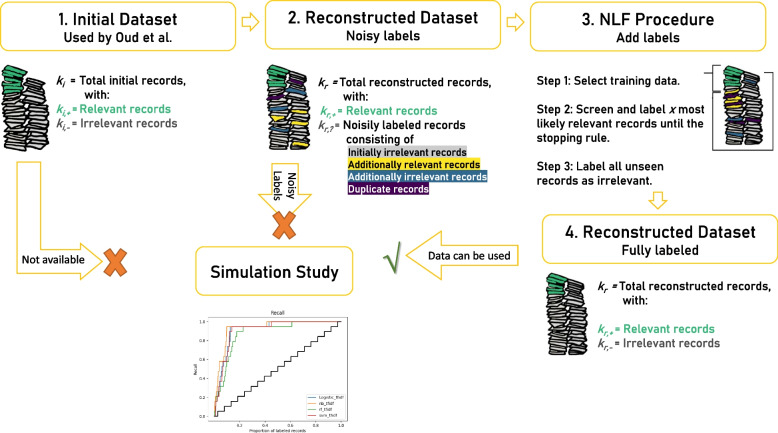
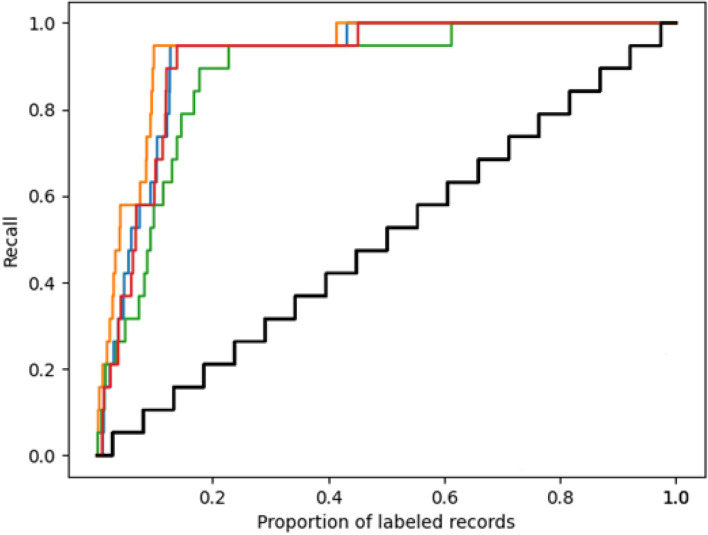
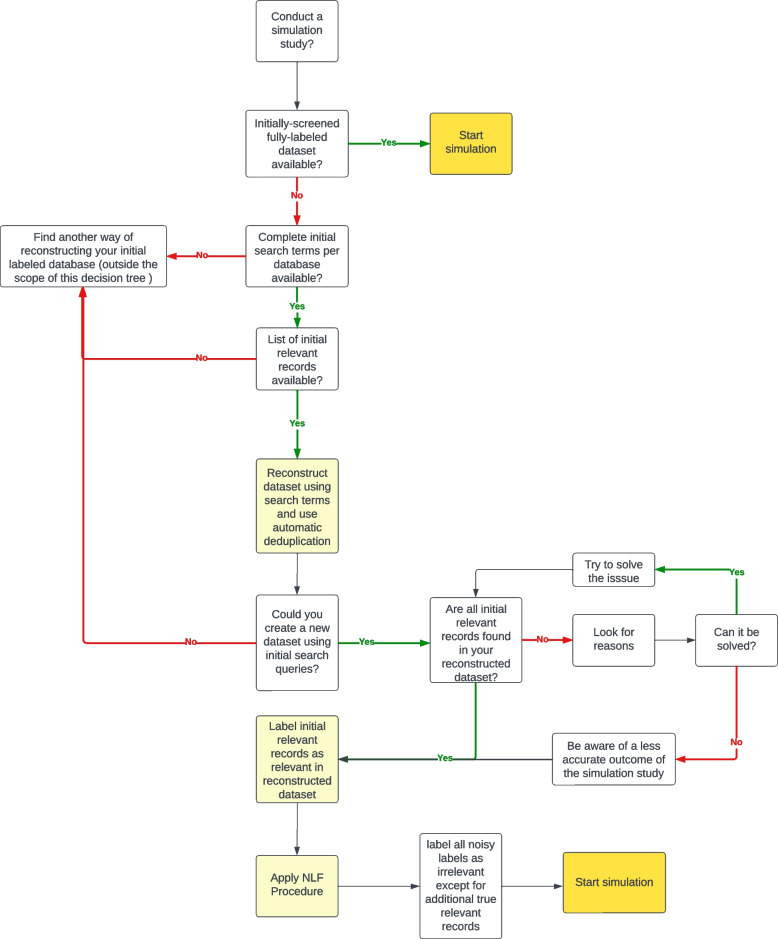
Systematic reviews and meta-analyses typically require significant time and effort. Machine learning models have the potential to enhance screening efficiency in these processes. To effectively evaluate such models, fully labeled datasets—detailing all records screened by humans and their labeling decisions—are imperative. This paper presents the creation of a comprehensive dataset for a systematic review of treatments for Borderline Personality Disorder, as reported by Oud et al. (2018) for running a simulation study. The authors adhered to the PRISMA guidelines and published both the search query and the list of included records, but the complete dataset with all labels was not disclosed. We replicated their search and, facing the absence of initial screening data, introduced a Noisy Label Filter (NLF) procedure using active learning to validate noisy labels. Following the NLF application, no further relevant records were found. A simulation study employing the reconstructed dataset demonstrated that active learning could reduce screening time by 82.30% compared to random reading. The paper discusses potential causes for discrepancies, provides recommendations, and introduces a decision tree to assist in reconstructing datasets for the purpose of running simulation studies.
Overview
The claims and statistics of this paper haven’t been checked yet.
Run the check — free, no account needed. It reads the open-access text and checks the sources it cites.
Integrity signals
Registry
Cites
Statistics
Figures
Verification
Claims the paper makes
The claims and statistics of this paper haven’t been checked yet.
Run the check — free, no account needed. It reads the open-access text and checks the sources it cites.
Claims other papers make about this one
Each is checked against this paper’s own text: does it say what the citing paper says it does?
In the citing paper
“Additionally, it can help detect “odd” relevant records28 that appear isolated from most other records but warrant closer inspection29 or to identify noisy labels.35”
From ASReview LAB v.2: Open-source text screening with multiple agents and a crowd of experts (2025) · cites this paper as [35]
Self-check
Percentages, sums and reported differences re-computed from the paper’s own numbers.
The self-check needs the paper’s full text.
Citations
Cites
The PRISMA 2020 statement: An updated guideline for reporting systematic reviews
Page, M. J., McKenzie, J. E., Bossuyt, P. M., Boutron, I., Hoffmann, T. C., Mulrow, C. D., Shamseer, L., Tetzlaff, J. M., Akl, E. A., Brennan, S. E., et al. (2021) · BMJ · doi:10.1136/bmj.n71 · Cited by 108,283
Cognitive-behavioral treatment of chronically parasuicidal borderline patients
Linehan, M. M. (1991) · Archives of General Psychiatry · doi:10.1001/archpsyc.1991.01810360024003 · Cited by 2,203 · cited 1×
“…This study had an already included follow-up study (Van den [36] Irrelevant [20] The article was a follow-up study of an initially included paper [19] Irrelevant Van den [35] This article seems to be a Dutch translation of an English article and has at least overlapping data (Van den [36]…”
BackgroundOsimo, E. F., Pillinger, T., Rodriguez, I. M., Khandaker, G. M., Pariante, C. M., & Howes, O. D. (2020) · Brain, Behavior, and Immunity · doi:10.1016/j.bbi.2020.02.010 · Cited by 937
McMain, S. F., Links, P. S., Gnam, W. H., Guimond, T., Cardish, R. J., Korman, L., & Streiner, D. L. (2009) · American Journal of Psychiatry · doi:10.1176/appi.ajp.2009.09010039 · Cited by 729 · cited 1×
“Final label [23] This is a follow-up study of an initially included record [24] Irrelevant [38] This study had an already included follow-up study (Van den [36] Irrelevant [20] The article was a follow-up study of an initially included paper [19] Irrelevant Van den [35] This article seems to be a…”
BackgroundReducing Workload in Systematic Review Preparation Using Automated Citation Classification
Cohen, A. M., Hersh, W. R., Peterson, K., & Yen, P.-Y. (2006) · Journal of the American Medical Informatics Association · doi:10.1197/jamia.m1929 · Cited by 411 · cited 2×
“[10], the number of Extra Relevant Records found at 10% recall, and the Average Time to Discover (ATD) a relevant record [14].”
BackgroundMethodNadort, M., Arntz, A., Smit, J. H., Giesen-Bloo, J., Eikelenboom, M., Spinhoven, P., van Asselt, T., Wensing, M., & van Dyck, R. (2009) · Behaviour Research and Therapy · doi:10.1016/j.brat.2009.07.013 · Cited by 259 · cited 2×
“More specifically, the two experimental groups only differ from each other in allowing patients to call their therapist while otherwise giving them the same intervention [26].”
BackgroundCarter, G. L., Willcox, C. H., Lewin, T. J., Conrad, A. M., & Bendit, N. (2010) · Australian & New Zealand Journal of Psychiatry · doi:10.3109/00048670903393621 · Cited by 180
Boetje, J., & van de Schoot, R. (2024) · Systematic Reviews · doi:10.1186/s13643-024-02502-7 · Cited by 146
Self-citationStatistical stopping criteria for automated screening in systematic reviews
Callaghan, M. W., & Müller-Hansen, F. (2020) · Systematic Reviews · doi:10.1186/s13643-020-01521-4 · Cited by 121
Koffel, J. B., & Rethlefsen, M. L. (2016) · PLOS ONE · doi:10.1371/journal.pone.0163309 · Cited by 107
Research works printed but not linked: 23
- Akhter, S., Pauyo, T., & Khan, M. What is the difference between a systematic review and a meta-analysis? In V. Musahl, J. Karlsson, M. T. Hirschmann, O. R. Ayeni, R. G. Marx, J. L. Koh, & N. Nakamura (Eds.), Basic Methods Handbook for Clinical Orthopaedic Research: A Practical Guide and Case Based Research Approach (pp. 331–342). 2019; Springer. https://doi.org/10.1007/978-3-662-58254-1_37 · DOI
- Bateman, A. W., & Fonagy, P. Psychotherapy for severe personality disorder. Article did not do justice to available research data. BMJ (Clinical Research Ed.). 1999;319(7211):709–710; author reply 710–711. · DOI
- Biocic M, Fidahic M, Puljak L. Reproducibility of search strategies of non-Cochrane systematic reviews published in anaesthesiology journals is suboptimal: Primary methodological study. Br J Anaesth. 2019;122(6):e79–81. https://doi.org/10.1016/j.bja.2019.02.014. · DOI
- Bloodgood, M., & Vijay-Shanker, K. A method for stopping active learning based on stabilizing predictions and the need for user-adjustable stopping. ArXiv Preprint ArXiv:1409.5165. 2014. · arXiv
- Cassidy LC, Leenaars CHC, Rincon AV, Pfefferle D. Comprehensive search filters for retrieving publications on nonhuman primates for literature reviews (filterNHP). Am J Primatol. 2021;83(7): e23287. https://doi.org/10.1002/ajp.23287. · DOI
- Franceschini F, Maisano D, Mastrogiacomo L. The museum of errors/horrors in Scopus. J Informet. 2016;10(1):174–82. https://doi.org/10.1016/j.joi.2015.11.006. · DOI
- Gmel G, Venzin V, Marmet K, Danko G, Labhart F. A quasi-randomized group trial of a brief alcohol intervention on risky single occasion drinking among secondary school students. Int J Public Health. 2012;57(6):935–44. https://doi.org/10.1007/s00038-012-0419-0. · DOI
- Ipeirotis PG, Provost F, Sheng VS, Wang J. Repeated labeling using multiple noisy labelers. Data Min Knowl Disc. 2014;28(2):402–41. https://doi.org/10.1007/s10618-013-0306-1. · DOI
- Linehan MM, Heard HL, Armstrong HE. Naturalistic follow-up of a behavioral treatment for chronically parasuicidal borderline patients. Arch Gen Psychiatry. 1993;50(12):971–4. https://doi.org/10.1001/archpsyc.1993.01820240055007. · DOI · Paper page
- López-Nicolás R, López-López JA, Rubio-Aparicio M, Sánchez-Meca J. A meta-review of transparency and reproducibility-related reporting practices in published meta-analyses on clinical psychological interventions (2000–2020). Behav Res Methods. 2022;54(1):334–49. https://doi.org/10.3758/s13428-021-01644-z. · DOI
- Maggio LA, Tannery NH, Kanter SL. Reproducibility of literature search reporting in medical education reviews. Acad Med. 2011;86(8):1049–54. https://doi.org/10.1097/ACM.0b013e31822221e7. · DOI · Paper page
- McMain SF, Guimond T, Streiner DL, Cardish RJ, Links PS. Dialectical behavior therapy compared with general psychiatric management for borderline personality disorder: Clinical outcomes and functioning over a 2-year follow-up. Am J Psychiatry. 2012;169(6):650–61. https://doi.org/10.1176/appi.ajp.2012.11091416. · DOI
- Moher D, Liberati A, Tetzlaff J, Altman DG. Preferred reporting items for systematic reviews and meta-analyses: The PRISMA statement. BMJ. 2009;339: b2535. https://doi.org/10.1136/bmj.b2535. · DOI · Paper page
- Neeleman, R., Oud, M., Weijdema, F., Leenaars, C., & Schoot, R. van de. Scripts, data and output to reproduce ‘Addressing the Challenges of Reconstructing Systematic Reviews Datasets: A Case Study and a Noisy Label Filter Procedure’. (2022). https://doi.org/10.17605/OSF.IO/PJR97 · DOI
- Oud M, Arntz A, Hermens ML, Verhoef R, Kendall T. Specialized psychotherapies for adults with borderline personality disorder: A systematic review and meta-analysis. Aust N Z J Psychiatry. 2018;52(10):949–61. https://doi.org/10.1177/0004867418791257. · DOI · Paper page
- Peterson MH, Barnason S, Donnelly B, Hill K, Miley H, Riggs L, Whiteman K. Choosing the best evidence to guide clinical practice: application of AACN levels of evidence. Crit Care Nurse. 2014;34(2):58–68. https://doi.org/10.4037/ccn2014411. · DOI
- Teijema, J., Seuren, S., Anadria, D., Bagheri, A., & van de Schoot, R. Simulation-based active learning for systematic reviews: a systematic review of the literature. 2023. https://doi.org/10.31234/osf.io/67zmt · DOI · Paper page
- Van den Bosch LMC. Efficacy of dialectical behaviour therapy in the treatment of female borderline patients with and without substance abuse problems: Result of a Dutch study. Dialectische gedragstherapie bij Nederlandse vrouwen met een borderline persoonlijkheidsstoornis, met en zonder verslavingsproblemen. 2005;47(3):127–37.
- Van den Bosch LMC, Koeter MWJ, Stijnen T, Verheul R, Van den Brink W. Sustained efficacy of dialectical behaviour therapy for borderline personality disorder. Behav Res Ther. 2005;43(9):1231–41. https://doi.org/10.1016/j.brat.2004.09.008. · DOI
- van der Mierden S, Hooijmans CR, Tillema AH, Rehn S, Bleich A, Leenaars CH. Laboratory animals search filter for different literature databases: PubMed, Embase, Web of Science and PsycINFO. Lab Anim. 2022;56(3):279–86. https://doi.org/10.1177/00236772211045485. · DOI
- Verheul R, van den Bosch LMC, Koeter MWJ, de Ridder MAJ, Stijnen T, van den Brink W. Dialectical behaviour therapy for women with borderline personality disorder: 12-month, randomised clinical trial in The Netherlands. Br J Psychiatry. 2003;182(2):135–40. https://doi.org/10.1192/bjp.182.2.135. · DOI
- Vlachos A. A stopping criterion for active learning. Comput Speech Lang. 2008;22(3):295–312. · DOI · Paper page
- Yang, E., Lewis, D. D., & Frieder, O. Heuristic stopping rules for technology-assisted review. Proceedings of the 21st ACM Symposium on Document Engineering 2021:1–10. · DOI
Cited by
ASReview LAB v.2: Open-source text screening with multiple agents and a crowd of experts
de Bruin, J., Lombaers, P., Kaandorp, C., Teijema, J., van der Kuil, T., Yazan, B., Dong, A., & van de Schoot, R. (2025) · Patterns · doi:10.1016/j.patter.2025.101318 · Cited by 27
Metadata
- Authors
- Neeleman, R., Leenaars, C. H. C., Oud, M., Weijdema, F., & van de Schoot, R.
- ORCID
- Neeleman, Rutger
- Venue
- Systematic Reviews
- Published
- 2024-02-17
- Volume
- 13
- Issue
- 1
- ISSN
- 2046-4053
- PMC
- PMC10874047
- Cited by
- 12
- References
- 12
- Language
- en
- Funders
- Nederlandse Organisatie voor Wetenschappelijk Onderzoek (406.22.GO.048)
About these checks
Registry, retraction, Cites and statistics results are computed, not judged, with one exception: a printed reference that no index lists is read once by a model before it counts as a citation error. Claims are extracted by a model and kept only when their quote appears verbatim in the text; each cited source is then checked, with a model’s help, for whether it says what the claim relies on. Those verdicts can be wrong — read the claim’s quote and the cited source before relying on one.
Statistics and arithmetic are recomputed, not judged.
Confidence bands are shown only for fields calibrated on our annotated test set. None is calibrated yet, so no band is shown.
What counts as a claim ›How we measure confidence ›How we check this ›
Are you an author, or do you see a problem with this page? Request a review
Data sources
Bibliographic data: Semantic Scholar, OpenAlex, Crossref.
Contains information from the Semantic Scholar Academic Graph Datasets, made available under the ODC Attribution License (ODC-BY 1.0).
Semantic Scholar’s data is described in: Kinney, R., et al. (2023). The Semantic Scholar Open Data Platform. arXiv:2301.10140.
