

“It’s all about asking from those who have walked the path”: Patient and stakeholder perspectives on how peers may shift substance use stigma in HIV care in South Africa
Open accessThe DOI matches its Crossref record; 44 of the 44 references it cites were found in a registry or an index.
Abstract
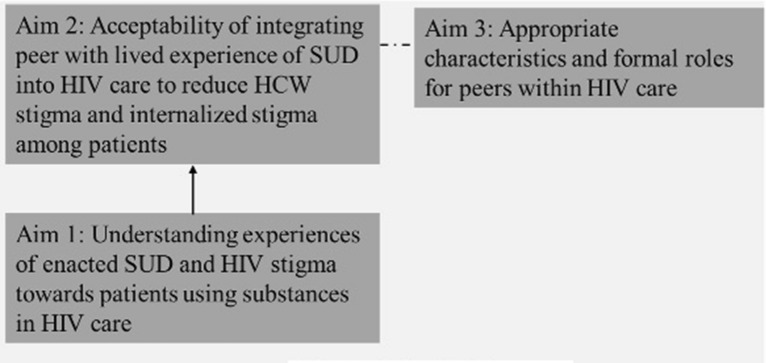
Background: South Africa has the highest number of people with HIV (PWH) globally and a significant burden of co-occurring substance use disorder (SUD). Health care worker (HCW) stigma towards SUD is a key barrier to HIV care engagement among PWH with SUD. Support from peers—individuals with lived experience of SUD—may be a promising solution for addressing SUD stigma, while also improving engagement in HIV care. We evaluated the perceived acceptability of integrating a peer role into community-based HIV care teams as a strategy to address SUD stigma at multiple levels and improve patient engagement in HIV care. Methods: Patients and stakeholders (N = 40) were recruited from publicly-funded HIV and SUD organizations in Cape Town, South Africa. We conducted a quantitative assessment of stigma among stakeholders using an adapted Social Distance Scale (SDS) and patient perceptions of working with a peer, as well as semi-structured interviews focused on experiences of SUD stigma, acceptability of a peer model integrated into community-based HIV care, and potential peer roles. Results: On the SDS, 75% of stakeholders had high stigma towards a patient with SUD, yet 90% had low stigma when in recovery for at least 2 years. All patients endorsed feeling comfortable talking to someone in recovery and wanting them on their HIV care team. Three main themes emerged from the qualitative data: (1) patient-reported experiences of enacted SUD and HIV stigmas were common and impacted HIV care engagement; (2) both patients and stakeholders considered a peer model highly acceptable for integration into HIV care to support engagement and address SUD stigma; and (3) patients and stakeholders identified both individual-level and systems-level roles for peers, how peers could work alongside other providers to improve patient care, and key characteristics that peers would need to be successful in these roles. Conclusions: Findings from this formative work point to the promise of a peer model for reducing SUD stigma among patients and HCWs within community-based HIV care teams in SA.
Overview
The claims and statistics of this paper haven’t been checked yet.
Free: it reads the open-access text and checks the first 5 claims that cite a source we can check. Create a free account to check every claim.
Integrity signals
Registry
Cites
Statistics
Figures
Verification
Claims the paper makes
The claims and statistics of this paper haven’t been checked yet.
Free: it reads the open-access text and checks the first 5 claims that cite a source we can check. Create a free account to check every claim.
Claims other papers make about this one
Each is checked against this paper’s own text: does it say what the citing paper says it does?
The source backs part of the claim, not all of it — or backs it for a different population, condition or comparison.
In the citing paper
“also display stigma towards patients with SU and depression”
From Siyakhana: A Hybrid Type 2 Effectiveness-Implementation Stepped-Wedge Trial to Reduce Stigma Towards Substance Use and Depression Among Community Health Workers in HIV/TB Care in South Africa (2025) · cites this paper as Magidson et al., 2022
Experimental — accuracy not yet measuredThe source backs part of the claim, not all of it — or backs it for a different population, condition or comparison.
In the citing paper
“Feasibility of training was enhanced by an extensive stakeholder engagement process and the formative work that preceded this trial (Magidson et al., 2022).”
From Siyakhana: A Hybrid Type 2 Effectiveness-Implementation Stepped-Wedge Trial to Reduce Stigma Towards Substance Use and Depression Among Community Health Workers in HIV/TB Care in South Africa (2025) · cites this paper as Magidson et al., 2022
Experimental — accuracy not yet measured
Self-check
Percentages, sums and reported differences re-computed from the paper’s own numbers.
The self-check needs the paper’s full text.
Citations
Cites
Using thematic analysis in psychology
Braun, V., & Clarke, V. (2006) · Qualitative Research in Psychology · doi:10.1191/1478088706qp063oa · Cited by 194,414 · cited 1×
“Guided by thematic analysis [37] and the theoretical frameworks informing the interview guide [31–33], the coding team—comprised of an SA-based faculty member, a US-based doctoral student, and a US-based research assistant—identified three key themes that mapped onto study aims: (1) experiences of SUD and HIV stigmas…”
MethodDamschroder, L. J., Aron, D. C., Keith, R. E., Kirsh, S. R., Alexander, J. A., & Lowery, J. C. (2009) · Implementation Science · doi:10.1186/1748-5908-4-50 · Cited by 14,496
(1998) · Cited by 13,501
Palinkas, L. A., Horwitz, S. M., Green, C. A., Wisdom, J. P., Duan, N., & Hoagwood, K. (2015) · Administration and Policy in Mental Health and Mental Health Services Research · doi:10.1007/s10488-013-0528-y · Cited by 12,038 · cited 1×
“The intention was not to recruit a sample that would generalize to the population of all stakeholders but rather to generate a diversity of perspectives relevant to implementing a peer model [27].”
BackgroundLink, B. G., & Phelan, J. C. (2001) · Annual Review of Sociology · doi:10.1146/annurev.soc.27.1.363 · Cited by 8,848
Basics of Qualitative Research: Techniques and Procedures for Developing Grounded Theory
Wuetherick, B. (2010) · Canadian Journal of University Continuing Education · doi:10.21225/d5g01t · Cited by 8,311
Bush, K. (1998) · Archives of Internal Medicine · doi:10.1001/archinte.158.16.1789 · Cited by 6,196
Qualitative Data Analysis for Health Services Research: Developing Taxonomy, Themes, and Theory
Bradley, E. H., Curry, L. A., & Devers, K. J. (2007) · Health Services Research · doi:10.1111/j.1475-6773.2006.00684.x · Cited by 3,437 · cited 2×
“By incorporating their own lived experience with SUD [38], peers may also be able to help patients address SUD-related barriers to HIV care, navigate services, and advocate for their health needs.”
BackgroundMethodBowleg, L. (2012) · American Journal of Public Health · doi:10.2105/ajph.2012.300750 · Cited by 2,996 · cited 1×
“, when both SUD and HIV stigmas co-occur and converge upon each other [15, 16]—can exacerbate poor HIV and SUD treatment outcomes [15, 17, 18].”
Backgroundvan Boekel, L. C., Brouwers, E. P. M., van Weeghel, J., & Garretsen, H. F. L. (2013) · Drug and Alcohol Dependence · doi:10.1016/j.drugalcdep.2013.02.018 · Cited by 1,810
Bauer, G. R. (2014) · Social Science & Medicine · doi:10.1016/j.socscimed.2014.03.022 · Cited by 1,620 · cited 1×
“, when both SUD and HIV stigmas co-occur and converge upon each other [15, 16]—can exacerbate poor HIV and SUD treatment outcomes [15, 17, 18].”
BackgroundLink, B. G. (1987) · American Sociological Review · doi:10.2307/2095395 · Cited by 1,587 · cited 9×
“–Male, late 40s, stakeholder, HIV care Table 2 Stakeholder social distance scale (SDS) results * The SDS is presented as the frequency of responses for each question, with four options ranging from definitely not to definitely, categorizing proximity as either “desirable” or “undesirable” High SDS = ≥ 2 undesirable re…”
MethodInfluentialEvidence for effective interventions to reduce mental-health-related stigma and discrimination
Thornicroft, G., Mehta, N., Clement, S., Evans-Lacko, S., Doherty, M., Rose, D., Koschorke, M., Shidhaye, R., O'Reilly, C., & Henderson, C. (2016) · The Lancet · doi:10.1016/s0140-6736(15)00298-6 · Cited by 1,338 · cited 2×
“Although strategies for reducing SUD stigma have rarely been evaluated in low- and middle-income countries (LMICs), the limited evidence available on mental health stigma suggests that contact with peers is an effective way of reducing mental health-related stigma among HCWs [20].”
BackgroundFrom Conceptualizing to Measuring HIV Stigma: A Review of HIV Stigma Mechanism Measures
Earnshaw, V. A., & Chaudoir, S. R. (2009) · AIDS and Behavior · doi:10.1007/s10461-009-9593-3 · Cited by 1,216
Stigma in health facilities: Why it matters and how we can change it
Nyblade, L., Stockton, M. A., Giger, K., Bond, V., Ekstrand, M. L., Lean, R. M., Mitchell, E. M. H., Nelson, L. R. E., Sapag, J. C., Siraprapasiri, T., et al. (2019) · BMC Medicine · doi:10.1186/s12916-019-1256-2 · Cited by 881
HIV Stigma Mechanisms and Well-Being Among PLWH: A Test of the HIV Stigma Framework
Earnshaw, V. A., Smith, L. R., Chaudoir, S. R., Amico, K. R., & Copenhaver, M. M. (2013) · AIDS and Behavior · doi:10.1007/s10461-013-0437-9 · Cited by 802
Challenges and opportunities in examining and addressing intersectional stigma and health
Turan, J. M., Elafros, M. A., Logie, C. H., Banik, S., Turan, B., Crockett, K. B., Pescosolido, B., & Murray, S. M. (2019) · BMC Medicine · doi:10.1186/s12916-018-1246-9 · Cited by 764
Kalichman, S. C., Simbayi, L. C., Kaufman, M., Cain, D., & Jooste, S. (2007) · Prevention Science · doi:10.1007/s11121-006-0061-2 · Cited by 582 · cited 1×
“Untreated substance use disorder (SUD) is prevalent in SA and a significant barrier to sustained engagement in HIV care and antiretroviral therapy (ART) adherence [2, 3].”
BackgroundPeer-Delivered Recovery Support Services for Addictions in the United States: A Systematic Review
Bassuk, E. L., Hanson, J., Greene, R. N., Richard, M., & Laudet, A. (2016) · Journal of Substance Abuse Treatment · doi:10.1016/j.jsat.2016.01.003 · Cited by 551
Combating HIV stigma in health care settings: what works?
Nyblade, L., Stangl, A., Weiss, E., & Ashburn, K. (2009) · Journal of the International AIDS Society · doi:10.1186/1758-2652-12-15 · Cited by 534
Turan, B., Budhwani, H., Fazeli, P. L., Browning, W. R., Raper, J. L., Mugavero, M. J., & Turan, J. M. (2017) · AIDS and Behavior · doi:10.1007/s10461-016-1451-5 · Cited by 480 · cited 1×
“, when both SUD and HIV stigmas co-occur and converge upon each other [15, 16]—can exacerbate poor HIV and SUD treatment outcomes [15, 17, 18].”
BackgroundEddie, D., Hoffman, L., Vilsaint, C., Abry, A., Bergman, B., Hoeppner, B., Weinstein, C., & Kelly, J. F. (2019) · Frontiers in Psychology · doi:10.3389/fpsyg.2019.01052 · Cited by 447
Community Attitudes toward People with Schizophrenia
Stuart, H., & Arboleda-Flórez, J. (2001) · The Canadian Journal of Psychiatry · doi:10.1177/070674370104600304 · Cited by 308 · cited 1×
“Specifically, we scored the SDS by categorizing stakeholder participants into three categories (high, moderate, or low stigma), based on previously used scoring methods [34, 35].”
MethodSmith, L. R., Earnshaw, V. A., Copenhaver, M. M., & Cunningham, C. O. (2016) · Drug and Alcohol Dependence · doi:10.1016/j.drugalcdep.2016.02.019 · Cited by 209
Earnshaw, V. A., Smith, L. R., Cunningham, C. O., & Copenhaver, M. M. (2015) · Journal of Health Psychology · doi:10.1177/1359105313507964 · Cited by 203
Progress towards the 2020 targets for HIV diagnosis and antiretroviral treatment in South Africa
Johnson, L. F., Dorrington, R. E., & Moolla, H. (2017) · Southern African Journal of HIV Medicine · doi:10.4102/sajhivmed.v18i1.694 · Cited by 189 · cited 1×
“8 million people with HIV (PWH) living in SA [1].”
Backgroundvan Brakel, W. H., Cataldo, J., Grover, S., Kohrt, B. A., Nyblade, L., Stockton, M., Wouters, E., & Yang, L. H. (2019) · BMC Medicine · doi:10.1186/s12916-018-1245-x · Cited by 156
Rivet Amico, K. (2011) · Journal of Health Psychology · doi:10.1177/1359105311398727 · Cited by 149
Social Distance Towards People with Mental Illness in Southwestern Nigeria
Adewuya, A. O., & Makanjuola, R. O. A. (2008) · Australian & New Zealand Journal of Psychiatry · doi:10.1080/00048670801961115 · Cited by 138 · cited 1×
“Specifically, we scored the SDS by categorizing stakeholder participants into three categories (high, moderate, or low stigma), based on previously used scoring methods [34, 35].”
MethodJack, H. E., Oller, D., Kelly, J., Magidson, J. F., & Wakeman, S. E. (2018) · Substance Abuse · doi:10.1080/08897077.2017.1389802 · Cited by 103 · cited 7×
“Peer recovery coaches or specialists typically assist with health services navigation, advocacy, and outreach, while also supporting motivation and ongoing recovery through shared lived experience with SUD [24, 25].”
BackgroundResultInfluentialSelf-citationMagidson, J. F., Regan, S., Powell, E., Jack, H. E., Herman, G. E., Zaro, C., Kane, M. T., & Wakeman, S. E. (2020) · Journal of Substance Abuse Treatment · doi:10.1016/j.jsat.2020.108248 · Cited by 93 · cited 2×
“Further, and similar to studies in other contexts [24, 25], our findings suggest that peers may be able to support patients to overcome pragmatic concerns that impact care engagement, similar to patient navigators who facilitate linkage to HIV and tuberculosis care in SA, but have not addressed the intersection of HIV…”
BackgroundResultSelf-citationMyers, B., Fakier, N., & Louw, J. (2009) · African Journal of Psychiatry · doi:10.4314/ajpsy.v12i3.48497 · Cited by 89
Self-citationKader, R., Seedat, S., Govender, R., Koch, J. R., & Parry, C. D. (2014) · AIDS and Behavior · doi:10.1007/s10461-013-0587-9 · Cited by 83 · cited 1×
“Untreated substance use disorder (SUD) is prevalent in SA and a significant barrier to sustained engagement in HIV care and antiretroviral therapy (ART) adherence [2, 3].”
BackgroundMahomed, O., & Asmall, S. (2015) · International Journal of Integrated Care · doi:10.5334/ijic.1454 · Cited by 81 · cited 1×
“In some parts of SA, an integrated chronic disease model that allows for HIV to be managed alongside other chronic diseases has been piloted [43, 44].”
BackgroundMagidson, J. F., Joska, J. A., Regenauer, K. S., Satinsky, E., Andersen, L. S., Seitz-Brown, C. J., Borba, C. P. C., Safren, S. A., & Myers, B. (2019) · International Journal of Drug Policy · doi:10.1016/j.drugpo.2018.11.004 · Cited by 80 · cited 2×
“In our prior work [4, 6, 8], PWH with SUD described being scolded or judged by HCWs and stopping HIV care prematurely due to anticipated stigma.”
BackgroundSelf-citationPeer-delivered services for substance use in low- and middle-income countries: A systematic review
Satinsky, E. N., Kleinman, M. B., Tralka, H. M., Jack, H. E., MYERS, B. J., & Magidson, J. F. (2021) · International Journal of Drug Policy · doi:10.1016/j.drugpo.2021.103252 · Cited by 68 · cited 3×
“Peers, individuals with lived experiences in SUD recovery, may be a promising solution for addressing SUD stigma among HCWs and patients, while also improving engagement in HIV care for PWH with SUD [19].”
BackgroundInfluentialSelf-citationRegenauer, K. S., Myers, B., Batchelder, A. W., & Magidson, J. F. (2020) · Drug and Alcohol Dependence · doi:10.1016/j.drugalcdep.2020.108322 · Cited by 62 · cited 3×
“In our prior work [4, 6, 8], PWH with SUD described being scolded or judged by HCWs and stopping HIV care prematurely due to anticipated stigma.”
BackgroundSelf-citationMyers, B., Joska, J., Lund, C., Levitt, N., Butler, C., Naledi, T., Milligan, P., Stein, D., & Sorsdahl, K. (2018) · Patient Preference and Adherence · doi:10.2147/ppa.s176356 · Cited by 57
Self-citationBassett, I. V., Coleman, S. M., Giddy, J., Bogart, L. M., Chaisson, C. E., Ross, D., Jacobsen, M. M., Robine, M., Govender, T., Freedberg, K. A., et al. (2016) · JAIDS Journal of Acquired Immune Deficiency Syndromes · doi:10.1097/qai.0000000000001025 · Cited by 55 · cited 16×
“%) stakeholders had high levels of desired social distance for interacting with a patient with HIV and SUD when not in SUD recovery, yet the majority (90”
ResultInfluentialSelf-citationStringer, K. L., Marotta, P., Baker, E., Turan, B., Kempf, M.-C., Drentea, P., Stepanikova, I., & Turan, J. M. (2019) · AIDS Patient Care and STDs · doi:10.1089/apc.2018.0311 · Cited by 54
Mutual Capacity Building to Reduce the Behavioral Health Treatment Gap Globally
Jack, H. E., MYERS, B. J., Regenauer, K. S., & Magidson, J. F. (2019) · Administration and Policy in Mental Health and Mental Health Services Research · doi:10.1007/s10488-019-00999-y · Cited by 38
Self-citationApplying lessons from task sharing in global mental health to the opioid crisis.
Magidson, J. F., Jack, H. E., Regenauer, K. S., & MYERS, B. J. (2019) · Journal of Consulting and Clinical Psychology · doi:10.1037/ccp0000434 · Cited by 28
Self-citationAnvari, M. S., Belus, J. M., Kleinman, M. B., Seitz‐Brown, C. J., Felton, J. W., Dean, D., Ciya, N., & Magidson, J. F. (2022) · Translational Issues in Psychological Science · doi:10.1037/tps0000305 · Cited by 24
Self-citationMyers, B., Breuer, E., Lund, C., Petersen Williams, P., van der Westhuizen, C., Brooke‐Sumner, C., Naledi, T., Stein, D. J., & Sorsdahl, K. (2019) · Journal of Psychiatric and Mental Health Nursing · doi:10.1111/jpm.12519 · Cited by 23 · cited 1×
“Prior work by our team [4, 6] and others [5] found that HCW stigma towards PWH and SUD results in inferior HIV care delivery, including less time spent with patients, lower likelihood of delivering evidence-based and patient-centered care, and reluctance to screen for SUD or provide brief interventions [5, 7].”
BackgroundSelf-citation
Research works printed but not linked: 2
- Bogardus ES Measuring social distances J Appl Sociol 1925 9 299 308
- Department of Health Integrated chronic disease management manual: a step-by-step guide for implementation 2012 South Africa National Department of Health
Cited by
Validation of a brief screener for broad-spectrum mental and substance-use disorders in South Africa
Stockton, M. A., Mazinyo, E. W., Mlanjeni, L., Nogemane, K., Ngcelwane, N., Sweetland, A. C., Basaraba, C. N., Bezuidenhout, C., Sansbury, G. M., Lovero, K. L., et al. (2023) · Cambridge Prisms Global Mental Health · doi:10.1017/gmh.2023.89 · Cited by 22
Malika, N. M., Bogart, L. M., Matovu, J. K. B., Phaladze, N., Mubiru, K., Rhandomy, M. L., Donastorg, Y., Valencia-Huamaní, J., Mpebe, O., Chisonga, N., et al. (2025) · PLOS Global Public Health · doi:10.1371/journal.pgph.0004240 · Cited by 19
“Study participants note that feeling financially unstable restricts their capacity to address additional concerns, such as taking medications or having the financial resources for transportation [51,55,56].”
InfluentialRegenauer, K. S., Rose, A. L., Belus, J. M., Johnson, K., Ciya, N., Ndamase, S., Jacobs, Y., Staniland, L., Sibeko, G., Bassett, I. V., et al. (2024) · PLOS Global Public Health · doi:10.1371/journal.pgph.0002657 · Cited by 12
“…was informed by formative qualitative interviews with patients receiving HIV/TB care, CHWs, healthcare workers, NGO leaders, and policymakers [38] and previous CHW training interventions to improve mental health literacy and skills for supporting patients who have symptoms of problem SU or…”
BackgroundSelf-citationMyers, B., Regenauer, K. S., Rose, A., Johnson, K., Ndamase, S., Ciya, N., Brown, I., Joska, J., Bassett, I. V., Belus, J. M., et al. (2024) · Implementation Science Communications · doi:10.1186/s43058-023-00537-w · Cited by 11
“…with the Situated Information Motivation Behavioral Skills Model of Care Initiation and Maintenance framework (sIMB-CIM) [37] and adapted based on prior formative work [23, 24], prior training programs to improve CHW mental health and SU literacy and teach problem-solving skills [15, 18, 19, 23].”
MethodSelf-citationRose, A. L., Ochieng, Y. A., Jack, H. E., Sangraula, A., Ciya, N., Jacobs, Y., Ndamase, S., Regenauer, K. S., Brown, I., Hines, A. C., et al. (2023) · International Journal of STD & AIDS · doi:10.1177/09564624231160581 · Cited by 11
Self-citation
Metadata
- Authors
- Magidson, J. F., Rose, A. L., Regenauer, K. S., Brooke-Sumner, C., Anvari, M. S., Jack, H. E., Johnson, K., Belus, J. M., Joska, J., Bassett, I. V., Sibeko, G., & Myers, B.
- Affiliations
- University of Maryland, College Park (US)
- University of Washington (US)
- South African Medical Research Council (ZA)
- University of Basel (CH)
- University of Cape Town (ZA)
- Harvard University (US)
- Corresponding author
- Magidson, Jessica F.
- Myers, Bronwyn
- ORCID
- Venue
- Addiction Science & Clinical Practice
- Published
- 2022-09-21
- Volume
- 17
- Issue
- 1
- Pages
- 52-52
- ISSN
- 1940-0632 (ISSN-L)
- 1940-0640
- PMC
- PMC9490994
- OpenAlex
- W4296711105
- Semantic Scholar
- 100c6afaee585fbeb5eb8c78536a81b660a55f88
- Cited by
- 37
- References
- 44
- Citations by year
- 2026: 4 · 2025: 5 · 2024: 9 · 2023: 19
- FWCI
- 4.03
- Type
- journal article
- Language
- en
- Open access
- gold
- doi.org
- Licence
- cc-by
- creativecommons.org/licenses/by/4.0 (tdm)
- creativecommons.org/licenses/by/4.0 (vor)
- Locations
- Addiction Science & Clinical Practice (publishedVersion, cc-by)
- PubMed Central (publishedVersion, cc-by)
- PubMed (publishedVersion)
- Open University of Cape Town (University of Cape Town) (submittedVersion, cc-by)
- DOAJ (DOAJ: Directory of Open Access Journals) (submittedVersion, cc-by-sa)
- University Libraries (University of Maryland) (submittedVersion)
- eSpace (Curtin University) (submittedVersion, cc-by)
- Digital Repository at the University of Maryland (University of Maryland College Park)
- Funders
- National Institute on Drug Abuse (R21DA053212)
- National Institute of Mental Health (R34MH122268, F31MH123020)
- Topics
- Health Sciences › Medicine › Infectious Diseases › HIV/AIDS Research and Interventions
- Health Sciences › Medicine › Epidemiology › HIV, Drug Use, Sexual Risk
- Health Sciences › Medicine › Epidemiology › Substance Abuse Treatment and Outcomes
- Keywords
- substance use stigma, HIV care engagement, peer support, lived experience, community-based HIV care, co-occurring substance use disorders, HIV, stigma reduction, acceptability, peer roles, South Africa
- MeSH terms
- Humans, South Africa, HIV Infections, Substance-Related Disorders, Qualitative Research, Social Stigma
About these checks
Registry, retraction, Cites and statistics results are computed, not judged, with one exception: a printed reference that no index lists is read once by a model before it counts as a citation error. Claims are extracted by a model and kept only when their quote appears verbatim in the text; each cited source is then checked, with a model’s help, for whether it says what the claim relies on. Those verdicts can be wrong — read the claim’s quote and the cited source before relying on one.
Statistics and arithmetic are recomputed, not judged.
Confidence bands are shown only for fields calibrated on our annotated test set. None is calibrated yet, so no band is shown.
What counts as a claim ›How we measure confidence ›How we check this ›
Are you an author, or do you see a problem with this page? Request a review
Data sources
Bibliographic data: Semantic Scholar, OpenAlex, Crossref.
Contains information from the Semantic Scholar Academic Graph Datasets, made available under the ODC Attribution License (ODC-BY 1.0).
Semantic Scholar’s data is described in: Kinney, R., et al. (2023). The Semantic Scholar Open Data Platform. arXiv:2301.10140.
