

The DOI matches its Crossref record; 139 of the 140 references it cites were found in a registry or an index.
Current understanding of metal ions in the pathogenesis of Alzheimer’s disease
Open accessAbstract
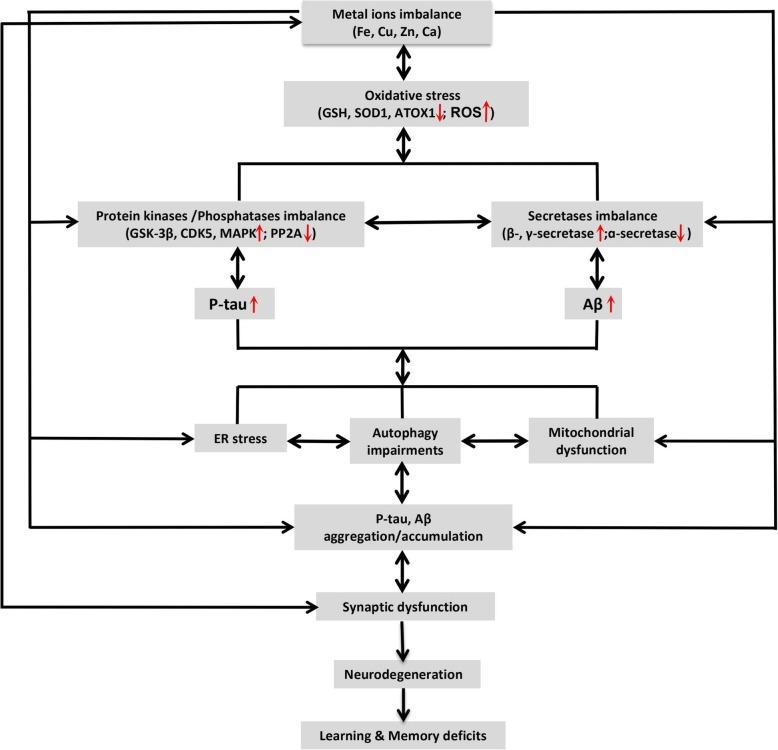
Background: The homeostasis of metal ions, such as iron, copper, zinc and calcium, in the brain is crucial for maintaining normal physiological functions. Studies have shown that imbalance of these metal ions in the brain is closely related to the onset and progression of Alzheimer's disease (AD), the most common neurodegenerative disorder in the elderly. Main body: Erroneous deposition/distribution of the metal ions in different brain regions induces oxidative stress. The metal ions imbalance and oxidative stress together or independently promote amyloid-β (Aβ) overproduction by activating β- or γ-secretases and inhibiting α-secretase, it also causes tau hyperphosphorylation by activating protein kinases, such as glycogen synthase kinase-3β (GSK-3β), cyclin-dependent protein kinase-5 (CDK5), mitogen-activated protein kinases (MAPKs), etc., and inhibiting protein phosphatase 2A (PP2A). The metal ions imbalances can also directly or indirectly disrupt organelles, causing endoplasmic reticulum (ER) stress; mitochondrial and autophagic dysfunctions, which can cause or aggravate Aβ and tau aggregation/accumulation, and impair synaptic functions. Even worse, the metal ions imbalance-induced alterations can reversely exacerbate metal ions misdistribution and deposition. The vicious cycles between metal ions imbalances and Aβ/tau abnormalities will eventually lead to a chronic neurodegeneration and cognitive deficits, such as seen in AD patients. Conclusion: The metal ions imbalance induces Aβ and tau pathologies by directly or indirectly affecting multiple cellular/subcellular pathways, and the disrupted homeostasis can reversely aggravate the abnormalities of metal ions transportation/deposition. Therefore, adjusting metal balance by supplementing or chelating the metal ions may be potential in ameliorating AD pathologies, which provides new research directions for AD treatment.
Overview
The claims and statistics of this paper haven’t been checked yet.
Run the check — free, no account needed. It reads the open-access text and checks the sources it cites.
Integrity signals
Registry
Cites
Statistics
Figures
Verification
Claims the paper makes
The claims and statistics of this paper haven’t been checked yet.
Run the check — free, no account needed. It reads the open-access text and checks the sources it cites.
Claims other papers make about this one
Each is checked against this paper’s own text: does it say what the citing paper says it does?
The source backs part of the claim, not all of it — or backs it for a different population, condition or comparison.
In the citing paper
“However, in AD, this finely tuned balance is disrupted. Misdistribution and pathological accumulation of these metals occur in Aβ plaques and NFTs, where they promote protein aggregation, oxidative stress, and neurotoxicity [107].”
From Toward a Unified Framework in Molecular Neurobiology of Alzheimer’s Disease: Revisiting the Pathophysiological Hypotheses (2026) · cites this paper as [107]
Experimental — accuracy not yet measuredIn the citing paper
“This protein known as the BACE performs proteolysis by generating a soluble fragment in the extracellular space known as “soluble APPβ” and an additional fragment bound to the plasma membrane, CTFβ peptide that undergoes proteolysis yet again by γ-secretase to generate toxic neuropeptides Aβ with 40–43 amino acids, finally causing the amyloid plaques characteristic of AD [165,166,167].”
From Multi-Target Mechanisms of Phytochemicals in Alzheimer’s Disease: Effects on Oxidative Stress, Neuroinflammation and Protein Aggregation (2022) · cites this paper as [165]
In the citing paper
“The absence of Aβ in neurons may inhibit adequate chelation of metal ions and appropriate removal of O2-, resulting in an increased rather than a reduced oxidative stress.424”
From Amyloid β-based therapy for Alzheimer’s disease: Challenges, successes and future (2023) · cites this paper as [424]
Self-check
Percentages, sums and reported differences re-computed from the paper’s own numbers.
The self-check needs the paper’s full text.
Citations
Cites
The amyloid hypothesis of Alzheimer's disease at 25 years
Selkoe, D. J., & Hardy, J. (2016) · EMBO Molecular Medicine · doi:10.15252/emmm.201606210 · Cited by 6,164
Guidelines for the use and interpretation of assays for monitoring autophagy (3rd edition).
Klionsky, D. J., Abdelmohsen, K., Abe, A., Abedin, M. J., Abeliovich, H., Acevedo Arozena, A., Adachi, H., Adams, C. M., Adams, P. D., Adeli, K., et al. (2016) · Autophagy · doi:10.1080/15548627.2015.1100356 · Cited by 5,894
Methods in Mammalian Autophagy Research
Mizushima, N., Yoshimori, T., & Levine, B. (2010) · Cell · doi:10.1016/j.cell.2010.01.028 · Cited by 4,497
Guidelines for the use and interpretation of assays for monitoring autophagy
Klionsky, D. J., Abdalla, F. C., Abeliovich, H., Abraham, R. T., Acevedo-Arozena, A., Adeli, K., Agholme, L., Agnello, M., Agostinis, P., Aguirre-Ghiso, J. A., et al. (2012) · Autophagy · doi:10.4161/auto.19496 · Cited by 3,996
Oxidative stress and the amyloid beta peptide in Alzheimer’s disease
Cheignon, C., Tomas, M., Bonnefont-Rousselot, D., Faller, P., Hureau, C., & Collin, F. (2018) · Redox Biology · doi:10.1016/j.redox.2017.10.014 · Cited by 2,185
Preclinical Alzheimer’s Disease: Definition, Natural History, and Diagnostic Criteria
Dubois, B., Hampel, H., Feldman, H. H., Scheltens, P., Aisen, P., Andrieu, S., Bakardjian, H., Benali, H., Bertram, L., Blennow, K., et al. (2016) · Alzheimer's & Dementia · doi:10.1016/j.jalz.2016.02.002 · Cited by 1,925
Lysosomal calcium signalling regulates autophagy through calcineurin and TFEB
Medina, D. L., Paola, S. D., Peluso, I., Armani, A., Stefani, D. D., Venditti, R., Montefusco, S., Rosato, A. S., Prezioso, C., Forrester, A. R., et al. (2015) · Nature Cell Biology · doi:10.1038/ncb3114 · Cited by 1,452
Woods, A., Dickerson, K., Heath, R. B., Hong, S. P., Momcilovic, M., Johnstone, S. R., Carlson, M., & Carling, D. (2005) · Cell Metabolism · doi:10.1016/j.cmet.2005.06.005 · Cited by 1,418
Oxidative Stress and the Central Nervous System
Salim, S. (2016) · Journal of Pharmacology and Experimental Therapeutics · doi:10.1124/jpet.116.237503 · Cited by 1,268
Boland, B., Kumar, A., Lee, S., Platt, F. M., Wegiel, J., Yu, W. H., & Nixon, R. A. (2008) · Journal of Neuroscience · doi:10.1523/jneurosci.0800-08.2008 · Cited by 1,119
Cited by
Sorted by citations
Items 201–300 of 458
Analytical Methods and Effects of Bioactive Peptides Derived from Animal Products: A Mini-Review
Jeong, J. W., Lee, S. Y., Lee, D. Y., Kim, J. H., Yun, S. H., Lee, J., Mariano, E., Moon, S., & Hur, S. J. (2024) · Food Science of Animal Resources · doi:10.5851/kosfa.2024.e31 · Cited by 11
Asokan, K., Sivaraman, S., Nallasamy, K., Jeyavijayan, S., & Paranthaman, S. (2024) · International Journal of Quantum Chemistry · doi:10.1002/qua.70006 · Cited by 12
Naik, R. A., Rajpoot, R., Koiri, R. K., Bhardwaj, R., Aldairi, A. F., Johargy, A. K., Faidah, H. S., Babalghith, A. O., Hjazi, A. M., Alsanie, W. F., et al. (2025) · The Journal of Prevention of Alzheimer s Disease · doi:10.1016/j.tjpad.2024.100004 · Cited by 12
Distinct Aggregation Behavior of N-Terminally Truncated Aβ4–42 Over Aβ1–42 in the Presence of Zn(II)
Na, C., Kim, M., Kim, G., Lin, Y., Lee, Y., Bal, W., Nam, E., & Lim, M. H. (2025) · ACS Chemical Neuroscience · doi:10.1021/acschemneuro.4c00831 · Cited by 11
Advancing Nanomaterial-Based Strategies for Alzheimer’s Disease: A Perspective
Zhou, H., Yin, X., Zhang, G., Yang, Z., & Zhou, R. (2025) · JACS Au · doi:10.1021/jacsau.5c00002 · Cited by 15
Cu(I) chelators: Useful tools to reveal and control Cu(I) homeostasis and toxicity
Esmieu, C., Hostachy, S., & Hureau, C. (2025) · Coordination Chemistry Reviews · doi:10.1016/j.ccr.2025.216684 · Cited by 14
Lojk, J., Babič, L., Sušjan, P., Bregar, V. B., Pavlin, M., Hafner‐Bratkovič, I., & Veranič, P. (2020) · International Journal of Molecular Sciences · doi:10.3390/ijms21197030 · Cited by 11
Amylin and Secretases in the Pathology and Treatment of Alzheimer’s Disease
Singh, S. P., Yang, F., Sivils, A., Cegielski, V., & Chu, X. (2022) · Biomolecules · doi:10.3390/biom12070996 · Cited by 11
Ashraf, G. M., Ebada, M. A., Suhail, M., Ali, A., Uddin, M. S., Bilgrami, A. L., Perveen, A., Husain, A., Tarique, M., Hafeez, A., et al. (2021) · Oxidative Medicine and Cellular Longevity · doi:10.1155/2021/4572471 · Cited by 11
Beliveau, V., Müller, C., Steiger, R., Gizewski, E. R., Poewe, W. H., Seppi, K., & Scherfler, C. (2022) · Parkinsonism & Related Disorders · doi:10.1016/j.parkreldis.2022.06.021 · Cited by 11
Zhou, B., Sheng, X., Xie, H., Zhou, S., Zhong, M., & Liu, A. (2022) · Chemistry & Biodiversity · doi:10.1002/cbdv.202200342 · Cited by 11
Khan, M. S., Hu, Q., Okeibunor, K., Ma, L., & Bopassa, J. C. (2025) · Frontiers in Physiology · doi:10.3389/fphys.2025.1641323 · Cited by 12
Onrubia-Márquez, M., Navas, F., Sánchez‐Carnerero, E. M. M., Martín, A. D., Liturri, A., Miciaccia, M., Sanz, R., Scilimati, A., García‐Muñoz, R. A., Perrone, M. G., et al. (2025) · ACS Applied Materials & Interfaces · doi:10.1021/acsami.5c18528 · Cited by 10
Paper‐in‐Tip Bipolar Electrospray Mass Spectrometry for Real‐Time Chemical Reaction Monitoring
Li, Y., Zhu, L., Wu, X., Zhang, Z., Pu, R., Zheng, Y., & Zhang, Z. (2024) · Angewandte Chemie International Edition · doi:10.1002/anie.202318169 · Cited by 10
Heavy metals toxicity on epigenetic modifications in the pathogenesis of Alzheimer's disease (AD)
Venkatesan, D., Muthukumar, S., Iyer, M., Babu, H. W. S., Gopalakrishnan, A. V., Yadav, M., & Vellingiri, B. (2024) · Journal of Biochemical and Molecular Toxicology · doi:10.1002/jbt.23741 · Cited by 10
Zhao, Y. S., Xi, E., Wang, Z., Ding, Q., Liu, K., Zhu, J., Wu, X., Xie, Y., Yang, F., Gao, N., et al. (2024) · Science China Chemistry · doi:10.1007/s11426-024-2303-x · Cited by 10
Cellular mechanisms of copper neurotoxicity in human, differentiated neurons
Witt, B., Friese, S., Walther, V., Ebert, F., Bornhorst, J., & Schwerdtle, T. (2024) · Archives of Toxicology · doi:10.1007/s00204-024-03921-0 · Cited by 10
Sviben, M., Odak, I., Barić, D., Mlakić, M., Horváth, O., Fodor, L., Roca, S., Šagud, I., & Škorić, I. (2025) · Molecules · doi:10.3390/molecules30020316 · Cited by 10
Rullo, M., Spada, G. L., Stefanachi, A., Macchia, E., Pisani, L., & Leonetti, F. (2025) · Molecules · doi:10.3390/molecules30040891 · Cited by 11
Copper metabolism and cuproptosis in Alzheimer's disease: mechanisms and therapeutic potential
Meng, D., Luo, G., & Liu, P. (2025) · Biomedicine & Pharmacotherapy · doi:10.1016/j.biopha.2025.118354 · Cited by 11
Liu, T., Rong, Z., Li, J., Wu, H., & Wei, J. (2025) · Genes & Diseases · doi:10.1016/j.gendis.2025.101846 · Cited by 10
Sharma, D. K. (2025) · Journal of drug targeting · doi:10.1080/1061186x.2025.2561788 · Cited by 11
Ji, H., Kang, X., Yang, X., Chen, H., Zhu, L., Mao, T., He, Y., Liu, J., Wang, Q., Zhou, X., et al. (2022) · Biosensors and Bioelectronics · doi:10.1016/j.bios.2022.114927 · Cited by 10
Dual Role for Astroglial Copper-Assisted Polyamine Metabolism during Intense Network Activity
Szabó, Z. M., Péter, M., Héja, L., & Kardos, J. (2021) · Biomolecules · doi:10.3390/biom11040604 · Cited by 10
Magrì, A. L., Mendola, D. L., & Rizzarelli, E. (2021) · International Journal of Molecular Sciences · doi:10.3390/ijms22105085 · Cited by 10
Kusova, A. M., Iskhakova, A., & Zuev, Y. F. (2022) · European Biophysics Journal · doi:10.1007/s00249-022-01605-0 · Cited by 10
Hou, Q., Lin, J., Xue, X., Zhang, Y., Qiu, Z., Zhang, H., Li, J., Wang, H., Zhang, S., Yao, Z., et al. (2024) · The Science of The Total Environment · doi:10.1016/j.scitotenv.2024.171736 · Cited by 9
Min, J.-H., Sarlus, H., & Harris, R. A. (2024) · Metallomics · doi:10.1093/mtomcs/mfae019 · Cited by 11
Sun, Q., Ren, L., Liu, J., Yang, Z., Zhang, D., & Li, S.-B. (2025) · Analytical Methods · doi:10.1039/d5ay00243e · Cited by 9
Programmed cell death in the cognitive impairment of obstructive sleep apnea
Ou, Y., Wang, X., Zong, D., & Ouyang, R. (2025) · Cell & Bioscience · doi:10.1186/s13578-025-01418-6 · Cited by 9
Chen, K., Zhou, J., Liu, N., & Meng, X. (2023) · Biological Trace Element Research · doi:10.1007/s12011-023-03718-9 · Cited by 9
Zhu, X., Lv, Y., Fan, M., Guo, J., Zhang, Y., Gao, B., Zhang, C., & Xie, Y. (2023) · Bioorganic Chemistry · doi:10.1016/j.bioorg.2023.106817 · Cited by 9
Wang, X., Huang, K., Yang, F., Chen, D., Cai, S., & Huang, L. (2021) · Behavioural Brain Research · doi:10.1016/j.bbr.2021.113330 · Cited by 9
Lupăescu, A.-V., Mocanu, C. S., Drochioiu, G., & Ciobanu, C. I. (2021) · Pharmaceuticals · doi:10.3390/ph14101011 · Cited by 9
Big versus small: The impact of aggregate size in disease
Hnath, B., Chen, J., Reynolds, J., Choi, E. S., Wang, J., Zhang, D., Sha, C. M., & Dokholyan, N. V. (2023) · Protein Science · doi:10.1002/pro.4686 · Cited by 8
Mazej, T., Knez, D., Meden, A., Gobec, S., & Sova, M. (2021) · Molecules · doi:10.3390/molecules26144118 · Cited by 9
Wei, X., Xiong, R., Xu, P., Zhang, T., Zhang, J., Jin, Z., & Li, L. (2025) · Alzheimer s Research & Therapy · doi:10.1186/s13195-025-01752-4 · Cited by 13
Hu, C., Shi, X., Zhou, J., Yang, Z., Wang, Z., Huang, L., Tang, C. C., & Wang, F. (2025) · Journal of Hazardous Materials · doi:10.1016/j.jhazmat.2025.138667 · Cited by 8
Charissopoulos, E., & Pontiki, E. A. (2025) · Molecules · doi:10.3390/molecules30173512 · Cited by 8
Deng, C., Mi, J., Zhou, Y. M., Li, X., Liu, Z., Sang, Z., & Li, H. (2022) · Medicinal Chemistry Research · doi:10.1007/s00044-022-02899-7 · Cited by 8
Association between mixed urinary metal exposure and liver function: analysis of NHANES data
Zha, B., Xu, H., Liu, Y., & Zha, X. (2023) · Environmental Science and Pollution Research · doi:10.1007/s11356-023-30242-z · Cited by 8
Memory Recovery Effect of a New Bioactive Innovative Combination in Rats with Experimental Dementia
Tancheva, L. P., Kalfin, R. E., Minchev, B., Uzunova, D. N., Tasheva, K. N., Tsvetanova, E. R., Georgieva, A. P., Alexandrova, A., Stefanova, M. O., Solak, A., et al. (2023) · Antioxidants · doi:10.3390/antiox12122050 · Cited by 7
Więckowski, K., Szałaj, N., Gryzło, B., Wichur, T., Góral, I., Sługocka, E., Śniecikowska, J., Latacz, G., Siwek, A., Godyń, J., et al. (2022) · International Journal of Molecular Sciences · doi:10.3390/ijms23169443 · Cited by 8
Atiya, A., Alhumaydhi, F. A., Shamsi, A., Olatunde, A., Alsagaby, S. A., Abdulmonem, W. A., Sharaf, S. E., & Shahwan, M. J. (2022) · ACS Omega · doi:10.1021/acsomega.2c03185 · Cited by 8
Wang, L., Wei, Y., Sun, Z., Jiang, L., Yin, Y., Zheng, P., Fu, Y., Wang, H., Li, C., & Wang, J. (2023) · Neuroscience · doi:10.1016/j.neuroscience.2023.07.004 · Cited by 8
Zakaria, N., Harun, W. M. R. S. W., Latif, M. A. M., Azaman, S. N. A., Rahman, M. B. A., & Faujan, N. H. (2024) · Journal of Molecular Graphics and Modelling · doi:10.1016/j.jmgm.2024.108732 · Cited by 7
Lee, H., Jung, M., Choi, K., Jang, J. H., Hwang, S.-K., Chae, S., Lee, J., & Mun, J. Y. (2024) · Free Radical Biology and Medicine · doi:10.1016/j.freeradbiomed.2024.05.017 · Cited by 7
Health Risk Assessment of Heavy Metals in Lettuce and Spring Onion on Human Health in Kumasi, Ghana
Adoma, P. O., Amponsah, A. S., Kwarteng, T. A., Acquah, F. N., Amu, H., Agjei, R. O., & Hanson, R. (2024) · Environmental Health Insights · doi:10.1177/11786302241285737 · Cited by 7
Food Functional Factors in Alzheimer’s Disease Intervention: Current Research Progress
Nie, R., Luo, H.-M., Liu, Y.-P., Wang, S., Hou, Y.-J., Chen, C., Wang, H., Lv, H.-L., Tao, X.-Y., Jing, Z.-H., et al. (2024) · Nutrients · doi:10.3390/nu16233998 · Cited by 7
Simakov, A., Chhor, S., Ismaïli, L., & Martin, H. (2025) · Molecules · doi:10.3390/molecules30092048 · Cited by 7
Alzheimer’s disease: a jigsaw puzzle comprised of different types of programmed cell death pieces
Wang, Y., Mu, D., Li, Y., Liu, C., Feng, J., Lai, Y., & Lou, G. (2025) · Brain Research · doi:10.1016/j.brainres.2025.149861 · Cited by 7
Challenges and Opportunities of Drug Delivery for Treatment of Alzheimer’s Disease
El-Fattah, M. A. A. (2026) · AAPS PharmSciTech · doi:10.1208/s12249-025-03316-z · Cited by 9
Ciccone, L., Camodeca, C., Tonali, N., Barlettani, L., Rossello, A., Fruchart‐Gaillard, C., Kaffy, J., Petrarolo, G., Motta, C. L., Nencetti, S., et al. (2023) · Pharmaceutics · doi:10.3390/pharmaceutics15102369 · Cited by 7
Gardner, R. S., Kyle, M. M., Hughes, K., & Zhao, L. (2024) · Biomolecules · doi:10.3390/biom14070827 · Cited by 7
Implications of liquid-liquid phase separation and ferroptosis in Alzheimer's disease
Wang, F., Chen, Z., Zhou, Q., Sun, Q., Zheng, N., Chen, Z., Lin, J., Li, B., & Li, L. (2024) · Neuropharmacology · doi:10.1016/j.neuropharm.2024.110083 · Cited by 9
Le, J., Xia, C., Xu, J., Cai, J., Hu, C., Bai, Y., Chen, H., Rong, W., Jiang, Y., Wu, X., et al. (2024) · CNS Neuroscience & Therapeutics · doi:10.1111/cns.70100 · Cited by 7
Nutrition and Brain Functions in Health and Disease
Mansour, H. M. (2022) · Nutritional neurosciences · doi:10.1007/978-981-19-5021-6_1 · Cited by 7
PERK/ATF3-Reduced ER Stress on high potassium environment in the suppression of tumor ferroptosis
Pu, X., Li, L., Chen, Z., Gong, A., Lei, J., Zhang, L., & Tsai, H. (2023) · Journal of Cancer · doi:10.7150/jca.83556 · Cited by 7
The Binding of Cu 2+ to Lipid Membranes Is Not Substantially Influenced by Electrostatic Screening
Reynolds, C. M., Fiebig, O. C., Marroquin, A., Glaid, A. J., Chokhany, K., Zdenek, R. G., Garcia, M. L. D. C., & Cremer, P. S. (2025) · Journal of the American Chemical Society · doi:10.1021/jacs.4c16066 · Cited by 6
Cavaleri, F. (2025) · Frontiers in Neurology · doi:10.3389/fneur.2025.1550709 · Cited by 7
Zheng, M., Chen, Z., Xie, J., Yang, Q., Mo, M., & Chen, L. (2025) · International Journal of Nanomedicine · doi:10.2147/ijn.s515951 · Cited by 6
Crosstalk between copper, Alzheimer’s disease, and melatonin
Deepika, Thakur, A., Panghal, A., Pundir, R., Singh, C., Goyal, M., Namdeo, A. G., & Kumar, J. (2025) · BioMetals · doi:10.1007/s10534-025-00712-7 · Cited by 6
Guan, Q., Cao, Y., Zhang, Y., Zhou, B., Wang, J., Baranenko, D., Cifuentes, A., Ibañez, E., Yuan, C., & Lu, W. (2025) · Trends in Food Science & Technology · doi:10.1016/j.tifs.2025.105177 · Cited by 9
Nanozymes - A new opportunity for the treatment of neurodegenerative diseases
Zhou, Y., Zhou, X., Song, Y., Tian, Q., Li, S., Li, T., & Lu, X. F. (2025) · Chemical Engineering Journal · doi:10.1016/j.cej.2025.169965 · Cited by 6
Ding, S., Zhu, Y., Zhu, A., & Shi, G. (2023) · Sensors & Diagnostics · doi:10.1039/d2sd00228k · Cited by 6
Wang, X., Wang, B., Yang, F., Shang, K., Chen, S. W., & Zhang, Y. (2024) · Frontiers in Aging Neuroscience · doi:10.3389/fnagi.2024.1353286 · Cited by 6
Bioactive compounds and dietary patterns in Alzheimer's disease
Christimann, G., dos Santos, G. R., & Sattler, J. A. G. (2025) · Journal of Alzheimer s Disease · doi:10.1177/13872877251319048 · Cited by 6
Baj, J., Forma, A., Kowalska, B., Teresiński, G., Buszewicz, G., Majerek, D., Flieger, W., Maciejewski, R., Karakuła, K. H., Flieger, M., et al. (2022) · International Journal of Environmental Research and Public Health · doi:10.3390/ijerph19074420 · Cited by 8
Kou, X., Shi, X., Pang, Z., Yang, A., Shen, R., & Zhao, L. (2023) · Current Medicinal Chemistry · doi:10.2174/0929867330666230125153027 · Cited by 6
Jarošová, R., Woolfolk, S. K., Martínez-Rivera, N., Jaeschke, M. W., Rosa‐Molinar, E., Tamerler, C., & Johnson, M. A. (2023) · Molecules · doi:10.3390/molecules28052260 · Cited by 6
Zebrafish as a comprehensive model of neurological diseases
Ahmed, S., Venkatesan, G., Prapul, D. S., & Md, A. R. (2023) · International Journal of Science and Research Archive · doi:10.30574/ijsra.2023.10.1.0696 · Cited by 6
Molecular interplay between phytoconstituents of Ficus Racemosa and neurodegenerative diseases
Rani, A., Sabah, Z. U., Tabassum, F., & Sharma, A. K. (2024) · European Journal of Neuroscience · doi:10.1111/ejn.16250 · Cited by 6
Xie, R.-R., Su, C.-L., Li, W., Zou, X.-Y., Chen, Y.-S., & Tang, H. (2021) · Bioorganic Chemistry · doi:10.1016/j.bioorg.2021.104710 · Cited by 6
Jamali, M., Mohajer, S., Sheikhlary, S., & Ara, M. H. M. (2022) · Photodiagnosis and Photodynamic Therapy · doi:10.1016/j.pdpdt.2022.102914 · Cited by 6
Li, R., Wang, M., Song, Q., Liu, D., Jiang, L., Wen, Y., Zhang, Q., Lu, D., Duan, K., Li, Y., et al. (2025) · Sensors and Actuators B Chemical · doi:10.1016/j.snb.2025.138175 · Cited by 5
Rational Modulation of Liquid–Liquid Phase Separation Offers Novel Ways to Combat Tauopathies
Zhang, X., Wang, L., Lin, N., Gao, M. Y., & Huang, Y. (2025) · International Journal of Molecular Sciences · doi:10.3390/ijms26146709 · Cited by 7
Debi, P. R., Barua, H., Ahmmed, M. K., & Bhowmik, S. (2025) · Marine Drugs · doi:10.3390/md23080310 · Cited by 7
Wang, Q., Gan, Y., Li, F., & Ling, D. (2025) · Accounts of Chemical Research · doi:10.1021/acs.accounts.5c00614 · Cited by 5
Chen, Z., Wang, F., Chen, Z., Zheng, N., Zhou, Q., Xie, L., Sun, Q., Li, L., & Li, B. (2024) · Neuroscience · doi:10.1016/j.neuroscience.2024.08.035 · Cited by 5
Bioinformatics insights into mitochondrial and immune gene regulation in Alzheimer's disease
Tian, M., Zhang, Y., Yuan, Y., Li, H., & He, Y. (2025) · European journal of medical research · doi:10.1186/s40001-025-02297-w · Cited by 7
Free Radicals and Actinobacteria as a Misexplored Goldmine of Antioxidant Compounds
de Oliveira, T. H. B., de Gusmão, N. B., da Silva, L. A. D. O., & Coelho, L. C. B. B. (2021) · Anais da Academia Brasileira de Ciências · doi:10.1590/0001-3765202120201925 · Cited by 9
The position of geochemical variables as causal co-factors of diseases of unknown aetiology
Davies, T. C. (2022) · SN Applied Sciences · doi:10.1007/s42452-022-05113-w · Cited by 5
The co-effect of copper and lipid vesicles on Aβ aggregation
Zhu, X., Liu, W., Zhao, W., Chang, Z., & Yang, J. (2022) · Biochimica et Biophysica Acta (BBA) - Biomembranes · doi:10.1016/j.bbamem.2022.184082 · Cited by 5
Radiolabeled imaging agents for Alzheimer's disease
Wu, J., Li, K., Yang, J., Mao, M., & Cheng, Y. (2023) · iRadiology · doi:10.1002/ird3.35 · Cited by 5
Skogholt’s disease—A tauopathy precipitated by iron and copper?
Aspli, K. T., Holmøy, T., Flaten, T. P., Whist, J. E., & Aaseth, J. (2021) · Journal of Trace Elements in Medicine and Biology · doi:10.1016/j.jtemb.2021.126915 · Cited by 5
Coumarin derivatives against amyloid-beta 40 – 42 peptide and tau protein
Kowalczyk, J., Skalicka‐Woźniak, K., Budzyńska, B., Sayed, N. S. E., Espargaró, A., & Sabaté, R. (2022) · Current Issues in Pharmacy and Medical Sciences · doi:10.2478/cipms-2022-0013 · Cited by 5
Zinc exacerbates tau-induced Alzheimer-like pathology in C57BL/6J mice
Li, X., Le, L., Shi, Q., Xu, H., Wang, C., Xiong, Y., Wang, X., Wu, G., Liu, Q., & Du, X. (2023) · International Journal of Biological Macromolecules · doi:10.1016/j.ijbiomac.2023.124652 · Cited by 5
de Jesus, J. R., Linhares, L. A., Aragão, A. Z. B., Arruda, M. A. Z., & Ramos, C. H. I. (2023) · Biochimie · doi:10.1016/j.biochi.2023.05.009 · Cited by 5
Xia, S., He, C., Li, Y., Li, H., Wang, B., Xu, L., & Zhao, X. (2025) · Neural Regeneration Research · doi:10.4103/nrr.nrr-d-25-00113 · Cited by 4
The Janus face of CaMKII: from memory consolidation to neurotoxic switch in Alzheimer’s disease
Tang, L., Liu, F., Sun, X., Yang, J., Liu, Y., Pan, X., Hao, L., Lou, F., & Su, J. (2025) · Archives of Toxicology · doi:10.1007/s00204-025-04160-7 · Cited by 5
Elongated Carbon Dots with Ratiometric Fluorescence for Biomedical pH Sensing
Ravishankar, S., Thala, K., Machina, A., & Chandra, A. (2025) · ACS Applied Nano Materials · doi:10.1021/acsanm.5c03429 · Cited by 4
A Review on the Pathophysiology of Alzheimer’s Disease
Agarwal, U., Kapoor, G. T., & Tonk, R. K. (2025) · Current Protein and Peptide Science · doi:10.2174/0113892037416859250915091846 · Cited by 5
Bathla, M., Saini, T. C., Teji, N., Randhawa, S., Bhardwaj, R., & Acharya, A. (2025) · Small · doi:10.1002/smll.202508683 · Cited by 4
Alzheimer’s Disease: Evolving Therapeutics, Scientific Progress, and Key Challenges
Sai Yasasvi, K., Goswami, A. K., Prasad, M. R., Chauhan, V. S., & Yadav, N. (2026) · Journal of Medicinal Chemistry · doi:10.1021/acs.jmedchem.5c02468 · Cited by 4
Impacts of host genetics on gut microbiome composition in Alzheimer’s disease
Liu, J., Cao, J., Jia, L., Gan, Z., Zhao, X., Yang, A., Lai, S., Chen, F., Yang, Y. T., & Zhao, X.-M. (2026) · Microbiome · doi:10.1186/s40168-026-02342-8 · Cited by 4
Dilshad, M., Shah, A., Muhammad, H., & Haleem, A. (2026) · Next research. · doi:10.1016/j.nexres.2026.101908 · Cited by 5
Chen, J., Feng, H., Zhan, C., Gao, H., Zhao, R., Zhang, D., Zhang, G., & Huang, Y. (2025) · Analytical Chemistry · doi:10.1021/acs.analchem.5c01051 · Cited by 4
Potential dietary geroprotectors and their impact on key mechanisms of aging
Moskalev, A., & Veselova, O. M. (2025) · Biogerontology · doi:10.1007/s10522-025-10355-3 · Cited by 4
Agunloye, O. M., Ogunsuyi, O. B., Oluokun, O. O., & Oboh, G. (2024) · Pharmacological Research - Modern Chinese Medicine · doi:10.1016/j.prmcm.2024.100361 · Cited by 4
Ding, Q., Zhao, Y. S., Xi, E., Liu, K., Gao, N., & Zhu, G. (2024) · Advanced Healthcare Materials · doi:10.1002/adhm.202402425 · Cited by 4
Metadata
- Authors
- Wang, L., Yin, Y.-L., Liu, X.-Z., Shen, P., Zheng, Y.-G., Lan, X.-R., Lu, C.-B., & Wang, J.-Z.
- Affiliations
- Henan Medical University (CN)
- Huazhong University of Science and Technology (CN)
- Corresponding author
- Wang, Jian-Zhi
- Venue
- Translational Neurodegeneration
- Published
- 2020-04-03
- Volume
- 9
- Issue
- 1
- Pages
- 10-10
- ISSN
- 2047-9158 (ISSN-L)
- PMC
- PMC7119290
- OpenAlex
- W3015096020
- Cited by
- 454
- References
- 140
- Citations by year
- 2026: 61 · 2025: 86 · 2024: 93 · 2023: 84 · 2022: 66 · 2021: 48 · 2020: 15
- FWCI
- 6.91
- Type
- journal article
- Language
- en
- Open access
- gold
- doi.org
- Locations
- Translational Neurodegeneration (publishedVersion, cc-by)
- PubMed Central (publishedVersion, cc-by)
- PubMed (publishedVersion)
- DOAJ (DOAJ: Directory of Open Access Journals) (submittedVersion, cc-by-sa)
- Funders
- Science and Technology Department of Henan Province (182102310209)
- National Natural Science Foundation of China (81771517, U1804197)
- Topics
- Life Sciences › Neuroscience › Cellular and Molecular Neuroscience › Alzheimer's disease research and treatments
- Health Sciences › Nursing › Nutrition and Dietetics › Trace Elements in Health
- Health Sciences › Medicine › Psychiatry and Mental health › Dementia and Cognitive Impairment Research
- Keywords
- Alzheimer's disease, metal homeostasis, iron, copper, zinc, calcium, oxidative stress, amyloid-beta, tau hyperphosphorylation, GSK3β, cyclin-dependent kinase 5, mitogen-activated protein kinase, protein phosphatase 2A, endoplasmic reticulum stress, mitochondrial dysfunction, autophagy, synaptic dysfunction, metal chelation, metal supplementation
- MeSH terms
- Alzheimer Disease, Brain Chemistry, Humans, Ions, Metals, Amyloid beta-Peptides, tau Proteins
About these checks
Registry, retraction, Cites and statistics results are computed, not judged, with one exception: a printed reference that no index lists is read once by a model before it counts as a citation error. Claims are extracted by a model and kept only when their quote appears verbatim in the text; each cited source is then checked, with a model’s help, for whether it says what the claim relies on. Those verdicts can be wrong — read the claim’s quote and the cited source before relying on one.
Statistics and arithmetic are recomputed, not judged.
Confidence bands are shown only for fields calibrated on our annotated test set. None is calibrated yet, so no band is shown.
What counts as a claim ›How we measure confidence ›How we check this ›
Are you an author, or do you see a problem with this page? Request a review
