

The DOI matches its Crossref record; 139 of the 140 references it cites were found in a registry or an index.
Current understanding of metal ions in the pathogenesis of Alzheimer’s disease
Open accessAbstract
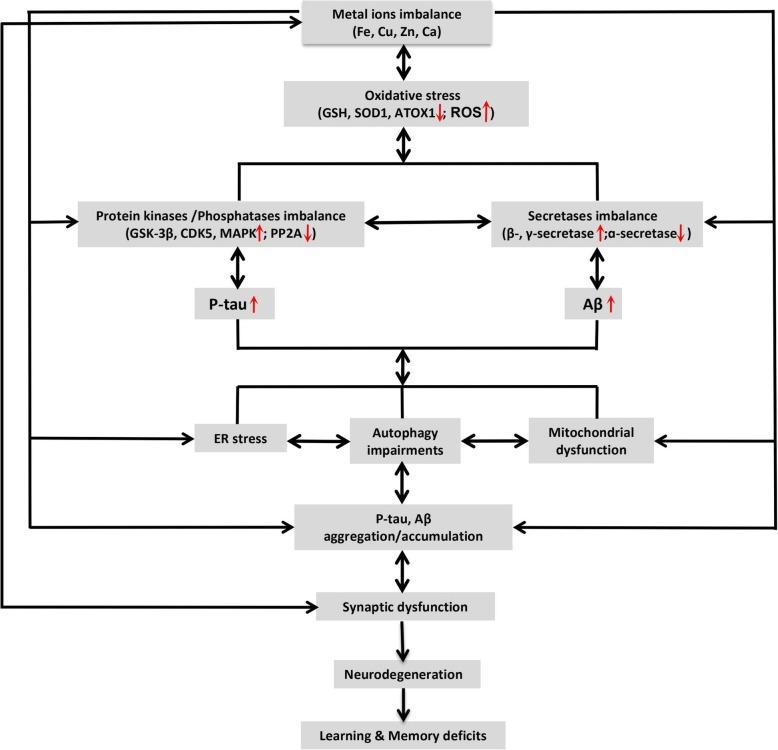
Background: The homeostasis of metal ions, such as iron, copper, zinc and calcium, in the brain is crucial for maintaining normal physiological functions. Studies have shown that imbalance of these metal ions in the brain is closely related to the onset and progression of Alzheimer's disease (AD), the most common neurodegenerative disorder in the elderly. Main body: Erroneous deposition/distribution of the metal ions in different brain regions induces oxidative stress. The metal ions imbalance and oxidative stress together or independently promote amyloid-β (Aβ) overproduction by activating β- or γ-secretases and inhibiting α-secretase, it also causes tau hyperphosphorylation by activating protein kinases, such as glycogen synthase kinase-3β (GSK-3β), cyclin-dependent protein kinase-5 (CDK5), mitogen-activated protein kinases (MAPKs), etc., and inhibiting protein phosphatase 2A (PP2A). The metal ions imbalances can also directly or indirectly disrupt organelles, causing endoplasmic reticulum (ER) stress; mitochondrial and autophagic dysfunctions, which can cause or aggravate Aβ and tau aggregation/accumulation, and impair synaptic functions. Even worse, the metal ions imbalance-induced alterations can reversely exacerbate metal ions misdistribution and deposition. The vicious cycles between metal ions imbalances and Aβ/tau abnormalities will eventually lead to a chronic neurodegeneration and cognitive deficits, such as seen in AD patients. Conclusion: The metal ions imbalance induces Aβ and tau pathologies by directly or indirectly affecting multiple cellular/subcellular pathways, and the disrupted homeostasis can reversely aggravate the abnormalities of metal ions transportation/deposition. Therefore, adjusting metal balance by supplementing or chelating the metal ions may be potential in ameliorating AD pathologies, which provides new research directions for AD treatment.
Overview
The claims and statistics of this paper haven’t been checked yet.
Run the check — free, no account needed. It reads the open-access text and checks the sources it cites.
Integrity signals
Registry
Cites
Statistics
Figures
Verification
Claims the paper makes
The claims and statistics of this paper haven’t been checked yet.
Run the check — free, no account needed. It reads the open-access text and checks the sources it cites.
Claims other papers make about this one
Each is checked against this paper’s own text: does it say what the citing paper says it does?
The source backs part of the claim, not all of it — or backs it for a different population, condition or comparison.
In the citing paper
“However, in AD, this finely tuned balance is disrupted. Misdistribution and pathological accumulation of these metals occur in Aβ plaques and NFTs, where they promote protein aggregation, oxidative stress, and neurotoxicity [107].”
From Toward a Unified Framework in Molecular Neurobiology of Alzheimer’s Disease: Revisiting the Pathophysiological Hypotheses (2026) · cites this paper as [107]
Experimental — accuracy not yet measuredIn the citing paper
“This protein known as the BACE performs proteolysis by generating a soluble fragment in the extracellular space known as “soluble APPβ” and an additional fragment bound to the plasma membrane, CTFβ peptide that undergoes proteolysis yet again by γ-secretase to generate toxic neuropeptides Aβ with 40–43 amino acids, finally causing the amyloid plaques characteristic of AD [165,166,167].”
From Multi-Target Mechanisms of Phytochemicals in Alzheimer’s Disease: Effects on Oxidative Stress, Neuroinflammation and Protein Aggregation (2022) · cites this paper as [165]
In the citing paper
“The absence of Aβ in neurons may inhibit adequate chelation of metal ions and appropriate removal of O2-, resulting in an increased rather than a reduced oxidative stress.424”
From Amyloid β-based therapy for Alzheimer’s disease: Challenges, successes and future (2023) · cites this paper as [424]
Self-check
Percentages, sums and reported differences re-computed from the paper’s own numbers.
The self-check needs the paper’s full text.
Citations
Cites
The amyloid hypothesis of Alzheimer's disease at 25 years
Selkoe, D. J., & Hardy, J. (2016) · EMBO Molecular Medicine · doi:10.15252/emmm.201606210 · Cited by 6,164
Guidelines for the use and interpretation of assays for monitoring autophagy (3rd edition).
Klionsky, D. J., Abdelmohsen, K., Abe, A., Abedin, M. J., Abeliovich, H., Acevedo Arozena, A., Adachi, H., Adams, C. M., Adams, P. D., Adeli, K., et al. (2016) · Autophagy · doi:10.1080/15548627.2015.1100356 · Cited by 5,894
Methods in Mammalian Autophagy Research
Mizushima, N., Yoshimori, T., & Levine, B. (2010) · Cell · doi:10.1016/j.cell.2010.01.028 · Cited by 4,497
Guidelines for the use and interpretation of assays for monitoring autophagy
Klionsky, D. J., Abdalla, F. C., Abeliovich, H., Abraham, R. T., Acevedo-Arozena, A., Adeli, K., Agholme, L., Agnello, M., Agostinis, P., Aguirre-Ghiso, J. A., et al. (2012) · Autophagy · doi:10.4161/auto.19496 · Cited by 3,996
Oxidative stress and the amyloid beta peptide in Alzheimer’s disease
Cheignon, C., Tomas, M., Bonnefont-Rousselot, D., Faller, P., Hureau, C., & Collin, F. (2018) · Redox Biology · doi:10.1016/j.redox.2017.10.014 · Cited by 2,185
Preclinical Alzheimer’s Disease: Definition, Natural History, and Diagnostic Criteria
Dubois, B., Hampel, H., Feldman, H. H., Scheltens, P., Aisen, P., Andrieu, S., Bakardjian, H., Benali, H., Bertram, L., Blennow, K., et al. (2016) · Alzheimer's & Dementia · doi:10.1016/j.jalz.2016.02.002 · Cited by 1,925
Lysosomal calcium signalling regulates autophagy through calcineurin and TFEB
Medina, D. L., Paola, S. D., Peluso, I., Armani, A., Stefani, D. D., Venditti, R., Montefusco, S., Rosato, A. S., Prezioso, C., Forrester, A. R., et al. (2015) · Nature Cell Biology · doi:10.1038/ncb3114 · Cited by 1,452
Woods, A., Dickerson, K., Heath, R. B., Hong, S. P., Momcilovic, M., Johnstone, S. R., Carlson, M., & Carling, D. (2005) · Cell Metabolism · doi:10.1016/j.cmet.2005.06.005 · Cited by 1,418
Oxidative Stress and the Central Nervous System
Salim, S. (2016) · Journal of Pharmacology and Experimental Therapeutics · doi:10.1124/jpet.116.237503 · Cited by 1,268
Boland, B., Kumar, A., Lee, S., Platt, F. M., Wegiel, J., Yu, W. H., & Nixon, R. A. (2008) · Journal of Neuroscience · doi:10.1523/jneurosci.0800-08.2008 · Cited by 1,119
Cited by
Sorted by citations
Items 401–458 of 458
Chen, L., Sun, S.-L., Zhong, H.-Y., Wan, D., Feng, F., Huang, S., & Zhou, X. (2025) · Results in Chemistry · doi:10.1016/j.rechem.2025.102138
Mechanistic Understanding of the Anti-Alzheimer’s Agents with Computational Studies
Joshi, N., Chobe, S., G., S. N. K. R., & Alavala, R. R. (2025) · Springer eBooks · doi:10.1007/978-981-96-4154-3_20
Immunochemical Applications Utilizing Laser-Induced Breakdown Spectroscopy Detection
Zikmundová, E., Modlitbová, P., Pořízka, P., Farka, Z., Kuchynka, M., Novotný, K., & Kaiser, J. (2025) · Springer eBooks · doi:10.1007/978-3-031-85975-5_11
Zhang, Y., Ye, Z., Wang, Z., Shen, Z., Liu, J., Zhang, W., Zheng, C., Deng, K., Lu, L., Han, H., et al. (2025) · SSRN Electronic Journal · doi:10.2139/ssrn.5350601
The Aging Gut–Brain Axis: Effects of Dietary Polyphenols and Metal Exposure
Cao, L., Jha, S. K., Gupta, N., Chen, X., Soni, R., Yuan, L., Srivastava, R., & Chen, Z. (2025) · Chronic Diseases and Translational Medicine · doi:10.1002/cdt3.70026
Wan, C., Liu, X.-Q., Chen, M., Ma, H.-H., Wu, G.-L., Qiao, L.-J., Cai, Y.-F., & Zhang, S. (2024) · Figshare · doi:10.6084/m9.figshare.26562958
Gu, J., & Tian, Y. (2025) · International Joint Conference on Neural Networks (IJCNN) · doi:10.1109/ijcnn64981.2025.11228081
Endogenous lithium deficiency: a potential early contributor to Alzheimer’s disease onset
Feng, S., & Yang, L. (2026) · Neuroscience and Behavioral Physiology · doi:10.1007/s11055-025-01939-0
Ahmadi, M., Wittek, K., Rieger, H. S., Thomas, M. L., Hartmann, L., Besenius, P., & Seiffert, S. (2026) · Chemistry of Materials · doi:10.1021/acs.chemmater.5c02542
Salivary Metal Ions as Potential Biomarkers for Diabetes: An Observational Study
Ding, Z., Ming, J., Dai, H., Chen, L., Guo, B., Li, W., Zhao, X., Zhao, H., & Xu, H. Y. (2026) · International Journal of Dentistry · doi:10.1155/ijod/9224685
Zhang, J., Li, Y., Li, Y.-P., Xun, Q., Ma, Y., & Shi, X.-L. (2026) · Bioorganic Chemistry · doi:10.1016/j.bioorg.2026.109760
Singh, L. K., Singh, S. P., & Sharma, P. (2026) · Journal of Biomaterials Science Polymer Edition · doi:10.1080/09205063.2026.2644503
Neurobiological links between Alzheimer’s disease and reward system dysfunction
Harutyunyan, H. S., Minasyan, R., Kalueff, A. V., & Yenkoyan, K. B. (2026) · Neuroscience · doi:10.1016/j.neuroscience.2026.03.028
Peng, W., Chung, K. B., Al-Qazzaz, A., Straut, A., O’Banion, M. K., Lawrence, B. P., Dirksen, R. T., & Onukwufor, J. O. (2026) · bioRxiv (Cold Spring Harbor Laboratory) · doi:10.64898/2026.03.25.714217
Programmed cell death: a promising management for Alzheimer’s disease
Yang, Q., Ren, X., Jia, R., Zheng, L., Ou, R., Xu, Y., Luo, Y., Yang, G., & Wang, X. (2026) · APOPTOSIS · doi:10.1007/s10495-026-02330-1
Signatures épigénétiques de la maladie d'Alzheimer dans l'ADN libre circulant
Guemri, J. (2021) · theses.fr (ABES) · doi:10.70675/aa3cb199zc068z4b72zab7fz6deb0fe1de87
Yatoui, D. (2022) · theses.fr (ABES) · doi:10.70675/e3620ccez2ea7z43f2za0dcz257a72021b17
Zhang, Y., Hou, C., Xu, H., Qiu, Z., Yuan, R., Shao, W., Xue, X., Lin, J., Li, J., Zhang, H., et al. (2026) · Green Health · doi:10.3390/greenhealth2020010
Mathematical Modeling of Oxidative Stress in Alzheimer’s Disease: A Differential Equations Approach
Meteumba, L. G., & Yarahmadian, S. (2026) · Mathematics · doi:10.3390/math14081390 · Cited by 1
Singh, K., Priyadarshi, N., Goyal, B., Singhal, N. K., & Goyal, D. (2026) · Bioconjugate Chemistry · doi:10.1021/acs.bioconjchem.5c00649
Luo, M. H., Zhao, F., Wang, Y.-M., Bian, J., & Luo, Y. (2026) · Journal of Nanobiotechnology · doi:10.1186/s12951-026-04529-5
Exploring and Targeting the Connection of Iron and Copper Homeostasis to Neurodegenerative Diseases
Liu, X., Jia, L., Wu, K., Chen, M., Sun, J., Yang, C., Xu, C., Sun, J., Wang, J., & Dai, L. (2026) · MedComm · doi:10.1002/mco2.70766
Choi, S., Manivannan, R., Jayasudha, P., & Son, Y.-Α. (2026) · Journal of Fluorescence · doi:10.1007/s10895-026-04786-5
Chen, K., Feng, H., Chen, Q., Cui, J., & Yang, A. (2026) · Journal of Molecular Structure · doi:10.1016/j.molstruc.2026.146648
Sharma, S., Kumar, V. V. R., Arulsamy, S., Kumar, S., & Wadhwa, P. K. (2026) · Computers in Biology and Medicine · doi:10.1016/j.compbiomed.2026.111765
ATOX1 deficiency induces memory impairment via promoting cuproptosis in Alzheimer’s disease
Yu, H., Yi, H., Jia, D., Chen, J., Yuan, J.-Q., Geng, S., Wang, F., Yang, L., Gao, T.-L., Keyu-Zhang, et al. (2026) · Journal of Advanced Research · doi:10.1016/j.jare.2026.06.009
Zhi, J., Feng, H., Xue, Q., Pang, Z., Shen, R., Yang, A., & Kou, X. (2026) · European Journal of Medicinal Chemistry · doi:10.1016/j.ejmech.2026.119050
Costa, R. K. M., de Souza, F. R., Silva, R. D. S., Rey, N. A., & Pimentel, A. S. (2026) · ACS Chemical Neuroscience · doi:10.1021/acschemneuro.6c00057
Shandini, B., & Ilanchelian, M. (2026) · Journal of environmental chemical engineering · doi:10.1016/j.jece.2026.123995
Metal Binding to Tau Protein: Physiological and Pathological Relevance
Quintanar, L., Juarez-Romero, G. U., & Lopez-Herrera, G. R. (2026) · Biochemistry · doi:10.1021/acs.biochem.6c00323
Li, M., Zhao, Y., Xu, B., Wang, L., Luo, W., Tan, R., 张晓斌, & Jiang, H. (2026) · Fitoterapia · doi:10.1016/j.fitote.2026.107393
Heme–copper–Aβ mediated dopamine oxidation through self-sustaining redox cycling
Dey, C., Pal, P., Khan, A., & Dey, S. G. (2026) · Chemical Communications · doi:10.1039/d6cc03615e
Periyasamy, T. S., Sekar, N., & Lakshmanan, H. (2026) · Journal of Alzheimer s Disease · doi:10.1177/13872877261471812
Yu, G., Sun, D., Ni, F., Chang, M., Song, X., Liang, Y., Zhu, Z., Zhao, R., & Wang, K. (2026) · ACS Applied Nano Materials · doi:10.1021/acsanm.6c02473
Yi, M., Wang, L., Chen, Y., Li, J., Weng, X., Zhang, C., Chen, D., Liu, L., Vasyutinskii, O. S., Lin, F., et al. (2026) · Applied Physics Reviews · doi:10.1063/5.0337865
Environmental determinants of neurotoxicity: role of heavy metals in neurological disorders
Mandal, S., Dipa, P., Neha, Chatterjee, D., & Maparu, K. (2026) · Frontiers in Neurology · doi:10.3389/fneur.2026.1867856
Foundations of Brain Metallomics
Grabrucker, A. M. (2026) · Neuromethods · doi:10.1007/978-1-0716-5468-2_1
Boşgelmez, İ. İ., Mertaş, B., & Deliser, H. (2026) · Frontiers in Toxicology · doi:10.3389/ftox.2026.1871830
Solute carrier membrane transporters: emerging targets in CNS disorders
Law, Y. K., Glück, S., Girardi, E., Bensimon, A., Angermayr, S. A., & Superti‐Furga, G. (2026) · Nature Reviews Drug Discovery · doi:10.1038/s41573-026-01513-4
Construction, application and challenges of metal–rGO composite SERS substrates: a review
Tong, Q., Liu, A., Miao, X., Xie, Y., Hu, X. J., Ren, Y., Wu, A., & Lin, J. (2026) · Nanoscale · doi:10.1039/d6nr02189a
Irving, R., Dasari, A., Duke, S., Wi, S., Hughes, R. M., Spuches, A. M., & Lim, K. H. (2026) · Biochemistry · doi:10.1021/acs.biochem.6c00448
Huang, L., Cheng, P., Liu, G., Xiang, Y., Hong, Z., & Le, W. (2026) · MedComm · doi:10.1002/mco2.71017
Barwiołek, M., Mandal, D., Tepliakova, I., Muzioł, T. M., Kaczmarek‐Kędziera, A., Jankowska, D., & Viter, R. (2026) · Journal of Photochemistry and Photobiology A Chemistry · doi:10.1016/j.jphotochem.2026.117704
Sivamaruthi, B. S., Fukngoen, P., Chaiyasut, C., Kesika, P., Nallasamy, P., Suganthy, N., & Khongtan, S. (2026) · Scientia Pharmaceutica · doi:10.3390/scipharm94040091
Qin, Q., Yan, Q., Zhu, K., Miao, J., Yang, M., Wu, Z., Fan, C., Jiang, P., Wu, G., & Wang, Q. (2026) · Molecules · doi:10.3390/molecules31203681
Liu, J., Wyatt‐Johnson, S. K., Chen, J., Chen, J., Liu, Z., Wu, H., Feng, L., Brutkiewicz, R. R., & Wang, N. (2026) · NeuroImage · doi:10.1016/j.neuroimage.2026.122276
Yang, J., Lou, F., Sun, W., Li, M., Su, L., Wang, Y., 李平安, & Su, J. (2026) · Pharmacological Research · doi:10.1016/j.phrs.2026.109690
Wang, Y., Cheng, J., Liu, T., Li, S., Wang, Q., Shao, K., Yang, G., & Li, P. (2026) · Nanomaterials · doi:10.3390/nano16211355
Developing precision nanoparticle-based drug delivery systems for Alzheimer's disease therapy
Shan, Q., Zheng, W., Yao, W., Bai, Y., Ding, W., Wang, J., & Bai, F. (2026) · Materials Today Bio · doi:10.1016/j.mtbio.2026.103789
Metadata
- Authors
- Wang, L., Yin, Y.-L., Liu, X.-Z., Shen, P., Zheng, Y.-G., Lan, X.-R., Lu, C.-B., & Wang, J.-Z.
- Affiliations
- Henan Medical University (CN)
- Huazhong University of Science and Technology (CN)
- Corresponding author
- Wang, Jian-Zhi
- Venue
- Translational Neurodegeneration
- Published
- 2020-04-03
- Volume
- 9
- Issue
- 1
- Pages
- 10-10
- ISSN
- 2047-9158 (ISSN-L)
- PMC
- PMC7119290
- OpenAlex
- W3015096020
- Cited by
- 454
- References
- 140
- Citations by year
- 2026: 61 · 2025: 86 · 2024: 93 · 2023: 84 · 2022: 66 · 2021: 48 · 2020: 15
- FWCI
- 6.91
- Type
- journal article
- Language
- en
- Open access
- gold
- doi.org
- Locations
- Translational Neurodegeneration (publishedVersion, cc-by)
- PubMed Central (publishedVersion, cc-by)
- PubMed (publishedVersion)
- DOAJ (DOAJ: Directory of Open Access Journals) (submittedVersion, cc-by-sa)
- Funders
- Science and Technology Department of Henan Province (182102310209)
- National Natural Science Foundation of China (81771517, U1804197)
- Topics
- Life Sciences › Neuroscience › Cellular and Molecular Neuroscience › Alzheimer's disease research and treatments
- Health Sciences › Nursing › Nutrition and Dietetics › Trace Elements in Health
- Health Sciences › Medicine › Psychiatry and Mental health › Dementia and Cognitive Impairment Research
- Keywords
- Alzheimer's disease, metal homeostasis, iron, copper, zinc, calcium, oxidative stress, amyloid-beta, tau hyperphosphorylation, GSK3β, cyclin-dependent kinase 5, mitogen-activated protein kinase, protein phosphatase 2A, endoplasmic reticulum stress, mitochondrial dysfunction, autophagy, synaptic dysfunction, metal chelation, metal supplementation
- MeSH terms
- Alzheimer Disease, Brain Chemistry, Humans, Ions, Metals, Amyloid beta-Peptides, tau Proteins
About these checks
Registry, retraction, Cites and statistics results are computed, not judged, with one exception: a printed reference that no index lists is read once by a model before it counts as a citation error. Claims are extracted by a model and kept only when their quote appears verbatim in the text; each cited source is then checked, with a model’s help, for whether it says what the claim relies on. Those verdicts can be wrong — read the claim’s quote and the cited source before relying on one.
Statistics and arithmetic are recomputed, not judged.
Confidence bands are shown only for fields calibrated on our annotated test set. None is calibrated yet, so no band is shown.
What counts as a claim ›How we measure confidence ›How we check this ›
Are you an author, or do you see a problem with this page? Request a review
