

The DOI matches its Crossref record; 139 of the 140 references it cites were found in a registry or an index.
Current understanding of metal ions in the pathogenesis of Alzheimer’s disease
Open accessAbstract
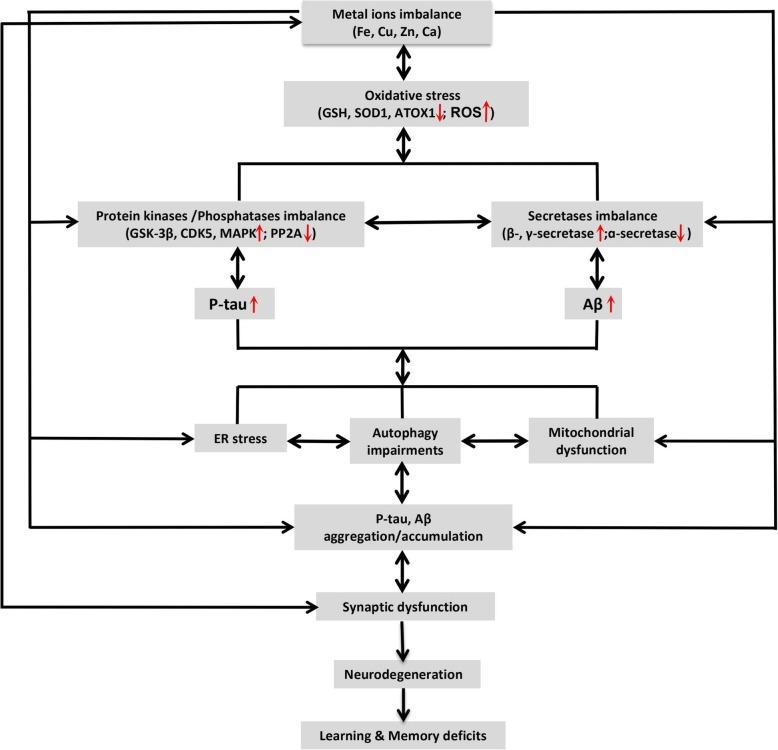
Background: The homeostasis of metal ions, such as iron, copper, zinc and calcium, in the brain is crucial for maintaining normal physiological functions. Studies have shown that imbalance of these metal ions in the brain is closely related to the onset and progression of Alzheimer's disease (AD), the most common neurodegenerative disorder in the elderly. Main body: Erroneous deposition/distribution of the metal ions in different brain regions induces oxidative stress. The metal ions imbalance and oxidative stress together or independently promote amyloid-β (Aβ) overproduction by activating β- or γ-secretases and inhibiting α-secretase, it also causes tau hyperphosphorylation by activating protein kinases, such as glycogen synthase kinase-3β (GSK-3β), cyclin-dependent protein kinase-5 (CDK5), mitogen-activated protein kinases (MAPKs), etc., and inhibiting protein phosphatase 2A (PP2A). The metal ions imbalances can also directly or indirectly disrupt organelles, causing endoplasmic reticulum (ER) stress; mitochondrial and autophagic dysfunctions, which can cause or aggravate Aβ and tau aggregation/accumulation, and impair synaptic functions. Even worse, the metal ions imbalance-induced alterations can reversely exacerbate metal ions misdistribution and deposition. The vicious cycles between metal ions imbalances and Aβ/tau abnormalities will eventually lead to a chronic neurodegeneration and cognitive deficits, such as seen in AD patients. Conclusion: The metal ions imbalance induces Aβ and tau pathologies by directly or indirectly affecting multiple cellular/subcellular pathways, and the disrupted homeostasis can reversely aggravate the abnormalities of metal ions transportation/deposition. Therefore, adjusting metal balance by supplementing or chelating the metal ions may be potential in ameliorating AD pathologies, which provides new research directions for AD treatment.
Overview
The claims and statistics of this paper haven’t been checked yet.
Run the check — free, no account needed. It reads the open-access text and checks the sources it cites.
Integrity signals
Registry
Cites
Statistics
Figures
Verification
Claims the paper makes
The claims and statistics of this paper haven’t been checked yet.
Run the check — free, no account needed. It reads the open-access text and checks the sources it cites.
Claims other papers make about this one
Each is checked against this paper’s own text: does it say what the citing paper says it does?
The source backs part of the claim, not all of it — or backs it for a different population, condition or comparison.
In the citing paper
“However, in AD, this finely tuned balance is disrupted. Misdistribution and pathological accumulation of these metals occur in Aβ plaques and NFTs, where they promote protein aggregation, oxidative stress, and neurotoxicity [107].”
From Toward a Unified Framework in Molecular Neurobiology of Alzheimer’s Disease: Revisiting the Pathophysiological Hypotheses (2026) · cites this paper as [107]
Experimental — accuracy not yet measuredIn the citing paper
“This protein known as the BACE performs proteolysis by generating a soluble fragment in the extracellular space known as “soluble APPβ” and an additional fragment bound to the plasma membrane, CTFβ peptide that undergoes proteolysis yet again by γ-secretase to generate toxic neuropeptides Aβ with 40–43 amino acids, finally causing the amyloid plaques characteristic of AD [165,166,167].”
From Multi-Target Mechanisms of Phytochemicals in Alzheimer’s Disease: Effects on Oxidative Stress, Neuroinflammation and Protein Aggregation (2022) · cites this paper as [165]
In the citing paper
“The absence of Aβ in neurons may inhibit adequate chelation of metal ions and appropriate removal of O2-, resulting in an increased rather than a reduced oxidative stress.424”
From Amyloid β-based therapy for Alzheimer’s disease: Challenges, successes and future (2023) · cites this paper as [424]
Self-check
Percentages, sums and reported differences re-computed from the paper’s own numbers.
The self-check needs the paper’s full text.
Citations
Cites
The amyloid hypothesis of Alzheimer's disease at 25 years
Selkoe, D. J., & Hardy, J. (2016) · EMBO Molecular Medicine · doi:10.15252/emmm.201606210 · Cited by 6,164
Guidelines for the use and interpretation of assays for monitoring autophagy (3rd edition).
Klionsky, D. J., Abdelmohsen, K., Abe, A., Abedin, M. J., Abeliovich, H., Acevedo Arozena, A., Adachi, H., Adams, C. M., Adams, P. D., Adeli, K., et al. (2016) · Autophagy · doi:10.1080/15548627.2015.1100356 · Cited by 5,894
Methods in Mammalian Autophagy Research
Mizushima, N., Yoshimori, T., & Levine, B. (2010) · Cell · doi:10.1016/j.cell.2010.01.028 · Cited by 4,497
Guidelines for the use and interpretation of assays for monitoring autophagy
Klionsky, D. J., Abdalla, F. C., Abeliovich, H., Abraham, R. T., Acevedo-Arozena, A., Adeli, K., Agholme, L., Agnello, M., Agostinis, P., Aguirre-Ghiso, J. A., et al. (2012) · Autophagy · doi:10.4161/auto.19496 · Cited by 3,996
Oxidative stress and the amyloid beta peptide in Alzheimer’s disease
Cheignon, C., Tomas, M., Bonnefont-Rousselot, D., Faller, P., Hureau, C., & Collin, F. (2018) · Redox Biology · doi:10.1016/j.redox.2017.10.014 · Cited by 2,185
Preclinical Alzheimer’s Disease: Definition, Natural History, and Diagnostic Criteria
Dubois, B., Hampel, H., Feldman, H. H., Scheltens, P., Aisen, P., Andrieu, S., Bakardjian, H., Benali, H., Bertram, L., Blennow, K., et al. (2016) · Alzheimer's & Dementia · doi:10.1016/j.jalz.2016.02.002 · Cited by 1,925
Lysosomal calcium signalling regulates autophagy through calcineurin and TFEB
Medina, D. L., Paola, S. D., Peluso, I., Armani, A., Stefani, D. D., Venditti, R., Montefusco, S., Rosato, A. S., Prezioso, C., Forrester, A. R., et al. (2015) · Nature Cell Biology · doi:10.1038/ncb3114 · Cited by 1,452
Woods, A., Dickerson, K., Heath, R. B., Hong, S. P., Momcilovic, M., Johnstone, S. R., Carlson, M., & Carling, D. (2005) · Cell Metabolism · doi:10.1016/j.cmet.2005.06.005 · Cited by 1,418
Oxidative Stress and the Central Nervous System
Salim, S. (2016) · Journal of Pharmacology and Experimental Therapeutics · doi:10.1124/jpet.116.237503 · Cited by 1,268
Boland, B., Kumar, A., Lee, S., Platt, F. M., Wegiel, J., Yu, W. H., & Nixon, R. A. (2008) · Journal of Neuroscience · doi:10.1523/jneurosci.0800-08.2008 · Cited by 1,119
Cited by
Sorted by citations
Items 301–400 of 458
Chu, Z., Chen, Y., Xie, D., Song, C., Lin, Y., Qin, T., Zhai, Z., Cao, Z., Xu, Y., & Sun, T. (2025) · Journal of Ethnopharmacology · doi:10.1016/j.jep.2025.119879 · Cited by 5
Wang, Y., Gu, C., & Ewing, A. G. (2021) · QRB Discovery · doi:10.1017/qrd.2021.10 · Cited by 4
Crosstalk between NLRP3 inflammasome and calpain in Alzheimer's disease
Mamsa, R., Prabhavalkar, K. S., & Bhatt, L. K. (2023) · European Journal of Neuroscience · doi:10.1111/ejn.16139 · Cited by 4
Nguyen, H. T., Giang, N. T. Q., Hà, N. V., Phương, H. T., Giang, L. N. T., Anh, N. T., Cham, B. T., Huy, L. D., Anh, D. T. T., Kiệm, P. V., et al. (2023) · Natural Product Communications · doi:10.1177/1934578x231201037 · Cited by 3
Wozniczka, C. M., & Weaver, D. F. (2026) · NeuroSci · doi:10.3390/neurosci7010013 · Cited by 3
Liu, J., Qiao, S., Gong, W., Liu, M., Qifeng, J., Zhang, B., Hui, W., Liu, D., & Zhou, S. Y. (2026) · Chemical Engineering Journal · doi:10.1016/j.cej.2026.173194 · Cited by 3
Targeted nanomedicine strategies for Alzheimer’s disease therapy
Ardah, M. T., Yaseen, B. M., Malathi, H., Ray, S., Thyagarajan, R., Shankhyan, A., Eshmetov, R., Ataullaev, Z., & Mishra, M. K. (2026) · Discover Nano · doi:10.1186/s11671-026-04763-8 · Cited by 3
Oxidative Stress and Metals in Alzheimer’s Disease
Fathima, S. A., Maurya, R., & Naqvi, S. (2023) · Springer eBooks · doi:10.1007/978-981-99-6038-5_2 · Cited by 5
Liu, Z., Zhang, X., Wang, P., Hong, M.-H., Yan, X., Qi, X., Zhao, Q., Chen, Z., Nie, H., Li, H., et al. (2025) · Genomics Proteomics & Bioinformatics · doi:10.1093/gpbjnl/qzaf007 · Cited by 3
Karakaya, A., Çevik, U. A., Kaya, B., Çi̇ftci̇, B., Necip, A., Işık, M., Beydemir, Ş., Özkay, Y., & Kaplancıklı, Z. A. (2025) · ChemistryOpen · doi:10.1002/open.202500305 · Cited by 3
Molecular Mechanisms and Aspects on the Role of Neuropeptide Y as a Zn2+ and Cu2+ Chelator
Ben-Shushan, S., & Miller, Y. (2020) · Inorganic Chemistry · doi:10.1021/acs.inorgchem.0c03350 · Cited by 3
Mocanu, C. S., Darie‐Ion, L., Petre, B. A., Grădinaru, V. R., & Drochioiu, G. (2022) · Journal of King Saud University - Science · doi:10.1016/j.jksus.2022.102184 · Cited by 3
Cao, T. H. M., Le, A. P. H., Tran, T. T., Huynh, V. K., Pham, B. H., Le, T., Nguyen, Q. L., Tran, T. C., Tong, T. M., Than, T. H. N., et al. (2023) · Frontiers in Molecular Neuroscience · doi:10.3389/fnmol.2023.1308610 · Cited by 3
Chen, L., Hu, Y., Cheng, Y., & Wang, H. (2024) · Nano Letters · doi:10.1021/acs.nanolett.4c03275 · Cited by 4
Photothermal imaging of cellular responses to glucose deprivation
Miyazaki, J., Wagatsuma, R., & Okamoto, K. (2025) · RSC Chemical Biology · doi:10.1039/d4cb00269e · Cited by 3
Li, J., Tao, L., Zhou, Y., Zhu, Y., Li, C., Pan, Y., Yao, P., Qian, X., & Liu, J. (2025) · PLoS ONE · doi:10.1371/journal.pone.0317915 · Cited by 3
Neupane, D., Santos-Fernandez, M., Fernandez-Lima, F. A., & Meier, K. K. (2025) · Biochemistry · doi:10.1021/acs.biochem.5c00012 · Cited by 3
Brain tissue electrical conductivity as a promising biomarker for dementia assessment using MRI
Chu, J., Yao, J., Li, Z., Li, J., Zhang, Y., Liu, C., He, H., Li, B., & Wei, H. (2025) · Alzheimer s & Dementia · doi:10.1002/alz.70270 · Cited by 4
Surgical advances in the treatment of Alzheimer's disease: A comprehensive review
Xie, F., Ye, Y., Hao, J., Liu, H., Richard, S. A., & Sen, H. (2025) · Journal of Alzheimer s Disease · doi:10.1177/13872877251364397 · Cited by 3
Blood Gene Expression of Zinc Transporters as Biological Indicators of Zinc Nutrition
Reis, B. Z., Sena‐Evangelista, K. C. M., & Pedrosa, L. F. C. (2022) · Biomarkers in disease · doi:10.1007/978-3-031-07389-2_28 · Cited by 3
Chen, S., Chang, Y., Li, L., Acosta, D. M., Morrison, C. T., Wang, C., Julian, D. L., Hester, M. E., Serrano, G. E., Beach, T. G., et al. (2021) · SSRN Electronic Journal · doi:10.21203/rs.3.rs-855234/v1 · Cited by 3
Surface engineered nano architectonics: An evolving paradigm for tackling Alzheimer's disease
Negi, M., Amulya, E., Phatale, V., Abraham, N., Hedaoo, A., Srinivasarao, D. A., & Srivastava, S. K. (2024) · Life Sciences · doi:10.1016/j.lfs.2024.123155 · Cited by 2
Computer-aided Drug Design for Alzheimer's Disease: Recent Advancements and Future Perspectives
Rohilla, S., & Goyal, G. (2025) · Current Topics in Medicinal Chemistry · doi:10.2174/0115680266343814250713100224 · Cited by 2
Decoding physical environment's role in protein phase transition
Ge, W., & Yin, D. (2025) · Advances in Colloid and Interface Science · doi:10.1016/j.cis.2025.103643 · Cited by 2
Influence of Rosmarinic Acid on Zinc(II)–Amyloid Beta Coordination
Kola, A., & Valensin, D. (2025) · European Journal of Inorganic Chemistry · doi:10.1002/ejic.202500334 · Cited by 2
Vitamin deficiencies and Alzheimer’s disease: evidence and implications for supplementation
Miteva, M. T., Laurenti, D., Mattioli, R., Risola, D. D., Mariano, A., & Mosca, L. N. (2026) · Frontiers in Nutrition · doi:10.3389/fnut.2026.1676497 · Cited by 2
Sharmah, H., Ahmed, L. A., Kemisetti, D., Kumar, S., Samanthula, K. S., Panigrahy, U. P., & Ghosh, N. S. (2026) · Molecular Diversity · doi:10.1007/s11030-026-11503-8 · Cited by 2
Zhao, R., Guo, M., Yang, F., Yan, Y., Tian, D., Deng, L., Wang, Q. Q., & Xie, M. (2026) · Journal of Materials Chemistry B · doi:10.1039/d6tb00201c · Cited by 2
Jegamohan, S., Jafari, M., Lauzon, M.-A., van de Ven, T. G. M., Bourgault, S., & Gaudreault, R. (2026) · Next Materials · doi:10.1016/j.nxmate.2026.102062 · Cited by 2
Zhu, G., Li, X., Yang, J., He, Y., Mi, J., Tang, L., & Sang, Z. (2021) · Medicinal Chemistry Research · doi:10.1007/s00044-021-02786-7 · Cited by 2
Computational design of rasagiline derivatives: Searching for enhanced antioxidant capability
Reina, M., Guzmán‐López, E. G., & Galano, A. (2022) · International Journal of Quantum Chemistry · doi:10.1002/qua.27011 · Cited by 3
Linking copper and neurotoxic activities to the CNS
Santos, G., Ávila-Rodriguez, M., Rubio, É. P., Galembeck, E., & Borges, J. M. P. (2023) · Elsevier eBooks · doi:10.1016/b978-0-323-89835-5.00035-1 · Cited by 2
D’Angiolini, S., Basile, M. S., Mazzon, E., & Gugliandolo, A. (2023) · International Journal of Molecular Sciences · doi:10.3390/ijms241813924 · Cited by 2
Improving Clinical Trials of Antioxidants in Alzheimer’s Disease
Daly, T. P. (2023) · Journal of Alzheimer s Disease · doi:10.3233/jad-230308 · Cited by 2
Chi, P., Ngo, T. C., Nguyen, T. H. Q., & Hải, L. T. H. (2023) · Journal of Fluorescence · doi:10.1007/s10895-023-03477-9 · Cited by 2
Ferroptosis in the Pathogenesis of Alzheimer’s Disease: The New Evidence for Validation of FAB Model
Aghajanov, M. I., Harutyunyan, H. S., Khamperyan, A., Karapetyan, G. A., Fereshetyan, K., & Yenkoyan, K. B. (2023) · Neurochemical Journal · doi:10.1134/s1819712423040049 · Cited by 2
Huang, C.-J., Ho, S.-Y., Wu, S., Wang, Y., & Dong, G. (2024) · Journal of the Taiwan Institute of Chemical Engineers · doi:10.1016/j.jtice.2024.105570 · Cited by 2
Revisiting the focal role of endostatin and environmental factors in Alzheimer’s disease
Behl, T., Dahim, M. A., & Aleya, L. (2024) · Environmental Science and Pollution Research · doi:10.1007/s11356-024-34113-z · Cited by 2
Zhao, L., Li, B., & Zheng, L. (2024) · Chemistry & Biodiversity · doi:10.1002/cbdv.202401548 · Cited by 2
Selenium and Episodic Memory: The Moderating Role of Apolipoprotein E ε4
Kim, S. G., Keum, M., Choe, Y. M., Suh, G., Lee, B. C., Kim, H. S., Lee, J. H., Hwang, J., Yi, D., & Kim, J. W. (2025) · Nutrients · doi:10.3390/nu17030595 · Cited by 3
Bacchella, C., Novellini, S., Miotto, E., Nicolis, S., Monzani, E., & Dell’Acqua, S. (2025) · ChemPlusChem · doi:10.1002/cplu.202500304 · Cited by 1
Metal Ions-Mediated Oxidative Stress in Alzheimer’s Disease and Chelation Therapy
Yeo, D., Choi, T. G., & Kim, S. S. (2021) · Biochemistry · doi:10.5772/intechopen.99690 · Cited by 2
Prachayasittikul, V., Pingaew, R., Prachayasittikul, S., & Prachayasittikul, V. (2022) · Heterocycles · doi:10.3987/rev-22-sr(r)6 · Cited by 2
Crnich, E., Sanchez, E., Havens, M. A., & Kissel, D. S. (2023) · JBIC Journal of Biological Inorganic Chemistry · doi:10.1007/s00775-023-02013-1 · Cited by 2
Exploration of Lycorine and Copper(II)’s Association with the N-Terminal Domain of Amyloid β
Kola, A., Vigni, G., & Valensin, D. (2023) · Inorganics · doi:10.3390/inorganics11110443 · Cited by 2
Therapeutic approaches in proteinopathies
Nabi‐Afjadi, M., Dabirmanesh, B., & Uversky, V. N. (2024) · Progress in molecular biology and translational science · doi:10.1016/bs.pmbts.2024.03.008 · Cited by 2
Etiology and treatment challenges for neurodegenerative disorders
Wankhede, N. L., Kale, M. B., Shende, P. V., Ratne, N., Taksande, B. G., Upaganlawar, A. B., Umekar, M. J., & Magrulkar, S. V. (2024) · Elsevier eBooks · doi:10.1016/b978-0-443-23841-3.00001-7 · Cited by 3
Tryptanthrin Analogs Substoichiometrically Inhibit Seeded and Unseeded Tau4RD AggregationPreprint
James, E. I., Baggett, D. W., Chang, E., Schachter, J. B., Nixey, T. E., Choi, K., Guttman, M., & Nath, A. (2024) · eLife · doi:10.7554/elife.98227.1 · Cited by 2
Yu, J., Li, X., Qi, X., Ding, Z., Su, S., Yu, L., Zhou, L., & Li, Y. (2024) · Scientific Reports · doi:10.1038/s41598-024-62986-0 · Cited by 1
Dual-emission Si dots-based sensing array for identification of metal ions
Mao, G., Zeng, Y., Ding, G., Qiu, C., Dai, J., Wan, Y., & Ma, Y. (2024) · Spectrochimica Acta Part A Molecular and Biomolecular Spectroscopy · doi:10.1016/j.saa.2024.125500 · Cited by 1
Hurdles and Strategies in Treating Alzheimer’s Disease
Qureshi, T., Desale, S. E., Chidambaram, H., & Chinnathambi, S. (2024) · Springer eBooks · doi:10.1007/978-981-96-0259-9_6 · Cited by 1
Cho, J., Bae, S., Jeon, J., Transfeld, J. L., Lee, C., Nott, A., Gao, F., & Seo, J. (2025) · iScience · doi:10.1016/j.isci.2025.112446 · Cited by 1
Photobiomodulation Ameliorates Neuronal Damage in an Amyloid-Beta Induced Rat Model
Li, N., Liu, N., Ye, Y., Shi, H., Shi, J., Luo, G., Guo, J., Liu, Y., & Chen, H. (2025) · IEEE Journal of Selected Topics in Quantum Electronics · doi:10.1109/jstqe.2025.3564366 · Cited by 1
Multifunctional molecular agent for tau-targeted combinational therapy of Alzheimer’s disease
Wu, J., Chai, K., Tu, Y., Fang, K., Shi, S., Hu, X., Liu, J., & Yao, T. (2025) · Journal of Biological Chemistry · doi:10.1016/j.jbc.2025.110583 · Cited by 1
Childhood exposure to heavy metals and long-term neurodevelopmental effects
Patel, M., & Kumar, P. (2025) · Elsevier eBooks · doi:10.1016/b978-0-443-36575-1.00016-9 · Cited by 1
Bagrel, M., Hureau, C., & Falcone, E. (2025) · Inorganic Chemistry · doi:10.1021/acs.inorgchem.5c03352 · Cited by 1
Mousavi, M. A., Salarvandian, S., Rafiee, S., Mohammadi, M., Khodagholi, F., & Javadpour, P. (2025) · BioMetals · doi:10.1007/s10534-025-00771-w · Cited by 1
Systematic Review and Meta-Analysis on Heavy Metals and Trace Elements in Mild Cognitive Impairment
Dong, Y., Ren, L., Tang, T., Zhang, X., Han, D., Luo, Y., Wang, L., Cui, Z., Ji, S. Y., Zheng, J., et al. (2025) · Biological Trace Element Research · doi:10.1007/s12011-025-04941-2 · Cited by 1
Lopes, F. B., Werner, T., Bagatin, I. A., Stark, H., & Fernandes, J. P. S. (2026) · ACS Chemical Neuroscience · doi:10.1021/acschemneuro.5c00803 · Cited by 1
Zhou, X., Zhang, L., Zhi, J., Zhao, L., Shen, R., Yang, A., & Kou, X. (2026) · Journal of Inorganic Biochemistry · doi:10.1016/j.jinorgbio.2026.113245 · Cited by 1
Yang, Y., Yang, F., Yao, M., Li, L., & Li, H. (2026) · Journal of Alzheimer s Disease · doi:10.1177/13872877261427028 · Cited by 1
Zhang, L., Zhou, X., Wu, J., Wang, H., Zhang, A., Shen, R., Yang, A., & Kou, X. (2026) · Journal of Molecular Structure · doi:10.1016/j.molstruc.2026.145940 · Cited by 1
The metabolic roots of memory loss: interlinking the Diabetes-Alzheimer’s hypothesis
Gupta, T., Kumar, S., Singh, T. G., & Singh, R. (2026) · Metabolic Brain Disease · doi:10.1007/s11011-026-01824-w · Cited by 1
Upadhyay, R., Kar, S., & Sevanan, M. (2026) · Frontiers in Chemical Biology · doi:10.3389/fchbi.2026.1836070 · Cited by 1
Blood Gene Expression of Zinc Transporters as Biological Indicators of Zinc Nutrition
Reis, B. Z., Sena‐Evangelista, K. C. M., & Pedrosa, L. F. C. (2022) · Biomarkers in disease · doi:10.1007/978-3-030-81304-8_28-1 · Cited by 1
Research progress of EGCG in the treatment of Alzheimer's disease
Meng, L. (2022) · International Journal of Frontiers in Medicine · doi:10.25236/ijfm.2022.040609 · Cited by 1
Natural Herbs Polishing Memory: Neuroprotection against Alzheimer's Disease
Thakkur, M., Dilnashin, H., & Keshri, P. K. (2023) · BENTHAM SCIENCE PUBLISHERS eBooks · doi:10.2174/9789815040197123010017 · Cited by 1
Alzheimer's disease therapeutics
Sang, Z., & Huang, L. (2023) · Elsevier eBooks · doi:10.1016/b978-0-443-18611-0.00031-0 · Cited by 1
Jiang, C., Zhang, B., Jiang, W., Liu, P., Kong, Y., Zhang, J., & Teng, W. (2024) · Heliyon · doi:10.1016/j.heliyon.2024.e27189 · Cited by 1
Nanotechnology at Work: Hydrogel Drug Delivery Architectures
Aher, S., Solanki, D., & Jain, A. (2024) · Journal of Drug Delivery and Therapeutics · doi:10.22270/jddt.v14i3.6465 · Cited by 1
Unveiling Nature’s Arsenal: Natural Sources for Drug Discovery in Alzheimer’s Disease
Remya, C., Aiswarya, N., & Dileep, K. V. (2024) · Springer eBooks · doi:10.1007/978-981-99-9183-9_13 · Cited by 1
Natural products from selected medicinal plants as potential therapeutics in Alzheimer's disease
Nair, P. G., Dixit, A. K., Dixit, D., Rotwar, D. S., & Sharma, M. K. (2024) · Studies in natural products chemistry · doi:10.1016/b978-0-443-15628-1.00008-8 · Cited by 1
Metallic Mysteries: Deciphering Their Contribution to Alzheimer’s Pathogenesis
Kalwaghe, S., Sadar, S., Porwal, P., Daswadkar, S. C., & Vyawahare, N. (2024) · International Journal of Pharmaceutical Sciences and Drug Research · doi:10.25004/ijpsdr.2024.160323
Çınar, S., & Sürücü, Ö. (2024) · Applied Organometallic Chemistry · doi:10.1002/aoc.7657 · Cited by 1
Kong, Y., Tai, Y., Chen, B., Li, C., Chen, H., & Shi, L. (2025) · Frontiers in Aging Neuroscience · doi:10.3389/fnagi.2025.1511881 · Cited by 1
Chen, Y., Ma, H., Jin, M., Zhang, S., Qu, S., Wang, G., & Aa, J. (2025) · Pharmaceuticals · doi:10.3390/ph18121871 · Cited by 1
Okafor, M., Schmitt, D., Falcone, E., Gasman, S., Raibaut, L., Hureau, C., Faller, P., & Vitale, N. (2026) · Inorganic Chemistry Frontiers · doi:10.1039/d6qi00862c · Cited by 1
Lysozyme protected Cu Nano-Cluster: A Photo Switch for the Selective Sensing of Iron (Fe2+)Preprint
Sebastian, A., Aarya, Sarangi, B. R., & Mojumdar, S. S. (2022) · ChemRxiv · doi:10.26434/chemrxiv-2022-kfchf
Jomehpour, D., Sheikhlary, S., Heydari, E., & Ara, M. H. M. (2022) · Research Square · doi:10.21203/rs.3.rs-2090375/v1
Balkrishna, A., Verma, S., Singh, S. K., & Arya, V. (2023) · European Journal of Neuroscience · doi:10.1111/ejn.16050
Controlo de Biometais no Contexto de Fármacos Multifuncionais para a Doença de Alzheimer
Santos, M. A., & Chaves, S. (2024) · Boletim da Sociedade Portuguesa de Química · doi:10.52590/m3.p708.a30002748
Tryptanthrin Analogs Substoichiometrically Inhibit Seeded and Unseeded Tau4RD AggregationPreprint
James, E. I., Baggett, D. W., Chang, E., Schachter, J. B., Nixey, T. E., Choi, K., Guttman, M., & Nath, A. (2024) · bioRxiv (Cold Spring Harbor Laboratory) · doi:10.1101/2024.02.02.578649
Pineal stones have an important function in Alzheimer’s diseasePreprint
Ge, W., Liu, H., Pan, M., Liu, X., Yang, Y., & Guo, B. (2024) · Research Square · doi:10.21203/rs.3.rs-4002326/v1
Li, J., Tao, L., Zhou, Y., Zhu, Y., Li, C., Pan, Y., & Liu, J. (2024) · Research Square · doi:10.21203/rs.3.rs-4221649/v1
Paper‐in‐Tip Bipolar Electrospray Mass Spectrometry for Real‐Time Chemical Reaction Monitoring
Li, Y., Zhu, L., Wu, X., Zhang, Z., Pu, R., Zheng, Y., & Zhang, Z. (2024) · Angewandte Chemie · doi:10.1002/ange.202318169
Geoenvironmental variables as causal cofactors of diseases of unknown etiology
Davies, T. C. (2024) · Elsevier eBooks · doi:10.1016/b978-0-12-818748-7.00013-7
Tryptanthrin Analogs Substoichiometrically Inhibit Seeded and Unseeded Tau4RD AggregationPreprint
James, E. I., Baggett, D. W., Chang, E., Schachter, J. B., Nixey, T. E., Choi, K., Guttman, M., & Nath, A. (2024) · eLife · doi:10.7554/elife.98227
Shin, G.-J., Choi, B.-H., Eum, H. H., Jo, A., Kim, N., Kang, H., Hong, D., Jang, J. J., Lee, H., Lee, Y. S., et al. (2024) · PLoS ONE · doi:10.1371/journal.pone.0301562
Unveiling the complexity of Alzheimer's disease: Introduction and its pathophysiology
Shabir, S., & Singh, M. P. (2024) · Elsevier eBooks · doi:10.1016/b978-0-443-15540-6.00012-4
Applications of Nanotechnology in Degenerative Disorders of the Brain
Lopes, D. H. J., Sisi, F. Y., Mehrabian, A., Davoudkhani, M., Noroozıan, M., Khawaja, A. M., & Heiss, J. D. (2024) · Springer eBooks · doi:10.1007/978-3-030-80662-0_30
Exploring the Connection Between Nanomaterials and Neurodegenerative Disorders
Nanda, S. S., & Yi, D. K. (2024) · Micromachines · doi:10.3390/mi15111382
Future Barriers and Possible Solutions with Recent Advances in Alzheimer’s Disease
Dwivedi, A. R., & Raghuveer, P. (2024) · Springer eBooks · doi:10.1007/978-981-96-0259-9_21
Metadata
- Authors
- Wang, L., Yin, Y.-L., Liu, X.-Z., Shen, P., Zheng, Y.-G., Lan, X.-R., Lu, C.-B., & Wang, J.-Z.
- Affiliations
- Henan Medical University (CN)
- Huazhong University of Science and Technology (CN)
- Corresponding author
- Wang, Jian-Zhi
- Venue
- Translational Neurodegeneration
- Published
- 2020-04-03
- Volume
- 9
- Issue
- 1
- Pages
- 10-10
- ISSN
- 2047-9158 (ISSN-L)
- PMC
- PMC7119290
- OpenAlex
- W3015096020
- Cited by
- 454
- References
- 140
- Citations by year
- 2026: 61 · 2025: 86 · 2024: 93 · 2023: 84 · 2022: 66 · 2021: 48 · 2020: 15
- FWCI
- 6.91
- Type
- journal article
- Language
- en
- Open access
- gold
- doi.org
- Locations
- Translational Neurodegeneration (publishedVersion, cc-by)
- PubMed Central (publishedVersion, cc-by)
- PubMed (publishedVersion)
- DOAJ (DOAJ: Directory of Open Access Journals) (submittedVersion, cc-by-sa)
- Funders
- Science and Technology Department of Henan Province (182102310209)
- National Natural Science Foundation of China (81771517, U1804197)
- Topics
- Life Sciences › Neuroscience › Cellular and Molecular Neuroscience › Alzheimer's disease research and treatments
- Health Sciences › Nursing › Nutrition and Dietetics › Trace Elements in Health
- Health Sciences › Medicine › Psychiatry and Mental health › Dementia and Cognitive Impairment Research
- Keywords
- Alzheimer's disease, metal homeostasis, iron, copper, zinc, calcium, oxidative stress, amyloid-beta, tau hyperphosphorylation, GSK3β, cyclin-dependent kinase 5, mitogen-activated protein kinase, protein phosphatase 2A, endoplasmic reticulum stress, mitochondrial dysfunction, autophagy, synaptic dysfunction, metal chelation, metal supplementation
- MeSH terms
- Alzheimer Disease, Brain Chemistry, Humans, Ions, Metals, Amyloid beta-Peptides, tau Proteins
About these checks
Registry, retraction, Cites and statistics results are computed, not judged, with one exception: a printed reference that no index lists is read once by a model before it counts as a citation error. Claims are extracted by a model and kept only when their quote appears verbatim in the text; each cited source is then checked, with a model’s help, for whether it says what the claim relies on. Those verdicts can be wrong — read the claim’s quote and the cited source before relying on one.
Statistics and arithmetic are recomputed, not judged.
Confidence bands are shown only for fields calibrated on our annotated test set. None is calibrated yet, so no band is shown.
What counts as a claim ›How we measure confidence ›How we check this ›
Are you an author, or do you see a problem with this page? Request a review
