

The skin microbiome: impact of modern environments on skin ecology, barrier integrity, and systemic immune programming
Open accessThe DOI matches its Crossref record; 180 of the 180 references it cites were found in a registry or an index.
Abstract
Skin barrier structure and function is essential to human health. Hitherto unrecognized functions of epidermal keratinocytes show that the skin plays an important role in adapting whole-body physiology to changing environments, including the capacity to produce a wide variety of hormones, neurotransmitters and cytokine that can potentially influence whole-body states, and quite possibly, even emotions. Skin microbiota play an integral role in the maturation and homeostatic regulation of keratinocytes and host immune networks with systemic implications. As our primary interface with the external environment, the biodiversity of skin habitats is heavily influenced by the biodiversity of the ecosystems in which we reside. Thus, factors which alter the establishment and health of the skin microbiome have the potential to predispose to not only cutaneous disease, but also other inflammatory non-communicable diseases (NCDs). Indeed, disturbances of the stratum corneum have been noted in allergic diseases (eczema and food allergy), psoriasis, rosacea, acne vulgaris and with the skin aging process. The built environment, global biodiversity losses and declining nature relatedness are contributing to erosion of diversity at a micro-ecological level, including our own microbial habitats. This emphasises the importance of ecological perspectives in overcoming the factors that drive dysbiosis and the risk of inflammatory diseases across the life course.
Overview
The claims and statistics of this paper haven’t been checked yet.
Free: it reads the open-access text and checks the first 5 claims that cite a source we can check. Create a free account to check every claim.
Integrity signals
Registry
Cites
Statistics
Figures
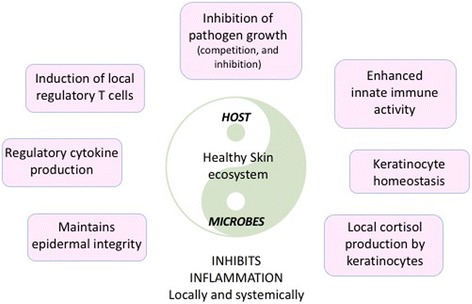
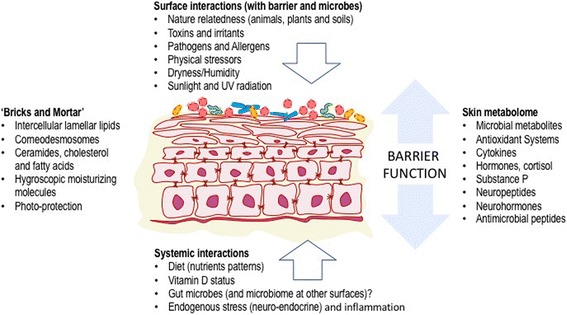
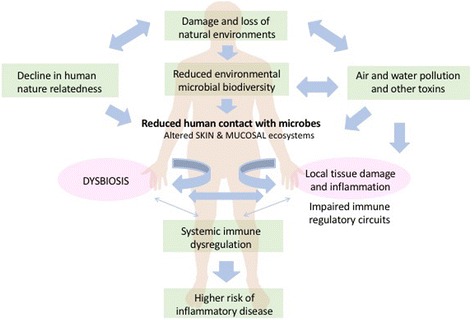
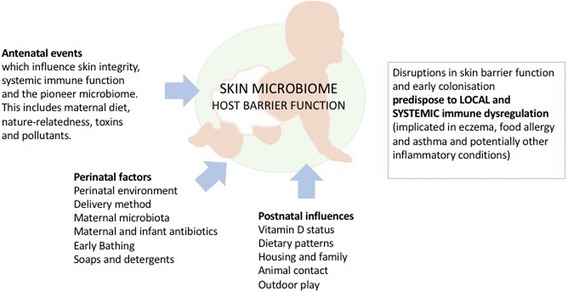
Verification
Claims the paper makes
The claims and statistics of this paper haven’t been checked yet.
Free: it reads the open-access text and checks the first 5 claims that cite a source we can check. Create a free account to check every claim.
Claims other papers make about this one
Each is checked against this paper’s own text: does it say what the citing paper says it does?
The cited source says what the claim attributes to it.
In the citing paper
“The decline of microbial diversity in urban and post‐industrial populations has been linked to immune dysregulation [87, 88, 89, 90].”
From Ignoring the planet: A critical blind spot for research on ageing (2025) · cites this paper as [88]
Self-check
Percentages, sums and reported differences re-computed from the paper’s own numbers.
The self-check needs the paper’s full text.
Citations
Cites
Dermyshi, E., Wang, Y., Yan, C., Hong, W., Qiu, G., Gong, X., & Zhang, T. (2017) · Neonatology · doi:10.1159/000454668 · Cited by 24,451
Ecosystems and Human Well-being: Synthesis
Assessment, M. E. (2005) · Island Press · doi:10.5281/zenodo.18167309 · Cited by 10,665
Dominguez-Bello, M. G., Costello, E. K., Contreras, M., Magris, M., Hidalgo, G., Fierer, N., & Knight, R. (2010) · Proceedings of the National Academy of Sciences · doi:10.1073/pnas.1002601107 · Cited by 4,774 · cited 4×
“Unlike vaginally delivered infants, who are colonized by bacteria from the vaginal community, infants born by C-section are dominantly colonized by Staphylococcus and other taxa reflecting maternal skin flora [83, 90].”
BackgroundInfluentialBacterial Community Variation in Human Body Habitats Across Space and Time
Costello, E. K., Lauber, C. L., Hamady, M., Fierer, N., Gordon, J. I., & Knight, R. (2009) · Science · doi:10.1126/science.1177486 · Cited by 3,231 · cited 1×
“indicating that environmental characteristics play a strong role in shaping skin bacterial communities at sebaceous sites such as the forehead [147].”
BackgroundGrice, E. A., & Segre, J. A. (2011) · Nature Reviews Microbiology · doi:10.1038/nrmicro2537 · Cited by 3,143
Atopic Dermatitis: Global Epidemiology and Risk Factors
Nutten, S. (2015) · Annals of Nutrition and Metabolism · doi:10.1159/000370220 · Cited by 3,055 · cited 1×
“While there is much focus in the gut microbiota in this context, we argue that the role of skin ecosystems may be equally important, especially as defects in skin integrity, namely early onset eczema, have increased in tandem with modernity [7].”
BackgroundWhitmee, S., Haines, A., Beyrer, C., Boltz, F., Capon, A. G., de Souza Dias, B. F., Ezeh, A., Frumkin, H., Gong, P., Head, P., et al. (2015) · The Lancet · doi:10.1016/s0140-6736(15)60901-1 · Cited by 2,998
Topographical and Temporal Diversity of the Human Skin Microbiome
Grice, E. A., Kong, H. H., Conlan, S., Deming, C. B., Davis, J., Young, A. C., Program, N. C. S., Bouffard, G. G., Blakesley, R. W., Murray, P. R., et al. (2009) · Science · doi:10.1126/science.1171700 · Cited by 2,953 · cited 2×
“In general, these studies have identified three broad microenvironment types with characteristic microbial communities: sebaceous areas (where Propionibacteria species and Staphylococci species predominate), moist areas (where Corynebacteria species predominate, with Staphylococci also present) and dry areas (with mix…”
BackgroundSudo, N., Chida, Y., Aiba, Y., Sonoda, J., Oyama, N., Yu, X., Kubo, C., & Koga, Y. (2004) · The Journal of Physiology · doi:10.1113/jphysiol.2004.063388 · Cited by 2,735 · cited 1×
“Many studies have shown that microbes, even when heat killed [63], have effects on innate immunity, and regulate gene expression in the brain [64], growth and glucose-insulin metabolism [65].”
BackgroundThe Placenta Harbors a Unique Microbiome
Aagaard, K., Ma, J., Antony, K. M., Ganu, R., Petrosino, J., & Versalovic, J. (2014) · Science Translational Medicine · doi:10.1126/scitranslmed.3008599 · Cited by 2,494 · cited 1×
“placental microbiome in healthy pregnancies [78], of likely influence to developing metabolic and immune responses in the fetus.”
Background
Research works printed but not linked: 1
- World Health Organisation Biodiversity and human health: a state of knowledge review 2015 Switzerland WHO
Cited by
Items 301–353 of 353
Leung, M. H. Y., Tong, X., Shen, Z., Du, S., Bastien, P., Appenzeller, B. M. R., Betts, R. J., Mezzache, S., Bourokba, N., Cavusoglu, N., et al. (2023) · Figshare · doi:10.6084/m9.figshare.23281075
Leung, M. H. Y., Tong, X., Shen, Z., Du, S., Bastien, P., Appenzeller, B. M. R., Betts, R. J., Mezzache, S., Bourokba, N., Cavusoglu, N., et al. (2023) · Figshare · doi:10.6084/m9.figshare.23281084
Leung, M. H. Y., Tong, X., Shen, Z., Du, S., Bastien, P., Appenzeller, B. M. R., Betts, R. J., Mezzache, S., Bourokba, N., Cavusoglu, N., et al. (2023) · Figshare · doi:10.6084/m9.figshare.23281078
Leung, M. H. Y., Tong, X., Shen, Z., Du, S., Bastien, P., Appenzeller, B. M. R., Betts, R. J., Mezzache, S., Bourokba, N., Cavusoglu, N., et al. (2023) · Figshare · doi:10.6084/m9.figshare.23281066
Leung, M. H. Y., Tong, X., Shen, Z., Du, S., Bastien, P., Appenzeller, B. M. R., Betts, R. J., Mezzache, S., Bourokba, N., Cavusoglu, N., et al. (2023) · Figshare · doi:10.6084/m9.figshare.23281069
Polysaccharide Applications in Cosmetic
Fitriana, N., Saksono, B., Ermawar, R. A., & Wicaksono, M. W. (2024) · Springer eBooks · doi:10.1007/978-981-97-1908-2_12
Human Skin Microbiota – Essentials for Beauty Studio Professionals
Gajdka, W., Rakoczy, R., & Augustyniak, A. (2024) · Postępy Mikrobiologii - Advancements of Microbiology · doi:10.2478/am-2024-0009 · Cited by 1
The Epigenetic Impact of the Human Microbiota on Host Cells
Stein, R. A., Cui, R., Faussete, K. C., & Riber, L. (2024) · Springer eBooks · doi:10.1007/978-981-97-3790-1_5
Chan, L., Da‐Long, C., Tseng, Y., & Liang, C. (2024) · Journal of Cosmetic Dermatology · doi:10.1111/jocd.16648
Singh, B., Mal, G., Kalra, R. S., & Marotta, F. (2024) · Springer eBooks · doi:10.1007/978-3-031-65459-6_6
Diegel, K. L., Andrews-Jones, L., & Wojcinski, Z. W. (2025) · Elsevier eBooks · doi:10.1016/b978-0-12-821045-1.00007-9
Urbanisation and Globalisation
Ramanathan, J. (2025) · Springer eBooks · doi:10.1007/978-3-031-80029-0_4
Considerations in Result Interpretation and Reporting for Microbiome Analysis
Craney, A. R. (2025) · Wiley eBooks · doi:10.1002/9781683674597.ch30
Chen, K., Hu, Y., Qian, S., Wu, J., Cao, L., Wang, L., Li, M., Xia, Y., Jiang, Q., Chen, H., et al. (2025) · Lasers in Surgery and Medicine · doi:10.1002/lsm.70036
Ahmed, R. (2025) · Premier Journal of Sports Science · doi:10.70389/pjsps.100002
Exploring the skin Microbiome of free-ranging Dugong dugon in new Caledonia
Stenger, P., Bonneville, C. D., Berre, V. L., Cleguer, C., Fauvelot, C., Garrigue, C., Derville, S., & Majorel, C. (2025) · Marine Biology · doi:10.1007/s00227-025-04696-3
“Finally, as the dugong’s skin microbiome reflects the individual’s health (Prescott et al. 2017) and the broader ecosystem (Callewaert et al. 2020), maintaining bacterial diversity should be considered key objective among conservation goals.”
Buildings have their own microbiomes – we’re striving to make them healthy places
Wymelenberg, K. G. V. D., Dietz, L. G., & Fretz, M. (2020) · The Conversation · doi:10.64628/aai.6tykwagym
From Skin to Lungs: The Causal Pathways Linking Skin Microbiota and Asthma
Chen, J. S., Zhang, Z., Jiang, N., Yu, Q., Li, F., & Zhou, D. (2025) · Dermatologic Therapy · doi:10.1155/dth/7880209
“Strategies that promote the health and integrity of the skin and its microbial communities may serve as potential approaches to prevent such diseases [63].”
Leung, M. H. Y., Tong, X., Shen, Z., Du, S., Bastien, P., Appenzeller, B. M. R., Betts, R. J., Mezzache, S., Bourokba, N., Cavusoglu, N., et al. (2023) · Figshare · doi:10.6084/m9.figshare.23281090
Leung, M. H. Y., Tong, X., Shen, Z., Du, S., Bastien, P., Appenzeller, B. M. R., Betts, R. J., Mezzache, S., Bourokba, N., Cavusoglu, N., et al. (2023) · Figshare · doi:10.6084/m9.figshare.23281087
Tsai, W.-H., Fang, Y.-T., Huang, T.-Y., Chiang, Y.-J., Lin, C.-G., & Chang, W.-W. (2023) · Figshare · doi:10.6084/m9.figshare.22723012
Lee, J. Y., Kim, S. E., Lee, H. T., & Hwang, J. H. (2020) · Figshare · doi:10.6084/m9.figshare.13317061
Leung, M. H. Y., Tong, X., Shen, Z., Du, S., Bastien, P., Appenzeller, B. M. R., Betts, R. J., Mezzache, S., Bourokba, N., Cavusoglu, N., et al. (2023) · Figshare · doi:10.6084/m9.figshare.23281096
Lee, J. Y., Kim, S. E., Lee, H. T., & Hwang, J. H. (2020) · Figshare · doi:10.6084/m9.figshare.13317058
Moskovicz, V., Ben-El, R. T. G., Horev, G., & Mizrahi, B. (2021) · Figshare · doi:10.6084/m9.figshare.16305939
Additional file 1 of Systematic literature review on surgical site preparation in paediatric surgery
Bielicki, I., Subotic, U., & Bielicki, J. A. (2022) · Figshare · doi:10.6084/m9.figshare.20399710
Islam, R. K., & Islam, K. N. (2025) · Premier Journal of Sports Science · doi:10.70389/pjsps.100012 · Cited by 2
152 Fundamentals of biological surfaces
Mirza, A., Sharma, I., Mishra, A., & Koten, H. (2025) · De Gruyter eBooks · doi:10.1515/9783111563176-002
Violation of the skin microbiome as a key factor in the development of occupational dermatoses
Izmerova, N. I., Kuzmina, L. P., & Chistova, I. Y. (2025) · Russian Journal of Occupational Health and Industrial Ecology · doi:10.31089/1026-9428-2025-65-11-722-727
THE INFLUENCE OF SKIN MICROBIOME IMBALANCE ON SPECIFIC PATHOLOGICAL SKIN CONDITIONS
Wycik, M., Chmielewski, H., Komar, J., Wądołowski, A., Kondratiuk, G., Kondrat, A., Szczupak, M., Mierzejewski, P., Werno, J., & Twarowska, Z. (2025) · International Journal of Innovative Technologies in Social Science · doi:10.31435/ijitss.4(48).2025.4364
Brahma, D., Mahanty, A., Chatterjee, P., Dey, R., Sarker, A., Kulavi, S., & Dutta, D. (2026) · Enzyme and Microbial Technology · doi:10.1016/j.enzmictec.2026.110821
Jerzyńska, O., Kałachurska, M., Rozek, M., Nowakowska, M. K., Kowalewska-Kurek, A., Lisowska, A., Nowak, B., Sierant, M., Gural, M., & Guy, C. E. (2026) · International Journal of Innovative Technologies in Social Science · doi:10.31435/ijitss.1(49).2026.4800
Yoo, H.-Y., Gil, T. G., Kim, N.-R., Lee, H.-W., Choi, S., Choi, S.-P., Park, S., & Park, B. (2026) · Microorganisms · doi:10.3390/microorganisms14040929
Zuo, T., Lu, Y., & Li, Y. P. (2025) · Springer handbooks · doi:10.1007/978-3-032-01636-2_37
Macroecological dynamics of skin microbiota
Tikka, P. (2026) · Elsevier eBooks · doi:10.1016/b978-0-443-41640-8.00007-6
Deng, L., Ling, X., Li, L., He, Y., & Guo, M. (2026) · Molecules · doi:10.3390/molecules31122093 · Cited by 1
“These transient strains struggle to compete against well-adapted, resident commensals like Cutibacterium acnes and Staphylococcus epidermidis [139,140].”
The microbiome in reptile health, disease, and ecology
Hoffbeck, C., & Taylor, M. W. (2026) · Microbiology and Molecular Biology Reviews · doi:10.1128/mmbr.00128-25 · Cited by 1
Pan, X., Chen, L., Zhong, C., Huang, Q., Ye, J., Xu, Y., Pan, Y., & Zhou, L. (2026) · Chemical Papers · doi:10.1007/s11696-026-05337-9
Yeh, H.-Y., Chand, M., Barawi, S. S., Ho, H., Liu, C., Chang, C.-W., Kazuki, H., & Chou, J. (2026) · International Journal of Microbiology · doi:10.1155/ijm/3943779
Riccio, B. V. F., Tonani, L., Chellegatti, M. A. D. S. C., Teixeira, M. V. S., Pereira, K. D. C., Furtado, N. A. J. C., Kress, M. R. V. Z., & Gaspar, L. R. (2026) · Journal of Applied Microbiology · doi:10.1093/jambio/lxag195
Hatem, G., Faria, A. M., Costa, C., Laffón, B., Salamova, A., Slezáková, K., Pereira, M. D. C., Hänninen, O., Teixeira, J. P., & Madureira, J. (2026) · European Journal of Pediatrics · doi:10.1007/s00431-026-07327-1
Microbiota de la piel identidad de cada individuo
Manrique, A. M. B., Preciado, M. P., Daniela Riaño, G., & G, J. V. S. (2018) · Biociencias (UNAD) · doi:10.22490/26194759.2233
d’Oro, E. C., Maio, C. D., White, R., & Greco, E. (2026) · International Journal of Environmental Medicine · doi:10.3390/ijem1030015
Yang, Z., Liu, Y., & Yang, H. (2026) · Chinese Medical Journal · doi:10.1097/cm9.0000000000004201
Addressing microbial inequity in urban children: the case for dirty play
Barrable, A., & Robinson, J. M. (2026) · Cities & Health · doi:10.1080/23748834.2026.2709967
Understanding newborn skincare practices: a rapid ethnographic study in Kenya
Lavender, T., Bedwell, C., & omoni, G. (2026) · International Journal of Midwifery and Women s Health · doi:10.12968/ijmw.2025.0011
Shao, J., Qiu, X., Dou, Y., Hu, C., 戴启刚, & Yuan, B. (2026) · Research Square · doi:10.21203/rs.3.rs-10499742/v1
Bodén, S., Österlund, J., Klinteberg, M. A., Lindam, A. P., Domellöf, M., & West, C. E. (2026) · The Journal of Allergy and Clinical Immunology In Practice · doi:10.1016/j.jaip.2026.08.039
Self-citationAxial Connectivity of the Lung Microbiome: A Review of Interorgan Crosstalk
Palanivel, M., Narayana, J. K., & Chotirmall, S. H. (2026) · Comprehensive physiology · doi:10.1002/cph4.70269 · Cited by 1
“…may remain critical to note, as skin microbiota are increasingly recognized to modulate immune programming beyond the localized skin site itself (Prescott et al. 2017) suggesting that microbial signals originating in the skin could potentially extend to distal organs, including the lungs,…”
Approaches and gaps in skin microbiome engineering
Rentz, L. E., Sathe, M., & Karig, D. (2026) · Academia molecular biology and genomics. · doi:10.20935/acadmolbiogen8511
Climate Change and Evolving Infections in Dermatology
Tan, I. J., Belzer, A., & Rosenbach, M. A. (2026) · Dermatologic Clinics · doi:10.1016/j.det.2026.08.009
Metadata
- Authors
- Prescott, S. L., Larcombe, D.-L., Logan, A. C., West, C., Burks, W., Caraballo, L., Levin, M., Etten, E. V., Horwitz, P., Kozyrskyj, A., & Campbell, D. E.
- Affiliations
- The University of Western Australia (AU)
- Edith Cowan University (AU)
- Umeå University (SE)
- University of North Carolina at Chapel Hill (US)
- Universidad de Cartagena (CO)
- University of Cape Town (ZA)
- University of Alberta (CA)
- The University of Sydney (AU)
- Corresponding author
- Prescott, Susan L.
- ORCID
- Venue
- World Allergy Organization Journal
- Publisher
- Elsevier BV
- Published
- 2017
- Volume
- 10
- Issue
- 1
- Pages
- 29
- ISSN
- 1939-4551 (ISSN-L)
- PMC
- PMC5568566
- OpenAlex
- W2738994169
- Semantic Scholar
- d1929444bfb36a5e18f22eb9def253d8477139a7
- Cited by
- 347
- References
- 180
- Citations by year
- 2026: 32 · 2025: 52 · 2024: 32 · 2023: 37 · 2022: 42 · 2021: 46 · 2020: 58 · 2019: 22 · 2018: 25 · 2017: 1
- FWCI
- 5.19
- Type
- journal article
- Language
- en
- Open access
- gold
- doi.org
- Licence
- cc-by-nc-nd
- www.elsevier.com/tdm/userlicense/1.0/ (tdm)
- creativecommons.org/licenses/by-nc-nd/4.0/ (vor, 834 d)
- Locations
- World Allergy Organization Journal (publishedVersion, cc-by-nc-nd)
- Europe PMC (PubMed Central) (publishedVersion, cc-by)
- PubMed Central (publishedVersion, cc-by)
- PubMed (publishedVersion)
- Carolina Digital Repository (University of North Carolina at Chapel Hill) (submittedVersion)
- UWA Profiles and Research Repository (UWA) (submittedVersion, cc-by)
- Australasian Journal of Paramedicine (submittedVersion, cc-by)
- DiVA at Umeå University (Umeå University) (submittedVersion, other-oa)
- DOAJ (DOAJ: Directory of Open Access Journals) (submittedVersion, cc-by-sa)
- Open University of Cape Town (University of Cape Town) (submittedVersion)
- UNC Libraries
- Topics
- Health Sciences › Medicine › Dermatology › Dermatology and Skin Diseases
- Health Sciences › Medicine › Dermatology › Contact Dermatitis and Allergies
- Life Sciences › Biochemistry, Genetics and Molecular Biology › Molecular Biology › Gut microbiota and health
- Keywords
- skin microbiome, skin barrier integrity, keratinocytes, stratum corneum, atopic dermatitis, food allergy, psoriasis, rosacea, acne, skin aging, dysbiosis, built environment, biodiversity loss, nature relatedness, non-communicable diseases, allergic diseases
About these checks
Registry, retraction, Cites and statistics results are computed, not judged, with one exception: a printed reference that no index lists is read once by a model before it counts as a citation error. Claims are extracted by a model and kept only when their quote appears verbatim in the text; each cited source is then checked, with a model’s help, for whether it says what the claim relies on. Those verdicts can be wrong — read the claim’s quote and the cited source before relying on one.
Statistics and arithmetic are recomputed, not judged.
Confidence bands are shown only for fields calibrated on our annotated test set. None is calibrated yet, so no band is shown.
What counts as a claim ›How we measure confidence ›How we check this ›
Are you an author, or do you see a problem with this page? Request a review
Data sources
Bibliographic data: Semantic Scholar, OpenAlex, Crossref.
Contains information from the Semantic Scholar Academic Graph Datasets, made available under the ODC Attribution License (ODC-BY 1.0).
Semantic Scholar’s data is described in: Kinney, R., et al. (2023). The Semantic Scholar Open Data Platform. arXiv:2301.10140.
