

Tasquinimod triggers an early change in the polarization of tumor associated macrophages in the tumor microenvironment
Open accessThe DOI matches its Crossref record; 55 of the 55 references it cites were found in a registry or an index.
Abstract
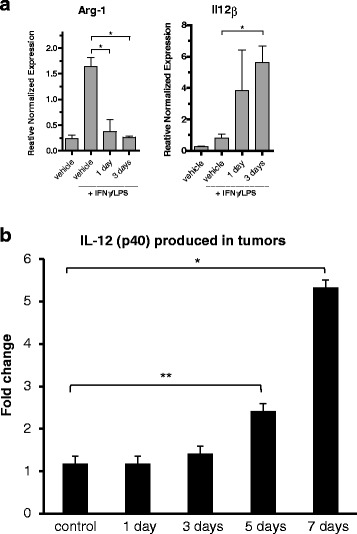
BACKGROUND: Tasquinimod (a quinoline-3-carboxyamide) is a small molecule immunotherapy with demonstrated effects on the tumor microenvironment (TME) involving immunomodulation, anti-angiogenesis and inhibition of metastasis. A target molecule of tasquinimod is the inflammatory protein S100A9 which has been shown to affect the accumulation and function of suppressive myeloid cell subsets in tumors. Given the major impact of myeloid cells to the tumor microenvironment, manipulation of this cell compartment is a desirable goal in cancer therapeutics. METHODS: To understand the consequences of tasquinimod treatment on the TME, we evaluated early treatment effects in tumor infiltrating myeloid cells. Cellular phenotypes were studied by flow cytometry while gene expression both in tumor tissue and in isolated CD11b(+) cells or tumor cells were measured by real time-PCR. Effects on angiogenesis were monitored by changes in CD31 levels and by gene expression in tumor tissue. Effects on cytokine levels in tumor tissue and serum were determined by multiplex analysis. RESULTS: The MC38-C215 colon carcinoma tumors showed a substantial infiltration of primarily myeloid cells that were dominated by Ly6C(low)F4/80(+)CD206(+) M2-polarized tumor associated macrophages (TAMs), an immuno-suppressive and pro-angiogenic cell population. Here, we show that tasquinimod treatment induces an anti-tumor effect which is subsequent to a reduction in tumor infiltrating CD206(+) M2 macrophages and a simultaneous increase in M1 macrophages expressing MHC class II and CD86. The tasquinimod-induced changes in TAM polarization were evident within 24 h of exposure, emphasizing the ability of tasquinimod to rapidly reprogram the tumor microenvironment. This change in the tumor associated myeloid compartment preceded an increased IL12-production within the tumor and a decrease in tumor neovascularization. The switch in TAM polarization by tasquinimod was confirmed in the 4T1 breast cancer model where tasquinimod also reduce lung metastasis development. CONCLUSION: Our data show that tasquinimod affects tumor infiltrating myeloid cells early after exposure, leading to a change in phenotype from pro-angiogenic and immunosuppressive M2-like TAMs to pro-inflammatory M1-like macrophages. These changes are consistent with the effects of tasquinimod seen on tumor vascularization, immune suppression and metastasis giving further insights to the anti-tumor mechanism of action of tasquinimod.
Overview
The claims and statistics of this paper haven’t been checked yet.
Free: it reads the open-access text and checks the first 5 claims that cite a source we can check. Create a free account to check every claim.
Integrity signals
Registry
Cites
Statistics
Figures
Verification
Claims the paper makes
The claims and statistics of this paper haven’t been checked yet.
Free: it reads the open-access text and checks the first 5 claims that cite a source we can check. Create a free account to check every claim.
Claims other papers make about this one
Each is checked against this paper’s own text: does it say what the citing paper says it does?
The cited source says what the claim attributes to it.
In the citing paper
“the small molecule immunotherapy drug tasquinimod induced TAM phenotype switching from M2 to M1 and inhibited tumor growth and vascularization in a mouse colon carcinoma model [233].”
From Mechanisms and Strategies to Overcome Drug Resistance in Colorectal Cancer (2025) · cites this paper as [233]
Self-check
Percentages, sums and reported differences re-computed from the paper’s own numbers.
The self-check needs the paper’s full text.
Citations
Cites
PD-1 and PD-L1 Immune Checkpoint Blockade to Treat Breast Cancer
Hartkopf, A. D., Taran, F.-A., Wallwiener, M., Walter, C. B., Krämer, B., Grischke, E.-M., & Brucker, S. Y. (2016) · Breast Care · doi:10.1159/000453569 · Cited by 30,845
The blockade of immune checkpoints in cancer immunotherapy
Pardoll, D. M. (2012) · Nature Reviews Cancer · doi:10.1038/nrc3239 · Cited by 13,838 · cited 1×
“Indeed, several studies from the literature have reported that the expression of immune checkpoints inihbitors in the TME such as the PD-1/PD-L1 axis may limit T cell infiltration and expansion [44].”
BackgroundMicroenvironmental regulation of tumor progression and metastasis
Quail, D. F., & Joyce, J. A. (2013) · Nature Medicine · doi:10.1038/nm.3394 · Cited by 7,994 · cited 1×
“These multiple stromal cells constitute the primary tumorigenic niche and their interactions are critical for tumor growth and metastasis [6].”
BackgroundMacrophage plasticity and polarization: in vivo veritas
Sica, A., & Mantovani, A. (2012) · Journal of Clinical Investigation · doi:10.1172/jci59643 · Cited by 6,335 · cited 1×
“Moreover, during tumor progression, MDSCs accumulate in blood and in spleen and are also recruited to the TME, where they accumulate and may also differentiate to M1 or M2 macrophages [36–38].”
BackgroundMANTOVANI, A., SOZZANI, S., LOCATI, M., ALLAVENA, P., & SICA, A. (2002) · Trends in Immunology · doi:10.1016/s1471-4906(02)02302-5 · Cited by 5,528 · cited 3×
“Macrophages are plastic cells and can be polarized towards (i) classically activated, pro-inflammatory M1 macrophages or (ii) alternatively activated, antiinflammatory and immune-suppressive M2 macrophages [7, 8].”
BackgroundMacrophage plasticity and interaction with lymphocyte subsets: cancer as a paradigm
Biswas, S. K., & Mantovani, A. (2010) · Nature Immunology · doi:10.1038/ni.1937 · Cited by 3,840 · cited 1×
“Polarization seems to depend on the nature of the TME where the localization, type and origin of the tumor, hypoxia, other infiltrating cells, and tumor produced factors is highly associated with the phenotype and function of the infiltrating TAMs [16].”
BackgroundCoordinated regulation of myeloid cells by tumours
Gabrilovich, D. I., Ostrand-Rosenberg, S., & Bronte, V. (2012) · Nature Reviews Immunology · doi:10.1038/nri3175 · Cited by 3,544 · cited 1×
“Consequently, a number of different therapeutic strategies are being developed to target the cells and molecules of the TME [1–5].”
BackgroundAlternative Activation of Macrophages: An Immunologic Functional Perspective
Martinez, F. O., Helming, L., & Gordon, S. (2009) · Annual Review of Immunology · doi:10.1146/annurev.immunol.021908.132532 · Cited by 2,745 · cited 2×
“M1 macrophages on the other hand produce anti-angiogenic cytokines such as IL-12 [14, 15] and promote immune-mediated anti-tumor activity via production of inducible nitric oxide synthase (iNOS) and by high expression of MHC class II molecules [8].”
BackgroundThe many faces of macrophage activation
Mosser, D. M. (2003) · Journal of Leukocyte Biology · doi:10.1189/jlb.0602325 · Cited by 1,902 · cited 2×
“Macrophages exert their antitumor effects by i) producing anti-angiogenic and cytotoxic cytokines and by ii) orienting the adaptive immune response by presenting MHC-II–bound peptides to T cells [11, 51].”
BackgroundRegulation of immune responses by L-arginine metabolism
Bronte, V., & Zanovello, P. (2005) · Nature Reviews Immunology · doi:10.1038/nri1668 · Cited by 1,775 · cited 1×
“depletion of L-arginine via arginase-1 (Arg-1) [9, 10], express the mannose receptor C type 1 (Msr1; also called CD206) and promote angiogenesis by expressing Tie-2 and by producing the pro-angiogenic factor VEGF-A [11–13].”
Background
Cited by
Targeting Inflammation in Cancer Prevention and Therapy
Todoric, J., Antonucci, L., & Karin, M. (2016) · Cancer Prevention Research · doi:10.1158/1940-6207.capr-16-0209 · Cited by 354
“A recent study demonstrated its ability to induce a shift of imunosuppresive M2 to proinflammatory M1 macrophages in colon and breast cancer models (110).”
BackgroundWang, H., Tian, T., & Zhang, J. (2021) · International Journal of Molecular Sciences · doi:10.3390/ijms22168470 · Cited by 364
“found that tasquinimod targets early-stage tumor-infiltrating myeloid cells and induces phenotype switching from the proangiogenic and immunosuppressive M2-like phenotype to the proinflammatory M1-like phenotype, which alters the TME to promote immunomodulation, prevent angiogenesis, and inhibit metastasis [142].”
BackgroundInvasion and metastasis in cancer: molecular insights and therapeutic targets
Li, Y., Liu, F., Cai, Q., Deng, L., Ouyang, Q., Zhang, X. H.-F., & Zheng, J. (2025) · Signal Transduction and Targeted Therapy · doi:10.1038/s41392-025-02148-4 · Cited by 244
Protein acylation: mechanisms, biological functions and therapeutic targets
Shang, S., Liu, J., & Hua, F. (2022) · Signal Transduction and Targeted Therapy · doi:10.1038/s41392-022-01245-y · Cited by 235
Dong, P., Ma, L., Liu, L., Zhao, G., Zhang, S., Dong, L., Xue, R., & Chen, S. (2016) · International Journal of Molecular Sciences · doi:10.3390/ijms17030320 · Cited by 207
“Previous study implied that M1 macrophages expressed high level of CD86 and tumor necrosis factor α (TNF-α), while M2 macrophages expressed relatively high level of CD206, CD163 and IL-10 [9] [10].”
Influential
Metadata
- Authors
- Olsson, A., Nakhlé, J., Sundstedt, A., Plas, P., Bauchet, A.-L., Pierron, V., Bruetschy, L., Deronic, A., Törngren, M., Liberg, D., Schmidlin, F., & Leanderson, T.
- Affiliations
- Active Biotech (Sweden) (SE)
- Ipsen (France) (FR)
- Lund University (SE)
- Corresponding author
- Olsson, Anders
- Schmidlin, Fabien
- ORCID
- Venue
- Journal for ImmunoTherapy of Cancer
- Publisher
- BMJ
- Published
- 2015-12
- Volume
- 3
- Issue
- 1
- Pages
- 53-53
- ISSN
- 2051-1426 (ISSN-L)
- PMC
- PMC4678646
- OpenAlex
- W2206870401
- Cited by
- 78
- References
- 55
- Citations by year
- 2026: 5 · 2025: 14 · 2024: 11 · 2023: 7 · 2022: 6 · 2021: 6 · 2020: 7 · 2019: 2 · 2018: 2 · 2017: 10 · 2016: 8
- FWCI
- 3.29
- Type
- journal article
- Language
- en
- Open access
- gold
- doi.org
- Licence
- cc-by
- creativecommons.org/licenses/by/4.0/ (tdm)
- Locations
- Journal for ImmunoTherapy of Cancer (publishedVersion, cc-by)
- PubMed Central (publishedVersion, cc-by)
- PubMed (publishedVersion)
- Lund University Publications (Lund University) (submittedVersion)
- Funders
- Cancerfonden
- Topics
- Life Sciences › Immunology and Microbiology › Immunology › Immune cells in cancer
- Life Sciences › Biochemistry, Genetics and Molecular Biology › Molecular Biology › Angiogenesis and VEGF in Cancer
- Health Sciences › Medicine › Oncology › Cancer Immunotherapy and Biomarkers
- Keywords
- tasquinimod, tumor-associated macrophages, macrophage polarization, M1/M2 macrophages, tumor microenvironment, S100A9, tumor-infiltrating myeloid cells, tumor angiogenesis, IL-12, tumor immunosuppression, lung metastasis, colon cancer, breast cancer, CD206, CD86, MHC class II
About these checks
Registry, retraction, Cites and statistics results are computed, not judged, with one exception: a printed reference that no index lists is read once by a model before it counts as a citation error. Claims are extracted by a model and kept only when their quote appears verbatim in the text; each cited source is then checked, with a model’s help, for whether it says what the claim relies on. Those verdicts can be wrong — read the claim’s quote and the cited source before relying on one.
Statistics and arithmetic are recomputed, not judged.
Confidence bands are shown only for fields calibrated on our annotated test set. None is calibrated yet, so no band is shown.
What counts as a claim ›How we measure confidence ›How we check this ›
Are you an author, or do you see a problem with this page? Request a review
Data sources
Bibliographic data: Semantic Scholar, OpenAlex, Crossref.
Contains information from the Semantic Scholar Academic Graph Datasets, made available under the ODC Attribution License (ODC-BY 1.0).
Semantic Scholar’s data is described in: Kinney, R., et al. (2023). The Semantic Scholar Open Data Platform. arXiv:2301.10140.
