

Artificial intelligence in intelligent tutoring systems toward sustainable education: a systematic review
Open accessThe DOI matches its Crossref record; 61 of the 61 references it cites were found in a registry or an index; 7 of the 78 sources its claims cite were checked for support.
Abstract
Sustainable education is a crucial aspect of creating a sustainable future, yet it faces several key challenges, including inadequate infrastructure, limited resources, and a lack of awareness and engagement. Artificial intelligence (AI) has the potential to address these challenges and enhance sustainable education by improving access to quality education, creating personalized learning experiences, and supporting data-driven decision-making. One outcome of using AI and Information Technology (IT) systems in sustainable education is the ability to provide students with personalized learning experiences that cater to their unique learning styles and preferences. Additionally, AI systems can provide teachers with data-driven insights into student performance, emotions, and engagement levels, enabling them to tailor their teaching methods and approaches or provide assistance or intervention accordingly. However, the use of AI and IT systems in sustainable education also presents challenges, including issues related to privacy and data security, as well as potential biases in algorithms and machine learning models. Moreover, the deployment of these systems requires significant investments in technology and infrastructure, which can be a challenge for educators. In this review paper, we will provide different perspectives from educators and information technology solution architects to connect education and AI technology. The discussion areas include sustainable education concepts and challenges, technology coverage and outcomes, as well as future research directions. By addressing these challenges and pursuing further research, we can unlock the full potential of these technologies and support a more equitable and sustainable education system.
Overview
CoChat Summary
TL;DR
This systematic review examines how AI and intelligent tutoring systems (ITSs) can support sustainable education, summarizing challenges, implementation approaches, outcomes, and future trends. It synthesizes 8 papers on sustainable education challenges and 29 papers on AI/ITS applications, emphasizing personalization, performance prediction, dropout prevention, and the need for explainable and human-centered AI.
Key findings
- The review identifies nine key sustainable education challenges: more students in virtual/blended learning; unequal global access and connectivity; teachers’ ICT skills and acceptance; lack of physical/emotional interaction; limited collaborative learning; engagement and dropout concerns; privacy/security; fairness and bias correction; and interpretability/transparency.
- Among 29 AI/ITS papers, the most common purposes were performance prediction (13), learning behavior analysis (9), engagement and dropout prevention (5), adaptation/personalization (5), instructors’ support (4), intervention (3), tutoring systems assessment (2), and self-regulation learning improvement (2).
- Reported outcomes included high-accuracy performance prediction (10 papers), identified learner behaviors (6), improved participation via early dropout notification (5), explainable results to instructors (2), and, for AI-embedded systems, improved performance through interaction with the AI system (3).
- Future directions emphasize explainable AI, human-centered AI, fairness, trustworthiness, and portability; only 2 of the 29 surveyed papers focused on explainable AI.
Methods
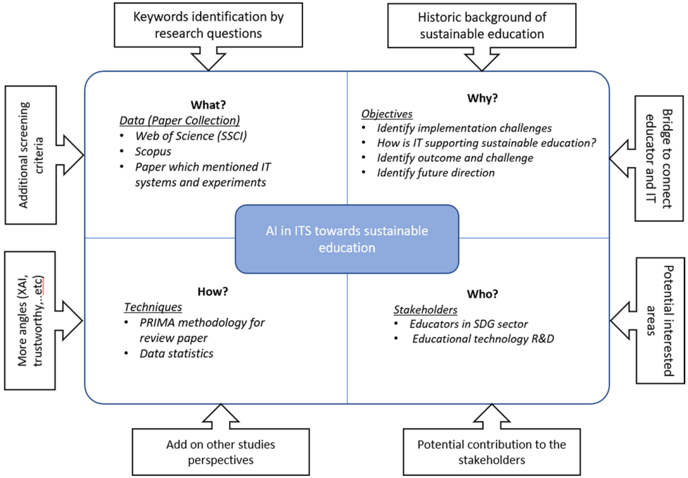
- The review follows the PRISMA methodology and uses a conceptualization process based on Yin’s qualitative research approach and Chatti et al.’s learning analytics reference model.
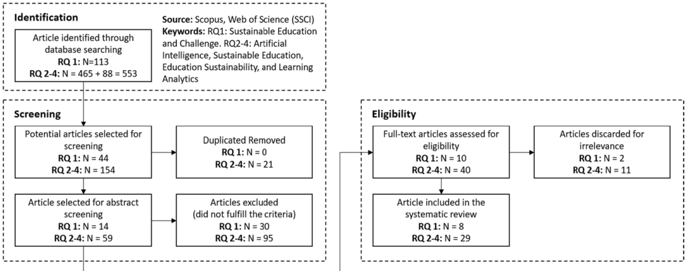
- For RQ1, Scopus was searched with “Sustainable Education” and “Challenge,” yielding 113 articles and selecting 8. For RQ2–RQ4, Scopus and Web of Science (SSCI) were searched with “Artificial Intelligence” AND (“Education Sustainability” OR “Sustainable Education” OR “Learning Analytics”), yielding 465 Scopus and 88 SSCI records, from which 29 papers were selected.
- Searches were limited to English-language journal or conference papers, with inclusion/exclusion criteria applied; selected papers were coded by data type, methods, objectives, and target learners/stakeholders.
Limitations
- The paper states that limitations and challenges of AI-embedded tutoring systems include the amount of data, feature extraction improvement, need for longer-period learning data, and solutions not being portable to other tutoring systems.
- It notes that most research does not explain why and how machine learning algorithms perform predictions, and that bias, fairness, and equality concerns arise from overfitting and the need for more and better training data.
- Evident from the text: the review is a qualitative synthesis without meta-analysis or formal effect-size aggregation, and its evidence base is restricted to Scopus/Web of Science, English-language journal and conference papers.
Model-written summary. Check it against the paper before relying on it.
Integrity signals
Registry
Cites
Statistics
Figures
Verification
Claims the paper makes
5 Valid · 7 Not valid · 41 Not checked · 38 Own results and interpretations
At least one cited source doesn’t support this claim or points to a different paper, and none confirmed it — see the verdicts below.
In the paper
“On the other hand, when performing learning behavior analysis (Pereira et al., 2021;Weng et al., 2020), most of the technology used turns to unsupervised learning, which also makes sense since there are no ground truth data for model training and the overall concept is for clustering or categorization without any reference.”
§ Smart Learning > RQ2: how are AI and IT incorporated as the ITS to support sustainable education?
What the sources say
- Disputedcites Pereira et al., 2021 matched to “Explaining Individual and Collective Programming Students’ Behavior by Interpreting a Black-Box Predictive Model” (2021) sourceExperimental — accuracy not yet measured
Our copy says the opposite of what is attributed: Sec. III (Related Work) states that 'educational data-driven researches identify patterns of behaviour based on data collected from the students learning process' and that 'there are many works in this field that use ML to construct predictive models', i.e. supervised prediction, not unsupervised clustering. The Introduction likewise frames prior work as methods 'to predict CS1 students' performance' and the paper itself trains a supervised XGBoost classifier on ground-truth pass/fail labels (Sec. V-E, 'students who passed (class 1) and students who failed (class 0)'), so the claim's rationale that 'there are no ground truth data for model training' is contrary to this source. The only unsupervised element is k-means applied post-hoc to Shapley values of the trained supervised model (Sec. V-G, Prediction Paths), presented as a contribution ('a new clustering approach'), not as the dominant technology of the field. (LLM, conf=0.70)
Checked by a reasoning model — may be wrong.
- Not checked yetcites Weng et al., 2020
plainstates an association- Asserted: passes — The authors put it forward as true.
- Checkable: passes — It can be checked against evidence.
- Load-bearing: unclear — It is unclear whether the paper’s conclusions depend on it.
- Based: passes — The paper gives a reason why it holds.
- Disputed
The cited sources support only part of this claim — read each source’s verdict below.
In the paper
“More challenges taking care of more students during virtual or blended learning environment (Tsegay et al., 2022;Wade, 2012), it may be because students are from remote especially like under COVID situation, and the instructors are forced to use tutoring systems to deliver courses on line.”
§ Smart Learning > RQ1: what are the key challenges of sustainable education implementation?
What the sources say
- Not checked yetcites Tsegay et al., 2022
- Partly supportedcites Wade, 2012 matched to “Pedagogy, Places And People” (2012) sourceExperimental — accuracy not yet measured
Wade (2012) does support the general point: the section 'challenges and opportunities of the virtual world' states that the exponential rise in 'distance or blended learning course, at least partially mediated by online provision' 'has thrown up a wide range of challenges and opportunities', and 'A formal taught course' describes the strain on tutors — students contacting tutors 'at all hours of the day and this is just not manageable... In personal sustainability terms for tutors this would be quite impossible so clear parameters need to be set'. However, no passage in our copy attributes the challenge to caring for *more* (larger numbers of) students, nor frames student volume as 'a key challenge of sustainable education implementation'; the paper's listed challenges are tutor accessibility/protocols, unequal broadband access in Sub-Saharan Africa, students' wariness of posting online, and the uncritical environmental cost of ICT. The remote/COVID gloss in the citing sentence is the citing authors' own framing (this paper predates it), and the Tsegay et al. (2022) part of the citation is separate evidence not judged here. (LLM, conf=0.72)
hedged- Asserted: passes — The authors put it forward as true.
- Checkable: passes — It can be checked against evidence.
- Load-bearing: unclear — It is unclear whether the paper’s conclusions depend on it.
- Based: passes — The paper gives a reason why it holds.
The cited sources support only part of this claim — read each source’s verdict below.
In the paper
“There are also some researchers who have explored different learning behaviors (Ruipérez-Valiente et al., 2021;Yang et al., 2021a, b) through clustering algorithms, which can also provide instructors with information for further intervention as necessary.”
§ Smart Learning > RQ3: what are the outcomes of AI/IT embedded as the ITS in sustainable education?
What the sources say
- Partly supportedcites Ruipérez-Valiente et al., 2021 matched to “Data-driven detection and characterization of communities of accounts collaborating in MOOCs” (2021) sourceExperimental — accuracy not yet measured
Our copy supports the clustering-of-behaviours half: Section 3.5.1/3.5.3 describe applying the IBM SPSS Two-Step clustering method to find different types of student accounts based on their engagement with the platform, and Section 5.1 reports the resulting cluster types (fruitful collaboration, free-riding, illicit, CAMEO). On the instructor-benefit half, Section 5.2 (Implications) only states that the work can 'provide the teacher with tools that allow them to somehow improve the design and development of MOOCs to promote more collaboration' and suggests course-design controls (randomization, linking accounts to a physical person) — i.e. course-design and dishonesty-deterrence measures, not information for instructors to intervene with individual students as necessary. The related-work statement in Section 2.1 that results 'can help understand instructors and researchers which behaviors can have a positive or negative impact' is credited to other studies ([27], [28]), not to clustering. (LLM, conf=0.72)
- Not checked yetcites Yang et al., 2021a, b
plainstates a cause- Asserted: passes — The authors put it forward as true.
- Checkable: passes — It can be checked against evidence.
- Load-bearing: unclear — It is unclear whether the paper’s conclusions depend on it.
- Based: passes — The paper gives a reason why it holds.
- Partly supported
The sources with a verdict support this claim; the rest weren’t checked yet, have no full text we could read, or their verdicts aren’t rated yet.
In the paper
“There are also some researchers who have explored different learning behaviors (Ruipérez-Valiente et al., 2021;Yang et al., 2021a, b) through clustering algorithms, which can also provide instructors with information for further intervention as necessary.”
§ Smart Learning > RQ3: what are the outcomes of AI/IT embedded as the ITS in sustainable education?
What the sources say
- Supportedcites Ruipérez-Valiente et al., 2021 matched to “Data-driven detection and characterization of communities of accounts collaborating in MOOCs” (2021) source
The source applies clustering to characterize behavioral profiles: Section 3.5.3 states it used the IBM SPSS Two-Step clustering method (Section 3.5.1) 'to find different types of student accounts based on their engagement with the learning platform,' and Section 5.1 reports detecting 'different collaboration behaviors among accounts' via that cluster analysis. Its review in Section 2.1 likewise surveys clustering studies that 'find different behavioral profiles of students,' and Section 5.2 (Implications) says the work can 'provide the teacher with tools' to improve MOOC design and to deter dishonesty/free-riding, which covers the citing sentence's point about information for instructor action. The paraphrase is broad but matches what our copy does. (LLM, conf=0.85)
- Not checked yetcites Yang et al., 2021a, b
plain- Asserted: passes — The authors put it forward as true.
- Checkable: passes — It can be checked against evidence.
- Load-bearing: unclear — It is unclear whether the paper’s conclusions depend on it.
- Based: passes — The paper gives a reason why it holds.
- Supported
The sources with a verdict support this claim; the rest weren’t checked yet, have no full text we could read, or their verdicts aren’t rated yet.
In the paper
“Of the 29 surveyed papers, only 2 focus on the result and try to leverage explainable AI (Afzaal et al., 2021;Pereira et al., 2021) on machine learning prediction.”
§ Smart Learning > RQ3: what are the outcomes of AI/IT embedded as the ITS in sustainable education?
What the sources say
- Not checked yetcites Afzaal et al., 2021
- Supportedcites Pereira et al., 2021 matched to “Explaining Individual and Collective Programming Students’ Behavior by Interpreting a Black-Box Predictive Model” (2021) source
The Introduction says the paper interprets a predictive model’s decisions, and the Conclusion says it developed an explainable machine-learning pipeline for predicting student performance. This supports citing Pereira et al. as an example of a paper applying explainable AI to machine-learning prediction. The count of 29 surveyed papers is the citing authors’ own survey finding, not a finding attributed to Pereira et al. (LLM, conf=0.91)
plain- Asserted: passes — The authors put it forward as true.
- Checkable: passes — It can be checked against evidence.
- Load-bearing: passes — The paper’s conclusions depend on it.
- Based: passes — The paper gives a reason why it holds.
28 more claims
Create a free account to see all 91 claims and to verify the 71 references still open.
- Probably not a substantial claim. 48
- It may state two separate claims as one. 27
- The quote only partly states this claim. 1
Claims other papers make about this one
Each is checked against this paper’s own text: does it say what the citing paper says it does?
The source backs part of the claim, not all of it — or backs it for a different population, condition or comparison.
In the citing paper
“It can support learners by providing customized feedback and opportunities for repeated practice appropriate to their level.”
From Development and pilot evaluation of an AI-based pediatric medication safety virtual simulation program for nursing students: a quasi-experimental study in South Korea (2026) · cites this paper as [12]
Experimental — accuracy not yet measuredThe source backs part of the claim, not all of it — or backs it for a different population, condition or comparison.
In the citing paper
“By analyzing learners’ input in real time, AI can identify patterns of errors in clinical performance and reasoning.”
From Development and pilot evaluation of an AI-based pediatric medication safety virtual simulation program for nursing students: a quasi-experimental study in South Korea (2026) · cites this paper as [12]
Experimental — accuracy not yet measuredThe cited source says what the claim attributes to it.
In the citing paper
“It can also promote adaptive learning by providing educational content tailored to students’ individual needs and learning styles [12].”
The cited source says what the claim attributes to it.
In the citing paper
“This approach enables instructors to utilize personalized AI-generated feedback without diminishing the role of traditional instruction [12,33].”
From The Role of AI in Academic Writing: Impacts on Writing Skills, Critical Thinking, and Integrity in Higher Education (2025) · cites this paper as [33]
In the citing paper
“Given that AI tools can provide instant feedback, students can work at their own pace, and those requiring additional support can benefit from AI assistance without the necessity of one-on-one tutoring [33].”
From The Role of AI in Academic Writing: Impacts on Writing Skills, Critical Thinking, and Integrity in Higher Education (2025) · cites this paper as [33]
2 more claims about this paper
Create a free account to see every claim other papers make about this one.
Self-check
Percentages, sums and reported differences re-computed from the paper’s own numbers.
Each contradiction between two passages listed here was confirmed by an independent check.
Rated minor: it would not touch a result — a value no result rests on, a p-value that stays on the same side of the significance level, or a conflict that is clerical, resolved elsewhere in the paper, or outside its own findings.
In the paper
§ Smart Learning > RQ3: what are the outcomes of AI/IT embedded as the ITS in sustainable education?
“For AI-embedded tutoring systems, most of the outcomes indicate that the performance prediction accuracy is high (Guerrero-Higueras et al., 2018;Hasnine et al., 2018)”
§ Smart Learning > Conclusions
“| AI not Embedded in | Performance prediction algorithm verified with high accuracy | 10 |”
Citations
Cites
The PRISMA 2020 statement: An updated guideline for reporting systematic reviews
Page, M. J., McKenzie, J. E., Bossuyt, P. M., Boutron, I., Hoffmann, T. C., Mulrow, C. D., Shamseer, L., Tetzlaff, J. M., Akl, E. A., Brennan, S. E., et al. (2021) · BMJ · doi:10.1136/bmj.n71 · Cited by 108,283
Arrieta, A. B., Díaz-Rodríguez, N., Del Ser, J., Bennetot, A., Tabik, S., Barbado, A., García, S., Gil-López, S., Molina, D., Benjamins, R., et al. (2019) · arXiv · doi:10.48550/arxiv.1910.10045 · Cited by 11,321 · cited 1×
“In the XAI review paper, Arrieta et al. (2020) categorized many common machine learning algorithms in detail and described how a model can be explained.”
BackgroundBarredo Arrieta, A., Díaz-Rodríguez, N., Del Ser, J., Bennetot, A., Tabik, S., Barbado, A., Garcia, S., Gil-Lopez, S., Molina, D., Benjamins, R., et al. (2020) · Information Fusion · doi:10.1016/j.inffus.2019.12.012 · Cited by 10,423 · cited 1×
“In the XAI review paper, Arrieta et al. (2020) categorized many common machine learning algorithms in detail and described how a model can be explained.”
BackgroundThe PRISMA 2020 statement: an updated guideline for reporting systematic reviews
Page, M. J., McKenzie, J., Bossuyt, P., Boutron, I., Hoffmann, T., mulrow, C., Shamseer, L., Tetzlaff, J., Akl, E., Brennan, S. E., et al. (2020) · doi:10.31222/osf.io/v7gm2_v1 · Cited by 8,090
Qualitative Research from Start to Finish
Yin, R. K. (2010) · Medical Entomology and Zoology · Cited by 5,667
The PRISMA 2020 statement: an updated guideline for reporting systematic reviews
Page, M. J., McKenzie, J., Bossuyt, P., Boutron, I., Hoffmann, T., mulrow, C., Shamseer, L., Tetzlaff, J., Akl, E., Brennan, S. E., et al. (2020) · doi:10.31222/osf.io/v7gm2 · Cited by 5,177
Human-Centered Artificial Intelligence: Reliable, Safe & Trustworthy
Shneiderman, B. (2020) · International Journal of Human–Computer Interaction · doi:10.1080/10447318.2020.1741118 · Cited by 1,743 · cited 1×
“Shneiderman (2020) defined a two-dimensional approach for categorizing and providing guidance on how to produce system designs that are Reliable, Safe, and Trustworthy (RST).”
DARPA's Explainable Artificial Intelligence Program
Gunning, D., & Aha, D. W. (2019) · AI Magazine · doi:10.1609/aimag.v40i2.2850 · Cited by 1,360 · cited 1×
“Similar to the 4-year project conducted by DARPA (Gunning & Aha, 2019), the technical teams were requested to provide an explainable model and explanation interface to support users making decisions.”
MethodAI in CAI: An Artificial-Intelligence Approach to Computer-Assisted Instruction
Carbonell, J. (1970) · IEEE Transactions on Man Machine Systems · doi:10.1109/tmms.1970.299942 · Cited by 955 · cited 1×
“The overall concept can be traced back to 1970 (Carbonell, 1970).”
BackgroundExplainable Artificial Intelligence in education
Khosravi, H., Shum, S. B., Chen, G., Conati, C., Tsai, Y.-S., Kay, J., Knight, S., Martinez-Maldonado, R., Sadiq, S., & Gašević, D. (2022) · Computers and Education: Artificial Intelligence · doi:10.1016/j.caeai.2022.100074 · Cited by 863 · cited 2×
“Khosravi et al. (2022) deeply explore XAI in terms of education, which also provides good guidance for educators and IT solution architects.”
Background
Research works printed but not linked: 2
- Lu, O. H. T., Huang, A. Y. Q., & Yang, S. J. H. (2018). Benchmarking and tuning regression algorithms on predicting students' academic performance. In 26th International conference on computers in education, Philippines.
- Sterling, S. R., & Orr, D. (2001). Sustainable education: Re-visioning learning and change (Vol. 6). Green Books for the Schu- macher Society Totnes.
Cited by
Items 201–300 of 897
Atef, R. (2025) · Advances in computational intelligence and robotics book series · doi:10.4018/979-8-3373-7584-7.ch007 · Cited by 6
Artificial Intelligence and Educational Quality in Higher Education: A Systematic Review
Sir, V. M. V., Reátegui, J. A., Guevara, R. C., Revilla, A. C., & Valqui, C. V. (2025) · TEM Journal · doi:10.18421/tem144-82 · Cited by 7
Simão, J. P. S., Machado, L. R., da Silva, J. B., & Behar, P. A. (2025) · Anais do ... Simpósio Brasileiro de Informática na Educação/Anais do Simpósio Brasileiro de Informática na Educação · doi:10.5753/sbie.2025.12293 · Cited by 5
“…inteligen-tes, sistemas de aprendizagem baseados em computador que utilizam IA para oferecer instrução personalizada e adaptativa aos estudantes [Lin et al. 2023], mas como parceiros ativos na construção do conhecimento, capazes de tomar decisões pedagógicas contextua-lizadas, planejar…”
Tracing 40 years of research on Artificial Intelligence and human metacognition from 1985 to 2024
Varghese, M. A., & Sharma, P. (2025) · Discover Psychology · doi:10.1007/s44202-025-00463-z · Cited by 7
“These developments demonstrate how AI has progressed from passive computational tools to active metacognitive partners that scaffold self-regulated learning and decision-making [12, 13].”
Fen Bilgisi Öğretmen Adaylarının Yapay Zekâ Okuryazarlığı: Farklı Değişkenler Açısından Bir İnceleme
Dağdelen, E., Güngör, H., & Ünal, İ. (2025) · İnönü Üniversitesi Eğitim Fakültesi Dergisi · doi:10.17679/inuefd.1650862 · Cited by 6
Writing Accuracy: How AI-Assisted Writing Instruction Can Support EFL Undergraduate Students
Almutairi, H., Alfaifi, A. A., & Saleem, M. (2026) · Information · doi:10.3390/info17020157 · Cited by 6
Ofem, U. J., Ajuluchukwu, E. N., Undie, S. B., Orim, F. S., Olom, P. A., Adie, J. A., Ukatu, J. O., & Ebaye, A. S. (2026) · Discover Education · doi:10.1007/s44217-026-01184-8 · Cited by 5
Beyond the Algorithm: A Critical Synthesis for Human-Centered AI in K-12 STEM Education
Lodhi, S. S., & Roehrig, G. (2026) · AI and Ethics · doi:10.1007/s43681-026-00994-8 · Cited by 8
Co-designing Digital Humans for Online Learning: A Framework for Human-AI Pedagogical Integration
Lei, X., Pang, C. C., Jiang, Y., Tong, X., & Hui, P. (2026) · Lecture notes in computer science · doi:10.1007/978-3-032-30784-2_34 · Cited by 5
Ogalo, E. O., & Mtenzi, F. J. (2024) · Advances in educational technologies and instructional design book series · doi:10.4018/979-8-3373-0025-2.ch001 · Cited by 13
Les défis de l’IA dans l’éducation : de la protection des données aux biais algorithmiques
Messaoudi, A. (2024) · Médiations et médiatisations · doi:10.52358/mm.vi18.409 · Cited by 7
Investigating the Impact of Machine Learning in Personalized Education Systems
Rawat, B., Joshi, Y., & Bisht, N. (2024) · International Conference on Technological Innovations and Advance Computing (TIACOMP) · doi:10.1109/tiacomp64125.2024.00045 · Cited by 7
General Data Protection Regulation and Adaptive Educational Games
Papadimitriou, S., & Virvou, M. K. (2025) · Intelligent systems reference library · doi:10.1007/978-3-031-77464-5_9 · Cited by 9
Bochniarz, K. T., Jurek, P., & Atroszko, P. A. (2025) · Sustainability · doi:10.3390/su17083478 · Cited by 8
Navigating Ethical Consideration of Artificial Intelligence and the Metaverse in Scientific Research
Uunona, G. N., & Goosen, L. (2025) · Advances in computational intelligence and robotics book series · doi:10.4018/979-8-3373-0340-6.ch011 · Cited by 5
Wang, W. (2025) · International Journal of High Speed Electronics and Systems · doi:10.1142/s0129156425406692 · Cited by 8
Yu, T., Yang, Z., Zhang, M., Lin, Y., & Sun, X. (2025) · Frontiers in Oncology · doi:10.3389/fonc.2025.1626680 · Cited by 9
Personalized learning resources created by generative artificial intelligence: A systematic review
Xu, Y., Ding, Z., Zhang, Z., Zhou, L., Zhou, Y., & Ge, Z.-G. (2025) · International Conference on Education and Training Technologies (ICETT) · doi:10.1109/icett66247.2025.11137092 · Cited by 5
“An AI-integrated tutoring system can use natural language processing and machine learning techniques to assess students ’ responses and provide personalized guidance by analyzing their learning behaviors [8] .”
Meske, C., Brenne, J., Ünal, E., Ölçer, S., & Doğangün, A. (2026) · Behaviour and Information Technology · doi:10.2139/ssrn.6211215 · Cited by 7
An, Y., Kolanupaka, S., An, J., Ma, M., Chhatwal, U., Kalinowski, A., Rogers, M. L., & Smith, B. K. (2024) · IEEE International Conference on Big Data (BigData) · doi:10.1109/bigdata62323.2024.10825180 · Cited by 6
“Since then, a substantial body of literature has emerged, addressing various aspects and technologies of IES [4], [5], [6], [7], [8].”
Gao, B., Liu, R., & Chu, J. (2025) · Lecture notes in computer science · doi:10.1007/978-3-031-93412-4_11 · Cited by 12
Harnessing AI for Inclusive Teaching: Professional Development Strategies for Early Educators
Marras, A., Fornara, F., & Pasqualotto, A. (2025) · Wiley eBooks · doi:10.1002/9781394352821.ch16 · Cited by 5
Méndez, J. I., Ponce, P., Rojas, J. J. B., Mazón, N., López-Caudana, E. O., & Molina, A. (2025) · International Journal of Social Robotics · doi:10.1007/s12369-025-01278-7 · Cited by 4
AI and Curriculum: Designing for the Future
Torrisi‐Steele, G. (2025) · Advances in computational intelligence and robotics book series · doi:10.4018/979-8-3373-2397-8.ch006 · Cited by 4
Human-Centric AI Tools Into Agile Methodologies for Optimized Software Development
Babulak, E., Kumar, A. P., Guru, D., Kudithipudi, K., Maddini, S., Gonaygunta, H., & Nadella, S. (2025) · Advances in computational intelligence and robotics book series · doi:10.4018/979-8-3373-4839-1.ch002 · Cited by 5
Han, P.-C. (2025) · Advances in computational intelligence and robotics book series · doi:10.4018/979-8-3373-5102-5.ch014 · Cited by 4
Brânoaea, G.-C. (2025) · BRAIN BROAD RESEARCH IN ARTIFICIAL INTELLIGENCE AND NEUROSCIENCE · doi:10.70594/brain/16.3/11 · Cited by 4
Ennadir, H., & Habiballah, S. (2025) · Arab World English Journal · doi:10.24093/awej/vol16no3.10 · Cited by 4
“Besides, they can model the psychological state of students, such as motivation, emotion, and cognition, as well as their prior knowledge, skills, and preferences (Lin et al., 2023).”
AI - Powered Digital Transformation in Higher Education: Intelligent Simulation Tool
Wang, X., Yue, P., & Li, Z. (2025) · doi:10.1109/icaie64856.2025.11158253 · Cited by 4
“With rapid advancements in artificial intelligence, cloud computing, and big data technologies, higher education is experiencing accelerated digital and intelligent transformations [1].”
Leveraging AI in Education: Benefits, Responsibilities, and Trends
Fitas, R., Ghosh, K., & Maity, S. (2025) · Signals and communication technology · doi:10.1007/978-3-031-96855-6_7 · Cited by 6
Redesigning Instructional Design with an AI-Incorporated ADDIE Model for 21st Century Education
Ussainova, G., Seitmuratov, A. Z., Issayeva, G., Shamsudinova, G., & Zhanseitova, L. (2025) · Journal of Curriculum Studies Research · doi:10.46303/jcsr.2025.31 · Cited by 7
Díaz, G. M. (2025) · Education Sciences · doi:10.3390/educsci15121688 · Cited by 4
Bridging the AI Divide: Equity, Integrity, and the Governance of Generative AI in Higher Education
Shapiro, S. J., & Lam, V. D. (2025) · Advances in computational intelligence and robotics book series · doi:10.4018/979-8-3373-1195-1.ch006 · Cited by 5
Cortez, L. H. V., Veloz, J. F. A., Oyarvide, W. R. V., Humanante, P. M. T., & Ramírez, C. S. T. (2026) · Data & Metadata · doi:10.56294/dm20261295 · Cited by 6
Learner-generated contexts in the elementary EFL classroom: A GenAI-assisted framework
Tsai, T.-J. (2025) · Journal of English and Education · doi:10.20885/jee.v11i2.40446 · Cited by 4
“Built on structured databases, rule-based AI has proven to be advantageous in supporting students through systematic learning tasks (e.g., drills, scaffolded sequences), thereby promoting differentiated learning and improving learning outcomes in student engagement and retention (Lin et al., 2023).”
A Survey on AI Applications in the Open Classroom Approach
Boutabia, I., Benmachiche, A., Betouil, A. A., Boutassetta, M., & Derdour, M. (2025) · International Conference on Networking and Advanced Systems (ICNAS) · doi:10.1109/icnas68168.2025.11298090 · Cited by 10
“Lin et al [8] conducted a systematic review of ITS orchestrating the interaction between learning paths and the students' reactions and commitment issues.”
Afifah, A. N., Amriyah, C., Koderi, Firmansyah, D., & Fiteriani, I. (2025) · Bitnet Jurnal Pendidikan Teknologi Informasi · doi:10.33084/bitnet.v10i3.10974 · Cited by 16
Education at a crossroads: will AI fix learning or break it?
Temimi, A., Rebai, R., Aldamen, H., Souki, K., & Amiri, K. (2025) · Management & Sustainability An Arab Review · doi:10.1108/msar-04-2025-0118 · Cited by 10
Esteban, A. J., Park, I., Nga, N. T., Perunovic, S., Park, S. E., Shehzadi, & Yi, J.-I. (2025) · rEFLections · doi:10.61508/refl.v32i2.282889 · Cited by 8
Sinaga, C. C., Syahri, S. K. A., Irmanda, S., Rozi, S., & Kustiawan, W. N. A. (2025) · Edu Society Jurnal Pendidikan Ilmu Sosial Dan Pengabdian Kepada Masyarakat · doi:10.56832/edu.v5i3.1904 · Cited by 6
Chen, X., Jian-jun, L., & Ryoo, J. (2026) · Quality Assurance in Education · doi:10.1108/qae-02-2025-0040 · Cited by 5
Arthur: An artificial intelligence powered teaching assistant system for Engineering Economics class
Yin, Z., Karakaya, E., Bass, K., & Cai, H. (2026) · International Journal of Artificial Intelligence in Education · doi:10.1016/j.ijaied.2026.100003 · Cited by 5
Human-AI collaboration or obedient and often clueless AI in instruct, serve, repeat dynamics?
Saqr, M., Misiejuk, K., & López‐Pernas, S. (2026) · The Internet and Higher Education · doi:10.1016/j.iheduc.2026.101087 · Cited by 9
Sholeh, M. N., Hatmoko, J. U. D., & Widoanindyawati, V. (2026) · Archives of Computational Methods in Engineering · doi:10.1007/s11831-026-10583-x · Cited by 7
“Intelligent tutoring systems apply AI techniques to adapt instructional content and teaching strategies to individual learners [45].”
Theoretical evolution of AI in medical education: models, frameworks, and future directions
Abdulrahman, K. A. B., & Hefny, M. (2026) · Frontiers in Education · doi:10.3389/feduc.2026.1796632 · Cited by 4
Malik, N., & Rafiq-uz-Zaman, M. (2025) · Journal of Applied Linguistics and TESOL (JALT) · doi:10.63878/jalt2080 · Cited by 5
The Impact of Artificial Intelligence on the Academic Performance of University Students in Ecuador
Junco, G. D. C. A. (2026) · Open Education Studies · doi:10.1515/edu-2025-0116 · Cited by 4
“…performance analysis to provide tailored content and resources, as exempli fi ed by Khan Academy and Coursera (Pikhart 2020); intelligent tutoring (Lin et al. 2023); automated assessment (Gardner et al. 2021); the analysis of educational data (Lameras and Arnab 2022); and virtual assistants,…”
Hsieh, C., Banda, H. W., & Li, H. (2026) · Computers & Education · doi:10.1016/j.compedu.2026.105724 · Cited by 4
Integrating AI Into Higher Education: A Comprehensive Exploration
Labib, L. N., & ElSabry, E. A. (2024) · Advances in wireless technologies and telecommunication book series · doi:10.4018/979-8-3373-1132-6.ch001 · Cited by 5
Fahimey, A. F. M., Masrom, M. B., Suwastika, N. A., Azizan, A., Othman, S. A., & Nuha, H. H. (2024) · IEEE International Conference on Computing (ICOCO) · doi:10.1109/icoco62848.2024.10928192 · Cited by 7
“AI technologies such as intelligent tutoring systems, predictive analytics, and automated grading can transform traditional LMS into dynamic and adaptive learning environments [5].”
AI-Driven Digital Transformation: Challenges and Opportunities
León, M. (2025) · Journal of Engineering Research and Sciences · doi:10.55708/js0404002 · Cited by 6
“These initiatives are increasingly being implemented in sectors like healthcare and finance, where understanding the reasoning behind AI decisions is crucial for compliance and ethical accountability [20].”
Kotsis, K. Τ., & Vakarou, G. (2025) · European Journal of Contemporary Education and E-Learning · doi:10.59324/ejceel.2025.3(4).03 · Cited by 6
Sahar, R., Labib, I., Kazimi, M. K., Mobarez, H., & Kakar, M. N. (2025) · Education Science and Management · doi:10.56578/esm030105 · Cited by 11
Will the Application of AI Technology in Higher Education Exacerbate Teacher Burnout?
Zhang, Y., & Xiong, P. (2025) · International Journal of High Speed Electronics and Systems · doi:10.1142/s0129156425408381 · Cited by 5
Revolutionizing education through AI-powered personalized learning: A systematic literature review
Abdullahi, U., Dhahi, A.-A. K. A., Khalid, M. S., & Mohamed, A. M. (2025) · Multidisciplinary Reviews · doi:10.31893/multirev.2026084 · Cited by 4
Emotion Trajectory and Student Performance in Engineering Education: A Preliminary Study
Nadaud, E., Yaacoub, A., Haidar, S., Grand, B. L., & Prévost, L. (2024) · Lecture notes in business information processing · doi:10.1007/978-3-031-59465-6_25 · Cited by 5
Zhang, H.-L., Yan, J.-J., 刘, 静., Zou, Z.-C., Zeng, Q.-F., Jin, Y.-L., & Wu, J.-N. (2025) · Journal of Educational Technology and Innovation · doi:10.61414/tykx7317 · Cited by 5
Asrifan, A., Widyaningrum, A., Ramli, R. B., Riyanti, R., & Sultan, S. (2025) · Advances in computational intelligence and robotics book series · doi:10.4018/979-8-3373-4576-5.ch013 · Cited by 5
Pedagogy-Driven Evaluation of Generative AI-Powered Intelligent Tutoring Systems
Maurya, K. K., & Kochmar, E. (2025) · Communications in computer and information science · doi:10.1007/978-3-031-99261-2_3 · Cited by 10
Massouti, A., Shaya, N., & Baroudi, S. (2026) · Social Sciences & Humanities Open · doi:10.1016/j.ssaho.2026.102954 · Cited by 4
Gürsoy, D., Corte, V. D., Gaudio, G. D., Crisci, A., & Xu, Y. (2025) · Work Aging and Retirement · doi:10.1093/workar/waaf016 · Cited by 4
Analysis of the Impact of Foreign Language Learners Emotional State on Learning Outcomes
Lu, Q. (2025) · IEEE Access · doi:10.1109/access.2025.3635632 · Cited by 3
“Lin et al. reviewed intelligent tutoring systems through the lens of sustainable education and noted a sharp increase in the incorporation of emotion-sensing and adaptive technologies after 2020 [29].”
Toha, M. A. (2025) · International Journal of Educational Management · doi:10.1108/ijem-12-2024-0773 · Cited by 9
Implementing AI-Powered Tutoring Systems to Enhance Personalized Learning in Higher Education
Ariza, H. H. (2026) · Lecture notes in networks and systems · doi:10.1007/978-3-032-09908-2_26 · Cited by 3
Chang, H. H., Yeh, S., Yeh, Y., & Chen, L. Y. (2026) · Electronic Commerce Research · doi:10.1007/s10660-025-10093-1 · Cited by 6
AI and Learning: A Management Perspective from College Students of Kathmandu Valley, Nepal
Lamichhane, B. D., Acharya, K. R., Pandey, P., & Lamichhane, S. (2025) · Nepal Journal of Multidisciplinary Research · doi:10.3126/njmr.v8i5.89966 · Cited by 3
“The international literature very suitably documents the potential of AI to improve learning outcomes through personalized tutoring, adaptive assessment, and intelligent content delivery (Mustafa et al., 2024; Lin et al., 2023).”
Maharani, K. A., Barid, S. S. A. Q., Astuti, S. R. D., & Wahyuni, S. (2026) · JURNAL PIJAR MIPA · doi:10.29303/jpm.v21i1.10924 · Cited by 3
“On one hand, digital media is often utilized as a tutor for directly completing exercises and quizzes, which results in a predominantly instructional approach that does not fully scaffold learners’ thinking processes [15].”
Mao, L., Dong, L., Li, W., Hu, X., Lee, K.-P., & Zhou, Z. (2026) · CHI Conference on Human Factors in Computing Systems · doi:10.1145/3772318.3791696 · Cited by 6
Abhishek, N., & Martis, R. (2026) · Responsible Enterprise Pedagogy · doi:10.1108/resep-04-2026-0009 · Cited by 4
Radovan, M., Košmerl, T., & Radovan, D. M. (2026) · Sustainability · doi:10.3390/su18147213 · Cited by 3
Ceci N’Est Pas Une Publication: The Art of AI-Generated Research Papers
Zolezzi, D. (2024) · International Journal of Emerging Technologies in Learning (iJET) · doi:10.3991/ijet.v19i05.48261 · Cited by 4
Harnessing Industry 4.0: A Framework for Integrating AI and Emerging Technologies
Baroud, S. Y., & Qureshi, M. N. (2024) · International Workshop on Artificial Intelligence and Education (WAIE) · doi:10.1109/waie63876.2024.00044 · Cited by 3
Prodromou, A., & Kountouridou, M. (2025) · IGI Global eBooks · doi:10.4018/979-8-3693-9040-5.ch017 · Cited by 3
Liu, J. (2025) · International Journal of High Speed Electronics and Systems · doi:10.1142/s012915642540614x · Cited by 5
Strategi Pemanfaatan Kecerdasan Buatan dalam Pembelajaran Pendidikan Agama Katolik Tingkat SMA
Lay, S., Mendrofa, K., Marbun, M. R., Sipahutar, A. P., & Naibaho, M. N. (2025) · JURNAL RISET RUMPUN AGAMA DAN FILSAFAT · doi:10.55606/jurrafi.v4i2.5496 · Cited by 3
Empowering Minds: Integrating AI into STEM Curriculum
Qablan, A. M., Badawy, H. R. I., Badawy, H. R. I., & Maradian, P. (2025) · Advances in computational intelligence and robotics book series · doi:10.4018/979-8-3373-0573-8.ch002 · Cited by 3
Alabi, A. J., Adelekan, A. T., & Olotu, G. (2025) · ETDC Indonesian Journal of Research and Educational Review · doi:10.51574/ijrer.v4i4.3883 · Cited by 4
“Information Technology Services Lin et al. (2023) describe it as an advanced educational software system that employs artificial intelligence techniques to emulate the adaptive and personalized instructional methods usually offered by human tutors.”
Zhai, J., Sudiarta, I. G. P., Santosa, M. H., & Astawa, I. W. P. (2025) · Future Technology · doi:10.55670/fpll.futech.4.4.17 · Cited by 5
An investigation of Korean music teachers’ perceptions of technology in music classes
Shin, J., & Jung, J. Y. (2024) · International Journal of Music Education · doi:10.1177/02557614241286189 · Cited by 5
“The artificial intelligence environment has also enabled teachers to provide students with personalized learning based on data-driven feedback (Lin et al., 2023).”
Sri, S. S., Rajitha, K., Muraleedharan, D., Premkishor, S. K., Elakki, R. T., & Prabhakaran, S. (2025) · Journal of Ecohumanism · doi:10.62754/joe.v4i1.6042 · Cited by 4
“For example, intelligent tutoring systems have demonstrated the potential to enhance student performance by adjusting content to match the individual learning pace (Lin, CC., et al.,2023).”
RAG-Enhanced Large Language Model for Intelligent Assistance from Web-Scraped Data
Kanataria, N., Patel, K. P., Patel, H. N., Goel, P., Patel, K., & Garg, D. (2024) · International Conference on Communication and Electronics Systems (ICCES) · doi:10.1109/icces63552.2024.10859894 · Cited by 5
“In a review paper, Chien-Chang Lin et al. discussed intelligent tutoring systems in education, focusing on issues such as data privacy concerns, potential biases in machine learning algorithms, and the challenges of developing reliable architectures [15].”
Transforming Education With AI-Driven Intelligent Tutoring Systems
Chinnasamy, P., Rani, R., Ayyasamy, R. K., Sujithra, L. R., Mounika, T., & Cherukuvada, S. (2025) · Advances in computational intelligence and robotics book series · doi:10.4018/979-8-3693-8292-9.ch011 · Cited by 3
Cong, J. (2025) · Lecture Notes in Education Psychology and Public Media · doi:10.54254/2753-7048/2025.22633 · Cited by 4
The Impact of Deep Learning Implementation on Student Engagement in the Digital Era
Afifatun, S. (2025) · International Journal of Innovation and Thinking · doi:10.71364/ijit.v2i1.7 · Cited by 6
Arruda, E. P., & Arruda, D. E. P. (2025) · Digital education and learning · doi:10.1007/978-3-032-03977-4_3 · Cited by 5
Dolinsky, M. S. (2024) · Computer Tools in Education · doi:10.32603/2071-2340-2024-2-85-96 · Cited by 8
Artificial Intelligence Integrated Energy Education Framework. A Holistic ApproachPreprint
Stecyk, A., & Miciuła, I. (2024) · Preprints.org · doi:10.20944/preprints202405.0690.v1 · Cited by 3
Teacher Emotion and AI: Current Status, Theories, and Prospects
Ci, F., & Jiang, L. G. (2025) · Springer eBooks · doi:10.1007/978-981-13-2262-4_329-1 · Cited by 4
Mahajan, P. T. (2025) · SSRN Electronic Journal · doi:10.2139/ssrn.5339873 · Cited by 3
CHATWISE “ChatGPT: As a High School Academic Tool for Writing, Innovation, Skills, and Education”
Nouzri, S., Fatimi, M. E., & Cuba, A. (2024) · Springer eBooks · doi:10.1007/978-3-031-65691-0_8 · Cited by 3
Avila-Santos, A. P., Rodrigues, L., da Silva, T. E. V., Vieira, T. M. D. A., Marinho, M., Macario, V., Dermeval, D., Bittencourt, I. I., & Isotani, S. (2024) · Anais do ... Simpósio Brasileiro de Informática na Educação/Anais do Simpósio Brasileiro de Informática na Educação · doi:10.5753/sbie.2024.242500 · Cited by 2
“…learning inequalities, as learners from underserved regions are restricted from benefiting from the solutions adopted when technological infrastructure is available, contrasting to Sustainable Development Goal 10: Reduce inequality within and among countries [Lin et al. 2023, Vinuesa et al. 2020].”
Owidi, S. O., & Lyanda, J. N. (2025) · African Journal of Empirical Research · doi:10.51867/ajernet.6.2.31 · Cited by 2
“(Lin et al., 2023) found classical agents are more enhancing to motivation, providing personalized support and leading to a more interactive learning environment.”
InfluentialAwashreh, R. A., & Almi, H. (2025) · Information systems engineering and management · doi:10.1007/978-3-031-91660-1_9 · Cited by 2
Huang, Y.-C., Tsai, H.-J., Liang, H.-T., Chen, B.-S., Chu, T.-H., Ho, W., Huang, W.-L., & Tseng, Y.-J. (2025) · Systems · doi:10.3390/systems13080668 · Cited by 4
Mustafa, A. N. (2025) · International Journal of Science and Research Archive · doi:10.30574/ijsra.2025.16.2.2029 · Cited by 4
Deep Learning and Transformer Models for Educational Chatbots
Siva Subramanian, R., Anurekha, G., Gomathi, C., Saha, S., Rajalakshmi, A., Elavarasi, J., & Ezhilvendan, M. (2025) · Advances in computational intelligence and robotics book series · doi:10.4018/979-8-3373-6791-0.ch005 · Cited by 2
AlNatour, A. S., Hijazi, D. A., & Yokuş, G. (2025) · Journal of Posthumanism · doi:10.63332/joph.v5i9.3350 · Cited by 3
“Intelligent tutoring systems (ITS) lie at the core of AI in education since they provide personalised learning resources and responses depending on the unique needs of a learner (Lin et al., 2023).”
Pervaiz, Z., Bakar, A., & Saddique, S. (2025) · ACADEMIA International Journal for Social Sciences · doi:10.63056/acad.004.03.0805 · Cited by 2
“They are now incorporating generative AI to aid in rich explanations and open-ended problem solving and capture detailed interaction data to be used in analytics (Lin et al., 2023; Son et al., 2024).”
Sustaining Mathematics Education in the AI Era: Opportunities, Challenges, and Future Directions
Akçay, A. O., & Çilingir, E. (2025) · Advances in computational intelligence and robotics book series · doi:10.4018/979-8-3373-1998-8.ch009 · Cited by 3
Molnár, G., Kiss, A., & Nagy, E. (2025) · IEEE International Symposium on Intelligent Systems and Informatics (SISY) · doi:10.1109/sisy67000.2025.11204876 · Cited by 2
“In addition, AI-generated responses are not always accurate or context-sensitive, so it is essential to maintain the presence of teachers or to teach critical thinking at the same 34].”
Metadata
- Authors
- Lin, C.-C., Huang, A. Y. Q., & Lu, O. H. T.
- Affiliations
- National Central University (TW)
- National Chengchi University (TW)
- Corresponding author
- Lin, Chien-Chang
- Venue
- Smart Learning Environments
- Published
- 2023-08-28
- Volume
- 10
- Issue
- 1
- ISSN
- 2196-7091 (ISSN-L)
- OpenAlex
- W4386223224
- Semantic Scholar
- dfbc9f44f0ff3c994eecee83a48cb27dd20c51b0
- Cited by
- 669
- References
- 59
- Citations by year
- 2026: 282 · 2025: 286 · 2024: 97 · 2023: 4
- FWCI
- 27.57
- Type
- journal article
- Language
- en
- Open access
- gold
- doi.org
- Licence
- cc-by
- creativecommons.org/licenses/by/4.0 (tdm)
- creativecommons.org/licenses/by/4.0 (vor)
- Locations
- Smart Learning Environments (publishedVersion, cc-by)
- DOAJ (DOAJ: Directory of Open Access Journals) (submittedVersion, cc-by-sa)
- Funders
- National Science and Technology Council (111-2410-H-008 -010 -MY3, 109-2511-H-008 -007 -MY3)
- Topics
- Social Sciences › Education › Artificial Intelligence in Education
- Physical Sciences › Computer Science › Artificial Intelligence › Intelligent Tutoring Systems and Adaptive Learning
- Social Sciences › Education › Educational Technology and Pedagogy
- Keywords
- artificial intelligence in education, intelligent tutoring systems, sustainable education, personalized learning, data-driven decision making, student engagement, student performance analysis, algorithmic bias, data privacy and security, educational technology infrastructure, educational equity
About these checks
Registry, retraction, Cites and statistics results are computed, not judged, with one exception: a printed reference that no index lists is read once by a model before it counts as a citation error. Claims are extracted by a model and kept only when their quote appears verbatim in the text; each cited source is then checked, with a model’s help, for whether it says what the claim relies on. Those verdicts can be wrong — read the claim’s quote and the cited source before relying on one.
The claim verdicts this report counts are experimental: their accuracy is not yet measured.
A language model drew the claims from the paper on 2026-10-07, under version 3 of the claim definition (model deepseek-v4.1-flash, prompt extract-v3).
A second model labelled each claim on 2026-10-07 (model jev-1.13-20260917, definition revision gold-guideline-v0.2).
Cited sources are checked with a language model’s help (qwen3.8-omni-flash and gpt-6-sol).
Statistics and arithmetic are recomputed, not judged.
Confidence bands are shown only for fields calibrated on our annotated test set. None is calibrated yet, so no band is shown.
What counts as a claim ›How we measure confidence ›How we check this ›
Are you an author, or do you see a problem with this page? Request a review
Data sources
Bibliographic data: Semantic Scholar, OpenAlex, Crossref.
Contains information from the Semantic Scholar Academic Graph Datasets, made available under the ODC Attribution License (ODC-BY 1.0).
Semantic Scholar’s data is described in: Kinney, R., et al. (2023). The Semantic Scholar Open Data Platform. arXiv:2301.10140.
