

Artificial intelligence in intelligent tutoring systems toward sustainable education: a systematic review
Open accessThe DOI matches its Crossref record; 61 of the 61 references it cites were found in a registry or an index; 7 of the 78 sources its claims cite were checked for support.
Abstract
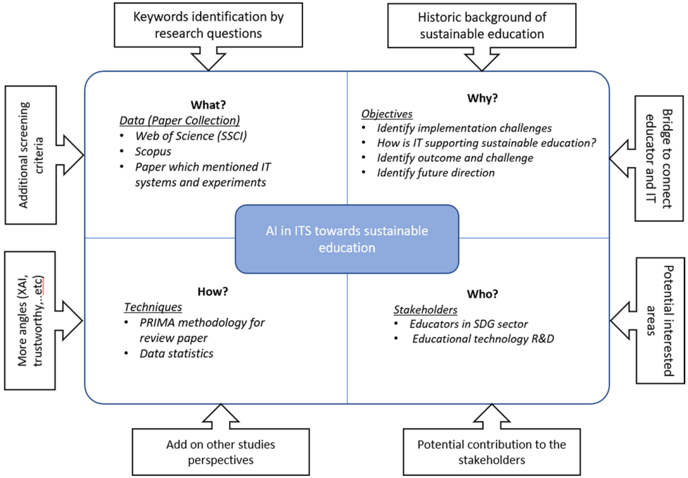
Sustainable education is a crucial aspect of creating a sustainable future, yet it faces several key challenges, including inadequate infrastructure, limited resources, and a lack of awareness and engagement. Artificial intelligence (AI) has the potential to address these challenges and enhance sustainable education by improving access to quality education, creating personalized learning experiences, and supporting data-driven decision-making. One outcome of using AI and Information Technology (IT) systems in sustainable education is the ability to provide students with personalized learning experiences that cater to their unique learning styles and preferences. Additionally, AI systems can provide teachers with data-driven insights into student performance, emotions, and engagement levels, enabling them to tailor their teaching methods and approaches or provide assistance or intervention accordingly. However, the use of AI and IT systems in sustainable education also presents challenges, including issues related to privacy and data security, as well as potential biases in algorithms and machine learning models. Moreover, the deployment of these systems requires significant investments in technology and infrastructure, which can be a challenge for educators. In this review paper, we will provide different perspectives from educators and information technology solution architects to connect education and AI technology. The discussion areas include sustainable education concepts and challenges, technology coverage and outcomes, as well as future research directions. By addressing these challenges and pursuing further research, we can unlock the full potential of these technologies and support a more equitable and sustainable education system.
Overview
CoChat Summary
TL;DR
This systematic review examines how AI and intelligent tutoring systems (ITSs) can support sustainable education, summarizing challenges, implementation approaches, outcomes, and future trends. It synthesizes 8 papers on sustainable education challenges and 29 papers on AI/ITS applications, emphasizing personalization, performance prediction, dropout prevention, and the need for explainable and human-centered AI.
Key findings
- The review identifies nine key sustainable education challenges: more students in virtual/blended learning; unequal global access and connectivity; teachers’ ICT skills and acceptance; lack of physical/emotional interaction; limited collaborative learning; engagement and dropout concerns; privacy/security; fairness and bias correction; and interpretability/transparency.
- Among 29 AI/ITS papers, the most common purposes were performance prediction (13), learning behavior analysis (9), engagement and dropout prevention (5), adaptation/personalization (5), instructors’ support (4), intervention (3), tutoring systems assessment (2), and self-regulation learning improvement (2).
- Reported outcomes included high-accuracy performance prediction (10 papers), identified learner behaviors (6), improved participation via early dropout notification (5), explainable results to instructors (2), and, for AI-embedded systems, improved performance through interaction with the AI system (3).
- Future directions emphasize explainable AI, human-centered AI, fairness, trustworthiness, and portability; only 2 of the 29 surveyed papers focused on explainable AI.
Methods
- The review follows the PRISMA methodology and uses a conceptualization process based on Yin’s qualitative research approach and Chatti et al.’s learning analytics reference model.
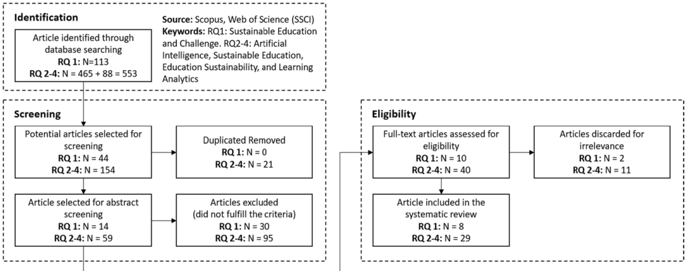
- For RQ1, Scopus was searched with “Sustainable Education” and “Challenge,” yielding 113 articles and selecting 8. For RQ2–RQ4, Scopus and Web of Science (SSCI) were searched with “Artificial Intelligence” AND (“Education Sustainability” OR “Sustainable Education” OR “Learning Analytics”), yielding 465 Scopus and 88 SSCI records, from which 29 papers were selected.
- Searches were limited to English-language journal or conference papers, with inclusion/exclusion criteria applied; selected papers were coded by data type, methods, objectives, and target learners/stakeholders.
Limitations
- The paper states that limitations and challenges of AI-embedded tutoring systems include the amount of data, feature extraction improvement, need for longer-period learning data, and solutions not being portable to other tutoring systems.
- It notes that most research does not explain why and how machine learning algorithms perform predictions, and that bias, fairness, and equality concerns arise from overfitting and the need for more and better training data.
- Evident from the text: the review is a qualitative synthesis without meta-analysis or formal effect-size aggregation, and its evidence base is restricted to Scopus/Web of Science, English-language journal and conference papers.
Model-written summary. Check it against the paper before relying on it.
Integrity signals
Registry
Cites
Statistics
Figures
Verification
Claims the paper makes
5 Valid · 7 Not valid · 41 Not checked · 38 Own results and interpretations
At least one cited source doesn’t support this claim or points to a different paper, and none confirmed it — see the verdicts below.
In the paper
“On the other hand, when performing learning behavior analysis (Pereira et al., 2021;Weng et al., 2020), most of the technology used turns to unsupervised learning, which also makes sense since there are no ground truth data for model training and the overall concept is for clustering or categorization without any reference.”
§ Smart Learning > RQ2: how are AI and IT incorporated as the ITS to support sustainable education?
What the sources say
- Disputedcites Pereira et al., 2021 matched to “Explaining Individual and Collective Programming Students’ Behavior by Interpreting a Black-Box Predictive Model” (2021) sourceExperimental — accuracy not yet measured
Our copy says the opposite of what is attributed: Sec. III (Related Work) states that 'educational data-driven researches identify patterns of behaviour based on data collected from the students learning process' and that 'there are many works in this field that use ML to construct predictive models', i.e. supervised prediction, not unsupervised clustering. The Introduction likewise frames prior work as methods 'to predict CS1 students' performance' and the paper itself trains a supervised XGBoost classifier on ground-truth pass/fail labels (Sec. V-E, 'students who passed (class 1) and students who failed (class 0)'), so the claim's rationale that 'there are no ground truth data for model training' is contrary to this source. The only unsupervised element is k-means applied post-hoc to Shapley values of the trained supervised model (Sec. V-G, Prediction Paths), presented as a contribution ('a new clustering approach'), not as the dominant technology of the field. (LLM, conf=0.70)
Checked by a reasoning model — may be wrong.
- Not checked yetcites Weng et al., 2020
plainstates an association- Asserted: passes — The authors put it forward as true.
- Checkable: passes — It can be checked against evidence.
- Load-bearing: unclear — It is unclear whether the paper’s conclusions depend on it.
- Based: passes — The paper gives a reason why it holds.
- Disputed
The cited sources support only part of this claim — read each source’s verdict below.
In the paper
“More challenges taking care of more students during virtual or blended learning environment (Tsegay et al., 2022;Wade, 2012), it may be because students are from remote especially like under COVID situation, and the instructors are forced to use tutoring systems to deliver courses on line.”
§ Smart Learning > RQ1: what are the key challenges of sustainable education implementation?
What the sources say
- Not checked yetcites Tsegay et al., 2022
- Partly supportedcites Wade, 2012 matched to “Pedagogy, Places And People” (2012) sourceExperimental — accuracy not yet measured
Wade (2012) does support the general point: the section 'challenges and opportunities of the virtual world' states that the exponential rise in 'distance or blended learning course, at least partially mediated by online provision' 'has thrown up a wide range of challenges and opportunities', and 'A formal taught course' describes the strain on tutors — students contacting tutors 'at all hours of the day and this is just not manageable... In personal sustainability terms for tutors this would be quite impossible so clear parameters need to be set'. However, no passage in our copy attributes the challenge to caring for *more* (larger numbers of) students, nor frames student volume as 'a key challenge of sustainable education implementation'; the paper's listed challenges are tutor accessibility/protocols, unequal broadband access in Sub-Saharan Africa, students' wariness of posting online, and the uncritical environmental cost of ICT. The remote/COVID gloss in the citing sentence is the citing authors' own framing (this paper predates it), and the Tsegay et al. (2022) part of the citation is separate evidence not judged here. (LLM, conf=0.72)
hedged- Asserted: passes — The authors put it forward as true.
- Checkable: passes — It can be checked against evidence.
- Load-bearing: unclear — It is unclear whether the paper’s conclusions depend on it.
- Based: passes — The paper gives a reason why it holds.
The cited sources support only part of this claim — read each source’s verdict below.
In the paper
“There are also some researchers who have explored different learning behaviors (Ruipérez-Valiente et al., 2021;Yang et al., 2021a, b) through clustering algorithms, which can also provide instructors with information for further intervention as necessary.”
§ Smart Learning > RQ3: what are the outcomes of AI/IT embedded as the ITS in sustainable education?
What the sources say
- Partly supportedcites Ruipérez-Valiente et al., 2021 matched to “Data-driven detection and characterization of communities of accounts collaborating in MOOCs” (2021) sourceExperimental — accuracy not yet measured
Our copy supports the clustering-of-behaviours half: Section 3.5.1/3.5.3 describe applying the IBM SPSS Two-Step clustering method to find different types of student accounts based on their engagement with the platform, and Section 5.1 reports the resulting cluster types (fruitful collaboration, free-riding, illicit, CAMEO). On the instructor-benefit half, Section 5.2 (Implications) only states that the work can 'provide the teacher with tools that allow them to somehow improve the design and development of MOOCs to promote more collaboration' and suggests course-design controls (randomization, linking accounts to a physical person) — i.e. course-design and dishonesty-deterrence measures, not information for instructors to intervene with individual students as necessary. The related-work statement in Section 2.1 that results 'can help understand instructors and researchers which behaviors can have a positive or negative impact' is credited to other studies ([27], [28]), not to clustering. (LLM, conf=0.72)
- Not checked yetcites Yang et al., 2021a, b
plainstates a cause- Asserted: passes — The authors put it forward as true.
- Checkable: passes — It can be checked against evidence.
- Load-bearing: unclear — It is unclear whether the paper’s conclusions depend on it.
- Based: passes — The paper gives a reason why it holds.
- Partly supported
The sources with a verdict support this claim; the rest weren’t checked yet, have no full text we could read, or their verdicts aren’t rated yet.
In the paper
“There are also some researchers who have explored different learning behaviors (Ruipérez-Valiente et al., 2021;Yang et al., 2021a, b) through clustering algorithms, which can also provide instructors with information for further intervention as necessary.”
§ Smart Learning > RQ3: what are the outcomes of AI/IT embedded as the ITS in sustainable education?
What the sources say
- Supportedcites Ruipérez-Valiente et al., 2021 matched to “Data-driven detection and characterization of communities of accounts collaborating in MOOCs” (2021) source
The source applies clustering to characterize behavioral profiles: Section 3.5.3 states it used the IBM SPSS Two-Step clustering method (Section 3.5.1) 'to find different types of student accounts based on their engagement with the learning platform,' and Section 5.1 reports detecting 'different collaboration behaviors among accounts' via that cluster analysis. Its review in Section 2.1 likewise surveys clustering studies that 'find different behavioral profiles of students,' and Section 5.2 (Implications) says the work can 'provide the teacher with tools' to improve MOOC design and to deter dishonesty/free-riding, which covers the citing sentence's point about information for instructor action. The paraphrase is broad but matches what our copy does. (LLM, conf=0.85)
- Not checked yetcites Yang et al., 2021a, b
plain- Asserted: passes — The authors put it forward as true.
- Checkable: passes — It can be checked against evidence.
- Load-bearing: unclear — It is unclear whether the paper’s conclusions depend on it.
- Based: passes — The paper gives a reason why it holds.
- Supported
The sources with a verdict support this claim; the rest weren’t checked yet, have no full text we could read, or their verdicts aren’t rated yet.
In the paper
“Of the 29 surveyed papers, only 2 focus on the result and try to leverage explainable AI (Afzaal et al., 2021;Pereira et al., 2021) on machine learning prediction.”
§ Smart Learning > RQ3: what are the outcomes of AI/IT embedded as the ITS in sustainable education?
What the sources say
- Not checked yetcites Afzaal et al., 2021
- Supportedcites Pereira et al., 2021 matched to “Explaining Individual and Collective Programming Students’ Behavior by Interpreting a Black-Box Predictive Model” (2021) source
The Introduction says the paper interprets a predictive model’s decisions, and the Conclusion says it developed an explainable machine-learning pipeline for predicting student performance. This supports citing Pereira et al. as an example of a paper applying explainable AI to machine-learning prediction. The count of 29 surveyed papers is the citing authors’ own survey finding, not a finding attributed to Pereira et al. (LLM, conf=0.91)
plain- Asserted: passes — The authors put it forward as true.
- Checkable: passes — It can be checked against evidence.
- Load-bearing: passes — The paper’s conclusions depend on it.
- Based: passes — The paper gives a reason why it holds.
28 more claims
Create a free account to see all 91 claims and to verify the 71 references still open.
- Probably not a substantial claim. 48
- It may state two separate claims as one. 27
- The quote only partly states this claim. 1
Claims other papers make about this one
Each is checked against this paper’s own text: does it say what the citing paper says it does?
The source backs part of the claim, not all of it — or backs it for a different population, condition or comparison.
In the citing paper
“It can support learners by providing customized feedback and opportunities for repeated practice appropriate to their level.”
From Development and pilot evaluation of an AI-based pediatric medication safety virtual simulation program for nursing students: a quasi-experimental study in South Korea (2026) · cites this paper as [12]
Experimental — accuracy not yet measuredThe source backs part of the claim, not all of it — or backs it for a different population, condition or comparison.
In the citing paper
“By analyzing learners’ input in real time, AI can identify patterns of errors in clinical performance and reasoning.”
From Development and pilot evaluation of an AI-based pediatric medication safety virtual simulation program for nursing students: a quasi-experimental study in South Korea (2026) · cites this paper as [12]
Experimental — accuracy not yet measuredThe cited source says what the claim attributes to it.
In the citing paper
“It can also promote adaptive learning by providing educational content tailored to students’ individual needs and learning styles [12].”
The cited source says what the claim attributes to it.
In the citing paper
“This approach enables instructors to utilize personalized AI-generated feedback without diminishing the role of traditional instruction [12,33].”
From The Role of AI in Academic Writing: Impacts on Writing Skills, Critical Thinking, and Integrity in Higher Education (2025) · cites this paper as [33]
In the citing paper
“Given that AI tools can provide instant feedback, students can work at their own pace, and those requiring additional support can benefit from AI assistance without the necessity of one-on-one tutoring [33].”
From The Role of AI in Academic Writing: Impacts on Writing Skills, Critical Thinking, and Integrity in Higher Education (2025) · cites this paper as [33]
2 more claims about this paper
Create a free account to see every claim other papers make about this one.
Self-check
Percentages, sums and reported differences re-computed from the paper’s own numbers.
Each contradiction between two passages listed here was confirmed by an independent check.
Rated minor: it would not touch a result — a value no result rests on, a p-value that stays on the same side of the significance level, or a conflict that is clerical, resolved elsewhere in the paper, or outside its own findings.
In the paper
§ Smart Learning > RQ3: what are the outcomes of AI/IT embedded as the ITS in sustainable education?
“For AI-embedded tutoring systems, most of the outcomes indicate that the performance prediction accuracy is high (Guerrero-Higueras et al., 2018;Hasnine et al., 2018)”
§ Smart Learning > Conclusions
“| AI not Embedded in | Performance prediction algorithm verified with high accuracy | 10 |”
Citations
Cites
The PRISMA 2020 statement: An updated guideline for reporting systematic reviews
Page, M. J., McKenzie, J. E., Bossuyt, P. M., Boutron, I., Hoffmann, T. C., Mulrow, C. D., Shamseer, L., Tetzlaff, J. M., Akl, E. A., Brennan, S. E., et al. (2021) · BMJ · doi:10.1136/bmj.n71 · Cited by 108,283
Arrieta, A. B., Díaz-Rodríguez, N., Del Ser, J., Bennetot, A., Tabik, S., Barbado, A., García, S., Gil-López, S., Molina, D., Benjamins, R., et al. (2019) · arXiv · doi:10.48550/arxiv.1910.10045 · Cited by 11,321 · cited 1×
“In the XAI review paper, Arrieta et al. (2020) categorized many common machine learning algorithms in detail and described how a model can be explained.”
BackgroundBarredo Arrieta, A., Díaz-Rodríguez, N., Del Ser, J., Bennetot, A., Tabik, S., Barbado, A., Garcia, S., Gil-Lopez, S., Molina, D., Benjamins, R., et al. (2020) · Information Fusion · doi:10.1016/j.inffus.2019.12.012 · Cited by 10,423 · cited 1×
“In the XAI review paper, Arrieta et al. (2020) categorized many common machine learning algorithms in detail and described how a model can be explained.”
BackgroundThe PRISMA 2020 statement: an updated guideline for reporting systematic reviews
Page, M. J., McKenzie, J., Bossuyt, P., Boutron, I., Hoffmann, T., mulrow, C., Shamseer, L., Tetzlaff, J., Akl, E., Brennan, S. E., et al. (2020) · doi:10.31222/osf.io/v7gm2_v1 · Cited by 8,090
Qualitative Research from Start to Finish
Yin, R. K. (2010) · Medical Entomology and Zoology · Cited by 5,667
The PRISMA 2020 statement: an updated guideline for reporting systematic reviews
Page, M. J., McKenzie, J., Bossuyt, P., Boutron, I., Hoffmann, T., mulrow, C., Shamseer, L., Tetzlaff, J., Akl, E., Brennan, S. E., et al. (2020) · doi:10.31222/osf.io/v7gm2 · Cited by 5,177
Human-Centered Artificial Intelligence: Reliable, Safe & Trustworthy
Shneiderman, B. (2020) · International Journal of Human–Computer Interaction · doi:10.1080/10447318.2020.1741118 · Cited by 1,743 · cited 1×
“Shneiderman (2020) defined a two-dimensional approach for categorizing and providing guidance on how to produce system designs that are Reliable, Safe, and Trustworthy (RST).”
DARPA's Explainable Artificial Intelligence Program
Gunning, D., & Aha, D. W. (2019) · AI Magazine · doi:10.1609/aimag.v40i2.2850 · Cited by 1,360 · cited 1×
“Similar to the 4-year project conducted by DARPA (Gunning & Aha, 2019), the technical teams were requested to provide an explainable model and explanation interface to support users making decisions.”
MethodAI in CAI: An Artificial-Intelligence Approach to Computer-Assisted Instruction
Carbonell, J. (1970) · IEEE Transactions on Man Machine Systems · doi:10.1109/tmms.1970.299942 · Cited by 955 · cited 1×
“The overall concept can be traced back to 1970 (Carbonell, 1970).”
BackgroundExplainable Artificial Intelligence in education
Khosravi, H., Shum, S. B., Chen, G., Conati, C., Tsai, Y.-S., Kay, J., Knight, S., Martinez-Maldonado, R., Sadiq, S., & Gašević, D. (2022) · Computers and Education: Artificial Intelligence · doi:10.1016/j.caeai.2022.100074 · Cited by 863 · cited 2×
“Khosravi et al. (2022) deeply explore XAI in terms of education, which also provides good guidance for educators and IT solution architects.”
Background
Research works printed but not linked: 2
- Lu, O. H. T., Huang, A. Y. Q., & Yang, S. J. H. (2018). Benchmarking and tuning regression algorithms on predicting students' academic performance. In 26th International conference on computers in education, Philippines.
- Sterling, S. R., & Orr, D. (2001). Sustainable education: Re-visioning learning and change (Vol. 6). Green Books for the Schu- macher Society Totnes.
Cited by
Items 301–400 of 897
Designing Adaptive Career Recommender Interfaces: Insights from South African University Students
Mavuso, N. C., van Greunen, D., & Jere, N. R. (2025) · African Human Computer Interaction Conference (AfriCHI) · doi:10.1145/3757232.3757246 · Cited by 2
Rajan, P. R. (2025) · Elsevier eBooks · doi:10.1016/b978-0-443-41660-6.00001-6 · Cited by 5
Bolaji, H. O., & Ahmed, A. A. (2025) · Universal Education Journal of Teaching and Learning · doi:10.63081/uejtl.v2i3.98 · Cited by 2
Retracted: Revolutionizing E-Learning through AI: A Personalized and Adaptive Learning Ecosystem
Kalaiarasi, K., Sathiyasuntharam, V., Ananya, B., Radhika, T., Ashwin, B., & Amrutha, R. (2025) · International Conference on Recent Innovation in Science Engineering and Technology (ICRISET) · doi:10.1109/icriset64803.2025.11253766 · Cited by 2
RetractedArtificial Intelligence and Adaptive Learning Technologies
Dikkatwar, R., Mohite, M., Sharma, S., Selvakumar, P., Jayadeva, S. M., & Manjunath, T. C. (2025) · IGI Global eBooks · doi:10.4018/979-8-3373-5157-5.ch011 · Cited by 3
Masalimova, A. R., Kosheleva, Y. P., Burov, А. I., Payushina, O. V., Sokolova, N. L., & Khvatova, M. A. (2025) · Contemporary Educational Technology · doi:10.30935/cedtech/17482 · Cited by 3
Manani, J. L., & Limachi, H. A. (2025) · Revista de Propuestas Educativas · doi:10.61287/propuestaseducativas.v7i15.5 · Cited by 2
Measuring Student Trust and Over-Reliance on AI Tutors: Implications for STEM Learning Outcomes
Mai, N. T., Fang, Q., & Cao, W. (2025) · International Journal of Social Sciences and English Literature · doi:10.55220/2576-683x.v9.799 · Cited by 52
Cai, X. (2026) · Language Teaching Research · doi:10.1177/13621688251398618 · Cited by 4
TeachSecure-CTI: Adaptive Cybersecurity Curriculum Generation Using Threat Dynamics and AI
Tolah, A. (2026) · Computers, materials & continua/Computers, materials & continua (Print) · doi:10.32604/cmc.2025.074997 · Cited by 2
“Current approaches either emphasise generic adaptability without domain relevance [9,10] or employ static methods unable to address emerging threats [14,16].”
Uchoa, A. P., Oliveira, C., Motta, C. L. R., & Schneider, D. (2026) · Communications in computer and information science · doi:10.1007/978-3-032-16451-3_23 · Cited by 5
Munenakoppa, M., Rane, N. L., Rane, J., & Heggond, S. B. (2026) · International Journal of Applied Resilience and Sustainability · doi:10.70593/deepsci.0202011 · Cited by 8
Artificial intelligence-driven green education for sustainable development goals: A review
Chaudhary, A. (2026) · International Journal of Applied Resilience and Sustainability · doi:10.70593/deepsci.0202001 · Cited by 4
A systematic review of sociocultural sustainability in tourism and hospitality: trends and gaps
Shirazi, R. S., Rezapouraghdam, H., & Saydam, M. B. (2026) · International Hospitality Review · doi:10.1108/ihr-03-2025-0029 · Cited by 2
Julien, G. (2026) · Journal of Creative Research in English Literature and Culture · doi:10.25125/jcrelc-feb-2026-3 · Cited by 3
Prompt Engineering and Multimodal Tasks in AI-Supported EFL Education: A Mixed Methods Study
Roy, D., Fragulis, G. F., & Surbhi, A. (2026) · Sustainability · doi:10.3390/su18052415 · Cited by 4
BOUNNITE, M. Y. (2026) · Quality & Quantity · doi:10.1007/s11135-026-02658-5 · Cited by 2
“…- tions, the system can forecast when confusion is likely to persist beyond a critical threshold, triggering real-time pedagogical interventions: These mechanisms align with research advocating for human in the loop personalization and dynamic scaffolding (Taub et al. 2020; Lin et al. 2023).”
Teachers’ perceptions and adoption of artificial intelligence in higher education
Silamanthula, H. K., Singavarapu, R. B., Rajesh, M., Mallavarapu, S. S., & Katru, E. R. (2026) · International Journal of Applied Resilience and Sustainability · doi:10.70593/deepsci.0202028 · Cited by 2
“Within such settings, AI will help in lesson design, evaluation, and more personalized suggestions, enabling educators to devote their time and energy to mentoring, innovation, and critical thinking [36,42-44].”
Bonilla, I. M., Guarneros-Reyes, E., & Silva-Rodríguez, A. (2026) · Ciencia Latina Revista Científica Multidisciplinar · doi:10.37811/cl_rcm.v10i2.23160 · Cited by 2
“…et al., 2023; Sa-ad et al., 2025); (2) altos costos y complejidad operativa de autoría y mantenimiento en ITS tradicionales (Feng et al., 2021; Lin et al., 2023); (3) dependencia del diseño pedagógico y del control de calidad para que la IA generativa sea útil y segura (Fuchs, 2023; Guizani…”
InfluentialIturralde, D. D. O. (2026) · Etic net Revista científica electrónica de Educación y Comunicación en la Sociedad del Conocimiento · doi:10.30827/eticanet.v26i1.31168 · Cited by 2
AI-Driven Digital Infrastructure and Infrastructure Innovation Systems: A Conceptual Analysis
Anh, N. M., & Huy, T. Q. (2026) · Civil Engineering Science and Technology · doi:10.51903/cpapgr89 · Cited by 2
Ethical Leadership and Governance Frameworks for Responsible AI Adoption in Higher Education
Atef, R. (2026) · Advances in computational intelligence and robotics book series · doi:10.4018/979-8-2600-1840-8.ch001 · Cited by 3
Vanessa.KA, V. K., Kingsly, G., & Thavaraj, H. S. (2026) · INTERNATIONAL JOURNAL OF RESEARCH AND ANALYTICAL REVIEWS · doi:10.56975/ijrar.v13i2.334515 · Cited by 2
Li, H., & Derakhshan, A. (2026) · BMC Psychology · doi:10.1186/s40359-026-04884-w · Cited by 3
“Intelligent tutoring systems, according to Lin et al. [27], are computer-based learning systems that use AI to offer adaptive and personalized education to learners.”
InfluentialExploring Student Acceptance of AI Teaching Assistants in African Higher Education
Hu, Z. (2026) · Trends in Higher Education · doi:10.3390/higheredu5030053 · Cited by 2
“For example, intelligent tutoring systems can adapt instructional content based on individual learners’ needs, allowing students to progress at their own pace [12].”
AI Integration in Indonesian Education: Trends, Outcomes, and Challenges - A Comprehensive Review
Riski, A., Paais, R. L., Komariah, A., Novebri, N., Alang, L. P., Ataupah, W. V., Yurihana, Z., Bety, M. V., Ramadhan, D., Syarifudin, A., et al. (2026) · F1000Research · doi:10.12688/f1000research.188536.1 · Cited by 2
The Transformative Impacts of Artificial Intelligence on Education through Ethical Perspectives
Ranjan, R., Vishwakarma, A. K., Sundaram, S., Dhengre, N., Motdhare, S. S., & Rao, A. P. (2024) · International Conference on Computing, Communication and Networking Technologies (ICCCNT) · doi:10.1109/icccnt61001.2024.10726162 · Cited by 2
“As time progressed, Computer-Assisted Instruction (CAI) underwent a transformation, evolving into intelligent tutoring systems (ITS) with the goal of emulating personalized interactions akin to those between students and tutors [3].”
BackgroundGetting Students' Preferences Right: AI-Powered Macrolearning
Rof, A., Bikfalvi, A., & Marquès, P. (2025) · International Journal of Distance Education Technologies · doi:10.4018/ijdet.374214 · Cited by 2
“In this regard, the incorporation of AI contributes to more equal access to education (Lin et al., 2023).”
Selfit v2 – The evaluation of an Intelligent Tutoring System for Psychomotor Development.
Neagu, L.-M., Rigaud, É., Guarnieri, V., Ghita, V., Travadel, S., Dascălu, M., & Rughiniș, R. (2025) · Interaction design & architecture(s)/ID&A Interaction design & architecture(s) · doi:10.55612/s-5002-067-008 · Cited by 2
Artificial Intelligence in Skill Development
Bhowmick, M., Goswami, S., Chakraborty, R., Bhowmick, P., Nandy, S. K., Afrose, N., & Kewatkar, S. M. (2024) · Advances in human resources management and organizational development book series · doi:10.4018/979-8-3693-6412-3.ch006 · Cited by 3
A BIBLIOMETRIC REVIEW OF ROLE OF ARTIFICIAL INTELLIGENCE IN EDUCATION
Yadav, B., & Anubha, A. (2024) · ShodhKosh Journal of Visual and Performing Arts · doi:10.29121/shodhkosh.v5.i6.2024.3206 · Cited by 4
The Collaborative Intelligent Mathematics Tutoring Agent Platform
Meng, H., Zhao, Q., Wang, X., Shen, J., Luo, Y., & Xie, F. (2024) · IEEE International Conference on Agents (ICA) · doi:10.1109/ica63002.2024.00041 · Cited by 2
“Systems [5]–[8] like Auto Tutor use AI and data models to provide personalized learning tutoring, though they generally focus on specific tasks and are not perfect for reasoning.”
GREENING THE SCIENCE CLASSROOM: A COMPREHENSIVE REVIEW ENVIRONMENTAL EDUCATION PRACTICES
Lestari, J., Mohamed, M., Efendi, M. H., & Purwati, N. (2024) · International Journal of Modern Education · doi:10.35631/ijmoe.622001 · Cited by 2
The Emerging Influence of Artificial Intelligence on Traditional Medical Textbooks
Dearani, J. A., & Mavroudis, C. D. (2025) · The Annals of Thoracic Surgery · doi:10.1016/j.athoracsur.2025.01.018 · Cited by 2
Gan, W., Sun, Y., & Yu, X. (2024) · International Conference on Intelligent Education and Intelligent Research (IEIR) · doi:10.1109/ieir62538.2024.10960029 · Cited by 2
Zhang, Y. (2025) · Current Psychology · doi:10.1007/s12144-025-08015-3 · Cited by 1
“For instance, tutoring systems that are powered by artificial intelligence ("AI") dynamically modify instructional strategies and difficulty levels to correspond with the progress of a student, in a manner similar to that of a human educator (Lin et al., 2023 ).”
Jin, Z. (2025) · International Symposium on Innovative Approaches in Smart Technologies (ISAS) · doi:10.1109/isas66241.2025.11101779 · Cited by 2
“Studies conducted on the effects of ITS in China indicate that these systems are useful in enhancing learning since they provide the students with immediate feedback on whether they are on the right track or not while at the same time motivating the students to continue learning [18].”
More than a chatbot: Human-centered AI for student engagement and academic efficiency
(2025) · Issues in Information Systems · doi:10.48009/1_iis_124 · Cited by 4
Jiao, J., & Shakibaei, G. (2025) · International Journal of Inclusive Education · doi:10.1080/13603116.2025.2565404 · Cited by 4
“AI-powered tools can provide teachers with valuable data on student progress, facilitating timely interventions and personalized support (Lin, Huang, and Lu 2023).”
MultiGen: Child-Friendly Multilingual Speech Generator with LLMs
Gao, X., Zhang, H., & Chen, N. F. (2025) · Companion Publication of the International Conference on Multimodal Interaction (ICMI Companion) · doi:10.1145/3747327.3764897 · Cited by 4
Cho, I. Y., Cho, S., Im, M. Y., Jeong, H. J., Choi, J., Choi, I. H., & Kim, H. Y. (2026) · Child Health Nursing Research · doi:10.4094/chnr.2026.016 · Cited by 1
“It can also promote adaptive learning by providing educational content tailored to students’ individual needs and learning styles [12].”
Enhancing Assessment Systems in Higher Education: A Review on Artificial Intelligence Usage
Al-Amin, M., Saqui, F. Z., & Khan, M. R. (2024) · Advances in educational technologies and instructional design book series · doi:10.4018/979-8-3693-2145-4.ch002 · Cited by 2
Introduction to human-machine interaction
Ahmed, S. S., Nisar, H., & Lo, P. K. (2024) · Elsevier eBooks · doi:10.1016/b978-0-443-29150-0.00008-1 · Cited by 3
Han, O. (2024) · The Journal of Korean Association of Computer Education · doi:10.32431/kace.2024.27.4.010 · Cited by 1
Kumari, D. A., Gowtham, M., Sudha, S., Divya, R., Sundari, K. S. B. T., & Vardhini, V. (2024) · International Conference on Advances in Computation, Communication and Information Technology (ICAICCIT) · doi:10.1109/icaiccit64383.2024.10912317 · Cited by 1
“Numerous research have examined how deep learning could be applied to raise student participation and understanding [7].”
Ediriweera, C., Pramudika, H., & Fernando, M. T. (2025) · Colombo Journal of Multi-Disciplinary Research · doi:10.4038/cjmr.v9i1-2.80 · Cited by 3
“AI helps educators to analyse student behaviour, performance, and student emotions (Lin et al., 2023).”
Trustworthy AI Meets Educational Assessment: Challenges and Opportunities
Li, S. (2025) · Proceedings of the AAAI Conference on Artificial Intelligence · doi:10.1609/aaai.v39i27.35089 · Cited by 6
Abdalla, R. A., Hidaytalla, L. A., Mulla, G. S., Al-Salman, M. M., Hammad, M., & Ahmed, E. (2025) · Studies in big data · doi:10.1007/978-3-031-83915-3_31 · Cited by 2
AI Tools: A Nostrum for Modern-Day Linguistic Educators and Learners
Jalan, V., Fouzdar, A. S., Oberai, H., & Saxena, A. (2025) · Advances in computational intelligence and robotics book series · doi:10.4018/979-8-3693-7260-9.ch004 · Cited by 1
Recommendation Systems to Aid Learning Using Artificial Intelligence: A Systematic Review
Henning, M., Ramos, V. F. C., Gracioli, G., & Cechinel, C. (2025) · Lecture notes in educational technology · doi:10.1007/978-981-96-3698-3_22 · Cited by 1
Artificial Intelligence in Education: A Systematic Review for Learning Techniques
Mohammed, S. J., Alkhaykanee, N. A., & Triassanti, R. (2025) · Information systems engineering and management · doi:10.1007/978-3-031-89960-7_12 · Cited by 1
Teachers' Technological Innovation Intention and Performance in the E-Learning Context
Zhang, X. Q., Shao, X., Hu, C., Dong, R. K., & Wu, C. (2025) · Journal of Organizational and End User Computing · doi:10.4018/joeuc.379724 · Cited by 1
Liu, L. (2024) · International Conference on Artificial Intelligence, Digital Media Technology and Interaction Design (ICADI) · doi:10.1145/3726010.3726091 · Cited by 1
AI in Education: Revolutionizing English Learning
Hossain, S. K. A., Yeasmin, F., & Kabir, S. (2025) · Advances in computational intelligence and robotics book series · doi:10.4018/979-8-3373-1952-0.ch001 · Cited by 1
Personalized Learning Paths: Bayesian Network-Based Pre-Assessment Grouping
Asunta, M. G., Mwangi, R. W., & Kimwele, M. W. (2025) · IST-Africa Conference (IST-Africa) · doi:10.23919/ist-africa67297.2025.11060519 · Cited by 1
“With the great advancement, it calls for increased focus on development and application of systems that are intelligent to have deep cognitive abilities to tailor an instruction process based on the needs and preferences of the learners [5].”
Artificial Intelligence and the Transformation of Career Technical Education
Crevar, A. R., Dubey, P., & Rischard, M. W. (2025) · Advances in computational intelligence and robotics book series · doi:10.4018/979-8-3373-5092-9.ch002 · Cited by 1
Garcia, M. B., Metwally, A. H. S., Wang, T., Ofosu‐Ampong, K., Alasgarova, R., Nerantzi, C., Nixon, J., & Bozkurt, A. (2025) · Advances in computational intelligence and robotics book series · doi:10.4018/979-8-3373-6007-2.ch003 · Cited by 1
Akefe, I. O., Adegoke, V. A., Akefe, E., Schweitzer, D. R., & Bolaji, S. (2025) · Trends in Higher Education · doi:10.3390/higheredu4030036 · Cited by 3
Harnessing ChatGPT-4o for Personalized Online Learning
Yabouri, H. E., Hibbi, F.-Z., & Abdoun, O. (2025) · Lecture notes on data engineering and communications technologies · doi:10.1007/978-3-031-98476-1_9 · Cited by 1
Understanding Privacy Concerns in Educational AI Systems
Khan, F., Arora, S., Pargaien, S., Mer, A., Khati, K., & Pande, L. (2025) · Lecture notes in networks and systems · doi:10.1007/978-981-96-3652-5_15 · Cited by 3
AI Innovations in Higher Education and Management of Students
Kumar, S., Thakur, K., & Kumar, A. D. (2025) · Advances in computational intelligence and robotics book series · doi:10.4018/979-8-3373-2150-9.ch002 · Cited by 1
AI-Enhanced Language Acquisition: Transforming the Learning Experience
Anshari, A., & Asrifan, A. (2025) · Advances in computational intelligence and robotics book series · doi:10.4018/979-8-3373-6330-1.ch005 · Cited by 2
Applications and Analysis of Artificial Intelligence in Modern Education
Guo, J. (2025) · Transactions on Computer Science and Intelligent Systems Research · doi:10.62051/hkn3xj93 · Cited by 1
Leveraging ChatGPT for Language Learning: A Study on Foreign Teachers’ Swedish Acquisition
Johansson, S., & Larsson, L. (2025) · doi:10.31274/isudp.2025.211.03 · Cited by 1
Migdalia Barría, G., & O., C. E. B. (2025) · Estudios y Perspectivas Revista Científica y Académica · doi:10.61384/r.c.a..v5i3.1410 · Cited by 1
Devaraju, B. N., & Sowmya, N. S. (2025) · International Journal For Multidisciplinary Research · doi:10.36948/ijfmr.2025.v07i04.54940 · Cited by 1
An Intelligent Tutoring System for Quote Generation Training in the Industry
Pashev, G., & Gaftandzhieva, S. N. (2025) · International Conference on Information Technologies (InfoTech) · doi:10.1109/infotech67177.2025.11175943 · Cited by 1
“Recent advancements in Generative Artificial Intelligence (AI), Large Language Models (LLMs), and multimodal AI are significantly advancing ITS capabilities by enabling dynamic content generation, real-time feedback, and highly adaptive learning pathways [1].”
Yang, L., Zhang, Y., Xu, Y., Zhang, Y., & Zeng, Z. (2025) · Neural Networks · doi:10.1016/j.neunet.2025.108209 · Cited by 1
Xu, B., & Zheng, L. (2025) · Advances in computational intelligence and robotics book series · doi:10.4018/979-8-3373-7508-3.ch009 · Cited by 2
Revolutionizing Education: The CourseSphere AI Platform for Personalized Learning
Sarker, A., Islam, M. T., Karmaker, R., Chowdhury, S., Roychoudhury, S., & Muthukumar, P. (2025) · International Conference on Circuit, Power and Computing Technologies · doi:10.1109/iccpct65132.2025.11176711 · Cited by 1
“CourseSphere AI is conceptualized to recognize that each student has a unique learning style and to provide tailored solutions to meet those individual needs [1, 2] .”
Empowering Pre-service Teachers Through Collaborating with ChatGPT to Explore Smartphone Colorimetry
Sirisathitkul, C., Dinmeung, N., Nuanjan, J., & Sirisathitkul, Y. (2025) · Journal of Science Education and Technology · doi:10.1007/s10956-025-10267-4 · Cited by 2
“…particular promise in inquiry-based teaching for pre-service teachers (Ramnarain et al., 2024), offering unique advantages over traditional methods by delivering instant, personalized feedback and creating interactive learning experiences tailored to individual needs (Cain, 2024; Lin et al., 2023).”
Yavuz, M., & Kayalı, B. (2025) · Advances in computational intelligence and robotics book series · doi:10.4018/979-8-3373-3815-6.ch006 · Cited by 1
Artificial Intelligence and ICT Systems for Promoting Inclusive, Equitable, and Quality Education
Sagir, Y., Yahya, A. T., & Naisa, A. U. K. (2025) · Journal of Information and Communications Technology Algorithms Systems and Applications · doi:10.64189/ict.25311 · Cited by 1
James, S. F., Gandhi, S. M. G., Isaac, R. A., & Sundaravadivel, P. (2025) · Lecture notes in networks and systems · doi:10.1007/978-981-95-0629-3_13 · Cited by 1
Plataformización del trabajo docente: caracterización de las relaciones y condiciones laborales
Giovine, M. A., Antolin-Solache, A.-M., González, F. J., & Rincón-Báez, W. U. (2025) · Revista Española de Educación Comparada · doi:10.5944/reec.48.2025.45383 · Cited by 1
INTERFACE DESIGN OF AN INTELLIGENT INTERACTIVE LEARNING SYSTEM
Ukenova, А., Bekmanova, G., Yergesh, B., & Altaibek, M. (2025) · Scientific Journal of Astana IT University · doi:10.37943/24vewa2615 · Cited by 1
Contreras, F. C., & Guerrero, J. C. O. (2025) · Revista Simón Rodríguez · doi:10.62319/simonrodriguez.v.5i10.58 · Cited by 1
KE-LPG: Toward Semantic Refinement for Lesson Plan Generation
Guo, H., Zhu, J., Pan, C., Wang, Q., Zhou, C., & Meng, C. (2025) · Arabian Journal for Science and Engineering · doi:10.1007/s13369-025-10808-4 · Cited by 3
Design and Evaluation of a Personalized AI Tutoring System Using ChatGPT
Nai, S., Moudden, T. E., Rifai, A., & Sadiq, A. (2025) · Advances in computational intelligence and robotics book series · doi:10.4018/979-8-3373-8011-7.ch006 · Cited by 1
Kurniawan, P. Y., Mumpuni, A., Yuniawan, T., Hasanudin, C., & Ariyatun, A. (2025) · Journal of Cultural Analysis and Social Change · doi:10.64753/jcasc.v10i2.2190 · Cited by 1
“…of AI-CreWLi shows that artificial intelligence can function as an educational partner that assists lecturers in providing quick feedback, objectively assessing student work, and monitoring the development of creative writing skills on an ongoing basis (Lin et al., 2023; Tanveer et al., 2020).”
Alabi, A. J., Adelekan, A. T., & Olotu, G. (2025) · ETDC Indonesian Journal of Research and Educational Review · doi:10.51574/ijrer.v5i1.3988 · Cited by 1
Raharjo, M. A., Rossydi, A., Burhanuddin, F., Octavianie, A., Idyaningsih, N., & Sukarman, S. (2025) · IJORER International Journal of Recent Educational Research · doi:10.46245/ijorer.v6i6.1107 · Cited by 1
Adaptive AI-Powered Learning Companion for Students
Raveesha, S., & Peiris, S. M. (2025) · International Conference on Business Analytics for Technology and Security (ICBATS) · doi:10.1109/icbats66542.2025.11258256 · Cited by 1
LXA v1.0: A Framework to Embrace Agentic AI in Mobile Learning for Industry 5.0 Readiness
Anthuvan, T., Prabhuram, S., Rathi, S., & Maheshwari, K. (2025) · International Journal of Interactive Mobile Technologies (iJIM) · doi:10.3991/ijim.v19i23.58635 · Cited by 1
Wu, H., Wu, G., Yang, R., Lin, M., & Zhang, W. (2025) · Thinking Skills and Creativity · doi:10.1016/j.tsc.2025.102102 · Cited by 1
Meteshkin, K. O., Kukhar, M., Shevchenko, V., & Masliy, L. (2025) · TECHNICAL SCIENCES AND TECHNOLOGIES · doi:10.25140/2411-5363-2025-3(41)-462-471 · Cited by 1
Sabancı, O., & Kutluay, G. (2025) · Advances in computational intelligence and robotics book series · doi:10.4018/979-8-3373-2948-2.ch005 · Cited by 1
Beyond algorithms: Revolutionized AI-education and human potentials for 2030
Khalaf, B. K., Ibrahim, H. I., makhlif, K., & Ali, S. J. (2025) · Research Journal in Advanced Humanities · doi:10.58256/fm5xwe42 · Cited by 1
Ragazou, V., & Antonis, K. (2025) · Next research. · doi:10.1016/j.nexres.2025.101299 · Cited by 1
Artificial Intelligence in Sustainable and Green Chemistry Education: A Bibliometric Analysis
Fitri, H. S. A., Putri, T. S., Rosa, Y. H. E., & Adumiranti, Y. (2026) · Lecture notes in educational technology · doi:10.1007/978-981-95-2521-8_42 · Cited by 1
Liang, S. Z., & Chan, Y. Y. (2026) · International Journal of Adolescence and Youth · doi:10.1080/02673843.2025.2610107 · Cited by 3
Pramudita, I. G. N. A. E. P., Sudipa, I. G. I., Fittryani, Y. P., Iswara, I. B. A. I., & Aristamy, I. G. A. A. M. (2026) · SinkrOn · doi:10.33395/sinkron.v10i1.15682 · Cited by 1
“…learning, and acting in a human-like manner, with the aim of not only creating computer vision capabilities but also building systems that are able to understand the environment, adapt to change, and respond naturally so that technology is increasingly relevant to humans (Lin et al., 2023).”
La IA como recurso tecnológico en la comprensión lectora
Taday, B., Chiluisa, A., & Fabara, K. M. G. (2026) · Revista Multidisciplinar de Estudios Generales · doi:10.70577/reg.v5i1.458 · Cited by 1
Kazim, D. T. (2026) · Journal Port Science Research · doi:10.36371/port.2026.1.14 · Cited by 2
Mogano, T. M., & Minty, R. (2026) · International Journal of Learning Teaching and Educational Research · doi:10.26803/ijlter.25.1.40 · Cited by 1
Bhoir, A. S., & Iyer, S. (2026) · Asian Journal of Management and Commerce · doi:10.22271/27084515.2026.v7.i2b.1010 · Cited by 1
Gao, N. (2025) · International Conference on Artificial Intelligence and Future Education (AIFE) · doi:10.1145/3785987.3786039 · Cited by 1
Scaffolding the Scaffolder: Augmenting Parental Agency in the Developmental Arena with Generative AI
Amorocho, J. D., & Giraldo-Huertas, J. J. (2026) · Human Arenas · doi:10.1007/s42087-025-00542-6 · Cited by 2
“The central challenge is to con - vert a process that is “contingent, collaborative, and interactive” (Wood et al., 1976)–tran - sient and multimodal–into codable observables the system can detect (Murray et al., 2023; Lin et al., 2023).”
Assessing students’ global competence using artificial intelligence: experimental research
Nikolaeva, S., Олегівна, Д. Я., & Syzenko, A. (2026) · International Journal of Evaluation and Research in Education (IJERE) · doi:10.11591/ijere.v15i1.34038 · Cited by 2
“Moreover, a systematic review examined AI’s role in intelligent tutoring systems, emphasizing its potential to enhance personalized learning experiences and support data-driven decision-making in sustainable education [12].”
AI for Personalized Learning Experiences: Adaptive Course Content and Intelligent Tutoring Systems
Khalil, S. A., Mahmood, M., Ali, Z., & Alam, I. (2026) · Advances in computational intelligence and robotics book series · doi:10.4018/979-8-3373-2752-5.ch010 · Cited by 1
Metadata
- Authors
- Lin, C.-C., Huang, A. Y. Q., & Lu, O. H. T.
- Affiliations
- National Central University (TW)
- National Chengchi University (TW)
- Corresponding author
- Lin, Chien-Chang
- Venue
- Smart Learning Environments
- Published
- 2023-08-28
- Volume
- 10
- Issue
- 1
- ISSN
- 2196-7091 (ISSN-L)
- OpenAlex
- W4386223224
- Semantic Scholar
- dfbc9f44f0ff3c994eecee83a48cb27dd20c51b0
- Cited by
- 669
- References
- 59
- Citations by year
- 2026: 282 · 2025: 286 · 2024: 97 · 2023: 4
- FWCI
- 27.57
- Type
- journal article
- Language
- en
- Open access
- gold
- doi.org
- Licence
- cc-by
- creativecommons.org/licenses/by/4.0 (tdm)
- creativecommons.org/licenses/by/4.0 (vor)
- Locations
- Smart Learning Environments (publishedVersion, cc-by)
- DOAJ (DOAJ: Directory of Open Access Journals) (submittedVersion, cc-by-sa)
- Funders
- National Science and Technology Council (111-2410-H-008 -010 -MY3, 109-2511-H-008 -007 -MY3)
- Topics
- Social Sciences › Education › Artificial Intelligence in Education
- Physical Sciences › Computer Science › Artificial Intelligence › Intelligent Tutoring Systems and Adaptive Learning
- Social Sciences › Education › Educational Technology and Pedagogy
- Keywords
- artificial intelligence in education, intelligent tutoring systems, sustainable education, personalized learning, data-driven decision making, student engagement, student performance analysis, algorithmic bias, data privacy and security, educational technology infrastructure, educational equity
About these checks
Registry, retraction, Cites and statistics results are computed, not judged, with one exception: a printed reference that no index lists is read once by a model before it counts as a citation error. Claims are extracted by a model and kept only when their quote appears verbatim in the text; each cited source is then checked, with a model’s help, for whether it says what the claim relies on. Those verdicts can be wrong — read the claim’s quote and the cited source before relying on one.
The claim verdicts this report counts are experimental: their accuracy is not yet measured.
A language model drew the claims from the paper on 2026-10-07, under version 3 of the claim definition (model deepseek-v4.1-flash, prompt extract-v3).
A second model labelled each claim on 2026-10-07 (model jev-1.13-20260917, definition revision gold-guideline-v0.2).
Cited sources are checked with a language model’s help (qwen3.8-omni-flash and gpt-6-sol).
Statistics and arithmetic are recomputed, not judged.
Confidence bands are shown only for fields calibrated on our annotated test set. None is calibrated yet, so no band is shown.
What counts as a claim ›How we measure confidence ›How we check this ›
Are you an author, or do you see a problem with this page? Request a review
Data sources
Bibliographic data: Semantic Scholar, OpenAlex, Crossref.
Contains information from the Semantic Scholar Academic Graph Datasets, made available under the ODC Attribution License (ODC-BY 1.0).
Semantic Scholar’s data is described in: Kinney, R., et al. (2023). The Semantic Scholar Open Data Platform. arXiv:2301.10140.
