

Artificial intelligence in intelligent tutoring systems toward sustainable education: a systematic review
Open accessThe DOI matches its Crossref record; 61 of the 61 references it cites were found in a registry or an index; 7 of the 78 sources its claims cite were checked for support.
Abstract
Sustainable education is a crucial aspect of creating a sustainable future, yet it faces several key challenges, including inadequate infrastructure, limited resources, and a lack of awareness and engagement. Artificial intelligence (AI) has the potential to address these challenges and enhance sustainable education by improving access to quality education, creating personalized learning experiences, and supporting data-driven decision-making. One outcome of using AI and Information Technology (IT) systems in sustainable education is the ability to provide students with personalized learning experiences that cater to their unique learning styles and preferences. Additionally, AI systems can provide teachers with data-driven insights into student performance, emotions, and engagement levels, enabling them to tailor their teaching methods and approaches or provide assistance or intervention accordingly. However, the use of AI and IT systems in sustainable education also presents challenges, including issues related to privacy and data security, as well as potential biases in algorithms and machine learning models. Moreover, the deployment of these systems requires significant investments in technology and infrastructure, which can be a challenge for educators. In this review paper, we will provide different perspectives from educators and information technology solution architects to connect education and AI technology. The discussion areas include sustainable education concepts and challenges, technology coverage and outcomes, as well as future research directions. By addressing these challenges and pursuing further research, we can unlock the full potential of these technologies and support a more equitable and sustainable education system.
Overview
CoChat Summary
TL;DR
This systematic review examines how AI and intelligent tutoring systems (ITSs) can support sustainable education, summarizing challenges, implementation approaches, outcomes, and future trends. It synthesizes 8 papers on sustainable education challenges and 29 papers on AI/ITS applications, emphasizing personalization, performance prediction, dropout prevention, and the need for explainable and human-centered AI.
Key findings
- The review identifies nine key sustainable education challenges: more students in virtual/blended learning; unequal global access and connectivity; teachers’ ICT skills and acceptance; lack of physical/emotional interaction; limited collaborative learning; engagement and dropout concerns; privacy/security; fairness and bias correction; and interpretability/transparency.
- Among 29 AI/ITS papers, the most common purposes were performance prediction (13), learning behavior analysis (9), engagement and dropout prevention (5), adaptation/personalization (5), instructors’ support (4), intervention (3), tutoring systems assessment (2), and self-regulation learning improvement (2).
- Reported outcomes included high-accuracy performance prediction (10 papers), identified learner behaviors (6), improved participation via early dropout notification (5), explainable results to instructors (2), and, for AI-embedded systems, improved performance through interaction with the AI system (3).
- Future directions emphasize explainable AI, human-centered AI, fairness, trustworthiness, and portability; only 2 of the 29 surveyed papers focused on explainable AI.
Methods
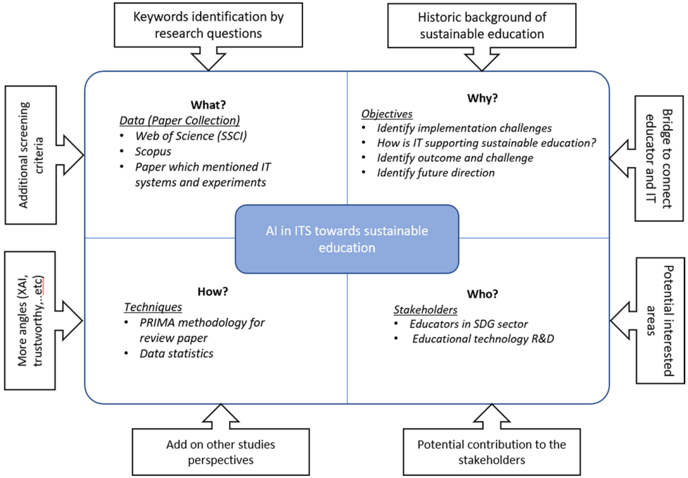
- The review follows the PRISMA methodology and uses a conceptualization process based on Yin’s qualitative research approach and Chatti et al.’s learning analytics reference model.
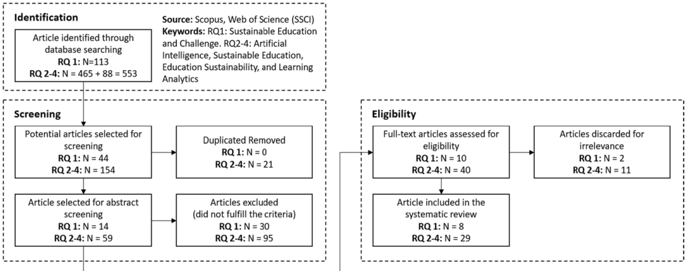
- For RQ1, Scopus was searched with “Sustainable Education” and “Challenge,” yielding 113 articles and selecting 8. For RQ2–RQ4, Scopus and Web of Science (SSCI) were searched with “Artificial Intelligence” AND (“Education Sustainability” OR “Sustainable Education” OR “Learning Analytics”), yielding 465 Scopus and 88 SSCI records, from which 29 papers were selected.
- Searches were limited to English-language journal or conference papers, with inclusion/exclusion criteria applied; selected papers were coded by data type, methods, objectives, and target learners/stakeholders.
Limitations
- The paper states that limitations and challenges of AI-embedded tutoring systems include the amount of data, feature extraction improvement, need for longer-period learning data, and solutions not being portable to other tutoring systems.
- It notes that most research does not explain why and how machine learning algorithms perform predictions, and that bias, fairness, and equality concerns arise from overfitting and the need for more and better training data.
- Evident from the text: the review is a qualitative synthesis without meta-analysis or formal effect-size aggregation, and its evidence base is restricted to Scopus/Web of Science, English-language journal and conference papers.
Model-written summary. Check it against the paper before relying on it.
Integrity signals
Registry
Cites
Statistics
Figures
Verification
Claims the paper makes
5 Valid · 7 Not valid · 41 Not checked · 38 Own results and interpretations
At least one cited source doesn’t support this claim or points to a different paper, and none confirmed it — see the verdicts below.
In the paper
“On the other hand, when performing learning behavior analysis (Pereira et al., 2021;Weng et al., 2020), most of the technology used turns to unsupervised learning, which also makes sense since there are no ground truth data for model training and the overall concept is for clustering or categorization without any reference.”
§ Smart Learning > RQ2: how are AI and IT incorporated as the ITS to support sustainable education?
What the sources say
- Disputedcites Pereira et al., 2021 matched to “Explaining Individual and Collective Programming Students’ Behavior by Interpreting a Black-Box Predictive Model” (2021) sourceExperimental — accuracy not yet measured
Our copy says the opposite of what is attributed: Sec. III (Related Work) states that 'educational data-driven researches identify patterns of behaviour based on data collected from the students learning process' and that 'there are many works in this field that use ML to construct predictive models', i.e. supervised prediction, not unsupervised clustering. The Introduction likewise frames prior work as methods 'to predict CS1 students' performance' and the paper itself trains a supervised XGBoost classifier on ground-truth pass/fail labels (Sec. V-E, 'students who passed (class 1) and students who failed (class 0)'), so the claim's rationale that 'there are no ground truth data for model training' is contrary to this source. The only unsupervised element is k-means applied post-hoc to Shapley values of the trained supervised model (Sec. V-G, Prediction Paths), presented as a contribution ('a new clustering approach'), not as the dominant technology of the field. (LLM, conf=0.70)
Checked by a reasoning model — may be wrong.
- Not checked yetcites Weng et al., 2020
plainstates an association- Asserted: passes — The authors put it forward as true.
- Checkable: passes — It can be checked against evidence.
- Load-bearing: unclear — It is unclear whether the paper’s conclusions depend on it.
- Based: passes — The paper gives a reason why it holds.
- Disputed
The cited sources support only part of this claim — read each source’s verdict below.
In the paper
“More challenges taking care of more students during virtual or blended learning environment (Tsegay et al., 2022;Wade, 2012), it may be because students are from remote especially like under COVID situation, and the instructors are forced to use tutoring systems to deliver courses on line.”
§ Smart Learning > RQ1: what are the key challenges of sustainable education implementation?
What the sources say
- Not checked yetcites Tsegay et al., 2022
- Partly supportedcites Wade, 2012 matched to “Pedagogy, Places And People” (2012) sourceExperimental — accuracy not yet measured
Wade (2012) does support the general point: the section 'challenges and opportunities of the virtual world' states that the exponential rise in 'distance or blended learning course, at least partially mediated by online provision' 'has thrown up a wide range of challenges and opportunities', and 'A formal taught course' describes the strain on tutors — students contacting tutors 'at all hours of the day and this is just not manageable... In personal sustainability terms for tutors this would be quite impossible so clear parameters need to be set'. However, no passage in our copy attributes the challenge to caring for *more* (larger numbers of) students, nor frames student volume as 'a key challenge of sustainable education implementation'; the paper's listed challenges are tutor accessibility/protocols, unequal broadband access in Sub-Saharan Africa, students' wariness of posting online, and the uncritical environmental cost of ICT. The remote/COVID gloss in the citing sentence is the citing authors' own framing (this paper predates it), and the Tsegay et al. (2022) part of the citation is separate evidence not judged here. (LLM, conf=0.72)
hedged- Asserted: passes — The authors put it forward as true.
- Checkable: passes — It can be checked against evidence.
- Load-bearing: unclear — It is unclear whether the paper’s conclusions depend on it.
- Based: passes — The paper gives a reason why it holds.
The cited sources support only part of this claim — read each source’s verdict below.
In the paper
“There are also some researchers who have explored different learning behaviors (Ruipérez-Valiente et al., 2021;Yang et al., 2021a, b) through clustering algorithms, which can also provide instructors with information for further intervention as necessary.”
§ Smart Learning > RQ3: what are the outcomes of AI/IT embedded as the ITS in sustainable education?
What the sources say
- Partly supportedcites Ruipérez-Valiente et al., 2021 matched to “Data-driven detection and characterization of communities of accounts collaborating in MOOCs” (2021) sourceExperimental — accuracy not yet measured
Our copy supports the clustering-of-behaviours half: Section 3.5.1/3.5.3 describe applying the IBM SPSS Two-Step clustering method to find different types of student accounts based on their engagement with the platform, and Section 5.1 reports the resulting cluster types (fruitful collaboration, free-riding, illicit, CAMEO). On the instructor-benefit half, Section 5.2 (Implications) only states that the work can 'provide the teacher with tools that allow them to somehow improve the design and development of MOOCs to promote more collaboration' and suggests course-design controls (randomization, linking accounts to a physical person) — i.e. course-design and dishonesty-deterrence measures, not information for instructors to intervene with individual students as necessary. The related-work statement in Section 2.1 that results 'can help understand instructors and researchers which behaviors can have a positive or negative impact' is credited to other studies ([27], [28]), not to clustering. (LLM, conf=0.72)
- Not checked yetcites Yang et al., 2021a, b
plainstates a cause- Asserted: passes — The authors put it forward as true.
- Checkable: passes — It can be checked against evidence.
- Load-bearing: unclear — It is unclear whether the paper’s conclusions depend on it.
- Based: passes — The paper gives a reason why it holds.
- Partly supported
The sources with a verdict support this claim; the rest weren’t checked yet, have no full text we could read, or their verdicts aren’t rated yet.
In the paper
“There are also some researchers who have explored different learning behaviors (Ruipérez-Valiente et al., 2021;Yang et al., 2021a, b) through clustering algorithms, which can also provide instructors with information for further intervention as necessary.”
§ Smart Learning > RQ3: what are the outcomes of AI/IT embedded as the ITS in sustainable education?
What the sources say
- Supportedcites Ruipérez-Valiente et al., 2021 matched to “Data-driven detection and characterization of communities of accounts collaborating in MOOCs” (2021) source
The source applies clustering to characterize behavioral profiles: Section 3.5.3 states it used the IBM SPSS Two-Step clustering method (Section 3.5.1) 'to find different types of student accounts based on their engagement with the learning platform,' and Section 5.1 reports detecting 'different collaboration behaviors among accounts' via that cluster analysis. Its review in Section 2.1 likewise surveys clustering studies that 'find different behavioral profiles of students,' and Section 5.2 (Implications) says the work can 'provide the teacher with tools' to improve MOOC design and to deter dishonesty/free-riding, which covers the citing sentence's point about information for instructor action. The paraphrase is broad but matches what our copy does. (LLM, conf=0.85)
- Not checked yetcites Yang et al., 2021a, b
plain- Asserted: passes — The authors put it forward as true.
- Checkable: passes — It can be checked against evidence.
- Load-bearing: unclear — It is unclear whether the paper’s conclusions depend on it.
- Based: passes — The paper gives a reason why it holds.
- Supported
The sources with a verdict support this claim; the rest weren’t checked yet, have no full text we could read, or their verdicts aren’t rated yet.
In the paper
“Of the 29 surveyed papers, only 2 focus on the result and try to leverage explainable AI (Afzaal et al., 2021;Pereira et al., 2021) on machine learning prediction.”
§ Smart Learning > RQ3: what are the outcomes of AI/IT embedded as the ITS in sustainable education?
What the sources say
- Not checked yetcites Afzaal et al., 2021
- Supportedcites Pereira et al., 2021 matched to “Explaining Individual and Collective Programming Students’ Behavior by Interpreting a Black-Box Predictive Model” (2021) source
The Introduction says the paper interprets a predictive model’s decisions, and the Conclusion says it developed an explainable machine-learning pipeline for predicting student performance. This supports citing Pereira et al. as an example of a paper applying explainable AI to machine-learning prediction. The count of 29 surveyed papers is the citing authors’ own survey finding, not a finding attributed to Pereira et al. (LLM, conf=0.91)
plain- Asserted: passes — The authors put it forward as true.
- Checkable: passes — It can be checked against evidence.
- Load-bearing: passes — The paper’s conclusions depend on it.
- Based: passes — The paper gives a reason why it holds.
28 more claims
Create a free account to see all 91 claims and to verify the 71 references still open.
- Probably not a substantial claim. 48
- It may state two separate claims as one. 27
- The quote only partly states this claim. 1
Claims other papers make about this one
Each is checked against this paper’s own text: does it say what the citing paper says it does?
The source backs part of the claim, not all of it — or backs it for a different population, condition or comparison.
In the citing paper
“It can support learners by providing customized feedback and opportunities for repeated practice appropriate to their level.”
From Development and pilot evaluation of an AI-based pediatric medication safety virtual simulation program for nursing students: a quasi-experimental study in South Korea (2026) · cites this paper as [12]
Experimental — accuracy not yet measuredThe source backs part of the claim, not all of it — or backs it for a different population, condition or comparison.
In the citing paper
“By analyzing learners’ input in real time, AI can identify patterns of errors in clinical performance and reasoning.”
From Development and pilot evaluation of an AI-based pediatric medication safety virtual simulation program for nursing students: a quasi-experimental study in South Korea (2026) · cites this paper as [12]
Experimental — accuracy not yet measuredThe cited source says what the claim attributes to it.
In the citing paper
“It can also promote adaptive learning by providing educational content tailored to students’ individual needs and learning styles [12].”
The cited source says what the claim attributes to it.
In the citing paper
“This approach enables instructors to utilize personalized AI-generated feedback without diminishing the role of traditional instruction [12,33].”
From The Role of AI in Academic Writing: Impacts on Writing Skills, Critical Thinking, and Integrity in Higher Education (2025) · cites this paper as [33]
In the citing paper
“Given that AI tools can provide instant feedback, students can work at their own pace, and those requiring additional support can benefit from AI assistance without the necessity of one-on-one tutoring [33].”
From The Role of AI in Academic Writing: Impacts on Writing Skills, Critical Thinking, and Integrity in Higher Education (2025) · cites this paper as [33]
2 more claims about this paper
Create a free account to see every claim other papers make about this one.
Self-check
Percentages, sums and reported differences re-computed from the paper’s own numbers.
Each contradiction between two passages listed here was confirmed by an independent check.
Rated minor: it would not touch a result — a value no result rests on, a p-value that stays on the same side of the significance level, or a conflict that is clerical, resolved elsewhere in the paper, or outside its own findings.
In the paper
§ Smart Learning > RQ3: what are the outcomes of AI/IT embedded as the ITS in sustainable education?
“For AI-embedded tutoring systems, most of the outcomes indicate that the performance prediction accuracy is high (Guerrero-Higueras et al., 2018;Hasnine et al., 2018)”
§ Smart Learning > Conclusions
“| AI not Embedded in | Performance prediction algorithm verified with high accuracy | 10 |”
Citations
Cites
The PRISMA 2020 statement: An updated guideline for reporting systematic reviews
Page, M. J., McKenzie, J. E., Bossuyt, P. M., Boutron, I., Hoffmann, T. C., Mulrow, C. D., Shamseer, L., Tetzlaff, J. M., Akl, E. A., Brennan, S. E., et al. (2021) · BMJ · doi:10.1136/bmj.n71 · Cited by 108,283
Arrieta, A. B., Díaz-Rodríguez, N., Del Ser, J., Bennetot, A., Tabik, S., Barbado, A., García, S., Gil-López, S., Molina, D., Benjamins, R., et al. (2019) · arXiv · doi:10.48550/arxiv.1910.10045 · Cited by 11,321 · cited 1×
“In the XAI review paper, Arrieta et al. (2020) categorized many common machine learning algorithms in detail and described how a model can be explained.”
BackgroundBarredo Arrieta, A., Díaz-Rodríguez, N., Del Ser, J., Bennetot, A., Tabik, S., Barbado, A., Garcia, S., Gil-Lopez, S., Molina, D., Benjamins, R., et al. (2020) · Information Fusion · doi:10.1016/j.inffus.2019.12.012 · Cited by 10,423 · cited 1×
“In the XAI review paper, Arrieta et al. (2020) categorized many common machine learning algorithms in detail and described how a model can be explained.”
BackgroundThe PRISMA 2020 statement: an updated guideline for reporting systematic reviews
Page, M. J., McKenzie, J., Bossuyt, P., Boutron, I., Hoffmann, T., mulrow, C., Shamseer, L., Tetzlaff, J., Akl, E., Brennan, S. E., et al. (2020) · doi:10.31222/osf.io/v7gm2_v1 · Cited by 8,090
Qualitative Research from Start to Finish
Yin, R. K. (2010) · Medical Entomology and Zoology · Cited by 5,667
The PRISMA 2020 statement: an updated guideline for reporting systematic reviews
Page, M. J., McKenzie, J., Bossuyt, P., Boutron, I., Hoffmann, T., mulrow, C., Shamseer, L., Tetzlaff, J., Akl, E., Brennan, S. E., et al. (2020) · doi:10.31222/osf.io/v7gm2 · Cited by 5,177
Human-Centered Artificial Intelligence: Reliable, Safe & Trustworthy
Shneiderman, B. (2020) · International Journal of Human–Computer Interaction · doi:10.1080/10447318.2020.1741118 · Cited by 1,743 · cited 1×
“Shneiderman (2020) defined a two-dimensional approach for categorizing and providing guidance on how to produce system designs that are Reliable, Safe, and Trustworthy (RST).”
DARPA's Explainable Artificial Intelligence Program
Gunning, D., & Aha, D. W. (2019) · AI Magazine · doi:10.1609/aimag.v40i2.2850 · Cited by 1,360 · cited 1×
“Similar to the 4-year project conducted by DARPA (Gunning & Aha, 2019), the technical teams were requested to provide an explainable model and explanation interface to support users making decisions.”
MethodAI in CAI: An Artificial-Intelligence Approach to Computer-Assisted Instruction
Carbonell, J. (1970) · IEEE Transactions on Man Machine Systems · doi:10.1109/tmms.1970.299942 · Cited by 955 · cited 1×
“The overall concept can be traced back to 1970 (Carbonell, 1970).”
BackgroundExplainable Artificial Intelligence in education
Khosravi, H., Shum, S. B., Chen, G., Conati, C., Tsai, Y.-S., Kay, J., Knight, S., Martinez-Maldonado, R., Sadiq, S., & Gašević, D. (2022) · Computers and Education: Artificial Intelligence · doi:10.1016/j.caeai.2022.100074 · Cited by 863 · cited 2×
“Khosravi et al. (2022) deeply explore XAI in terms of education, which also provides good guidance for educators and IT solution architects.”
Background
Research works printed but not linked: 2
- Lu, O. H. T., Huang, A. Y. Q., & Yang, S. J. H. (2018). Benchmarking and tuning regression algorithms on predicting students' academic performance. In 26th International conference on computers in education, Philippines.
- Sterling, S. R., & Orr, D. (2001). Sustainable education: Re-visioning learning and change (Vol. 6). Green Books for the Schu- macher Society Totnes.
Cited by
Human-centred learning analytics and AI in education: A systematic literature review
Alfredo, R., Echeverria, V., Jin, Y., Yan, L., Swiecki, Z., Gašević, D., & Martinez-Maldonado, R. (2024) · Computers and Education: Artificial Intelligence · doi:10.1016/j.caeai.2024.100215 · Cited by 281
Integrating AI literacy into teacher education: a critical perspective paper
Daher, R. (2025) · Discover Artificial Intelligence · doi:10.1007/s44163-025-00475-7 · Cited by 253
“However, achieving true equity requires addressing challenges such as access disparities, algorithmic biases, and privacy concerns, data security, as well as potential bias in algorithms and machine learning models [43].”
Feigerlova, E., Hani, H., & Hothersall-Davies, E. (2025) · BMC Medical Education · doi:10.1186/s12909-025-06719-5 · Cited by 166
“Finally, as mentioned earlier in this work, AI-based technologies have the potential to support sustainable education [81]; however, it is important to consider an obsolescence index that applies to AI tools given the rapid evolution of medical knowledge [88].”
Mohebbi, A. (2025) · Cogent Education · doi:10.1080/2331186x.2024.2433814 · Cited by 161
“…this pedagogical shift is the burgeoning recognition of the criticality of learner autonomy in fostering self-directed and lifelong learning, aligning with the tenets of contemporary pedago-gies that vaunt personalised education tailored to individual learners (Lin et al., 2023; Son et al., 2023).”
Khairullah, S. A., Harris, S., Hadi, H. J., Sandhu, R. A., Ahmad, N., & Alshara, M. A. (2025) · Frontiers in Education · doi:10.3389/feduc.2025.1548104 · Cited by 211
Khan, S., Mazhar, T., Shahzad, T., Khan, M. A., Rehman, A. U., Saeed, M. M. A., & Hamam, H. (2025) · Discover Sustainability · doi:10.1007/s43621-025-00809-6 · Cited by 153
“AI’s potential to revolutionize education includes applications such as adaptive learning, personalized curricula, and predictive analytics for student success [3, 4].”
Examining AI Use in Educational Contexts: A Scoping Meta-Review and Bibliometric Analysis
Fu, Y., Weng, Z., & Wang, J. (2025) · International Journal of Artificial Intelligence in Education · doi:10.1007/s40593-024-00442-w · Cited by 57
Fernández-Herrero, J. (2024) · Education Sciences · doi:10.3390/educsci14080839 · Cited by 120
“[39] reports high satisfaction and perceived ease of use among university students who tested their ATS.”
Lubbe, A., Marais, E., & Kruger, D. (2025) · Education and Information Technologies · doi:10.1007/s10639-025-13476-x · Cited by 61
“Intelligent tutoring systems around the mid-2000s marked a new phase where these systems could mimic individualized human mentorship through student feedback and assistance (Lin, Huang & Lu, 2023).”
Λαμπρόπουλος, Γ. (2025) · Multimodal Technologies and Interaction · doi:10.3390/mti9020011 · Cited by 121
Achruh, A., Rapi, M., Rusdi, M., & Idris, R. (2024) · International Journal of Learning Teaching and Educational Research · doi:10.26803/ijlter.23.11.22 · Cited by 157
Fortuna, A., Prasetya, F., Samala, A. D., Rawas, S., Criollo-C, S., Kaya, D., Raihan, M. F. M., Andriani, W., Safitri, D., & Nabawi, R. A. (2025) · Social Sciences & Humanities Open · doi:10.1016/j.ssaho.2025.102114 · Cited by 125
Artificial Intelligence in Health Professions Education assessment: AMEE Guide No. 178
Masters, K., MacNeil, H., Benjamin, J., Carver, T., Nemethy, K., Valanci-Aroesty, S., Taylor, D. C. M., Thoma, B., & Thesen, T. (2025) · Medical Teacher · doi:10.1080/0142159x.2024.2445037 · Cited by 80
“…learning activities, adapt-ability, automation, and feasibility to promote self-regulated learning and performance prediction of the learner [53,54], providing frequent feedback to learners in real-time to develop specific skills, leading to enhanced learning outcomes while providing…”
Ateş, H. (2024) · Education and Information Technologies · doi:10.1007/s10639-024-12970-y · Cited by 99
“Similarly, researches by Lin et al. (2023) and Wang et al. (2023) demonstrated that ITSs that adapt to students’ learning progress can keep students more involved by continuously providing challenges that are neither too easy nor too difficult, thus maintaining an optimal learning curve.”
Latif, E., Liu, V., & Zhaı, X. (2026) · Smart Learning Environments · doi:10.1186/s40561-025-00427-9 · Cited by 108
“The integration of generative AI into ITS further enhances their adaptability, enabling real-time customization of instructional content based on student behavior and feedback (Banjade et al., 2024; Lin et al., 2023).”
The Educational Value of Artificial Intelligence and Social Robots
Λαμπρόπουλος, Γ., & Papadakis, S. (2025) · Studies in computational intelligence · doi:10.1007/978-3-031-82915-4_1 · Cited by 97
Wang, X., Xu, X., Zhang, Y., Hao, S., & Weng, J. (2024) · Humanities and Social Sciences Communications · doi:10.1057/s41599-024-04168-x · Cited by 96
“For example, a study found that students believe interacting with generative AI (GAI) tools can enhance academic performance by boosting self-ef fi cacy and cognitive engagement (Lin et al., 2023).”
León, C. E. Y., Lipuma, J. M., & Torres, X. O. (2025) · Frontiers in Education · doi:10.3389/feduc.2025.1619888 · Cited by 92
Artificial intelligence in nursing education: A review of AI-based teaching pedagogies
Labrague, L. J., Sabei, S. D. A., & Yahyaei, A. A. (2025) · Teaching and learning in nursing · doi:10.1016/j.teln.2025.01.019 · Cited by 83
Multi-stakeholder perspective on responsible artificial intelligence and acceptability in education
Karran, A. J., Charland, P., Martineau, J. T., de Guinea, A. O., Lesage, A., Sénécal, S., & Léger, P. (2025) · npj Science of Learning · doi:10.1038/s41539-025-00333-2 · Cited by 91
Deep, P. D., & Chen, Y. (2025) · Societies · doi:10.3390/soc15090247 · Cited by 65
“Given that AI tools can provide instant feedback, students can work at their own pace, and those requiring additional support can benefit from AI assistance without the necessity of one-on-one tutoring [33].”
InfluentialSaleh, Z. T., Rababa, M., Elshatarat, R. A., Alharbi, M., Alhumaidi, B. N., Al-Za'areer, M. S., Jarrad, R. A., niarat, T. F. A., Almagharbeh, W. T., Al‐Sayaghi, K. M., et al. (2025) · BMC Nursing · doi:10.1186/s12912-025-03082-0 · Cited by 83
“They can deliver interactive simulations, provide personalized feedback, and offer real-time academic support to students [3, 15, 16].”
InfluentialIntegrating generative AI in university teaching and learning: A model for balanced guidelines
Cacho, R. (2024) · Online Learning · doi:10.24059/olj.v28i3.4508 · Cited by 59
“Moreover, AI has the potential to improve student learning outcomes by offering customized, instant feedback and adjusting to each learner's unique style (Chan & Hu, 2023; Delcker et al., 2024; Lin et al., 2023; Schroeder et al., 2022).”
BackgroundResultAI in Higher Education: Academic Integrity, Harmony of Insights, and Recommendations
Fowler, D. S. (2023) · Journal of Ethics in Higher Education · doi:10.26034/fr.jehe.2023.4657 · Cited by 58
Alqurni, J. (2026) · Frontiers in Artificial Intelligence · doi:10.3389/frai.2026.1738774 · Cited by 58
“However, the positive influence of trust on self-learning motivation was in line with from Cui et al. (2025) and Lin et al. (2023), who mentioned that motivated learners to utilize the AI-based systems have been triggered by emotional trust—perceiving that AI will improve fairness, personalization,…”
AI-Powered E-Learning for Lifelong Learners: Impact on Performance and Knowledge Application
Ahn, H. Y. (2024) · Sustainability · doi:10.3390/su16209066 · Cited by 56
Aravantinos, S., Lavidas, K., Komis, V., Karalis, T., & Papadakis, S. (2026) · Computers · doi:10.3390/computers15010049 · Cited by 87
“The findings of this study could serve the best interests of multiple stakeholders [13]: teachers, who strengthen their professional resilience; school leaders, who enhance institutional performance; educational consultants, who organize training programs supporting teachers; and students, who…”
Visualizing the knowledge mapping of artificial intelligence in education: A systematic review
Qin, Q., & Zhang, S. (2024) · Education and Information Technologies · doi:10.1007/s10639-024-13076-1 · Cited by 71
“One result of using AI and information technology (IT) systems in sustainable education is the ability to provide students with a personalized learning experience that meets their unique learning styles and preferences (Lin et al., 2023).”
Kyambade, M., Namatovu, A., & Ssentumbwe, A. M. (2025) · Cogent Education · doi:10.1080/2331186x.2025.2505297 · Cited by 71
“By aligning AI capabilities with educational goals, HAI emphasizes empowering learners to take ownership of their learning journeys (Kovari, 2025; Lin et al., 2023).”
Zulianti, H., Hastuti, H., Nurchurifiani, E., Hastomo, T., Maximilian, A., & Ajeng, G. D. (2024) · World Journal of English Language · doi:10.5430/wjel.v15n3p117 · Cited by 26
The Role of Artificial Intelligence in Shaping the Future of Education: Opportunities and Challenges
Іванашко, О., Козак, А., Knysh, T., & Honchar, K. (2024) · Futurity Education · doi:10.57125/fed.2024.03.25.08 · Cited by 60
“Also, it provides adaptive learning promoting a more customized learning experience (Gligorea et al., 2023), and AI-powered tutoring systems provide real-time assistance (Lin et al., 2023).”
BackgroundMethodInfluentialXing, W., Song, Y., Li, C., Liu, Z., Zhu, W., & Oh, H. (2025) · British Journal of Educational Technology · doi:10.1111/bjet.13586 · Cited by 50
Λαμπρόπουλος, Γ. (2025) · Applied Sciences · doi:10.3390/app15063223 · Cited by 69
Sun, D., Cheng, G., Yu, P. L. H., Jia, J., Zheng, Z., & Chen, A. (2025) · Interactive Learning Environments · doi:10.1080/10494820.2025.2462156 · Cited by 69
Analyzing the Impact of AI Tools on Student Study Habits and Academic Performance
Ward, B., Bhati, D., Neha, F., & Guercio, A. (2025) · 2025 IEEE 15th Annual Computing and Communication Workshop and Conference (CCWC) · doi:10.1109/ccwc62904.2025.10903692 · Cited by 48
“This personalized approach not only enhances student motivation but also supports more effective learning outcomes, addressing the unique challenges faced by each learner in a sustainable education system [7].”
Mosly, I. (2024) · Societies · doi:10.3390/soc14060089 · Cited by 59
Çayak, S. (2024) · Journal of Educational Technology and Online Learning · doi:10.31681/jetol.1490307 · Cited by 72
Sarshartehrani, F., Mohammadrezaei, E., Behravan, M., & Gračanin, D. (2024) · Lecture notes in computer science · doi:10.1007/978-3-031-60609-0_20 · Cited by 65
AI Integration into Language Education and Teacher Identity: An Ecological Perspective
Satvati, N., Kamali, J., Boldaji, F. S., Khodadadi, M., & Akhondi, S. (2025) · Language Teaching Research Quarterly · doi:10.32038/ltrq.2025.47.01 · Cited by 60
Hamamra, B. T., Khlaif, Z. N., Mayaleh, A., & Baker, A. A. (2025) · Cogent Education · doi:10.1080/2331186x.2025.2526435 · Cited by 48
“…(Hamamra et al., 2024; Zhang & Aslan, 2021), generative AI integration (Chan, 2023; Khlaif et al., 2023), intelligent tutoring systems (Alam, 2023; Lin et al., 2023), and automated grading mechanisms (Farazouli, 2024) — there remains a notable paucity of studies focusing on the human element,…”
Students' Perceptions about the Impact of AI Chatbots on their Vocabulary and Grammar in EFL Writing
Waziana, W., Andewi, W., Hastomo, T., & Hasbi, M. (2024) · Register Journal · doi:10.18326/register.v17i2.352-382 · Cited by 60
Generative AI as a Personal Tutor for English Language Learning: A Review of Benefits and Concerns
Pang, S., Nol, E., & Heng, K. (2025) · International Journal of Changes in Education · doi:10.47852/bonviewijce52023724 · Cited by 51
Integrating CALL and AIALL for an interactive pedagogical model of language learning
Bahari, A., Han, F., & Strzelecki, A. (2025) · Education and Information Technologies · doi:10.1007/s10639-025-13388-w · Cited by 64
“These AI-based tools hold great poten - tial in providing personalized instruction, adaptive feedback, and intelligent analy - sis of learner performance (Lin et al., 2023a, b; Yesilyurt, 2023).”
Education AI: exploring the impact of artificial intelligence on education in the digital age
Singh, A., Kiriti, M. K., Singh, H., & Shrivastava, A. (2025) · International Journal of Systems Assurance Engineering and Management · doi:10.1007/s13198-025-02755-y · Cited by 60
“These early systems focused on delivering personalized instruction through interactive computer programs (Lin et al. 2023).”
Cultural integration in AI-enhanced mathematics education: insights from Southeast Asian educators
Payadnya, I. P. A. A., Putri, G. A. M. A., Suwija, I. K., Saelee, S., & Jayantika, I. G. A. N. T. (2024) · Journal for Multicultural Education · doi:10.1108/jme-09-2024-0119 · Cited by 52
Sun, T., & Yoon, M. (2025) · Frontiers in Psychology · doi:10.3389/fpsyg.2025.1693375 · Cited by 50
“Previous studies have identified various digital tools impacting teaching and research outcomes, such as intelligent tutoring systems (Lin et al., 2023), virtual reality (VR) technology (Marks and Thomas, 2022), and remote learning solutions (Abaci et al., 2021).”
Fawaz, M. A., Malti, W. E., Alreshidi, S. M., & Kavuran, E. (2025) · Nursing and Health Sciences · doi:10.1111/nhs.70030 · Cited by 40
AI Adoption for Collaboration: Factors Influencing Inclusive Learning Adoption in Higher Education
Alyoussef, I. Y., Drwish, A. M., Albakheet, F. A., Alqahtani, R. H. A., & Technology, A. A. A. E. (2025) · IEEE Access · doi:10.1109/access.2025.3567656 · Cited by 58
“These systems use data on student performance to determine each student’s unique learning requirements and modify the curriculum to increase academic success and student engagement [39], [40].”
Abulibdeh, A. O. (2025) · Sustainable Futures · doi:10.1016/j.sftr.2025.101033 · Cited by 47
Mnguni, L. E., Nuangchalerm, P., Islami, R. A. Z. E., Sibanda, D., Sari, I. J., & Ramulumo, M. (2024) · Computers and Education Artificial Intelligence · doi:10.1016/j.caeai.2024.100334 · Cited by 43
Navigating ChatGPT in ASEAN Higher Education: Ethical and Pedagogical Perspectives
Buragohain, D., & Chaudhary, S. (2025) · Computer Applications in Engineering Education · doi:10.1002/cae.70062 · Cited by 34
Designing a model of sustainable education based on artificial intelligence in higher education
Bagherimajd, K., & Khajedad, K. (2025) · Computers and Education Artificial Intelligence · doi:10.1016/j.caeai.2025.100439 · Cited by 51
Enhancing student experience and learning with iterative design in an intelligent educational game
Hare, R., Ferguson, S. L., & Tang, Y. G. (2024) · British Journal of Educational Technology · doi:10.1111/bjet.13526 · Cited by 38
Arce, C. G. M., Gavilanes, J. A. C., Arce, E. M., Haro, E. M., & Jurado, D. M. B. (2025) · Sustainability · doi:10.3390/su17177741 · Cited by 41
Lim, T., Gottipati, S., & Cheong, M. L. F. (2025) · International Journal of Educational Technology in Higher Education · doi:10.1186/s41239-025-00556-8 · Cited by 44
“AI system design and checks for assessment purposes is directed towards the development of a robust and secure AI system, spanning across physical infrastructure, cognitive functionalities, and data management protocols (e.g., Lin et al., 2023).”
Harnessing Potential: Meta-Analysis of AI Integration in Higher Education
Samman, A. M. A. (2024) · ASU International Conference in Emerging Technologies for Sustainability and Intelligent Systems (ICETSIS) · doi:10.1109/icetsis61505.2024.10459420 · Cited by 35
Dahri, N. A., Al-Rahmi, W. M., Alhashmi, K. A., & Shaikh, F. B. (2025) · International Journal of Interactive Mobile Technologies (iJIM) · doi:10.3991/ijim.v19i11.54643 · Cited by 34
Wang, Z., Wang, M., Zeng, C., & Li, L. (2024) · Applied Sciences · doi:10.3390/app14188357 · Cited by 28
Mapping the evolution of AI in education: Toward a co-adaptive and human-centered paradigm
Feng, S., Zhang, H., & Gašević, D. (2025) · Computers and Education Artificial Intelligence · doi:10.1016/j.caeai.2025.100513 · Cited by 38
The Role of Artificial Intelligence in Creation of Future Education: Possibilities and Challenges
Zadorina, O., Hurskaya, V., Соболєва, С. М., Грекова, Л. Ю., & Vasylyuk-Zaitseva, S. (2024) · Futurity Education · doi:10.57125/fed.2024.06.25.09 · Cited by 55
As’ad, M. (2024) · Cureus · doi:10.7759/cureus.69710 · Cited by 29
Integrating Artificial Intelligence in Education: Trends and Opportunities
Wangdi, P. (2024) · International Journal on Research in STEM Education · doi:10.33830/ijrse.v6i2.1722 · Cited by 40
Gomes, D. J. (2024) · Advances in educational technologies and instructional design book series · doi:10.4018/979-8-3693-6170-2.ch008 · Cited by 32
Evaluating the Impact of AI Tools on Grammar Mastery: A Comparative Study of Learning Outcomes
Lalira, J. E., Pangemanan, Y. A. T., Scipio, J. E., Lumi, S. M., Merentek, T. C., & Tumuju, V. N. (2024) · Voices of English Language Education Society · doi:10.29408/veles.v8i3.27856 · Cited by 34
Asamoah, M. K., & Amarteifio, J. (2025) · Discover Education · doi:10.1007/s44217-025-00593-5 · Cited by 28
“These systems provide personalized instruction, adapting to learners’ specific needs, and creating more engaging and effective learning environments [61].”
Carbon emissions across income groups: exploring the role of trade, energy use, and economic growth
Dharmapriya, N., Gunawardena, V., Methmini, D., Jayathilaka, R., & Rathnayake, N. (2025) · Discover Sustainability · doi:10.1007/s43621-025-01261-2 · Cited by 28
Mzwri, K., & Turcsányi-Szabó, M. (2025) · Journal of Computers in Education · doi:10.1007/s40692-025-00367-w · Cited by 34
“This aligns with studies on AI tutoring systems enhancing learning through personalized, on-demand support (C.-C. Lin et al., 2023; Mannekote et al., 2024).”
Bahari, A., & Liu, Y. (2025) · Interactive Learning Environments · doi:10.1080/10494820.2025.2591251 · Cited by 26
“Lin et al. (2023) emphasized the importance of institutional support and leadership in fostering meaningful professional learning experiences.”
Artificial intelligence in K-12 education: An umbrella review
Huang, R., Yin, Y., Zhou, N., & Lang, F. (2025) · Computers and Education Artificial Intelligence · doi:10.1016/j.caeai.2025.100519 · Cited by 37
A Review of AI Tools: Definitions, Functions, and Applications for K-12 Education
Kwid, G., Sarty, N., & Yang, D. (2024) · AI Computer Science and Robotics Technology · doi:10.5772/acrt.20240048 · Cited by 37
Extending Cognitive Load Theory: The CLAM Framework for Biometric, Adaptive, and Ethical Learning
Vasilaki, E., & Mavrogianni, A. (2025) · Psychology International · doi:10.3390/psycholint7020040 · Cited by 30
Gupta, S., & Jaiswal, R. (2024) · The International Journal of Management Education · doi:10.1016/j.ijme.2024.101070 · Cited by 22
Huangfu, J., Li, R., Xu, J., & Pan, Y. (2024) · Sustainability · doi:10.3390/su17010144 · Cited by 28
Gökçe, O. K., Kaya, D., & Kutluca, T. (2025) · Discourse and Communication for Sustainable Education · doi:10.2478/dcse-2025-0009 · Cited by 26
Artificial Intelligence: Solutions in Special Education
Ahmad, W., Shokeen, R., & Raj, R. (2024) · Advances in educational technologies and instructional design book series · doi:10.4018/979-8-3693-5538-1.ch017 · Cited by 28
Luo, L., & Yusuf, A. (2026) · Assessment & Evaluation in Higher Education · doi:10.1080/02602938.2025.2548919 · Cited by 21
“Recent AI models incorporate longitudinal learner data to detect stagnation, thereby modulating the complexity of feedback to sustain challenge (Lin, Huang, and Lu 2023).”
Responsible and Ethical Use of AI in Education: Are We Forcing a Square Peg into a Round Hole?
Amigud, A., & Pell, D. J. (2025) · World · doi:10.3390/world6020081 · Cited by 24
“…potential to improve the learning environment; it can fillin the gaps in student and faculty support, providing a personalized learning experience, on-demand tutoring, and immediate feedback, as well as automating assignment grading and streamlining course creation and research activities [9–11].”
Inteligencia artificial en educación superior: revisión integrativa de la literatura
Perdomo, B., & Martínez, Ó. G. (2025) · Cuadernos de Investigación Educativa · doi:10.18861/cied.2025.16.2.4034 · Cited by 34
Narreddy, C., Joordens, S., & Prompiengchai, S. (2025) · Trends in Higher Education · doi:10.3390/higheredu4040065 · Cited by 27
“These advancements have been supported by techniques such as performance prediction, learning behavior analysis, and enhancements in SRL [131].”
Zhou, C., Ren, T., & Lang, L. (2025) · Education and Information Technologies · doi:10.1007/s10639-025-13646-x · Cited by 32
“However, it is also noted that the application of AI in ITS presents challenges, including issues related to pri - vacy, data security, and potential biases in algorithms and machine learning models (Lin et al., 2023 ).”
InfluentialKong, K., Isleem, H. F., Aluvalu, R., Tejani, G. G., & Metwally, A. S. M. (2025) · Journal Of Big Data · doi:10.1186/s40537-025-01333-0 · Cited by 20
“…and motivational supports rise during disengagement, consistent with extraneous‑load reduction and re‑engagement goals in Real-world testing [31] Eye-tracking, Face 1200–1500 73.4 8.7 Lab only [32] Face, Interaction 1050–1300 77.2 9.3 Yes (Limited) [21] Face, Voice 1100–1800 79.8 11.2 Lab…”
InfluentialGenerative AI as a Tool for Enhancing Reflective Learning in Students
Yuan, B., & Hu, J. (2025) · IEEE International Conference on Teaching, Assessment, and Learning for Engineering · doi:10.1109/tale66047.2025.11346600 · Cited by 29
“An ITS is a computer-based instructional platform designed to deliver personalized guidance, adaptive feedback, and tailored experiences, thereby supporting self-directed and autonomous learning [8].”
The Impact of Artificial Intelligence on Personalized Learning in Education: A Systematic Review
Jiali, S. (2024) · Pakistan Journal of Life and Social Sciences (PJLSS) · doi:10.57239/pjlss-2024-22.2.00560 · Cited by 22
Garcia, M. B., Goi, C. L., Shively, K., Maher, D., Rosak-Szyrocka, J., Happonen, A., Bozkurt, A., & Damaševičius, R. (2024) · Advances in educational technologies and instructional design book series · doi:10.4018/979-8-3693-5633-3.ch001 · Cited by 22
Artificial Intelligence in Mathematics Education: Trends, Challenges, and Opportunities
Tang, W. K.-W. (2025) · International Journal of Research in Mathematics Education · doi:10.24090/ijrme.v3i1.13496 · Cited by 29
Villegas-Ch, W. E., Gutierrez, R., García-Ortiz, J., & Guevara, V. (2025) · Discover Artificial Intelligence · doi:10.1007/s44163-025-00438-y · Cited by 22
KARAGÖL, E., Yıldırım, D., & KORKMAZ, C. B. (2025) · Teaching and Teacher Education · doi:10.1016/j.tate.2025.105180 · Cited by 23
Reimagining healthcare education through nurturing AI-driven innovation
Mendes, J. M. (2025) · BMC Medical Education · doi:10.1186/s12909-025-08254-9 · Cited by 22
“Lin et al. [34]; Rubin [35]; Zu-hair et al. [36]; Lee et al. [37]. figures, into scholarly work, noting that such materials typically require substantial human curation and revision to meet scientific standards.”
InfluentialThe Application of Artificial Intelligence in Education – The Current State and Trends
Milićević, V., Lazarova, L. K., & Jordović-Pavlović, M. I. (2024) · International Journal of Cognitive Research in Science Engineering and Education · doi:10.23947/2334-8496-2024-12-2-259-272 · Cited by 22
A Systematic Review Exploring AI’s Role in Self-Regulated Learning Within Education Contexts
Ren, L., Lee, K. M., & May, L. (2025) · IEEE Access · doi:10.1109/access.2025.3582600 · Cited by 22
Artificial Intelligence Agents for Personalized Adaptive Learning
Tebourbi, H., Nouzri, S., Mualla, Y., & Abbas‐Turki, A. (2025) · Procedia Computer Science · doi:10.1016/j.procs.2025.07.179 · Cited by 24
Qin, L., & Derakhshan, A. (2026) · Language learning & technology · doi:10.64152/10125/73685 · Cited by 39
“These systems can adjust the difficulty of learning tasks, suggest targeted exercises, and provide feedback on pronunciation, grammar, and vocabulary (Lin et al., 2023).”
Bibliometric Insight into Artificial Intelligence Application in Investment
Sarjas, M. K., & Velmurugan, G. (2025) · International Journal of Computational and Experimental Science and Engineering · doi:10.22399/ijcesen.864 · Cited by 18
Grammar and engagement in focus: Evaluating Gemini AI’s impact on an educational environment
Ng, M. L., Behforouz, B., & Ghaithi, A. A. (2025) · Computers and Education Open · doi:10.1016/j.caeo.2025.100302 · Cited by 19
Ghasem, N. M. (2025) · Cogent Education · doi:10.1080/2331186x.2025.2560057 · Cited by 18
“Generative AI contributes to the flexibility and personalization of a curriculum, which is also a part of Education 4.0 objectives (Kuhn, 1999; Lin et al., 2023).”
InfluentialFoundations of Sustainability Education
Abdallah, A. K., Ismail, L. S., & Ismail, O. A. S. (2024) · Advances in human services and public health (AHSPH) book series · doi:10.4018/979-8-3693-2987-0.ch011 · Cited by 15
The Use of Artificial Intelligence among Students in Higher Education
Jereb, E., & Urh, M. (2024) · Organizacija · doi:10.2478/orga-2024-0024 · Cited by 14
Xiong, F., & Bao, J. (2025) · Journal of Emerging Technologies in Accounting · doi:10.2308/jeta-2024-012 · Cited by 19
A research roadmap for AI opportunities in student assessment for medical education
Rezaei-Zadeh, M., & Cerbin‐Koczorowska, M. (2025) · BMC Medical Education · doi:10.1186/s12909-025-08078-7 · Cited by 19
“…tools, including Natural Language Processing (NLP), Machine Learning (ML) algorithms, and Intelligent Tutoring Systems (ITS), are increasingly being used to provide real-time, individualised feedback, simulate clinical decision-making environments, and evaluate complex learner behaviours [11, 12].”
Metadata
- Authors
- Lin, C.-C., Huang, A. Y. Q., & Lu, O. H. T.
- Affiliations
- National Central University (TW)
- National Chengchi University (TW)
- Corresponding author
- Lin, Chien-Chang
- Venue
- Smart Learning Environments
- Published
- 2023-08-28
- Volume
- 10
- Issue
- 1
- ISSN
- 2196-7091 (ISSN-L)
- OpenAlex
- W4386223224
- Semantic Scholar
- dfbc9f44f0ff3c994eecee83a48cb27dd20c51b0
- Cited by
- 669
- References
- 59
- Citations by year
- 2026: 282 · 2025: 286 · 2024: 97 · 2023: 4
- FWCI
- 27.57
- Type
- journal article
- Language
- en
- Open access
- gold
- doi.org
- Licence
- cc-by
- creativecommons.org/licenses/by/4.0 (tdm)
- creativecommons.org/licenses/by/4.0 (vor)
- Locations
- Smart Learning Environments (publishedVersion, cc-by)
- DOAJ (DOAJ: Directory of Open Access Journals) (submittedVersion, cc-by-sa)
- Funders
- National Science and Technology Council (111-2410-H-008 -010 -MY3, 109-2511-H-008 -007 -MY3)
- Topics
- Social Sciences › Education › Artificial Intelligence in Education
- Physical Sciences › Computer Science › Artificial Intelligence › Intelligent Tutoring Systems and Adaptive Learning
- Social Sciences › Education › Educational Technology and Pedagogy
- Keywords
- artificial intelligence in education, intelligent tutoring systems, sustainable education, personalized learning, data-driven decision making, student engagement, student performance analysis, algorithmic bias, data privacy and security, educational technology infrastructure, educational equity
About these checks
Registry, retraction, Cites and statistics results are computed, not judged, with one exception: a printed reference that no index lists is read once by a model before it counts as a citation error. Claims are extracted by a model and kept only when their quote appears verbatim in the text; each cited source is then checked, with a model’s help, for whether it says what the claim relies on. Those verdicts can be wrong — read the claim’s quote and the cited source before relying on one.
The claim verdicts this report counts are experimental: their accuracy is not yet measured.
A language model drew the claims from the paper on 2026-10-07, under version 3 of the claim definition (model deepseek-v4.1-flash, prompt extract-v3).
A second model labelled each claim on 2026-10-07 (model jev-1.13-20260917, definition revision gold-guideline-v0.2).
Cited sources are checked with a language model’s help (qwen3.8-omni-flash and gpt-6-sol).
Statistics and arithmetic are recomputed, not judged.
Confidence bands are shown only for fields calibrated on our annotated test set. None is calibrated yet, so no band is shown.
What counts as a claim ›How we measure confidence ›How we check this ›
Are you an author, or do you see a problem with this page? Request a review
Data sources
Bibliographic data: Semantic Scholar, OpenAlex, Crossref.
Contains information from the Semantic Scholar Academic Graph Datasets, made available under the ODC Attribution License (ODC-BY 1.0).
Semantic Scholar’s data is described in: Kinney, R., et al. (2023). The Semantic Scholar Open Data Platform. arXiv:2301.10140.
