

Artificial intelligence in intelligent tutoring systems toward sustainable education: a systematic review
Open accessThe DOI matches its Crossref record; 61 of the 61 references it cites were found in a registry or an index; 7 of the 78 sources its claims cite were checked for support.
Abstract
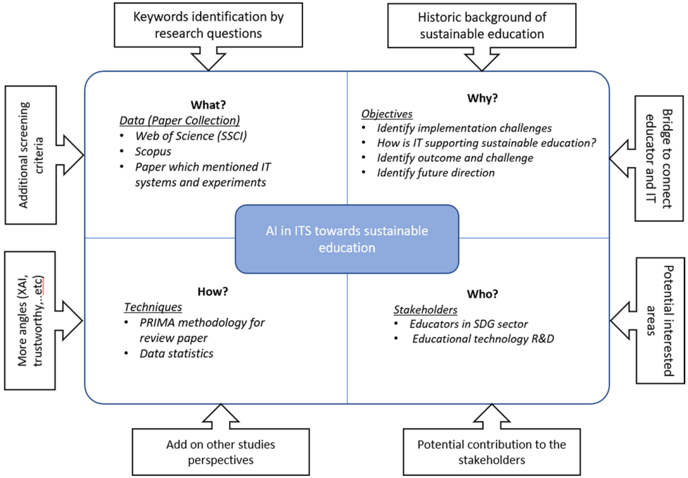
Sustainable education is a crucial aspect of creating a sustainable future, yet it faces several key challenges, including inadequate infrastructure, limited resources, and a lack of awareness and engagement. Artificial intelligence (AI) has the potential to address these challenges and enhance sustainable education by improving access to quality education, creating personalized learning experiences, and supporting data-driven decision-making. One outcome of using AI and Information Technology (IT) systems in sustainable education is the ability to provide students with personalized learning experiences that cater to their unique learning styles and preferences. Additionally, AI systems can provide teachers with data-driven insights into student performance, emotions, and engagement levels, enabling them to tailor their teaching methods and approaches or provide assistance or intervention accordingly. However, the use of AI and IT systems in sustainable education also presents challenges, including issues related to privacy and data security, as well as potential biases in algorithms and machine learning models. Moreover, the deployment of these systems requires significant investments in technology and infrastructure, which can be a challenge for educators. In this review paper, we will provide different perspectives from educators and information technology solution architects to connect education and AI technology. The discussion areas include sustainable education concepts and challenges, technology coverage and outcomes, as well as future research directions. By addressing these challenges and pursuing further research, we can unlock the full potential of these technologies and support a more equitable and sustainable education system.
Overview
CoChat Summary
TL;DR
This systematic review examines how AI and intelligent tutoring systems (ITSs) can support sustainable education, summarizing challenges, implementation approaches, outcomes, and future trends. It synthesizes 8 papers on sustainable education challenges and 29 papers on AI/ITS applications, emphasizing personalization, performance prediction, dropout prevention, and the need for explainable and human-centered AI.
Key findings
- The review identifies nine key sustainable education challenges: more students in virtual/blended learning; unequal global access and connectivity; teachers’ ICT skills and acceptance; lack of physical/emotional interaction; limited collaborative learning; engagement and dropout concerns; privacy/security; fairness and bias correction; and interpretability/transparency.
- Among 29 AI/ITS papers, the most common purposes were performance prediction (13), learning behavior analysis (9), engagement and dropout prevention (5), adaptation/personalization (5), instructors’ support (4), intervention (3), tutoring systems assessment (2), and self-regulation learning improvement (2).
- Reported outcomes included high-accuracy performance prediction (10 papers), identified learner behaviors (6), improved participation via early dropout notification (5), explainable results to instructors (2), and, for AI-embedded systems, improved performance through interaction with the AI system (3).
- Future directions emphasize explainable AI, human-centered AI, fairness, trustworthiness, and portability; only 2 of the 29 surveyed papers focused on explainable AI.
Methods
- The review follows the PRISMA methodology and uses a conceptualization process based on Yin’s qualitative research approach and Chatti et al.’s learning analytics reference model.
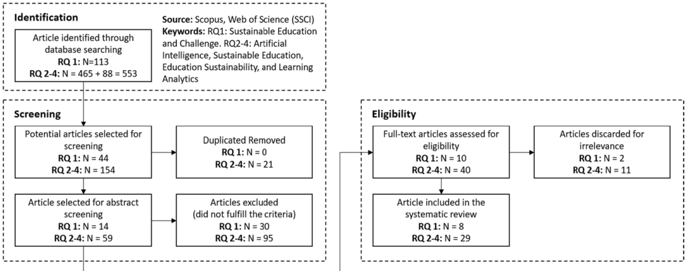
- For RQ1, Scopus was searched with “Sustainable Education” and “Challenge,” yielding 113 articles and selecting 8. For RQ2–RQ4, Scopus and Web of Science (SSCI) were searched with “Artificial Intelligence” AND (“Education Sustainability” OR “Sustainable Education” OR “Learning Analytics”), yielding 465 Scopus and 88 SSCI records, from which 29 papers were selected.
- Searches were limited to English-language journal or conference papers, with inclusion/exclusion criteria applied; selected papers were coded by data type, methods, objectives, and target learners/stakeholders.
Limitations
- The paper states that limitations and challenges of AI-embedded tutoring systems include the amount of data, feature extraction improvement, need for longer-period learning data, and solutions not being portable to other tutoring systems.
- It notes that most research does not explain why and how machine learning algorithms perform predictions, and that bias, fairness, and equality concerns arise from overfitting and the need for more and better training data.
- Evident from the text: the review is a qualitative synthesis without meta-analysis or formal effect-size aggregation, and its evidence base is restricted to Scopus/Web of Science, English-language journal and conference papers.
Model-written summary. Check it against the paper before relying on it.
Integrity signals
Registry
Cites
Statistics
Figures
Verification
Claims the paper makes
5 Valid · 7 Not valid · 41 Not checked · 38 Own results and interpretations
At least one cited source doesn’t support this claim or points to a different paper, and none confirmed it — see the verdicts below.
In the paper
“On the other hand, when performing learning behavior analysis (Pereira et al., 2021;Weng et al., 2020), most of the technology used turns to unsupervised learning, which also makes sense since there are no ground truth data for model training and the overall concept is for clustering or categorization without any reference.”
§ Smart Learning > RQ2: how are AI and IT incorporated as the ITS to support sustainable education?
What the sources say
- Disputedcites Pereira et al., 2021 matched to “Explaining Individual and Collective Programming Students’ Behavior by Interpreting a Black-Box Predictive Model” (2021) sourceExperimental — accuracy not yet measured
Our copy says the opposite of what is attributed: Sec. III (Related Work) states that 'educational data-driven researches identify patterns of behaviour based on data collected from the students learning process' and that 'there are many works in this field that use ML to construct predictive models', i.e. supervised prediction, not unsupervised clustering. The Introduction likewise frames prior work as methods 'to predict CS1 students' performance' and the paper itself trains a supervised XGBoost classifier on ground-truth pass/fail labels (Sec. V-E, 'students who passed (class 1) and students who failed (class 0)'), so the claim's rationale that 'there are no ground truth data for model training' is contrary to this source. The only unsupervised element is k-means applied post-hoc to Shapley values of the trained supervised model (Sec. V-G, Prediction Paths), presented as a contribution ('a new clustering approach'), not as the dominant technology of the field. (LLM, conf=0.70)
Checked by a reasoning model — may be wrong.
- Not checked yetcites Weng et al., 2020
plainstates an association- Asserted: passes — The authors put it forward as true.
- Checkable: passes — It can be checked against evidence.
- Load-bearing: unclear — It is unclear whether the paper’s conclusions depend on it.
- Based: passes — The paper gives a reason why it holds.
- Disputed
The cited sources support only part of this claim — read each source’s verdict below.
In the paper
“More challenges taking care of more students during virtual or blended learning environment (Tsegay et al., 2022;Wade, 2012), it may be because students are from remote especially like under COVID situation, and the instructors are forced to use tutoring systems to deliver courses on line.”
§ Smart Learning > RQ1: what are the key challenges of sustainable education implementation?
What the sources say
- Not checked yetcites Tsegay et al., 2022
- Partly supportedcites Wade, 2012 matched to “Pedagogy, Places And People” (2012) sourceExperimental — accuracy not yet measured
Wade (2012) does support the general point: the section 'challenges and opportunities of the virtual world' states that the exponential rise in 'distance or blended learning course, at least partially mediated by online provision' 'has thrown up a wide range of challenges and opportunities', and 'A formal taught course' describes the strain on tutors — students contacting tutors 'at all hours of the day and this is just not manageable... In personal sustainability terms for tutors this would be quite impossible so clear parameters need to be set'. However, no passage in our copy attributes the challenge to caring for *more* (larger numbers of) students, nor frames student volume as 'a key challenge of sustainable education implementation'; the paper's listed challenges are tutor accessibility/protocols, unequal broadband access in Sub-Saharan Africa, students' wariness of posting online, and the uncritical environmental cost of ICT. The remote/COVID gloss in the citing sentence is the citing authors' own framing (this paper predates it), and the Tsegay et al. (2022) part of the citation is separate evidence not judged here. (LLM, conf=0.72)
hedged- Asserted: passes — The authors put it forward as true.
- Checkable: passes — It can be checked against evidence.
- Load-bearing: unclear — It is unclear whether the paper’s conclusions depend on it.
- Based: passes — The paper gives a reason why it holds.
The cited sources support only part of this claim — read each source’s verdict below.
In the paper
“There are also some researchers who have explored different learning behaviors (Ruipérez-Valiente et al., 2021;Yang et al., 2021a, b) through clustering algorithms, which can also provide instructors with information for further intervention as necessary.”
§ Smart Learning > RQ3: what are the outcomes of AI/IT embedded as the ITS in sustainable education?
What the sources say
- Partly supportedcites Ruipérez-Valiente et al., 2021 matched to “Data-driven detection and characterization of communities of accounts collaborating in MOOCs” (2021) sourceExperimental — accuracy not yet measured
Our copy supports the clustering-of-behaviours half: Section 3.5.1/3.5.3 describe applying the IBM SPSS Two-Step clustering method to find different types of student accounts based on their engagement with the platform, and Section 5.1 reports the resulting cluster types (fruitful collaboration, free-riding, illicit, CAMEO). On the instructor-benefit half, Section 5.2 (Implications) only states that the work can 'provide the teacher with tools that allow them to somehow improve the design and development of MOOCs to promote more collaboration' and suggests course-design controls (randomization, linking accounts to a physical person) — i.e. course-design and dishonesty-deterrence measures, not information for instructors to intervene with individual students as necessary. The related-work statement in Section 2.1 that results 'can help understand instructors and researchers which behaviors can have a positive or negative impact' is credited to other studies ([27], [28]), not to clustering. (LLM, conf=0.72)
- Not checked yetcites Yang et al., 2021a, b
plainstates a cause- Asserted: passes — The authors put it forward as true.
- Checkable: passes — It can be checked against evidence.
- Load-bearing: unclear — It is unclear whether the paper’s conclusions depend on it.
- Based: passes — The paper gives a reason why it holds.
- Partly supported
The sources with a verdict support this claim; the rest weren’t checked yet, have no full text we could read, or their verdicts aren’t rated yet.
In the paper
“There are also some researchers who have explored different learning behaviors (Ruipérez-Valiente et al., 2021;Yang et al., 2021a, b) through clustering algorithms, which can also provide instructors with information for further intervention as necessary.”
§ Smart Learning > RQ3: what are the outcomes of AI/IT embedded as the ITS in sustainable education?
What the sources say
- Supportedcites Ruipérez-Valiente et al., 2021 matched to “Data-driven detection and characterization of communities of accounts collaborating in MOOCs” (2021) source
The source applies clustering to characterize behavioral profiles: Section 3.5.3 states it used the IBM SPSS Two-Step clustering method (Section 3.5.1) 'to find different types of student accounts based on their engagement with the learning platform,' and Section 5.1 reports detecting 'different collaboration behaviors among accounts' via that cluster analysis. Its review in Section 2.1 likewise surveys clustering studies that 'find different behavioral profiles of students,' and Section 5.2 (Implications) says the work can 'provide the teacher with tools' to improve MOOC design and to deter dishonesty/free-riding, which covers the citing sentence's point about information for instructor action. The paraphrase is broad but matches what our copy does. (LLM, conf=0.85)
- Not checked yetcites Yang et al., 2021a, b
plain- Asserted: passes — The authors put it forward as true.
- Checkable: passes — It can be checked against evidence.
- Load-bearing: unclear — It is unclear whether the paper’s conclusions depend on it.
- Based: passes — The paper gives a reason why it holds.
- Supported
The sources with a verdict support this claim; the rest weren’t checked yet, have no full text we could read, or their verdicts aren’t rated yet.
In the paper
“Of the 29 surveyed papers, only 2 focus on the result and try to leverage explainable AI (Afzaal et al., 2021;Pereira et al., 2021) on machine learning prediction.”
§ Smart Learning > RQ3: what are the outcomes of AI/IT embedded as the ITS in sustainable education?
What the sources say
- Not checked yetcites Afzaal et al., 2021
- Supportedcites Pereira et al., 2021 matched to “Explaining Individual and Collective Programming Students’ Behavior by Interpreting a Black-Box Predictive Model” (2021) source
The Introduction says the paper interprets a predictive model’s decisions, and the Conclusion says it developed an explainable machine-learning pipeline for predicting student performance. This supports citing Pereira et al. as an example of a paper applying explainable AI to machine-learning prediction. The count of 29 surveyed papers is the citing authors’ own survey finding, not a finding attributed to Pereira et al. (LLM, conf=0.91)
plain- Asserted: passes — The authors put it forward as true.
- Checkable: passes — It can be checked against evidence.
- Load-bearing: passes — The paper’s conclusions depend on it.
- Based: passes — The paper gives a reason why it holds.
28 more claims
Create a free account to see all 91 claims and to verify the 71 references still open.
- Probably not a substantial claim. 48
- It may state two separate claims as one. 27
- The quote only partly states this claim. 1
Claims other papers make about this one
Each is checked against this paper’s own text: does it say what the citing paper says it does?
The source backs part of the claim, not all of it — or backs it for a different population, condition or comparison.
In the citing paper
“It can support learners by providing customized feedback and opportunities for repeated practice appropriate to their level.”
From Development and pilot evaluation of an AI-based pediatric medication safety virtual simulation program for nursing students: a quasi-experimental study in South Korea (2026) · cites this paper as [12]
Experimental — accuracy not yet measuredThe source backs part of the claim, not all of it — or backs it for a different population, condition or comparison.
In the citing paper
“By analyzing learners’ input in real time, AI can identify patterns of errors in clinical performance and reasoning.”
From Development and pilot evaluation of an AI-based pediatric medication safety virtual simulation program for nursing students: a quasi-experimental study in South Korea (2026) · cites this paper as [12]
Experimental — accuracy not yet measuredThe cited source says what the claim attributes to it.
In the citing paper
“It can also promote adaptive learning by providing educational content tailored to students’ individual needs and learning styles [12].”
The cited source says what the claim attributes to it.
In the citing paper
“This approach enables instructors to utilize personalized AI-generated feedback without diminishing the role of traditional instruction [12,33].”
From The Role of AI in Academic Writing: Impacts on Writing Skills, Critical Thinking, and Integrity in Higher Education (2025) · cites this paper as [33]
In the citing paper
“Given that AI tools can provide instant feedback, students can work at their own pace, and those requiring additional support can benefit from AI assistance without the necessity of one-on-one tutoring [33].”
From The Role of AI in Academic Writing: Impacts on Writing Skills, Critical Thinking, and Integrity in Higher Education (2025) · cites this paper as [33]
2 more claims about this paper
Create a free account to see every claim other papers make about this one.
Self-check
Percentages, sums and reported differences re-computed from the paper’s own numbers.
Each contradiction between two passages listed here was confirmed by an independent check.
Rated minor: it would not touch a result — a value no result rests on, a p-value that stays on the same side of the significance level, or a conflict that is clerical, resolved elsewhere in the paper, or outside its own findings.
In the paper
§ Smart Learning > RQ3: what are the outcomes of AI/IT embedded as the ITS in sustainable education?
“For AI-embedded tutoring systems, most of the outcomes indicate that the performance prediction accuracy is high (Guerrero-Higueras et al., 2018;Hasnine et al., 2018)”
§ Smart Learning > Conclusions
“| AI not Embedded in | Performance prediction algorithm verified with high accuracy | 10 |”
Citations
Cites
The PRISMA 2020 statement: An updated guideline for reporting systematic reviews
Page, M. J., McKenzie, J. E., Bossuyt, P. M., Boutron, I., Hoffmann, T. C., Mulrow, C. D., Shamseer, L., Tetzlaff, J. M., Akl, E. A., Brennan, S. E., et al. (2021) · BMJ · doi:10.1136/bmj.n71 · Cited by 108,283
Arrieta, A. B., Díaz-Rodríguez, N., Del Ser, J., Bennetot, A., Tabik, S., Barbado, A., García, S., Gil-López, S., Molina, D., Benjamins, R., et al. (2019) · arXiv · doi:10.48550/arxiv.1910.10045 · Cited by 11,321 · cited 1×
“In the XAI review paper, Arrieta et al. (2020) categorized many common machine learning algorithms in detail and described how a model can be explained.”
BackgroundBarredo Arrieta, A., Díaz-Rodríguez, N., Del Ser, J., Bennetot, A., Tabik, S., Barbado, A., Garcia, S., Gil-Lopez, S., Molina, D., Benjamins, R., et al. (2020) · Information Fusion · doi:10.1016/j.inffus.2019.12.012 · Cited by 10,423 · cited 1×
“In the XAI review paper, Arrieta et al. (2020) categorized many common machine learning algorithms in detail and described how a model can be explained.”
BackgroundThe PRISMA 2020 statement: an updated guideline for reporting systematic reviews
Page, M. J., McKenzie, J., Bossuyt, P., Boutron, I., Hoffmann, T., mulrow, C., Shamseer, L., Tetzlaff, J., Akl, E., Brennan, S. E., et al. (2020) · doi:10.31222/osf.io/v7gm2_v1 · Cited by 8,090
Qualitative Research from Start to Finish
Yin, R. K. (2010) · Medical Entomology and Zoology · Cited by 5,667
The PRISMA 2020 statement: an updated guideline for reporting systematic reviews
Page, M. J., McKenzie, J., Bossuyt, P., Boutron, I., Hoffmann, T., mulrow, C., Shamseer, L., Tetzlaff, J., Akl, E., Brennan, S. E., et al. (2020) · doi:10.31222/osf.io/v7gm2 · Cited by 5,177
Human-Centered Artificial Intelligence: Reliable, Safe & Trustworthy
Shneiderman, B. (2020) · International Journal of Human–Computer Interaction · doi:10.1080/10447318.2020.1741118 · Cited by 1,743 · cited 1×
“Shneiderman (2020) defined a two-dimensional approach for categorizing and providing guidance on how to produce system designs that are Reliable, Safe, and Trustworthy (RST).”
DARPA's Explainable Artificial Intelligence Program
Gunning, D., & Aha, D. W. (2019) · AI Magazine · doi:10.1609/aimag.v40i2.2850 · Cited by 1,360 · cited 1×
“Similar to the 4-year project conducted by DARPA (Gunning & Aha, 2019), the technical teams were requested to provide an explainable model and explanation interface to support users making decisions.”
MethodAI in CAI: An Artificial-Intelligence Approach to Computer-Assisted Instruction
Carbonell, J. (1970) · IEEE Transactions on Man Machine Systems · doi:10.1109/tmms.1970.299942 · Cited by 955 · cited 1×
“The overall concept can be traced back to 1970 (Carbonell, 1970).”
BackgroundExplainable Artificial Intelligence in education
Khosravi, H., Shum, S. B., Chen, G., Conati, C., Tsai, Y.-S., Kay, J., Knight, S., Martinez-Maldonado, R., Sadiq, S., & Gašević, D. (2022) · Computers and Education: Artificial Intelligence · doi:10.1016/j.caeai.2022.100074 · Cited by 863 · cited 2×
“Khosravi et al. (2022) deeply explore XAI in terms of education, which also provides good guidance for educators and IT solution architects.”
Background
Research works printed but not linked: 2
- Lu, O. H. T., Huang, A. Y. Q., & Yang, S. J. H. (2018). Benchmarking and tuning regression algorithms on predicting students' academic performance. In 26th International conference on computers in education, Philippines.
- Sterling, S. R., & Orr, D. (2001). Sustainable education: Re-visioning learning and change (Vol. 6). Green Books for the Schu- macher Society Totnes.
Cited by
Items 401–500 of 897
Sidik, D. P., Irawijayanti, F., & Fatqurhohman, F. (2025) · JINEA Journal of Innovation in Education and Learning · doi:10.66031/jinea.132025.38 · Cited by 2
“The systematic review conducted by (C. C. Lin et al., 2023) in Smart Learning Environments (SpringerOpen) affirmed that Artificial Intelligence (AI) makes a significant contribution to achieving the goals of sustainable education through the implementation of personalized learning.”
InfluentialLearning Analytics, Artificial Intelligence, and the Future of Democratic Curricular Governance
Carrión, J., Jaramillo, C., & Villarreal, S. N. C. (2026) · Advances in computational intelligence and robotics book series · doi:10.4018/979-8-3373-4480-5.ch015 · Cited by 1
Transforming Education With Artificial Intelligence: Tools, Challenges, and Future Directions
Sammy, F., priya, P. G., Lakumarapu, S., Jebamalar, G. B., Vijay, J. A., Lokesh, P., & Dinesh, M. G. (2026) · Advances in computational intelligence and robotics book series · doi:10.4018/979-8-3373-3436-3.ch017 · Cited by 1
The Role of AI in Facilitating Value Co-Creation in Service Industries
Reda, L. (2026) · Advances in computational intelligence and robotics book series · doi:10.4018/979-8-3373-3436-3.ch016 · Cited by 1
Kuncoro, K. S., Fitriasari, P., Erlangga, S. Y., Ario, M., & Kartika, D. L. (2026) · F1000Research · doi:10.12688/f1000research.176098.1 · Cited by 3
Reimagining Education: An Architectural Blueprint for a Synergistic AI-Driven Learning Environment
Sahana, S., Ghosh, P., & Anutariya, C. (2025) · IEEE Annual Information Technology, Electronics and Mobile Communication Conference (IEMCON) · doi:10.1109/iemcon67450.2025.11381300 · Cited by 1
Suhail., T., & Rajakumari, K. E. (2025) · International Conference on Artificial Intelligence and Knowledge Discovery in Concurrent Engineering (ICECONF) · doi:10.1109/iceconf65644.2025.11379461 · Cited by 2
Chy, M. K. A., Arthi, P. B., Ifty, R. A., Hamim, A. M. A. I., Iqbal, J., & Franklin, A. (2026) · Lecture notes in networks and systems · doi:10.1007/978-3-032-15346-3_47 · Cited by 2
INTELIGENCIA ARTIFICIAL Y ANALÍTICA DEL APRENDIZAJE: DEL DATO A LA DECISIÓN EN LA EDUCACIÓN SUPERIOR
Córdova, R. J. P., Delgado-Ramirez, J. C., Pachay, J. F. Z., & Rodríguez, A. D. S. (2026) · doi:10.66059/9789907809008 · Cited by 1
Majuita, S., Hakim, L. E., & Ristanto, . H. (2025) · CARONG Jurnal Pendidikan Sosial dan Humaniora · doi:10.62710/fqwaqf32 · Cited by 1
“…peralatan, analisis kualitas produk, dan penerapan protokol keselamatan yang dapat dimodelkan melalui skenario PBL berbasis simulasi AI (Lin et al., 2023) Meski potensi tersebut besar, kajian literatur juga menunjukkan adanya kekurangan penelitian empiris yang mengembangkan dan…”
Madhala, R. T., Suri, S., Rahul, N., Rusum, G. P., Boda, S. S., & Gupta, D. (2025) · International Conference on AI-Driven STEM Education and Learning Technologies (AISTEMEDU) · doi:10.1109/aistemedu67077.2025.11403936 · Cited by 1
“The integration of Intelligent Tutoring Systems (ITS) with Machine Learning (ML) has become a central focus in educational technology research due to its potential to enhance student learning in higher STEM education [10][11].”
Educational Data Mining to support the Design of AI-Powered Tutoring Systems
Khayat, G. A. E., Cheniti‐Belcadhi, L., & Benelhadj, M. E. H. (2025) · International Conference on Research in Computing at Feminine (RIF) · doi:10.1109/rif68108.2025.11406802 · Cited by 2
Digital Policy Integration for Poverty Reduction: Leveraging e-Government and Data Interoperability
Sarofah, R., Ramdhani, H., & Firmadi, S. (2026) · Jurnal Public Policy · doi:10.35308/jpp.v12i1.12859 · Cited by 1
“3) Improving Technology Infrastructure and Data Security: Infrastructure is an element of implementing information technology services (Lin et al., 2023).”
How we learn language collaboratively through technology: a systematic review
Li, Z., & Zhou, Z. (2026) · Journal of Computers in Education · doi:10.1007/s40692-026-00385-2 · Cited by 1
“…can also guide learners through complex collaborative tasks by offering process-level support, such as modeling students’ psychological states, monitoring learning process, or helping resolve disagreements (Lin et al., 2023 ), which are difficult to replicate consistently in classroom settings.”
Chung, P. T., & Ngo, T. T. A. (2026) · Journal of Information Technology Education Research · doi:10.28945/5720 · Cited by 2
“This loop encourages continued behavioral interaction and deepens cognitive investment, as the learner perceives the interaction as productive and supportive (C. C. Lin et al., 2023).”
Purigay, J. P. D., & Lopez, E. B. (2026) · Research in Learning Technology · doi:10.25304/rlt.v34.3632 · Cited by 1
Zhang, H., & Leong, W. Y. (2026) · Eurasia Journal of Mathematics Science and Technology Education · doi:10.29333/ejmste/18075 · Cited by 2
“By integrating technological sophistication with emotional sensitivity, these systems can help students achieve more effective and meaningful learning experiences (Lin et al., 2023).”
Nature on the Use of AI Tools and Academic Achievement in Mathematics
Arce, I. J. S. (2026) · International Journal of Education in Mathematics Science and Technology · doi:10.46328/ijemst.5645 · Cited by 1
“Shearman (2024) and Holmes et al. (2019) highlighted that scaffolded AI fosters critical thinking and comprehension, while Lin, Huang, and Lu (2023) emphasized its role in strengthening conceptual understanding.”
Sofianos, K. C., Kaponis, A., Stefanidakis, M., Μaragoudakis, M., Pappas, T., & Bukauskas, L. (2026) · Engineering Technology & Applied Science Research · doi:10.48084/etasr.13756 · Cited by 1
“AI tools (e.g., ChatGPT) can provide instant feedback, identify trends in learning behavior, and facilitate the intervention of personalized learning strategies for each student [8, 9].”
Zhang, S., Zhu, J., Meng, X., Zhang, Y., Wang, X., & Liu, Z. (2026) · Journal of educational theory and practice. · doi:10.62177/jetp.v3i1.1267 · Cited by 1
“Moreover, research on intelligent tutoring systems has demonstrated the potential of AI to deliver personalized instruction at scale [10] , yet the connection between tutoring interventions and measurable learning outcomes remains insufficiently explored through machine learning approaches.”
A neuro-symbolic reasoning for affective-aware personalization in virtual learning environments
Olaniyan, D., & Wario, R. D. (2026) · Interactive Technology and Smart Education · doi:10.1108/itse-03-2026-0094 · Cited by 2
Budi, N. S., Fadly, H. D., Nurdin, N., & Rubai’ah, S. (2026) · Jurnal Pembelajaran Bimbingan dan Pengelolaan Pendidikan · doi:10.17977/um065.v6.i5.2026.2 · Cited by 2
Popgeorgiev, A., Ibryamova, E., & Ivanova, G. (2026) · International Symposium INFOTEH-JAHORINA (INFOTEH) · doi:10.1109/infoteh68759.2026.11477613 · Cited by 1
Majeed, B. H., Ibrahim, Z. H., Abdulsalam, W. H., Al-Mallah, D., & ALRikabi, H. T. S. (2026) · International Journal of Engineering Pedagogy (iJEP) · doi:10.3991/ijep.v16i2.60769 · Cited by 1
The effect of AI-assisted problem-based learning strategies on civic education learning outcomes
Suarniati, N. W., Bramantya, A., Pujiati, E., & Soares, M. V. (2026) · Research and Development in Education (RaDEn) · doi:10.22219/raden.v6i1.43409 · Cited by 5
Kamali, J., pour, R. A., Naderi, M. S., Afrasiabi, M., & Piri, F. (2026) · Asian-Pacific Journal of Second and Foreign Language Education · doi:10.1186/s40862-026-00403-x · Cited by 2
Xu, S., & Zhang, G. (2026) · Frontiers in Psychology · doi:10.3389/fpsyg.2026.1828331 · Cited by 3
Chan, C. K. Y., Dai, W., Cao, K., Poon, A. T. Y., & Colloton, T. (2026) · Applied Sciences · doi:10.3390/app16115268 · Cited by 2
Λαμπρόπουλος, Γ., & Papadakis, S. (2026) · Advances in computational intelligence and robotics book series · doi:10.4018/979-8-3373-6471-1.ch001 · Cited by 1
Karlıdağ, B. A., MALKOÇ, T., & Küçüktepe, S. E. (2026) · Applied Sciences · doi:10.3390/app16115383 · Cited by 2
Adaptive meta-path discovery for dual-stream collaborative knowledge tracing
Qiu, L., & Xu, Y. (2026) · Expert Systems with Applications · doi:10.1016/j.eswa.2026.133016 · Cited by 1
Yelibayeva, G., Nazyrova, A., Strecker, M., Shamshanovna, R. B., & Sharipbay, A. (2026) · Ingénierie des systèmes d information · doi:10.18280/isi.310415 · Cited by 1
Cai, Y. (2026) · International Conference on Big Data and Informatization Education (ICBDIE) · doi:10.1145/3806980.3807031 · Cited by 1
Research on an AI-Based Sustainable Education Content Recommendation System
Wei, L., Kakade, K., Cheng, Y., & Yang, S. (2026) · International Conference on Recent Trends in Computer Science and Technology (ICRTCST) · doi:10.1109/icrtcst68392.2026.11545234 · Cited by 1
“Intelligent systems which can creatively suggest content that is contextually relevant and relevant to learn meaningful and toward the end goal of sustainable learning, there is the necessity of immense pressure [5].”
Unveiling Factors Influencing University Students’ Intention to Adopt AI-Based Teaching Assistance
So, I. G., Chanda, R. C., Zhang, M. L., Gui, A., Bachri, S., & Kowirya, P. C. (2025) · International Conference on Intelligent & Innovative Practices in Engineering & Management (IIPEM) · doi:10.1109/iipem65914.2025.11548378 · Cited by 1
“By integrating this strong structure with robust service quality (e.g., providing timely feedback, personalized support, consistent availability), the AI tools can achieve greater impact [23].”
InfluentialAlruwaili, H. R. (2026) · Technology and Disability · doi:10.1177/10554181261458683 · Cited by 1
AI-Transparency and Algorithmic Trust in Smart LMS Adoption: An Explainable-AI Extended TAM Model
Shannaq, B., Almaqbali, S., & Ali, O. (2026) · ASU International Conference in Emerging Technologies for Sustainability and Intelligent Systems (ICETSIS) · doi:10.1109/icetsis68266.2026.11548913 · Cited by 1
“The study of smart learning technologies proves that an increase in trust results in an increase in perceived efficacy and intentions to implement adaptive systems [19] [29].”
Sahoo, S. K., Sahu, S., Choudhury, B. B., Dhal, P. R., & Dhar, I. (2026) · Journal of Contemporary Decision Science · doi:10.67334/cds21202611 · Cited by 5
Mattingly, T. J., Peterson, R. T., Hume, W. R., & Duffin, K. C. (2026) · Academic Medicine · doi:10.1093/acamed/wvag182 · Cited by 1
Pujitha, G., & Saritha, A. (2026) · International Conference on Inventive Research in Computing Applications (ICIRCA) · doi:10.1109/icirca69024.2026.11570306 · Cited by 1
“To overcome these drawbacks, AI-powered ITSs incorporate artificial intelligence technologies such as machine learning, NLP, educational data mining and adaptive analytics to facilitate sustainable and student-centered learning [1].”
A Comprehensive Review of Artificial Intelligence in Civil Engineering Education
Zohourian, M., Pamidimukkala, A., Kermanshachi, S., & Almaskati, D. N. (2026) · ASCE International Conference on Transportation and Development (ICTD) · doi:10.1061/9780784487013.015 · Cited by 2
Kotzanikolaou, P., Dasaklis, T. K., Christodoulakis, V., & Malamas, V. (2026) · Computers in Human Behavior Reports · doi:10.1016/j.chbr.2026.101182 · Cited by 1
A Dual-Agent Intelligent Tutoring System for Teaching Two-Step Fraction Word Problems
Chang, C.-C., Shih, S.-C., & Kuo, B. (2026) · IEEE Transactions on Learning Technologies · doi:10.1109/tlt.2026.3708780 · Cited by 3
Optimisation of university instructors’ professional practice through AI agents: a systematic review
Doszhanov, B., Zhumadilla, B., & Zhapparbergenov, R. (2026) · Frontiers in Education · doi:10.3389/feduc.2026.1893124 · Cited by 1
Permata, C. A., & Nugroho, D. P. (2025) · Education Jurnal Sosial Humaniora dan Pendidikan · doi:10.51903/5gn23z75 · Cited by 3
Ismail, S. M., Ibrahim, K. A. A.-A., & Hashemifardnia, A. (2026) · Scientific Reports · doi:10.1038/s41598-026-62920-6 · Cited by 2
“One of the most promising applications of AI in education is the AI-based tutoring system, which has been widely discussed as a tool for personalized learning 18 .”
Ivanova, T. (2026) · Applied Sciences · doi:10.3390/app16157824 · Cited by 1
Grab, M. Ö. (2026) · Social Sciences & Humanities Open · doi:10.1016/j.ssaho.2026.103465 · Cited by 2
Jansson, M., Tian, K., Hrastinski, S., & Engwall, O. (2024) · Proceedings of the International Conference on Networked Learning · doi:10.54337/nlc.v14i1.8070 · Cited by 4
“Having human tutors between the AI bot and the students may also help minimize potential biases from the system (Lin et al., 2023).”
BackgroundDesigning a knowledge assessment system for the Data structures and Algorithms course
Long, H. N. L. H. N., Thanh, T., & Do, N. V. (2024) · TẠP CHÍ KHOA HỌC TRƯỜNG ĐẠI HỌC QUỐC TẾ HỒNG BÀNG · doi:10.59294/hiujs.vol.6.2024.631 · Cited by 1
Generative AI-Human Collaboration in Higher Education: Applications, Challenges, and Strategies
Jha, B., Devanesan, M. D., Jha, D., & Giri, P. (2024) · Advances in computational intelligence and robotics book series · doi:10.4018/979-8-3693-6806-0.ch020 · Cited by 1
A MOOC for exam training mathematics using intelligent tutoring
Rothkrantz, C., Fitrianie, S., & Rothkrantz, L. J. M. (2024) · International Conference on Computer Systems and Technologies (CompSysTech) · doi:10.1145/3674912.3674928 · Cited by 1
Artificial intelligence as perceived by accounting students. An observation from Poland
(2024) · Scientific Papers of Silesian University of Technology Organization and Management Series · doi:10.29119/1641-3466.2024.203.29 · Cited by 6
Simulation Training System of Power Dispatching Operation Command Based on Artificial Intelligence
Fu, Y., Yang, S. Y., Ning, Y., Wei, X., Liu, J., & Li, S. (2025) · Sustainable civil infrastructures · doi:10.1007/978-3-031-72509-8_36 · Cited by 1
THE ROLE OF AI IN EDUCATION: REVOLUTIONIZING LEARNING THROUGH PERSONALIZATION
Nendrambaka, S. K. (2025) · INTERNATIONAL JOURNAL OF RESEARCH IN COMPUTER APPLICATIONS AND INFORMATION TECHNOLOGY · doi:10.34218/ijrcait_08_01_116 · Cited by 1
DIGICOMPASS: A Framework for Global Language Education
Rocca, S. (2024) · Springer eBooks · doi:10.1007/978-3-031-81318-4_2 · Cited by 1
AI-Based Photography Assessment System using Convolutional Neural Networ
Vorapatratorn, S., & Thongsibsong, N. (2025) · Advances in Science Technology and Engineering Systems Journal · doi:10.25046/aj100203 · Cited by 1
Kustini, S., Amelia, R., Mutammimah, H., Ningsih, R. P., & Amelia, R. (2025) · Proceeding International Seminar of Science and Technology · doi:10.33830/isst.v4i1.5224 · Cited by 1
“As for example, [6] review some papers related to the role of artificial intelligence in Intelligence Tutoring Systems (ITS) to support sustainable education.”
GAIL: Enhancing Student Engagement and Productivity
León, M. (2025) · Proceedings of the ... International Florida Artificial Intelligence Research Society Conference · doi:10.32473/flairs.38.1.138689 · Cited by 3
Nair, U. N., & Azath, H. (2025) · Journal of Experimental & Theoretical Artificial Intelligence · doi:10.1080/0952813x.2025.2511091 · Cited by 2
“Lin et al. (2023) have investigated the different perspectives of educators and information technology to connect education and AI technology.”
Trudel-Ferland, M., Ghodbane, A., Yoshida, M., Kouki, A. B., Lina, J.-M., Deslandes, D., & Zhuldybina, M. (2025) · Education and Training in Optics and Photonics · doi:10.1109/etop64842.2025.11030638 · Cited by 1
“Traditional teaching methods often struggle to effectively convey these complex concepts, resulting in significant learning gaps and blocking practical application of essential knowledge [1, 2].”
AI Educational Support Framework for At-Risk Media Students
Assad, A. (2025) · International Conference on e-Education, e-Business, e-Management and e-Learning · doi:10.1109/ic4e65071.2025.11075419 · Cited by 1
“In addition, AI also offers real-time feedback based on tools like intelligent tutoring systems, which helps students to identify the problems and assists them in developing their understanding [22].”
Artificial Intelligence in Academic Research: Applications, Challenges, and Future Directions
Han, P.-C. (2025) · Advances in computational intelligence and robotics book series · doi:10.4018/979-8-3373-2397-8.ch015 · Cited by 3
Dang, R., & Samad, N. B. A. (2025) · Future Technology · doi:10.55670/fpll.futech.4.4.14 · Cited by 1
Wang, J., Du, Y., & Jin, Q. (2026) · Computers and Education Artificial Intelligence · doi:10.1016/j.caeai.2026.100676 · Cited by 1
Balancing Innovation with Ethics
Luise, R. S. A.-D., Arnau‐González, P., Serrano-Mamolar, A., Solera-Monforte, S., & Wu, Y. (2024) · Wiley eBooks · doi:10.1002/9781394257744.ch11 · Cited by 1
Impact of Prior Knowledge on Student Learning: A Narrative ReviewPreprint
Dilinika, J. M. S. (2025) · SSRN Electronic Journal · doi:10.2139/ssrn.5198482 · Cited by 2
Avedzi, J. E. (2025) · Research Square · doi:10.21203/rs.3.rs-7349948/v1 · Cited by 1
Ethics in AI : A Structured Approach to Teaching and Learning with AI in Ethical Contexts
Sadruddin, M. M. (2025) · Wiley eBooks · doi:10.1002/9781394352821.ch12 · Cited by 2
Chang, L. (2026) · Research Square · doi:10.21203/rs.3.rs-8998934/v1 · Cited by 1
Вплив неорганічного фосфору на вміст ліпідів у тканинах і органах Anodonta cygnea
С., Ш. Ю., & Бєлікова, К. В. (2026) · doi:10.70286/eoss-01.06.2026 · Cited by 1
Wiśniewska-Sałek, A. (2023) · Scientific Papers of Silesian University of Technology Organization and Management Series · doi:10.29119/1641-3466.2023.181.40
“This issue is defined by Lin and co-authors (Lin et al., 2023).”
Conclusion and Future Directions
(2024) · Advances in knowledge acquisition, transfer, and management book series/Advances in knowledge acquisition, transfer and management book series · doi:10.4018/979-8-3693-6905-0.ch008
The Dynamic Impact of Neuroscience and Artificial Intelligence on Education
Karmakar, S., & Das, S. (2024) · Information systems engineering and management · doi:10.1007/978-3-031-72410-7_13 · Cited by 2
Burton, S. L. (2024) · World Journal of Business Research · doi:10.71002/wjbr.v4n1p9
“AI technologies, like intelligent tutoring systems and adaptive learning environments, offer personalized experiences that align with the constructivist approach (Lin et al., 2023).”
BackgroundPeixer, C. G., Nass, F. A., Hirt, F. N., de Moura, G. S., Trainoti, J. D. A. S., Schroeder, K., Wagner, L. A., Becker, L. C., Rodrigues, N. C., & Busnello, V. E. I. (2025) · doi:10.29327/5474955
Cultural relations between India and Uzbekistan
Mourya, R., & Diwan, G. (2024) · RADINKA JOURNAL OF SCIENCE AND SYSTEMATIC LITERATURE REVIEW · doi:10.56778/rjslr.v2i3.371
“(Lin et al., 2023), This makes it clear how deep the relations have been between India and Uzbekistan in the field of education, which has not only strengthened bilateral relations but also made invaluable contributions in the field of cultural relations.”
Directions for using Generative Artificial Intelligence in Introductory Programming
Dolinsky, M. S. (2024) · WSEAS Transactions on Computers archive · doi:10.37394/23205.2024.23.26
A Bibliometric Analysis of Smart Learning Environments Under the Digital Pedagogy Paradigm
Rad, D., & Rad, G. (2025) · Advances in educational technologies and instructional design book series · doi:10.4018/979-8-3693-7723-9.ch001 · Cited by 3
Blending Tradition with Innovation: An Interactive Tutoring in Handwriting Islamic Calligraphy
Jamaluddin, N., Zain, N. H. M., & Diah, N. M. (2024) · IEEE Student Conference on Research and Development (SCOReD) · doi:10.1109/scored64708.2024.10872672
“In addition to their past knowledge, abilities, and preferences, these systems can simulate students’ psychological states, including motivation, emotion, and cognition [23].”
A Study of Classifiers for Marking Short Answers in Intelligent Tutoring Systems
Pillay, N., & Marais, G. (2025) · Lecture notes in computer science · doi:10.1007/978-3-031-81596-6_12
Empirical investigation of a GPT-4o mini-based tutor for the learning of R programming
Dielingen, J. V., Rebholz, T. R., & Papenmeier, F. (2025) · Zeitschrift für Hochschulentwicklung · doi:10.21240/zfhe/sh-ki-2/13
“…conversational AI tutors enables more personalized and scalable support, facilitating independent learning by using natural language processing and machine learning techniques to assess student responses and monitor progress through the analysis of individual learning patterns (Lin et al., 2023).”
AI, Stereotyping, Bias, and Law Beyond Utopia and Dystopia: Safeguarding Human Rights
Ghosh, A., Amulya, N. V. N. S. S. U., & Parihar, S. S. (2025) · Advances in human and social aspects of technology book series · doi:10.4018/979-8-3693-9035-1.ch002
Pan, Y. (2025) · International Journal of Computational and Experimental Science and Engineering · doi:10.22399/ijcesen.1171
“It 's tough to keep up with all the data the system creates [28].”
The Impact of Generative AI on Education: A Review of Applications and Challenges
Bahri, N. E., Itahriouan, Z., & Abtoy, A. (2025) · Advances in educational technologies and instructional design book series · doi:10.4018/979-8-3373-2262-9.ch002
Preparing for a Future With Generative AI
Oleet, J. B. (2025) · Advances in computational intelligence and robotics book series · doi:10.4018/979-8-3693-8744-3.ch012
Lin, X., & Bian, W. (2025) · Advances in Educational Technology and Psychology · doi:10.23977/aetp.2025.090216
“For instance, adaptive learning systems and intelligent tutoring systems have been applied to customize learning experiences and provide real-time feedback [3, 4].”
Perspectives of Faculty on the Easiness and Usefulness of AI Tutoring Systems in Higher Education
Hamam, D., Ouda, Y., Hysaj, A., Ezzat, M., & Khan, S. A. (2025) · Lecture notes in computer science · doi:10.1007/978-3-031-93539-8_12 · Cited by 3
Patel, B., & Patel, D. (2025) · International Research Journal of Innovations in Engineering and Technology · doi:10.47001/irjiet/2025.905016
Zhang, K., Nimno, R., & Thienmongkol, R. (2025) · Journal of Posthumanism · doi:10.63332/joph.v5i6.2267
Técnicas de Inteligencia Artificial para el análisis de calidad de vida: Mapeo Sistemático
Caicedo, J., Cuaces, J. C. Á., Luna, R. M. R., & Ordóñez, H. (2025) · Ingeniería y Competitividad · doi:10.25100/iyc.v27i2.14764
Ethical Framework for the Application of Intelligent Systems in Iranian Universities
Saed, S., Montazer, G. A., Kalashi, K., & Olyaee, S. (2025) · International and National Conference on E-Learning and E-Teaching (ICeLeT) · doi:10.1109/icelet66022.2025.11025202
“Intelligent tutoring systems (ITS) like Carnegie Learning offer real-time feedback [4], and platforms like Gradescope automate assessments, reducing faculty workload.”
TRANSFORMING HIGHER EDUCATION: THE IMPACT OF ARTIFICIAL INTELLIGENCE IN KERALA’S ACADEMIC LANDSCAPE
Rani, L., & Biju, S. (2024) · INTERNATIONAL JOURNAL OF MANAGEMENT · doi:10.34218/ijm_15_06_018
Xây dựng ứng dụng kiểm tra đánh giá kiến thức môn học Cấu trúc dữ liệu và Giải thuật
Long, H. N., & Do, N. V. (2025) · TẠP CHÍ KHOA HỌC TRƯỜNG ĐẠI HỌC QUỐC TẾ HỒNG BÀNG · doi:10.59294/hiujs2025020
Revolutionizing Global Education: The Transformative Power of Artificial Intelligence
U, U. A. S. S. (2025) · Shanlax International Journal of Arts Science and Humanities · doi:10.34293/sijash.v12is1-may.8981
Suplemento sobre la evaluación de lenguas en la era de la inteligencia artificial
Chamorro, M. E. G., & Varón, O. C. (2025) · Lenguaje · doi:10.25100/lenguaje.v53i1s.15058
Golub, T. P., Kovalenko, O., Zhygzhytova, L. M., & Nazarenko, O. (2025) · Наукові інновації та передові технології · doi:10.52058/2786-5274-2025-6(46)-754-767
Ganesh, K. S., Shunmugasundaram, M., Sundari, V. M., Gangadharan, S., & Kannan, G. (2025) · International Journal of Computational Intelligence and Applications · doi:10.1142/s1469026825500063
Research on AI-Empowered Precision Training Strategies for Rural Teachers
Zhang, B. (2025) · Education insights. · doi:10.70088/ms9sbr23
Metadata
- Authors
- Lin, C.-C., Huang, A. Y. Q., & Lu, O. H. T.
- Affiliations
- National Central University (TW)
- National Chengchi University (TW)
- Corresponding author
- Lin, Chien-Chang
- Venue
- Smart Learning Environments
- Published
- 2023-08-28
- Volume
- 10
- Issue
- 1
- ISSN
- 2196-7091 (ISSN-L)
- OpenAlex
- W4386223224
- Semantic Scholar
- dfbc9f44f0ff3c994eecee83a48cb27dd20c51b0
- Cited by
- 669
- References
- 59
- Citations by year
- 2026: 282 · 2025: 286 · 2024: 97 · 2023: 4
- FWCI
- 27.57
- Type
- journal article
- Language
- en
- Open access
- gold
- doi.org
- Licence
- cc-by
- creativecommons.org/licenses/by/4.0 (tdm)
- creativecommons.org/licenses/by/4.0 (vor)
- Locations
- Smart Learning Environments (publishedVersion, cc-by)
- DOAJ (DOAJ: Directory of Open Access Journals) (submittedVersion, cc-by-sa)
- Funders
- National Science and Technology Council (111-2410-H-008 -010 -MY3, 109-2511-H-008 -007 -MY3)
- Topics
- Social Sciences › Education › Artificial Intelligence in Education
- Physical Sciences › Computer Science › Artificial Intelligence › Intelligent Tutoring Systems and Adaptive Learning
- Social Sciences › Education › Educational Technology and Pedagogy
- Keywords
- artificial intelligence in education, intelligent tutoring systems, sustainable education, personalized learning, data-driven decision making, student engagement, student performance analysis, algorithmic bias, data privacy and security, educational technology infrastructure, educational equity
About these checks
Registry, retraction, Cites and statistics results are computed, not judged, with one exception: a printed reference that no index lists is read once by a model before it counts as a citation error. Claims are extracted by a model and kept only when their quote appears verbatim in the text; each cited source is then checked, with a model’s help, for whether it says what the claim relies on. Those verdicts can be wrong — read the claim’s quote and the cited source before relying on one.
The claim verdicts this report counts are experimental: their accuracy is not yet measured.
A language model drew the claims from the paper on 2026-10-07, under version 3 of the claim definition (model deepseek-v4.1-flash, prompt extract-v3).
A second model labelled each claim on 2026-10-07 (model jev-1.13-20260917, definition revision gold-guideline-v0.2).
Cited sources are checked with a language model’s help (qwen3.8-omni-flash and gpt-6-sol).
Statistics and arithmetic are recomputed, not judged.
Confidence bands are shown only for fields calibrated on our annotated test set. None is calibrated yet, so no band is shown.
What counts as a claim ›How we measure confidence ›How we check this ›
Are you an author, or do you see a problem with this page? Request a review
Data sources
Bibliographic data: Semantic Scholar, OpenAlex, Crossref.
Contains information from the Semantic Scholar Academic Graph Datasets, made available under the ODC Attribution License (ODC-BY 1.0).
Semantic Scholar’s data is described in: Kinney, R., et al. (2023). The Semantic Scholar Open Data Platform. arXiv:2301.10140.
