

Artificial intelligence in intelligent tutoring systems toward sustainable education: a systematic review
Open accessThe DOI matches its Crossref record; 61 of the 61 references it cites were found in a registry or an index; 7 of the 78 sources its claims cite were checked for support.
Abstract
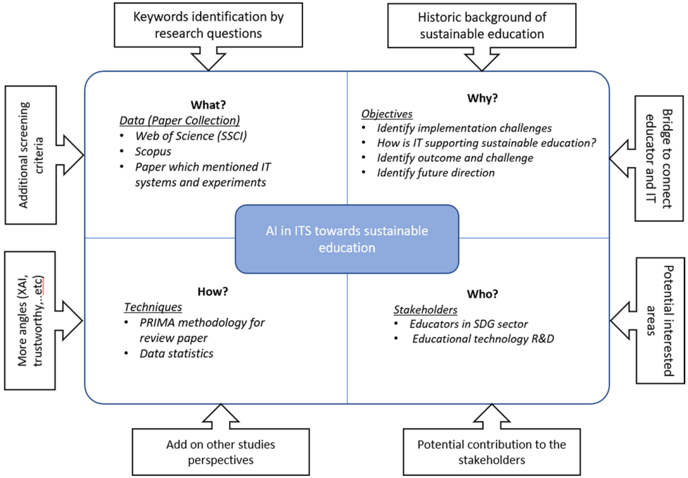
Sustainable education is a crucial aspect of creating a sustainable future, yet it faces several key challenges, including inadequate infrastructure, limited resources, and a lack of awareness and engagement. Artificial intelligence (AI) has the potential to address these challenges and enhance sustainable education by improving access to quality education, creating personalized learning experiences, and supporting data-driven decision-making. One outcome of using AI and Information Technology (IT) systems in sustainable education is the ability to provide students with personalized learning experiences that cater to their unique learning styles and preferences. Additionally, AI systems can provide teachers with data-driven insights into student performance, emotions, and engagement levels, enabling them to tailor their teaching methods and approaches or provide assistance or intervention accordingly. However, the use of AI and IT systems in sustainable education also presents challenges, including issues related to privacy and data security, as well as potential biases in algorithms and machine learning models. Moreover, the deployment of these systems requires significant investments in technology and infrastructure, which can be a challenge for educators. In this review paper, we will provide different perspectives from educators and information technology solution architects to connect education and AI technology. The discussion areas include sustainable education concepts and challenges, technology coverage and outcomes, as well as future research directions. By addressing these challenges and pursuing further research, we can unlock the full potential of these technologies and support a more equitable and sustainable education system.
Overview
CoChat Summary
TL;DR
This systematic review examines how AI and intelligent tutoring systems (ITSs) can support sustainable education, summarizing challenges, implementation approaches, outcomes, and future trends. It synthesizes 8 papers on sustainable education challenges and 29 papers on AI/ITS applications, emphasizing personalization, performance prediction, dropout prevention, and the need for explainable and human-centered AI.
Key findings
- The review identifies nine key sustainable education challenges: more students in virtual/blended learning; unequal global access and connectivity; teachers’ ICT skills and acceptance; lack of physical/emotional interaction; limited collaborative learning; engagement and dropout concerns; privacy/security; fairness and bias correction; and interpretability/transparency.
- Among 29 AI/ITS papers, the most common purposes were performance prediction (13), learning behavior analysis (9), engagement and dropout prevention (5), adaptation/personalization (5), instructors’ support (4), intervention (3), tutoring systems assessment (2), and self-regulation learning improvement (2).
- Reported outcomes included high-accuracy performance prediction (10 papers), identified learner behaviors (6), improved participation via early dropout notification (5), explainable results to instructors (2), and, for AI-embedded systems, improved performance through interaction with the AI system (3).
- Future directions emphasize explainable AI, human-centered AI, fairness, trustworthiness, and portability; only 2 of the 29 surveyed papers focused on explainable AI.
Methods
- The review follows the PRISMA methodology and uses a conceptualization process based on Yin’s qualitative research approach and Chatti et al.’s learning analytics reference model.
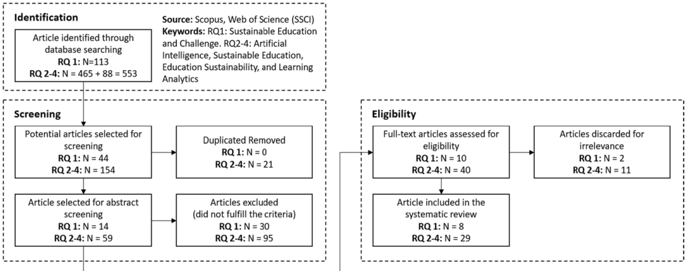
- For RQ1, Scopus was searched with “Sustainable Education” and “Challenge,” yielding 113 articles and selecting 8. For RQ2–RQ4, Scopus and Web of Science (SSCI) were searched with “Artificial Intelligence” AND (“Education Sustainability” OR “Sustainable Education” OR “Learning Analytics”), yielding 465 Scopus and 88 SSCI records, from which 29 papers were selected.
- Searches were limited to English-language journal or conference papers, with inclusion/exclusion criteria applied; selected papers were coded by data type, methods, objectives, and target learners/stakeholders.
Limitations
- The paper states that limitations and challenges of AI-embedded tutoring systems include the amount of data, feature extraction improvement, need for longer-period learning data, and solutions not being portable to other tutoring systems.
- It notes that most research does not explain why and how machine learning algorithms perform predictions, and that bias, fairness, and equality concerns arise from overfitting and the need for more and better training data.
- Evident from the text: the review is a qualitative synthesis without meta-analysis or formal effect-size aggregation, and its evidence base is restricted to Scopus/Web of Science, English-language journal and conference papers.
Model-written summary. Check it against the paper before relying on it.
Integrity signals
Registry
Cites
Statistics
Figures
Verification
Claims the paper makes
5 Valid · 7 Not valid · 41 Not checked · 38 Own results and interpretations
At least one cited source doesn’t support this claim or points to a different paper, and none confirmed it — see the verdicts below.
In the paper
“On the other hand, when performing learning behavior analysis (Pereira et al., 2021;Weng et al., 2020), most of the technology used turns to unsupervised learning, which also makes sense since there are no ground truth data for model training and the overall concept is for clustering or categorization without any reference.”
§ Smart Learning > RQ2: how are AI and IT incorporated as the ITS to support sustainable education?
What the sources say
- Disputedcites Pereira et al., 2021 matched to “Explaining Individual and Collective Programming Students’ Behavior by Interpreting a Black-Box Predictive Model” (2021) sourceExperimental — accuracy not yet measured
Our copy says the opposite of what is attributed: Sec. III (Related Work) states that 'educational data-driven researches identify patterns of behaviour based on data collected from the students learning process' and that 'there are many works in this field that use ML to construct predictive models', i.e. supervised prediction, not unsupervised clustering. The Introduction likewise frames prior work as methods 'to predict CS1 students' performance' and the paper itself trains a supervised XGBoost classifier on ground-truth pass/fail labels (Sec. V-E, 'students who passed (class 1) and students who failed (class 0)'), so the claim's rationale that 'there are no ground truth data for model training' is contrary to this source. The only unsupervised element is k-means applied post-hoc to Shapley values of the trained supervised model (Sec. V-G, Prediction Paths), presented as a contribution ('a new clustering approach'), not as the dominant technology of the field. (LLM, conf=0.70)
Checked by a reasoning model — may be wrong.
- Not checked yetcites Weng et al., 2020
plainstates an association- Asserted: passes — The authors put it forward as true.
- Checkable: passes — It can be checked against evidence.
- Load-bearing: unclear — It is unclear whether the paper’s conclusions depend on it.
- Based: passes — The paper gives a reason why it holds.
- Disputed
The cited sources support only part of this claim — read each source’s verdict below.
In the paper
“More challenges taking care of more students during virtual or blended learning environment (Tsegay et al., 2022;Wade, 2012), it may be because students are from remote especially like under COVID situation, and the instructors are forced to use tutoring systems to deliver courses on line.”
§ Smart Learning > RQ1: what are the key challenges of sustainable education implementation?
What the sources say
- Not checked yetcites Tsegay et al., 2022
- Partly supportedcites Wade, 2012 matched to “Pedagogy, Places And People” (2012) sourceExperimental — accuracy not yet measured
Wade (2012) does support the general point: the section 'challenges and opportunities of the virtual world' states that the exponential rise in 'distance or blended learning course, at least partially mediated by online provision' 'has thrown up a wide range of challenges and opportunities', and 'A formal taught course' describes the strain on tutors — students contacting tutors 'at all hours of the day and this is just not manageable... In personal sustainability terms for tutors this would be quite impossible so clear parameters need to be set'. However, no passage in our copy attributes the challenge to caring for *more* (larger numbers of) students, nor frames student volume as 'a key challenge of sustainable education implementation'; the paper's listed challenges are tutor accessibility/protocols, unequal broadband access in Sub-Saharan Africa, students' wariness of posting online, and the uncritical environmental cost of ICT. The remote/COVID gloss in the citing sentence is the citing authors' own framing (this paper predates it), and the Tsegay et al. (2022) part of the citation is separate evidence not judged here. (LLM, conf=0.72)
hedged- Asserted: passes — The authors put it forward as true.
- Checkable: passes — It can be checked against evidence.
- Load-bearing: unclear — It is unclear whether the paper’s conclusions depend on it.
- Based: passes — The paper gives a reason why it holds.
The cited sources support only part of this claim — read each source’s verdict below.
In the paper
“There are also some researchers who have explored different learning behaviors (Ruipérez-Valiente et al., 2021;Yang et al., 2021a, b) through clustering algorithms, which can also provide instructors with information for further intervention as necessary.”
§ Smart Learning > RQ3: what are the outcomes of AI/IT embedded as the ITS in sustainable education?
What the sources say
- Partly supportedcites Ruipérez-Valiente et al., 2021 matched to “Data-driven detection and characterization of communities of accounts collaborating in MOOCs” (2021) sourceExperimental — accuracy not yet measured
Our copy supports the clustering-of-behaviours half: Section 3.5.1/3.5.3 describe applying the IBM SPSS Two-Step clustering method to find different types of student accounts based on their engagement with the platform, and Section 5.1 reports the resulting cluster types (fruitful collaboration, free-riding, illicit, CAMEO). On the instructor-benefit half, Section 5.2 (Implications) only states that the work can 'provide the teacher with tools that allow them to somehow improve the design and development of MOOCs to promote more collaboration' and suggests course-design controls (randomization, linking accounts to a physical person) — i.e. course-design and dishonesty-deterrence measures, not information for instructors to intervene with individual students as necessary. The related-work statement in Section 2.1 that results 'can help understand instructors and researchers which behaviors can have a positive or negative impact' is credited to other studies ([27], [28]), not to clustering. (LLM, conf=0.72)
- Not checked yetcites Yang et al., 2021a, b
plainstates a cause- Asserted: passes — The authors put it forward as true.
- Checkable: passes — It can be checked against evidence.
- Load-bearing: unclear — It is unclear whether the paper’s conclusions depend on it.
- Based: passes — The paper gives a reason why it holds.
- Partly supported
The sources with a verdict support this claim; the rest weren’t checked yet, have no full text we could read, or their verdicts aren’t rated yet.
In the paper
“There are also some researchers who have explored different learning behaviors (Ruipérez-Valiente et al., 2021;Yang et al., 2021a, b) through clustering algorithms, which can also provide instructors with information for further intervention as necessary.”
§ Smart Learning > RQ3: what are the outcomes of AI/IT embedded as the ITS in sustainable education?
What the sources say
- Supportedcites Ruipérez-Valiente et al., 2021 matched to “Data-driven detection and characterization of communities of accounts collaborating in MOOCs” (2021) source
The source applies clustering to characterize behavioral profiles: Section 3.5.3 states it used the IBM SPSS Two-Step clustering method (Section 3.5.1) 'to find different types of student accounts based on their engagement with the learning platform,' and Section 5.1 reports detecting 'different collaboration behaviors among accounts' via that cluster analysis. Its review in Section 2.1 likewise surveys clustering studies that 'find different behavioral profiles of students,' and Section 5.2 (Implications) says the work can 'provide the teacher with tools' to improve MOOC design and to deter dishonesty/free-riding, which covers the citing sentence's point about information for instructor action. The paraphrase is broad but matches what our copy does. (LLM, conf=0.85)
- Not checked yetcites Yang et al., 2021a, b
plain- Asserted: passes — The authors put it forward as true.
- Checkable: passes — It can be checked against evidence.
- Load-bearing: unclear — It is unclear whether the paper’s conclusions depend on it.
- Based: passes — The paper gives a reason why it holds.
- Supported
The sources with a verdict support this claim; the rest weren’t checked yet, have no full text we could read, or their verdicts aren’t rated yet.
In the paper
“Of the 29 surveyed papers, only 2 focus on the result and try to leverage explainable AI (Afzaal et al., 2021;Pereira et al., 2021) on machine learning prediction.”
§ Smart Learning > RQ3: what are the outcomes of AI/IT embedded as the ITS in sustainable education?
What the sources say
- Not checked yetcites Afzaal et al., 2021
- Supportedcites Pereira et al., 2021 matched to “Explaining Individual and Collective Programming Students’ Behavior by Interpreting a Black-Box Predictive Model” (2021) source
The Introduction says the paper interprets a predictive model’s decisions, and the Conclusion says it developed an explainable machine-learning pipeline for predicting student performance. This supports citing Pereira et al. as an example of a paper applying explainable AI to machine-learning prediction. The count of 29 surveyed papers is the citing authors’ own survey finding, not a finding attributed to Pereira et al. (LLM, conf=0.91)
plain- Asserted: passes — The authors put it forward as true.
- Checkable: passes — It can be checked against evidence.
- Load-bearing: passes — The paper’s conclusions depend on it.
- Based: passes — The paper gives a reason why it holds.
28 more claims
Create a free account to see all 91 claims and to verify the 71 references still open.
- Probably not a substantial claim. 48
- It may state two separate claims as one. 27
- The quote only partly states this claim. 1
Claims other papers make about this one
Each is checked against this paper’s own text: does it say what the citing paper says it does?
The source backs part of the claim, not all of it — or backs it for a different population, condition or comparison.
In the citing paper
“It can support learners by providing customized feedback and opportunities for repeated practice appropriate to their level.”
From Development and pilot evaluation of an AI-based pediatric medication safety virtual simulation program for nursing students: a quasi-experimental study in South Korea (2026) · cites this paper as [12]
Experimental — accuracy not yet measuredThe source backs part of the claim, not all of it — or backs it for a different population, condition or comparison.
In the citing paper
“By analyzing learners’ input in real time, AI can identify patterns of errors in clinical performance and reasoning.”
From Development and pilot evaluation of an AI-based pediatric medication safety virtual simulation program for nursing students: a quasi-experimental study in South Korea (2026) · cites this paper as [12]
Experimental — accuracy not yet measuredThe cited source says what the claim attributes to it.
In the citing paper
“It can also promote adaptive learning by providing educational content tailored to students’ individual needs and learning styles [12].”
The cited source says what the claim attributes to it.
In the citing paper
“This approach enables instructors to utilize personalized AI-generated feedback without diminishing the role of traditional instruction [12,33].”
From The Role of AI in Academic Writing: Impacts on Writing Skills, Critical Thinking, and Integrity in Higher Education (2025) · cites this paper as [33]
In the citing paper
“Given that AI tools can provide instant feedback, students can work at their own pace, and those requiring additional support can benefit from AI assistance without the necessity of one-on-one tutoring [33].”
From The Role of AI in Academic Writing: Impacts on Writing Skills, Critical Thinking, and Integrity in Higher Education (2025) · cites this paper as [33]
2 more claims about this paper
Create a free account to see every claim other papers make about this one.
Self-check
Percentages, sums and reported differences re-computed from the paper’s own numbers.
Each contradiction between two passages listed here was confirmed by an independent check.
Rated minor: it would not touch a result — a value no result rests on, a p-value that stays on the same side of the significance level, or a conflict that is clerical, resolved elsewhere in the paper, or outside its own findings.
In the paper
§ Smart Learning > RQ3: what are the outcomes of AI/IT embedded as the ITS in sustainable education?
“For AI-embedded tutoring systems, most of the outcomes indicate that the performance prediction accuracy is high (Guerrero-Higueras et al., 2018;Hasnine et al., 2018)”
§ Smart Learning > Conclusions
“| AI not Embedded in | Performance prediction algorithm verified with high accuracy | 10 |”
Citations
Cites
The PRISMA 2020 statement: An updated guideline for reporting systematic reviews
Page, M. J., McKenzie, J. E., Bossuyt, P. M., Boutron, I., Hoffmann, T. C., Mulrow, C. D., Shamseer, L., Tetzlaff, J. M., Akl, E. A., Brennan, S. E., et al. (2021) · BMJ · doi:10.1136/bmj.n71 · Cited by 108,283
Arrieta, A. B., Díaz-Rodríguez, N., Del Ser, J., Bennetot, A., Tabik, S., Barbado, A., García, S., Gil-López, S., Molina, D., Benjamins, R., et al. (2019) · arXiv · doi:10.48550/arxiv.1910.10045 · Cited by 11,321 · cited 1×
“In the XAI review paper, Arrieta et al. (2020) categorized many common machine learning algorithms in detail and described how a model can be explained.”
BackgroundBarredo Arrieta, A., Díaz-Rodríguez, N., Del Ser, J., Bennetot, A., Tabik, S., Barbado, A., Garcia, S., Gil-Lopez, S., Molina, D., Benjamins, R., et al. (2020) · Information Fusion · doi:10.1016/j.inffus.2019.12.012 · Cited by 10,423 · cited 1×
“In the XAI review paper, Arrieta et al. (2020) categorized many common machine learning algorithms in detail and described how a model can be explained.”
BackgroundThe PRISMA 2020 statement: an updated guideline for reporting systematic reviews
Page, M. J., McKenzie, J., Bossuyt, P., Boutron, I., Hoffmann, T., mulrow, C., Shamseer, L., Tetzlaff, J., Akl, E., Brennan, S. E., et al. (2020) · doi:10.31222/osf.io/v7gm2_v1 · Cited by 8,090
Qualitative Research from Start to Finish
Yin, R. K. (2010) · Medical Entomology and Zoology · Cited by 5,667
The PRISMA 2020 statement: an updated guideline for reporting systematic reviews
Page, M. J., McKenzie, J., Bossuyt, P., Boutron, I., Hoffmann, T., mulrow, C., Shamseer, L., Tetzlaff, J., Akl, E., Brennan, S. E., et al. (2020) · doi:10.31222/osf.io/v7gm2 · Cited by 5,177
Human-Centered Artificial Intelligence: Reliable, Safe & Trustworthy
Shneiderman, B. (2020) · International Journal of Human–Computer Interaction · doi:10.1080/10447318.2020.1741118 · Cited by 1,743 · cited 1×
“Shneiderman (2020) defined a two-dimensional approach for categorizing and providing guidance on how to produce system designs that are Reliable, Safe, and Trustworthy (RST).”
DARPA's Explainable Artificial Intelligence Program
Gunning, D., & Aha, D. W. (2019) · AI Magazine · doi:10.1609/aimag.v40i2.2850 · Cited by 1,360 · cited 1×
“Similar to the 4-year project conducted by DARPA (Gunning & Aha, 2019), the technical teams were requested to provide an explainable model and explanation interface to support users making decisions.”
MethodAI in CAI: An Artificial-Intelligence Approach to Computer-Assisted Instruction
Carbonell, J. (1970) · IEEE Transactions on Man Machine Systems · doi:10.1109/tmms.1970.299942 · Cited by 955 · cited 1×
“The overall concept can be traced back to 1970 (Carbonell, 1970).”
BackgroundExplainable Artificial Intelligence in education
Khosravi, H., Shum, S. B., Chen, G., Conati, C., Tsai, Y.-S., Kay, J., Knight, S., Martinez-Maldonado, R., Sadiq, S., & Gašević, D. (2022) · Computers and Education: Artificial Intelligence · doi:10.1016/j.caeai.2022.100074 · Cited by 863 · cited 2×
“Khosravi et al. (2022) deeply explore XAI in terms of education, which also provides good guidance for educators and IT solution architects.”
Background
Research works printed but not linked: 2
- Lu, O. H. T., Huang, A. Y. Q., & Yang, S. J. H. (2018). Benchmarking and tuning regression algorithms on predicting students' academic performance. In 26th International conference on computers in education, Philippines.
- Sterling, S. R., & Orr, D. (2001). Sustainable education: Re-visioning learning and change (Vol. 6). Green Books for the Schu- macher Society Totnes.
Cited by
Items 501–600 of 897
Ibrahim, A. I., & Iqbal, S. (2025) · International Journal of Environmental Sciences · doi:10.64252/bgewk868
“Intelligent Tutoring Systems (ITS) remains a mainstay of AI-enhanced instruction, with research positing significant support for individualised learning paths and reduced cognitive load (Lin et al., 2023) – specifically in STEM education (Sadiku et al., 2021).”
Tobing, F. A. T., & Haryanto, T. (2025) · Ultimatics Jurnal Teknik Informatika · doi:10.31937/ti.v17i1.4178
AI-Guided Professional Development
Hernandez-Ledezma, L. J., & Janecek, U. (2025) · Advances in computational intelligence and robotics book series · doi:10.4018/979-8-3373-1122-7.ch009
The Role of AI in Lifelong Learning
Shelton, K., & Dockens, A. L. (2025) · Advances in computational intelligence and robotics book series · doi:10.4018/979-8-3373-2397-8.ch008
Imamguluyev, R., Imanova, T., Soltanova, A. E., Orujova, N., ATAKISHIYEVA, T., Yusubova, Z., & Huseynova, S. (2025) · Lecture notes in networks and systems · doi:10.1007/978-3-031-98565-2_21
Is a Chatbot Enough? A Pilot Study on Integrating UDL Principles into Intelligent Tutoring Systems
Barbieri, U., Carruba, M. C., Limone, P., & Fuccio, R. D. (2025) · Qwerty · doi:10.30557/qw000097 · Cited by 1
Performance Analysis of AI Based Online Learning platform
Soni, P., & Verma, A. (2025) · Lecture notes in networks and systems · doi:10.1007/978-3-031-95017-9_30
Alakoum, A., & Nica, E. (2025) · Emerald Group Publishing Limited eBooks · doi:10.1108/978-1-83708-432-620251002 · Cited by 2
BARRIERS TO VIRTUAL REALITY ADOPTION IN ENGINEERING SAFETY TRAINING: A DELPHI CONSENSUS STUDY
Huang, B., Barati, K., Jiang, L., Ren, X., & Wang, C. (2025) · PUPIL International Journal of Teaching Education and Learning · doi:10.20319/ictel.2025.449460
Kasaraneni, V. K., Zhao, L., Zhou, L., & Ji, X. (2025) · ASEE Annual Conference & Exposition · doi:10.18260/1-2--56522
Cardoso, P. J. S., Rodrigues, J. M. F., & Portalés, C. (2025) · Applied Sciences · doi:10.3390/app15179426
Doddapaneni, S. J., Luther, V. S., Prakasam, K., Pagidipati, B., Giftsy Dorcas, E., & Alphonse, F. R. (2024) · International Conference on Innovative Sustainable Computational Technologies (CISCT) · doi:10.1109/cisct62494.2024.11134186
“English grammar, a core component of language learning, is often perceived as challenging by learners due to its complex rules and exceptions [5].”
Mukhdoom, H., & Rajkumar, S. R. (2025) · Language, Technology, and Social Media. · doi:10.70211/ltsm.v3i2.229
Innovations in Digital Postgraduate Education
Мантуленко, А. В., Arkhipov, E. O., & Troshina, E. P. (2025) · Lecture notes in networks and systems · doi:10.1007/978-3-031-99598-9_27
Knowledge Scaffolding Recommendation System for Supervising Term Papers
Duong‐Trung, N., Wang, X., Bhoyar, R. R., Jose, A. M., Wrede, S. E., van Rijn, L., Panse, T., de Witt, C., & Pinkwart, N. (2025) · Lecture notes in computer science · doi:10.1007/978-3-032-03870-8_10 · Cited by 1
Automatic Teaching Platform on Vision Language Retrieval Augmented Generation
Gokhman, R., Li, J., & Zhang, Y. (2025) · IEEE Integrated STEM Education Conference (ISEC) · doi:10.1109/isec64801.2025.11147298
“Lin et al. [22] highlighted how intelligent tutoring systems offer personalized instruction and what kind of challenges they bring, and Abd El-Haleem [21] showed how AI can predict student s’ performance, facilitating more effective educational strategies.”
Woo, J. Y., & Doo, I. C. (2025) · Journal of Advances in Information Technology · doi:10.12720/jait.16.9.1295-1306
“To address this issue, AI-based educational systems designed with language independence and modularity can facilitate personalized learning across diverse educational contexts, regardless of language or location, while ensuring high reproducibility, accessibility, and scalability [10, 11].”
ChatGPT como tutor invisible: potenciales y dilemas éticos en la educación universitaria
Barro, A. C. B. (2025) · Revista Social Fronteriza · doi:10.59814/resofro.2025.5(5)876
The Role of AI Tutors in Enhancing Student Engagement and Support in Blended Learning Environments
Bakar, A., Saddique, S., & Soomro, M. S. (2025) · Research Journal for Social Affairs · doi:10.71317/rjsa.003.05.0417
Mirza, M. R., Raja, S., & Nizami, A. N. (2025) · ACADEMIA International Journal for Social Sciences · doi:10.63056/acad.004.03.0835
“Simultaneously, systematic reviews warn that the effect size differs according to contexts and designs, and that the usefulness of AI tutoring does not necessarily come on a silver platter but depends on the pedagogy, activity, and equity (Létourneau et al., 2025; Lin et al., 2023).”
InfluentialDigital and Artificial Intelligence in Education
Гордиенко, О. В., Sokolova, A., Braun, Y., Ivanov, O., Lapin, V. G., & Jenefa, J. (2025) · Lecture notes in networks and systems · doi:10.1007/978-3-032-04365-8_19
Liu, J., & Vibulphol, J. (2025) · Pasaa Paritat Journal · doi:10.58837/chula.ppj.40.4
Inteligencia artificial y Big Data: Transformando la educación superior en América latina
Balseca, C. L. I. (2024) · Innovación Integral · doi:10.70577/xf92ng40
Павельчук, М. О. (2025) · Суспільство та національні інтереси. · doi:10.52058/3041-1572-2025-10(18)-236-245
Harnessing Artificial Intelligence in Foreign Language Education
Fanani, A., Maisarah, M., & Masrur, M. (2025) · PIONEER Journal of Language and Literature · doi:10.36841/pioneer.v17i1.6489
“This aligns with Lin et al. (2023), who found that AI-supported platforms can deliver customized language content, particularly beneficial for learners needing extra support.”
Williams, J. E., Luongo, N., Finetti, M., & Garrels, J. (2025) · Advances in computational intelligence and robotics book series · doi:10.4018/979-8-3373-0396-3.ch007
Boichenko, M. A., Zavolodko, H. E., Chernobrovkina, S. V., Antonova, I. V., Karabin, O. Y., Kirdan, O. L., Koval, A. M., Zheliezko, A. M., Popova, M. A., Sbruieva, A. A., et al. (2025) · Izdevniecība “Baltija Publishing” eBooks · doi:10.30525/978-9934-26-600-3
Freeman, B., & Freeman, C. (2025) · Journal of Nurse Anesthesia Education · doi:10.63524/jnae.2845731 · Cited by 1
Malhotra, N., & Kumar, B. (2025) · Lecture notes in networks and systems · doi:10.1007/978-3-032-03740-4_28
Sustainable Education Affordances in Natural Sciences to Promote Quality Learning
Khoza, L. N., Tlali, M. F., & Legodu, G. (2025) · E-Journal of Humanities Arts and Social Sciences · doi:10.38159/ehass.20256120 · Cited by 1
Artificial Intelligence in Education: Computational Approaches and Challenges
Qi, Z., Peng, S., Wang, J., & Jiang, C. (2025) · International Conference on Simulation, Modeling and Big Data (SMBD) · doi:10.1145/3768740.3768777
Transforming Curriculum Design with AI Learning Analytics in the University Context
Eskandarzadeh, A., & Gogia, Y. (2025) · Advances in computational intelligence and robotics book series · doi:10.4018/979-8-3373-7729-2.ch004
Yin, M. (2025) · International Conference on Intelligent Algorithms for Computational Intelligence Systems (IACIS) · doi:10.1109/iacis65746.2025.11211130 · Cited by 1
“…systematic reviews have documented the sustainable integration of artificial intelligence into intelligent tutoring systems for higher education [9], supplemented by comprehensive AI-powered teaching systems that merge several artificial intelligence methods to produce an integrated learning…”
Research on Learning System Based on VR Technology and Artificial Intelligence Algorithm
Xue, Y. (2025) · International Conference on Intelligent Algorithms for Computational Intelligence Systems (IACIS) · doi:10.1109/iacis65746.2025.11211232
“By incorporating adaptive algorithms, these systems create personalized learning pathways that improve efficiency and engagement [4-5].”
Gaitán, J. E. M., Cardoso, M. B., Medina, I. I. S., Rojas, C. F. A., & Montealegre, M. I. N. (2025) · IEEE Congreso Internacional en Inteligencia Ambiental, Ingeniería de Software y Salud Electrónica y Móvil (AmITIC) · doi:10.1109/amitic68284.2025.11214598
Li, Y., Sulaiman, N. A., & Omar, H. B. (2025) · Future Technology · doi:10.55670/fpll.futech.4.4.9
Exploring Digital Competencies among B.Ed Teacher Trainees
S, S. N., & Devaraju, B. N. (2025) · IMRJR · doi:10.17148/imrjr.2025.021101 · Cited by 1
Nevondwe, N. T., & Ngwenya, T. (2025) · Journal of Education and Learning Technology · doi:10.38159/jelt.20256113
Evaluating Students' Attention: A Deep Learning Approach
Yeh, F., Hosen, M. I., & Hafızoğlu, F. M. (2025) · International Conference on Image Processing Theory, Tools and Applications (IPTA) · doi:10.1109/ipta66025.2025.11222059
Green AI in Education: Integrating Sustainability Principles into Algorithmic Learning Systems
Ramesh, R. K. (2025) · IGI Global eBooks · doi:10.4018/979-8-3373-3720-3.ch006
Adaptive Fine-tuning with Language Models in Subject Education Tutoring
Zhang, M., & Chen, H. (2025) · International Joint Conference on Neural Networks (IJCNN) · doi:10.1109/ijcnn64981.2025.11228921
“In the realm of educational tutoring, the integration of artificial intelligence (AI) technologies has proven transformative [13], [14].”
Information Systems and Educational Technologies to Obtain a Driving License in Portugal
Gonçalves, P. A., & Gonçalves, V. (2025) · Lecture notes in networks and systems · doi:10.1007/978-3-032-01130-5_27
Impacto psicoeducativo de los tutores inteligentes: Una revisión sistemática
Conza, F., & Bracho, A. I. S. (2025) · Simbiosis Revista de Educación y Psicología · doi:10.59993/simbiosis.v.5i12.114
Smart Financial Learning: An Intelligent Agent with Chatbot Assistance
Sawant, S., Nampalliwar, S., Masand, A., & Negi, V. (2025) · Lecture notes in networks and systems · doi:10.1007/978-3-032-06677-0_34
Yang, L., & Fu, Y. (2025) · IEEE International Conference on Computation, Big-Data and Engineering (ICCBE) · doi:10.1109/iccbe65177.2025.11256028
“As a result, AI redefines the educational landscape and advances digitalization in education [6].”
Javed, S., Javed, T., Draissi, Z., Rehman, N., Maqbool, S., & Sarwar, U. (2025) · Advances in computational intelligence and robotics book series · doi:10.4018/979-8-3373-4217-7.ch007
Tutoring and Mentoring in the Age of AI: An Academic Perspective
Manoharan, G. (2025) · Advances in computational intelligence and robotics book series · doi:10.4018/979-8-3373-4621-2.ch011
AI in sustainable higher education: an interpretive structural model and MICMAC approach
Mamites, I. O., Garcia, J. M. S., Tirol, G. S., Nolon, N. F., Olarte, J. M., Malait, U. D., & Himang, M. M. (2025) · International Journal of Business and Globalisation · doi:10.1504/ijbg.2025.10074950
Ji, Z., Tang, Y., Hu, C., Wang, Y., Guo, M., Luo, Z., Zhou, C., Pons, D. J., Chen, Y., & Yang, S. (2025) · Virtual Reality · doi:10.1007/s10055-025-01261-7 · Cited by 1
“Existing adaptive systems are primarily designed based on performance metrics such as kinematics and physiological measures, which focus on physical responses and actions (Lin et al. 2023).”
AI-Powered Moodle Modules for Advanced E-Learning
Nacheva, R. V. (2025) · International Symposium on Multidisciplinary Studies and Innovative Technologies (ISMSIT) · doi:10.1109/ismsit67332.2025.11268055 · Cited by 1
“Studies have shown that student interactions with AI – including intelligent learning systems and adaptive recommendation platforms – lead to positive outcomes in student motivation and course completion in higher education [1, 6].”
Alowayr, A. S. (2025) · Edelweiss Applied Science and Technology · doi:10.55214/2576-8484.v9i12.11383
“In the study by Lin et al. [16] that was carried out to analyze the history of artificial intelligence (AI), its application in the educational sector, and the most effective ways to implement it, the researchers used a systematic review of literature on the topic.”
Alshehri, M. A., Mosleet, A. F. B. S., Abdellatif, M. S., & Nemt-allah, M. A. (2025) · Research Journal in Advanced Humanities · doi:10.58256/b3atyz61
“Intelligent tutoring systems now emulate one-on-one human tutoring at scale, providing individualized instruction and targeted interventions that significantly improve learning outcomes and student engagement (Lin et al., 2023; Seo et al., 2021).”
Natteshan, N. V. S., Sabri, M. O., Satyanarayana, T., Babu, M., Karthikeyan, G., & Balasubramaniyan, R. (2025) · Asian Conference on Innovation in Technology (ASIANCON) · doi:10.1109/asiancon66527.2025.11281376
“Optical systems that capture and use huge amounts of data on student interaction this way can recognize models of learning, track students’ progress and reveal insights actionable toward adaptive learning [4,5].”
Mdletshe, L. N. (2025) · IGI Global eBooks · doi:10.4018/979-8-3693-8866-2.ch015
Luna, R. T., Reyes, S. J. S., & Cruz, G. C. (2025) · LACCEI International Multi-Conference for Engineering, Education and Technology (LACCEI) · doi:10.18687/laccei2025.1.1.2428
Del aula tradicional al aprendizaje inteligente: La inteligencia artificial en la Educación Superior
León, J. M. G., Jimenez, V. N. S., & Suárez, A. A. F. (2025) · Sinergia Académica · doi:10.51736/sa778
Sabeib, Z. A. A. (2025) · Research Square · doi:10.21203/rs.3.rs-7729091/v1 · Cited by 1
Farid, I., Javed, A., Yusaf, S., Syed, M. I., Khalid, M. A., & Hafizullah, D. (2025) · Inverge Journal of Social Sciences · doi:10.63544/ijss.v4i4.202
“Adaptive systems based on AI contributed to the detection of performance shortfalls and personalization of learning resources at the workplace according to individual skill patterns (Lin et al., 2023; Kumar et al., 2022; Wang, 2024).”
InfluentialYuliati, Y., Istiadi, N. Y., Buana, L., & Ngui, W. Y. X. (2025) · Journal of English and Education · doi:10.20885/jee.v11i2.40605
“This study critically discusses how the MOOCs redefine open online learning by promoting learning at one’s own pace and without any geographical boundaries, therefore removing the barriers of access and equity in higher education (Lambert, 2020; Lin et al., 2023; Malik & Hooda, 2023).”
Pepping, J., de Wit, J., Kamoen, N., & Liebrecht, C. (2025) · International Journal of Human-Computer Interaction · doi:10.1080/10447318.2025.2600535 · Cited by 1
“Chatbots are transforming learning environments by offering personalized learning experiences and increasing access to quality education (Lin et al., 2023).”
Impact of Digital Transformation in Education Systems
Kumar, S. (2025) · Advances in computational intelligence and robotics book series · doi:10.4018/979-8-3373-8857-1.ch001 · Cited by 1
Sabirova, Z., Eshmuhamedova, M., Khamzaev, T., Jalalova, N., Alimukhamedov, R., & Joraev, S.-M. (2025) · International Conference on Intelligent Technologies for Sustainable Electric and Communications Systems (iTech SECOM) · doi:10.1109/itechsecom64750.2025.11307654
“This system employs rule-based machine learning to look at code structures and data from PV simulations, image recognition to work with schematic diagrams, and NLP to look at written reports [10].”
Meteshkin, K. O., Kukhar, M., & Masliy, L. (2025) · Automobile Roads and Road Construction · doi:10.33744/0365-8171-2025-118.2-148-158
Kim, J., Heo, S., Cho, S., Lee, J., Lee, W., & Shin, J.-H. (2025) · Physical therapy rehabilitation science · doi:10.14474/ptrs.2025.14.4.549
Improving Student Participation Through Message Personalization with Pre-trained Models
Aciar, S. V., González, C. S. G., & Aciar, G. I. (2025) · Lecture notes in educational technology · doi:10.1007/978-981-95-4689-3_9
Evaluating Usability and User Experience of the OrChemSTAR Educational App Using Eye Tracking
Däullary, L., Loch, F., Syskowski, S., Huwer, J., & Thoms, L. (2026) · Lecture notes in computer science · doi:10.1007/978-3-032-13174-4_2
Sense, F., Dye, I., Collins, M. G., Krusmark, M., Starkey, J., Asadpour, K., Graham, L., & Myers, T. (2026) · Lecture notes in computer science · doi:10.1007/978-3-032-13174-4_19 · Cited by 1
Yabouri, H. E., Hibbi, F.-Z., & Abdoun, O. (2026) · Lecture notes in networks and systems · doi:10.1007/978-3-032-07785-1_19
Kahenya, N. P. (2026) · IGI Global eBooks · doi:10.4018/979-8-3373-8795-6.ch010
The Soul of Business Learning Integrating AI With Human-Centred Education
Raj, Y. A. (2026) · Advances in computational intelligence and robotics book series · doi:10.4018/979-8-3373-4377-8.ch004
Wanigasekara, S., Gunawardhane, K., & Kumara, S. T. (2025) · The proceedings of sliit international conference on advancements in science and humanities · doi:10.54389/rwaf3172
Exploring the Potential of Generative AI in Initial Teacher Training: A Motivational Analysis
Lamrabet, M., Fakhar, H., Echantoufi, N., khattabi, K. E., & Ajana, L. (2026) · International Journal of Information and Education Technology · doi:10.18178/ijiet.2026.16.1.2489
“Originating in the 1970s, ITSs adapt instruction to each student ’ s psychological states, prior knowledge, skills, and preferences, offering tailored feedback and learning tasks [38].”
Edu Quest: Transform Your Learning with Artificial Intelligence
Venodhani, A. R., Jethose, V., Raghuram, B. N., Dharmik, P. G. K., Vennela, G., & Reddy, A. R. (2025) · International Conference on Automation, Computing and Renewable Systems (ICACRS) · doi:10.1109/icacrs67045.2025.11324274
Using Smart Complexes to Optimize the Pace of Students’ Vocational Training
Петрович, Р. О., Пригодій, М. А., & Radkevych, V. (2026) · Lecture notes in networks and systems · doi:10.1007/978-3-032-07316-7_23
Purwandari, N., Suhendra, A., & Tarigan, A. (2025) · International Conference on Informatics, Multimedia, Cyber and Information System (ICIMCIS) · doi:10.1109/icimcis68501.2025.11327082
Berondo, C. M., & Vasay-Cruz, M. J. (2026) · Psychology and Education A Multidisciplinary Journal · doi:10.70838/pemj.510702
Yang, C. Q. (2025) · International Conference on Software, Systems and Information Technology (SSITCON) · doi:10.1109/ssitcon66133.2025.11342176
Çebi, B. (2026) · Black Sea Journal of Public and Social Science · doi:10.52704/bssocialscience.1830071
Cao, H. (2026) · International Journal of Education and Social Development · doi:10.54097/ct6m0084
Madhavarao, S. (2025) · International Journal of Engineering Applied Sciences and Technology · doi:10.33564/ijeast.2025.v10i08.006
Du, D. (2026) · International Journal of Social Sciences and Public Administration · doi:10.62051/ijsspa.v10n1.07
“The community builds a learning exchange and interest cultivation community based on the data, inviting professionals to share their experiences [5]; Establish a home school linkage mechanism to synchronize student status and help form an educational synergy.”
Hoang, L. N., & Do, N. V. (2025) · RIVF International Conference on Computing and Communication Technologies (RIVF) · doi:10.1109/rivf68649.2025.11365228
“Intelligent Tutoring Systems (ITS) have emerged as a powerful application of artificial intelligence (AI) in education, enabling personalized instruction and adaptive assessment through the integration of domain knowledge and student interaction data [1], [2].”
Rodríguez, M. Á. O., Miñano, A. S. P., Cuya, A. G. R., Cueva, J. E. C., Gutierrez, J. E. S., & López, P. P. R. (2025) · International Symposium on Accreditation of Engineering and Computing Education (ICACIT) · doi:10.1109/icacit66767.2025.11369589
“Similarly, Lin, Huang, and Lu (2023) examined the use of intelligent tutoring systems (ITS) in educational settings and found that these tools can improve problem-solving accuracy and support more personalized learning — key aspects for finance education at the university level.”
A Survey of the Applications of Large Language Models in the Educational Sector
Muchina, F. E., Damle, A., Yadav, S., Kaushik, A., & Morris, D. B. (2026) · Advances in computational intelligence and robotics book series · doi:10.4018/979-8-3373-9195-3.ch006
AI Adoption in Bahraini Higher Education: Challenges and Opportunities for Sustainable Learning
Naser, H., & Saeed, S. (2026) · Lecture notes in networks and systems · doi:10.1007/978-3-032-16389-9_39
The Impact of Artificial Intelligence on Second Language Acquisition Experiences
Alava-Arboleda, J. A., Saraguro-Reyes, J. F., Zambrano, J., & Castellanos, E. X. (2026) · EAI/Springer Innovations in Communication and Computing · doi:10.1007/978-3-032-10310-9_12
AI Agent for Intelligent Tutoring in Natural Science Teaching
Goyez, J. P. L., Ortega, J. I. M., Ponce, G. G. A., & Miranda, J. (2026) · EAI/Springer Innovations in Communication and Computing · doi:10.1007/978-3-032-10310-9_24
Exploring The Role Of Artificial Intelligence In Enhancing Tourism Education And Training
Singh, S., & Vaishnava, A. (2025) · International Conference on Advancement in Electronics & Communication Engineering (AECE) · doi:10.1109/aece67531.2025.11386720
Malipatil, S., Rane, J., Chiniwalar, S., Dhurve, S., & Rane, N. L. (2026) · International Journal of Applied Resilience and Sustainability · doi:10.70593/deepsci.0202008 · Cited by 1
“The hesitation/selectivity of educators using AI technologies cannot be explained by single factors; it is formed by a complex of the combination of psychological [6,9], institutional [10], technological [10-12], and pedagogical ones [7,13-16].”
Green education for sustainable development goals: Environmental, social, and economic resilience
Padhy, A., & Rane, J. (2026) · International Journal of Applied Resilience and Sustainability · doi:10.70593/deepsci.0202004
Martínez, J. H. A., & Martínez, E. P. (2026) · Trends in Higher Education · doi:10.3390/higheredu5010021
“For higher education, this pattern supports framing generative AI as a tool for thinking and argumentation rather than an answer engine, particularly when embedded in interpretive, evidence-based humanistic work [30–33].”
Pedagogy with generative artificial intelligence: Opportunities and challenges in education
Adewale, O. A., Rane, J., Ogbonna, M. O., & Rane, N. L. (2026) · International Journal of Applied Resilience and Sustainability · doi:10.70593/deepsci.0202013 · Cited by 2
“Students were taught that ChatGPT is also prone to giving wrong answers or false explanation sometimes [3,48-50].”
Luke, J. Y., Pawestri, N., Rusgowanto, F. H., & Nathanael, J. A. (2025) · International Conference on ICT for Smart Society (ICISS) · doi:10.1109/iciss66954.2025.11389450
AI for Smart Learning Environments: A Survey of Awareness and Acceptance Teachers
Rahmah, N. N., Sasmoko, Indrianti, Y., & Hermanus, D. R. (2025) · International Conference on ICT for Smart Society (ICISS) · doi:10.1109/iciss66954.2025.11389296
“AI integration enables learning to become more personalized, adaptive, and data-driven, offering revolutionary potential to enhance the quality and efficiency of teaching and learning processes [3], [4].”
AI-Driven Literary Analysis for High School Education Using Transformer Architecture
Shaalan, K. F., Deepthi, R., Hussian, F. S., Hadi, A. A., Chellappan, C. P., & Eshqulova, N. (2025) · International Conference on AI-Driven STEM Education and Learning Technologies (AISTEMEDU) · doi:10.1109/aistemedu67077.2025.11403887
“The research also seeks to find out how well this methodology works in a classroom setting by comparing its results to those of more traditional ways of analysing literature[21].”
AI-Driven Accent Feedback for Pronunciation Support in Language Classrooms
Ali, O., MuhamedAle, H., Hussian, F. S., Husseyn, M., Khudhair, B. M., & Usmanov, C. B. (2025) · International Conference on AI-Driven STEM Education and Learning Technologies (AISTEMEDU) · doi:10.1109/aistemedu67077.2025.11403875
“Time-space converters and hybrid models like YOLOv8 demonstrate that combining different deep learning components is crucial for achieving strong, real-time analysis[15].”
Talebian, S. H., Ibrahim, A. O., & Syed, H. J. (2025) · International Conference on Advances in Machine Intelligence and Cybersecurity Technologies (AMICT) · doi:10.1109/amict65811.2025.11402818 · Cited by 1
Benefits and Learning Experience for University Students via AI Application in Can Tho, Vietnam
Truong, T.-K. H. V., & Võ, T. H. (2025) · International Conference on Applied Artificial Intelligence, Data Engineering and Sciences (ICAIDES) · doi:10.1109/icaides67265.2025.11404007
“Chatbots and large language models enhance natural language personalisation; however, their effectiveness relies on the design of recommendations and established usage standards [15], [14].”
Dumiyati, D., Apriono, D., Supiyanto, Y., & Wiratsiwi, W. (2026) · AIP conference proceedings · doi:10.1063/5.0317779
Aravantinos, S., Lavidas, K., Papadakis, S., Karalis, T., & Komis, V. (2026) · Advances in computational intelligence and robotics book series · doi:10.4018/979-8-2600-0101-1.ch012 · Cited by 3
Metadata
- Authors
- Lin, C.-C., Huang, A. Y. Q., & Lu, O. H. T.
- Affiliations
- National Central University (TW)
- National Chengchi University (TW)
- Corresponding author
- Lin, Chien-Chang
- Venue
- Smart Learning Environments
- Published
- 2023-08-28
- Volume
- 10
- Issue
- 1
- ISSN
- 2196-7091 (ISSN-L)
- OpenAlex
- W4386223224
- Semantic Scholar
- dfbc9f44f0ff3c994eecee83a48cb27dd20c51b0
- Cited by
- 669
- References
- 59
- Citations by year
- 2026: 282 · 2025: 286 · 2024: 97 · 2023: 4
- FWCI
- 27.57
- Type
- journal article
- Language
- en
- Open access
- gold
- doi.org
- Licence
- cc-by
- creativecommons.org/licenses/by/4.0 (tdm)
- creativecommons.org/licenses/by/4.0 (vor)
- Locations
- Smart Learning Environments (publishedVersion, cc-by)
- DOAJ (DOAJ: Directory of Open Access Journals) (submittedVersion, cc-by-sa)
- Funders
- National Science and Technology Council (111-2410-H-008 -010 -MY3, 109-2511-H-008 -007 -MY3)
- Topics
- Social Sciences › Education › Artificial Intelligence in Education
- Physical Sciences › Computer Science › Artificial Intelligence › Intelligent Tutoring Systems and Adaptive Learning
- Social Sciences › Education › Educational Technology and Pedagogy
- Keywords
- artificial intelligence in education, intelligent tutoring systems, sustainable education, personalized learning, data-driven decision making, student engagement, student performance analysis, algorithmic bias, data privacy and security, educational technology infrastructure, educational equity
About these checks
Registry, retraction, Cites and statistics results are computed, not judged, with one exception: a printed reference that no index lists is read once by a model before it counts as a citation error. Claims are extracted by a model and kept only when their quote appears verbatim in the text; each cited source is then checked, with a model’s help, for whether it says what the claim relies on. Those verdicts can be wrong — read the claim’s quote and the cited source before relying on one.
The claim verdicts this report counts are experimental: their accuracy is not yet measured.
A language model drew the claims from the paper on 2026-10-07, under version 3 of the claim definition (model deepseek-v4.1-flash, prompt extract-v3).
A second model labelled each claim on 2026-10-07 (model jev-1.13-20260917, definition revision gold-guideline-v0.2).
Cited sources are checked with a language model’s help (qwen3.8-omni-flash and gpt-6-sol).
Statistics and arithmetic are recomputed, not judged.
Confidence bands are shown only for fields calibrated on our annotated test set. None is calibrated yet, so no band is shown.
What counts as a claim ›How we measure confidence ›How we check this ›
Are you an author, or do you see a problem with this page? Request a review
Data sources
Bibliographic data: Semantic Scholar, OpenAlex, Crossref.
Contains information from the Semantic Scholar Academic Graph Datasets, made available under the ODC Attribution License (ODC-BY 1.0).
Semantic Scholar’s data is described in: Kinney, R., et al. (2023). The Semantic Scholar Open Data Platform. arXiv:2301.10140.
