

Artificial intelligence in intelligent tutoring systems toward sustainable education: a systematic review
Open accessThe DOI matches its Crossref record; 61 of the 61 references it cites were found in a registry or an index; 7 of the 78 sources its claims cite were checked for support.
Abstract
Sustainable education is a crucial aspect of creating a sustainable future, yet it faces several key challenges, including inadequate infrastructure, limited resources, and a lack of awareness and engagement. Artificial intelligence (AI) has the potential to address these challenges and enhance sustainable education by improving access to quality education, creating personalized learning experiences, and supporting data-driven decision-making. One outcome of using AI and Information Technology (IT) systems in sustainable education is the ability to provide students with personalized learning experiences that cater to their unique learning styles and preferences. Additionally, AI systems can provide teachers with data-driven insights into student performance, emotions, and engagement levels, enabling them to tailor their teaching methods and approaches or provide assistance or intervention accordingly. However, the use of AI and IT systems in sustainable education also presents challenges, including issues related to privacy and data security, as well as potential biases in algorithms and machine learning models. Moreover, the deployment of these systems requires significant investments in technology and infrastructure, which can be a challenge for educators. In this review paper, we will provide different perspectives from educators and information technology solution architects to connect education and AI technology. The discussion areas include sustainable education concepts and challenges, technology coverage and outcomes, as well as future research directions. By addressing these challenges and pursuing further research, we can unlock the full potential of these technologies and support a more equitable and sustainable education system.
Overview
CoChat Summary
TL;DR
This systematic review examines how AI and intelligent tutoring systems (ITSs) can support sustainable education, summarizing challenges, implementation approaches, outcomes, and future trends. It synthesizes 8 papers on sustainable education challenges and 29 papers on AI/ITS applications, emphasizing personalization, performance prediction, dropout prevention, and the need for explainable and human-centered AI.
Key findings
- The review identifies nine key sustainable education challenges: more students in virtual/blended learning; unequal global access and connectivity; teachers’ ICT skills and acceptance; lack of physical/emotional interaction; limited collaborative learning; engagement and dropout concerns; privacy/security; fairness and bias correction; and interpretability/transparency.
- Among 29 AI/ITS papers, the most common purposes were performance prediction (13), learning behavior analysis (9), engagement and dropout prevention (5), adaptation/personalization (5), instructors’ support (4), intervention (3), tutoring systems assessment (2), and self-regulation learning improvement (2).
- Reported outcomes included high-accuracy performance prediction (10 papers), identified learner behaviors (6), improved participation via early dropout notification (5), explainable results to instructors (2), and, for AI-embedded systems, improved performance through interaction with the AI system (3).
- Future directions emphasize explainable AI, human-centered AI, fairness, trustworthiness, and portability; only 2 of the 29 surveyed papers focused on explainable AI.
Methods
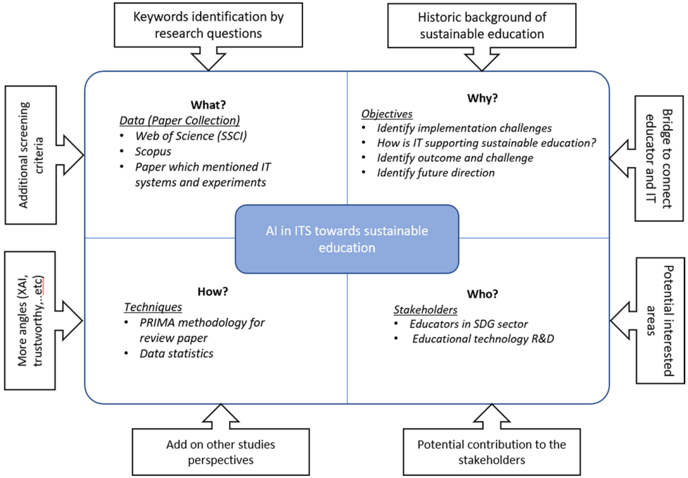
- The review follows the PRISMA methodology and uses a conceptualization process based on Yin’s qualitative research approach and Chatti et al.’s learning analytics reference model.
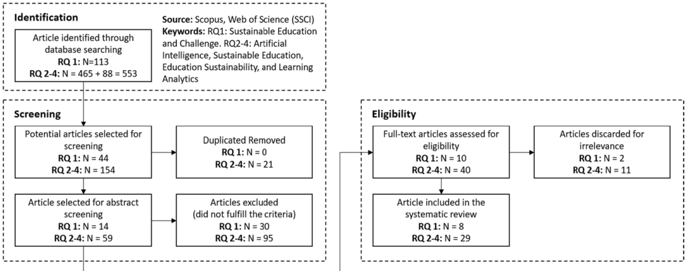
- For RQ1, Scopus was searched with “Sustainable Education” and “Challenge,” yielding 113 articles and selecting 8. For RQ2–RQ4, Scopus and Web of Science (SSCI) were searched with “Artificial Intelligence” AND (“Education Sustainability” OR “Sustainable Education” OR “Learning Analytics”), yielding 465 Scopus and 88 SSCI records, from which 29 papers were selected.
- Searches were limited to English-language journal or conference papers, with inclusion/exclusion criteria applied; selected papers were coded by data type, methods, objectives, and target learners/stakeholders.
Limitations
- The paper states that limitations and challenges of AI-embedded tutoring systems include the amount of data, feature extraction improvement, need for longer-period learning data, and solutions not being portable to other tutoring systems.
- It notes that most research does not explain why and how machine learning algorithms perform predictions, and that bias, fairness, and equality concerns arise from overfitting and the need for more and better training data.
- Evident from the text: the review is a qualitative synthesis without meta-analysis or formal effect-size aggregation, and its evidence base is restricted to Scopus/Web of Science, English-language journal and conference papers.
Model-written summary. Check it against the paper before relying on it.
Integrity signals
Registry
Cites
Statistics
Figures
Verification
Claims the paper makes
5 Valid · 7 Not valid · 41 Not checked · 38 Own results and interpretations
At least one cited source doesn’t support this claim or points to a different paper, and none confirmed it — see the verdicts below.
In the paper
“On the other hand, when performing learning behavior analysis (Pereira et al., 2021;Weng et al., 2020), most of the technology used turns to unsupervised learning, which also makes sense since there are no ground truth data for model training and the overall concept is for clustering or categorization without any reference.”
§ Smart Learning > RQ2: how are AI and IT incorporated as the ITS to support sustainable education?
What the sources say
- Disputedcites Pereira et al., 2021 matched to “Explaining Individual and Collective Programming Students’ Behavior by Interpreting a Black-Box Predictive Model” (2021) sourceExperimental — accuracy not yet measured
Our copy says the opposite of what is attributed: Sec. III (Related Work) states that 'educational data-driven researches identify patterns of behaviour based on data collected from the students learning process' and that 'there are many works in this field that use ML to construct predictive models', i.e. supervised prediction, not unsupervised clustering. The Introduction likewise frames prior work as methods 'to predict CS1 students' performance' and the paper itself trains a supervised XGBoost classifier on ground-truth pass/fail labels (Sec. V-E, 'students who passed (class 1) and students who failed (class 0)'), so the claim's rationale that 'there are no ground truth data for model training' is contrary to this source. The only unsupervised element is k-means applied post-hoc to Shapley values of the trained supervised model (Sec. V-G, Prediction Paths), presented as a contribution ('a new clustering approach'), not as the dominant technology of the field. (LLM, conf=0.70)
Checked by a reasoning model — may be wrong.
- Not checked yetcites Weng et al., 2020
plainstates an association- Asserted: passes — The authors put it forward as true.
- Checkable: passes — It can be checked against evidence.
- Load-bearing: unclear — It is unclear whether the paper’s conclusions depend on it.
- Based: passes — The paper gives a reason why it holds.
- Disputed
The cited sources support only part of this claim — read each source’s verdict below.
In the paper
“More challenges taking care of more students during virtual or blended learning environment (Tsegay et al., 2022;Wade, 2012), it may be because students are from remote especially like under COVID situation, and the instructors are forced to use tutoring systems to deliver courses on line.”
§ Smart Learning > RQ1: what are the key challenges of sustainable education implementation?
What the sources say
- Not checked yetcites Tsegay et al., 2022
- Partly supportedcites Wade, 2012 matched to “Pedagogy, Places And People” (2012) sourceExperimental — accuracy not yet measured
Wade (2012) does support the general point: the section 'challenges and opportunities of the virtual world' states that the exponential rise in 'distance or blended learning course, at least partially mediated by online provision' 'has thrown up a wide range of challenges and opportunities', and 'A formal taught course' describes the strain on tutors — students contacting tutors 'at all hours of the day and this is just not manageable... In personal sustainability terms for tutors this would be quite impossible so clear parameters need to be set'. However, no passage in our copy attributes the challenge to caring for *more* (larger numbers of) students, nor frames student volume as 'a key challenge of sustainable education implementation'; the paper's listed challenges are tutor accessibility/protocols, unequal broadband access in Sub-Saharan Africa, students' wariness of posting online, and the uncritical environmental cost of ICT. The remote/COVID gloss in the citing sentence is the citing authors' own framing (this paper predates it), and the Tsegay et al. (2022) part of the citation is separate evidence not judged here. (LLM, conf=0.72)
hedged- Asserted: passes — The authors put it forward as true.
- Checkable: passes — It can be checked against evidence.
- Load-bearing: unclear — It is unclear whether the paper’s conclusions depend on it.
- Based: passes — The paper gives a reason why it holds.
The cited sources support only part of this claim — read each source’s verdict below.
In the paper
“There are also some researchers who have explored different learning behaviors (Ruipérez-Valiente et al., 2021;Yang et al., 2021a, b) through clustering algorithms, which can also provide instructors with information for further intervention as necessary.”
§ Smart Learning > RQ3: what are the outcomes of AI/IT embedded as the ITS in sustainable education?
What the sources say
- Partly supportedcites Ruipérez-Valiente et al., 2021 matched to “Data-driven detection and characterization of communities of accounts collaborating in MOOCs” (2021) sourceExperimental — accuracy not yet measured
Our copy supports the clustering-of-behaviours half: Section 3.5.1/3.5.3 describe applying the IBM SPSS Two-Step clustering method to find different types of student accounts based on their engagement with the platform, and Section 5.1 reports the resulting cluster types (fruitful collaboration, free-riding, illicit, CAMEO). On the instructor-benefit half, Section 5.2 (Implications) only states that the work can 'provide the teacher with tools that allow them to somehow improve the design and development of MOOCs to promote more collaboration' and suggests course-design controls (randomization, linking accounts to a physical person) — i.e. course-design and dishonesty-deterrence measures, not information for instructors to intervene with individual students as necessary. The related-work statement in Section 2.1 that results 'can help understand instructors and researchers which behaviors can have a positive or negative impact' is credited to other studies ([27], [28]), not to clustering. (LLM, conf=0.72)
- Not checked yetcites Yang et al., 2021a, b
plainstates a cause- Asserted: passes — The authors put it forward as true.
- Checkable: passes — It can be checked against evidence.
- Load-bearing: unclear — It is unclear whether the paper’s conclusions depend on it.
- Based: passes — The paper gives a reason why it holds.
- Partly supported
The sources with a verdict support this claim; the rest weren’t checked yet, have no full text we could read, or their verdicts aren’t rated yet.
In the paper
“There are also some researchers who have explored different learning behaviors (Ruipérez-Valiente et al., 2021;Yang et al., 2021a, b) through clustering algorithms, which can also provide instructors with information for further intervention as necessary.”
§ Smart Learning > RQ3: what are the outcomes of AI/IT embedded as the ITS in sustainable education?
What the sources say
- Supportedcites Ruipérez-Valiente et al., 2021 matched to “Data-driven detection and characterization of communities of accounts collaborating in MOOCs” (2021) source
The source applies clustering to characterize behavioral profiles: Section 3.5.3 states it used the IBM SPSS Two-Step clustering method (Section 3.5.1) 'to find different types of student accounts based on their engagement with the learning platform,' and Section 5.1 reports detecting 'different collaboration behaviors among accounts' via that cluster analysis. Its review in Section 2.1 likewise surveys clustering studies that 'find different behavioral profiles of students,' and Section 5.2 (Implications) says the work can 'provide the teacher with tools' to improve MOOC design and to deter dishonesty/free-riding, which covers the citing sentence's point about information for instructor action. The paraphrase is broad but matches what our copy does. (LLM, conf=0.85)
- Not checked yetcites Yang et al., 2021a, b
plain- Asserted: passes — The authors put it forward as true.
- Checkable: passes — It can be checked against evidence.
- Load-bearing: unclear — It is unclear whether the paper’s conclusions depend on it.
- Based: passes — The paper gives a reason why it holds.
- Supported
The sources with a verdict support this claim; the rest weren’t checked yet, have no full text we could read, or their verdicts aren’t rated yet.
In the paper
“Of the 29 surveyed papers, only 2 focus on the result and try to leverage explainable AI (Afzaal et al., 2021;Pereira et al., 2021) on machine learning prediction.”
§ Smart Learning > RQ3: what are the outcomes of AI/IT embedded as the ITS in sustainable education?
What the sources say
- Not checked yetcites Afzaal et al., 2021
- Supportedcites Pereira et al., 2021 matched to “Explaining Individual and Collective Programming Students’ Behavior by Interpreting a Black-Box Predictive Model” (2021) source
The Introduction says the paper interprets a predictive model’s decisions, and the Conclusion says it developed an explainable machine-learning pipeline for predicting student performance. This supports citing Pereira et al. as an example of a paper applying explainable AI to machine-learning prediction. The count of 29 surveyed papers is the citing authors’ own survey finding, not a finding attributed to Pereira et al. (LLM, conf=0.91)
plain- Asserted: passes — The authors put it forward as true.
- Checkable: passes — It can be checked against evidence.
- Load-bearing: passes — The paper’s conclusions depend on it.
- Based: passes — The paper gives a reason why it holds.
28 more claims
Create a free account to see all 91 claims and to verify the 71 references still open.
- Probably not a substantial claim. 48
- It may state two separate claims as one. 27
- The quote only partly states this claim. 1
Claims other papers make about this one
Each is checked against this paper’s own text: does it say what the citing paper says it does?
The source backs part of the claim, not all of it — or backs it for a different population, condition or comparison.
In the citing paper
“It can support learners by providing customized feedback and opportunities for repeated practice appropriate to their level.”
From Development and pilot evaluation of an AI-based pediatric medication safety virtual simulation program for nursing students: a quasi-experimental study in South Korea (2026) · cites this paper as [12]
Experimental — accuracy not yet measuredThe source backs part of the claim, not all of it — or backs it for a different population, condition or comparison.
In the citing paper
“By analyzing learners’ input in real time, AI can identify patterns of errors in clinical performance and reasoning.”
From Development and pilot evaluation of an AI-based pediatric medication safety virtual simulation program for nursing students: a quasi-experimental study in South Korea (2026) · cites this paper as [12]
Experimental — accuracy not yet measuredThe cited source says what the claim attributes to it.
In the citing paper
“It can also promote adaptive learning by providing educational content tailored to students’ individual needs and learning styles [12].”
The cited source says what the claim attributes to it.
In the citing paper
“This approach enables instructors to utilize personalized AI-generated feedback without diminishing the role of traditional instruction [12,33].”
From The Role of AI in Academic Writing: Impacts on Writing Skills, Critical Thinking, and Integrity in Higher Education (2025) · cites this paper as [33]
In the citing paper
“Given that AI tools can provide instant feedback, students can work at their own pace, and those requiring additional support can benefit from AI assistance without the necessity of one-on-one tutoring [33].”
From The Role of AI in Academic Writing: Impacts on Writing Skills, Critical Thinking, and Integrity in Higher Education (2025) · cites this paper as [33]
2 more claims about this paper
Create a free account to see every claim other papers make about this one.
Self-check
Percentages, sums and reported differences re-computed from the paper’s own numbers.
Each contradiction between two passages listed here was confirmed by an independent check.
Rated minor: it would not touch a result — a value no result rests on, a p-value that stays on the same side of the significance level, or a conflict that is clerical, resolved elsewhere in the paper, or outside its own findings.
In the paper
§ Smart Learning > RQ3: what are the outcomes of AI/IT embedded as the ITS in sustainable education?
“For AI-embedded tutoring systems, most of the outcomes indicate that the performance prediction accuracy is high (Guerrero-Higueras et al., 2018;Hasnine et al., 2018)”
§ Smart Learning > Conclusions
“| AI not Embedded in | Performance prediction algorithm verified with high accuracy | 10 |”
Citations
Cites
The PRISMA 2020 statement: An updated guideline for reporting systematic reviews
Page, M. J., McKenzie, J. E., Bossuyt, P. M., Boutron, I., Hoffmann, T. C., Mulrow, C. D., Shamseer, L., Tetzlaff, J. M., Akl, E. A., Brennan, S. E., et al. (2021) · BMJ · doi:10.1136/bmj.n71 · Cited by 108,283
Arrieta, A. B., Díaz-Rodríguez, N., Del Ser, J., Bennetot, A., Tabik, S., Barbado, A., García, S., Gil-López, S., Molina, D., Benjamins, R., et al. (2019) · arXiv · doi:10.48550/arxiv.1910.10045 · Cited by 11,321 · cited 1×
“In the XAI review paper, Arrieta et al. (2020) categorized many common machine learning algorithms in detail and described how a model can be explained.”
BackgroundBarredo Arrieta, A., Díaz-Rodríguez, N., Del Ser, J., Bennetot, A., Tabik, S., Barbado, A., Garcia, S., Gil-Lopez, S., Molina, D., Benjamins, R., et al. (2020) · Information Fusion · doi:10.1016/j.inffus.2019.12.012 · Cited by 10,423 · cited 1×
“In the XAI review paper, Arrieta et al. (2020) categorized many common machine learning algorithms in detail and described how a model can be explained.”
BackgroundThe PRISMA 2020 statement: an updated guideline for reporting systematic reviews
Page, M. J., McKenzie, J., Bossuyt, P., Boutron, I., Hoffmann, T., mulrow, C., Shamseer, L., Tetzlaff, J., Akl, E., Brennan, S. E., et al. (2020) · doi:10.31222/osf.io/v7gm2_v1 · Cited by 8,090
Qualitative Research from Start to Finish
Yin, R. K. (2010) · Medical Entomology and Zoology · Cited by 5,667
The PRISMA 2020 statement: an updated guideline for reporting systematic reviews
Page, M. J., McKenzie, J., Bossuyt, P., Boutron, I., Hoffmann, T., mulrow, C., Shamseer, L., Tetzlaff, J., Akl, E., Brennan, S. E., et al. (2020) · doi:10.31222/osf.io/v7gm2 · Cited by 5,177
Human-Centered Artificial Intelligence: Reliable, Safe & Trustworthy
Shneiderman, B. (2020) · International Journal of Human–Computer Interaction · doi:10.1080/10447318.2020.1741118 · Cited by 1,743 · cited 1×
“Shneiderman (2020) defined a two-dimensional approach for categorizing and providing guidance on how to produce system designs that are Reliable, Safe, and Trustworthy (RST).”
DARPA's Explainable Artificial Intelligence Program
Gunning, D., & Aha, D. W. (2019) · AI Magazine · doi:10.1609/aimag.v40i2.2850 · Cited by 1,360 · cited 1×
“Similar to the 4-year project conducted by DARPA (Gunning & Aha, 2019), the technical teams were requested to provide an explainable model and explanation interface to support users making decisions.”
MethodAI in CAI: An Artificial-Intelligence Approach to Computer-Assisted Instruction
Carbonell, J. (1970) · IEEE Transactions on Man Machine Systems · doi:10.1109/tmms.1970.299942 · Cited by 955 · cited 1×
“The overall concept can be traced back to 1970 (Carbonell, 1970).”
BackgroundExplainable Artificial Intelligence in education
Khosravi, H., Shum, S. B., Chen, G., Conati, C., Tsai, Y.-S., Kay, J., Knight, S., Martinez-Maldonado, R., Sadiq, S., & Gašević, D. (2022) · Computers and Education: Artificial Intelligence · doi:10.1016/j.caeai.2022.100074 · Cited by 863 · cited 2×
“Khosravi et al. (2022) deeply explore XAI in terms of education, which also provides good guidance for educators and IT solution architects.”
Background
Research works printed but not linked: 2
- Lu, O. H. T., Huang, A. Y. Q., & Yang, S. J. H. (2018). Benchmarking and tuning regression algorithms on predicting students' academic performance. In 26th International conference on computers in education, Philippines.
- Sterling, S. R., & Orr, D. (2001). Sustainable education: Re-visioning learning and change (Vol. 6). Green Books for the Schu- macher Society Totnes.
Cited by
Items 701–800 of 897
LearnForge: An AI-Powered Intelligent Learning Assistant with RAG-Based Document Intelligence
Nitishkumar, R. J., & Ranjini, R. (2026) · International Conference on Intelligent Systems and Computational Networks (ICISCN) · doi:10.1109/iciscn67954.2026.11566245
Teacher and Learner Support: European Perspectives on AI and AR in Learning
Gupta, A., Абдурахманова, М., Buzulayho, K., Xaydarova, M., Gaffarovich, N. M., Putheara, D. Y., Phearak, P. O. K., & Moreira, F. T. T. (2026) · Advances in computational intelligence and robotics book series · doi:10.4018/979-8-3373-9883-9.ch007
System, User, and Design Factors in AI Tutor Engagement
Duong, N. T. (2026) · International Journal of Human-Computer Interaction · doi:10.1080/10447318.2026.2690103
Novriyanto, E., Hardhienata, S., & Harsani, P. (2026) · Research Square · doi:10.21203/rs.3.rs-9701237/v1
Ramadhani, S., Nurlina, N., Sutrisno, S., & Irsan, I. (2026) · Indonesian Journal of Education Research (IJoER) · doi:10.37251/ijoer.v7i3.3187
“Research on AI in higher education has expanded across a broad spectrum of areas, including intelligent tutoring systems, learning analytics, personalized content recommendation, and AI-based automated assessment [3]-[5].”
Fatmawati, A., Utomo, D. P., Purwanti, E., & ., B. (2026) · International Journal of Multidisciplinary Research and Growth Evaluation · doi:10.54660/.ijmrge.2026.7.3.1187-1192
Batubara, H. H. (2026) · JMIE (Journal of Madrasah Ibtidaiyah Education) · doi:10.32934/jmie.v10i1.904 · Cited by 1
MANSOUR, N. M., El-Kafy, J. A., Salem, A. E., & Hassan, T. H. (2026) · African Journal of Hospitality Tourism and Leisure · doi:10.46222/ajhtl.19770720.754
Teaching AI-Native Learners: Reimagining Medical Education for the Post-ChatGPT Era
Naeem, N.-I.-K. (2026) · Horizon · doi:10.66547/948202
Al-Gharaba, S. (2026) · Dibon Journal of Education · doi:10.64169/dje.238
“Lin et al. (2023) have conducted a review of AI-based intelligent tutoring systems to provide sustainable education and pinpoint personalisation as the most promising affordance.”
Awan, A., Marasco, E., & Barcomb, A. (2026) · Lecture notes in computer science · doi:10.1007/978-3-032-30015-7_26
NEXILA: A Temporal Retrieval Protocol for Lifelong Learning Tutoring Systems
Nwodo, N. A., & Madisetti, V. K. (2026) · IEEE Symposium on Computer Applications & Industrial Electronics (ISCAIE) · doi:10.1109/iscaie68866.2026.11576426
“Intelligent tutoring systems (ITS) and large language model (LLM) based agents provide adaptive, conversational support at scale [1], [2], but largely deliver short-term personalization rather than cumulative learning.”
赵锦阳 (2026) · Creative Education Studies · doi:10.12677/ces.2026.146455
Transforming Medical Education Through AI-Powered Interactive Tutoring
Palivela, L. H., Karthik, V., & Micheal, A. (2026) · Advances in computational intelligence and robotics book series · doi:10.4018/979-8-3373-8217-3.ch009
Toro-Dupouy, L., & Erdmann, A. (2026) · Transformations In Business & Economics · doi:10.15388/tibe.2026.25.2.20
AI tutoring system: adaptive learning with mobile technology for Gen Z university students
Por, F. P. (2026) · International Journal of Mobile Learning and Organisation · doi:10.1504/ijmlo.2026.10079504
Moiseev, S. V., Tolstova, M. A., Nesterenko, V. V., Garina, A. V., & Kondratyev, A. Y. (2026) · Psychological Science and Education · doi:10.17759/pse.2026310311
Montenegro, M. V. G., & Bogantes, M. R. (2026) · LATAM Revista Latinoamericana de Ciencias Sociales y Humanidades · doi:10.56712/latam.v7i3.6140
“Leveraging AI to drive adaptive learning for sustainable educational reforms”
Shinde, P. A., Ubale, S., Raut, Y., Ubale, D. S., Padle, A., & Bura, S. B. (2026) · Journal of Asia Entrepreneurship and Sustainability · doi:10.66635/ch2gq119
Sánchez, S. M. Q., Suntasig, C. M. S., & Anchatuña, A. L. A. (2026) · Revista Multidisciplinar de Estudios Generales · doi:10.70577/reg.v5i3.755
AI-Driven Personalized Learning Coach System Towards Sustainable Education
Sree, K. C., Rekha, G., Anusha, D., Kumar, M. N., Ganesh, K., & Kumar, V. S. (2026) · International Conference on Computing Theory and Wireless Communications (ICCTWC) · doi:10.1109/icctwc68241.2026.11583406
“These approaches often cannot meet the diversity among learners in terms of prior knowledge, style of learning, cognitive abilities, and pace, resulting in lack of engagement and consequently poor, inequitable outcomes, and limited access for disadvantaged students [1][2].”
VLA-Ethos: Designing Ethical Vision-Language-Action Models for Inclusive Education
Xia, L., Xiao-mei, L., Li, D., Zhang, S., Fan, J., & Fan, L. (2026) · Lecture notes in computer science · doi:10.1007/978-3-032-30542-8_32
Ikwuazom, C. T., Prasad, R., Aliyu, A. R., Benjamin, O., & USMAN, M. M. (2026) · Advances in computational intelligence and robotics book series · doi:10.4018/979-8-3373-7665-3.ch009
Butar-Butar, L. I., Afandi, Marlina, R., Enawaty, E., & Ripanti, E. F. (2026) · Journal of Advanced Sciences and Mathematics Education · doi:10.58524/jasme.v6i2.1280
“…digital divide has largely concentrated on disparities in digital infrastructure, internet accessibility, and technology utilization across communities and regions rather than on teachers’ acceptance of AI in educational contexts (Feurich et al., 2024; Lin et al., 2023; J. Wang et al., 2025).”
More Than AI: Developing Intelligent Chatbot to Empower Algebra Mastery for Grade VII Students
Ramadhan, M. N., Qohar, A., Sisworo, S., & Yasin, M. (2026) · PRISMA · doi:10.35194/jp.v15i1.5770
“Qohar, Sisworo, Mohamad Yasin adapting to the individual learning needs and pace of each student (Guo et al., 2021; Lin et al., 2023).”
Isnina, N., Suranti, N. M. Y., & Nurwahidah (2026) · Jurnal Nalar Pendidikan dan Pembelajaran · doi:10.52232/nalar.v5i2.279
AI-Enabled Learning Ecosystems: A Psychological Perspective on Education Reform
Garg, A. (2026) · IntechOpen eBooks · doi:10.5772/intechopen.1016672
Attitudes toward Artificial Intelligence among University Students: The Role of Personality Traits
Karakoyun, F. (2026) · Journal of Computer and Education Research · doi:10.18009/jcer.1865790
A Lightweight Approach: LLM-Driven Classroom Rehearsal on Apple Silicon
Liao, K.-C., Lau, J., Chung, M., Wu, C.-W., & Kuang, J.-R. (2026) · Springer proceedings in physics · doi:10.1007/978-981-95-9035-3_40
Jin, P. (2026) · Innovations in Education and Teaching International · doi:10.1080/14703297.2026.2702451
Zhai, M., & Farhan, M. (2026) · Interactive Learning Environments · doi:10.1080/10494820.2026.2687874
Alwaqdani, M. (2026) · Education and Information Technologies · doi:10.1007/s10639-026-14095-w · Cited by 1
Intelligent Assistant Model for University Educational Process
Fedorenko, D., Zemlianko, H., & Pevnev, V. (2026) · Lecture notes in networks and systems · doi:10.1007/978-3-032-22372-2_18
Role of Artificial Intelligence in Promoting Personalized Learning in Pakistani Universities
Ishtiaq, M., Munir, A., & Shoaib, A. (2026) · TAMSAAL · doi:10.59075/tamsaal.v4i7.62
Artificial Intelligence Adoption in Learning Systems: Systematic Literature Review
Sama, H., Nurkayla, A., & Prasetyo, S. E. (2026) · JISA(Jurnal Informatika dan Sains) · doi:10.31326/jisa.v9i1.2705
Mahmudah, A., Prastowo, A., Hidayat, N., & Muqowin (2026) · Decision Sciences in Human Learning and Development · doi:10.64268/decision.v1i1.5
“In particular, the integration of artificial intelligence (AI) into learning environments has introduced new opportunities for enhancing student engagement and learning outcomes (A. Y. Q. Huang et al., 2023; Nguyen et al., 2024; Radif, 2024; Vistorte et al., 2024).”
Educational Data Mining Techniques: A Review of the Potential and the Performance
Zakur, Y. A. (2026) · Al-Noor Journal of Engineering Management and Computer Science · doi:10.71229/ygr02415
Marengo, A., Amante, D. S. A., Pagano, A., Lytras, M. D., Pange, J., & Santamato, V. (2026) · Discover Artificial Intelligence · doi:10.1007/s44163-026-01822-y
“Research on intelligent tutoring emphasizes AI in responsive, explainable learning environments [46].”
AI-Augmented Education: Benefits, Challenges and Implications
Zdravkova, K. (2026) · Lecture notes in networks and systems · doi:10.1007/978-3-032-32032-2_36 · Cited by 1
Fadillah, N., Suhandi, A., & Riyana, C. (2025) · Asia Conference on Cognitive Engineering and Intelligent Interaction (CEII) · doi:10.1109/ceii67787.2025.00033
“These systems use artificial intelligence (AI) methods including machine learning, learning analytics, and natural language processing to tailor educational materials to each learner's cognitive requirements [1] [2] [3].”
Widowati, T. (2026) · Journal of Intelligent Decision Making and Information Science · doi:10.59543/jidmis.v3.812
The Determinants of Greenhouse Gas Emissions (GHE) in European Economies
ILOIE, L. M., Albulescu, C.-T., & Drăghici, A. (2026) · Proceedings of the ... International Conference on Business Excellence · doi:10.2478/picbe-2026-0132
“Other studies reveal that various factors influence GHE, including foreign direct investment (FDI) (Iamsiraro, 2016; Lin et al., 2023), economic growth (Giba et al., 2024), population density (Petre et al., 2025), and human activity (Yao et al., 2020; Mahmood et al., 2020).”
Castro, R. A. G., Asté, W. M. B., Aratia, G. P., Cruz, K. M. L.-D. L., Huanacuni, L. E. A., Ancoa, N. Z., & Romero, M. A. (2026) · doi:10.59899/dis-met
Chen, Y.-T., & Chen, S.-M. (2026) · European Public & Social Innovation Review · doi:10.31637/epsir-2027-3010
“Recent frameworks define AI literacy as a multidimensional construct involving conceptual understanding, practical application, and ethical reflection (Lin et al., 2023).”
Chasi, M. E. R., Espin, J. M. G., Constante, N. C. C., Moreta, L. S. C., & Velastegui, M. E. S. (2026) · Sage Sphere of Technology Sciences Discoveries And Society · doi:10.63688/9mkze757
Mathematics Teachers’ Stances on AI Integration in Their Classroom
Alamassi, S., Zaitoun, E. A., & Yaghi, A. (2026) · International Conference on Artificial Intelligence Systems (AIS) · doi:10.1109/ais69919.2026.11621143
“On the other hand, ITSs precisely adapt to students’ skills by diagnosing their knowledge and progress [9].”
Fouzi, N. I. M., & Rahman, M. J. A. (2026) · Journal of Research Innovation and Strategies for Education (RISE) · doi:10.70148/rise.v3i5.8
“Sumber digital yang telah disemak boleh disimpan dan disesuaikan semula untuk menyokong kelestarian, asalkan bahan kekal boleh dicapai dan adil kepada murid (Allman et al., 2024; Lin et al., 2023).”
Dance Emotion-Related Performance Training System Based on Multimodal Perception and Knowledge Graph
Tian, Y. (2026) · Neural Processing Letters · doi:10.1007/s11063-026-11876-9
“Huang and Lu’s systematic review analyzed the application of intelligent tutoring systems in sustainable education, emphasizing these systems’ ability to personalize learning through real-time analysis of student performance and adaptive content recommendations [29].”
Advancing diagram-based reasoning in AI tutoring systems: a structural approach for STEM education
Sun, Y., Liao, Y., & Ma, X. (2026) · Smart Learning Environments · doi:10.1186/s40561-026-00459-9
“Artificial Intelligence (AI) tutoring systems (Lin et al., 2023) have rapidly evolved into a transformative component of modern educational ecosystems (Alam, 2023; Basri, 2024; Khine, 2024).”
Enhancing Trust in AI Predictions for Education: An Application of XAI with XGBoost
Alharbi (2026) · Journal of Intelligent Decision Making and Information Science · doi:10.59543/jidmis.v3.1247
“ML is also used in intelligent tutoring systems, automatic grading, and learning analytics dashboards that provide real-time insights into student behavior and engagement [25].”
Syafaruddin, Aransyah, A., Rosidin, U., Siregar, R. A., & Handoko (2026) · Jurnal Teknologi Pendidikan Jurnal Penelitian dan Pengembangan Pembelajaran · doi:10.33394/jtp.v11i3.21513
Wang, L. (2026) · Frontiers in Psychology · doi:10.3389/fpsyg.2026.1750189
Sir, V. M. V. (2026) · ITEGAM- Journal of Engineering and Technology for Industrial Applications (ITEGAM-JETIA) · doi:10.5935/jetia.v12i60.3840
Yustiana, S., & Afandi, M. (2026) · IJORER International Journal of Recent Educational Research · doi:10.46245/ijorer.v7i4.1512
Digital Twin-Based Mathematical Modeling of Learning Systems
Gupta, V., Yadav, A. K., & Das, S. (2026) · Studies in big data · doi:10.1007/978-3-032-31204-4_13
Chauhan, D., Wankhade, S. G., & Sahni, M. (2026) · Studies in big data · doi:10.1007/978-3-032-31204-4_10
Gulbanbegim, J. (2026) · Journal of Intelligent Decision Making and Information Science · doi:10.59543/jidmis.v3.1282
“Despite the increasing importance of digital transformation and dual education, several significant research gaps persist [50, 51].”
Goyal, V., Mokashi, S. S., Misra, D., Khetade, V. E., Vangipuram, V. L., & Devi, K. S. (2026) · Lecture notes in networks and systems · doi:10.1007/978-3-032-28594-2_21
Liu, M., Xiao, R., & Liu, M. (2026) · Learning Environments Research · doi:10.1007/s10984-026-09593-0
“…pedagogy has become an important direction in higher education innovation, with studies demonstrating its potential to provide personalised feedback, adapt content to learner profiles, and foster active engagement (Cao & Phongsatha, 2025; Lin et al., 2023; Ogunkunle & Qu, 2020; Singh et al., 2022).”
Alulema, D., & Montenegro, E. (2026) · Applied Sciences · doi:10.3390/app16157774
Predicting AI Readiness and Teacher Motivation in Blended Secondary Mathematics ClassroomsPreprint
Bedada, T. B., Abame, A., Gelato, L., & Bekele, J. (2026) · Research Square · doi:10.21203/rs.3.rs-10408764/v1
Ali, S. H. S., & Ismail, S. (2026) · Communications in computer and information science · doi:10.1007/978-981-92-4305-1_13
Exploring AI and Ethics in GCC’S Education Sector: A Bibliometric Study
Ekundayo, T., Nehad, A. E., & Chaudhry, S. A. (2026) · Advances in Science, Technology & Innovation/Advances in science, technology & innovation · doi:10.1007/978-3-032-24784-1_38
Sari, W. A. (2026) · Journal of Innovation in Teaching and Instructional Media · doi:10.52690/jitim.v6i2.1553
“Temuan ini sejalan dengan kajian yang menegaskan bahwa AI mampu menciptakan ekosistem belajar yang adaptif sekaligus prediktif, sehingga membantu dosen dan mahasiswa mengidentifikasi serta mengatasi kendala belajar secara cepat dan tepat (Lin et al., 2023) (Woolf, 2009).”
InfluentialGuo, M., Zhang, F., Xu, H., Xie, C., Sun, B., & He, J. (2026) · Sustainability · doi:10.3390/su18168162
Thomsen, M., Scheer, A., Brings, C., Köller, O., Molenaar, I., Ahn, S. H., Choe, J., & Kim, J. (2026) · Springer eBooks · doi:10.1007/978-3-032-26816-7_8
Alkhayat, A. (2026) · IEEE International Conference on Intelligent Reality (ICIR) · doi:10.1109/icir70631.2026.11628320
“This partially aligns with previous work on affective ITS and embodied pedagogical agents, where social presence, multimodal feedback, and affect-sensitive design have been associated with increased engagement and reduced confusion or frustration [4]–[5].”
InfluentialThapaliya, R. (2026) · Transactions on Engineering and Computing Sciences · doi:10.14738/tecs.1404.12089
Teachers' Adoption Drivers and Design Implications for an Intelligent Tutoring System
Tosto, C., Augello, A., Città, G., Gentile, M., & Perna, S. (2026) · IEEE International Conference on Intelligent Reality (ICIR) · doi:10.1109/icir70631.2026.11628132
“These observations also provide confirmation to the need for adequate teacher training before the introduction of ITS platforms into school and classroom practice [21].”
Flores, H. I. O. (2026) · Revista Científica Multidisciplinar G-nerando · doi:10.66473/rcmg.v7i2.1403
Aiouni, R., & Bey, A. (2026) · International Journal of Artificial Intelligence and Machine Learning · doi:10.21203/rs.3.rs-10573777/v1
Bilau, A. A., Ogunbote, S., Dawodu, R. A., Okeowo, R. O., & AKINDE, M. (2026) · Federal University Gusau Faculty of Education Journal · doi:10.64348/zije.2026518
Oliver, M. O. O., Gutiérrez, E., Rivera, M. A. E., Ordaz, P., & Hernández-Pérez, J. (2026) · Advances in computational intelligence and robotics book series · doi:10.4018/979-8-2600-3658-7.ch008
Qiang, J., & Baolin, L. (2026) · Journal of higher education teaching. · doi:10.62517/jhet.202615323
Austria-Cornejo, A., García-Márquez, M. A., & Rodríguez-Flores, J. (2026) · Advances in computational intelligence and robotics book series · doi:10.4018/979-8-3373-9675-0.ch005
Nisrina, A., Prasetyo, E. W., Kamila, A. R., & Lee, F. S. (2026) · Jurnal Ragam Pengabdian · doi:10.62710/sqmn2d94
“Intelligent Tutoring System (ITS) adalah sistem berbasis digital yang kerap digunakan sebagai media e-learning modern (Ginting et al., 2025; Lin et al., 2023), dan dapat berbentuk aplikasi secara lokal maupun online seperti web-app (Dinata et al., 2024; Gomes, 2025 ).”
Gomase, V. S., DHANDE, S. B., & NATU, P. R. (2026) · International Journal of Computer Information Systems and Industrial Management Applications · doi:10.70917/ijcisim-2026-4616
Role of artificial intelligence in enhancing school digital twin
Krishnan, P., Tyagi, A. K., & Kumari, S. (2026) · Elsevier eBooks · doi:10.1016/b978-0-443-41632-3.00031-x
Rodríguez, F. J. S., Montaño, L. C. R., & Lamadrid, M. I. R. (2026) · Medición y Evaluación del Aprendizaje Inclusivo · doi:10.63688/aprendizaje.v3.i1.25
Angin, J. T. K. P., Abdul Hamid, K., & Napitupulu, E. (2026) · Jurnal Times · doi:10.51351/jtm.15.1.2026971
Ilvis-Vacacela, J. M., Cázarez, M. R., & Arroyo, J. H. (2026) · doi:10.64245/eanean45
Human-AI collaboration in education: continual learning systems as adaptive instructional partners
Barari, G., Dewees, A. A. D., & Barari, N. (2026) · Artificial Intelligence in Education · doi:10.1108/aiie-07-2025-0193
Jain, V. K., Gupta, S. K., Mitra, A., & Mukherjee, S. (2026) · IGI Global eBooks · doi:10.4018/979-8-3373-9330-8.ch014
Nazareno, M., Gonzales, K. B., Aliviado, R. M., & Micaroz, M. (2026) · Psychology and Education A Multidisciplinary Journal · doi:10.70838/pemj.610710
Ismail, M. A. (2026) · IGI Global eBooks · doi:10.4018/979-8-2600-3723-2.ch003
Digital Infrastructure: AI Governance and Data Use Within Educational Accountability Reform
Ismail, M. A. (2026) · IGI Global eBooks · doi:10.4018/979-8-2600-3723-2.ch005
Research on Intelligent Adaptive Academic Management System Based on PPO Reinforcement Learning
Yang, X., Lyu, P., & Wan, Q. (2026) · International Conference on IoT, Data Science and Advanced Computing (IDSAC) · doi:10.1109/idsac70973.2026.11650685
“Adaptive Learning Systems (ALS) demonstrate significant potential in enhancing learning outcomes by modeling learner characteristics and dynamically adjusting teaching content and sequences [3] .”
Rahman, F., & Syafii, A. M. (2026) · Southeast Asian Journal of Islamic Education · doi:10.21093/sajie.v9i1.13598 · Cited by 1
“Machine learning techniques offer a promising solution for transforming these data into actionable intelligence (Lin et al., 2023; Yağcı, 2022) .”
Baldwin, B. M., Walker, S., Dennis, G. P., Mani, S., & Lippert, K. J. (2026) · ASEE Annual Conference & Exposition · doi:10.18260/1-2--59346
Amin, M. K., Sultana, K., Begum, H. A., Akter, A., & Khan, M. (2026) · Advances in computational intelligence and robotics book series · doi:10.4018/979-8-2600-3663-1.ch009
Qin, X., Yang, H., & Yuan, Y. (2026) · International Conference on Bioinformatics and Intelligent Computing (BIC) · doi:10.1145/3809986.3810068
LLM Agents in Learning Management Systems: Ethical Dimensions at the Learning–Research Interface
Puhach, R. S. (2026) · Izdevniecība “Baltija Publishing” eBooks · doi:10.30525/978-9934-26-708-6-12
Gao, J., Shu, Y., & Alomair, M. A. (2026) · Sustainable Development · doi:10.1002/sd.71587
Abbas, I., Khosiin, K., & Hakim, A. (2026) · Jurnal Ilmu Pendidikan dan Sains Islam Interdisipliner · doi:10.59944/jipsi.v5i2.1432
“Intelligent tutoring systems can support education by analyzing student learning data, providing feedback, monitoring student performance, and helping teachers design appropriate interventions (Lin, Huang, & Lu, 2023).”
Fusion Rush: Enhancing Proficiency in Boolean Logic Algebra through Gamification
Bascug, F. M. F. G., Gemina, R. B., Mendoza, B. X. B., Arellano, C. N., & Laviste, R. P. (2026) · International Conference on Education and Training Technologies (ICETT) · doi:10.1109/icett70124.2026.11665957
“Lin et al. [14] emphasize AI's potential to adapt to individual learners, though they caution against machine inaccuracies.”
Raxmatov, S. S., Musurmonova, M., qizi, S. U. H., Pirnazarovich, I. M., Qodirov, F., Shanasirova, Z. Y., Jabborova, O. M., Khamidovna, N. R., & Ratmaningsih, N. (2026) · Semarak Engineering Journal · doi:10.37934/sej.15.1.245256
Lising, S. D. B. (2026) · International Journal of Research Studies in Management · doi:10.5861/ijrsm.2026.26111
Artificial intelligence as a tutor: A scoping literature review
Garg, S. (2026) · Journal of International Students · doi:10.32674/c74mv539
“This is a system that uses AI as a tutor for education (Lin et al., 2023; Kohnke et al., 2025).”
From Innovation to Inclusion: Ethical and Cultural Dimensions of Emerging Technologies in Education
-, S. S. (2026) · International Journal For Multidisciplinary Research · doi:10.36948/ijfmr.2026.v08i04.86728
“This not only overcomes the limitations of traditional learning systems but also enhances engagement, comprehension, and the overall learning experience (Lin et al.,2023).”
Metadata
- Authors
- Lin, C.-C., Huang, A. Y. Q., & Lu, O. H. T.
- Affiliations
- National Central University (TW)
- National Chengchi University (TW)
- Corresponding author
- Lin, Chien-Chang
- Venue
- Smart Learning Environments
- Published
- 2023-08-28
- Volume
- 10
- Issue
- 1
- ISSN
- 2196-7091 (ISSN-L)
- OpenAlex
- W4386223224
- Semantic Scholar
- dfbc9f44f0ff3c994eecee83a48cb27dd20c51b0
- Cited by
- 669
- References
- 59
- Citations by year
- 2026: 282 · 2025: 286 · 2024: 97 · 2023: 4
- FWCI
- 27.57
- Type
- journal article
- Language
- en
- Open access
- gold
- doi.org
- Licence
- cc-by
- creativecommons.org/licenses/by/4.0 (tdm)
- creativecommons.org/licenses/by/4.0 (vor)
- Locations
- Smart Learning Environments (publishedVersion, cc-by)
- DOAJ (DOAJ: Directory of Open Access Journals) (submittedVersion, cc-by-sa)
- Funders
- National Science and Technology Council (111-2410-H-008 -010 -MY3, 109-2511-H-008 -007 -MY3)
- Topics
- Social Sciences › Education › Artificial Intelligence in Education
- Physical Sciences › Computer Science › Artificial Intelligence › Intelligent Tutoring Systems and Adaptive Learning
- Social Sciences › Education › Educational Technology and Pedagogy
- Keywords
- artificial intelligence in education, intelligent tutoring systems, sustainable education, personalized learning, data-driven decision making, student engagement, student performance analysis, algorithmic bias, data privacy and security, educational technology infrastructure, educational equity
About these checks
Registry, retraction, Cites and statistics results are computed, not judged, with one exception: a printed reference that no index lists is read once by a model before it counts as a citation error. Claims are extracted by a model and kept only when their quote appears verbatim in the text; each cited source is then checked, with a model’s help, for whether it says what the claim relies on. Those verdicts can be wrong — read the claim’s quote and the cited source before relying on one.
The claim verdicts this report counts are experimental: their accuracy is not yet measured.
A language model drew the claims from the paper on 2026-10-07, under version 3 of the claim definition (model deepseek-v4.1-flash, prompt extract-v3).
A second model labelled each claim on 2026-10-07 (model jev-1.13-20260917, definition revision gold-guideline-v0.2).
Cited sources are checked with a language model’s help (qwen3.8-omni-flash and gpt-6-sol).
Statistics and arithmetic are recomputed, not judged.
Confidence bands are shown only for fields calibrated on our annotated test set. None is calibrated yet, so no band is shown.
What counts as a claim ›How we measure confidence ›How we check this ›
Are you an author, or do you see a problem with this page? Request a review
Data sources
Bibliographic data: Semantic Scholar, OpenAlex, Crossref.
Contains information from the Semantic Scholar Academic Graph Datasets, made available under the ODC Attribution License (ODC-BY 1.0).
Semantic Scholar’s data is described in: Kinney, R., et al. (2023). The Semantic Scholar Open Data Platform. arXiv:2301.10140.
