

RETRACTED ARTICLE: Low prices and high regret: how pricing influences regret at all-you-can-eat buffets
Open accessThis paper was retracted on 2017-09-15 (retraction notice 10.1186/s40795-017-0195-6). The DOI matches its Crossref record; 20 of the 20 references it cites were found in a registry or an index; none of the 11 sources its claims cite is checked for support yet.
Abstract
Background: In this study we shed light on an unknown area of research: whether the price paid for a meal influenced consumers’ perceptions of fullness, and feelings of guilt and regret about how much they ate. This has implications for consumers, restaurants and public health. Methods: A field experiment was conducted in which diners at an AYCE restaurant were either charged $4 or $8 for an Italian lunch buffet. Following lunch, participants rated dimensions such as physical discomfort, the degree they felt they overate, and guilt. Results: 139 total individuals who came to the restaurant alone ( n = 8), in groups of two ( n = 52) and in groups of three or four ( n = 43) and five and over ( n = 30) are participated to the study. Out of participants who ate at least one piece of pizza and were included to our analysis ( n = 95), 49 of them were male and 46 of them were female, the mean age was 44.11, the mean height was 67.58 in., and the mean weight was 181.61 lb. The results were analyzed using a 2x3 between groups ANOVA. Diners who paid $4 for their buffet rated themselves as physically more uncomfortable and had eaten more than they should have compared to the diners who paid $8 for the buffet ( p < 0.05). However, diners who paid $4 for their buffet gave higher ratings to overeating, feelings of guilt and physical discomfort than the diners who paid $8 for the buffet, even if they ate the exact same number of pieces. Conclusion: Paying less for an AYCE experience has a number of surprising consequences; lower paying diners feel themselves as more physically uncomfortable and guiltier compared to the higher paying diners, even when they ate the same amount.
Overview
CoChat Summary
TL;DR
In a field experiment at an all-you-can-eat Italian buffet, diners randomly charged $4 vs. $8 for the same buffet reported more physical discomfort, overeating, and guilt when they paid less, even when they ate the same number of pizza pieces. The bibliographic record labels the article as retracted.
Key findings
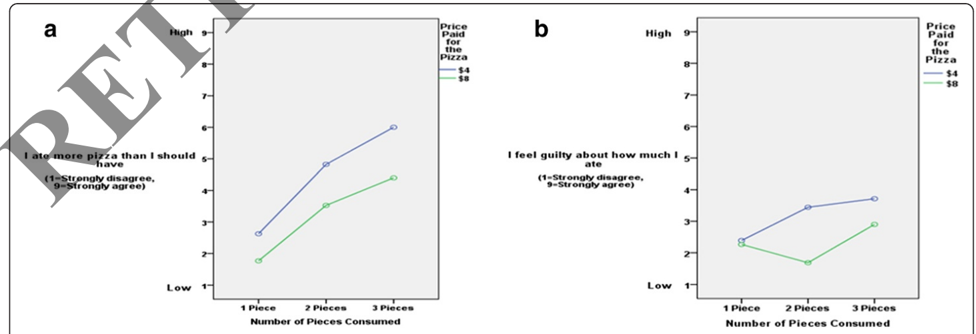
- Among 95 analyzed diners who ate at least one piece of pizza, the $4 group rated “I am physically uncomfortable” higher than the $8 group (2.56 vs. 1.70, F(1,84)=5.36, p=0.02), as well as “I ate more pizza than I should have” (4.48 vs. 3.22, F=5.35, p=0.02), “I overate” (3.30 vs. 2.25, F=5.26, p=0.02), “I ate more than I should have” (3.87 vs. 2.66, F=5.86, p=0.02), and “I feel guilty about how much I ate” (3.25 vs. 2.25, F=4.95, p=0.03).
- As pieces of pizza consumed increased, overeating ratings increased: “I ate more pizza than I should have” 2.20, 4.17, 5.20 for 1, 2, 3 pieces, F(2,84)=10.57, p=0.00; “I overate” 1.98, 2.75, 3.61, F=3.85, p=0.03; “I ate more than I should have” 2.29, 3.23, 4.29, F=4.89, p=0.01.
- There was no significant price × pieces interaction on any item (p>0.05). The paper reports the price effect persisted across slices and was stronger for those who ate 2 slices (e.g., guilt 3.44 vs. 1.68, F=7.13; physical discomfort 2.94 vs. 1.28, F=8.11; “I ate more than I should have” 4.28 vs. 2.05, F=10.36).
Methods
- Field experiment at Aeillo’s Italian Restaurant, an AYCE Italian luncheon buffet between Syracuse and Binghamton, NY, over a two-week spring period. Groups were randomly assigned in alternating order to receive a flier for an $8 buffet with free beverage or the same flier/free beverage but told the buffet cost $4; diners did not know another price condition existed.
- 139 individuals participated; analysis included 95 who ate at least one piece of pizza (49 male, 46 female; mean age 44.11 years, mean height 67.58 in., mean weight 181.61 lb). After paying, diners completed a questionnaire with 9-point Likert scales (1 = strongly disagree, 9 = strongly agree) on guilt, physical discomfort, and overeating; results were analyzed with ANOVA (abstract says 2×3 between-groups ANOVA; methods says one-way ANOVA).
Limitations
- Paper-stated: single site; no extensive demographic information; income not measured and could affect how $4 vs. $8 is evaluated; findings may not generalize. Future work should examine gender, group, and income effects and control for day of week/weekend.
- Evident from the text: small analyzed sample (n=95) with small subgroup cells (e.g., 7 in the $4 three-piece group), self-reported feelings, and inconsistent reported n’s across Tables 2 and 3 for some $8 subgroups.
- The bibliographic record labels the article as retracted; the paper text itself does not discuss the retraction.
Model-written summary. Check it against the paper before relying on it.
Integrity signals
Registry
Cites
Statistics
Figures
Verification
Claims the paper makes
0 Valid · 0 Not valid · 6 Not checked · 21 Own results and interpretations
A result the paper reports from its own data — it cites no other source for it, so there is none to check. The quote shows it is in the paper.
In the paper
“There was no significant interaction effect between price paid for the buffet and pieces eaten on any of the items (p > 0.05) (Table 2).”
§ Low prices and high regret: how pricing influences regret at all-you-can-eat buffets > Results
plain- Asserted: passes — The authors put it forward as true.
- Checkable: passes — It can be checked against evidence.
- Load-bearing: passes — The paper’s conclusions depend on it.
- Based: passes — The paper gives a reason why it holds.
A result the paper reports from its own data — it cites no other source for it, so there is none to check. The quote shows it is in the paper.
In the paper
“When controlling for how many pieces of pizza they consumed, the $4 group rated the discomfort, overeating and guilt items higher than the $8 group;”
§ Low prices and high regret: how pricing influences regret at all-you-can-eat buffets > Results
plainstates an association- Asserted: passes — The authors put it forward as true.
- Checkable: passes — It can be checked against evidence.
- Load-bearing: passes — The paper’s conclusions depend on it.
- Based: passes — The paper gives a reason why it holds.
A result the paper reports from its own data — it cites no other source for it, so there is none to check. The quote shows it is in the paper.
In the paper
“Although the results were not significant for”
§ Low prices and high regret: how pricing influences regret at all-you-can-eat buffets > Results
plainn = 95- Asserted: passes — The authors put it forward as true.
- Checkable: passes — It can be checked against evidence.
- Load-bearing: unclear — It is unclear whether the paper’s conclusions depend on it.
- Based: passes — The paper gives a reason why it holds.
A result the paper reports from its own data — it cites no other source for it, so there is none to check. The quote shows it is in the paper.
In the paper
“When controlling for how many pieces of pizza they consumed, the $4 group rated the discomfort, overeating and guilt items higher than the $8 group;”
§ Low prices and high regret: how pricing influences regret at all-you-can-eat buffets > Results
plainstates an association- Asserted: passes — The authors put it forward as true.
- Checkable: passes — It can be checked against evidence.
- Load-bearing: passes — The paper’s conclusions depend on it.
- Based: passes — The paper gives a reason why it holds.
A result the paper reports from its own data — it cites no other source for it, so there is none to check. The quote shows it is in the paper.
In the paper
“When controlling for how many pieces of pizza they consumed, the $4 group rated the discomfort, overeating and guilt items higher than the $8 group;”
§ Low prices and high regret: how pricing influences regret at all-you-can-eat buffets > Results
plainstates an association- Asserted: passes — The authors put it forward as true.
- Checkable: passes — It can be checked against evidence.
- Load-bearing: passes — The paper’s conclusions depend on it.
- Based: passes — The paper gives a reason why it holds.
4 more claims
Create a free account to see all 27 claims and to verify the 10 references still open.
- The quote only partly states this claim. 5
- It may state two separate claims as one. 9
- Probably not a substantial claim. 6
Statistics recomputed
Every reported test result, recomputed from its test statistic and degrees of freedom. A result shows as not adding up only once an independent check has confirmed it.
- ConsistentF(2, 84) = 10.57reported p = 0 · recomputed p < .001
“F(2,84) = 10.57,p = .00”
- ConsistentF(2, 84) = 3.85reported p = .03 · recomputed p = .025
“F(2,84) = 3.85, p = .03”
- ConsistentF(2, 84) = 4.89reported p = .01 · recomputed p = .010
“F(2,84) = 4.89, p = .01”
- ConsistentF(1, 84) = 5.36reported p = .02 · recomputed p = .023
“F(1,84) = 5.36, p = .02”
- ConsistentF(1, 84) = 5.35reported p = .02 · recomputed p = .023
“F(1,84) = 5.35, p = .02”
3 more recomputed tests
Create a free account to see every test the Stats check recomputed.
Self-check
Percentages, sums and reported differences re-computed from the paper’s own numbers.
Each contradiction between two passages listed here was confirmed by an independent check.
Rated major: it would touch a result — a value a result rests on, reported and recomputed p-values on opposite sides of the significance level, two passages that conflict with no sign which is right, or a cited work retracted before this paper was published.
In the paper
§ Low prices and high regret: how pricing influences regret at all-you-can-eat buffets > Discussion and conclusion
“| | (n = 18) | (n = 18) | (n = 7) | (n = 17) | (n = 19) | (n = 10) | price | pieces | price x pieces |”
§ Low prices and high regret: how pricing influences regret at all-you-can-eat buffets > Discussion and conclusion
“| | $4 (n = 18) $8 (n = 19) | F-Test $4 (n = 18) $8 (n = 21) F-Test | $4 (n = 7) | $8 (n = 12) F-Test | | | | |”
Rated minor: it would not touch a result — a value no result rests on, a p-value that stays on the same side of the significance level, or a conflict that is clerical, resolved elsewhere in the paper, or outside its own findings.
In the paper
“Of the 72 groups of people who arrived at the restaurant during these times, 139 total individuals participated in the study.Although some diners came as individuals (n = 8), most people came in groups of two (n = 52), three or four (n = 43), or five and over (n = 30).”
§ Low prices and high regret: how pricing influences regret at all-you-can-eat buffets > Methods
Reported 139 · recomputed 133
Rated minor: it would not touch a result — a value no result rests on, a p-value that stays on the same side of the significance level, or a conflict that is clerical, resolved elsewhere in the paper, or outside its own findings.
In the paper
§ Low prices and high regret: how pricing influences regret at all-you-can-eat buffets > Abstract
“The mean age was 44.11, the mean height was 67.58 in., and the mean weight was 181.61 lb.”
§ Low prices and high regret: how pricing influences regret at all-you-can-eat buffets > Discussion and conclusion
“| | (n = 43) | (n = 52) | | | Age (years) | 43.67 (18.50) | 44.55 (14.30) | 0.25 | | Height (inches) | 68.65 (3.67) | 66.51 (9.44) | 1.38 | | Weight (pounds) | 184.83 (63.70) | 178.38 (45.71) | 0.52 |”
Citations
Cites
The Framing of Decisions and the Psychology of Choice
Tversky, A., & Kahneman, D. (1981) · Science · doi:10.1126/science.7455683 · Cited by 18,497 · cited 1×
“tions depending on how it is presented [21]- could affect the results, none of the participants knew that another consumer group was given a different price.”
Raghunathan, R., Naylor, R. W., & Hoyer, W. D. (2006) · Journal of Marketing · doi:10.1509/jmkg.70.4.170 · Cited by 1,289 · cited 1×
“where generally only one food was offered without any charge [18, 19], this study was conducted in a field setting,”
The Moderating Effect of Prior Knowledge on Cue Utilization in Product Evaluations
Rao, A. R., & Monroe, K. B. (1988) · Journal of Consumer Research · doi:10.1086/209162 · Cited by 1,223 · cited 1×
“Pricing as an external cue is known to be an important influencer of consumer quality perceptions [15–17] however, the lack of studies focusing on the effects of pricing on consumers’ experienced feelings, such as guilt and satiety, makes this study a significant one.”
The price-perceived quality relationship: A meta-analytic review and assessment of its determinants
Völckner, F., & Hofmann, J. (2007) · Marketing Letters · doi:10.1007/s11002-007-9013-2 · Cited by 321 · cited 1×
“Pricing as an external cue is known to be an important influencer of consumer quality perceptions [15–17] however, the lack of studies focusing on the effects of pricing on consumers’ experienced feelings, such as guilt and satiety, makes this study a significant one.”
Wansink, B., van Ittersum, K., & Painter, J. E. (2006) · American Journal of Preventive Medicine · doi:10.1016/j.amepre.2006.04.003 · Cited by 301 · cited 1×
“The effects of a variety of other issues on satiety and fullness including nutritional information and labeling [6, 7] actual and perceived portion size [8] external cues such as serving container and tableware used [9] and vertical-horizontal illusions [10] have also been examined.”
Self-citationVolume of food consumed affects satiety in men
Rolls, B., Castellanos, V., Halford, J., Kilara, A., Panyam, D., Pelkman, C., Smith, G., & Thorwart, M. (1998) · The American Journal of Clinical Nutrition · doi:10.1093/ajcn/67.6.1170 · Cited by 301 · cited 1×
“Several studies have emphasized volume and physical dimensions as key factors that impact the fullness experienced at the end of a meal [11–13].”
Bottoms Up! The Influence of Elongation on Pouring and Consumption Volume
Wansink, B., & van Ittersum, K. (2003) · Journal of Consumer Research · doi:10.1086/378621 · Cited by 298 · cited 1×
“The effects of a variety of other issues on satiety and fullness including nutritional information and labeling [6, 7] actual and perceived portion size [8] external cues such as serving container and tableware used [9] and vertical-horizontal illusions [10] have also been examined.”
Self-citationPlate Size and Color Suggestibility: The Delboeuf Illusion’s Bias on Serving and Eating Behavior
Van Ittersum, K., & Wansink, B. (2012) · Journal of Consumer Research · doi:10.1086/662615 · Cited by 297 · cited 1×
“where generally only one food was offered without any charge [18, 19], this study was conducted in a field setting,”
Self-citationPortion Size Me: Downsizing Our Consumption Norms
Wansink, B., & van Ittersum, K. (2007) · Journal of the American Dietetic Association · doi:10.1016/j.jada.2007.05.019 · Cited by 246 · cited 1×
“The effects of a variety of other issues on satiety and fullness including nutritional information and labeling [6, 7] actual and perceived portion size [8] external cues such as serving container and tableware used [9] and vertical-horizontal illusions [10] have also been examined.”
Self-citationSweetness, Satiation, and Satiety
Bellisle, F., Drewnowski, A., Anderson, G. H., Westerterp‐Plantenga, M. S., & Martin, C. K. (2012) · Journal of Nutrition · doi:10.3945/jn.111.149583 · Cited by 169 · cited 1×
“Previous studies investigate the effects of different foods and drinks [1], sensory properties [2, 3] familiarity [4] and perceived density [5] on satiety and the feeling of fullness.”
Measuring food reward and the transfer effect of sensory specific satiety
Griffioen-Roose, S., Finlayson, G., Mars, M., Blundell, J. E., & de Graaf, C. (2010) · Appetite · doi:10.1016/j.appet.2010.09.018 · Cited by 147 · cited 1×
“Previous studies investigate the effects of different foods and drinks [1], sensory properties [2, 3] familiarity [4] and perceived density [5] on satiety and the feeling of fullness.”
Physiologic Versus Cognitive Factors in Short Term Food Regulation in the Obese and Nonobese
Wooley, S. C. (1972) · Psychosomatic Medicine · doi:10.1097/00006842-197201000-00007 · Cited by 147 · cited 1×
“The effects of a variety of other issues on satiety and fullness including nutritional information and labeling [6, 7] actual and perceived portion size [8] external cues such as serving container and tableware used [9] and vertical-horizontal illusions [10] have also been examined.”
The Flat-Rate Pricing Paradox: Conflicting Effects of “All-You-Can-Eat” Buffet Pricing
Just, D. R., & Wansink, B. (2011) · Review of Economics and Statistics · doi:10.1162/rest_a_00057 · Cited by 110 · cited 3×
“It has also been shown that the more you eat, the less you will like it [14].”
InfluentialSelf-citationPiqueras-Fiszman, B., & Spence, C. (2012) · Appetite · doi:10.1016/j.appet.2011.12.021 · Cited by 95 · cited 1×
“Previous studies investigate the effects of different foods and drinks [1], sensory properties [2, 3] familiarity [4] and perceived density [5] on satiety and the feeling of fullness.”
Volume and variety: Relative effects on food intake
Norton, G. N. M., Anderson, A. S., & Hetherington, M. M. (2006) · Physiology & Behavior · doi:10.1016/j.physbeh.2006.01.010 · Cited by 79 · cited 1×
“Several studies have emphasized volume and physical dimensions as key factors that impact the fullness experienced at the end of a meal [11–13].”
Familiarity changes expectations about fullness
Brunstrom, J. M., Shakeshaft, N. G., & Alexander, E. J. (2010) · Appetite · doi:10.1016/j.appet.2010.01.015 · Cited by 75
Yeomans, M. R., Lartamo, S., Procter, E. L., Lee, M. D., & Gray, R. W. (2001) · Physiology & Behavior · doi:10.1016/s0031-9384(01)00502-9 · Cited by 65 · cited 1×
“The effects of a variety of other issues on satiety and fullness including nutritional information and labeling [6, 7] actual and perceived portion size [8] external cues such as serving container and tableware used [9] and vertical-horizontal illusions [10] have also been examined.”
Kirchler, E., Fischer, F., & Hölzl, E. (2010) · Journal of Consumer Policy · doi:10.1007/s10603-010-9138-1 · Cited by 37 · cited 1×
“Pricing as an external cue is known to be an important influencer of consumer quality perceptions [15–17] however, the lack of studies focusing on the effects of pricing on consumers’ experienced feelings, such as guilt and satiety, makes this study a significant one.”
Gray, R. W., French, S. J., Robinson, T. M., & Yeomans, M. R. (2003) · Nutritional Neuroscience · doi:10.1080/1028415021000056032 · Cited by 24 · cited 1×
“Several studies have emphasized volume and physical dimensions as key factors that impact the fullness experienced at the end of a meal [11–13].”
Sensory-specific satiety: An expression of learned satiety?
Robins-Hobden, S. L., Vincenzi, F., French, S., & Yeomans, M. R. (2008) · Appetite · doi:10.1016/j.appet.2008.05.023 · Cited by 1 · cited 1×
“Previous studies investigate the effects of different foods and drinks [1], sensory properties [2, 3] familiarity [4] and perceived density [5] on satiety and the feeling of fullness.”
Research works printed but not linked: 1
- Bradburn NM, Sudman S, Wansink B. Asking questions: the definitive guide to questionnaire design-for market research, political polls, and social and health questionnaires. San Francisco, CA:John Wiley & Sons; 2004
Cited by
Nutritional labelling for healthier food or non-alcoholic drink purchasing and consumption
Crockett, R. A., King, S. E., Marteau, T. M., Prevost, A. T., Bignardi, G., Roberts, N. W., Stubbs, B., Hollands, G. J., & Jebb, S. A. (2018) · Cochrane Database of Systematic Reviews · doi:10.1002/14651858.cd009315.pub2 · Cited by 298
van der Zee, T., Anaya, J., & Brown, N. J. L. (2017) · BMC Nutrition · doi:10.1186/s40795-017-0167-x · Cited by 61
Multichannel presence, boon or curse?: A comparison in price, loyalty, regret, and disappointment
Mookherjee, S., Lee, J. J., & Sung, B. (2021) · Journal of Business Research · doi:10.1016/j.jbusres.2021.04.041 · Cited by 27
Situating Linguistics in the Social Science Data Movement
Gawne, L., & Styles, S. J. (2022) · The MIT Press eBooks · doi:10.7551/mitpress/12200.003.0006 · Cited by 11
Sığırcı, Ö., & Wansink, B. C. (2017) · BMC Nutrition · doi:10.1186/s40795-017-0195-6 · Cited by 2
Self-citation
Metadata
- Authors
- Siğirci, Ö., & Wansink, B.
- Affiliations
- Cornell University (US)
- Corresponding author
- Wansink, Brian
- ORCID
- Wansink, Brian
- Venue
- BMC Nutrition
- Published
- 2015-11-19
- Volume
- 1
- Issue
- 1
- Pages
- 36
- ISSN
- 2055-0928 (ISSN-L)
- OpenAlex
- W3125293380
- Cited by
- 8
- References
- 20
- Citations by year
- 2024: 1 · 2022: 1 · 2021: 1 · 2017: 4
- FWCI
- 0.90
- Type
- journal article
- Language
- en
- Status
- Retracted
- Update notices
- Open access
- gold
- doi.org
- Licence
- cc-by
- creativecommons.org/licenses/by/4.0 (tdm)
- creativecommons.org/licenses/by/4.0 (vor)
- Locations
- BMC Nutrition (publishedVersion, cc-by)
- SSRN Electronic Journal (submittedVersion)
- Dspace Repository (Marmara Üniversitesi) (submittedVersion)
- Topics
- Health Sciences › Nursing › Nutrition and Dietetics › Nutrition, Health and Food Behavior
- Social Sciences › Business, Management and Accounting › Marketing › Consumer Market Behavior and Pricing
- Social Sciences › Decision Sciences › General Decision Sciences › Decision-Making and Behavioral Economics
- Keywords
- pricing, price sensitivity, overeating, guilt, regret, physical discomfort, eating out, dietary intake, retracted article
About these checks
Registry, retraction, Cites and statistics results are computed, not judged, with one exception: a printed reference that no index lists is read once by a model before it counts as a citation error. Claims are extracted by a model and kept only when their quote appears verbatim in the text; each cited source is then checked, with a model’s help, for whether it says what the claim relies on. Those verdicts can be wrong — read the claim’s quote and the cited source before relying on one.
A language model drew the claims from the paper on 2026-11-27, under version 3 of the claim definition (model deepseek-v4.1-flash, prompt extract-v3).
A second model labelled each claim on 2026-11-27 (model jev-1.13-20260917, definition revision gold-guideline-v0.2).
Statistics and arithmetic are recomputed, not judged.
Confidence bands are shown only for fields calibrated on our annotated test set. None is calibrated yet, so no band is shown.
What counts as a claim ›How we measure confidence ›How we check this ›
Are you an author, or do you see a problem with this page? Request a review
Data sources
Bibliographic data: Semantic Scholar, OpenAlex, Crossref.
Contains information from the Semantic Scholar Academic Graph Datasets, made available under the ODC Attribution License (ODC-BY 1.0).
Semantic Scholar’s data is described in: Kinney, R., et al. (2023). The Semantic Scholar Open Data Platform. arXiv:2301.10140.
