

School-related physical activity interventions and mental health among children: a systematic review and meta-analysis
Open accessThe DOI matches its Crossref record; 70 of the 70 references it cites were found in a registry or an index.
Abstract
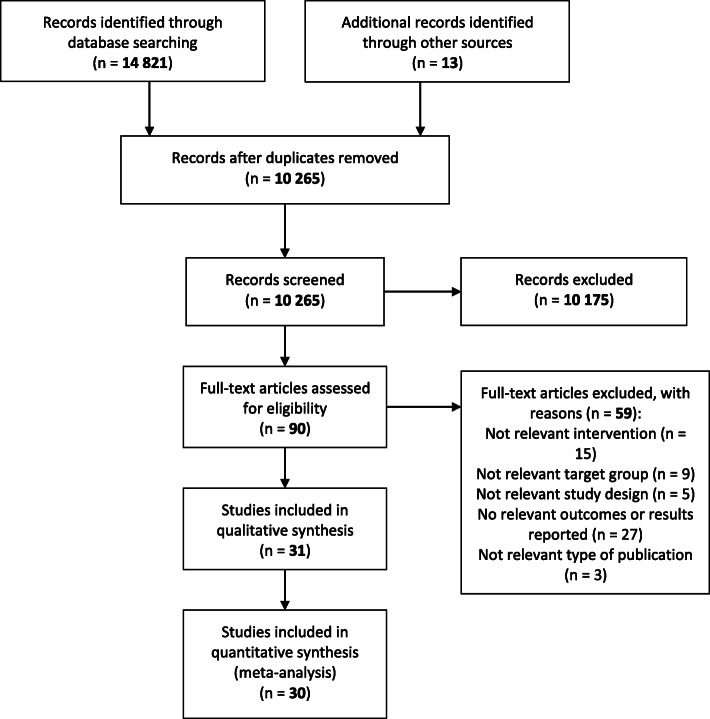
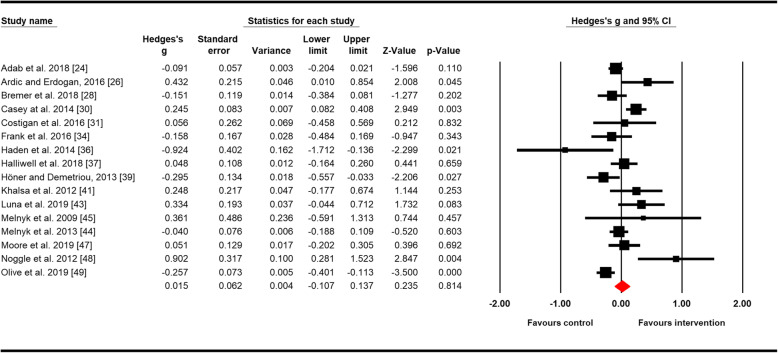
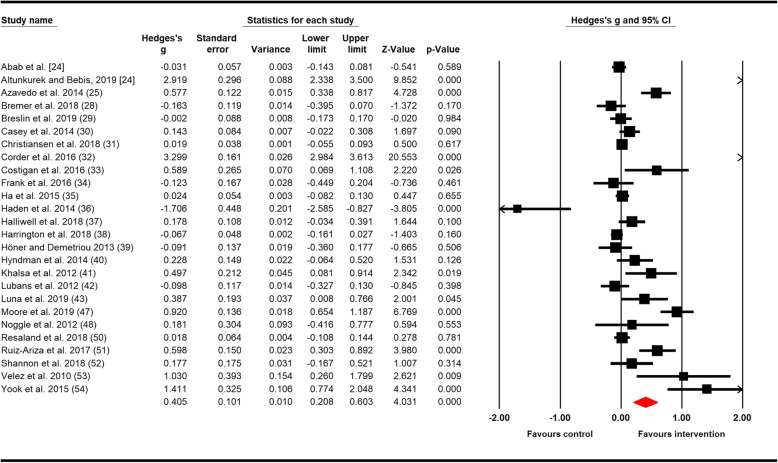
Background: Low levels of physical activity, sedentary behaviour and mental health problems are issues that have received considerable attention in the last decade. The aim of this systematic review and meta-analysis was to investigate effects of interventions targeting school-related physical activity or sedentary behaviour on mental health in children and adolescents and to identify the features of effective interventions. Methods: Scientific articles published between January 2009 and October 2019 fulfilling the following criteria were included: general populations of children and adolescents between age 4 and 19, all types of school-related efforts to promote physical activity or reduce sedentary behaviour. Study selection, data extraction and quality assessment were done by at least two authors independently of each other. Data were analysed with a random effects meta-analysis and by narrative moderator analyses. Results: The literature search resulted in 10265 unique articles. Thirty-one articles, describing 30 interventions, were finally included. Eleven relevant outcomes were identified: health-related quality of life, well-being, self-esteem and self-worth, resilience, positive effect, positive mental health, anxiety, depression, emotional problems, negative effect and internalising mental health problems. There was a significant beneficial effect of school-related physical activity interventions on resilience (Hedges’ g = 0.748, 95% CI = 0.326; 1.170, p = 0.001), positive mental health (Hedges’ g = 0.405, 95% CI = 0.208; 0.603, p = < 0.001), well-being (Hedges’ g = 0.877, 95% CI = 0.356; 1.398, p = < 0.001) and anxiety (Hedges’ g = 0.347, 95% CI = 0.072; 0.623, p = 0.013). Heterogeneity was moderate to high ( I 2 = 59–98%) between studies for all outcomes except positive effect, where heterogeneity was low ( I 2 = 2%). The narrative moderator analyses of outcomes based on 10 or more studies showed that age of the children moderated the effect of the intervention on internalising mental health problems. Interventions in younger children showed a significantly negative or no effect on internalising mental health problems while those in older children showed a significant positive or no effect. Moreover, studies with a high implementation reach showed a significant negative or no effect while those with a low level of implementation showed no or a positive effect. No signs of effect moderation were found for self-esteem, well-being or positive mental health. Risk of publication bias was evident for several outcomes, but adjustment did not change the results. Conclusions: School-related physical activity interventions may reduce anxiety, increase resilience, improve well-being and increase positive mental health in children and adolescents. Considering the positive effects of physical activity on health in general, these findings may reinforce school-based initiatives to increase physical activity. However, the studies show considerable heterogeneity. The results should therefore be interpreted with caution. Future studies should report on implementation factors and more clearly describe the activities of the control group and whether the activity is added to or replacing ordinary physical education lessons in order to aid interpretation of results. Trial registration: PROSPERO, CRD42018086757 .
Overview
The claims and statistics of this paper haven’t been checked yet.
Free: it reads the open-access text and checks the first 5 claims that cite a source we can check. Create a free account to check every claim.
Integrity signals
Registry
Cites
Statistics
Figures
Verification
Claims the paper makes
The claims and statistics of this paper haven’t been checked yet.
Free: it reads the open-access text and checks the first 5 claims that cite a source we can check. Create a free account to check every claim.
Claims other papers make about this one
Each is checked against this paper’s own text: does it say what the citing paper says it does?
The cited source says what the claim attributes to it.
In the citing paper
“Overlapping concepts and components found in mental health interventions conducted before the pandemic included: physical activity [57, 58], yoga [20], art [59, 60], psychoeducation, psychological counseling, and psychotherapeutic approaches (e.g. CBT) [20], which were also found in the included studies in our review focusing on the COVID-19 pandemic.”
Self-check
Percentages, sums and reported differences re-computed from the paper’s own numbers.
The self-check needs the paper’s full text.
Citations
Cites
Preferred Reporting Items for Systematic Reviews and Meta-Analyses: the PRISMA statement
Moher, D., Liberati, A., Tetzlaff, J., Altman, D. G., & for the PRISMA Group (2009) · BMJ · doi:10.1136/bmj.b2535 · Cited by 83,823
Preferred Reporting Items for Systematic Reviews and Meta-Analyses: The PRISMA Statement
Moher, D., Liberati, A., Tetzlaff, J., Altman, D. G., & The PRISMA Group (2009) · PLoS Medicine · doi:10.1371/journal.pmed.1000097 · Cited by 64,042 · cited 1×
“The aims of the systematic review were as follows: 1) To study the impact of school-related physical activity interventions or interventions to reduce sedentary behaviour on symptoms of mental health in terms of internalising mental health problems and positive mental health in children aged 4–19 years 2) To investiga…”
Measuring inconsistency in meta-analyses
Higgins, J. P. T., Thompson, S. G., Deeks, J. J., & Altman, D. G. (2003) · BMJ · doi:10.1136/bmj.327.7414.557 · Cited by 63,139
Preferred reporting items for systematic reviews and meta-analyses: the PRISMA Statement.
(2009) · PubMed Central · Cited by 44,859
Kessler, R. C., Berglund, P., Demler, O., Jin, R., Merikangas, K. R., & Walters, E. E. (2005) · Archives of General Psychiatry · doi:10.1001/archpsyc.62.6.593 · Cited by 20,391 · cited 1×
“Considering that the average age of onset for anxiety disorders is 11 years [60] and 11–13 years for depressive disorders [61], prevention effectiveness may vary depending on not only the type of intervention, but also the age or developmental stage of the child [7].”
BackgroundWang, G., Ma, R., Qiao, G., Wada, K., Aizawa, Y., & Satoh, T. (2015) · Integrative Medicine International · doi:10.1159/000368408 · Cited by 18,657
Borenstein, M., Hedges, L. V., Higgins, J. P. T., & Rothstein, H. R. (2009) · doi:10.1002/9780470743386 · Cited by 14,225
Borenstein, M., Hedges, L. V., Higgins, J. P. T., & Rothstein, H. R. (2021) · doi:10.1002/9781119558378 · Cited by 9,799
The Construct of Resilience: A Critical Evaluation and Guidelines for Future Work
Luthar, S. S., Cicchetti, D., & Becker, B. (2000) · Child Development · doi:10.1111/1467-8624.00164 · Cited by 9,381 · cited 1×
“adaptation within the context of significant adversity [65].”
BackgroundGlobal physical activity levels: surveillance progress, pitfalls, and prospects
Hallal, P. C., Andersen, L. B., Bull, F. C., Guthold, R., Haskell, W., & Ekelund, U. (2012) · The Lancet · doi:10.1016/s0140-6736(12)60646-1 · Cited by 5,711
Research works printed but not linked: 2
- World Health Organization. Global recommendations on physical activity for health; 5–17 years old. Geneva; 2010. 26180873
- Quality Assessment Tool For Quantitative Studies Effective Public Health Practice Project 1998
Cited by
Items 201–300 of 434
Liu, Q., Dong, Q., Fang, Q., Oh, E., Jia, M., & Yang, D. (2026) · Frontiers in Psychology · doi:10.3389/fpsyg.2026.1760902 · Cited by 3
Martone, D., Iuliano, E., & Padulo, J. (2026) · Obesities · doi:10.3390/obesities6020023 · Cited by 3
“Overall, active breaks represent a promising strategy to promote healthier lifestyles and psychosocial health in children, but they are most effective when integrated into structured programs that engage cognitive and social aspects alongside physical activity [27,32,44,45].”
Edukasi gaya hidup aktif sebagai upaya meningkatkan kesehatan reproduksi pada remaja urban
Amelia, D., Novembriani, R. P., Puriastuti, A. C., Merawati, D., Mukharam, K., Billah, M. A. A., & Aprilianingrum, N. R. (2026) · Jurnal Inovasi Hasil Pengabdian Masyarakat (JIPEMAS) · doi:10.33474/jipemas.v9i1.24492 · Cited by 3
Oh, J. W., Gwon, S. H., Lee, S., & Son, N. (2024) · Journal of Psychiatric Research · doi:10.1016/j.jpsychires.2024.07.048 · Cited by 3
D'Sa, M. B., Relph, N., Liverpool, S., Tebble, G., & Owen, M. B. (2025) · PLOS mental health. · doi:10.1371/journal.pmen.0000227 · Cited by 5
“Additionally, PA can positively impact mental health, improving mood, boosting self-esteem, and reducing anxiety and stress [15,16].”
Viskari, T., Appelqvist‐Schmidlechner, K., Ståhl, T., Vaara, J. P., & Fröjd, S. A. (2026) · European Journal of Public Health · doi:10.1093/eurpub/ckag020 · Cited by 3
“Previous research has shown that school-based PA promotion supports mental health, as it has been shown to reduce anxiety [11], increase mental well-being [11, 12], and promote the social well-being of pupils [13, 14].”
Tennfjord, M. K., Strand, M. F., Østby, N., Harbø, K. M. T., & Fredriksen, P. M. (2022) · Scandinavian Journal of Medicine and Science in Sports · doi:10.1111/sms.14278 · Cited by 4
Yoga and Meditation Benefits in Developmental Age: at School, to Relax the Body and Mind
Valentini, M., & Raschi, E. (2023) · Lubelski Rocznik Pedagogiczny · doi:10.17951/lrp.2023.42.2.181-193 · Cited by 3
Effectiveness of Physical Activities in Students’ Mental Health at Elementary Level
Bagum, M., Riaz, Z., & Fareed, A. (2024) · Journal of Education and Social Studies · doi:10.52223/jess.2024.5119 · Cited by 3
DadeMatthews, A. O., Pangelinan, M. M., Bowen, A. E., Simon, S. L., Chandrasekhar, J. L., Musci, R. J., & Kaar, J. L. (2024) · Community Mental Health Journal · doi:10.1007/s10597-024-01292-5 · Cited by 3
“Unfortunately, low-resource schools are often unable to access these programs due to financial burden of having mental health professionals on staff (Hoying et al., 2016; Andermo et al., 2020; Felver et al., 2016; Sarkissian et al., 2018).”
Peningkatan Pengetahuan Tentang Gangguan Kesehatan Mental Di SMK Kesehatan Bhakti Insani Kota Depok
Nopratilova, N. (2024) · Jurnal Andara · doi:10.70608/0hgqjh98 · Cited by 3
“Sehingga diperlukan Kerjasama mengenai peningkatan kesadaran dan pemahaman tentang kesehatan mental remaja di sekolah menjadi suatu kebutuhan mendesak untuk mendukung pertumbuhan dan perkembangan mereka [5].”
BackgroundBalla, B. J., Boroș-Balint, I., & Szatmári, É. (2022) · Studia Universitatis Babeş-Bolyai Educatio Artis Gymnasticae · doi:10.24193/subbeag.67(4).32 · Cited by 3
Physical activity, exercise, and mental health
Cadenas‐Sánchez, C., Torres‐Lopez, L. V., & Migueles, J. H. (2023) · Oxford University Press eBooks · doi:10.1093/med/9780192843968.003.0027 · Cited by 3
Decisive Factors for a Physically Active School Day in Denmark—A Multi-Stakeholder Delphi Process
Nielsen, J. H., & Hansen, T. A. (2024) · Translational Journal of the American College of Sports Medicine · doi:10.1249/tjx.0000000000000254 · Cited by 2
Studi Analisis Preferensi Strategi Coping dalam Pemeliharaan Kesehatan Mental Siswa SMA
Hartanto, D., Fauziah, M., Kusumaningtyas, D., Nugraha, A., & Syifa, A. A. (2025) · Indonesian Journal of Educational Counseling · doi:10.30653/001.202591.473 · Cited by 2
Battista, K., Smout, S., Patte, K. A., Gardner, L. A., Newton, N. C., Osman, B., Chapman, C., Leatherdale, S. T., & Champion, K. E. (2025) · Prevention Science · doi:10.1007/s11121-025-01837-4 · Cited by 2
Alqaisi, R. S., Al-Qerem, W. A., Al-zu’bi, B., Al-Tah, B., Daher, M., Alfreahat, M. I., Mousa, N. A., Jankhout, S., Atrooz, A. O., & Eberhardt, J. (2025) · Children · doi:10.3390/children12091199 · Cited by 2
“Evidence from a recent systematic review and meta-analysis further supports the positive association between mental school-based physical activity interventions and mental health outcomes, including resilience, well-being, and anxiety symptoms in young people [50].”
Chen, L., Wang, X., Luo, L., Li, Y., Wu, Y., Lv, G., Wu, X., Chen, L., Chen, L., An, X., et al. (2025) · Clinical and Experimental Hypertension · doi:10.1080/10641963.2025.2560635 · Cited by 2
“11,12 Recent studies have also yielded varying conclusions regarding the effectiveness of interventions for psychological problems in children and adolescents.”
Fairclough, S. J., Clifford, L., Banks, J., Edwards, P., Gilmour, A.-M., Tyler, R., Brown, D. M. Y., Rowlands, A. V., & MacDonald, M. J. (2025) · Journal of Activity Sedentary and Sleep Behaviors · doi:10.1186/s44167-025-00091-x · Cited by 2
Dixon, S., Hettinga, F. J., McCullogh, N., & Tempest, G. D. (2025) · Journal of Sports Sciences · doi:10.1080/02640414.2025.2595408 · Cited by 2
“For instance, school-based PA can foster social cohesion between pupils, reduce stress, and support emotion regulation (Andermo et al., 2020; Chen et al., 2019; Fu et al., 2025), all of which are plausibly linked to improved classroom environment and pupil well-being, even in the absence of…”
Harrison, Z., Bourke, M., & Gomersall, S. R. (2025) · Child Care Health and Development · doi:10.1111/cch.70226 · Cited by 2
Pristilia, F., & Hanafi, M. (2025) · Jurnal Review Pendidikan dan Pengajaran · doi:10.31004/jrpp.v8i4.52006 · Cited by 2
Bodnar, I., Sofinskii, R., & Fedan, Y. (2025) · Physical education sport and health culture in modern society · doi:10.29038/2220-7481-2025-03-28-37 · Cited by 2
Wong, M. Y. C., Garcia, A. C. M., & Fung, H. W. (2026) · Australian Journal of Psychology · doi:10.1080/00049530.2026.2620254 · Cited by 2
“While the success of physical activity interventions seems not to be heavily influenced by the type, duration, or increase in physical activity, certain moderators (such as frequency and session duration) might affect specific mental health outcomes (Andermo et al., 2020).”
Anggia, A. (2025) · Journal Of Salutare · doi:10.62872/jos.v2i1.355 · Cited by 2
Li, C., Wang, Y., Zhao, W., Yan, X., Liu, K., Zhong, J., Wang, L., Wang, H., & Wang, L. (2026) · European Child & Adolescent Psychiatry · doi:10.1007/s00787-026-03069-5 · Cited by 2
“In particular, there were moderate effects on child and adolescent mental health (Hedges’ g = 0.405, p = < 0.001) [7 ]; and mild effects on child and adolescent physical health (MD = 1.19 mL/kg/min, low-quality evidence) [8 ].”
InfluentialBrocken, J. E. A., Meeter, M., & de Bruijn, A. G. M. (2026) · Journal of School Health · doi:10.1111/josh.70198 · Cited by 2
Solas-Martínez, J. L., Marques, A., Loureiro, V., & Ruiz‐Ariza, A. (2026) · Review of Educational Research · doi:10.3102/00346543261469145 · Cited by 2
Yamakita, M., Ando, D., Sugita, H., Akiyama, Y., Sato, M., Yokomichi, H., Yamaguchi, K., & Yamagata, Z. (2021) · International Journal of Environmental Research and Public Health · doi:10.3390/ijerph18073351 · Cited by 2
Kabiri, L. S., Perkins-Ball, A. M., Diep, C. S., Kelavkar, U., & Rodriguez, A. X. (2022) · Recent Progress in Nutrition · doi:10.21926/rpn.2201009 · Cited by 2
“The impact of school-based physical activity interventions on mental health were more promising; a literature review of 30 interventions found significant beneficial effects on resilience, positive mental health, well-being, and anxiety [21].”
Sociocultural differences in the development of obesity in adolescents in Murcia
Lucas, P. J. C., Candel, M. I. J., Sánchez‐Cubo, F., Ceballos‐Santamaría, G., Vargas, M. V., & Jiménez, J. M. (2022) · Endocrinología Diabetes y Nutrición (English ed ) · doi:10.1016/j.endien.2021.12.011 · Cited by 2
Capobianco, L., Adewusi, J. K., Cooper, B. G., Belcher, A., & Adrian Wells, A. (2023) · BMJ Open · doi:10.1136/bmjopen-2022-067342 · Cited by 2
The Toolbox Approach: Towards a Novel Flexible Way of Implementing and Testing Positive Education
Lucciarini, E., & Boniwell, I. (2023) · Springer eBooks · doi:10.1007/978-981-99-5609-8_8 · Cited by 2
Exploring Secondary School Athletic Trainers’ Perspectives in Managing Mental Health Situations
Jang, S., Drescher, M. J., Armstrong, T. A., Neil, E. R., & Eberman, L. E. (2024) · International Journal of Environmental Research and Public Health · doi:10.3390/ijerph21050577 · Cited by 2
“These findings contradict previous studies that student–athletes have better coping strategies for mental health difficulties than non-sport individuals [6,7,9].”
BackgroundResultYang, Y., Law, M. A., & Vaghri, Z. (2024) · PLoS ONE · doi:10.1371/journal.pone.0301008 · Cited by 4
“A series of recently published meta-analyses confirm that healthy habits, including regular exercise [26, 27], adequate sleep [28, 29], and solid nutritional intake [5, 30, 31], have both short-term and lasting impacts on youth mental health and wellbeing.”
BackgroundVancampfort, D., Mugisha, J., & Damme, T. V. (2024) · Pan African Medical Journal · doi:10.11604/pamj.2024.48.140.40024 · Cited by 2
“It is known from studies in high-income countries that school-related physical activity interventions improve resilience, positive mental health, and well-being and reduce anxiety [13].”
Gholami, A., Mousavi, S., Naeimikia, M., & Sofizadeh, P. (2024) · journal of physical education · doi:10.4025/jphyseduc.v35i1.3506 · Cited by 2
How Can Muscle-Strengthening Activities Be Promoted in School Settings?
Cox, A. (2024) · Springer eBooks · doi:10.1007/978-3-031-65595-1_15 · Cited by 2
Silva, T. M. D. S., dos Santos, G. C., Barbosa, R. D. O., da Silva, J. M., Dias, P. H. G., Francisquini, M. C. J., da Costa, B. G. G., & Neto, A. S. (2025) · Sport Sciences for Health · doi:10.1007/s11332-024-01311-8 · Cited by 2
Alzaidi, H., Alnuwaysir, N., Almoajel, A. M., Hadaddi, S., Almutairi, K. B., Alessa, N., Almadani, T., Alotibe, F., & Alhaider, M. (2025) · Global Journal of Health Science · doi:10.5539/gjhs.v17n2p46 · Cited by 2
“This paper on systematic review and meta-analysis concluded that school-based physical activity interventions can help lower anxiety levels, boost resilience, enhance overall well-being, and promote positive mental health among children and adolescents (Andermo et al., 2020).”
Amoah, P. A., Leung, A. Y. M., Okyere, J., Lau, S. S. S., Dadaczynski, K., & Okan, O. (2025) · Public Health · doi:10.1016/j.puhe.2025.105749 · Cited by 3
Astutik, N. W. W. A., Dimyati, D., & Setiawan, C. (2025) · Retos · doi:10.47197/retos.v72.116827 · Cited by 2
Arocutipa, B. C., Cahuana, M. V., Hilachoque, V. H., & Bolaños, M. C. (2024) · International Journal of Advanced Computer Science and Applications · doi:10.14569/ijacsa.2024.0150895 · Cited by 2
“The analysis by Andermo et al. [7] underlines the effectiveness of school initiatives that promote physical activity among children and young people.”
MethodHIIT and Resistance Training Effects on Learning-related Outcomes in Underserved School Children
Peacock, J. C., Finn, K. E., & Bowling, A. B. (2022) · International Journal of Physical Education Fitness and Sports · doi:10.34256/ijpefs2211 · Cited by 1
“historically underserved populations [4, 6].”
BackgroundDiferencias socioculturales en el desarrollo de la obesidad en adolescentes en Murcia
Lucas, P. J. C., Candel, M. I. J., Sánchez‐Cubo, F., Ceballos‐Santamaría, G., Vargas, M. V., & Jiménez, J. M. (2022) · Endocrinología Diabetes y Nutrición · doi:10.1016/j.endinu.2021.12.007 · Cited by 1
Measurment Of Youth Physical Fitness In Pontianak City Using TKPN Instruments
Hidasari, F. P. (2023) · Journal Physical Health Recreation · doi:10.55081/jphr.v3i2.987 · Cited by 1
Meyers, R. N., Garcia, M. C., Taylor‐Haas, J. A., Long, J. T., Rauh, M. J., Paterno, M. V., Ford, K. R., & Bazett-Jones, D. M. (2023) · Pediatric Exercise Science · doi:10.1123/pes.2022-0080 · Cited by 2
Bae, M.-H. (2023) · Iranian Journal of Public Health · doi:10.18502/ijph.v52i12.14320 · Cited by 1
“Studies conducted abroad have been systematic reviews that synthesize multiple studies over a long period (13-14).”
BackgroundAnxiety and Depression-Related Problems Associated with Adolescents
Ghosh, D., & Kumar, A. (2024) · BENTHAM SCIENCE PUBLISHERS eBooks · doi:10.2174/9789815274400124010013 · Cited by 1
Sortwell, A., Ramírez‐Campillo, R., Granacher, U., Burfield, L., Redwin, R., Heelis, J., & Andre, R. (2024) · Strategies · doi:10.1080/08924562.2024.2375991 · Cited by 2
“Educators can positively influence—day by day—students’ learning and develop healthy lifelong behaviors (Andermo et al., 2020; Hahn & Truman, 2015).”
Hu, Z., & Chi, X. (2024) · American Journal of Health Behavior · doi:10.5993/ajhb.48.4.9 · Cited by 1
Bai, D., Hashim, A. H. M., Chen, Z., Xu, M., & Chen, W. (2024) · Retos · doi:10.47197/retos.v62.109471 · Cited by 1
THE IMPORTANCE OF ADAPTED PHYSİCAL ACTİVİTİES ON PROBLEM BEHAVİOURS OF INDİVİDUA
Başkonuş, T. (2024) · International Journal Of Eurasia Social Sciences · doi:10.35826/ijoess.5617 · Cited by 1
Milenković, D., Zubić, I., Nikić, N., & Radonjić, J. (2024) · Zbornik Instituta za pedagoska istrazivanja · doi:10.2298/zipi2402281m · Cited by 1
“С тим у вези, сматра се да физичка активност позитивно утиче на квалитет живота (Shoesmith et al., 2020; Urchaga et al., 2020; Villafaina et al., 2021), ментално здравље (Andermo et al., 2020; Li et al., 2023) и психолошку добробит овог узраста (Hale et al., 2023; Piñeiro-Cossio et al., 2021).”
Preschool teachers’ perceptions of a curriculum-integrated video-based yoga program
Stapp, A. C., & Wolff, K. (2025) · Early Years Journal of International Research and Development · doi:10.1080/09575146.2025.2490983 · Cited by 1
“While many yoga programs act as a supplemental resource in the preschool classroom, much of the research has focussed on quantitatively examining the impact on children’s cognitive and psychological outcomes (Andermo et al. 2020; James-Palmer et al. 2020; Khunti et al. 2022).”
Liu, C., Yang, Y., Arbour‐Nicitopoulos, K. P., Ho, R., Cheung, J. S.-T., Leung, A., & Sit, C. H. P. (2025) · Journal of Autism and Developmental Disorders · doi:10.1007/s10803-025-06809-9 · Cited by 2
“Meta-analytical findings showed that PA interventions were ben - eficial to resilience in adolescents (Andermo et al., 2020 ).”
Relación de la actividad física escolar y la salud mental de los adolescentes.
López, L. C. C., Villarroel, S. D. V., Vinueza, K. M. V., Cazar, G. A. B., Ibarra, S. M. H., & Cadena, M. A. L. (2025) · Revista Interdisciplinaria de Educación, Salud, Actividad Física y Deporte. · doi:10.70262/riesafd.v2i2.2025.62 · Cited by 1
Holistic Health as Perceived by Nepalese Teenagers: A Qualitative Descriptive Study
Gauro, P., Balthip, K., Boonyasopun, U., & Songwathana, P. (2025) · Pacific Rim International Journal of Nursing Research · doi:10.60099/prijnr.2025.273325 · Cited by 1
García‐Hermoso, A., Hormazábal‐Aguayo, I., Muñoz‐Pardeza, J., López‐Gil, J. F., Yáñez-Sepúlveda, R., Páez‐Herrera, J., & Ezzatvar, Y. (2025) · Academic Pediatrics · doi:10.1016/j.acap.2025.103151 · Cited by 2
de Souza-Lima, J., Ferrari, G., Sepulveda, R. A. Y., Giakoni-Ramírez, F., Muñoz-Strale, C., Alarcón-Aguilar, J., Parra-Saldías, M., Bastías, D. M. D., Godoy-Cumillaf, A. E. R., Merellano-Navarro, E., et al. (2025) · Children · doi:10.3390/children12101339 · Cited by 1
“However, our findings diverge slightly from single-country studies, such as one in European adolescents where PA explained up to 5% of variance in stress reduction, suggesting cultural or methodological variations in multinational datasets like ISCWeB may dilute associations [20,40].”
Andoy, R. E. (2025) · International Journal of Advanced Research in Science Communication and Technology · doi:10.48175/ijarsct-29294 · Cited by 1
Halberschmidt, B., Leisterer, S., Dreiskämper, D., & Lautenbach, F. (2025) · Journal of Applied Sport and Exercise Psychology · doi:10.1026/2941-7597/a000057 · Cited by 1
Efecto de la actividad física en la autoestima de los adolescentes
Aparicio, A., & Colocho, P. E. S. (2025) · ALERTA Revista Científica del Instituto Nacional de Salud · doi:10.5377/alerta.v8i4.21192 · Cited by 1
Lei, Y., & Morazuki, S. R. (2025) · International Journal of Research and Innovation in Social Science · doi:10.47772/ijriss.2025.917psy0065 · Cited by 1
Mierniczek, M., Mierniczek, M., Mierniczek, A., Kaczmarska, K., Rosołowska, K. Z., & Dudek, J. (2025) · Journal of Education Health and Sport · doi:10.12775/jehs.2025.81.66752 · Cited by 1
Kegelaers, J. J., Hove, L. V., Heel, M. V., & Baetens, I. (2025) · International Review of Sport and Exercise Psychology · doi:10.1080/1750984x.2025.2596585 · Cited by 2
Alonazi, A., Almutairi, D., Alyousef, T., & Alkhateeb, A. M. (2025) · PeerJ · doi:10.7717/peerj.20353 · Cited by 1
“Studies suggest that physical activity enhances body satisfaction and self-worth, potentially mitigating risks of low self-esteem, disordered eating, and mood disturbances ( Andermo et al., 2020 ; Lee & Lee, 2016 ; Liu, Menhas & Saqib, 2024 ; Melo et al., 2025 ; Thorup et al., 2024 ).”
Fikri, M. D., Sudijandoko, A., Purnomo, M., Kusuma, D. A., Özman, C., Rusdiawan, A., Rohman, M. F., Wardani, A. P. S., Sholikhah, A. M., Firmansyah, A., et al. (2026) · Retos · doi:10.47197/retos.v75.117110 · Cited by 1
“According to a systematic study by Andermo et al. (2020), university students in developing nations now participate in physical activity and are much more fit thanks to institutional interventions like sports policies and increased coach capacity.”
Educación Física y Deporte. Agentes socioculturales de salud, identidad y transformación social
Garcia, M. I., Rosario-Pérez, R. D. C., & Gutiérrez-Valerio, C. J. (2025) · Revista Académica Internacional de Educación Física · doi:10.59614/acief52025228 · Cited by 1
Martins, G. F., da Silva, M. N., & Silva, E. V. A. D. (2025) · Brazilian Journal of Development · doi:10.34117/bjdv11n12-077 · Cited by 1
Andermo, S., Helgadóttir, B., Vera, L. F., Ekblom, Ö. B., & Nyberg, G. (2026) · BMC Public Health · doi:10.1186/s12889-026-26469-3 · Cited by 1
“However, the evidence to date on the effects of school-based physical activity interventions on mental health, cognitive function and academic performance has not been consistent [17, 21, 22].”
Self-citationVásquez, G. I. V., Ochoa, E. D. Q., Quizhpe, C. F. B., & Orellana, S. M. (2026) · Veredas do Direito Direito Ambiental e Desenvolvimento Sustentável · doi:10.18623/rvd.v23.n4.4708 · Cited by 1
Anwar, N. I. A. (2025) · Jurnal Muara Olahraga · doi:10.52060/jmo.v8i1.3783 · Cited by 1
López‐Fuenzalida, A., Varas-Yupátova, L., Gómez, F. B., Valdés-Badilla, P. A., Cubillos-Bianchini, P., Castro-González, L., Carrasco-García, E., Henríquez-Camus, V., Saad-Tomasovic, V., Guerra-Ferrer, C., et al. (2026) · Retos · doi:10.47197/retos.v78.117747 · Cited by 1
“…with the theoretical framework outlined in the introduction, which positions Physical Education as a pedagogical context capable of fostering socio-emotional competencies alongside motor development (Soriano Sánchez et al., 2023; López et al., 2021; Andermo et al., 2020; Huerta-Ojeda et al., 2022).”
Bretz, K., Kress, J., & Herrmann, C. (2026) · BMC Public Health · doi:10.1186/s12889-026-27094-w · Cited by 1
“Studies investigating mental health parameters revealed positive associations between PA and mental health parameters, whereby significant associations between PA and lower levels of psychological ill-being and greater psychological well-being were found [53–56].”
Thienes, G., Pahmeier, I., Siemer, J. G., & Braksiek, M. (2026) · Journal of Teaching in Physical Education · doi:10.1123/jtpe.2025-0231 · Cited by 1
Galan, Y. P., Moldovan, A., & БРАЖАНЮК, А. (2026) · Реабілітаційні та фізкультурно-рекреаційні аспекти розвитку людини (Rehabilitation & recreation) · doi:10.32782/2522-1795.2026.20.1.21 · Cited by 1
Well-being and quality of life among youths with a mental health issue
Ahorsu, D. K., Isabel, S. V. D., & Lin, C. Y. (2026) · Elsevier eBooks · doi:10.1016/b978-0-443-28842-5.00021-1 · Cited by 1
Liu, C., Liang, J., Nie, Y., Ma, W., Tan, W., Zhong, J., Xia, Z., Fan, Z., & Qin, Q. (2026) · BMC Psychology · doi:10.1186/s40359-026-04940-5 · Cited by 1
“It is the first to quantitatively verify the statistically significant moderating effect of intervention duration after Bonferroni correction (p = 0.01, with > 8 weeks being optimal), thereby supple-menting the qualitative conclusions of Andermo et al. [17].”
InfluentialFeng, W. (2026) · Frontiers in Public Health · doi:10.3389/fpubh.2026.1829856 · Cited by 1
“As an important carrier of school mental health education, the scientific teaching mode of physical education directly affects the effectiveness of psychological intervention (7, 8).”
Cai, Z., Herold, F., Zhou, L., Lubans, D. R., Gerber, M., Chen, J., Werneck, A. O., Pan, S., Aikeremu, A., Mavilidi, M. F., et al. (2026) · Mental health and physical activity · doi:10.1016/j.mhpa.2026.100795 · Cited by 2
Chen, J., Zou, L., Fan, Z., Feng, X., Wu, X., Peng, D., Dong, W., Lu, C., & Chen, J. (2026) · Frontiers in Psychology · doi:10.3389/fpsyg.2026.1780820 · Cited by 1
Nugraheni, A. S., Syaripudin, A., & Hasan, M. F. (2026) · Journal of Disability & Religion · doi:10.1080/23312521.2026.2695592 · Cited by 1
Kong, J. (2026) · Lifespan development and mental health. · doi:10.70322/ldmh.2026.10014 · Cited by 1
TENDÊNCIAS DE COMPORTAMENTO SEDENTÁRIO ENTRE ESTUDANTES DO SUL DO BRASIL
Brito, L. M. S., Moser, D. C., Tadiotto, M. C., de Menezes-Junior, F. J., Titski, A. C. K., Cieslak, F., Corazza, P. R. P., Mota, J. A. P. S., Mascarenhas, L. P. G., & Leite, N. (2023) · Fiep Bulletin - online · doi:10.16887/93.a2.09 · Cited by 2
Levine, J. F. (2024) · Journal of Legal Aspects of Sport · doi:10.18060/27251 · Cited by 2
“Given the myriad benefits associated with sport, play, and physical activity (Amado-Alonso et al, 2019; Andermo et al., 2020; Biddle & Asare, 2011; Sahlberg & Doyle, 2019; Savina et al., 2016; Yogman & Hirsch-Pasek, 2018), its role in building human connection and fighting the mental health crisis…”
BackgroundXu, G. (2024) · Molecular & cellular biomechanics · doi:10.62617/mcb.v21i2.398 · Cited by 1
O’Rourke, R. H., Arbour‐Nicitopoulos, K. P., Voss, C., Ginis, K. A. M., & Brown, D. M. Y. (2024) · Pediatric Exercise Science · doi:10.1123/pes.2023-0178 · Cited by 1
Effect of Exercise Therapy on Endurance and Flexibility in Young School Children
Khan, U. A., Ansari, B., & Azeemi, H. I. (2025) · Journal of Political Stability Archive · doi:10.63468/jpsa.3.1.03 · Cited by 2
Cassar, S., Salmon, J., Timperio, A. F., Shea, C. M., Ma, J., & Koorts, H. (2025) · Translational Journal of the American College of Sports Medicine · doi:10.1249/tjx.0000000000000316 · Cited by 2
Peary, A., Strout, K. A., Bonnet, J., McNulty, J., & Robinson, K. (2025) · Child Care Health and Development · doi:10.1111/cch.70164 · Cited by 1
Quality of Life and Physical Conditioning in Women
Milenković, D., Zubić, I., & Nikić, N. (2023) · Спортске науке и здравље - АПЕИРОН · doi:10.7251/ssh2302174m · Cited by 1
Capio, C. M., Cheung, S. K., Fung, S. S. W., & Hu, X. (2023) · EdArXiv (OSF Preprints) · doi:10.35542/osf.io/mz5kq · Cited by 1
Jarnig, G., Kerbl, R., & van Poppel, M. N. M. (2023) · medRxiv · doi:10.1101/2023.02.22.23286304 · Cited by 1
Chen, S., Yu, Q., Stubbs, B., Clark, C. C. T., Zhang, Z., Zhu, M., Hossain, M. M., Yeung, A., Griffiths, M. D., & Zou, L. (2020) · Research Square · doi:10.31234/osf.io/3qr2s
“Collectively, AST may result in exercise-induced physiological changes [31, 32] that are associated with improved emotion regulation ability that could alleviate depressive symptom, which in turn makes the odds for suicide attempts lower [9, 33, 34].”
BackgroundSelf-citationSuivi médical de la pratique sportive intensive entre 8 et 18 ans
Nguyen, S. (2021) · Cahiers de la Puéricultrice · doi:10.1016/j.cahpu.2021.07.005
Hasan, A. R. (2021) · Mspace (University of Manitoba) · Cited by 3
The refinement and development of the Project FLAME intervention
Donovan, B. (2020) · Cork Open Research Archive (University College Cork, Ireland)
Encouraging Your Child to Be Physically Active
Kramer, M. S. (2021) · Springer eBooks · doi:10.1007/978-3-030-74765-7_17
Anxiety Management at the Time of COVID-19: the Contribution of Physical Activity in Childhood
Valentini, M., & Giardina, G. (2021) · Lubelski Rocznik Pedagogiczny · doi:10.17951/lrp.2021.40.4.43-61
Metadata
- Authors
- Andermo, S., Hallgren, M., Nguyen, T.-T.-D., Jonsson, S., Petersen, S., Friberg, M., Romqvist, A., Stubbs, B., & Elinder, L. S.
- Affiliations
- Karolinska Institutet (SE)
- Region Stockholm (SE)
- Public Health Agency of Sweden (SE)
- National Health Service (GB)
- Corresponding author
- Andermo, Susanne
- Venue
- Sports Medicine - Open
- Published
- 2020-06-16
- Volume
- 6
- Issue
- 1
- Pages
- 25-25
- ISSN
- 2198-9761 (ISSN-L)
- 2199-1170
- PMC
- PMC7297899
- OpenAlex
- W3035372294
- Semantic Scholar
- 16a10205c4caa9265c5f507ef1c059e34f8a2f14
- Cited by
- 336
- References
- 70
- Citations by year
- 2026: 58 · 2025: 82 · 2024: 77 · 2023: 50 · 2022: 40 · 2021: 22 · 2020: 7
- FWCI
- 3.79
- Type
- journal article
- Language
- en
- Open access
- gold
- doi.org
- Licence
- cc-by
- creativecommons.org/licenses/by/4.0 (tdm)
- creativecommons.org/licenses/by/4.0 (vor)
- Locations
- Sports Medicine - Open (publishedVersion, cc-by)
- PubMed Central (publishedVersion, cc-by)
- PubMed (publishedVersion)
- DiVA at Umeå University (Umeå University) (submittedVersion, other-oa)
- Figshare (submittedVersion, cc-by)
- Research Portal (King's College London) (submittedVersion, other-oa)
- Funders
- Folkhälsomyndigheten (04287-2017, 05031-2018)
- Topics
- Health Sciences › Medicine › Public Health, Environmental and Occupational Health › Physical Activity and Health
- Health Sciences › Medicine › Public Health, Environmental and Occupational Health › School Health and Nursing Education
- Health Sciences › Medicine › Public Health, Environmental and Occupational Health › Obesity, Physical Activity, Diet
- Keywords
- school-based physical activity intervention, sedentary behavior, child mental health, adolescents, resilience, positive mental health, well-being, anxiety, depression, internalizing problems, health-related quality of life, self-esteem, intervention duration, intervention intensity, school health promotion, physical activity promotion, sedentary behavior reduction, socioemotional skills
About these checks
Registry, retraction, Cites and statistics results are computed, not judged, with one exception: a printed reference that no index lists is read once by a model before it counts as a citation error. Claims are extracted by a model and kept only when their quote appears verbatim in the text; each cited source is then checked, with a model’s help, for whether it says what the claim relies on. Those verdicts can be wrong — read the claim’s quote and the cited source before relying on one.
Statistics and arithmetic are recomputed, not judged.
Confidence bands are shown only for fields calibrated on our annotated test set. None is calibrated yet, so no band is shown.
What counts as a claim ›How we measure confidence ›How we check this ›
Are you an author, or do you see a problem with this page? Request a review
Data sources
Bibliographic data: Semantic Scholar, OpenAlex, Crossref.
Contains information from the Semantic Scholar Academic Graph Datasets, made available under the ODC Attribution License (ODC-BY 1.0).
Semantic Scholar’s data is described in: Kinney, R., et al. (2023). The Semantic Scholar Open Data Platform. arXiv:2301.10140.
