

School-related physical activity interventions and mental health among children: a systematic review and meta-analysis
Open accessThe DOI matches its Crossref record; 70 of the 70 references it cites were found in a registry or an index.
Abstract
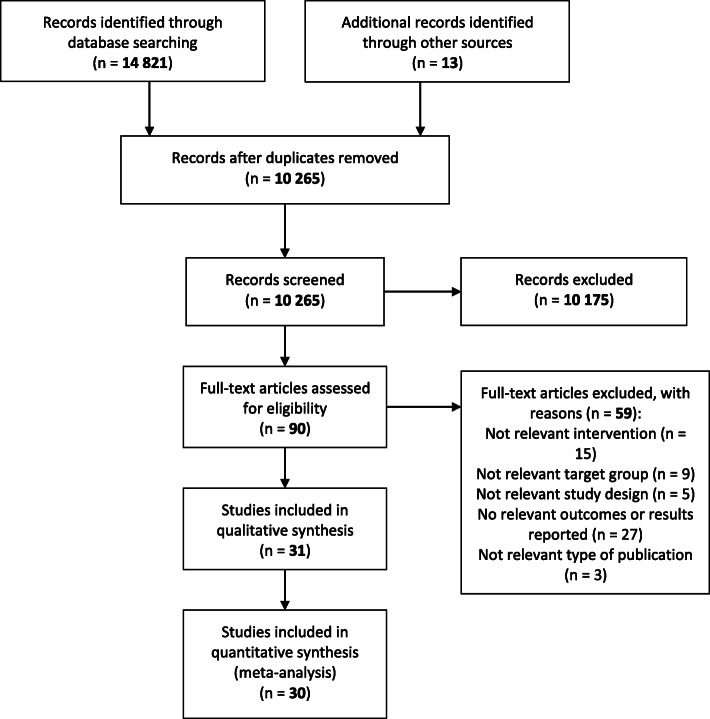
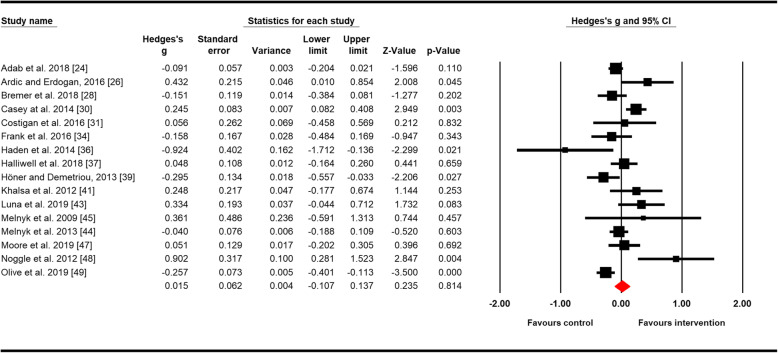
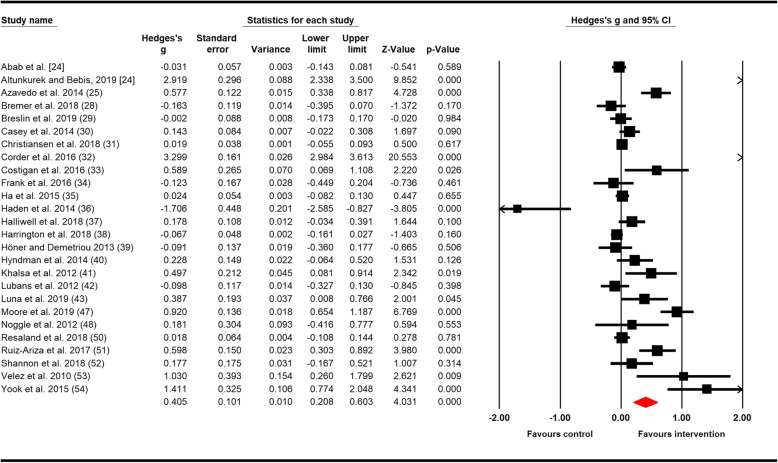
Background: Low levels of physical activity, sedentary behaviour and mental health problems are issues that have received considerable attention in the last decade. The aim of this systematic review and meta-analysis was to investigate effects of interventions targeting school-related physical activity or sedentary behaviour on mental health in children and adolescents and to identify the features of effective interventions. Methods: Scientific articles published between January 2009 and October 2019 fulfilling the following criteria were included: general populations of children and adolescents between age 4 and 19, all types of school-related efforts to promote physical activity or reduce sedentary behaviour. Study selection, data extraction and quality assessment were done by at least two authors independently of each other. Data were analysed with a random effects meta-analysis and by narrative moderator analyses. Results: The literature search resulted in 10265 unique articles. Thirty-one articles, describing 30 interventions, were finally included. Eleven relevant outcomes were identified: health-related quality of life, well-being, self-esteem and self-worth, resilience, positive effect, positive mental health, anxiety, depression, emotional problems, negative effect and internalising mental health problems. There was a significant beneficial effect of school-related physical activity interventions on resilience (Hedges’ g = 0.748, 95% CI = 0.326; 1.170, p = 0.001), positive mental health (Hedges’ g = 0.405, 95% CI = 0.208; 0.603, p = < 0.001), well-being (Hedges’ g = 0.877, 95% CI = 0.356; 1.398, p = < 0.001) and anxiety (Hedges’ g = 0.347, 95% CI = 0.072; 0.623, p = 0.013). Heterogeneity was moderate to high ( I 2 = 59–98%) between studies for all outcomes except positive effect, where heterogeneity was low ( I 2 = 2%). The narrative moderator analyses of outcomes based on 10 or more studies showed that age of the children moderated the effect of the intervention on internalising mental health problems. Interventions in younger children showed a significantly negative or no effect on internalising mental health problems while those in older children showed a significant positive or no effect. Moreover, studies with a high implementation reach showed a significant negative or no effect while those with a low level of implementation showed no or a positive effect. No signs of effect moderation were found for self-esteem, well-being or positive mental health. Risk of publication bias was evident for several outcomes, but adjustment did not change the results. Conclusions: School-related physical activity interventions may reduce anxiety, increase resilience, improve well-being and increase positive mental health in children and adolescents. Considering the positive effects of physical activity on health in general, these findings may reinforce school-based initiatives to increase physical activity. However, the studies show considerable heterogeneity. The results should therefore be interpreted with caution. Future studies should report on implementation factors and more clearly describe the activities of the control group and whether the activity is added to or replacing ordinary physical education lessons in order to aid interpretation of results. Trial registration: PROSPERO, CRD42018086757 .
Overview
The claims and statistics of this paper haven’t been checked yet.
Free: it reads the open-access text and checks the first 5 claims that cite a source we can check. Create a free account to check every claim.
Integrity signals
Registry
Cites
Statistics
Figures
Verification
Claims the paper makes
The claims and statistics of this paper haven’t been checked yet.
Free: it reads the open-access text and checks the first 5 claims that cite a source we can check. Create a free account to check every claim.
Claims other papers make about this one
Each is checked against this paper’s own text: does it say what the citing paper says it does?
The cited source says what the claim attributes to it.
In the citing paper
“Overlapping concepts and components found in mental health interventions conducted before the pandemic included: physical activity [57, 58], yoga [20], art [59, 60], psychoeducation, psychological counseling, and psychotherapeutic approaches (e.g. CBT) [20], which were also found in the included studies in our review focusing on the COVID-19 pandemic.”
Self-check
Percentages, sums and reported differences re-computed from the paper’s own numbers.
The self-check needs the paper’s full text.
Citations
Cites
Preferred Reporting Items for Systematic Reviews and Meta-Analyses: the PRISMA statement
Moher, D., Liberati, A., Tetzlaff, J., Altman, D. G., & for the PRISMA Group (2009) · BMJ · doi:10.1136/bmj.b2535 · Cited by 83,823
Preferred Reporting Items for Systematic Reviews and Meta-Analyses: The PRISMA Statement
Moher, D., Liberati, A., Tetzlaff, J., Altman, D. G., & The PRISMA Group (2009) · PLoS Medicine · doi:10.1371/journal.pmed.1000097 · Cited by 64,042 · cited 1×
“The aims of the systematic review were as follows: 1) To study the impact of school-related physical activity interventions or interventions to reduce sedentary behaviour on symptoms of mental health in terms of internalising mental health problems and positive mental health in children aged 4–19 years 2) To investiga…”
Measuring inconsistency in meta-analyses
Higgins, J. P. T., Thompson, S. G., Deeks, J. J., & Altman, D. G. (2003) · BMJ · doi:10.1136/bmj.327.7414.557 · Cited by 63,139
Preferred reporting items for systematic reviews and meta-analyses: the PRISMA Statement.
(2009) · PubMed Central · Cited by 44,859
Kessler, R. C., Berglund, P., Demler, O., Jin, R., Merikangas, K. R., & Walters, E. E. (2005) · Archives of General Psychiatry · doi:10.1001/archpsyc.62.6.593 · Cited by 20,391 · cited 1×
“Considering that the average age of onset for anxiety disorders is 11 years [60] and 11–13 years for depressive disorders [61], prevention effectiveness may vary depending on not only the type of intervention, but also the age or developmental stage of the child [7].”
BackgroundWang, G., Ma, R., Qiao, G., Wada, K., Aizawa, Y., & Satoh, T. (2015) · Integrative Medicine International · doi:10.1159/000368408 · Cited by 18,657
Borenstein, M., Hedges, L. V., Higgins, J. P. T., & Rothstein, H. R. (2009) · doi:10.1002/9780470743386 · Cited by 14,225
Borenstein, M., Hedges, L. V., Higgins, J. P. T., & Rothstein, H. R. (2021) · doi:10.1002/9781119558378 · Cited by 9,799
The Construct of Resilience: A Critical Evaluation and Guidelines for Future Work
Luthar, S. S., Cicchetti, D., & Becker, B. (2000) · Child Development · doi:10.1111/1467-8624.00164 · Cited by 9,381 · cited 1×
“adaptation within the context of significant adversity [65].”
BackgroundGlobal physical activity levels: surveillance progress, pitfalls, and prospects
Hallal, P. C., Andersen, L. B., Bull, F. C., Guthold, R., Haskell, W., & Ekelund, U. (2012) · The Lancet · doi:10.1016/s0140-6736(12)60646-1 · Cited by 5,711
Research works printed but not linked: 2
- World Health Organization. Global recommendations on physical activity for health; 5–17 years old. Geneva; 2010. 26180873
- Quality Assessment Tool For Quantitative Studies Effective Public Health Practice Project 1998
Cited by
Items 401–434 of 434
White, K. (2025) · Brock University Digital Repository (Brock University)
THE INFLUENCE OF PHYSICAL ACTIVITY ON THE MOOD OF FIRST-YEAR UNIVERSITY STUDENTS
NEGRU, I. N., Szabó, P.-Z., Pop, A. C., & Nuț, R. A. (2025) · Studia Universitatis Babeş-Bolyai Educatio Artis Gymnasticae · doi:10.24193/subbeag.70.sp.iss.2.42
McLeod, B., Lai, S. K., Salmon, J., & Lander, N. (2026) · Frontiers in Sports and Active Living · doi:10.3389/fspor.2026.1942048
“A growing body of evidence highlights the positive impact of PAL on both academic outcomes (10, 12, 13) and on physical and mental health (9, 14, 15).”
Silva, T. M. D. S., da Costa, B. G. G., dos Santos, G. C., & Neto, A. S. (2026) · Journal of Mental Health · doi:10.1080/09638237.2026.2732881
Sofyan, D., Yudha, B. A. R., Abdullah, K. H., Tanucan, J. C. M., & Osiobe, E. U. (2026) · COMPETITOR Jurnal Pendidikan Kepelatihan Olahraga · doi:10.67322/cpjok.v18i3.1326
“In addition, various challenges such as decreased physical activity (Kaur et al., 2020), mental health problems (Andermo et al., 2020; Du & Liu, 2022; Grasdalsmoen et al., 2020), and unequal access to education (Crochemore-Silva et al., 2020; D’Agostino et al., 2021; Tolgfors, 2020) place the…”
CrossFit participants’ experiences of balancing family, work, and fitness in a South African context
O'Brien, C., & Koen, V. (2026) · Frontiers in Psychology · doi:10.3389/fpsyg.2026.1868541
Yin, T., Peng, Y., Chen, L., Lin, X., & Liang, F. (2026) · Frontiers in Public Health · doi:10.3389/fpubh.2026.1934268
“Previous studies have shown that PE is associated with lower risks of depression and SI, and that these effects may operate through self-esteem, social support, perceived physical competence, and emotion regulation (25, 57–59).”
Li, X. (2026) · International Journal of Education and Social Development · doi:10.54097/6yyhvb06
Zhu, Y., Hu, Y., & Zhu, Y. (2026) · Frontiers in Psychology · doi:10.3389/fpsyg.2026.1932607
Geronimo, G. P. (2026) · Contemporary research analysis journal. · doi:10.55677/craj/03-2026-vol03i09
Physical Activity and Adolescent Brain Structure, Mental Health, and Academic Outcomes
Li, Q., Paluch, A. E., & Rakesh, D. (2026) · JAMA Network Open · doi:10.1001/jamanetworkopen.2026.36973
Primary School Teachers’ Competence in Promoting Mental Health – A Systematic Mixed-Methods Review
Starck, L., & Puoskari, M. (2025) · UEF eRepo (University of Eastern Finland)
Zhang, M., & Zhang, B. (2026) · Frontiers in Public Health · doi:10.3389/fpubh.2026.1962774
“For psychosocial outcomes, our effect sizes (g = 0.15–0.21) fall within the range reported by Andermo et al. (17) (g = 0.35–0.88 across outcomes, albeit with wider confidence intervals and fewer studies) and are consistent with the broader evidence base linking PA to mental health in youth (7, 8,…”
InfluentialPaterson, J. (2026) · Kent Academic Repository (University of Kent) · doi:10.22024/unikent/01.02.116593
Pause attive e didattica della matematica
SABENA, C., Soldano, C., & Casi, R. (2026) · Institutional Research Information System University of Turin (University of Turin)
Robinson, D. B., Sulz, L., Gleddie, D., & Berg, S. (2021) · Revue phénEPS / PHEnex Journal · Cited by 2
ผลของการใช้เกมดิจิทัลต่อการเรียนรู้ด้านโภชนาการ และการคิดคำนวณของนักเรียนประถมศึกษา
Boonarchatong, C., Pantrakool, S., Chunhapataragul, T., & Wongma, K. (2026) · Journal of MCU Nakhondhat
Gamification as a Means of Increasing Students' Motivation for Physical Activity
Zhao, Y., Chen, J., Liu, H., & Volkotrubova, A. V. (2026) · Journal of Computing & Biomedical Informatics · doi:10.56979/1102/2026/1598
“More directly related to higher education, [2] found that when physical activity was gamified, rather than non-gamified, there was an increase in intrinsic motivation and a decrease in amotivation among university students.”
Ehrensberger, I. F. (2026) · Qucosa (Saxon State and University Library Dresden)
Supporting Teacher Wellbeing and the Implementation of Movement Integration in the Classroom
Sobolewski, K. M. (2026) · HARVEST (University of Saskatchewan)
Hwang, S.-H., Roh, S.-Y., & Kim, G.-K. (2026) · Behavioral Sciences · doi:10.3390/bs16101867
“Such school-based physical activities may provide adolescents with regular opportunities for physical activity and social support (Andermo et al., 2020).”
The Role of Sports in Developing Resilience and Socialization Among Young Children Aged 4–8 Years
Villarta, M. G. (2026) · QualiSearch Journal of Educational Research and Practice · doi:10.66437/qjerp.v2i10.036
Gschwendtner, M. (. (2026) · KiDokS
Ma, Z., Zhu, R., Madiyeva, G., Bulatbayeva, A. A., & Xu, J. (2026) · Behavioral Sciences · doi:10.3390/bs16101944
“Du and Liu (2022) specifically examine college PE and student mental health, while Andermo et al. (2020) synthesize evidence on school-related physical activity interventions and mental health among children.”
Determinants of psychosocial wellbeing within a year-long youth cycling program
Adamic, E. M., Wozniak, M. J., Dickerson, C. M., Miller, L. C., Panther, J. L., Vanderberg, A., Whorton, J., & Brown, C. L. (2026) · Frontiers in Sports and Active Living · doi:10.3389/fspor.2026.1892082
Improving functional abilities of children with developmental disorders
Polevoy, G. G. (2026) · Balneo and PRM Research Journal · doi:10.12680/balneo.2026.1076
Ferreira, Á. R. P., Torreani, R. J. A., Barrios, D. A. A., & de Souza, L. M. O. (2026) · Revista Ibero-Americana de Humanidades, Ciências e Educação · doi:10.51891/rease.v12i10.31348
Chen, L., Zhang, J., Wang, B., & Gao, Z. (2026) · Frontiers in Psychology · doi:10.3389/fpsyg.2026.2000159
Espejo, P. R. (2026) · RUJA. Institutional Repository of Scientific Production of the University of Jaén (University of Jaén)
Teaching suggestions for physical activity and nutritional habits of children
Skiada, G., & Mekras, A. (2026) · ΙΝΣΤΙΤΟΥΤΟ ΙΣΤΟΡΙΚΩΝ ΕΡΕΥΝΩΝ (National Hellenic Research Foundation)
He, X., & 陈晓霞 (2026) · Frontiers in Public Health · doi:10.3389/fpubh.2026.2000168
Zhou, Z., 张天成, 張詩淵, & Chai, C. (2026) · Frontiers in Pediatrics · doi:10.3389/fped.2026.2002360
Gartika, N., Novianto, U., Salsabila, A., & Ssyuhada, M. R. F. (2026) · JURPIKAT (Jurnal Pengabdian Kepada Masyarakat) · doi:10.37339/jurpikat.v7i4.3491
Pásztor-Horváth, D., & Bognár, J. (2026) · University of Szeged eBooks · doi:10.14232/uknttm.2025.24
Metadata
- Authors
- Andermo, S., Hallgren, M., Nguyen, T.-T.-D., Jonsson, S., Petersen, S., Friberg, M., Romqvist, A., Stubbs, B., & Elinder, L. S.
- Affiliations
- Karolinska Institutet (SE)
- Region Stockholm (SE)
- Public Health Agency of Sweden (SE)
- National Health Service (GB)
- Corresponding author
- Andermo, Susanne
- Venue
- Sports Medicine - Open
- Published
- 2020-06-16
- Volume
- 6
- Issue
- 1
- Pages
- 25-25
- ISSN
- 2198-9761 (ISSN-L)
- 2199-1170
- PMC
- PMC7297899
- OpenAlex
- W3035372294
- Cited by
- 336
- References
- 70
- Citations by year
- 2026: 58 · 2025: 82 · 2024: 77 · 2023: 50 · 2022: 40 · 2021: 22 · 2020: 7
- FWCI
- 3.79
- Type
- journal article
- Language
- en
- Open access
- gold
- doi.org
- Licence
- cc-by
- creativecommons.org/licenses/by/4.0 (tdm)
- creativecommons.org/licenses/by/4.0 (vor)
- Locations
- Sports Medicine - Open (publishedVersion, cc-by)
- PubMed Central (publishedVersion, cc-by)
- PubMed (publishedVersion)
- DiVA at Umeå University (Umeå University) (submittedVersion, other-oa)
- Figshare (submittedVersion, cc-by)
- Research Portal (King's College London) (submittedVersion, other-oa)
- Funders
- Folkhälsomyndigheten (04287-2017, 05031-2018)
- Topics
- Health Sciences › Medicine › Public Health, Environmental and Occupational Health › Physical Activity and Health
- Health Sciences › Medicine › Public Health, Environmental and Occupational Health › School Health and Nursing Education
- Health Sciences › Medicine › Public Health, Environmental and Occupational Health › Obesity, Physical Activity, Diet
- Keywords
- school-based physical activity intervention, sedentary behavior, child mental health, adolescents, resilience, positive mental health, well-being, anxiety, depression, internalizing problems, health-related quality of life, self-esteem, intervention duration, intervention intensity, school health promotion, physical activity promotion, sedentary behavior reduction, socioemotional skills
About these checks
Registry, retraction, Cites and statistics results are computed, not judged, with one exception: a printed reference that no index lists is read once by a model before it counts as a citation error. Claims are extracted by a model and kept only when their quote appears verbatim in the text; each cited source is then checked, with a model’s help, for whether it says what the claim relies on. Those verdicts can be wrong — read the claim’s quote and the cited source before relying on one.
Statistics and arithmetic are recomputed, not judged.
Confidence bands are shown only for fields calibrated on our annotated test set. None is calibrated yet, so no band is shown.
What counts as a claim ›How we measure confidence ›How we check this ›
Are you an author, or do you see a problem with this page? Request a review
Data sources
Bibliographic data: Semantic Scholar, OpenAlex, Crossref.
Contains information from the Semantic Scholar Academic Graph Datasets, made available under the ODC Attribution License (ODC-BY 1.0).
Semantic Scholar’s data is described in: Kinney, R., et al. (2023). The Semantic Scholar Open Data Platform. arXiv:2301.10140.
