

School-related physical activity interventions and mental health among children: a systematic review and meta-analysis
Open accessThe DOI matches its Crossref record; 70 of the 70 references it cites were found in a registry or an index.
Abstract
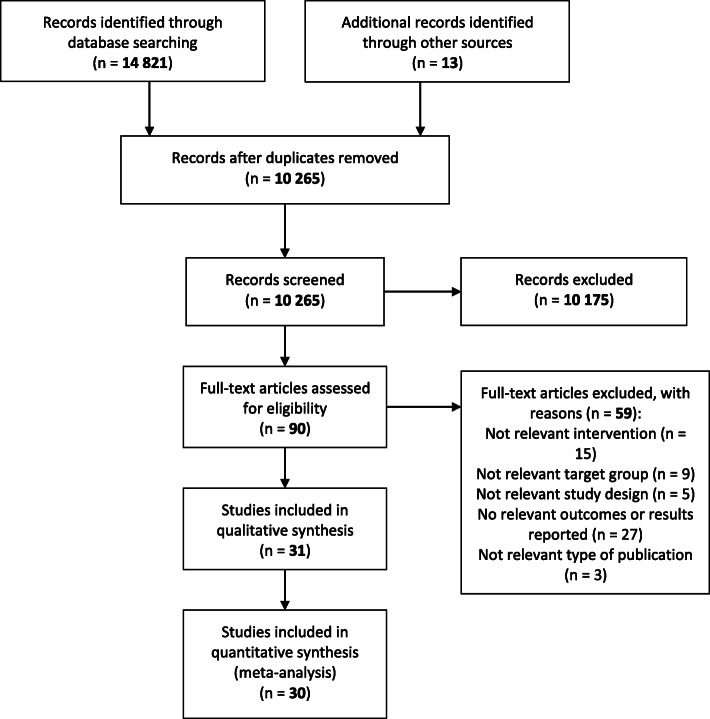
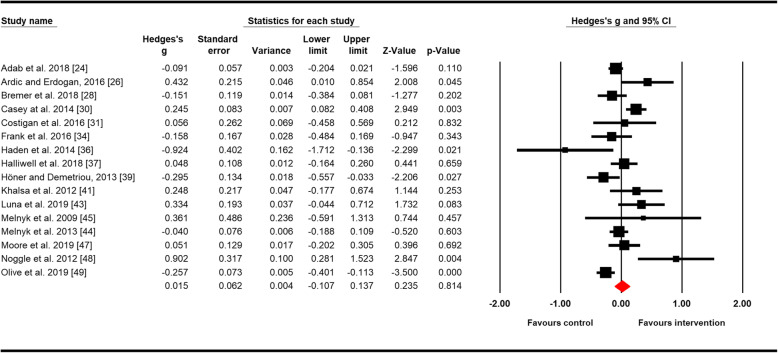
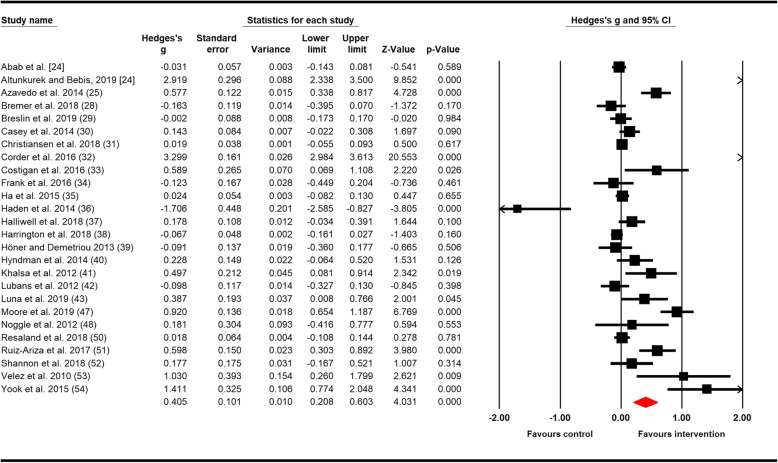
Background: Low levels of physical activity, sedentary behaviour and mental health problems are issues that have received considerable attention in the last decade. The aim of this systematic review and meta-analysis was to investigate effects of interventions targeting school-related physical activity or sedentary behaviour on mental health in children and adolescents and to identify the features of effective interventions. Methods: Scientific articles published between January 2009 and October 2019 fulfilling the following criteria were included: general populations of children and adolescents between age 4 and 19, all types of school-related efforts to promote physical activity or reduce sedentary behaviour. Study selection, data extraction and quality assessment were done by at least two authors independently of each other. Data were analysed with a random effects meta-analysis and by narrative moderator analyses. Results: The literature search resulted in 10265 unique articles. Thirty-one articles, describing 30 interventions, were finally included. Eleven relevant outcomes were identified: health-related quality of life, well-being, self-esteem and self-worth, resilience, positive effect, positive mental health, anxiety, depression, emotional problems, negative effect and internalising mental health problems. There was a significant beneficial effect of school-related physical activity interventions on resilience (Hedges’ g = 0.748, 95% CI = 0.326; 1.170, p = 0.001), positive mental health (Hedges’ g = 0.405, 95% CI = 0.208; 0.603, p = < 0.001), well-being (Hedges’ g = 0.877, 95% CI = 0.356; 1.398, p = < 0.001) and anxiety (Hedges’ g = 0.347, 95% CI = 0.072; 0.623, p = 0.013). Heterogeneity was moderate to high ( I 2 = 59–98%) between studies for all outcomes except positive effect, where heterogeneity was low ( I 2 = 2%). The narrative moderator analyses of outcomes based on 10 or more studies showed that age of the children moderated the effect of the intervention on internalising mental health problems. Interventions in younger children showed a significantly negative or no effect on internalising mental health problems while those in older children showed a significant positive or no effect. Moreover, studies with a high implementation reach showed a significant negative or no effect while those with a low level of implementation showed no or a positive effect. No signs of effect moderation were found for self-esteem, well-being or positive mental health. Risk of publication bias was evident for several outcomes, but adjustment did not change the results. Conclusions: School-related physical activity interventions may reduce anxiety, increase resilience, improve well-being and increase positive mental health in children and adolescents. Considering the positive effects of physical activity on health in general, these findings may reinforce school-based initiatives to increase physical activity. However, the studies show considerable heterogeneity. The results should therefore be interpreted with caution. Future studies should report on implementation factors and more clearly describe the activities of the control group and whether the activity is added to or replacing ordinary physical education lessons in order to aid interpretation of results. Trial registration: PROSPERO, CRD42018086757 .
Overview
The claims and statistics of this paper haven’t been checked yet.
Free: it reads the open-access text and checks the first 5 claims that cite a source we can check. Create a free account to check every claim.
Integrity signals
Registry
Cites
Statistics
Figures
Verification
Claims the paper makes
The claims and statistics of this paper haven’t been checked yet.
Free: it reads the open-access text and checks the first 5 claims that cite a source we can check. Create a free account to check every claim.
Claims other papers make about this one
Each is checked against this paper’s own text: does it say what the citing paper says it does?
The cited source says what the claim attributes to it.
In the citing paper
“Overlapping concepts and components found in mental health interventions conducted before the pandemic included: physical activity [57, 58], yoga [20], art [59, 60], psychoeducation, psychological counseling, and psychotherapeutic approaches (e.g. CBT) [20], which were also found in the included studies in our review focusing on the COVID-19 pandemic.”
Self-check
Percentages, sums and reported differences re-computed from the paper’s own numbers.
The self-check needs the paper’s full text.
Citations
Cites
Preferred Reporting Items for Systematic Reviews and Meta-Analyses: the PRISMA statement
Moher, D., Liberati, A., Tetzlaff, J., Altman, D. G., & for the PRISMA Group (2009) · BMJ · doi:10.1136/bmj.b2535 · Cited by 83,823
Preferred Reporting Items for Systematic Reviews and Meta-Analyses: The PRISMA Statement
Moher, D., Liberati, A., Tetzlaff, J., Altman, D. G., & The PRISMA Group (2009) · PLoS Medicine · doi:10.1371/journal.pmed.1000097 · Cited by 64,042 · cited 1×
“The aims of the systematic review were as follows: 1) To study the impact of school-related physical activity interventions or interventions to reduce sedentary behaviour on symptoms of mental health in terms of internalising mental health problems and positive mental health in children aged 4–19 years 2) To investiga…”
Measuring inconsistency in meta-analyses
Higgins, J. P. T., Thompson, S. G., Deeks, J. J., & Altman, D. G. (2003) · BMJ · doi:10.1136/bmj.327.7414.557 · Cited by 63,139
Preferred reporting items for systematic reviews and meta-analyses: the PRISMA Statement.
(2009) · PubMed Central · Cited by 44,859
Kessler, R. C., Berglund, P., Demler, O., Jin, R., Merikangas, K. R., & Walters, E. E. (2005) · Archives of General Psychiatry · doi:10.1001/archpsyc.62.6.593 · Cited by 20,391 · cited 1×
“Considering that the average age of onset for anxiety disorders is 11 years [60] and 11–13 years for depressive disorders [61], prevention effectiveness may vary depending on not only the type of intervention, but also the age or developmental stage of the child [7].”
BackgroundWang, G., Ma, R., Qiao, G., Wada, K., Aizawa, Y., & Satoh, T. (2015) · Integrative Medicine International · doi:10.1159/000368408 · Cited by 18,657
Borenstein, M., Hedges, L. V., Higgins, J. P. T., & Rothstein, H. R. (2009) · doi:10.1002/9780470743386 · Cited by 14,225
Borenstein, M., Hedges, L. V., Higgins, J. P. T., & Rothstein, H. R. (2021) · doi:10.1002/9781119558378 · Cited by 9,799
The Construct of Resilience: A Critical Evaluation and Guidelines for Future Work
Luthar, S. S., Cicchetti, D., & Becker, B. (2000) · Child Development · doi:10.1111/1467-8624.00164 · Cited by 9,381 · cited 1×
“adaptation within the context of significant adversity [65].”
BackgroundGlobal physical activity levels: surveillance progress, pitfalls, and prospects
Hallal, P. C., Andersen, L. B., Bull, F. C., Guthold, R., Haskell, W., & Ekelund, U. (2012) · The Lancet · doi:10.1016/s0140-6736(12)60646-1 · Cited by 5,711
Janssen, I., & LeBlanc, A. G. (2010) · International Journal of Behavioral Nutrition and Physical Activity · doi:10.1186/1479-5868-7-40 · Cited by 4,829
Physical Activity for Cognitive and Mental Health in Youth: A Systematic Review of Mechanisms
Lubans, D., Richards, J., Hillman, C., Faulkner, G., Beauchamp, M., Nilsson, M., Kelly, P., Smith, J., Raine, L., & Biddle, S. (2016) · Pediatrics · doi:10.1542/peds.2016-1642 · Cited by 1,548 · cited 2×
“[67], improving our understanding of the mechanisms of how physical activity leads to better mental health may assist in the development of more specific and effective interventions.”
BackgroundExercise as a treatment for depression: a meta-analysis adjusting for publication bias
Schuch, F. B., Vancampfort, D., Richards, J., Rosenbaum, S., Ward, P. B., & Stubbs, B. (2016) · Journal of Psychiatric Research · doi:10.1016/j.jpsychires.2016.02.023 · Cited by 1,529 · cited 1×
“Third, the control groups were mostly not inactive but frequently performed other activities; a design problem also shown to reduce the magnitude of effect sizes in studies of exercise for depression in adult populations [58, 59].”
BackgroundSelf-citationRodriguez-Ayllon, M., Cadenas-Sánchez, C., Estévez-López, F., Muñoz, N. E., Mora-Gonzalez, J., Migueles, J. H., Molina-García, P., Henriksson, H., Mena-Molina, A., Martínez-Vizcaíno, V., et al. (2019) · Sports Medicine · doi:10.1007/s40279-019-01099-5 · Cited by 1,360 · cited 3×
“Systematic reviews of universal or targeted interventions not restricted to the school setting have concluded that physical activity has beneficial effects on psychosocial outcomes such as externalising [17] and internalising mental health problems [17], self-concept [17, 18], self-esteem [19], academic achievement [1…”
BackgroundResultEpidemiology of mental disorders in children and adolescents
Merikangas, K. R., Nakamura, E. F., & Kessler, R. C. (2009) · Dialogues in Clinical Neuroscience · doi:10.31887/dcns.2009.11.1/krmerikangas · Cited by 1,246 · cited 1×
“Considering that the average age of onset for anxiety disorders is 11 years [60] and 11–13 years for depressive disorders [61], prevention effectiveness may vary depending on not only the type of intervention, but also the age or developmental stage of the child [7].”
BackgroundPhysical Education and Sport in Schools: A Review of Benefits and Outcomes
Bailey, R. (2006) · Journal of School Health · doi:10.1111/j.1746-1561.2006.00132.x · Cited by 1,080 · cited 1×
“Such interventions are also shown to have numerous other cardiometabolic health benefits, especially in high-risk youngsters with obesity or high blood pressure [55, 56].”
BackgroundHealth metrics and evaluation: strengthening the science
Murray, C. J., & Frenk, J. (2008) · The Lancet · doi:10.1016/s0140-6736(08)60526-7 · Cited by 849
Werner-Seidler, A., Perry, Y., Calear, A. L., Newby, J. M., & Christensen, H. (2017) · Clinical Psychology Review · doi:10.1016/j.cpr.2016.10.005 · Cited by 773
Hoare, E., Milton, K., Foster, C., & Allender, S. (2016) · International Journal of Behavioral Nutrition and Physical Activity · doi:10.1186/s12966-016-0432-4 · Cited by 616 · cited 1×
“Moreover, strong and consistent relationships have been found between sedentary time using screens for leisure and depressive symptomatology and psychological distress, respectively [15].”
BackgroundExercise in prevention and treatment of anxiety and depression among children and young people
Larun, L., Nordheim, L. V., Ekeland, E., Hagen, K. B., & Heian, F. (2006) · Cochrane Database of Systematic Reviews · doi:10.1002/14651858.cd004691.pub2 · Cited by 492 · cited 2×
“Previous reviews examining the effect of different physical activity interventions on anxiety and depression in children and youth have shown varying results [7, 13].”
BackgroundLiu, M., Wu, L., & Ming, Q. (2015) · PLOS ONE · doi:10.1371/journal.pone.0134804 · Cited by 374
Barrett, P., & Turner, C. (2001) · British Journal of Clinical Psychology · doi:10.1348/014466501163887 · Cited by 363 · cited 1×
“Prevention programmes can be universal reaching all children or targeted at groups with elevated risk or with clinical symptoms [16].”
BackgroundBrown, H. E., Pearson, N., Braithwaite, R. E., Brown, W. J., & Biddle, S. J. H. (2013) · Sports Medicine · doi:10.1007/s40279-012-0015-8 · Cited by 313
Lonsdale, C., Sanders, T., Cohen, K. E., Parker, P., Noetel, M., Hartwig, T., Vasconcellos, D., Kirwan, M., Morgan, P., Salmon, J., et al. (2016) · BMC Public Health · doi:10.1186/s12889-016-3243-2 · Cited by 287
Khalsa, S. B. S., Hickey-Schultz, L., Cohen, D., Steiner, N., & Cope, S. (2012) · The Journal of Behavioral Health Services & Research · doi:10.1007/s11414-011-9249-8 · Cited by 271 · cited 3×
“The level of implementation reach was low in six studies [24, 27, 28, 30, 38, 48], medium in two studies [32, 41], high in eighteen studies [25, 31, 33, 34, 36, 37, 39, 40, 42–47, 49–51, 53] and unknown in five studies [26, 29, 35, 52, 54].”
Spruit, A., Assink, M., van Vugt, E., van der Put, C., & Stams, G. J. (2016) · Clinical Psychology Review · doi:10.1016/j.cpr.2016.03.006 · Cited by 250 · cited 3×
“Targeted interventions usually result in larger effect sizes [17].”
BackgroundResultEkeland, E., Heian, F., & Hagen, K. B. (2005) · British Journal of Sports Medicine · doi:10.1136/bjsm.2004.017707 · Cited by 250 · cited 1×
“Systematic reviews of universal or targeted interventions not restricted to the school setting have concluded that physical activity has beneficial effects on psychosocial outcomes such as externalising [17] and internalising mental health problems [17], self-concept [17, 18], self-esteem [19], academic achievement [1…”
BackgroundHigh-Intensity Interval Training for Cognitive and Mental Health in Adolescents
(2016) · doi:10.1249/mss.0000000000000993 · Cited by 236 · cited 4×
“Eight studies were conducted in the USA [34, 36, 41, 44–46, 48, 53], and six were from Australia [30, 33, 40, 42, 47, 49].”
BackgroundInfluentialNoggle, J. J., Steiner, N. J., Minami, T., & Khalsa, S. B. S. (2012) · Journal of Developmental & Behavioral Pediatrics · doi:10.1097/dbp.0b013e31824afdc4 · Cited by 224 · cited 2×
“The level of implementation reach was low in six studies [24, 27, 28, 30, 38, 48], medium in two studies [32, 41], high in eighteen studies [25, 31, 33, 34, 36, 37, 39, 40, 42–47, 49–51, 53] and unknown in five studies [26, 29, 35, 52, 54].”
Bonhauser, M., Fernandez, G., Püschel, K., Yañez, F., Montero, J., Thompson, B., & Coronado, G. (2005) · Health Promotion International · doi:10.1093/heapro/dah603 · Cited by 205 · cited 1×
“[62] from 2005 would have qualified for the present review but was excluded due to year of publication (i.”
BackgroundAddressing the Determinants of Positive Mental Health: Concepts, Evidence and Practice
Barry, M. M. (2009) · International Journal of Mental Health Promotion · doi:10.1080/14623730.2009.9721788 · Cited by 199 · cited 2×
“[64] notes that the concept is connected to socio-cultural norms.”
BackgroundPromoting Healthy Lifestyles in High School Adolescents
Melnyk, B. M., Jacobson, D., Kelly, S., Belyea, M., Shaibi, G., Small, L., O’Haver, J., & Marsiglia, F. F. (2013) · American Journal of Preventive Medicine · doi:10.1016/j.amepre.2013.05.013 · Cited by 183 · cited 1×
“[44, 46] were from the same intervention, and therefore the long-term follow-up study [46] was not included in the meta-analysis.”
BackgroundLubans, D. R. (2012) · Archives of Pediatrics & Adolescent Medicine · doi:10.1001/archpediatrics.2012.41 · Cited by 172 · cited 2×
“Eight studies were conducted in the USA [34, 36, 41, 44–46, 48, 53], and six were from Australia [30, 33, 40, 42, 47, 49].”
BackgroundMethodPotrebny, T., Wiium, N., & Lundegård, M. M.-I. (2017) · PLOS ONE · doi:10.1371/journal.pone.0188374 · Cited by 172 · cited 2×
“Mental health problems have increased among children and adolescents over a number of years in high-income countries, especially in Northern Europe [1], but the reasons for this remain elusive.”
BackgroundWolfenden, L., Nathan, N. K., Sutherland, R., Yoong, S. L., Hodder, R. K., Wyse, R. J., Delaney, T., Grady, A., Fielding, A., Tzelepis, F., et al. (2017) · Cochrane Database of Systematic Reviews · doi:10.1002/14651858.cd011677.pub2 · Cited by 171 · cited 1×
“Implementation of physical activity and other behavioural interventions in schools is a well-known challenge [57] and deserves greater attention and standardisation in future studies.”
BackgroundMelnyk, B. M., Jacobson, D., Kelly, S., O'Haver, J., Small, L., & Mays, M. Z. (2009) · Journal of School Health · doi:10.1111/j.1746-1561.2009.00451.x · Cited by 166 · cited 1×
“The sample size varied from 19 [45] to 2797 participants.”
BackgroundYoga in school settings: a research review
Khalsa, S. B. S., & Butzer, B. (2016) · Annals of the New York Academy of Sciences · doi:10.1111/nyas.13025 · Cited by 135 · cited 1×
“[66] investigating the effect of yoga interventions in the school context on mental, emotional, physical and behavioural health characteristics concluded that yoga is a potentially effective strategy to improve child health in the school setting.”
BackgroundA Meta-Analysis of Universal School-Based Prevention Programs for Anxiety and Depression in Children
Johnstone, K. M., Kemps, E., & Chen, J. (2018) · Clinical Child and Family Psychology Review · doi:10.1007/s10567-018-0266-5 · Cited by 125 · cited 3×
“Previous reviews examining the effect of different physical activity interventions on anxiety and depression in children and youth have shown varying results [7, 13].”
BackgroundEkkekakis, P. (2015) · Mental Health and Physical Activity · doi:10.1016/j.mhpa.2014.12.001 · Cited by 114 · cited 1×
“Third, the control groups were mostly not inactive but frequently performed other activities; a design problem also shown to reduce the magnitude of effect sizes in studies of exercise for depression in adult populations [58, 59].”
BackgroundHankonen, N. E., Heino, M. T. J., Araújo‐Soares, V., Sniehotta, F. F., Sund, R., Vasankari, T. J., Absetz, P., Borodulin, K., Uutela, A. K., Lintunen, T., et al. (2016) · BMC Public Health · doi:10.1186/s12889-016-3094-x · Cited by 114
Velez, A., Golem, D. L., & Arent, S. M. (2010) · Journal of Strength and Conditioning Research · doi:10.1519/jsc.0b013e3181cc230a · Cited by 113 · cited 2×
“The study designs were RCT (N = 9) [33, 34, 36, 37, 41, 47, 51, 53, 54], cRCT (N = 15) [24, 25, 29–32, 35, 38, 42–46, 48–50], quasi-experimental (N = 5) [26, 28, 39, 40, 52] and observational study (N = 1) [27].”
Ruiz‐Ariza, A., Suárez-Manzano, S., López-Serrano, S., & López, E. J. M. (2017) · European Physical Education Review · doi:10.1177/1356336x17739271 · Cited by 110 · cited 3×
“The rest were conducted in Great Britain (n = 5) [24, 27, 32, 37, 38], Ireland (n = 2) [29, 52], Germany (n = 1) [39], China (n = 1) [35], South Korea (n = 1) [54], Canada (n = 1) [28], Denmark (n = 1) [31], Spain (n = 2) [43, 51], Norway (n = 1) [50] and Turkey (n = 2) [25, 26].”
Luna, P., Guerrero, J., & Cejudo, J. (2019) · International Journal of Environmental Research and Public Health · doi:10.3390/ijerph16101821 · Cited by 100 · cited 2×
“The rest were conducted in Great Britain (n = 5) [24, 27, 32, 37, 38], Ireland (n = 2) [29, 52], Germany (n = 1) [39], China (n = 1) [35], South Korea (n = 1) [54], Canada (n = 1) [28], Denmark (n = 1) [31], Spain (n = 2) [43, 51], Norway (n = 1) [50] and Turkey (n = 2) [25, 26].”
MethodHyndman, B. P., Benson, A. C., Ullah, S., & Telford, A. (2014) · BMC Public Health · doi:10.1186/1471-2458-14-164 · Cited by 96 · cited 3×
“Eight studies were conducted in the USA [34, 36, 41, 44–46, 48, 53], and six were from Australia [30, 33, 40, 42, 47, 49].”
BackgroundCasey, M. M., Harvey, J. T., Telford, A., Eime, R. M., Mooney, A., & Payne, W. R. (2014) · BMC Public Health · doi:10.1186/1471-2458-14-649 · Cited by 91 · cited 2×
“Eight studies were conducted in the USA [34, 36, 41, 44–46, 48, 53], and six were from Australia [30, 33, 40, 42, 47, 49].”
BackgroundChristiansen, L. B., Lund-Cramer, P., Brondeel, R., Smedegaard, S., Holt, A.-D., & Skovgaard, T. (2017) · Mental health and physical activity · doi:10.1016/j.mhpa.2017.12.005 · Cited by 89 · cited 1×
“The rest were conducted in Great Britain (n = 5) [24, 27, 32, 37, 38], Ireland (n = 2) [29, 52], Germany (n = 1) [39], China (n = 1) [35], South Korea (n = 1) [54], Canada (n = 1) [28], Denmark (n = 1) [31], Spain (n = 2) [43, 51], Norway (n = 1) [50] and Turkey (n = 2) [25, 26].”
Melnyk, B. M., Jacobson, D., Kelly, S. A., Belyea, M. J., Shaibi, G. Q., Small, L., O'Haver, J. A., & Marsiglia, F. F. (2015) · Journal of School Health · doi:10.1111/josh.12342 · Cited by 83 · cited 1×
“[44, 46] were from the same intervention, and therefore the long-term follow-up study [46] was not included in the meta-analysis.”
BackgroundFrank, J. L., Kohler, K., Peal, A., & Bose, B. (2017) · Mindfulness · doi:10.1007/s12671-016-0628-3 · Cited by 81 · cited 2×
“The study designs were RCT (N = 9) [33, 34, 36, 37, 41, 47, 51, 53, 54], cRCT (N = 15) [24, 25, 29–32, 35, 38, 42–46, 48–50], quasi-experimental (N = 5) [26, 28, 39, 40, 52] and observational study (N = 1) [27].”
Evaluating the impact of a brief yoga intervention on preadolescents’ body image and mood
Halliwell, E., Jarman, H. K., Tylka, T. L., & Slater, A. (2018) · Body Image · doi:10.1016/j.bodyim.2018.10.003 · Cited by 76 · cited 3×
“The rest were conducted in Great Britain (n = 5) [24, 27, 32, 37, 38], Ireland (n = 2) [29, 52], Germany (n = 1) [39], China (n = 1) [35], South Korea (n = 1) [54], Canada (n = 1) [28], Denmark (n = 1) [31], Spain (n = 2) [43, 51], Norway (n = 1) [50] and Turkey (n = 2) [25, 26].”
Azevedo, L. B., Watson, D. B., Haighton, C., & Adams, J. (2014) · BMC Public Health · doi:10.1186/1471-2458-14-951 · Cited by 74
Harrington, D. M., Davies, M. J., Bodicoat, D. H., Charles, J. M., Chudasama, Y. V., Gorely, T., Khunti, K., Plekhanova, T., Rowlands, A. V., Sherar, L. B., et al. (2018) · International Journal of Behavioral Nutrition and Physical Activity · doi:10.1186/s12966-018-0664-6 · Cited by 74 · cited 2×
“The rest were conducted in Great Britain (n = 5) [24, 27, 32, 37, 38], Ireland (n = 2) [29, 52], Germany (n = 1) [39], China (n = 1) [35], South Korea (n = 1) [54], Canada (n = 1) [28], Denmark (n = 1) [31], Spain (n = 2) [43, 51], Norway (n = 1) [50] and Turkey (n = 2) [25, 26].”
Moore, B., Woodcock, S., & Dudley, D. A. (2018) · International Journal of Environmental Research and Public Health · doi:10.3390/ijerph16010081 · Cited by 68 · cited 3×
“Eight studies were conducted in the USA [34, 36, 41, 44–46, 48, 53], and six were from Australia [30, 33, 40, 42, 47, 49].”
BackgroundYook, Y.-S., Kang, S., & Park, I. (2015) · International Journal of Sport and Exercise Psychology · doi:10.1080/1612197x.2015.1069878 · Cited by 61 · cited 5×
“The study designs were RCT (N = 9) [33, 34, 36, 37, 41, 47, 51, 53, 54], cRCT (N = 15) [24, 25, 29–32, 35, 38, 42–46, 48–50], quasi-experimental (N = 5) [26, 28, 39, 40, 52] and observational study (N = 1) [27].”
MethodInfluentialCorder, K. L., Brown, H. E., Schiff, A., & van Sluijs, E. M. F. (2016) · BMJ Open · doi:10.1136/bmjopen-2016-012335 · Cited by 59 · cited 3×
“The rest were conducted in Great Britain (n = 5) [24, 27, 32, 37, 38], Ireland (n = 2) [29, 52], Germany (n = 1) [39], China (n = 1) [35], South Korea (n = 1) [54], Canada (n = 1) [28], Denmark (n = 1) [31], Spain (n = 2) [43, 51], Norway (n = 1) [50] and Turkey (n = 2) [25, 26].”
MethodTercedor, P., Villa‐González, E., Ávila‐García, M., Díaz-Piedra, C., Baena, A. C. M., Soriano‐Maldonado, A., López, I. J. P., García-Rodríguez, I. C., Mandic, S., Cuadros, J. P., et al. (2017) · BMC Public Health · doi:10.1186/s12889-017-4788-4 · Cited by 59
Shannon, S., Brennan, D., Hanna, D., Younger, Z., Hassan, J., & Breslin, G. (2018) · Sports Medicine - Open · doi:10.1186/s40798-018-0129-0 · Cited by 58
Ardic, A., & Erdogan, S. (2017) · Journal of Advanced Nursing · doi:10.1111/jan.13217 · Cited by 57 · cited 3×
“The rest were conducted in Great Britain (n = 5) [24, 27, 32, 37, 38], Ireland (n = 2) [29, 52], Germany (n = 1) [39], China (n = 1) [35], South Korea (n = 1) [54], Canada (n = 1) [28], Denmark (n = 1) [31], Spain (n = 2) [43, 51], Norway (n = 1) [50] and Turkey (n = 2) [25, 26].”
Ha, A. S. C., Lonsdale, C., Lubans, D. R., & Ng, J. Y. Y. (2017) · BMC Public Health · doi:10.1186/s12889-017-4553-8 · Cited by 49
Adab, P., Barrett, T. G., Bhopal, R. S., Cade, J. E., Canaway, A., Cheng, K. K., Clarke, J. L., Daley, A., Deeks, J. J., Duda, J. L., et al. (2018) · Health Technology Assessment · doi:10.3310/hta22080 · Cited by 49 · cited 2×
“The rest were conducted in Great Britain (n = 5) [24, 27, 32, 37, 38], Ireland (n = 2) [29, 52], Germany (n = 1) [39], China (n = 1) [35], South Korea (n = 1) [54], Canada (n = 1) [28], Denmark (n = 1) [31], Spain (n = 2) [43, 51], Norway (n = 1) [50] and Turkey (n = 2) [25, 26].”
Resaland, G. K., Aadland, E., Moe, V. F., Kolotkin, R. L., Anderssen, S. A., & Andersen, J. R. (2018) · Preventive Medicine Reports · doi:10.1016/j.pmedr.2018.11.002 · Cited by 45 · cited 3×
“The rest were conducted in Great Britain (n = 5) [24, 27, 32, 37, 38], Ireland (n = 2) [29, 52], Germany (n = 1) [39], China (n = 1) [35], South Korea (n = 1) [54], Canada (n = 1) [28], Denmark (n = 1) [31], Spain (n = 2) [43, 51], Norway (n = 1) [50] and Turkey (n = 2) [25, 26].”
Haden, S. C., Daly, L., & Hagins, M. (2014) · Focus on Alternative and Complementary Therapies · doi:10.1111/fct.12130 · Cited by 43 · cited 5×
“Negative effects on younger children were found in three studies [36, 39, 49].”
BackgroundInfluentialOutcomes of the Rope Skipping ‘STAR’ Programme for Schoolchildren
Ha, A. S., Burnett, A., Sum, R., Medic, N., & Ng, J. Y. Y. (2015) · Journal of Human Kinetics · doi:10.1515/hukin-2015-0024 · Cited by 40 · cited 5×
“Four studies had strong quality [33, 35, 47, 50], 16 had moderate quality [24, 26, 30– 32, 34, 36–39, 41, 42, 44, 46, 49, 51] and 11 had low quality [25, 27–29, 40, 43, 45, 48, 52–54].”
MethodInfluentialEmerging Trends and New Developments in Disaster Research after the 2008 Wenchuan Earthquake
Wang, C., Wu, J., He, X., Ye, M., Liu, W., & Tang, R. (2018) · International Journal of Environmental Research and Public Health · doi:10.3390/ijerph16010029 · Cited by 40
OLIVE, L. S., Byrne, D. G., Cunningham, R. B., Telford, R. M., & Telford, R. D. (2019) · Journal of Educational Psychology · doi:10.1037/edu0000338 · Cited by 38 · cited 4×
“Eight studies were conducted in the USA [34, 36, 41, 44–46, 48, 53], and six were from Australia [30, 33, 40, 42, 47, 49].”
BackgroundInfluentialMarella, M., Smith, F. M., Hilfi, L., & Sunjaya, D. K. (2018) · International Journal of Environmental Research and Public Health · doi:10.3390/ijerph16010023 · Cited by 37
Effects of a health‐promotion programme in sixth grade German students' physical education
Höner, O., & Demetriou, Y. (2012) · European Journal of Sport Science · doi:10.1080/17461391.2012.704080 · Cited by 35 · cited 5×
“Negative effects on younger children were found in three studies [36, 39, 49].”
BackgroundInfluentialA program evaluation of an in-school daily physical activity initiative for children and youth
Bremer, E., Graham, J. D., Veldhuizen, S., & Cairney, J. (2018) · BMC Public Health · doi:10.1186/s12889-018-5943-2 · Cited by 23 · cited 4×
“The rest were conducted in Great Britain (n = 5) [24, 27, 32, 37, 38], Ireland (n = 2) [29, 52], Germany (n = 1) [39], China (n = 1) [35], South Korea (n = 1) [54], Canada (n = 1) [28], Denmark (n = 1) [31], Spain (n = 2) [43, 51], Norway (n = 1) [50] and Turkey (n = 2) [25, 26].”
InfluentialThe effects of wellness coaching on the wellness and health behaviors of early adolescents
Altunkürek, Ş. Z., & Bebiş, H. (2019) · Public Health Nursing · doi:10.1111/phn.12608 · Cited by 22 · cited 1×
“The rest were conducted in Great Britain (n = 5) [24, 27, 32, 37, 38], Ireland (n = 2) [29, 52], Germany (n = 1) [39], China (n = 1) [35], South Korea (n = 1) [54], Canada (n = 1) [28], Denmark (n = 1) [31], Spain (n = 2) [43, 51], Norway (n = 1) [50] and Turkey (n = 2) [25, 26].”
Breslin, G., Shannon, S., Rafferty, R., Fitzpatrick, B., Belton, S., O’Brien, W., Chambers, F. C., Haughey, T. J., Hanna, D., Gormley, R., et al. (2019) · Health and Quality of Life Outcomes · doi:10.1186/s12955-019-1133-x · Cited by 21
Approaches to Mental Health and Illness: Conflicting Definitions and Emphases
Scheid, T. L., & Brown, T. N. (2009) · Cambridge University Press eBooks · doi:10.1017/cbo9780511984945.003 · Cited by 16
Research works printed but not linked: 2
- World Health Organization. Global recommendations on physical activity for health; 5–17 years old. Geneva; 2010. 26180873
- Quality Assessment Tool For Quantitative Studies Effective Public Health Practice Project 1998
Cited by
Carter, T., Pascoe, M., Bastounis, A., Morres, I. D., Callaghan, P., & Parker, A. G. (2021) · Journal of Affective Disorders · doi:10.1016/j.jad.2021.02.026 · Cited by 190
Tandon, P. S., Zhou, C., Johnson, A. M., Gonzalez, E. S., & Kroshus, E. (2021) · JAMA Network Open · doi:10.1001/jamanetworkopen.2021.27892 · Cited by 185
Fu, Q., Li, L., Li, Q., & Wang, J. (2025) · BMC Public Health · doi:10.1186/s12889-025-22690-8 · Cited by 177
“Numerous meta-analyses and systematic reviews have highlighted the mental health benefits of physical activity, including reductions in anxiety [17, 18], depression [19–21], and stress [22, 23], as well as improvements in self-esteem [6, 24, 25] and overall mental health [7, 26, 27].”
Klizienė, I., Čižauskas, G., Sipavičienė, S., Aleksandravičienė, R., & Zaičenkovienė, K. (2021) · International Journal of Environmental Research and Public Health · doi:10.3390/ijerph18147536 · Cited by 177
Physical activity, exercise, and mental health of healthy adolescents: A review of the last 5 years
Ruiz-Ranz, E., & Asín‐Izquierdo, I. (2024) · Sports Medicine and Health Science · doi:10.1016/j.smhs.2024.10.003 · Cited by 103
“This review updates previous reviews 35 – 40 and provides additional insights into the psychological bene fi ts of these interventions.”
Metadata
- Authors
- Andermo, S., Hallgren, M., Nguyen, T.-T.-D., Jonsson, S., Petersen, S., Friberg, M., Romqvist, A., Stubbs, B., & Elinder, L. S.
- Affiliations
- Karolinska Institutet (SE)
- Region Stockholm (SE)
- Public Health Agency of Sweden (SE)
- National Health Service (GB)
- Corresponding author
- Andermo, Susanne
- Venue
- Sports Medicine - Open
- Published
- 2020-06-16
- Volume
- 6
- Issue
- 1
- Pages
- 25-25
- ISSN
- 2198-9761 (ISSN-L)
- 2199-1170
- PMC
- PMC7297899
- OpenAlex
- W3035372294
- Cited by
- 336
- References
- 70
- Citations by year
- 2026: 58 · 2025: 82 · 2024: 77 · 2023: 50 · 2022: 40 · 2021: 22 · 2020: 7
- FWCI
- 3.79
- Type
- journal article
- Language
- en
- Open access
- gold
- doi.org
- Licence
- cc-by
- creativecommons.org/licenses/by/4.0 (tdm)
- creativecommons.org/licenses/by/4.0 (vor)
- Locations
- Sports Medicine - Open (publishedVersion, cc-by)
- PubMed Central (publishedVersion, cc-by)
- PubMed (publishedVersion)
- DiVA at Umeå University (Umeå University) (submittedVersion, other-oa)
- Figshare (submittedVersion, cc-by)
- Research Portal (King's College London) (submittedVersion, other-oa)
- Funders
- Folkhälsomyndigheten (04287-2017, 05031-2018)
- Topics
- Health Sciences › Medicine › Public Health, Environmental and Occupational Health › Physical Activity and Health
- Health Sciences › Medicine › Public Health, Environmental and Occupational Health › School Health and Nursing Education
- Health Sciences › Medicine › Public Health, Environmental and Occupational Health › Obesity, Physical Activity, Diet
- Keywords
- school-based physical activity intervention, sedentary behavior, child mental health, adolescents, resilience, positive mental health, well-being, anxiety, depression, internalizing problems, health-related quality of life, self-esteem, intervention duration, intervention intensity, school health promotion, physical activity promotion, sedentary behavior reduction, socioemotional skills
About these checks
Registry, retraction, Cites and statistics results are computed, not judged, with one exception: a printed reference that no index lists is read once by a model before it counts as a citation error. Claims are extracted by a model and kept only when their quote appears verbatim in the text; each cited source is then checked, with a model’s help, for whether it says what the claim relies on. Those verdicts can be wrong — read the claim’s quote and the cited source before relying on one.
Statistics and arithmetic are recomputed, not judged.
Confidence bands are shown only for fields calibrated on our annotated test set. None is calibrated yet, so no band is shown.
What counts as a claim ›How we measure confidence ›How we check this ›
Are you an author, or do you see a problem with this page? Request a review
Data sources
Bibliographic data: Semantic Scholar, OpenAlex, Crossref.
Contains information from the Semantic Scholar Academic Graph Datasets, made available under the ODC Attribution License (ODC-BY 1.0).
Semantic Scholar’s data is described in: Kinney, R., et al. (2023). The Semantic Scholar Open Data Platform. arXiv:2301.10140.
