

School-related physical activity interventions and mental health among children: a systematic review and meta-analysis
Open accessThe DOI matches its Crossref record; 70 of the 70 references it cites were found in a registry or an index.
Abstract
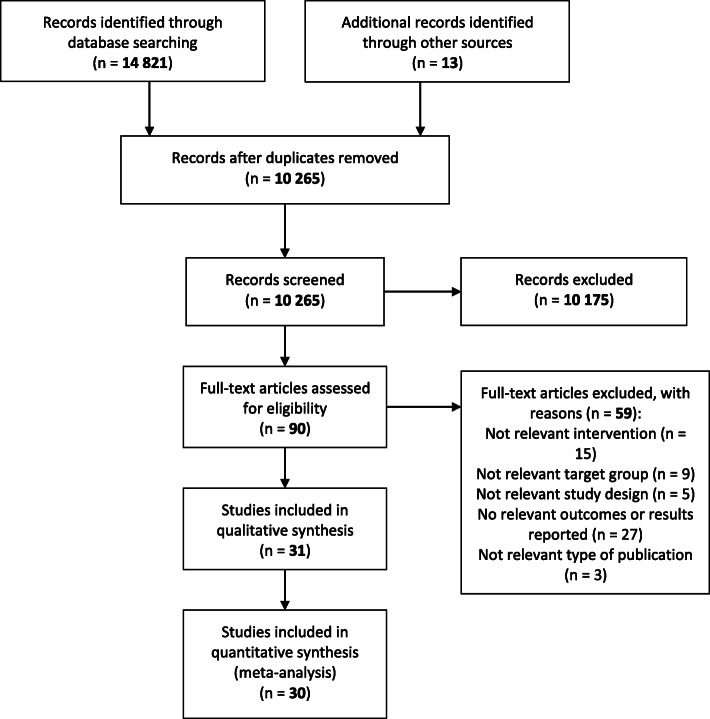
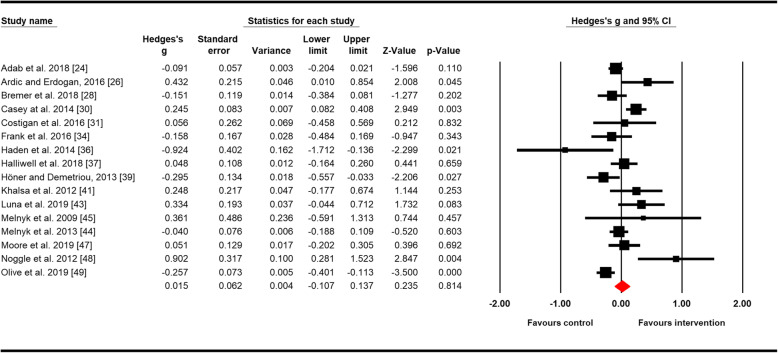
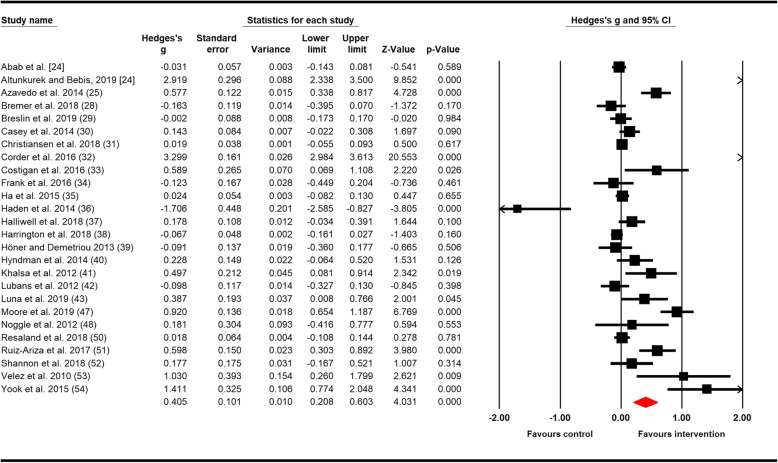
Background: Low levels of physical activity, sedentary behaviour and mental health problems are issues that have received considerable attention in the last decade. The aim of this systematic review and meta-analysis was to investigate effects of interventions targeting school-related physical activity or sedentary behaviour on mental health in children and adolescents and to identify the features of effective interventions. Methods: Scientific articles published between January 2009 and October 2019 fulfilling the following criteria were included: general populations of children and adolescents between age 4 and 19, all types of school-related efforts to promote physical activity or reduce sedentary behaviour. Study selection, data extraction and quality assessment were done by at least two authors independently of each other. Data were analysed with a random effects meta-analysis and by narrative moderator analyses. Results: The literature search resulted in 10265 unique articles. Thirty-one articles, describing 30 interventions, were finally included. Eleven relevant outcomes were identified: health-related quality of life, well-being, self-esteem and self-worth, resilience, positive effect, positive mental health, anxiety, depression, emotional problems, negative effect and internalising mental health problems. There was a significant beneficial effect of school-related physical activity interventions on resilience (Hedges’ g = 0.748, 95% CI = 0.326; 1.170, p = 0.001), positive mental health (Hedges’ g = 0.405, 95% CI = 0.208; 0.603, p = < 0.001), well-being (Hedges’ g = 0.877, 95% CI = 0.356; 1.398, p = < 0.001) and anxiety (Hedges’ g = 0.347, 95% CI = 0.072; 0.623, p = 0.013). Heterogeneity was moderate to high ( I 2 = 59–98%) between studies for all outcomes except positive effect, where heterogeneity was low ( I 2 = 2%). The narrative moderator analyses of outcomes based on 10 or more studies showed that age of the children moderated the effect of the intervention on internalising mental health problems. Interventions in younger children showed a significantly negative or no effect on internalising mental health problems while those in older children showed a significant positive or no effect. Moreover, studies with a high implementation reach showed a significant negative or no effect while those with a low level of implementation showed no or a positive effect. No signs of effect moderation were found for self-esteem, well-being or positive mental health. Risk of publication bias was evident for several outcomes, but adjustment did not change the results. Conclusions: School-related physical activity interventions may reduce anxiety, increase resilience, improve well-being and increase positive mental health in children and adolescents. Considering the positive effects of physical activity on health in general, these findings may reinforce school-based initiatives to increase physical activity. However, the studies show considerable heterogeneity. The results should therefore be interpreted with caution. Future studies should report on implementation factors and more clearly describe the activities of the control group and whether the activity is added to or replacing ordinary physical education lessons in order to aid interpretation of results. Trial registration: PROSPERO, CRD42018086757 .
Overview
The claims and statistics of this paper haven’t been checked yet.
Free: it reads the open-access text and checks the first 5 claims that cite a source we can check. Create a free account to check every claim.
Integrity signals
Registry
Cites
Statistics
Figures
Verification
Claims the paper makes
The claims and statistics of this paper haven’t been checked yet.
Free: it reads the open-access text and checks the first 5 claims that cite a source we can check. Create a free account to check every claim.
Claims other papers make about this one
Each is checked against this paper’s own text: does it say what the citing paper says it does?
The cited source says what the claim attributes to it.
In the citing paper
“Overlapping concepts and components found in mental health interventions conducted before the pandemic included: physical activity [57, 58], yoga [20], art [59, 60], psychoeducation, psychological counseling, and psychotherapeutic approaches (e.g. CBT) [20], which were also found in the included studies in our review focusing on the COVID-19 pandemic.”
Self-check
Percentages, sums and reported differences re-computed from the paper’s own numbers.
The self-check needs the paper’s full text.
Citations
Cites
Preferred Reporting Items for Systematic Reviews and Meta-Analyses: the PRISMA statement
Moher, D., Liberati, A., Tetzlaff, J., Altman, D. G., & for the PRISMA Group (2009) · BMJ · doi:10.1136/bmj.b2535 · Cited by 83,823
Preferred Reporting Items for Systematic Reviews and Meta-Analyses: The PRISMA Statement
Moher, D., Liberati, A., Tetzlaff, J., Altman, D. G., & The PRISMA Group (2009) · PLoS Medicine · doi:10.1371/journal.pmed.1000097 · Cited by 64,042 · cited 1×
“The aims of the systematic review were as follows: 1) To study the impact of school-related physical activity interventions or interventions to reduce sedentary behaviour on symptoms of mental health in terms of internalising mental health problems and positive mental health in children aged 4–19 years 2) To investiga…”
Measuring inconsistency in meta-analyses
Higgins, J. P. T., Thompson, S. G., Deeks, J. J., & Altman, D. G. (2003) · BMJ · doi:10.1136/bmj.327.7414.557 · Cited by 63,139
Preferred reporting items for systematic reviews and meta-analyses: the PRISMA Statement.
(2009) · PubMed Central · Cited by 44,859
Kessler, R. C., Berglund, P., Demler, O., Jin, R., Merikangas, K. R., & Walters, E. E. (2005) · Archives of General Psychiatry · doi:10.1001/archpsyc.62.6.593 · Cited by 20,391 · cited 1×
“Considering that the average age of onset for anxiety disorders is 11 years [60] and 11–13 years for depressive disorders [61], prevention effectiveness may vary depending on not only the type of intervention, but also the age or developmental stage of the child [7].”
BackgroundWang, G., Ma, R., Qiao, G., Wada, K., Aizawa, Y., & Satoh, T. (2015) · Integrative Medicine International · doi:10.1159/000368408 · Cited by 18,657
Borenstein, M., Hedges, L. V., Higgins, J. P. T., & Rothstein, H. R. (2009) · doi:10.1002/9780470743386 · Cited by 14,225
Borenstein, M., Hedges, L. V., Higgins, J. P. T., & Rothstein, H. R. (2021) · doi:10.1002/9781119558378 · Cited by 9,799
The Construct of Resilience: A Critical Evaluation and Guidelines for Future Work
Luthar, S. S., Cicchetti, D., & Becker, B. (2000) · Child Development · doi:10.1111/1467-8624.00164 · Cited by 9,381 · cited 1×
“adaptation within the context of significant adversity [65].”
BackgroundGlobal physical activity levels: surveillance progress, pitfalls, and prospects
Hallal, P. C., Andersen, L. B., Bull, F. C., Guthold, R., Haskell, W., & Ekelund, U. (2012) · The Lancet · doi:10.1016/s0140-6736(12)60646-1 · Cited by 5,711
Research works printed but not linked: 2
- World Health Organization. Global recommendations on physical activity for health; 5–17 years old. Geneva; 2010. 26180873
- Quality Assessment Tool For Quantitative Studies Effective Public Health Practice Project 1998
Cited by
Items 301–400 of 434
Østergaard, L. D., Fuglsang, E. B., Hannibal, J. L., Rasmussen, S. L., & Møller, S. K. (2022) · Forum for idræt · doi:10.7146/ffi.v37i1.130605 · Cited by 1
“…ikke kun har en positiv effekt på elevers fysiske sundhed (Yuksel, Şahin, Maksimovic, Drid, & Bianco, 2020), men også på deres mentale sundhed (Andermo et al., 2020), deres trivsel i skolen (Christiansen et al., 2018) og deres læring, bl.a. ved at deres koncentration forøges, deres kognitive…”
BackgroundIs exercising better for your Mental Health?Preprint
Desai, D. H., Shukla, A. A., & Desai, H. (2023) · medRxiv · doi:10.1101/2023.03.28.23287187
“Having said this the participants with younger age group (17-30) showed best improvement of 72.”
BackgroundПротас, М., Іващенко, О. В., & Кравчук, Т. М. (2023) · Journal of Learning Theory and Methodology · doi:10.17309/jltm.2023.2.02
Ganjeh, P. (2023) · eDiss (Georg-August-Universität Göttingen) · doi:10.53846/goediss-10106
(2023) · Emerald Group Publishing Limited eBooks · doi:10.1108/978-1-83753-908-620231011
Lise Öğrencilerinin Fiziksel Aktivite Düzeyleri ile İyilik Halleri Arasındaki İlişki
Kartal, E., & Yarım, İ. (2024) · The Online Journal of Recreation and Sport · doi:10.22282/tojras.1392878
Gonçalves, B. S. D. S., Alvarez, D. F., Correa, E. L. C., Dossi, G. C., Cucarolla, L. B., Saraiva, L. F. D. O., Milanezi, M. E. C., Zanchetta, M. A., Figueira, P. H. B., & Covizzi, U. D. S. (2024) · International Seven Journal of Health Research · doi:10.56238/isevjhv3n1-024
Lin, X. E. (2024) · Advances in Psychology · doi:10.12677/ap.2024.143143
Fysisk aktivitet i psykisk helsearbeid blant barn og unge: en narrativ litteraturstudie
Bratland‐Sanda, S. (2024) · Tidsskrift for psykisk helsearbeid · doi:10.18261/tph.21.2.4
Park, J.-H., Prochnow, T. M., Flores, S. A., Jackson, D., Patterson, M. S., & Meyer, M. R. U. (2024) · Child & Youth Services · doi:10.1080/0145935x.2024.2384093
“Convincing scientific evidence has been reported to support the benefits of participating in regular physical activity (PA) to improve children’s health (Andermo et al., 2020; Eddolls et al., 2017; Errisuriz et al., 2018).”
Yu, Y. (2024) · American Journal of Health Behavior · doi:10.5993/ajhb.48.3.11
ДЕРЖАВНА ПОЛІТИКА ДЛЯ ПОКРАЩЕННЯ ЗДОРОВ’Я ШКОЛЯРІВ У ПЕРІОД НАВЧАННЯ: СВІТОВИЙ ДОСВІД
Сливка, Є. М. (2024) · Derzhavne upravlinnya udoskonalennya ta rozvytok · doi:10.32702/2307-2156.2024.9.20
Efstratopoulou, M., Habeeb, H., Abdulla, J. O., & Shen, D. (2024) · Advances in educational marketing, administration, and leadership book series · doi:10.4018/979-8-3693-5325-7.ch005
Bai, D., Hashim, A. H. M., Chen, Z., & Xu, M. (2024) · Retos · doi:10.47197/retos.v62.109473
“Several other studies indicate that PA is associated with lower levels of depressive symptoms in adolescents (Andermo et al., 2020; Gu, 2022; Wang & Peiper, 2022; Wang et al., 2022).”
BackgroundEFFECTS OF PILATES EXERCISES ON BALANCE AND GAIT IN SCHOOL GOING CHILDREN
Arshad, K., Anwar, S., Nadir, F., Tariq, S., Maqbool, A., Khalid, R., Fatima, M., & Shahid, N. (2024) · Insights-Journal of Health and Rehabilitation · doi:10.71000/hts0st59
Intervenciones psicosociales en la mejora del bienestar mental de los profesionales de la salud
Palacios-Guillen, A., & Novillo-Montoya, C. E. (2025) · 593 Digital Publisher CEIT · doi:10.33386/593dp.2025.1.2836
Lautenbach, F., Dreiskämper, D., Halberschmidt, B., & Leisterer, S. (2025) · Journal of Applied Sport and Exercise Psychology · doi:10.1026/2941-7597/a000041
Galan, Y. (2025) · Physical Culture and Sport Scientific Perspective · doi:10.31891/pcs.2025.1(1).38
Diana, D., Sunardi, S., Jawad, G., & Yusuf, M. (2024) · International Journal of Special Education and Information Technologies · doi:10.18844/jeset.v10i1.9474
Мандюк, А., Павлова, Ю., & Rymar, O. (2025) · Scientific Journal of National Pedagogical Dragomanov University Series 15 Scientific and pedagogical problems of physical culture (physical culture and sports) · doi:10.31392/udu-nc.series15.2025.05k(191).27 · Cited by 2
Lian, J. (2025) · Scientific Journal Of Humanities and Social Sciences · doi:10.54691/whv8zj02
Unravelling the roadblocks and pathways to adolescents’ physical activity
Alexandrou, C., Lindqvist, A.-K., Wieslander, H., & Rutberg, S. (2025) · International Journal of Qualitative Studies on Health and Well-Being · doi:10.1080/17482631.2025.2524270
“This is also in line with previous reports where the important role of schools is brought up (Andermo et al., 2020; van Sluijs Emf et al., 2021; World Health Organization, 2022).”
Pickard, A., Alving‐Jessep, E., Delivett, C. P., Jenkins, R. H., Pullar, L., Farrow, C. V., & Blissett, J. M. (2025) · Nutrition Reviews · doi:10.1093/nutrit/nuaf092 · Cited by 1
McDiarmid, K. P., Clinton‐McHarg, T., O’Brien, K. M., Bartlem, K. M., Wolfenden, L., Blowes, A., Kühne, C., Lee, D. C. W., & Hodder, R. K. (2025) · medRxiv · doi:10.1101/2025.07.10.25331240
Ding, P., & Ping, W. S. (2025) · International Journal of Academic Research in Business and Social Sciences · doi:10.6007/ijarbss/v15-i7/25974
Lian, J. (2025) · Advances in Engineering Technology Research · doi:10.56028/aetr.14.1.912.2025
Davis, A., Gross, S., McEntyre, K., Biber, D., & Meyer, A. M. (2025) · Women in Sport and Physical Activity Journal · doi:10.1123/wspaj.2025-0030
Why Should Kids Move at School?
Brush, C. J., Merica, C. B., Orendorff, K. L., Knudson, K., Klein, L. M., & Egan, C. A. (2025) · Frontiers for Young Minds · doi:10.3389/frym.2025.1492450
Liu, C., Yang, Y., Arbour‐Nicitopoulos, K. P., Ho, R., Cheung, J. S.-T., Leung, A., & Sit, C. H. P. (2025) · Journal of Autism and Developmental Disorders · doi:10.1007/s10803-025-07052-y
Li, X., Zhao, G., & Li, R. (2025) · Research Square · doi:10.21203/rs.3.rs-7577961/v1
Holistically healthy humans: championing mental and physical wellbeing in education
Jayman, M., Rose, A., Glazzard, J., & Quickfall, A. (2025) · Frontiers research topics · doi:10.3389/978-2-8325-7179-8
Larsson, R., Ljung, E., Josefsson, S., & Ljung, T. (2024) · Figshare · doi:10.6084/m9.figshare.26708984
Cripps, H. (2025) · doi:10.11575/prism49124 · Cited by 1
Andermo, S., Lidin, M., Hellenius, M.-L., Nordenfelt, A., & Nyberg, G. (2020) · Figshare · doi:10.6084/m9.figshare.13467563
Self-citationPoulos, A., Wilson, K., Schulke, M., Nam, K., Ohri‐Vachaspati, P., Bai, Y., & Kulinna, P. H. (2024) · Figshare · doi:10.6084/m9.figshare.26669457
Jacobs, J., Strugnell, C., Allender, S., Orellana, L., Backholer, K., Bolton, D. K., Fraser, P., Le, H., Brown, A. D., & Nichols, M. (2021) · Figshare · doi:10.6084/m9.figshare.17087836
Einsamkeit bei Kindern und Jugendlichen im Kontext Schule
Schütz, R., & Bilz, L. (2024)
Ericsson, F., & Öhman, B. (2023) · DiVA (Linnaeus University)
La Educación Física para la prevención de la obesidad infantil: propuesta didáctica de intervención
Uriarte de la Fuente, L. (2024) · UVaDOC UVaDOC University of Valladolid Documentary Repository (University of Valladolid)
Terpautisk träning med syfte att främja barns psykiska hälsa : en litteraturöversikt
Holm, L. (2025) · Theseus (Ammattikorkeakoulujen)
Barn och ungdomars psykiska hälsa i skolan : En kvalitativ intervjustudie
Ramstedt, E., & Holm Sundqvist, E. (2023) · DiVA (Linnaeus University)
Liikunnan ja sukupuolen yhteys mielenterveyteen kouluikäisillä lapsilla ja nuorilla
Brilli, M. (2025) · Jyväskylä University Digital Archive (University of Jyväskylä)
Ahmad chaeroni (2021) · Repository at Universitas Pendidikan Indonesia (Universitas Pendidikan Indonesia) · Cited by 1
Kokko, L., & Niskasaari, S. (2025) · Theseus (Ammattikorkeakoulujen)
STUDI DESKRIPTIF PERBEDAAN KESEHATAN MENTAL SISWA-SISWI ATLET DAN NON-ATLET SMAN 10 BANDUNG
Muthia, D. S. (2024) · Repository at Universitas Pendidikan Indonesia (Universitas Pendidikan Indonesia)
Participation in Physical Education and the Effect on Mental Health
O'Connor, K. (2021) · NWCommons (Northwestern College - Iowa) · Cited by 2
Valmentajan käsityksiä roolistaan hyvinvoinnin edistäjänä
Vuorenmaa, E. (2023) · Osuva (University of Vaasa)
Chattha, H. (2023) · Brock University Digital Repository (Brock University)
Sánchez-García, C. (2025) · Repositorio Institucional de la Universidad de Málaga (University of Málaga)
Fyysisen aktiivisuuden yhteys lasten ja nuorten mielenterveyteen
Kiviniemi, A. (2024) · Jyväskylä University Digital Archive (University of Jyväskylä)
Schöch, K. (2021) · Digital Library of the University of Innsbruck (University of Innsbruck)
Bruhn, L. (2023) · KTH Publication Database DiVA (KTH Royal Institute of Technology)
Lifelong influence of sports and physical activity
(2025) · Frontiers research topics · doi:10.3389/978-2-8325-6371-7
Vourdoumpa, A., Paltoglou, G., Manou, M., Koutaki, D., Kassari, P., Papadopoulou, M., Kolaitis, G. A., & Charmandari, E. (2026) · Nutrients · doi:10.3390/nu18010150
MacMillan, P., Yunus, F. M., Rogers, M., Jiang, Y., Climie, E. A., Mah, J. W. T., & Corkum, P. V. (2026) · Children · doi:10.3390/children13010082
“…factors that are known to be particularly important for the mental health of children with ADHD, such as consistent routines and physical activity levels [33], with emerging research showing that physical activity has a strong relationship with mental health in children [34] and adolescents [35].”
Linking physical activity and mental health: Meta analysis of school-based interventions in children
Prasad, D., Chinnaswamy, V., Manoranjan, D., Madhana, B., Kumar, R., & Singla, A. (2025) · Multidisciplinary Reviews · doi:10.31893/multirev.2025ss0422
“Andermo et al. (2020) investigated the characteristics of successful programs as well as the impact of educational exercise or sedentary behavioral changes on children's and teenagers' mental health.”
Relationship Between Emotional Wellbeing and Physical Activity of Primary School Children
Augūnaitė, R., Pekeliūnaitė, S., Mackelaitė, A., Gruodytė-Račienė, R., & Rutkauskaitė, R. (2025) · Laisvalaikio tyrimai · doi:10.33607/elt.v2i26.1761
Kyriakides, E., Tsangaridou, N., Charalambous, C. Y., & Kyriakides, L. E. (2026) · Journal of Teaching in Physical Education · doi:10.1123/jtpe.2025-0018
Wahyudin, Amin, A. N., Samsiana, Ismaniar, N. I., & Muhammadong (2025) · PROFICIO · doi:10.36728/jpf.v7i1.5867
Enacting Fitness Education by involving students in Assessment for Learning and Technology use
da Silva, A. M. C. (2026) · Portuguese National Funding Agency for Science, Research and Technology (RCAAP Project by FCT)
Vancampfort, D., Mugisha, J., Ward, P. B., & Damme, T. V. (2026) · Journal of Child & Adolescent Trauma · doi:10.1007/s40653-025-00811-0 · Cited by 1
“Furthermore, there is evidence that school-based physical activity enhances children’s physical, emotional, social, and cognitive development, and reduces antisocial behavior-(Andermo et al., 2020).”
Kim, J., & Dongwoo, L. (2025) · IJASS(International Journal of Applied Sports Sciences) · doi:10.24985/ijass.2025.37.2.188
Mugisha, J., Ward, P. B., Kwiringira, J. N., & Vancampfort, D. (2026) · Mental health and physical activity · doi:10.1016/j.mhpa.2026.100764
Liu, J., Zhao, Y., Ren, X., Wang, B., Chen, Y., & Tang, C. (2026) · BMC Psychology · doi:10.1186/s40359-026-04156-7
“Schools offer an equitable platform to reach nearly all adolescents, but recent evaluations show that many school-based physical activity programmes yield only small or inconsistent improvements in mental health and fitness, highlighting the need for more effective and sustainable models [14].”
Hartwig, T. W., da Cunha, G. D. O. K., & Bergmann, G. G. (2026) · Journal of Physical Activity and Health · doi:10.1123/jpah.2025-0668
Effectiveness of a family–school–community collaborative physical activity intervention
KONG, L., Chen, X., Gong, B., Zhang, X., & Guo, M. (2026) · Frontiers in Public Health · doi:10.3389/fpubh.2026.1767961
Salin, E. (2025) · Tampere University Institutional Repository (Tampere University)
O’Rourke, B. (2021) · TSpace (University of Toronto)
Fan, X., Ha, T., Xu, X., & Kim, J. (2026) · Quest · doi:10.1080/00336297.2026.2645088
Caballero-Cerbán, M., Morillo-Baro, J. P., Reigal, R. E., Hernández-Mendo, A., & Morales‐Sánchez, V. (2026) · Apunts Educación Física y Deportes · doi:10.5672/apunts.2014-0983.es.2026.164.04
Durlević, M., & Durlević, S. (2025) · Sport — nauka i praksa = Sport — Science And Practice · doi:10.5937/snp15-1-63937
Vella, L., Silva, C. D., Carl, J., Crotti, M., Barnett, L. M., & Duncan, M. J. (2026) · International Review of Sport and Exercise Psychology · doi:10.1080/1750984x.2026.2645901
Bergenheim, A., Bornhöft, L., & Larsson, A. (2026) · European Journal of Physiotherapy · doi:10.1080/21679169.2026.2663843
Rama, A., Lofandri, W., & Fuad, S. M. (2025) · Journal of Counseling Education and Society · doi:10.29210/08jces677700
A Systematic Review of Socioemotional Learning Interventions for Children and AdolescentsPreprint
Njenga, S., Dzoro, E., Ogari, W., Wanami, M., Khamis, A., Mwanzu, A., & Abubakar, A. A. (2026) · Research Square · doi:10.21203/rs.3.rs-9220595/v1
The Effects of Family Sports on Mental Health in Children and Adolescents: A Meta-Analysis
Peng, S., Li, C., Wang, J., & Wang, S. (2026) · Behavioral Sciences · doi:10.3390/bs16050776
L’uso delle Pause Attive nella scuola primaria: una prima analisi sulle percezioni degli insegnanti
Marca, A. L., & Falzone, Y. (2026) · Nova Science Publishers (Nova Science Publishers, Inc.)
Haeril, H., Mbaydeen, M., & MUKHAMMADIEVNA, A. R. (2026) · Multidisciplinary Journal of Tourism, Hospitality, Sport and Physical Education · doi:10.37251/jthpe.v2i2.3181
“This result is in line with the study conducted by Andermo [32], which found that the implementation of School Health Program in Indonesian secondary schools was mostly categorized as “adequate” because teachers were active in educational activities but still weak in preventive and managerial…”
Moloney, S., Hajmohammadi, H., Wood, H. E., Mead, M. I., Mudway, I., Mosler, G., Thomson, A. C., Calvo, I. G., Scales, J., & Whitehouse, A. (2026) · medRxiv · doi:10.64898/2026.05.28.26353607
Effect of screen time and physical activity on the mental health of students
Azim, W. Q., & Indahwati, N. (2026) · Citius Jurnal Pendidikan Jasmani Olahraga dan Kesehatan · doi:10.32665/citius.v6i1.6504
“Sufficient physical activity not only helps prevent the risk of obesity but also influences reductions in stress, anxiety, and depression (Andermo et al., 2020).”
Bertills, K., Johansson, D., & Augustine, L. (2026) · Frontiers in Sports and Active Living · doi:10.3389/fspor.2026.1736134
“A meta-analysis of school-based interventions shows positive effects on some aspects of wellbeing but calls for improved reports on the implementation front (16).”
Shao, Q., Zhang, X., LI, X., & Wang, J. (2026) · Frontiers in Public Health · doi:10.3389/fpubh.2026.1878144
“School-based intervention evidence also shows promise, but not every intervention improves all psychological end-points to the same degree (8).”
Tammisto-Rohtla, L. (2026) · DSpace repository (University of Tartu)
Wang, H., & Jo, W.-Y. (2026) · Behavioral Sciences · doi:10.3390/bs16071192
“School-related intervention reviews likewise show heterogeneity across program designs and outcomes (Andermo et al., 2020).”
Cardoso, G. C. D. A., da Costa, R. M., da Costa, B. G. G., Guerra, P. H., Mota, J. A. P. S., & Autran, R. (2026) · Cadernos de Saúde Pública · doi:10.1590/0102-311xen181324
Rahman, L. (2026) · Advances in Physical Education · doi:10.4236/ape.2026.163005
Majed, E. Z., O’Rourke, R. H., O’Loughlin, E. K., Wellman, R. J., & O’Loughlin, J. L. (2026) · American Journal of Health Promotion · doi:10.1177/08901171261473005
Grygus, I. M., Ярмак, О. М., Dotsyuk, L., & Kushnir, I. G. (2026) · Реабілітаційні та фізкультурно-рекреаційні аспекти розвитку людини (Rehabilitation & recreation) · doi:10.67034/2786-8354.2026.20.2.12
Paloposki, V. (2026) · Jyväskylä University Digital Archive (University of Jyväskylä)
MARTÍNEZ-SÁNCHEZ, S. M. (2021) · RIO (Universidad Pablo de Olavide)
Varhaisen erikoistumisen yhteys aikuisiän fyysiseen aktiivisuuteen
Tuominen, V. (2026) · Jyväskylä University Digital Archive (University of Jyväskylä)
Hodder, R. K., Wrigley, J., Ainsworth, E., McDiarmid, K. P., O’Brien, K. M., Nathan, N., Bartlem, K. M., Groombridge, D., & Clinton‐McHarg, T. (2026) · Australian and New Zealand Journal of Public Health · doi:10.1016/j.anzjph.2026.100580
Paterson, J., McCarthy, M., Triantafyllopoulou, P., & Murphy, G. H. (2026) · Journal of Research in Special Educational Needs · doi:10.1111/1471-3802.70153
Asociación entre actividad física y clima escolar en adolescentes españoles
Miguel, G. F. (2026) · Academica-e (Universidad Pública de Navarra)
Ramírez-Espejo, P., Solas-Martínez, J. L., la Torre‐Cruz, M. J. D., & Ruiz‐Ariza, A. (2026) · Healthcare · doi:10.3390/healthcare14162625
“…school day, when adolescents spend long hours seated [47], incorporating active breaks, physically active lessons, or structured recess not only contributes to the movement necessary for health but also improves classroom emotional climate and encourages more cooperative peer relationships [48–50].”
Hyde, C., Fuelscher, I. T., Rosch, K. S., Seymour, K. E., Crocetti, D., Silk, T. J., Singh, M., & Mostofsky, S. H. (2026) · NeuroImage Clinical · doi:10.1016/j.nicl.2026.104053
“There is already some evidence from earlier work that physical activity interventions in school-age children may improve internalizing symptoms (e.g. Andermo et al., 2020 for a review).”
Atividade física, saúde mental e desempenho acadêmico em adolescentes
Silva, R. G., Silva, L. F., & Carvalho, T. B. (2026) · Congresso de Educação Física de Volta Redonda · doi:10.47385/cedvr.2778.7.2026
Metadata
- Authors
- Andermo, S., Hallgren, M., Nguyen, T.-T.-D., Jonsson, S., Petersen, S., Friberg, M., Romqvist, A., Stubbs, B., & Elinder, L. S.
- Affiliations
- Karolinska Institutet (SE)
- Region Stockholm (SE)
- Public Health Agency of Sweden (SE)
- National Health Service (GB)
- Corresponding author
- Andermo, Susanne
- Venue
- Sports Medicine - Open
- Published
- 2020-06-16
- Volume
- 6
- Issue
- 1
- Pages
- 25-25
- ISSN
- 2198-9761 (ISSN-L)
- 2199-1170
- PMC
- PMC7297899
- OpenAlex
- W3035372294
- Semantic Scholar
- 16a10205c4caa9265c5f507ef1c059e34f8a2f14
- Cited by
- 336
- References
- 70
- Citations by year
- 2026: 58 · 2025: 82 · 2024: 77 · 2023: 50 · 2022: 40 · 2021: 22 · 2020: 7
- FWCI
- 3.79
- Type
- journal article
- Language
- en
- Open access
- gold
- doi.org
- Licence
- cc-by
- creativecommons.org/licenses/by/4.0 (tdm)
- creativecommons.org/licenses/by/4.0 (vor)
- Locations
- Sports Medicine - Open (publishedVersion, cc-by)
- PubMed Central (publishedVersion, cc-by)
- PubMed (publishedVersion)
- DiVA at Umeå University (Umeå University) (submittedVersion, other-oa)
- Figshare (submittedVersion, cc-by)
- Research Portal (King's College London) (submittedVersion, other-oa)
- Funders
- Folkhälsomyndigheten (04287-2017, 05031-2018)
- Topics
- Health Sciences › Medicine › Public Health, Environmental and Occupational Health › Physical Activity and Health
- Health Sciences › Medicine › Public Health, Environmental and Occupational Health › School Health and Nursing Education
- Health Sciences › Medicine › Public Health, Environmental and Occupational Health › Obesity, Physical Activity, Diet
- Keywords
- school-based physical activity intervention, sedentary behavior, child mental health, adolescents, resilience, positive mental health, well-being, anxiety, depression, internalizing problems, health-related quality of life, self-esteem, intervention duration, intervention intensity, school health promotion, physical activity promotion, sedentary behavior reduction, socioemotional skills
About these checks
Registry, retraction, Cites and statistics results are computed, not judged, with one exception: a printed reference that no index lists is read once by a model before it counts as a citation error. Claims are extracted by a model and kept only when their quote appears verbatim in the text; each cited source is then checked, with a model’s help, for whether it says what the claim relies on. Those verdicts can be wrong — read the claim’s quote and the cited source before relying on one.
Statistics and arithmetic are recomputed, not judged.
Confidence bands are shown only for fields calibrated on our annotated test set. None is calibrated yet, so no band is shown.
What counts as a claim ›How we measure confidence ›How we check this ›
Are you an author, or do you see a problem with this page? Request a review
Data sources
Bibliographic data: Semantic Scholar, OpenAlex, Crossref.
Contains information from the Semantic Scholar Academic Graph Datasets, made available under the ODC Attribution License (ODC-BY 1.0).
Semantic Scholar’s data is described in: Kinney, R., et al. (2023). The Semantic Scholar Open Data Platform. arXiv:2301.10140.
