

Mindfulness-based stress reduction adapted to pregnant women with psychosocial vulnerabilities—a protocol for a randomized feasibility study in a Danish hospital-based outpatient setting
Open accessThe DOI matches its Crossref record; 41 of the 42 references it cites were found in a registry or an index; 27 of the 42 sources its claims cite were checked for support.
Abstract
Background: This protocol is for a feasibility study of a mindfulness-based stress reduction (MBSR) program adapted for pregnant women with psychosocial vulnerabilities. The rationale for the study is the need for a wider array of evidence-based options to address prenatal mental health care needs in pregnant women. MBSR is a promising mental health intervention but has not yet been adapted for pregnant women with the aim of addressing prenatal mental health. The purpose is thus to evaluate the feasibility, acceptability, and clinical outcomes of an adapted MBSR program, prenatal MBSR, compared to usual care to inform a randomized controlled trial. Methods/design: Pregnant women (n = 60) referred to an outpatient clinic at Copenhagen University Hospital, Amager and Hvidovre, Denmark, will be recruited for the study. The design is a single-center feasibility trial, with prenatal MBSR, as an add-on to usual care. The primary outcome is to assess the feasibility of a full-scale randomized controlled trial. The secondary feasibility outcome includes possible effects of the adapted MBSR program estimated by self-report questionnaires measuring stress, anxiety, depression, well-being, decentering, reflective functioning, mindfulness, and compassion. Participants will be randomized in a 1:1 ratio to prenatal MBSR or usual care. Discussion: The study is part of the Good Start to Family Life study anchored at Copenhagen University Hospital, Amager and Hvidovre, Denmark. Teaching the skills of mindfulness meditation to a psychosocially vulnerable group of pregnant women could prove a viable and non-pharmacological approach to reduce stress, improve mental health, and provide support in the transition to parenthood. The outcomes of the feasibility study will inform the design of a fully powered randomized controlled trial. Trial registration: ClinicalTrials.gov, NCT04571190. Registered on September 30, 2020 © 2021, The Author(s).
Overview
CoChat Summary
## TL;DR
This paper is a protocol for a single-center randomized feasibility trial testing a prenatal mindfulness-based stress reduction (MBSR) program adapted for psychosocially vulnerable pregnant women in Denmark. It aims to assess feasibility and acceptability, and to explore potential effects on self-reported mental health and related outcomes before a full randomized controlled trial.
## Key findings
- The planned study will recruit 60 pregnant women referred to an outpatient clinic at Copenhagen University Hospital, Amager and Hvidovre, and randomize them 1:1 to prenatal MBSR plus usual care or usual care alone.
- The primary outcome is feasibility of a full-scale randomized controlled trial, including recruitment rate, acceptance of allocated interventions, compliance defined as attending ≥ 5 sessions, non-completion, and adverse events.
- Secondary outcomes are self-reported measures of stress, anxiety, depression, well-being, decentering, reflective functioning, mindfulness, and compassion; outcomes will be collected at baseline, immediately after the program, and 3 months post-completion.
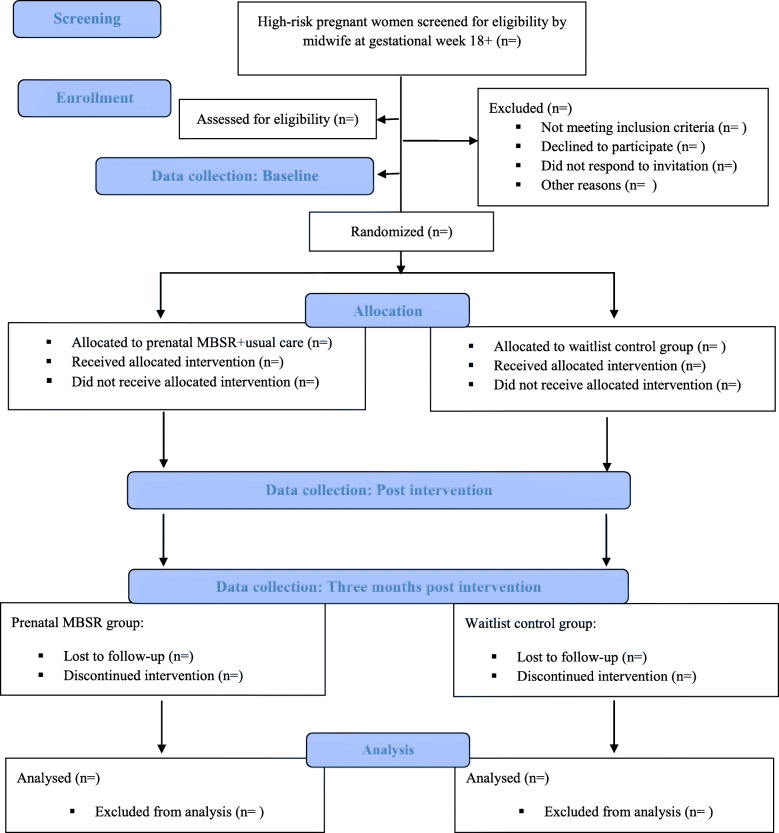
- The adapted program consists of nine 2-hour sessions, with reduced 15-minute daily practice, no full-day session, and a mix of physical attendance (sessions 1, 4, and 9) and online delivery.
## Methods
- Randomized, single-center feasibility trial in a hospital-based outpatient antenatal clinic in Denmark; participants are pregnant women with psychosocial vulnerabilities referred for reasons including mental disorders, substance abuse, domestic violence, or sexual abuse history.
- Planned sample size is n = 60; inclusion requires estimated due date at least 3 months from intervention start, age 18+, Danish language proficiency, availability for group sessions, and written informed consent; exclusions include concurrent substance abuse, psychotic disorders, PTSD, and suicidality.
- Main analysis is descriptive and comparative: recruitment/retention will be reported as percentages, acceptability will be assessed by attendance/home practice/dropout, and possible effects will be analyzed under intention-to-treat with effect estimates and 95% CIs; independent t-tests or Mann-Whitney U tests are planned, with logistic regression for skewed baseline variables.
## Limitations
- The paper states that the study is not powered for formal hypothesis testing, so it will not provide definitive efficacy evidence; only feasibility metrics and effect estimates will be presented.
- As a feasibility protocol, the paper does not yet report outcomes from the trial itself; this is inherent to the study stage and is evident from the text.
- Participants cannot be blinded, and the paper notes this may introduce difficulties such as resentful demoralization; group affiliation is concealed only for the statistical analyst.
Model-written summary. Check it against the paper before relying on it.
Integrity signals
Registry
Cites
Statistics
Figures
Verification
Claims the paper makes
18 Valid · 1 Not valid · 12 Not checked · 11 Own results and interpretations
The cited sources support only part of this claim — read each source’s verdict below.
In the paper
“Mindfulness-based interventions are promising non-pharmacological interventions for mental disorders or symptoms, and performance has been found to be equivalent to evidence-based treatments, such as cognitive behavioral therapy and antidepressant medication for some disorders [1, 2].”
§ Mindfulness-based stress reduction adapted to pregnant women with psychosocial vulnerabilities—a protocol for a randomized feasibility study in a Danish hospital-based outpatient setting > Background
What the sources say
- Supportedcites [1] Goldberg SB Tucker RP Greene PA Davidson RJ Wampold BE Kearney DJ Simpson TL Mindfulness-based interventions for psychiatric disorders: a systematic review and meta-analysis Clin Psychol Rev 2018 59 52 60 10.1016/j.cpr.2017.10.011 29126747 PMC5741505 source
The Discussion states that mindfulness-based interventions were, on average, not different from first-line evidence-based therapies, including cognitive behavioral therapy and antidepressant medications. It also reports equivalence to evidence-based treatments for depression and anxiety. The Results report no overall difference from evidence-based treatments at post-treatment. (LLM, conf=0.93)
- Partly supportedcites [2] Kuyken W Warren FC Taylor RS Whalley B Crane C Bondolfi G Hayes R Huijbers M Ma H Schweizer S Segal Z Speckens A Teasdale JD van Heeringen K Williams M Byford S Byng R Dalgleish T Efficacy of mindfulness-based cognitive therapy in prevention of depressive relapse: an individual patient data meta-analysis from randomized trials JAMA Psychiatry 2016 73 6 565 574 10.1001/jamapsychiatry.2016.0076 27119968 PMC6640038 sourceExperimental — accuracy not yet measured
The Discussion (Conclusions; page not provided) says MBCT’s protective effects against depressive relapse are comparable with those of cognitive therapy. The Results (page not provided) report a lower relapse risk with MBCT than with antidepressant medication, not equivalent performance. The paper addresses MBCT for relapse prevention in recurrent depression, not mindfulness-based interventions across multiple disorders, and does not report a direct comparison with cognitive behavioral therapy. (LLM, conf=0.88)
plain- Asserted: passes — The authors put it forward as true.
- Checkable: passes — It can be checked against evidence.
- Load-bearing: passes — The paper’s conclusions depend on it.
- Based: passes — The paper gives a reason why it holds.
- Supported
The cited sources support only part of this claim — read each source’s verdict below.
In the paper
“Moreover, it is an acceptable intervention for pregnant women [3].”
§ Mindfulness-based stress reduction adapted to pregnant women with psychosocial vulnerabilities—a protocol for a randomized feasibility study in a Danish hospital-based outpatient setting > Background
What the sources say
- Partly supportedcites [3] Shi Z MacBeth A The effectiveness of mindfulness-based interventions on maternal perinatal mental health outcomes: a systematic review Mindfulness (N Y) 2017 8 4 823 847 10.1007/s12671-016-0673-y 28757900 PMC5506176 sourceExperimental — accuracy not yet measured
The Discussion concludes that mindfulness-based interventions are “likely to be acceptable to women in pregnancy.” The citing sentence presents acceptability as established rather than as the review’s qualified conclusion. (LLM, conf=0.83)
plain- Asserted: passes — The authors put it forward as true.
- Checkable: passes — It can be checked against evidence.
- Load-bearing: passes — The paper’s conclusions depend on it.
- Based: passes — The paper gives a reason why it holds.
- Partly supported
Every source the paper cites for this claim was checked and supports it.
In the paper
“This measure may serve as an early indicator of mother-child interaction [21].”
§ Mindfulness-based stress reduction adapted to pregnant women with psychosocial vulnerabilities—a protocol for a randomized feasibility study in a Danish hospital-based outpatient setting > Background
What the sources say
- Supportedcites [21] Sharp C, Fonagy P. The parent’s capacity to treat the child as a psychological agent: constructs, measures and implications for developmental psychopathology. Soc Dev. 2008;17. source
The maternal mind-mindedness section (p. 744) reports that higher reflective functioning is associated with greater parental mind-mindedness, a measure of parent–child interaction. The reflective-function section also reports that prenatal reflective functioning predicted later parent–infant attachment. Together, these findings support the hedged claim that it may serve as an early indicator of mother–child interaction. (LLM, conf=0.86)
hedgedstates an association- Asserted: passes — The authors put it forward as true.
- Checkable: passes — It can be checked against evidence.
- Load-bearing: passes — The paper’s conclusions depend on it.
- Based: passes — The paper gives a reason why it holds.
- Supported
The cited sources support only part of this claim — read each source’s verdict below.
In the paper
“Mindfulness-based interventions are promising non-pharmacological interventions for mental disorders or symptoms, and performance has been found to be equivalent to evidence-based treatments, such as cognitive behavioral therapy and antidepressant medication for some disorders [1, 2].”
§ Mindfulness-based stress reduction adapted to pregnant women with psychosocial vulnerabilities—a protocol for a randomized feasibility study in a Danish hospital-based outpatient setting > Background
What the sources say
- Supportedcites [1] Goldberg SB Tucker RP Greene PA Davidson RJ Wampold BE Kearney DJ Simpson TL Mindfulness-based interventions for psychiatric disorders: a systematic review and meta-analysis Clin Psychol Rev 2018 59 52 60 10.1016/j.cpr.2017.10.011 29126747 PMC5741505 source
The Abstract says mindfulness-based interventions hold promise as evidence-based treatments for clinical populations with psychiatric symptoms. The Discussion also reports that they were, on average, not different from first-line treatments such as cognitive behavioral therapy and antidepressant medications, while noting that evidence varies by disorder. (LLM, conf=0.93)
- Partly supportedcites [2] Kuyken W Warren FC Taylor RS Whalley B Crane C Bondolfi G Hayes R Huijbers M Ma H Schweizer S Segal Z Speckens A Teasdale JD van Heeringen K Williams M Byford S Byng R Dalgleish T Efficacy of mindfulness-based cognitive therapy in prevention of depressive relapse: an individual patient data meta-analysis from randomized trials JAMA Psychiatry 2016 73 6 565 574 10.1001/jamapsychiatry.2016.0076 27119968 PMC6640038 sourceExperimental — accuracy not yet measured
The Abstract’s Conclusions and Relevance (page not available) describe mindfulness-based cognitive therapy as efficacious for preventing relapse in recurrent depression, supporting its promise as a nonpharmacological intervention. The paper does not establish that mindfulness-based interventions generally are promising across mental disorders or symptoms; its finding is limited to this therapy and condition. (LLM, conf=0.88)
plain- Asserted: passes — The authors put it forward as true.
- Checkable: passes — It can be checked against evidence.
- Load-bearing: passes — The paper’s conclusions depend on it.
- Based: passes — The paper gives a reason why it holds.
- Supported
Every source the paper cites for this claim was checked and supports it.
In the paper
“By training the capacity of becoming aware of one’s own mental state and developing a relationship with it can contribute to process suffering and ultimately improve mental health [11, 12].”
§ Mindfulness-based stress reduction adapted to pregnant women with psychosocial vulnerabilities—a protocol for a randomized feasibility study in a Danish hospital-based outpatient setting > Background
What the sources say
- Supportedcites [11] Vago DR Silbersweig DA Self-awareness, self-regulation, and self-transcendence (S-ART): a framework for understanding the neurobiological mechanisms of mindfulness Front Hum Neurosci 2012 6 296 10.3389/fnhum.2012.00296 23112770 PMC3480633 source
The Conclusions section describes mindfulness training as developing awareness of the conditions shaping one’s internal experience and proposes that meditation supports a sustainable healthy mind by reducing maladaptive emotions and cognitions. It also describes the framework as a way mindfulness functions to reduce suffering. The claim is a fair paraphrase of that proposed process, rather than a claim of a demonstrated clinical outcome. (LLM, conf=0.90)
- Supportedcites [12] Wielgosz J Goldberg SB Kral TRA Dunne JD Davidson RJ Mindfulness meditation and psychopathology Annu Rev Clin Psychol 2019 15 1 285 316 10.1146/annurev-clinpsy-021815-093423 30525995 PMC6597263 source
The Introduction sections on Targeting Core Capacities and Development Through Structured Training describe learning to notice mental states and adopt a curious, nonjudging stance toward experience. The Introduction links these capacities to mental health treatment, and the Pain section reports reduced distress and improved quality of life after mindfulness training. The claim’s tentative wording is consistent with the review; page numbers were not available in our copy. (LLM, conf=0.87)
plainstates a possible cause- Asserted: passes — The authors put it forward as true.
- Checkable: passes — It can be checked against evidence.
- Load-bearing: passes — The paper’s conclusions depend on it.
- Based: passes — The paper gives a reason why it holds.
- Supported
12 more claims · 6 with their cited sources checked
Create a free account to see all 42 claims and to verify the 1 reference still open.
- It may state two separate claims as one. 8
- Probably not a substantial claim. 21
Citations
Cites
Harris, P. A., Taylor, R., Thielke, R., Payne, J., Gonzalez, N., & Conde, J. G. (2009) · Journal of Biomedical Informatics · doi:10.1016/j.jbi.2008.08.010 · Cited by 51,384 · cited 1×
“REDCap is a secure, web-based application designed to support data capture for research studies [39].”
BackgroundA Global Measure of Perceived Stress
Cohen, S., Kamarck, T., & Mermelstein, R. (1983) · Journal of Health and Social Behavior · doi:10.2307/2136404 · Cited by 32,807
Lovibond, P. F., & Lovibond, S. H. (1995) · Behaviour Research and Therapy · doi:10.1016/0005-7967(94)00075-u · Cited by 14,523 · cited 3×
“The Depression Anxiety Stress Scales (DASS-21) [30] has three subscales designed to discriminate between depression, anxiety, and stress in the last week.”
BackgroundDetection of Postnatal Depression: Development of the 10-item Edinburgh Postnatal Depression Scale
Cox, J. L., Holden, J. M., & Sagovsky, R. (1987) · British Journal of Psychiatry · doi:10.1192/bjp.150.6.782 · Cited by 14,183 · cited 1×
“The Edinburgh Depression Scale (EDS) is a widely used screening questionnaire containing questions on how the respondent has felt in the past 7 days [27].”
MethodThe WHO-5 well-being index: A systematic review of the literature
Topp, C. W., Østergaard, S. D., Søndergaard, S., & Bech, P. (2015) · Psychotherapy and Psychosomatics · doi:10.1159/000376585 · Cited by 4,708
Mindfulness-based stress reduction and health benefits
Grossman, P., Niemann, L., Schmidt, S., & Walach, H. (2004) · Journal of Psychosomatic Research · doi:10.1016/s0022-3999(03)00573-7 · Cited by 3,958
Baer, R. A., Smith, G. T., Lykins, E., Button, D., Krietemeyer, J., Sauer, S., Walsh, E., Duggan, D., & Williams, J. M. G. (2008) · Assessment · doi:10.1177/1073191107313003 · Cited by 2,930 · cited 1×
“Previous studies have provided good support for the construct validity of the FFMQ; furthermore, four of the five facets (except for “acting with awareness”) have been found to be significantly correlated with meditation experience [36].”
ResultCONSORT 2010 statement: extension to randomised pilot and feasibility trials
on behalf of the PAFS consensus group, Eldridge, S. M., Chan, C. L., Campbell, M. J., Bond, C. M., Hopewell, S., Thabane, L., & Lancaster, G. A. (2016) · Pilot and Feasibility Studies · doi:10.1186/s40814-016-0105-8 · Cited by 2,843
Garnefski, N., Kraaij, V., Schroevers, M. J., & Somsen, G. A. (2008) · Journal of Clinical Psychology in Medical Settings · doi:10.1007/s10880-008-9136-5 · Cited by 2,479
Effects of perinatal mental disorders on the fetus and child
Stein, A., Pearson, R. M., Goodman, S. H., Rapa, E., Rahman, A., McCallum, M., Howard, L. M., & Pariante, C. M. (2014) · The Lancet · doi:10.1016/s0140-6736(14)61277-0 · Cited by 2,166 · cited 2×
“Stress and mental disorders in pregnancy have been associated with adverse outcomes such as preterm birth and/or low birth weight [6].”
BackgroundMindfulness-based stress reduction for healthy individuals: A meta-analysis
Khoury, B., Sharma, M., Rush, S. E., & Fournier, C. (2015) · Journal of Psychosomatic Research · doi:10.1016/j.jpsychores.2015.03.009 · Cited by 1,617 · cited 1×
“clinical and non-clinical populations [1, 14, 15].”
Mindfulness-based stress reduction and health benefits: A meta-analysis
Grossman, P., Niemann, L., Schmidt, S., & Walach, H. (2003) · Focus on Alternative and Complementary Therapies · doi:10.1111/j.2042-7166.2003.tb04008.x · Cited by 1,394 · cited 1×
“clinical and non-clinical populations [1, 14, 15].”
Non-psychotic mental disorders in the perinatal period
Howard, L. M., Molyneaux, E., Dennis, C.-L., Rochat, T., Stein, A., & Milgrom, J. (2014) · The Lancet · doi:10.1016/s0140-6736(14)61276-9 · Cited by 1,328 · cited 1×
“A history of any psychopathology or psychosocial adversities, including low social support and abuse, are predictors of mental disorders during and after pregnancy with little diagnostic specificity [5].”
BackgroundVago, D. R., & Silbersweig, D. A. (2012) · Frontiers in Human Neuroscience · doi:10.3389/fnhum.2012.00296 · Cited by 1,310 · cited 2×
“Mindfulness can be conceptualized as an attentional skill [11], and the practice of mindfulness meditation is”
BackgroundPreventive strategies for mental health
Arango, C., Díaz-Caneja, C. M., McGorry, P. D., Rapoport, J., Sommer, I. E., Vorstman, J. A., McDaid, D., Marín, O., Serrano-Drozdowskyj, E., Freedman, R., et al. (2018) · The Lancet Psychiatry · doi:10.1016/s2215-0366(18)30057-9 · Cited by 1,271 · cited 3×
“Mental disorders often have an early onset, compared to other chronic diseases, with about 50% starting before the age of 14 years and 75% before the age of 24 years [8].”
BackgroundInfluentialMindfulness-based interventions for psychiatric disorders: A systematic review and meta-analysis
Goldberg, S. B., Tucker, R. P., Greene, P. A., Davidson, R. J., Wampold, B. E., Kearney, D. J., & Simpson, T. L. (2018) · Clinical Psychology Review · doi:10.1016/j.cpr.2017.10.011 · Cited by 1,145 · cited 2×
“ventions are promising non-pharmacological interventions for mental disorders or symptoms, and performance has been found to be equivalent to evidence-based treatments, such as cognitive behavioral therapy and antidepressant medication for some disorders [1, 2].”
BackgroundBillingham, S. A., Whitehead, A. L., & Julious, S. A. (2013) · BMC Medical Research Methodology · doi:10.1186/1471-2288-13-104 · Cited by 962 · cited 1×
“This sample size is justified based on the design and objectives of the study [38].”
MethodWhat defines mindfulness-based programs? The warp and the weft
Crane, R. S., Brewer, J., Feldman, C., Kabat-Zinn, J., Santorelli, S., Williams, J. M. G., & Kuyken, W. (2017) · Psychological Medicine · doi:10.1017/s0033291716003317 · Cited by 868 · cited 2×
“When adapting MBSR to high-risk pregnancies, the essential program elements characterizing MBSR were maintained [16] and integrated with the particular context and specific needs of pregnant women.”
BackgroundKuyken, W., Warren, F. C., Taylor, R. S., Whalley, B., Crane, C., Bondolfi, G., Hayes, R., Huijbers, M., Ma, H., Schweizer, S., et al. (2016) · JAMA Psychiatry · doi:10.1001/jamapsychiatry.2016.0076 · Cited by 821
Fresco, D. M., Moore, M. T., van Dulmen, M. H. M., Segal, Z. V., Ma, S. H., Teasdale, J. D., & Williams, J. M. G. (2007) · Behavior Therapy · doi:10.1016/j.beth.2006.08.003 · Cited by 810 · cited 2×
“Initial support has been reported for the reliability and validity of the scale as a measure of decentering [35].”
BackgroundFonagy, P., Luyten, P., Moulton-Perkins, A., Lee, Y.-W., Warren, F., Howard, S., Ghinai, R., Fearon, P., & Lowyck, B. (2016) · PLOS ONE · doi:10.1371/journal.pone.0158678 · Cited by 754 · cited 1×
“periences as well as those of the child [34].”
BackgroundThe mentalizing approach to psychopathology: State of the art and future directions
Luyten, P., Campbell, C., Allison, E., & Fonagy, P. (2020) · Annual Review of Clinical Psychology · doi:10.1146/annurev-clinpsy-071919-015355 · Cited by 748 · cited 1×
“Imbalance in mentalizing processes has been suggested as key to the understanding of psychopathology irrespective of diagnostic category [23].”
BackgroundSharp, C., & Fonagy, P. (2008) · Social Development · doi:10.1111/j.1467-9507.2007.00457.x · Cited by 480 · cited 1×
“This measure may serve as an early indicator of mother-child interaction [21].”
BackgroundSiegenthaler, E., Munder, T., & Egger, M. (2012) · Journal of the American Academy of Child & Adolescent Psychiatry · doi:10.1016/j.jaac.2011.10.018 · Cited by 452 · cited 1×
“Outcomes from a meta-analysis on the effectiveness of interventions in mentally ill parents concluded that the risk of developing the same mental illness was reduced by 40% in the children [10].”
BackgroundMindfulness Meditation and Psychopathology
Wielgosz, J., Goldberg, S. B., Kral, T. R. A., Dunne, J. D., & Davidson, R. J. (2019) · Annual Review of Clinical Psychology · doi:10.1146/annurev-clinpsy-021815-093423 · Cited by 435 · cited 2×
“, distraction, repression, aggression, or somatic symptoms that may ultimately generate even more suffering [12].”
BackgroundThe Development and Validation of the Compassion Scale
Pommier, E., Neff, K. D., & Tóth-Király, I. (2020) · Assessment · doi:10.1177/1073191119874108 · Cited by 345 · cited 2×
“The Self-Compassion Scale measures the ability to have a healthy stand towards oneself that does not involve evaluations of self-worth [37].”
BackgroundAnxiety measures validated in perinatal populations: A systematic review
Meades, R., & Ayers, S. (2011) · Journal of Affective Disorders · doi:10.1016/j.jad.2010.10.009 · Cited by 329 · cited 1×
“The DASS excludes somatic items such as sleep disturbance, lack of energy, and poor concentration, which may not be valid markers in pregnancy or the postpartum period [31].”
BackgroundValidation studies of the Edinburgh Postnatal Depression Scale for the antenatal period
Kozinszky, Z., & Dudas, R. B. (2015) · Journal of Affective Disorders · doi:10.1016/j.jad.2015.01.044 · Cited by 307 · cited 1×
“The EDS has been validated as a screening instrument for prenatal and postpartum depression, showing good psychometric properties [29].”
MethodThe neurobiology of mentalizing.
Luyten, P., & Fonagy, P. (2015) · Personality Disorders: Theory, Research, and Treatment · doi:10.1037/per0000117 · Cited by 306 · cited 3×
“the operationalization of mentalizing [22].”
BackgroundInfluentialLever Taylor, B., Cavanagh, K., & Strauss, C. (2016) · PLOS ONE · doi:10.1371/journal.pone.0155720 · Cited by 284
Mindfulness-based interventions during pregnancy: a systematic review and meta-analysis
Dhillon, A., Sparkes, E., & Duarte, R. V. (2017) · Mindfulness · doi:10.1007/s12671-017-0726-x · Cited by 239 · cited 1×
“The majority of studies are pilot and feasibility trials that are not adequately powered to demonstrate the effectiveness [3, 18, 19].”
BackgroundRod, N. H., Bengtsson, J., Budtz-Jørgensen, E., Clipet-Jensen, C., Taylor-Robinson, D., Andersen, A.-M. N., Dich, N., & Rieckmann, A. (2020) · The Lancet · doi:10.1016/s0140-6736(20)30621-8 · Cited by 232 · cited 1×
“Evidence also points to children experiencing multiple adversities in childhood having a markedly increased all-cause mortality risk in adulthood [9].”
BackgroundSmith-Nielsen, J., Matthey, S., Lange, T., & Væver, M. S. (2018) · BMC Psychiatry · doi:10.1186/s12888-018-1965-7 · Cited by 215 · cited 1×
“A higher score points to more depressive symptoms, and a score of 11 has been suggested as the optimal cutoff for depression according to both DSM-5 and ICD-10 criteria [28].”
MethodLee, D. (2019) · Journal of Affective Disorders · doi:10.1016/j.jad.2019.06.036 · Cited by 196 · cited 1×
“The DASS-21 has shown good psychometric properties when administered to young adults in non-clinical settings [32].”
BackgroundEskildsen, A., Dalgaard, V. L., Nielsen, K. J., Andersen, J. H., Zachariae, R., Olsen, L. R., Jørgensen, A., & Christiansen, D. H. (2015) · Scandinavian Journal of Work, Environment & Health · doi:10.5271/sjweh.3510 · Cited by 195 · cited 1×
“The Danish consensus version of the PSS-10 can be used in clinical research settings and has good psychometric properties [26].”
MethodShi, Z., & MacBeth, A. (2017) · Mindfulness · doi:10.1007/s12671-016-0673-y · Cited by 148 · cited 3×
“The majority of studies are pilot and feasibility trials that are not adequately powered to demonstrate the effectiveness [3, 18, 19].”
BackgroundPearson, R. M., Melotti, R., Heron, J., Joinson, C., Stein, A., Ramchandani, P. G., & Evans, J. (2012) · Infant Behavior and Development · doi:10.1016/j.infbeh.2012.07.020 · Cited by 128 · cited 1×
“Moreover, it is an independent risk factor for later disruptions in child development including an increased risk for mental disorders [6, 7].”
BackgroundLönnberg, G., Jonas, W., Unternaehrer, E., Bränström, R., Nissen, E., & Niemi, M. (2020) · Journal of Affective Disorders · doi:10.1016/j.jad.2019.10.048 · Cited by 108 · cited 2×
“A recent randomized controlled trial (RCT) examined the effect of a Mindfulness-Based Childbirth and Parenting Program (MBCP), which is adapted from MBSR [20], in pregnant women at risk of perinatal depression.”
BackgroundResultPajulo, M., Tolvanen, M., Karlsson, L., Halme-Chowdhury, E., Öst, C., Luyten, P., Mayes, L., & Karlsson, H. (2015) · Infant Mental Health Journal · doi:10.1002/imhj.21523 · Cited by 67 · cited 3×
“Entering motherhood is one of the most intensive transitional stages in life that require adaptations on many levels [4], and this process is likely challenged by the simultaneous presence of psychosocial vulnerabilities.”
BackgroundInfluentialZeegers, M. A. J., Potharst, E. S., Veringa-Skiba, I. K., Aktar, E., Goris, M., Bögels, S. M., & Colonnesi, C. (2019) · Frontiers in Psychology · doi:10.3389/fpsyg.2019.00753 · Cited by 45 · cited 1×
“The second adaption relates to the fact that transition to motherhood is often presented as an exciting and joyful time with naturally developing emotional growth by modern society and the media [24].”
BackgroundKabat-Zinn, J. (2020) · Mindfulness · doi:10.1007/s12671-020-01369-8 · Cited by 4
Research works printed but not linked: 1
- Kabatt-Zinn J Full catastrophe living Piatkus 2004
Cited by
Skovbjerg, S., Sumbundu, A. D., Kolls, M., Kjærbye‐Thygesen, A., & Fjorback, L. O. (2023) · BMC Complementary Medicine and Therapies · doi:10.1186/s12906-023-04194-3 · Cited by 14
“To fulfill these aims the MBSR program was adapted to fit a clinical context and named prenatal MBSR [41].”
BackgroundMethodSelf-citationBecker, M., Dai, J., Chang, A. L., Feyaerts, D., Stelzer, I. A., Zhang, M., Berson, E., Saarunya, G., Francesco, D. D., Espinosa, C. A., et al. (2022) · Frontiers in Pediatrics · doi:10.3389/fped.2022.933266 · Cited by 6
Li, X., Gao, W. D., Yu, J., Mao, Y., Gu, H., Li, F., & Ren, D. (2024) · Actas Españolas de Psiquiatría · doi:10.62641/aep.v52i2.1600 · Cited by 10
“[25] found that teaching mindfulness meditation techniques to pregnant women from socially and psychologically disadvantaged groups reduced stress and improved mental health.”
BackgroundSkovbjerg, S., Kolls, M., Kjærbye‐Thygesen, A., & Fjorback, L. O. (2025) · Pilot and Feasibility Studies · doi:10.1186/s40814-025-01670-0 · Cited by 3
“This trial aimed to assess the feasibility of an adaption of MBSR for a clinical setting to inform a full-scale RCT [34].”
InfluentialSelf-citationDesidério, B. M. A., Hernandes, L. F., Bacelar, J. K. S. S., França, J. D. S., Pelisão, T., Bezerra, H. S., Bragança, J. L. R., Feitosa, M. S. D. C. X., da Silva, G. F. S., Costa, K. L. S. D. S., et al. (2025) · Cognitus Interdisciplinary Journal · doi:10.71248/hz2v0p63 · Cited by 2
Metadata
- Authors
- Skovbjerg, S., Birk, D., Bruggisser, S., Wolf, A. L. A., & Fjorback, L.
- Affiliations
- Aarhus University (DK)
- Hvidovre Hospital (DK)
- Corresponding author
- Skovbjerg, S.
- Venue
- Pilot and Feasibility Studies
- Published
- 2021-06-03
- Volume
- 7
- Issue
- 1
- Pages
- 118-118
- ISSN
- 2055-5784 (ISSN-L)
- PMC
- PMC8173971
- OpenAlex
- W3164443679
- Cited by
- 8
- References
- 42
- Citations by year
- 2025: 4 · 2024: 1 · 2023: 1 · 2022: 2
- FWCI
- 0.68
- Type
- journal article
- Language
- en
- Open access
- gold
- doi.org
- Licence
- cc-by
- creativecommons.org/licenses/by/4.0 (tdm)
- creativecommons.org/licenses/by/4.0 (vor)
- Locations
- Pilot and Feasibility Studies (publishedVersion, cc-by)
- PubMed Central (publishedVersion, cc-by)
- PubMed (publishedVersion)
- DOAJ (DOAJ: Directory of Open Access Journals) (submittedVersion, cc-by-sa)
- Scopus (Elsevier) (submittedVersion, other-oa)
- Funders
- Oestifterne (None)
- Topics
- Social Sciences › Psychology › Clinical Psychology › Mindfulness and Compassion Interventions
- Health Sciences › Medicine › Public Health, Environmental and Occupational Health › Maternal Mental Health During Pregnancy and Postpartum
- Social Sciences › Psychology › Applied Psychology › Digital Mental Health Interventions
- Keywords
- mindfulness-based stress reduction, prenatal mental health, pregnant women, psychosocial vulnerability, mindfulness meditation, anxiety, depression, stress, decentering, reflective functioning, compassion, transition to parenthood, non-pharmacological treatment, feasibility, outpatient care
About these checks
Registry, retraction, Cites and statistics results are computed, not judged, with one exception: a printed reference that no index lists is read once by a model before it counts as a citation error. Claims are extracted by a model and kept only when their quote appears verbatim in the text; each cited source is then checked, with a model’s help, for whether it says what the claim relies on. Those verdicts can be wrong — read the claim’s quote and the cited source before relying on one.
The claim verdicts this report counts are experimental: their accuracy is not yet measured.
A language model drew the claims from the paper on 2026-10-11, under version 3 of the claim definition (model deepseek-v4.1-flash, prompt extract-v3).
A second model labelled each claim on 2026-10-11 (model jev-1.13-20260917, definition revision gold-guideline-v0.2).
Cited sources are checked with a language model’s help (gpt-6-sol).
Statistics and arithmetic are recomputed, not judged.
Confidence bands are shown only for fields calibrated on our annotated test set. None is calibrated yet, so no band is shown.
What counts as a claim ›How we measure confidence ›How we check this ›
Are you an author, or do you see a problem with this page? Request a review
Data sources
Bibliographic data: Semantic Scholar, OpenAlex, Crossref.
Contains information from the Semantic Scholar Academic Graph Datasets, made available under the ODC Attribution License (ODC-BY 1.0).
Semantic Scholar’s data is described in: Kinney, R., et al. (2023). The Semantic Scholar Open Data Platform. arXiv:2301.10140.
