

The DOI matches its Crossref record; 43 of the 43 references it cites were found in a registry or an index.
AI-generated feedback on writing: insights into efficacy and ENL student preference
Open accessAbstract
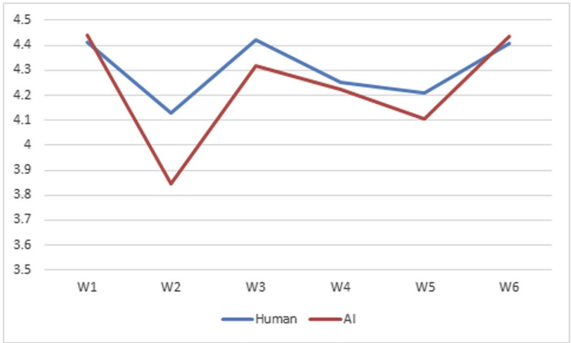
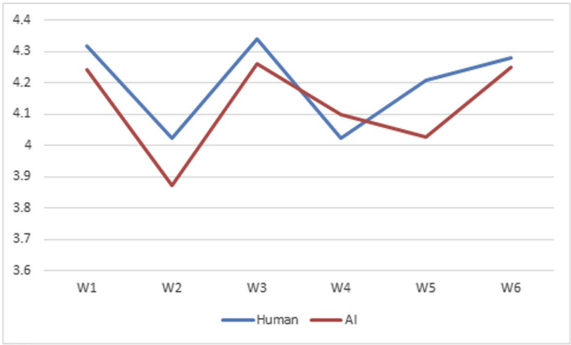
The question of how generative AI tools, such as large language models and chatbots, can be leveraged ethically and effectively in education is ongoing. Given the critical role that writing plays in learning and assessment within educational institutions, it is of growing importance for educators to make thoughtful and informed decisions as to how and in what capacity generative AI tools should be leveraged to assist in the development of students’ writing skills. This paper reports on two longitudinal studies. Study 1 examined learning outcomes of 48 university English as a new language (ENL) learners in a six-week long repeated measures quasi experimental design where the experimental group received writing feedback generated from ChatGPT (GPT-4) and the control group received feedback from their human tutor. Study 2 analyzed the perceptions of a different group of 43 ENLs who received feedback from both ChatGPT and their tutor. Results of study 1 showed no difference in learning outcomes between the two groups. Study 2 results revealed a near even split in preference for AI-generated or human-generated feedback, with clear advantages to both forms of feedback apparent from the data. The main implication of these studies is that the use of AI-generated feedback can likely be incorporated into ENL essay evaluation without affecting learning outcomes, although we recommend a blended approach that utilizes the strengths of both forms of feedback. The main contribution of this paper is in addressing generative AI as an automatic essay evaluator while incorporating learner perspectives.
Overview
The claims and statistics of this paper haven’t been checked yet.
Run the check — free, no account needed. It reads the open-access text and checks the sources it cites.
Integrity signals
Registry
Cites
Statistics
Figures
Verification
Claims the paper makes
The claims and statistics of this paper haven’t been checked yet.
Run the check — free, no account needed. It reads the open-access text and checks the sources it cites.
Claims other papers make about this one
Each is checked against this paper’s own text: does it say what the citing paper says it does?
The source backs part of the claim, not all of it — or backs it for a different population, condition or comparison.
In the citing paper
“This explanation is supported by a study from Escalante, Pack, and Barrett (2023) in which students considered AI-generated feedback more 'readable and detailed' compared to human-generated feedback.”
From Summarise, elaborate, try again: exploring the effect of feedback literacy on AI-enhanced essay writing (2026) · cites this paper as Escalante, Pack, and Barrett (2023)
Experimental — accuracy not yet measuredIn the citing paper
“Combining AI-driven feedback with human input may provide comprehensive guidance tailored to individual needs [142].”
From Leveraging AI in E-Learning: Personalized Learning and Adaptive Assessment through Cognitive Neuropsychology—A Systematic Analysis (2024) · cites this paper as [142]
Self-check
Percentages, sums and reported differences re-computed from the paper’s own numbers.
The self-check needs the paper’s full text.
Citations
Cites
Perceived usefulness, perceived ease of use, and user acceptance of information technology
Davis, F. D. (1989) · MIS Quarterly · doi:10.2307/249008 · Cited by 68,483
Principles and Practice in Second Language Acquisition
Higgs, T. V., & Krashen, S. D. (1983) · Modern Language Journal · doi:10.2307/328293 · Cited by 5,375
Principles and Practice in Second Language Acquisition
Krahnke, K. J., & Krashen, S. D. (1983) · TESOL Quarterly · doi:10.2307/3586656 · Cited by 4,483
Language Learning with Technology
Castillo, D. G. (2021) · Springer eBooks · doi:10.1007/978-981-16-2697-5 · Cited by 2,211
Clinical versus mechanical prediction: a meta-analysis
Grove, W. M., Zald, D. H., Lebow, B. S., Snitz, B. E., & Nelson, C. (2000) · Psychological Assessment · doi:10.1037/1040-3590.12.1.19 · Cited by 1,640
Sociocultural approaches to learning and development: A Vygotskian framework
John-Steiner, V. P., & Mahn, H. (1996) · Educational Psychologist · doi:10.1080/00461520.1996.9653266 · Cited by 1,389
A SWOT analysis of ChatGPT: Implications for educational practice and research
Farrokhnia, M., Banihashem, S. K., Noroozi, O., & Wals, A. (2024) · Innovations in Education and Teaching International · doi:10.1080/14703297.2023.2195846 · Cited by 1,384
Chiu, T. K. F., Xia, Q., Zhou, X., Chai, C. S., & Cheng, M. (2023) · Computers and Education: Artificial Intelligence · doi:10.1016/j.caeai.2022.100118 · Cited by 1,181 · cited 2×
“Personalized learning through evaluating and giving feedback on essay writing has been identified as a potential strength of GenAI (Chiu et al., 2023; Farrokhnia et al., 2023; Zhu et al., 2023), which can, in turn, help decrease teacher workload (Farrokhnia et al., 2023) and prevent teacher burnout.”
BackgroundChatGPT in higher education: considerations for academic integrity and student learning
(2023) · Journal of Applied Learning & Teaching · doi:10.37074/jalt.2023.6.1.17 · Cited by 853 · cited 1×
“…across Australia, New Zealand, The U.K., and the U.S., general sentiment appeared evenly split between positive and negative, but concerns about academic integrity have been raised (Sullivan, 2023), with some educational institutions deciding to ban ChatGPT than to allow its use (Yang, 2023).”
BackgroundExploring the potential of using an AI language model for automated essay scoring
Mizumoto, A., & Eguchi, M. (2023) · Research Methods in Applied Linguistics · doi:10.1016/j.rmal.2023.100050 · Cited by 647
Cited by
Sorted by citations
Items 101–200 of 800
Alamäki, A. V., Khan, U. A., Kauttonen, J., & Schlögl, S. (2024) · Education Sciences · doi:10.3390/educsci14121386 · Cited by 31
Xia, Q., Zhang, P., Huang, W., & Chiu, T. K. F. (2025) · Asia Pacific Journal of Education · doi:10.1080/02188791.2025.2530503 · Cited by 32
Cengiz, B. C., Bilki, Z., Ataş, A. H., & Çelik, B. (2025) · System · doi:10.1016/j.system.2025.103837 · Cited by 36
The value of GenAI for peer feedback provision: student perceptions and impacts
Noroozi, O., Haddadian, G., Gao, X., Schunn, C. D., Alqassab, M., & Banihashem, S. K. (2025) · International Journal of Educational Technology in Higher Education · doi:10.1186/s41239-025-00558-6 · Cited by 31
Effects of GenAI Interventions on Student Academic Performance: A Meta-Analysis
Gu, J., & Yan, Z. (2025) · Journal of Educational Computing Research · doi:10.1177/07356331251349620 · Cited by 30
Yang, M., Jiang, S., Li, B., Herman, K., Luo, T., Chappell, S., & Lovett, N. (2025) · British Journal of Educational Technology · doi:10.1111/bjet.13588 · Cited by 30
Critical AI literacy for applied linguistics and language education students
Pérez-Paredes, P., Curry, N., & Ordoñana-Guillamón, C. (2025) · Journal of China Computer-Assisted Language Learning · doi:10.1515/jccall-2025-0005 · Cited by 32
Leveraging prompt-based LLMs for automated scoring and feedback generation in higher education
AlGhamdi, E., Li, Y., Gašević, D., & Chen, G. (2025) · Computers & Education · doi:10.1016/j.compedu.2025.105511 · Cited by 36
Emerging Dynamics of ChatGPT in Academia: A Scoping Review
Mahrishi, M., Abbas, A., Radovanović, D., & Hosseini, S. (2024) · Journal of University Teaching and Learning Practice · doi:10.53761/b182ws13 · Cited by 28
Generative AI in Technical Communication: A Review of Research from 2023 to 2024
Reeves, C. A., & Sylvia, J. J. (2024) · Journal of Technical Writing and Communication · doi:10.1177/00472816241260043 · Cited by 33
Joo, S. H. (2024) · Studies in Applied Linguistics and TESOL · doi:10.52214/salt.v24i1.12865 · Cited by 28
Leveraging ChatGPT for research writing: An exploration of ESL graduate students’ practices
Cheng, D., Li, M., & Lee, T. S. (2025) · Computers & composition/Computers and composition · doi:10.1016/j.compcom.2025.102934 · Cited by 28
Lu, D., & Zeng, Y. (2025) · Innovation in Language Learning and Teaching · doi:10.1080/17501229.2025.2525341 · Cited by 28
Who Gives Feedback Matters: Student Biases Towards Human and AI ‐Generated Formative Feedback
Nazaretsky, T., Mejia‐Domenzain, P., Swamy, V., Frej, J., & Käser, T. (2026) · Journal of Computer Assisted Learning · doi:10.1111/jcal.70153 · Cited by 26
Bond, M. (2024) · International Journal of Educational Technology in Higher Education · doi:10.1186/s41239-024-00492-z · Cited by 27
Enhancing language learning through generative AI feedback on picture-cued writing tasks
Zhuang, Y., Zhao, R., Xie, Z., & Yu, P. L. H. (2025) · Computers and Education Artificial Intelligence · doi:10.1016/j.caeai.2025.100450 · Cited by 35
Gong, Y., Xu, C., Luo, S., & Lin, J. (2025) · Scientific Reports · doi:10.1038/s41598-025-03298-9 · Cited by 32
Jamshed, M., Ahmed, A. S. M. M., Sarfaraj, M., & Warda, W. U. (2024) · International Journal of Interactive Mobile Technologies (iJIM) · doi:10.3991/ijim.v18i19.50361 · Cited by 24
Lu, G., & Ba, S. (2026) · Educational Psychology · doi:10.1080/01443410.2025.2489784 · Cited by 24
Self-assessment design in a digital world: centring student agency
Nieminen, J. H., Yan, Z., & Boud, D. J. (2025) · Assessment & Evaluation in Higher Education · doi:10.1080/02602938.2025.2467647 · Cited by 27
Xue-qing, W., Li, R., & Quek, C. L. (2025) · Interactive Learning Environments · doi:10.1080/10494820.2025.2538756 · Cited by 25
Mi, Y., Rong, M., & Chen, X. (2025) · ECNU Review of Education · doi:10.1177/20965311241310883 · Cited by 23
Alpar, Ö. (2025) · European Journal of Educational Research · doi:10.12973/eu-jer.14.4.1291 · Cited by 23
Quan, Y. (2025) · Learning and Motivation · doi:10.1016/j.lmot.2025.102192 · Cited by 23
Wang, W., Wang, Y., Chen, J., Wang, X., Zhang, H., Chunli, G., & Peng, Y. (2025) · Journal of Educational Computing Research · doi:10.1177/07356331251410020 · Cited by 23
ChatGPT-generated versus human direct corrective feedback on L2 writing
Muñoz Muñoz, B. C., Nassaji, H., & Bello Carrillo, F. I. (2025) · System · doi:10.1016/j.system.2025.103805 · Cited by 22
Student reactions to AI versus human feedback in teamwork skills assessment
Kotlyar, I., & Krasman, J. (2025) · International Journal of Educational Technology in Higher Education · doi:10.1186/s41239-025-00555-9 · Cited by 21
ChatGPT Interventions in Higher Education: A Systematic Review of Experimental Studies
Jin, Y., & Sercu, L. (2025) · Journal of Computer Assisted Learning · doi:10.1111/jcal.70072 · Cited by 21
Özdere, M. (2025) · International Journal of Technology in Education · doi:10.46328/ijte.1001 · Cited by 21
Awareness, perception, and adoption of ChatGPT in African HEIs: A multi-dimensional analysis
Ojubanire, O. A., Olaleye, S. A., Marhraoui, M. A., Kamihanda, M. W., Oke, O. I., & Ojubanire, O. A. (2025) · The Internet and Higher Education · doi:10.1016/j.iheduc.2025.100999 · Cited by 22
Kim, M., & Chon, Y. V. (2025) · Assessing Writing · doi:10.1016/j.asw.2025.100950 · Cited by 25
Tabari, M. A., Kushki, A., & Wang, Y. (2025) · Computer Assisted Language Learning · doi:10.1080/09588221.2025.2561608 · Cited by 24
Usher, M., & Faraon, M. (2025) · Assessment & Evaluation in Higher Education · doi:10.1080/02602938.2025.2588682 · Cited by 22
Aljasser, A. (2025) · Education and Information Technologies · doi:10.1007/s10639-025-13649-8 · Cited by 22
From Struggle to Mastery: AI-Powered Writing Skills in ESL Education
Jaramillo, J. J., Chiappe, A., & Sáez-Delgado, F. (2025) · Applied Sciences · doi:10.3390/app15148079 · Cited by 20
LLM-Generated Feedback Supports Learning if Learners Choose to Use it
Thomas, D. R., Borchers, C., Bhushan, S., Gatz, E. E., Gupta, S., & Koedinger, K. R. (2025) · Lecture notes in computer science · doi:10.1007/978-3-032-03870-8_33 · Cited by 20
Ruwe, T., & Kuklick, L. (2025) · British Journal of Educational Technology · doi:10.1111/bjet.70011 · Cited by 21
Bernik, A., Radošević, D., & Čep, A. (2025) · Applied Sciences · doi:10.3390/app151810055 · Cited by 21
Zhang, N., Wong, W. L., & Barrot, J. S. (2025) · Scientific Reports · doi:10.1038/s41598-025-21205-0 · Cited by 19
EFL teachers and feedback fatigue: AI to the rescue?
Hyland, K. (2025) · Language Teaching · doi:10.1017/s0261444825101018 · Cited by 23
Understanding Student Engagement in AI-Powered Online Learning Platforms
Garcia, M. B., Goi, C. L., Shively, K., Maher, D., Rosak-Szyrocka, J., Happonen, A., Bozkurt, A., & Damaševičius, R. (2024) · Advances in educational technologies and instructional design book series · doi:10.4018/979-8-3693-5633-3.ch001 · Cited by 19
Budiyono, H. (2025) · International Journal of Information and Education Technology · doi:10.18178/ijiet.2025.15.5.2306 · Cited by 26
Hong, S., & Shin, Y. K. (2025) · System · doi:10.1016/j.system.2025.103820 · Cited by 19
Undergraduate students’ learning outcomes with ChatGPT: A meta-analytic study
Mo, F., Huang, J., Yang, Y., Ozen, Z., Maeda, Y., & Olenchak, F. R. (2025) · Computers and Education Artificial Intelligence · doi:10.1016/j.caeai.2025.100536 · Cited by 22
Chinese EFL learners’ engagement with ChatGPT feedback on academic writing: A case study in Malaysia
Kailin, Z., & Saeed, M. A. (2025) · Computers & composition/Computers and composition · doi:10.1016/j.compcom.2025.102976 · Cited by 19
Hawkins, B., Taylor-Griffiths, D., & Lodge, J. M. (2026) · Assessment & Evaluation in Higher Education · doi:10.1080/02602938.2025.2492070 · Cited by 17
“This explanation is supported by a study from Escalante, Pack, and Barrett (2023) in which students considered AI-generated feedback more ‘readable and detailed’ compared to human-generated feedback.”
Using ChatGPT in Teaching Arabic as a Foreign Language
Nasaruddin, N. (2024) · ARABIYATUNA Jurnal Bahasa Arab · doi:10.29240/jba.v8i1.9413 · Cited by 19
ChatGPT-Generated Corrective Feedback: Does It Do What It Says on the Tin?
Ebyary, K. E., & Shabara, R. (2024) · Teaching English With Technology · doi:10.56297/vaca6841//bffo7057/myeh4562 · Cited by 19
Developing a college student feedback literacy scale for the GenAI context
Cui, Y. H., Meng, Y., Qian, X., & Tang, L. (2025) · Assessment & Evaluation in Higher Education · doi:10.1080/02602938.2025.2495048 · Cited by 17
Abdul-Jabbar, W. K., & Bhatt, I. (2025) · Postdigital Science and Education · doi:10.1007/s42438-025-00586-5 · Cited by 17
Stretching AI's reach: Assessing an AI-driven feedback system for extended academic writing
Lo, J., Wong, C., Ng, A., Wong, P., Cheung, D., & Lai, P. P. Y. (2025) · Computers and Education Artificial Intelligence · doi:10.1016/j.caeai.2025.100511 · Cited by 20
Zhang, C., Hu, M., Wu, W., Chen, Y., Wang, K., Gao, T., & Fu, Q. (2025) · Teaching and Teacher Education · doi:10.1016/j.tate.2025.105355 · Cited by 17
Exploring AI-Driven Adaptive Feedback in the Second Language Writing Skills Prompt
Kenshinbay, T., & Ghorbandordinejad, F. (2024) · EIKI Journal of Effective Teaching Methods · doi:10.59652/jetm.v2i3.264 · Cited by 26
Unpacking the Rejection of L2 Students Toward ChatGPT-Generated Feedback: An Explanatory Research
Chen (陈子淇), Z., Wei (韦卫), W., Zhu (祝新华), X., & Yao (姚远), Y. (2026) · ECNU Review of Education · doi:10.1177/20965311241305140 · Cited by 16
Exploring the efficacy of ChatGPT-4 feedback in second language Spanish writing
Barrios-Beltran, D. (2025) · System · doi:10.1016/j.system.2025.103771 · Cited by 18
Tang, Y., Du, X., Hung, J.-L., Li, H., Tang, H., & Xie, Y. (2024) · Education and Information Technologies · doi:10.1007/s10639-024-12569-3 · Cited by 16
Sullivan, M., McAuley, M., Degiorgio, D., & McLaughlan, P. (2024) · Journal of Applied Learning and Teaching · doi:10.37074/jalt.2024.7.2.7 · Cited by 15
Exploring undergraduate students' usage and perceptions of AI writing tools
Bensalem, E., Harizi, R., & Boujlida, A. (2024) · Global Journal of Foreign Language Teaching · doi:10.18844/gjflt.v14i2.9344 · Cited by 15
Sichterman, B., Banihashem, S. K., Verstappen, M., Schipper, M., Waisvisz, P., Noroozi, O., & van Ginkel, S. O. (2025) · Interactive Learning Environments · doi:10.1080/10494820.2025.2521338 · Cited by 15
Nazaretsky, T., Gabbay, H., & Käser, T. (2025) · Computers and Education Artificial Intelligence · doi:10.1016/j.caeai.2025.100533 · Cited by 18
Akanda, F., & Talukder, T. (2026) · Social Sciences & Humanities Open · doi:10.1016/j.ssaho.2026.102437 · Cited by 18
Pretorius, M., & Thewissen, J. (2026) · Journal of Second Language Writing · doi:10.1016/j.jslw.2026.101286 · Cited by 17
Transforming Military Healthcare Education and Training: AI Integration for Future Readiness
Peacock, J. G., Cole, R., Duncan, J. R., Jensen, B., Snively, B., & Samuel, A. (2025) · Military Medicine · doi:10.1093/milmed/usaf169 · Cited by 14
From Curiosity to Dependency: Nigerian Students’ Perspectives on AI Integration in Academic Research
Nwagbara, U. U. (2025) · Journal of Academic Ethics · doi:10.1007/s10805-025-09641-z · Cited by 15
Chen, Y., & Chen, J. (2025) · Language Teaching Research · doi:10.1177/13621688251397724 · Cited by 14
Gu, J., Chen, J., & Yan, Z. (2026) · Frontiers in Education · doi:10.3389/feduc.2025.1736446 · Cited by 15
Zhang, J., Zhang, H., & Wu, X. (2026) · System · doi:10.1016/j.system.2026.103979 · Cited by 15
Bashraheel, M., & Ghinea, G. (2026) · Computer Science Review · doi:10.1016/j.cosrev.2026.100929 · Cited by 14
Wang, Y. (2026) · Frontiers in Psychology · doi:10.3389/fpsyg.2026.1761562 · Cited by 16
Li, Y., Tsang, Y.-P., Ho, D. C., Ozden, M., Lee, C. K. H., & Hu, H. (2025) · Enterprise Information Systems · doi:10.1080/17517575.2025.2462069 · Cited by 12
Large Language Models in Student Assessment: Comparing ChatGPT and Human GradersPreprint
Lundgren, M. (2024) · SSRN Electronic Journal · doi:10.2139/ssrn.4874359 · Cited by 14
The impact of automated writing evaluation on writing gains
Deygers, B., Buelens, L., Chan, D., Schildt, L., Parys, A. V., & Vanbuel, M. (2025) · ELT Journal · doi:10.1093/elt/ccaf020 · Cited by 14
Chen, S. C., Zhang, L., & Li, A. W. (2025) · Assessment & Evaluation in Higher Education · doi:10.1080/02602938.2025.2546349 · Cited by 13
Integrating generative AI into EFL writing: University students’ strategies and perceptions
Lee, Y., Davis, R. O., & Choi, J.-I. (2025) · Online Journal of Communication and Media Technologies · doi:10.30935/ojcmt/17545 · Cited by 12
Wang, S., & Hew, K. F. (2026) · Computers & Education · doi:10.1016/j.compedu.2026.105621 · Cited by 15
Dong, H., Chen, X., & Shen, J. (2026) · International Journal of Educational Technology in Higher Education · doi:10.1186/s41239-026-00591-z · Cited by 15
Ortiz, L. G., Maina, M. F., Lanzo, N. C., & Fernández-Ferrer, M. (2024) · Revista de Educación a Distancia (RED) · doi:10.6018/red.599511 · Cited by 21
Hou, X., He, S., & Cuigong, R. (2024) · International Conference on Education and Multimedia Technology (ICEMT) · doi:10.1145/3678726.3678767 · Cited by 12
AI’s Corrective Feedback vs. Traditional Recasts: which fosters better grammar accuracy?
Chhabriya, M., Babu, N. N., & Kumari, A. S. P. (2024) · DMIHER International Conference on Artificial Intelligence in Healthcare, Education and Industry (IDICAIHEI) · doi:10.1109/idicaiei61867.2024.10842936 · Cited by 12
Kim, C., Passonneau, R. J., Lee, E., Karizaki, M. S., Gnesdilow, D., & Puntambekar, S. (2025) · British Journal of Educational Technology · doi:10.1111/bjet.13596 · Cited by 12
Yang, Y., & Lin, C. (2025) · Computer Assisted Language Learning · doi:10.1080/09588221.2025.2513988 · Cited by 12
Zhu, S., Li, Q. H., Yao, Y., Li, J., & Zhu, X. (2025) · Assessing Writing · doi:10.1016/j.asw.2025.100960 · Cited by 12
Bibliometric and Systematic Analysis of Artificial Intelligence Chatbots’ Use for Language Education
Wu, T., & Yu, Z. (2024) · Journal of University Teaching and Learning Practice · doi:10.53761/6jmnst54 · Cited by 15
Garcia, M. B., Goi, C. L., Shively, K., Maher, D., Rosak-Szyrocka, J., Happonen, A., Bozkurt, A., & Damaševičius, R. (2025) · SSRN Electronic Journal · doi:10.2139/ssrn.5074608 · Cited by 12
Jovic, M., Papakonstantinidis, S., & Kirkpatrick, R. (2025) · Language Testing in Asia · doi:10.1186/s40468-025-00389-2 · Cited by 11
Schmitt-Fumian, T. K., Tauscher, S., & Thoring, K. (2025) · Proceedings of the Design Society · doi:10.1017/pds.2025.10057 · Cited by 11
Kozan, K., Hur, J., Kim, I., & Barrett, A. J. (2025) · Education Sciences · doi:10.3390/educsci15091133 · Cited by 15
Self-citationLu, D., & Zeng, Y. (2025) · Language Teaching Research · doi:10.1177/13621688251397578 · Cited by 11
AI assistance in peer feedback provision: Pedagogically sound, but minimally adopted
Pozdniakov, S., Brazil, J., Banihashem, S. K., Noroozi, O., Gašević, D., Sadiq, S., & Khosravi, H. (2026) · Computers & Education · doi:10.1016/j.compedu.2026.105591 · Cited by 11
Abudalfa, S. I., & Barrot, J. S. (2026) · Assessing Writing · doi:10.1016/j.asw.2026.101041 · Cited by 15
Exploring the effect of GenAI on learning outcomes in higher education: a three-level meta-analysis
Fan, C., Ke, L., Chen, Z., & Lv, P. (2026) · Frontiers in Psychology · doi:10.3389/fpsyg.2026.1758670 · Cited by 13
Assessing the Impact of ChatGPT on EFL Students’ Writing Productivity and Proficiency
Alwasidi, M. A., & Al-Khalifah, K. S. (2025) · Journal of Language Teaching and Research · doi:10.17507/jltr.1603.29 · Cited by 11
Student perceptions of hybrid feedback: Using Gen-AI to enhance engagement with EAP writing feedback
Zhang, J., & Wang, J. (2025) · The JALT CALL Journal · doi:10.29140/jaltcall.v21n2.2175 · Cited by 12
Hu, W., Gong, R., Wu, S., & Li, Y. (2025) · Educational Technology Research and Development · doi:10.1007/s11423-025-10526-6 · Cited by 13
AI versus human assessment in EFL speaking classrooms: a comparative study in China
Liu, X., Huang, J., Deng, Y., & Spiridakis, J. (2025) · Computer Assisted Language Learning · doi:10.1080/09588221.2025.2530555 · Cited by 11
Oğuz, E. (2025) · Assessing Writing · doi:10.1016/j.asw.2025.100981 · Cited by 12
Enoch, S. K., Mejira, A., Bayor, N., Nyemewero, I., & Godfred, A. A. (2024) · American Journal of Technology · doi:10.58425/ajt.v3i1.301 · Cited by 10
Li, K., Lan, J., & Hu, Y. (2025) · Educational Technology Research and Development · doi:10.1007/s11423-025-10467-0 · Cited by 12
Motivation and achievement in EFL: the power of instructional approach
Liu, J., Hamid, H. A., & Bao, X. (2025) · Frontiers in Education · doi:10.3389/feduc.2025.1614388 · Cited by 11
Liu, T., & Zou, B. (2025) · Computer Assisted Language Learning · doi:10.1080/09588221.2025.2539160 · Cited by 10
Metadata
- Authors
- Escalante, J., Pack, A., & Barrett, A.
- Affiliations
- Brigham Young University–Hawaii (US)
- Florida State University (US)
- Corresponding author
- Escalante, Juan
- Venue
- International Journal of Educational Technology in Higher Education
- Published
- 2023-10-27
- Volume
- 20
- Issue
- 1
- ISSN
- 2365-9440 (ISSN-L)
- OpenAlex
- W4387954002
- Cited by
- 589
- References
- 38
- Citations by year
- 2026: 267 · 2025: 231 · 2024: 90 · 2023: 1
- FWCI
- 138.70
- Type
- journal article
- Language
- en
- Open access
- diamond
- doi.org
- Locations
- International Journal of Educational Technology in Higher Education (publishedVersion, cc-by)
- DOAJ (DOAJ: Directory of Open Access Journals) (submittedVersion, cc-by-sa)
- Topics
- Social Sciences › Education › Artificial Intelligence in Education
- Social Sciences › Arts and Humanities › Language and Linguistics › EFL/ESL Teaching and Learning
- Social Sciences › Education › Student Assessment and Feedback
- Keywords
- AI-generated feedback, generative AI in education, ChatGPT, large language models, writing instruction, learner preferences, writing learning outcomes
About these checks
Registry, retraction, Cites and statistics results are computed, not judged, with one exception: a printed reference that no index lists is read once by a model before it counts as a citation error. Claims are extracted by a model and kept only when their quote appears verbatim in the text; each cited source is then checked, with a model’s help, for whether it says what the claim relies on. Those verdicts can be wrong — read the claim’s quote and the cited source before relying on one.
Statistics and arithmetic are recomputed, not judged.
Confidence bands are shown only for fields calibrated on our annotated test set. None is calibrated yet, so no band is shown.
What counts as a claim ›How we measure confidence ›How we check this ›
Are you an author, or do you see a problem with this page? Request a review
