

The DOI matches its Crossref record; 43 of the 43 references it cites were found in a registry or an index.
AI-generated feedback on writing: insights into efficacy and ENL student preference
Open accessAbstract
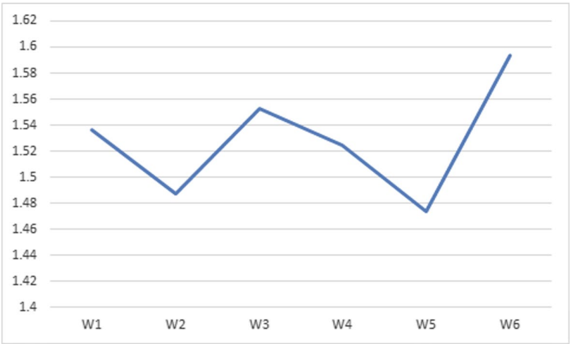
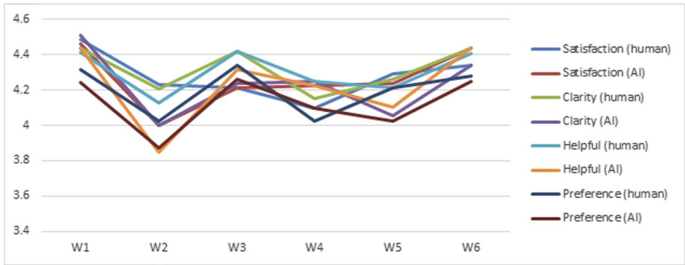
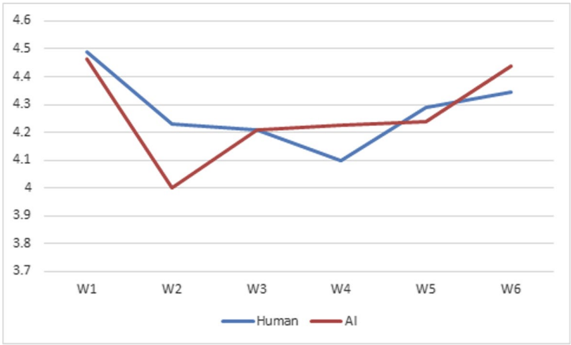
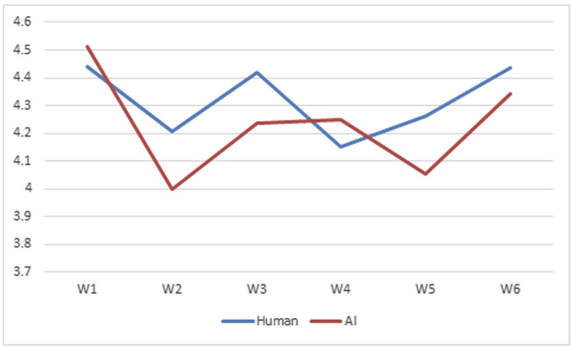
The question of how generative AI tools, such as large language models and chatbots, can be leveraged ethically and effectively in education is ongoing. Given the critical role that writing plays in learning and assessment within educational institutions, it is of growing importance for educators to make thoughtful and informed decisions as to how and in what capacity generative AI tools should be leveraged to assist in the development of students’ writing skills. This paper reports on two longitudinal studies. Study 1 examined learning outcomes of 48 university English as a new language (ENL) learners in a six-week long repeated measures quasi experimental design where the experimental group received writing feedback generated from ChatGPT (GPT-4) and the control group received feedback from their human tutor. Study 2 analyzed the perceptions of a different group of 43 ENLs who received feedback from both ChatGPT and their tutor. Results of study 1 showed no difference in learning outcomes between the two groups. Study 2 results revealed a near even split in preference for AI-generated or human-generated feedback, with clear advantages to both forms of feedback apparent from the data. The main implication of these studies is that the use of AI-generated feedback can likely be incorporated into ENL essay evaluation without affecting learning outcomes, although we recommend a blended approach that utilizes the strengths of both forms of feedback. The main contribution of this paper is in addressing generative AI as an automatic essay evaluator while incorporating learner perspectives.
Overview
The claims and statistics of this paper haven’t been checked yet.
Run the check — free, no account needed. It reads the open-access text and checks the sources it cites.
Integrity signals
Registry
Cites
Statistics
Figures
Verification
Claims the paper makes
The claims and statistics of this paper haven’t been checked yet.
Run the check — free, no account needed. It reads the open-access text and checks the sources it cites.
Claims other papers make about this one
Each is checked against this paper’s own text: does it say what the citing paper says it does?
The source backs part of the claim, not all of it — or backs it for a different population, condition or comparison.
In the citing paper
“This explanation is supported by a study from Escalante, Pack, and Barrett (2023) in which students considered AI-generated feedback more 'readable and detailed' compared to human-generated feedback.”
From Summarise, elaborate, try again: exploring the effect of feedback literacy on AI-enhanced essay writing (2026) · cites this paper as Escalante, Pack, and Barrett (2023)
Experimental — accuracy not yet measuredIn the citing paper
“Combining AI-driven feedback with human input may provide comprehensive guidance tailored to individual needs [142].”
From Leveraging AI in E-Learning: Personalized Learning and Adaptive Assessment through Cognitive Neuropsychology—A Systematic Analysis (2024) · cites this paper as [142]
Self-check
Percentages, sums and reported differences re-computed from the paper’s own numbers.
The self-check needs the paper’s full text.
Citations
Cites
Perceived usefulness, perceived ease of use, and user acceptance of information technology
Davis, F. D. (1989) · MIS Quarterly · doi:10.2307/249008 · Cited by 68,483
Principles and Practice in Second Language Acquisition
Higgs, T. V., & Krashen, S. D. (1983) · Modern Language Journal · doi:10.2307/328293 · Cited by 5,375
Principles and Practice in Second Language Acquisition
Krahnke, K. J., & Krashen, S. D. (1983) · TESOL Quarterly · doi:10.2307/3586656 · Cited by 4,483
Language Learning with Technology
Castillo, D. G. (2021) · Springer eBooks · doi:10.1007/978-981-16-2697-5 · Cited by 2,211
Clinical versus mechanical prediction: a meta-analysis
Grove, W. M., Zald, D. H., Lebow, B. S., Snitz, B. E., & Nelson, C. (2000) · Psychological Assessment · doi:10.1037/1040-3590.12.1.19 · Cited by 1,640
Sociocultural approaches to learning and development: A Vygotskian framework
John-Steiner, V. P., & Mahn, H. (1996) · Educational Psychologist · doi:10.1080/00461520.1996.9653266 · Cited by 1,389
A SWOT analysis of ChatGPT: Implications for educational practice and research
Farrokhnia, M., Banihashem, S. K., Noroozi, O., & Wals, A. (2024) · Innovations in Education and Teaching International · doi:10.1080/14703297.2023.2195846 · Cited by 1,384
Chiu, T. K. F., Xia, Q., Zhou, X., Chai, C. S., & Cheng, M. (2023) · Computers and Education: Artificial Intelligence · doi:10.1016/j.caeai.2022.100118 · Cited by 1,181 · cited 2×
“Personalized learning through evaluating and giving feedback on essay writing has been identified as a potential strength of GenAI (Chiu et al., 2023; Farrokhnia et al., 2023; Zhu et al., 2023), which can, in turn, help decrease teacher workload (Farrokhnia et al., 2023) and prevent teacher burnout.”
BackgroundChatGPT in higher education: considerations for academic integrity and student learning
(2023) · Journal of Applied Learning & Teaching · doi:10.37074/jalt.2023.6.1.17 · Cited by 853 · cited 1×
“…across Australia, New Zealand, The U.K., and the U.S., general sentiment appeared evenly split between positive and negative, but concerns about academic integrity have been raised (Sullivan, 2023), with some educational institutions deciding to ban ChatGPT than to allow its use (Yang, 2023).”
BackgroundExploring the potential of using an AI language model for automated essay scoring
Mizumoto, A., & Eguchi, M. (2023) · Research Methods in Applied Linguistics · doi:10.1016/j.rmal.2023.100050 · Cited by 647
Cited by
Sorted by citations
Items 401–500 of 800
Students’ psychological biases towards teacher and AI-generated feedback: an experimental study
Haiyan, Y. U. (2026) · BMC Psychology · doi:10.1186/s40359-026-04568-5 · Cited by 1
Abbasi, F. F., Usman, M., & Latif, B. (2026) · European journal of training and development · doi:10.1108/ejtd-07-2025-0151 · Cited by 1
Exploring Critical Interaction with GAI in Academic Writing: A Mixed-Methods Study
Sun, Q., & Yin, S. (2026) · TechTrends · doi:10.1007/s11528-026-01199-w · Cited by 1
Li, S., Wang, S., & Huang, Y. (2026) · Assessment & Evaluation in Higher Education · doi:10.1080/02602938.2026.2671207 · Cited by 2
ChatGPT and higher education in Latin America: measuring perceived academic skills
George-Reyes, C. E., Romero, C. A., Mérida-Córdova, E. J., & Yeguas-Bolívar, E. (2026) · Frontiers in Research Metrics and Analytics · doi:10.3389/frma.2026.1816902 · Cited by 1
Effectiveness of GenAI in enhancing writing performance: a meta-analysis
Teng, M. F. (2026) · Asian-Pacific Journal of Second and Foreign Language Education · doi:10.1186/s40862-026-00444-2 · Cited by 1
ChatGPT and Large Language Models for English Professors: Getting It Right
Sheu, C. J. (2026) · College English · doi:10.58680/ce2026883346 · Cited by 1
Gençdal, G., & Çoğaltay, N. (2026) · Studies In Educational Evaluation · doi:10.1016/j.stueduc.2026.101651 · Cited by 2
Zhang, J., Yang, Y., & Zhang, H. (2026) · Acta Psychologica · doi:10.1016/j.actpsy.2026.107581 · Cited by 1
Mäkipää, T., & Soltyska, A. (2024) · Studies in Language Assessment · doi:10.58379/mszy9375 · Cited by 1
Pagaduan, J. (2025) · International Journal For Multidisciplinary Research · doi:10.36948/ijfmr.2025.v07i03.43394 · Cited by 1
Forlales, A. L., & Villanueva, E. R. (2025) · Romblon State University Research Journal · doi:10.58780/rsurj.v7i1.229 · Cited by 1
Lee, Y. (2025) · The Korean Association of General Education · doi:10.46392/kjge.2025.19.3.19 · Cited by 1
McCloskey, R. M., Morris, P., Keeping‐Burke, L., McGill, A., Goudreau, A., Knight, H., Buckley, S., Mazerolle, D., & Jones, C. (2025) · Quality Advancement in Nursing Education - Avancées en formation infirmière · doi:10.17483/d4g46t54 · Cited by 1
Relevance of Artificial Intelligence in Assessment
Dubey, P., Crevar, A. R., & Rischard, M. W. (2025) · Advances in computational intelligence and robotics book series · doi:10.4018/979-8-3373-2397-8.ch016 · Cited by 1
AI and the Future of Education
Wang, V., & Torrisi‐Steele, G. (2025) · Advances in computational intelligence and robotics book series · doi:10.4018/979-8-3373-2397-8.ch001 · Cited by 1
Comparison of Feedback from ChatGPT and Human Professors in Higher Education: A Systematic Review
Paniura, C. H. G., Luza, T. C., Cruz-Carpio, F. M., Díaz, R. R. I., Apaza-Paco, D. V., Rojas, N. R., Mamani-Mamani, B., Terrero-Pérez, Á., Yaedú, R. Y. F., & Peralta-Mamani, M. (2025) · Journal of Computer and Communications · doi:10.4236/jcc.2025.137013 · Cited by 1
ChatGPT in ESL Writing: L2 Learners’ Practices and Perspectives
Na, I., Duris, M., & Hegelheimer, V. H. (2025) · doi:10.31274/isudp.2025.211.04 · Cited by 1
Widyaningsih, T. L., Septiana, A. R., Hanafi, M., & Huda, M. C. (2024) · JIPI (Jurnal Ilmiah Penelitian dan Pembelajaran Informatika) · doi:10.29100/jipi.v9i4.9184 · Cited by 1
Thao, V. T. T. (2025) · International Journal on Studies in English Language and Literature · doi:10.20431/2347-3134.1309005 · Cited by 1
Eze, M. (2025) · International Journal of Marketing Studies · doi:10.5539/ijms.v17n2p62 · Cited by 1
AI, Impostor Syndrome, and Emotional Resilience
Domingo, M. A. T. (2025) · Advances in computational intelligence and robotics book series · doi:10.4018/979-8-3373-3745-6.ch009 · Cited by 1
Fontanilla, K. P., Aquino, J. M., Manzano, C., Galay, A., & Raymundo, J. L. (2025) · Student Journal of Technology and Educational Research · doi:10.65141/sjter.v2i2n8 · Cited by 1
ZhiZi, C., & Ostolaza, L. M. (2025) · Studies in Applied Linguistics and TESOL · doi:10.52214/salt.v25i2.14470 · Cited by 1
Voss, E., Joo, S. H., & Eskin, D. (2026) · Language Assessment Quarterly · doi:10.1080/15434303.2025.2606233 · Cited by 1
Does the impact of GenAI persist in learning? comparing AI and instructor feedback on accessibility
Deriba, F. G., Saqr, M., & Tukiainen, M. (2026) · Universal Access in the Information Society · doi:10.1007/s10209-025-01268-6 · Cited by 1
Xiojing, G., Tegeh, I. M., & Santyasa, I. W. (2026) · Indonesian Journal of Educational Development (IJED) · doi:10.59672/ijed.v6i4.5649 · Cited by 1
Fauziah, Malago, J. D., & Martawijaya, M. A. (2025) · Jurnal Penelitian Pendidikan IPA · doi:10.29303/jppipa.v11i7.5602 · Cited by 1
Comparing Teacher and ChatGPT Feedback in EFL/ESL Writing
Hamzehloo, M., Azar, A. S., & Hamzehloo, M. (2026) · Advances in computational intelligence and robotics book series · doi:10.4018/979-8-3373-5601-3.ch007 · Cited by 1
Collective Monograph on Artificial Intelligence in Digital Society Vol 1 2026
(2026) · KRPOCH eBooks · doi:10.26697/9786177089192.2026 · Cited by 1
Artificial Intelligence in the Evaluation of Academic Writing in Higher Education
Goundar, P. R., & Li, H. (2026) · English Language Teaching · doi:10.5539/elt.v19n4p51 · Cited by 1
Yaacoub, A., Assaghir, Z., Prévost, L., & Da-Rugna, J. (2025) · International Conference on Computer, Software and Modeling (ICCSM) · doi:10.1109/iccsm66818.2025.00026 · Cited by 1
iRULER: Intelligible Rubric-Based User-Defined LLM Evaluation for Revision
Bai, J., Cheong, W. S., Müller, P., & Lim, B. Y. (2026) · CHI Conference on Human Factors in Computing Systems · doi:10.1145/3772318.3790539 · Cited by 4
Wang, X., & Fang, L. (2026) · International Journal of Interactive Mobile Technologies (iJIM) · doi:10.3991/ijim.v20i08.61323 · Cited by 1
Applications and Effectiveness of Generative AI (GAI) in Higher Education: A Systematic Review
Song, Z., Wang, W., Liu, W., Wu, M., & Lin, Q. (2026) · MIER Journal of Educational Studies Trends & Practices · doi:10.52634/mier/2026/v16/i1/3072 · Cited by 1
Zuo, Y., Xu, X., & Dunning, L. A. (2026) · Journal of Applied Learning & Teaching · doi:10.37074/jalt.2026.9.1.8 · Cited by 1
“Maybe that's the landscape that's coming?”
Ott, M. C., Veselka, M., Cristancho, S., Hibbert, K., & Lingard, L. (2026) · Language and Literacy · doi:10.20360/langandlit29798 · Cited by 1
Acan, Y. G., & Kaban, A. L. (2026) · Asia Pacific Journal of Educators and Education · doi:10.21315/apjee2026.41.1.8 · Cited by 1
Williyan, A., Rohmah, N., Ramdani, J. M., Dewi, E. W., & Fadhilah, N. (2026) · Asia Pacific Journal of Educators and Education · doi:10.21315/apjee2026.41.1.10 · Cited by 1
Meyer, J., Steinbach, M., Schiller, R., Mertens, U., Schaller, N.-J., Horbach, A., Fleckenstein, J., Köller, O., Kizilcec, R. F., & Jansen, T. (2026) · ACM Conference on Learning @ Scale (L@S) · doi:10.1145/3774398.3811602 · Cited by 1
Madden, O. N., Paiva, J., Edwards, K., Daley, J.-L., & Prince, A. (2026) · Artificial Intelligence in Language Education · doi:10.29140/aile.2026.104107 · Cited by 1
Юрченко, А. О., Skoropad, H., & Семеніхіна, О. В. (2026) · Academic Notes Series Pedagogical Science · doi:10.36550/2415-7988-2026-1-223-867-872 · Cited by 1
Using LLM chatbots for feedback in L2 English academic writing: a scoping review
Ho, N. N. Y., Rappa, N. A., & Wishart, J. (2026) · Innovation in Language Learning and Teaching · doi:10.1080/17501229.2026.2698704 · Cited by 1
Farhaty, M., Luthfiyah, L., & Nasaruddin, N. (2026) · Journal of Islamic Education Students (JIES) · doi:10.31958/jies.v6i1.16728 · Cited by 1
Kumar, J. A., Salim, Z., Annamalai, N., Dhaliwal, J., & Singh, A. D. (2026) · Quality & Quantity · doi:10.1007/s11135-026-02982-w · Cited by 1
Generative AI for Second Language Writing Feedback, Assessment, and Instruction
Li, M., Han, J., & Taha, G. (2026) · Cambridge University Press eBooks · doi:10.1017/9781009657334 · Cited by 1
Alzahrani, M. (2026) · International Journal of Language and Literary Studies · doi:10.36892/ijlls.v8i5.2737 · Cited by 1
Li, T., Liu, Z., & Zou, D. (2026) · PLoS ONE · doi:10.1371/journal.pone.0355494 · Cited by 1
Odeh, M. I. (2026) · Journal of Intelligent Decision Making and Information Science · doi:10.59543/jidmis.v3.1429 · Cited by 1
Malinee, D. V. V., & Mujahid, S. (2026) · Stanzaleaf International Journal of Multidisciplinary Studies · doi:10.67313/slijms.2026.43 · Cited by 1
Generative AI Mediation in EFL Oral and Written Production: Colombian Student and Teacher Perception
Villalobos, D. J. M. (2026) · International journal of AI in language education. · doi:10.54855/ijaile.26321 · Cited by 1
The impact of generative artificial intelligence on language teaching and learning
Rejeb, A., Rejeb, K., Zaher, H. F., Hassoun, A., Lahbib, M., & Süle, E. (2026) · Quality & Quantity · doi:10.1007/s11135-026-03068-3 · Cited by 2
Zhao, H., & Ji, J. (2026) · Frontiers in Education · doi:10.3389/feduc.2026.1904852 · Cited by 1
Yan, W., Cui, Y., Chiu, T. K. F., Nakajima, T., & Kozima, H. (2026) · Australasian Journal of Educational Technology · doi:10.14742/ajet.11725 · Cited by 1
Beyond artificial encouragement: Why pre-service teachers value critical over positive feedback
Thomson, E., Park, H., Chapman, R., & Nelson, S. W. (2026) · Australasian Journal of Educational Technology · doi:10.14742/ajet.11550 · Cited by 1
Artificial Intelligence and Language Learning
Costa, A. R., Vasconcelos, S., & Balula, A. (2024) · Advances in educational technologies and instructional design book series · doi:10.4018/979-8-3693-3944-2.ch011 · Cited by 1
Huang, Z., & Tan, B. (2024) · Journal of Education Humanities and Social Sciences · doi:10.54097/e7azj733 · Cited by 1
Laksana, I. P. Y., Virginiya, P. T., & Yuliantini, N. N. (2024) · Advances in economics, business and management research/Advances in Economics, Business and Management Research · doi:10.2991/978-94-6463-622-2_45 · Cited by 1
Framework and Potential Applications of GAI-Based Language Learning Design
Tu, Y., & Chen, J. (2025) · Chinese language learning sciences · doi:10.1007/978-981-95-0245-5_9 · Cited by 2
Alnajashi, A. (2024) · SSRN Electronic Journal · doi:10.2139/ssrn.4691198 · Cited by 1
Abdellatif, M. S., Alshehri, M. A., Lamouchi, A., Rahmath, M., & Nemt-allah, M. A. (2026) · Frontiers in Psychology · doi:10.3389/fpsyg.2026.1809174
“Additionally, AI developers and educational technology providers influence assessment practices through system design, affordances, and inherent biases (Escalante et al., 2023; Zhang et al., 2025).”
InfluentialAlnajashi, A. (2024) · SSRN Electronic Journal · doi:10.2139/ssrn.4687328
Generative Artificial Intelligence as a Tool for the Development and Evaluation Student’s Thinking
Larionova, V. A., Гончарова, Н., Daineko, L. V., & Евгеньевич, С. В. (2024) · Lecture notes in networks and systems · doi:10.1007/978-3-031-76800-2_6
Altun, H. K. (2024) · Asia-pacific Journal of Convergent Research Interchange · doi:10.47116/apjcri.2024.12.15
Re-imagining Education Through AI: Students Insights from DigiEduHack
Paludo, G., Vielmo, C., Fiore, F., Zozzo, A. D., Decarli, G., Montresor, A., & Bigatto, M. (2024) · Lecture notes on data engineering and communications technologies · doi:10.1007/978-981-97-9255-9_30
Effectiveness and moderating factors of computer-mediated feedback in L2 writing: A meta-analysis
Park, S. (2025) · International Journal of English Language and Literature Studies · doi:10.55493/5019.v14i1.5328
Addressing the Misuse of GenAI for Malicious Purposes
Desai, T. (2025) · Journal of Information Systems Engineering & Management · doi:10.52783/jisem.v10i42s.8363
Setiyono, Y. C. P., Sulianto, J., & Rakhmawati, D. (2025) · Jurnal Ilmiah Profesi Pendidikan · doi:10.29303/jipp.v10i2.3305
The AIMED model: Creating opportunities for AI in Higher EducationPreprint
Howard, S. K., Tondeur, J., Neubert, C., Hauck, J., & Böhme, R. (2025) · EdArXiv (OSF Preprints) · doi:10.35542/osf.io/pzk9t_v1
Rosa, S., Sukmawati, N., Saputra, N., & Fatmawati, E. (2025) · Cogent Arts and Humanities · doi:10.1080/23311983.2025.2507509
Wang, Y., & Li, H. (2025) · SSRN Electronic Journal · doi:10.2139/ssrn.5274267
Brändle, M., Bahr, T., Arnold, J. B., & Zinn, B. (2025) · IEEE Global Engineering Education Conference (EDUCON) · doi:10.1109/educon62633.2025.11016452
Enhancing Peer Feedback Practices with Generative AI
Greisel, M., Hornstein, J., Kollar, I., Noroozi, O., Haddadian, G., Gao, X., Alqassab, M., Banihashem, K., Khosravi, H., Pozdniakov, S., et al. (2025) · Computer-supported collaborative learning/The Computer-Supported Collaborative Learning Conference · doi:10.22318/cscl2025.921873
Advancing Rubric-Based Automated Essay Scoring with Multi-view BERT: A Case Study in New Zealand
Dong, J., Gao, X., & Mei, Y. (2025) · Lecture notes in computer science · doi:10.1007/978-981-96-8298-0_14
Research on AI Application in English Writing Instruction
Wang, W. (2025) · Lecture Notes in Education Psychology and Public Media · doi:10.54254/2753-7048/2025.cb23805
Johnsi, R., & Kumar, G. B. (2026) · Frontiers in Artificial Intelligence · doi:10.21203/rs.3.rs-6619776/v1
Evaluating GPT-4 Turbo`s Ability to Design English Reading Test Items for Language Learners
Alshehri, S. M., & Alharbi, M. S. (2025) · English Language Teaching · doi:10.5539/elt.v18n7p48
Bridging Gamification and Assessment
Khawar, K., Munawar, S., & Naveed, N. (2025) · Advances in computational intelligence and robotics book series · doi:10.4018/979-8-3373-0035-1.ch003 · Cited by 1
Lim, M., Iida, S., & Bournival, G. (2025) · ASEE Annual Conference & Exposition · doi:10.18260/1-2--57532
BOARD # 97: WIP: The Effectiveness of Rubric-Based LLM Feedback for Programming Assessments
Raj, J., Muppa, A., Nirmal, R., Kamath, T., Dipukumar, A., Laddha, A., & Boicu, M. (2025) · ASEE Annual Conference & Exposition · doi:10.18260/1-2--55914
Collaborative Practitioner Research Reveals GenAI Integration Challenges in L2 Writing
Dalziel, G., & Senna, M. (2025) · doi:10.37546/jaltpcp2024-05
Ma, B., Wanpen, S., & Kaewmanee, T. (2025) · Edelweiss Applied Science and Technology · doi:10.55214/2576-8484.v9i8.9708
Ausgewählte KI-Anwendungen zur Überwindung der Sprechangst im DaF‑Unterricht an der Oberschule
الدين, ر. ب. (2025) · Mağallaẗ Al-Baḥṯ Al-Tarbawī/Mağallaẗ Al-Baḥṯ Al-Tarbawī · doi:10.21608/ncerd.2025.405405.1082
Generative Artificial Intelligence in Enhancing Andragogy
Abubakari, M. S. (2025) · Advances in computational intelligence and robotics book series · doi:10.4018/979-8-3373-6791-0.ch003
Nhan, L. K. (2025) · SSRN Electronic Journal · doi:10.2139/ssrn.5493567
Using ChatGPT as an AWE tool: quality, precision, and accuracy of the feedback
Hernández, A. P. (2025) · Bellaterra Journal of Teaching & Learning Language & Literature · doi:10.5565/rev/jtl3.1338
Cao, X., Wei, W., & Chen, Z. (2025) · doi:10.1109/icaie64856.2025.11158315 · Cited by 2
Dorji, C., & Subba, P. B. (2025) · Educational innovation and practice · doi:10.17102/eip.11.2025.01
Integración de la tecnología y las herramientas digitales en la enseñanza de la redacción de ensayos
Mendoza, J. F. V., Moreira, M. R. B., Delgado, C. J. Z., Loor, M. I. S., & Corrales, J. G. R. (2025) · Sinergia Académica · doi:10.51736/sa784
Ghazali, R. C., Hanid, M. F. A., Said, M. N. H. M., & Lee, H. Y. (2025) · International Journal of Academic Research in Progressive Education and Development · doi:10.6007/ijarped/v14-i4/26661
AI-Supported Feedback for Writing
Kemal, S., Süzan, D., Öztüfekçi, A., & Eşfer, S. (2025) · Advances in computational intelligence and robotics book series · doi:10.4018/979-8-3373-7579-3.ch011
Ren, X., Zhou, Y., & Detrick, R. (2025) · Distance Education · doi:10.1080/01587919.2025.2571899
Can generative AI further the classroom interactional justice?
Yang, X., Gao, Y., & Liu, X. (2025) · Journal of Computing in Higher Education · doi:10.1007/s12528-025-09473-1
Ruijten, P. A. M. (2025) · Research Square · doi:10.21203/rs.3.rs-7922211/v1
Empowering Students: Utilizing Cambridge's Write and Improve for Personalized Writing Development
Sihite, M. R., Ekayati, R., Nababan, I. A., & Murni, S. (2025) · Conference on English Language Teaching · doi:10.24090/celti.2025.1323
Optimizing EFL Learners’ Writing Learning Processes through Automated Writing Evaluation
Wijaya, K. F. (2025) · Cognitive Insight in Education · doi:10.64850/cognitive.v1i1.11
The Role of AI Tools in LG120 Students Proofreading Practices
Adam, S., Amir, N., Varma, S. B., Zamani, N. F. M., Abidin, N. S. Z., & Sukimin, I. S. (2025) · International Journal of Research and Innovation in Social Science · doi:10.47772/ijriss.2025.924ileiid0087
Metadata
- Authors
- Escalante, J., Pack, A., & Barrett, A.
- Affiliations
- Brigham Young University–Hawaii (US)
- Florida State University (US)
- Corresponding author
- Escalante, Juan
- Venue
- International Journal of Educational Technology in Higher Education
- Published
- 2023-10-27
- Volume
- 20
- Issue
- 1
- ISSN
- 2365-9440 (ISSN-L)
- OpenAlex
- W4387954002
- Cited by
- 589
- References
- 38
- Citations by year
- 2026: 267 · 2025: 231 · 2024: 90 · 2023: 1
- FWCI
- 138.70
- Type
- journal article
- Language
- en
- Open access
- diamond
- doi.org
- Locations
- International Journal of Educational Technology in Higher Education (publishedVersion, cc-by)
- DOAJ (DOAJ: Directory of Open Access Journals) (submittedVersion, cc-by-sa)
- Topics
- Social Sciences › Education › Artificial Intelligence in Education
- Social Sciences › Arts and Humanities › Language and Linguistics › EFL/ESL Teaching and Learning
- Social Sciences › Education › Student Assessment and Feedback
- Keywords
- AI-generated feedback, generative AI in education, ChatGPT, large language models, writing instruction, learner preferences, writing learning outcomes
About these checks
Registry, retraction, Cites and statistics results are computed, not judged, with one exception: a printed reference that no index lists is read once by a model before it counts as a citation error. Claims are extracted by a model and kept only when their quote appears verbatim in the text; each cited source is then checked, with a model’s help, for whether it says what the claim relies on. Those verdicts can be wrong — read the claim’s quote and the cited source before relying on one.
Statistics and arithmetic are recomputed, not judged.
Confidence bands are shown only for fields calibrated on our annotated test set. None is calibrated yet, so no band is shown.
What counts as a claim ›How we measure confidence ›How we check this ›
Are you an author, or do you see a problem with this page? Request a review
