

The DOI matches its Crossref record; 43 of the 43 references it cites were found in a registry or an index.
AI-generated feedback on writing: insights into efficacy and ENL student preference
Open accessAbstract
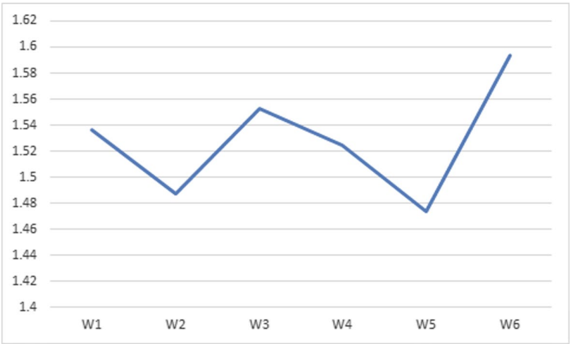
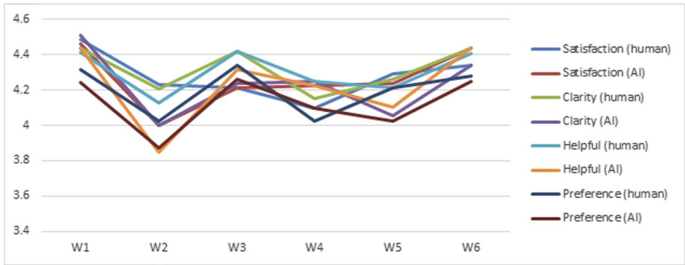
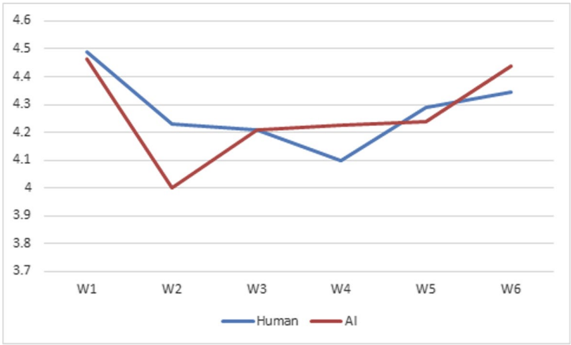
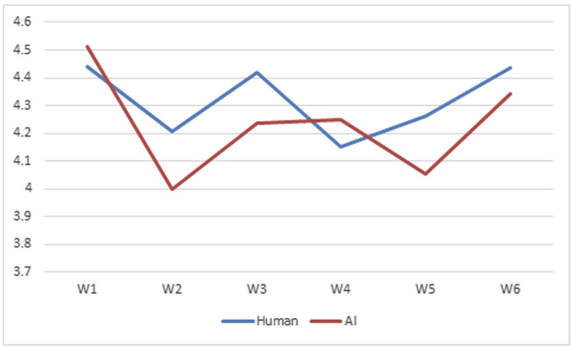
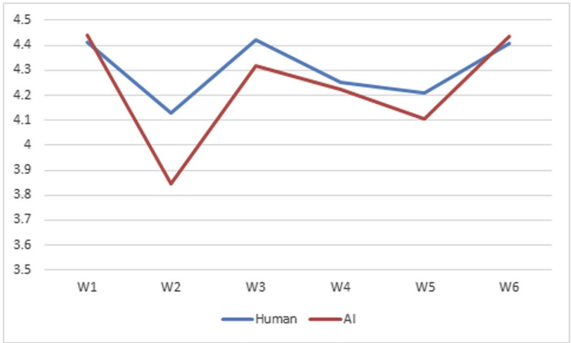
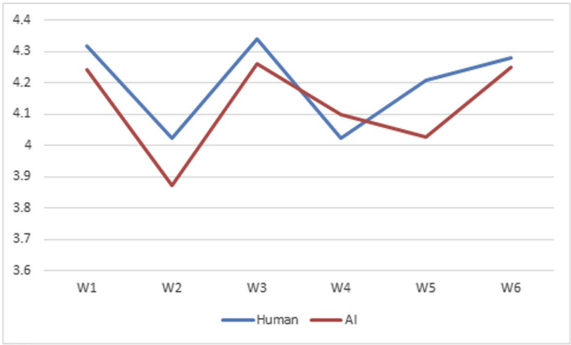
The question of how generative AI tools, such as large language models and chatbots, can be leveraged ethically and effectively in education is ongoing. Given the critical role that writing plays in learning and assessment within educational institutions, it is of growing importance for educators to make thoughtful and informed decisions as to how and in what capacity generative AI tools should be leveraged to assist in the development of students’ writing skills. This paper reports on two longitudinal studies. Study 1 examined learning outcomes of 48 university English as a new language (ENL) learners in a six-week long repeated measures quasi experimental design where the experimental group received writing feedback generated from ChatGPT (GPT-4) and the control group received feedback from their human tutor. Study 2 analyzed the perceptions of a different group of 43 ENLs who received feedback from both ChatGPT and their tutor. Results of study 1 showed no difference in learning outcomes between the two groups. Study 2 results revealed a near even split in preference for AI-generated or human-generated feedback, with clear advantages to both forms of feedback apparent from the data. The main implication of these studies is that the use of AI-generated feedback can likely be incorporated into ENL essay evaluation without affecting learning outcomes, although we recommend a blended approach that utilizes the strengths of both forms of feedback. The main contribution of this paper is in addressing generative AI as an automatic essay evaluator while incorporating learner perspectives.
Overview
The claims and statistics of this paper haven’t been checked yet.
Run the check — free, no account needed. It reads the open-access text and checks the sources it cites.
Integrity signals
Registry
Cites
Statistics
Figures
Verification
Claims the paper makes
The claims and statistics of this paper haven’t been checked yet.
Run the check — free, no account needed. It reads the open-access text and checks the sources it cites.
Claims other papers make about this one
Each is checked against this paper’s own text: does it say what the citing paper says it does?
The source backs part of the claim, not all of it — or backs it for a different population, condition or comparison.
In the citing paper
“This explanation is supported by a study from Escalante, Pack, and Barrett (2023) in which students considered AI-generated feedback more 'readable and detailed' compared to human-generated feedback.”
From Summarise, elaborate, try again: exploring the effect of feedback literacy on AI-enhanced essay writing (2026) · cites this paper as Escalante, Pack, and Barrett (2023)
Experimental — accuracy not yet measuredIn the citing paper
“Combining AI-driven feedback with human input may provide comprehensive guidance tailored to individual needs [142].”
From Leveraging AI in E-Learning: Personalized Learning and Adaptive Assessment through Cognitive Neuropsychology—A Systematic Analysis (2024) · cites this paper as [142]
Self-check
Percentages, sums and reported differences re-computed from the paper’s own numbers.
The self-check needs the paper’s full text.
Citations
Cites
Perceived usefulness, perceived ease of use, and user acceptance of information technology
Davis, F. D. (1989) · MIS Quarterly · doi:10.2307/249008 · Cited by 68,483
Principles and Practice in Second Language Acquisition
Higgs, T. V., & Krashen, S. D. (1983) · Modern Language Journal · doi:10.2307/328293 · Cited by 5,375
Principles and Practice in Second Language Acquisition
Krahnke, K. J., & Krashen, S. D. (1983) · TESOL Quarterly · doi:10.2307/3586656 · Cited by 4,483
Language Learning with Technology
Castillo, D. G. (2021) · Springer eBooks · doi:10.1007/978-981-16-2697-5 · Cited by 2,211
Clinical versus mechanical prediction: a meta-analysis
Grove, W. M., Zald, D. H., Lebow, B. S., Snitz, B. E., & Nelson, C. (2000) · Psychological Assessment · doi:10.1037/1040-3590.12.1.19 · Cited by 1,640
Sociocultural approaches to learning and development: A Vygotskian framework
John-Steiner, V. P., & Mahn, H. (1996) · Educational Psychologist · doi:10.1080/00461520.1996.9653266 · Cited by 1,389
A SWOT analysis of ChatGPT: Implications for educational practice and research
Farrokhnia, M., Banihashem, S. K., Noroozi, O., & Wals, A. (2024) · Innovations in Education and Teaching International · doi:10.1080/14703297.2023.2195846 · Cited by 1,384
Chiu, T. K. F., Xia, Q., Zhou, X., Chai, C. S., & Cheng, M. (2023) · Computers and Education: Artificial Intelligence · doi:10.1016/j.caeai.2022.100118 · Cited by 1,181 · cited 2×
“Personalized learning through evaluating and giving feedback on essay writing has been identified as a potential strength of GenAI (Chiu et al., 2023; Farrokhnia et al., 2023; Zhu et al., 2023), which can, in turn, help decrease teacher workload (Farrokhnia et al., 2023) and prevent teacher burnout.”
BackgroundChatGPT in higher education: considerations for academic integrity and student learning
(2023) · Journal of Applied Learning & Teaching · doi:10.37074/jalt.2023.6.1.17 · Cited by 853 · cited 1×
“…across Australia, New Zealand, The U.K., and the U.S., general sentiment appeared evenly split between positive and negative, but concerns about academic integrity have been raised (Sullivan, 2023), with some educational institutions deciding to ban ChatGPT than to allow its use (Yang, 2023).”
BackgroundExploring the potential of using an AI language model for automated essay scoring
Mizumoto, A., & Eguchi, M. (2023) · Research Methods in Applied Linguistics · doi:10.1016/j.rmal.2023.100050 · Cited by 647
Cited by
Sorted by citations
Items 501–600 of 800
The use of AI-generated feedback in fostering learners’ speaking skills
Azizah, R. N., Wijayanto, A., & Laila, M. (2025) · AIP conference proceedings · doi:10.1063/5.0291141
The convenience trap: How AI could hinder creativity in education
Worwood, M. J. (2025) · Elsevier eBooks · doi:10.1016/b978-0-443-34073-4.00024-1
Nhan, L. K. (2025) · SSRN Electronic Journal · doi:10.2139/ssrn.5822271
Prabawanthi, P. P. W. P., Santosa, M. H., & Indrayani, L. (2025) · Jurnal Pendidikan dan Sastra Inggris · doi:10.55606/jupensi.v5i3.5763
Anwar, K., & Harmanto, B. (2025) · International Journal of Learning Teaching and Educational Research · doi:10.26803/ijlter.24.12.17
Feedback practices in EFL writing instruction – the case of Polish secondary schools
Majchrzak, O. (2023) · Językoznawstwo · doi:10.25312/2391-5137.ns23_omfe
Paita, M., & Romagnoli, S. (2025) · Italiano LinguaDue · doi:10.54103/2037-3597/30460
Murshidi, G. A., Shulgina, G., Kapuza, A., & Costley, J. (2024) · Figshare · doi:10.6084/m9.figshare.26757733
Murshidi, G. A., Shulgina, G., Kapuza, A., & Costley, J. (2024) · Figshare · doi:10.6084/m9.figshare.26757736
Frimayanti, A. I. (2025) · Jurnal Ilmu Pendidikan (JIP) STKIP Kusuma Negara · doi:10.37640/jip.v17i1.2280
Navigating the Review Process in a World of Generative AI
Armstrong, M., & McCarthy, T. M. (2025) · doi:10.37546/jaltpcp2024-02
Enhancing Second Language Acquisition Through Artificial Intelligence
Jafary, M., & Shakib, S. T. (2025) · Advances in computational intelligence and robotics book series · doi:10.4018/979-8-3373-0275-1.ch004
Design and Application of a Homework Behavior Recognition and Personalized Feedback System
Liu, M., Liu, J., & Ouyang, L. (2025) · International Symposium on Artificial Intelligence for Education (ISAIE) · doi:10.1145/3775073.3775168
Okafor, M. U., Shaoan, M. R., Arif, M., Namanyane, T., & Feng, M. (2025) · Kwartalnik Pedagogiczny · doi:10.31338/2657-6007.kp.2025-2.4
Jin, Y. D., Sercu, L., & Zhou, J. (2025) · European Association for Computer Assisted Language Learning Conference (EUROCALL) · doi:10.4995/eurocall2025.2025.21265
Do Social Robots Motivate Students like Humans?
Pande, A., Gosala, B., Gupta, M., & Mishra, D. (2025) · Lecture notes in computer science · doi:10.1007/978-981-95-2379-5_8
The Ethics of AI in English Language Teaching
Rosmayanti, V. (2025) · Advances in computational intelligence and robotics book series · doi:10.4018/979-8-3373-3561-2.ch015
Chatbot-Driven Writing Practice: A Boon or a Bust for EFL Learners?
Karabulut, E., & Ekmekçi, E. (2025) · GiST Education and Learning Research Journal · doi:10.26817/16925777.2015
Fradesta, M., Novita, E. P., & Perti, R. (2025) · Journal of English Education and Teaching · doi:10.33369/jeet.9.3.480-490
Harness the Generative AI tools for Automated Feedback in EAP Writing Assessment
Hu, M., & Xu, R. Y. (2025) · European Journal of Teaching and Education · doi:10.33422/ejte.v7i4.1659
Optimizing the Feedback Process Through Instructor and AI-Generated Feedback
Moni, A. (2026) · Springer proceedings in complexity · doi:10.1007/978-3-032-09062-1_4
生成式语言模型在自动写作评估中的早期综述:自动作文评分与反馈生成领域的进展、挑战及方向
Yue, H., Palermo, C., Liu, R., & He, Y. (2025) · Chinese/English Journal of Educational Measurement and Evaluation · doi:10.59863/kfps7749
AlShahrani, A., & Al-Inbari, F. A. Y. (2025) · Journal of Posthumanism · doi:10.63332/joph.v5i12.3873
A Scientometric Analysis of Generative AI in the Educational Context
Vázquez, J. P. G., Astorga-Vargas, M. A., Corral, L. E. V., Zatarain-Aceves, H., & Vega, J. E. S. (2026) · Springer eBooks · doi:10.1007/978-981-95-4871-2_18
Dyatmika, I. K. W., Sendratari, L. P., & Syahrin, A. A. (2026) · JUPEIS Jurnal Pendidikan dan Ilmu Sosial · doi:10.57218/jupeis.vol5.iss1.2364
Sunitha, G., Vaishnavi, M. S., Joshitha, V., Rajesh, M., Phani, V. A., & Amala, K. (2025) · International Conference on Applied Artificial Intelligence and Computing (ICAAIC) · doi:10.1109/icaaic64647.2025.11330583
Niu, X., & Chen, P. (2026) · Journal of Curriculum and Teaching · doi:10.5430/jct.v15n1p117
Integrating Artificial Intelligence in Language Education: A Systematic Literature Review
Qi, P., Jumaat, N. F., & Abuhassna, H. (2025) · International Conference on Artificial Intelligence for Sustainable Innovation (AI-SI) · doi:10.1109/ai-si66213.2025.11341181
Zhao¹, Y., & Li², D. (2026) · Research Square · doi:10.21203/rs.3.rs-8386846/v1
Li, J., Lu, W., Li, J., & Zhang, Q. (2025) · International Conference on Artificial Intelligence and Future Education (AIFE) · doi:10.1145/3785987.3786050
FROM REDUNDANCY TO CLARITY: ADDRESSING CIRCUMLOCUTION IN STUDENTS’ ENGLISH TRANSLATIONS
Karini, Z. (2025) · ELT Echo The Journal of English Language Teaching in Foreign Language Context · doi:10.24235/eltecho.v10i2.22405
Anissa, Zulaiha, S., Mulyono, H., & Fakhira, J. (2026) · JOALL (Journal of Applied Linguistics and Literature) · doi:10.33369/joall.v11i1.44945
You, Z., & Gong, W. A. (2026) · International Journal of Web-Based Learning and Teaching Technologies · doi:10.4018/ijwltt.400953
Jongkind, R., Heikens, M., Barmentloo, L. M., Elings, E., van der Steijle, F., & van Klaveren, L. (2026) · Research Square · doi:10.21203/rs.3.rs-8352038/v1
Saeli, H., Mahmoodi‐Bakhtiari, B., & Ringer, J. M. (2026) · Iranian and Persian Studies. · doi:10.1007/978-981-95-1046-7_8
AUDIOBOOKS AS A MEDIUM TO ENHANCE EFL STUDENTS’ READING COMPREHENSION
Datumusu, N. A. T. (2025) · TELL-US JOURNAL · doi:10.22202/tus.2025.v11i2.9565
Acut, D. P., Malayao, S. O., Buan, A. T., Caparoso, J. K. V., Mangubat, J. C., & Garcia, M. B. (2026) · Springer eBooks · doi:10.1007/978-3-032-01638-6_11
Gupta, S., Agarwal, A., Iyer, V., & Arya, P. K. (2026) · Emerald Group Publishing Limited eBooks · doi:10.1108/s2754-586520260000005006
AI in Foreign Language Assessment
Ramakrishna, N. K. (2026) · Advances in computational intelligence and robotics book series · doi:10.4018/979-8-3373-2721-1.ch007
Implementing a Modern Hybrid Geology Curriculum: A Case Study from a South African UniversityPreprint
Tibane, L. V., & Ndebele, C. (2026) · doi:10.5194/egusphere-2026-1008
Xue, C., Nitiasih, P. K., Padmadewi, N. N., & Mahayanti, N. W. S. (2025) · PPSDP International Journal of Education · doi:10.59175/pijed.v4i2.797
Hidayat, N., Muafan, W., Nurjannah, E., Affandi, A., & Rosidah (2025) · Journal of Vocational Informatics and Computer Education · doi:10.66053/voice.v3i2.261
Creating a Higher Education Ecosystem Based on Artificial Intelligence Implementation
Melnyk, Y. B., & Pypenko, I. S. (2026) · KRPOCH eBooks · doi:10.26697/aids.2026.11
An investigation of utilizing technology in English as a foreign language writing: a scoping review
Wu, X. (2026) · Reading and Writing · doi:10.1007/s11145-026-10800-w
Боголепова, С. В., & Греченко, А. А. (2025) · Rhema · doi:10.31862/2500-2953-2025-3-81-102
王, 梓. (2026) · 教育创新探索 · doi:10.64635/ja.2026.001
Bao, M., Cao, C., & Zhang, Y. (2025) · International Conference on Artificial Intelligence and Teacher Education (ICAITE) · doi:10.1109/icaite68636.2025.11442463
Hynds, A. R. B. (2025) · I+D Internacional Revista Científica y Académica · doi:10.63636/3078-1639.v4.n2.51
WHITE, S. A. (2024) · Institutional Repositories DataBase (IRDB) · doi:10.50873/11189
Artificial Intelligence Adoption in Education Opportunities Challenges and Future Directions
Kaur, D. I. (2026) · International Journal for Multidimensional Research Perspectives · doi:10.61877/ijmrp.v4i4.318
Liu, W., & Pagano, A. S. (2025) · Translation Cognition & Behavior · doi:10.1075/tcb.00101.liu
Generative Artificial Intelligence (GenAI) in Language Education: Current Trends and Perspectives
Bui, T. T. T., & Hoa, C. T. H. (2026) · Studies in computational intelligence · doi:10.1007/978-3-032-18392-7_1
Design and Evaluation of a Photorealistic AI Virtual Peer in Elementary Collaborative Classroom
Tokida, S., Usui, K., Tanaka, G., Osuga, S., Kayano, M., Itoh, Y., & Ishiguro, Y. (2026) · CHI Conference on Human Factors in Computing Systems · doi:10.1145/3772318.3791450
From Awareness to Application: University Students’ Conceptualizations of AI in English Education
Oh, H.-J. (2026) · Modern English Education · doi:10.18095/meeso.2026.27.1.94
Halimah, N., Muslimin, A. I., & Prabjandee, D. (2026) · Journal of Research on English and Language Learning (J-REaLL) · doi:10.33474/j-reall.v7i1.24655
Ji, Z., & Kaur, N. (2026) · International Journal of Modern Education · doi:10.35631/ijmoe.829068
ChatGPT as a Semiotic Technology: Evolving Gains and Losses for English Language LearningPreprint
Sindoni, M. G. (2026) · SSRN Electronic Journal · doi:10.2139/ssrn.6592482
Park, S., & Choe, H. (2026) · The Journal of Korean Association of Computer Education · doi:10.32431/kace.2026.29.3.009
Japanese EFL Students’ Use of AI Tools in Writing Assignments
Wilkins, M., & Peet, T. (2026) · Institutional Repositories DataBase (IRDB)
Chen, S. (2026) · Acta Globalis Humanitatis et Linguarum · doi:10.69760/aghel.026002009
Tarifa‐Rodríguez, A., Ortega, J. V., & Elvira, A. C. (2026) · Journal of Behavioral Education · doi:10.1007/s10864-026-09629-8
Ghosh, A., & Bhatia, A. (2026) · Lecture notes in networks and systems · doi:10.1007/978-3-032-19678-1_31
Büber, A., & Okvuran, S. A. (2026) · International Journal of Science Education · doi:10.1080/09500693.2026.2647304
Liu, J., Hamid, H. A., & Bao, X. (2026) · International Journal of Evaluation and Research in Education (IJERE) · doi:10.11591/ijere.v15i2.33508
Lv, Y., & Liu, W. (2026) · International Conference on Informatics Education and Computer Technology Applications (IECA) · doi:10.1145/3802133.3802140
Sun, Y., Chen, J., & Wang, D. (2026) · International Conference on Informatics Education and Computer Technology Applications (IECA) · doi:10.1145/3802133.3802254
Miao, W., & Yuen, M. (2026) · Journal of Creativity in Mental Health · doi:10.1080/15401383.2026.2666304
Ginting, E. (2026) · Pengertian Jurnal Pendidikan Indonesia (PJPI) · doi:10.61930/pjpi.v4i1.1519
Azwar, T. A., & Yunita, W. (2026) · JOALL (Journal of Applied Linguistics and Literature) · doi:10.33369/joall.v11i1.45873
Sanzain, S. D., Ilham, I., & Rahmaniah, R. (2026) · Journal of Education Review Provision · doi:10.55885/jerp.v6i1.924
Lu, Y., & Jia, C. (2026) · Computer Assisted Language Learning · doi:10.1080/09588221.2026.2665351
Measuring Collaborative Maturity in Human–AI Work: Development and Validation of the CIQ Scale
Raditya, A., Kaihatu, T. S., & Sutrisno, T. F. (2026) · Inkubis Jurnal Ekonomi dan Bisnis · doi:10.59261/inkubis.v8i1.188
Wali, F. A., Alesh, R. F., Rahuman, S., Mohamed, K. E., & Abdulla, M. (2026) · Advances in computational intelligence and robotics book series · doi:10.4018/979-8-2600-1840-8.ch007
Zou, Z., Ahmad, N. K., & Ismail, L. (2026) · International Journal of Humanities and Social Science · doi:10.30845/ijhss.v16p10
A process-genre approach with genAI Feedback: Interpersonal lexicogrammar development
Zainurrahman, Z., Emilia, E., & Rodliyah, R. S. (2026) · KEMBARA Journal of Scientific Language Literature and Teaching · doi:10.22219/kembara.v12i1.42479
A Generative Feedback System to Support Failure At-risk Online LearnersPreprint
Bañeres, D., Espasa, A., Melo, M. M., & Cortadas, P. (2026) · Research Square · doi:10.21203/rs.3.rs-9538769/v1
The impact of L2 learners’ use of AI on their grit, shyness, and L2 achievements
Kang, D.-M. (2026) · Applied Linguistics · doi:10.1093/applin/amag041
Tikhonova, E. A., & Raitskaya, L. (2026) · Journal of language and Education · doi:10.17323/jle.2026.33523
Voices through the EFL Classroom
ALAÇAM, D., & Aşık, A. (2026) · Journal of Language Teaching and Learning · doi:10.66887/jltl.v16i3.1071
(2026) · International Journal of Education Learning and Pedagogical Sciences (INJELPS) · doi:10.63498/injelps71
Li, S., Wang, S., & Huang, Y. (2026) · Innovations in Education and Teaching International · doi:10.1080/14703297.2026.2678377
Evaluating Generative AI Error Detection in L2 Spanish TextsPreprint
Clementi, L., & Jiménez‐López, M. D. (2026) · SSRN Electronic Journal · doi:10.2139/ssrn.6839402
Bezen, S., & Derman, İ. (2026) · Educational Psychology · doi:10.1080/01443410.2026.2680187
ChatGPT Okuryazarlık Ölçeğinin Türkçeye Uyarlanması; Geçerlilik ve Güvenirlik Çalışması
Arslan, R., & KARAMAN, M. (2026) · Selçuk Üniversitesi Sosyal Bilimler Meslek Yüksekokulu dergisi · doi:10.29249/selcuksbmyd.1791247
Uzun, M., Demir, İ., & Höl, D. (2026) · Research Square · doi:10.21203/rs.3.rs-9876127/v1
Harnessing AI-assisted Writing in Educational Institutions: A Systematic Literature Review
Sudirman, A., Kristanto, T., Gemilang, A. V., & Rais, B. (2026) · IJORER International Journal of Recent Educational Research · doi:10.46245/ijorer.v7i3.1172
He, C., & Zhou, P. (2026) · SSRN Electronic Journal · doi:10.2139/ssrn.6878934
(121778), J. Y., & Hu, J. (2026) · SSRN Electronic Journal · doi:10.2139/ssrn.6879731
Garcia, M. (2026) · International Journal of Transformative Multidisciplinary Studies · doi:10.66074/net55e77r6
A BIBLIOMETRIC ANALYSIS OF AWE IN ACADEMIC WRITING: INSIGHT FROM THE SCOPUS DATABASE
Hanifah, H. N., Hidayat, M. S., & Hasim, W. (2026) · LEARNING Jurnal Inovasi Penelitian Pendidikan dan Pembelajaran · doi:10.51878/learning.v6i3.11692
Learner perceptions of AI-generated feedback on L2 speaking in the ESP context
Yolum, M., & Atay, D. (2026) · English for Specific Purposes · doi:10.1016/j.esp.2026.06.002
The Use of AI-Generated Feedback in an Indonesian EFL Writing Class: Student PerceptionsPreprint
Arifin, M. A., & Salsbury, T. (2026) · SSRN Electronic Journal · doi:10.2139/ssrn.6950560
Examining the Impact of ChatGPT Usage on Student Engagement in MOOCsPreprint
Pham, A. N. M., Ngo, Y., Ha, L., Ho, C., & Pham, N. (2026) · SSRN Electronic Journal · doi:10.2139/ssrn.6960898
Putri, N. A., Zulaiha, S., Mulyono, H., & Fakhira, J. (2026) · Indonesian EFL Journal · doi:10.25134/ieflj.v12i2.67
Kassymova, G. K. (2026) · Bima Journal of Elementary Education · doi:10.37630/bijee.v4i1.4446
Qinjie, S., Zhang, Z., Pituksung, S., Atsawamaitree, L., & He, Y. (2026) · Acta Psychologica · doi:10.1016/j.actpsy.2026.107286
Syahidi, A. A., & Voraputhaporn, K. (2026) · International Conference on Information and Education Technology (ICIET) · doi:10.1109/iciet69664.2026.11561592
Shen, Y., & He, S. (2026) · International Conference on Information and Education Technology (ICIET) · doi:10.1109/iciet69664.2026.11561596 · Cited by 1
AI for Assessment in Art Education: Using NLP for Analyzing Thai Reflective Writing
Chanrueang, S., Chanrueang, S., & Sookplung, P. (2026) · International Conference on Information and Education Technology (ICIET) · doi:10.1109/iciet69664.2026.11561648
Metadata
- Authors
- Escalante, J., Pack, A., & Barrett, A.
- Affiliations
- Brigham Young University–Hawaii (US)
- Florida State University (US)
- Corresponding author
- Escalante, Juan
- Venue
- International Journal of Educational Technology in Higher Education
- Published
- 2023-10-27
- Volume
- 20
- Issue
- 1
- ISSN
- 2365-9440 (ISSN-L)
- OpenAlex
- W4387954002
- Cited by
- 589
- References
- 38
- Citations by year
- 2026: 267 · 2025: 231 · 2024: 90 · 2023: 1
- FWCI
- 138.70
- Type
- journal article
- Language
- en
- Open access
- diamond
- doi.org
- Locations
- International Journal of Educational Technology in Higher Education (publishedVersion, cc-by)
- DOAJ (DOAJ: Directory of Open Access Journals) (submittedVersion, cc-by-sa)
- Topics
- Social Sciences › Education › Artificial Intelligence in Education
- Social Sciences › Arts and Humanities › Language and Linguistics › EFL/ESL Teaching and Learning
- Social Sciences › Education › Student Assessment and Feedback
- Keywords
- AI-generated feedback, generative AI in education, ChatGPT, large language models, writing instruction, learner preferences, writing learning outcomes
About these checks
Registry, retraction, Cites and statistics results are computed, not judged, with one exception: a printed reference that no index lists is read once by a model before it counts as a citation error. Claims are extracted by a model and kept only when their quote appears verbatim in the text; each cited source is then checked, with a model’s help, for whether it says what the claim relies on. Those verdicts can be wrong — read the claim’s quote and the cited source before relying on one.
Statistics and arithmetic are recomputed, not judged.
Confidence bands are shown only for fields calibrated on our annotated test set. None is calibrated yet, so no band is shown.
What counts as a claim ›How we measure confidence ›How we check this ›
Are you an author, or do you see a problem with this page? Request a review
