

BRITD: behavior rhythm insider threat detection with time awareness and user adaptation
Open accessThe DOI matches its Crossref record; 44 of the 45 references it cites were found in a registry or an index; 6 of the 42 sources its claims cite were checked for support.
Abstract
This paper proposes a behavioral feature extraction scheme with time awareness and user adaptation for insider threat detection using deep learning.
Overview
CoChat Summary
TL;DR
BRITD is a deep-learning insider threat detection scheme that implicitly encodes absolute time in behavior feature sequences and adapts sequence construction per user via covariance. On CMU CERT v6.2 it reports overall AUC 0.9730 and precision 0.8072, outperforming all baselines.
Key findings
- BRITD achieves overall AUC 0.9730 and precision 0.8072 on CMU CERT v6.2; the paper states this is at least 0.0802 higher in AUC and at least 0.2746 higher in precision than baselines.
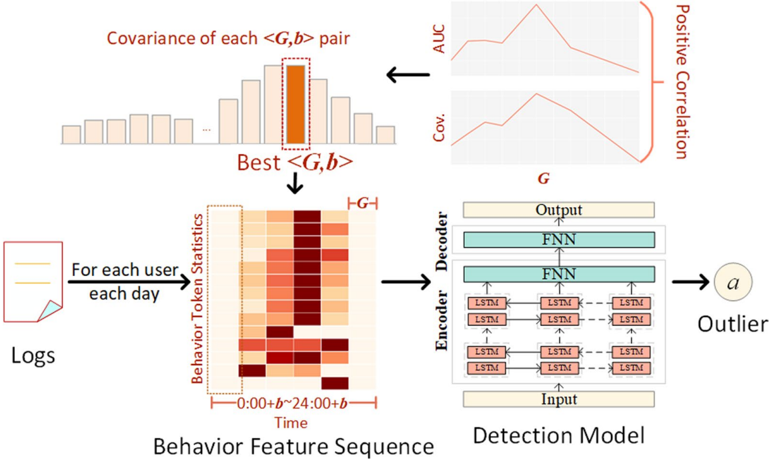
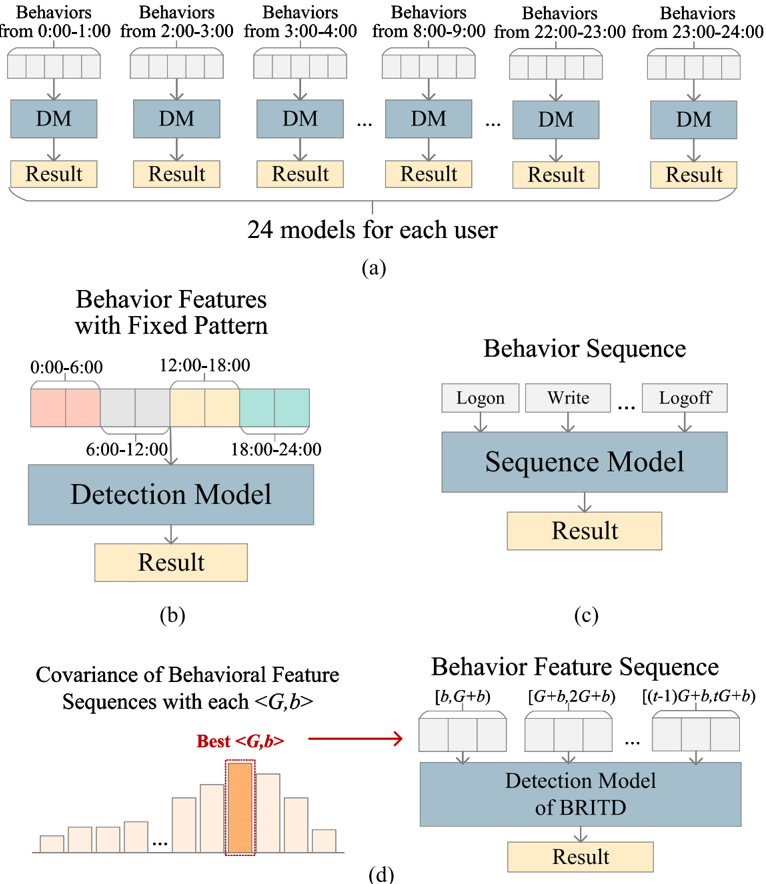
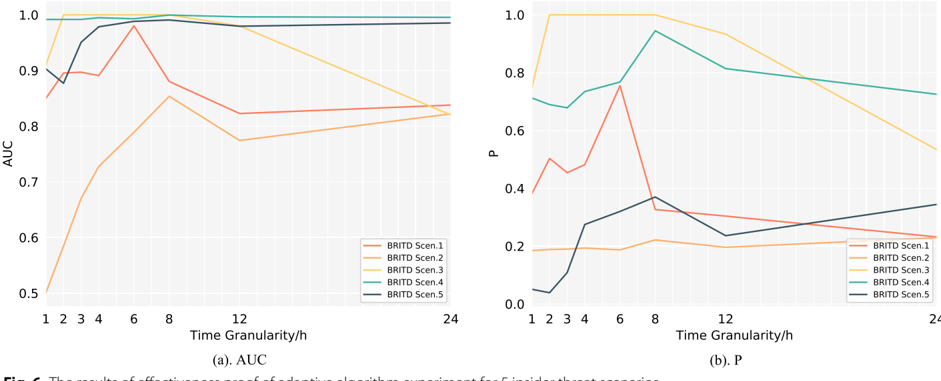
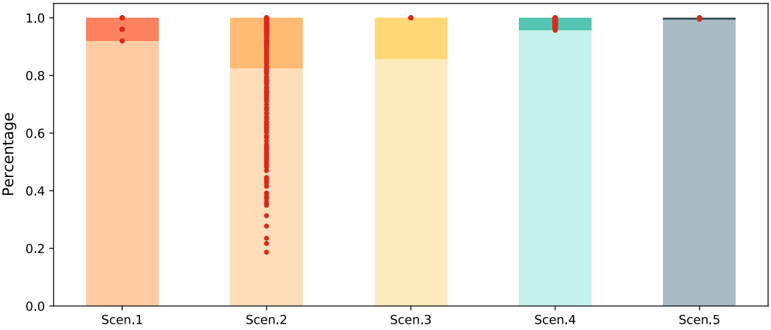
- The user-adaptive feature construction selects the `<G, b>` scheme maximizing feature-sequence covariance; selected optimal schemes were Scen.1 `<12 h, 7 h>`, Scen.2 `<12 h, 8 h>`, Scen.3 `<12 h, 5 h>`, Scen.4 `<12 h, 8 h>`, Scen.5 `<12 h, 8 h>`.
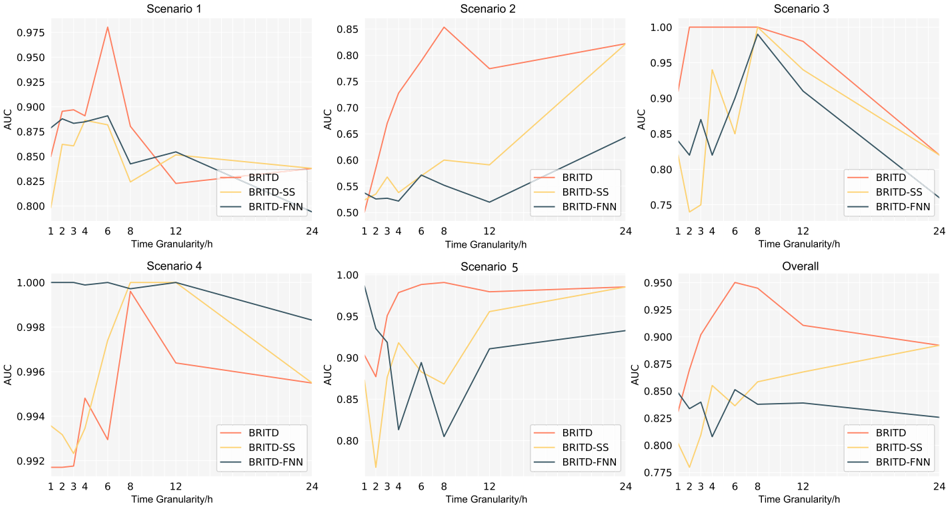
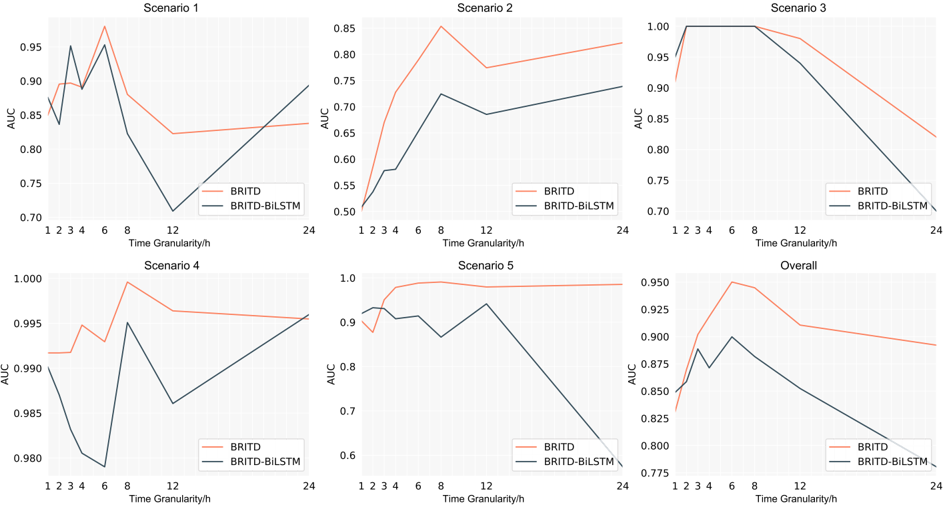
- Ablation shows stacked BiLSTM helps contextual and collective threat scenarios, while FNN improves detection of point, coarse-grained collective, and fine-grained collective threat behaviors; BRITD is best in most scenarios, with Scenario 4 showing slight overfitting because its threats are time-independent point threats.
- Runtime is reported as under 3 s total test time for all test instances of a single user; training time ranges from 426.71 s at 1-h granularity to 65.86 s at 24-h granularity, with 78.49 s at the selected 12-h granularity.
Methods
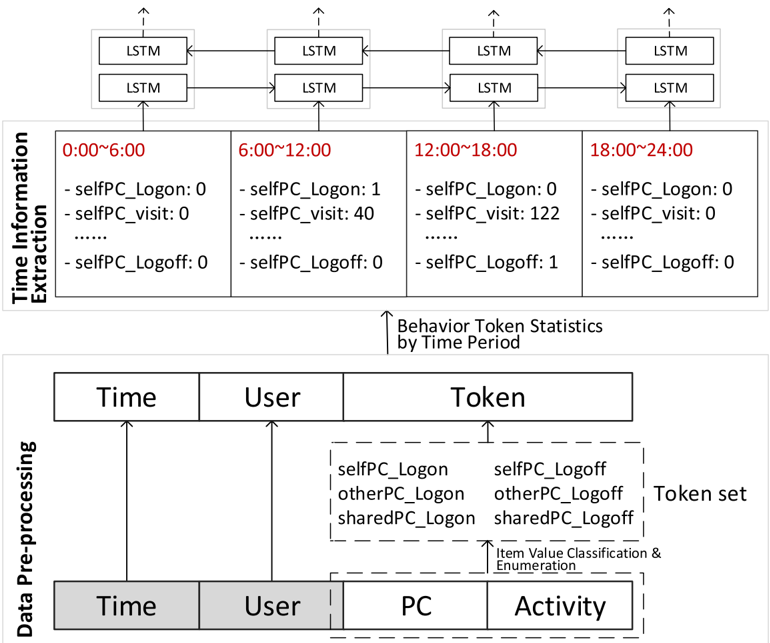
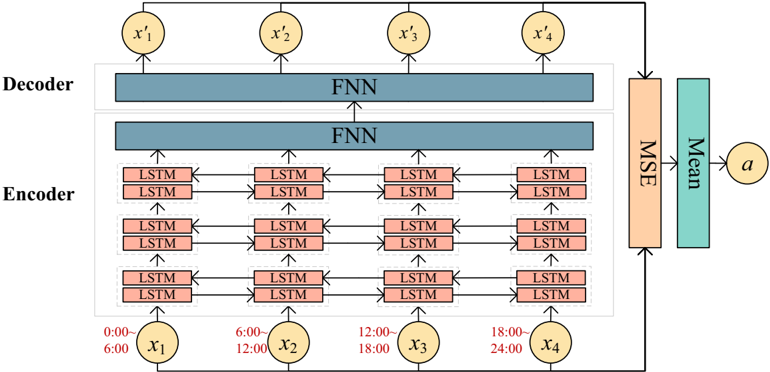
- Feature extraction keeps user id and time, converts other log attributes to behavior tokens, aggregates logs per user chronologically, divides 24 h into periods of granularity `G` with starting bias `b`, counts tokens per period into a 129-dimension statistical vector, and concatenates daily vectors chronologically so absolute time becomes position information.
- The detection model is an autoencoder: encoder uses stacked BiLSTM plus FNN, decoder uses FNN; loss is mean squared reconstruction error, training is semi-supervised on data without insider threat instances, and reconstruction error is the outlier score.
- Experiments use CMU CERT v6.2 (4,000 employees over 516 days); a subset where each user generated insider threat behaviors covering all five scenarios is used, with the first 150 days per user for training and the rest for testing; metrics are AUC and precision (max precision when recall = 1), thresholded by the minimum anomaly value of true anomalies, evaluated at 24-h/day granularity and averaged over 10 replicates.
Limitations
- Paper-stated: detection granularity is not fine enough; accuracy and precision, especially in Scenario 2, still have room for improvement; user behavioral rhythms may change over time but the adaptive scheme does not account for this; and the CERT dataset is synthetic, making real-world effectiveness difficult to demonstrate.
- Paper-stated: optimal threshold selection still depends on the proportion of insider threat instances because the number of test instances is not large enough; adding self-attention can overfit when time granularity is larger and sequences are shorter; Scenario 4 shows slight overfitting because its threats are time-independent.
- Evident from Table 1: some scenario test sets are small (e.g., Scenario 3 has 7 test days), which may limit robustness of the per-scenario results.
Model-written summary. Check it against the paper before relying on it.
Integrity signals
Registry
Cites
Statistics
Figures

Verification
Claims the paper makes
5 Valid · 6 Not valid · 28 Not checked · 95 Own results and interpretations
The cited sources that could be checked couldn’t confirm or dispute this claim.
In the paper
“These studies have focused only on one type of time information, either absolute time information or relative time information.”
§ BRITD: behavior rhythm insider threat detection with time awareness and user adaptation > Introduction
What the sources say
- Not matchedcites Ye et al. (2020)
This doesn’t read as a citation we can look up.
- Not checked — no full text of the sourcecites Liu et al. (2018) matched to “Anomaly-Based Insider Threat Detection Using Deep Autoencoders” (2018) source
- Could not verifycites Tuor et al. (2017) matched to “Deep Learning for Unsupervised Insider Threat Detection in Structured Cybersecurity Data Streams” (2017) sourceExperimental — accuracy not yet measured
Our copy of Tuor et al. (2017) nowhere draws an absolute-vs-relative time distinction: searches for 'absolute time information versus relative time information', 'relative time elapsed since last event absolute timestamp feature', and 'limitations of prior insider threat studies temporal features' returned no such passage. Its Prior Work section characterizes prior studies' gaps along other axes (unstructured input features and lack of online training in Ryan et al. 1998 and Debar et al. 1992; Chandola et al. 2012 noting online and multivariate techniques are underdeveloped; 'each work surveyed below addresses some subset of these components' — namely concurrent multi-entity tracking, structured multivariate data, adaptation to shifting activity distributions, interpretable judgments), and its own time treatment is the 'same time step' vs 'next time step' prediction contrast plus daily aggregation granularity (Conclusions: 'explore different granularities of times'). Nothing in our copy supports the claim, but nothing contradicts it either, so the attribution cannot be checked against this source. (LLM, conf=0.70)
plain- Asserted: passes — The authors put it forward as true.
- Checkable: passes — It can be checked against evidence.
- Load-bearing: passes — The paper’s conclusions depend on it.
- Based: passes — The paper gives a reason why it holds.
- Not matched
The cited sources support only part of this claim — read each source’s verdict below.
In the paper
“Insider threat events were injected into the normal behavior logs.”
§ BRITD: behavior rhythm insider threat detection with time awareness and user adaptation > Experimental settings Dataset
What the sources say
- Partly supportedcites Glasser and Lindauer 2013 matched to “Bridging the Gap: A Pragmatic Approach to Generating Insider Threat Data” (2013) sourceExperimental — accuracy not yet measured
The Threat Scenarios passage says insider-threat incidents were instantiated as synthetic data in the same form and scope as normal background data, supporting the description of threat events appearing alongside normal activity logs. Our copy does not identify those data as the CMU CERT v6.2 dataset, so it does not support that dataset-specific part of the claim. (LLM, conf=0.85)
plain- Asserted: passes — The authors put it forward as true.
- Checkable: passes — It can be checked against evidence.
- Load-bearing: passes — The paper’s conclusions depend on it.
- Based: passes — The paper gives a reason why it holds.
- Partly supported
The cited sources support only part of this claim — read each source’s verdict below.
In the paper
“This dataset simulates a series of behavior logs (including login logs, HTTP logs, file logs, email logs, device logs, and so on) of 4,000 employees over 516 days.”
§ BRITD: behavior rhythm insider threat detection with time awareness and user adaptation > Experimental settings Dataset
What the sources say
- Partly supportedcites Glasser and Lindauer 2013 matched to “Bridging the Gap: A Pragmatic Approach to Generating Insider Threat Data” (2013) sourceExperimental — accuracy not yet measured
The Introduction (page unavailable) says the authors generated synthetic logs from workstations across a large organization for an approximately 500-day period; the Decoy Model section gives examples of logon and HTTP logs. Our copy does not identify the dataset as CMU CERT v6.2 or substantiate the precise figures of 4,000 employees and 516 days. (LLM, conf=0.85)
plain- Asserted: passes — The authors put it forward as true.
- Checkable: passes — It can be checked against evidence.
- Load-bearing: passes — The paper’s conclusions depend on it.
- Based: passes — The paper gives a reason why it holds.
- Partly supported
Every source the paper cites for this claim was checked and supports it.
In the paper
“the CERT dataset we used in the experiments is a synthetic dataset.”
§ BRITD: behavior rhythm insider threat detection with time awareness and user adaptation > Training and test time
What the sources say
- Supportedcites Glasser and Lindauer 2013 matched to “Bridging the Gap: A Pragmatic Approach to Generating Insider Threat Data” (2013) source
The Introduction says the authors’ task was to generate simulated organizational activity logs for the DARPA ADAMS program, and describes the resulting data as synthetic. The citing authors’ statement that they used the dataset in their experiments is about their own work, not a claim this source needs to establish. (LLM, conf=0.88)
plain- Asserted: passes — The authors put it forward as true.
- Checkable: passes — It can be checked against evidence.
- Load-bearing: passes — The paper’s conclusions depend on it.
- Based: passes — The paper gives a reason why it holds.
- Supported
None of the sources cited for this claim have been checked yet.
In the paper
“Without the need for labeled malicious instances, the F1 score of our scheme can still exceed the above two classification-based schemes.”
§ BRITD: behavior rhythm insider threat detection with time awareness and user adaptation > Comparison experiment with classification-based schemes
What the sources say
- Not checked — no full text of the sourcecites Yuan et al. 2020 matched to “Few-shot Insider Threat Detection” (2020) source
- Not matchedcites Chunhui Wu et al. 2021
An author–year citation the paper’s reference list doesn’t settle. We don’t search these by name.
plain- Asserted: passes — The authors put it forward as true.
- Checkable: passes — It can be checked against evidence.
- Load-bearing: passes — The paper’s conclusions depend on it.
- Based: passes — The paper gives a reason why it holds.
70 more claims
Create a free account to see all 134 claims and to verify the 16 references still open.
- Probably not a substantial claim. 34
- It may state two separate claims as one. 34
- The quote only partly states this claim. 2
Self-check
Percentages, sums and reported differences re-computed from the paper’s own numbers.
Each contradiction between two passages listed here was confirmed by an independent check.
Rated minor: it would not touch a result — a value no result rests on, a p-value that stays on the same side of the significance level, or a conflict that is clerical, resolved elsewhere in the paper, or outside its own findings.
In the paper
§ BRITD: behavior rhythm insider threat detection with time awareness and user adaptation > Comparison experiment with anomaly-based schemes
“In scenarios 1, 2, 3, and 5, our model achieves better experimental results than any other baselines”
§ BRITD: behavior rhythm insider threat detection with time awareness and user adaptation > HMM
“| BRITD* | 0.9957 | 0.9333 | 0.8707 | 0.2629 | 1.0000 | 1.0000 | 0.9999 | 0.9900 | 0.9985 | 0.8500 | 0.9730 | 0.8072 | | HMM-BRITD | 0.9152 | 0.4267 | 0.6310 | 0.1861 | 1.0000 | 1.0000 | 1.0000 | 1.0000 | 0.9049 | 0.0504 | 0.8902 | 0.5326 |”
Citations
Cites
Chandola, V., Banerjee, A., & Kumar, V. (2009) · ACM Computing Surveys · doi:10.1145/1541880.1541882 · Cited by 11,687 · cited 1×
“Referring to the classification of behavioral anomalies (Chandola et al. 2009), we classify the insider threat behaviors into the following four categories.”
MethodLSTM-based Encoder-Decoder for Multi-sensor Anomaly Detection
Malhotra, P., Ramakrishnan, A., Anand, G., Vig, L., Agarwal, P., & Shroff, G. (2016) · arXiv · doi:10.48550/arxiv.1607.00148 · Cited by 819 · cited 1×
“Input data can be reconstructed using the encoder-decoder structure and insider threat behaviors can be effectively detected with the help of reconstruction errors (Malhotra et al. 2016).”
BackgroundBridging the Gap: A Pragmatic Approach to Generating Insider Threat Data
Glasser, J., & Lindauer, B. (2013) · 2013 IEEE Security and Privacy Workshops · doi:10.1109/spw.2013.37 · Cited by 344 · cited 2×
“The CERT dataset simulates a series of operational behaviors of internal personnel in a virtual organization system using the relationship graph model, asset graph model, behavior model, psychological model, and topic model (Glasser and Lindauer 2013), Fig.”
MethodLiu, F., Wen, Y., Zhang, D., Jiang, X., Xing, X., & Meng, D. (2019) · Proceedings of the 2019 ACM SIGSAC Conference on Computer and Communications Security · doi:10.1145/3319535.3363224 · Cited by 319 · cited 3×
“Similarly, Soh et al. (2019) (Liu et al. 2019).”
BackgroundMethodDeep learning for insider threat detection: Review, challenges and opportunities
Yuan, S., & Wu, X. (2021) · Computers & Security · doi:10.1016/j.cose.2021.102221 · Cited by 271
Homoliak, I., Toffalini, F., Guarnizo, J., Elovici, Y., & Ochoa, M. (2020) · ACM Computing Surveys · doi:10.1145/3303771 · Cited by 255 · cited 2×
“Insider threat refers to the insider’s behaviors that violate the security policy of the organization (Homoliak et al. 2019), and it is currently widely affecting various enterprises and organizations.”
BackgroundTHREATRACE: Detecting and Tracing Host-Based Threats in Node Level Through Provenance Graph Learning
Wang, S., Wang, Z., Zhou, T., Sun, H., Yin, X., Han, D., Zhang, H., Shi, X., & Yang, J. (2022) · IEEE Transactions on Information Forensics and Security · doi:10.1109/tifs.2022.3208815 · Cited by 228 · cited 1×
“…produced a large number of outstanding research results in the fields of vulnerability mining (Zhang et al. 2021; Ispo-glou et al. 2020), malicious code defense (Lu et al. 2021a, b), APT attack detection (Wang et al. 2022; Alsaheel et al. 2021), and network traffic analysis (Khandait et al. 2021).”
BackgroundUnderstanding Insider Threat: A Framework for Characterising Attacks
Nurse, J. R. C., Buckley, O., Legg, P. A., Goldsmith, M., Creese, S., Wright, G. R. T., & Whitty, M. (2014) · 2014 IEEE Security and Privacy Workshops · doi:10.1109/spw.2014.38 · Cited by 212 · cited 1×
“According to the research of Nurse et al. (2014), users with insider threat risks may disable security tools to provide convenience for their possible threat activities, which can negatively affect the reliability of intrusion detection systems of the organization.”
BackgroundAl-Shehari, T., & Alsowail, R. A. (2021) · Entropy · doi:10.3390/e23101258 · Cited by 193 · cited 1×
“Al-Shehari and Alsowail (2021) implement seven commonly used machine learning algorithms to detect data leakage, with the synthetic minority oversampling technique (SMOTE) to address the data imbalance issue.”
MethodAnomaly Detection with Graph Convolutional Networks for Insider Threat and Fraud Detection
Jiang, J., Chen, J., Gu, T., Choo, K.-K. R., Liu, C., Yu, M., Huang, W., & Mohapatra, P. (2019) · MILCOM 2019 - 2019 IEEE Military Communications Conference (MILCOM) · doi:10.1109/milcom47813.2019.9020760 · Cited by 166 · cited 1×
“…2020), RNN (Zhang et al. 2018; Yuan et al. 2019; Tuor et al. 2017; Nasir et al. 2021; Dr et al. 2022; Villarreal-Vasquez et al. 2023), Transformer (Yuan et al. 2020), isomorphic graph representation learning (Jiang et al. 2019), heterogeneous graph representation learning (Liu et al. 2019), etc.”
Background
Research works printed but not linked: 2
- 2. Alsaheel A, Nan Y, Ma S, Yu L, Walkup G, Celik ZB, Zhang X, Xu D (2021) ATLAS: A sequence-based learning approach for attack investigation. In: USENIX security symposium
- 35. Schlkopf B, Williamson RC, Smola A, Shawe-Taylor J, Platt J (1999) Support vec- tor method for novelty detection. Adv Neural Inf Process Syst, 12
Cited by
Panja, S., Mondal, S., Nag, A., Singh, J. P., Saikia, M. J., & Barman, A. K. (2025) · IEEE Access · doi:10.1109/access.2025.3526878 · Cited by 27
“In [23] researchers introduce a new approach for extracting characteristics of behavior.”
Insights into user behavioral-based insider threat detection: systematic review
Kamatchi, K., & Uma, E. (2025) · International Journal of Information Security · doi:10.1007/s10207-025-01002-6 · Cited by 48
“Among RNNs, LSTM networks have emerged as a dominant choice for UBITD studies [10, 126–128].”
Optimising insider threat prediction: Exploring BiLSTM networks and sequential features
Manoharan, P., Hong, W., Yin, J., Wang, H., Zhang, Y., & Ye, W. (2024) · Data Science and Engineering · doi:10.1007/s41019-024-00260-z · Cited by 22
“Song et al. [45] introduced BRITD (behavior rhythm insider threat detection), a novel approach that prioritises time awareness and user adaptation.”
Self-citationPrasad, P. S. S., Nayak, S. K., & Krishna, M. V. (2025) · International Research Journal of Multidisciplinary Technovation · doi:10.54392/irjmt2527 · Cited by 27
Handling imbalance dataset issue in insider threat detection using machine learning methods
Jaiswal, A., Dwivedi, P., & Dewang, R. K. (2024) · Computers & Electrical Engineering · doi:10.1016/j.compeleceng.2024.109726 · Cited by 18
Jaiswal, A., Dwivedi, P., & Dewang, R. K. (2024) · Multimedia Tools and Applications · doi:10.1007/s11042-024-20273-0 · Cited by 11
Insider Threat Detection: A Review
Manoharan, P., Yin, J., Wang, H., Zhang, Y., & Ye, W. (2024) · International Conference on Networking and Network Applications (NaNA) · doi:10.1109/nana63151.2024.00031 · Cited by 8
“Song et al. [28] proposed BRITD, a novel approach to insider threat detection that prioritizes time awareness and user adaptation.”
BackgroundSelf-citationPolat, O., Doğan, F., Türkoğlu, M., Yolcu, F., & Baturay, M. (2026) · Computer Networks · doi:10.1016/j.comnet.2026.112540 · Cited by 5
An Adaptive Insider Threat Detection Framework Using Causal Analysis and Liquid Neural Networks
Sivakrishna, A. M., Mohan, R., & Anumandla, S. K. (2025) · Security and Privacy · doi:10.1002/spy2.70157 · Cited by 4
A Framework for Insider Threat Detection Using Role-Based Profile Assessment and Threshold
Al-Na’amneh, Q., Aljawarneh, M. M., & Hazaymih, R. (2025) · Advances in computational intelligence and robotics book series · doi:10.4018/979-8-3693-9919-4.ch006 · Cited by 5
Akampurira, P., Edozie, E., Sadiq, B. O., & Buhari, M. D. (2026) · F1000Research · doi:10.12688/f1000research.178351.2 · Cited by 2
MSGL: A multi-scale group learning model for insider threat detection
Pang, M., Ou, W., Meng, W., Shen, M., Yue, Q., & Han, W. (2026) · Expert Systems with Applications · doi:10.1016/j.eswa.2026.132379 · Cited by 4
An authorization framework to mitigate insider threat in CIM-based smart grid
Mahmoudi-Nasr, P. (2024) · Sustainable Energy Grids and Networks · doi:10.1016/j.segan.2024.101572 · Cited by 2
ISFL-AE: Insider-Specific Feature Learning Autoencoder for Lightweight Insider Threat Detection
Kim, Y., & Kim, Y.-G. (2026) · IEEE Transactions on Information Forensics and Security · doi:10.1109/tifs.2026.3659000 · Cited by 1
“…e ff ectiveness of insider-specific feature learning within deep learning-based anomaly detection models, we extended its application to two representative AE architectures—LSTM-AE [21] and Transformer-AE [23]—each built upon backbone models widely employed in prior insider threat detection studies.”
Lavanya, P., Glory, H. A., Aggarwal, M., & Sriram, V. S. S. (2025) · Scientific Reports · doi:10.1038/s41598-025-12127-y · Cited by 1
Rohini, V., & Mohan, R. (2026) · Knowledge-Based Systems · doi:10.1016/j.knosys.2026.116407 · Cited by 2
Data Leakage Behavior Recognition Based on Cyclical Learning Rate based Long-Short Term Memory
Wang, J., Liu, C., Yu, X., Li, T., & Zhou, L. (2024) · International Conference on Integrated Circuits and Communication Systems (ICICACS) · doi:10.1109/icicacs60521.2024.10498905 · Cited by 1
Wang, J., Zheng, D., Xie, D., & Fang, Y. K. (2024) · International Conference on Big Data, Artificial Intelligence and Risk Management (ICBAR) · doi:10.1145/3718751.3718857 · Cited by 2
“BRITD [ 11 ] uses statistical data to construct user behavior sequences and uses Bi-LSTM as an insider threat detection model.”
Galadima, I. B., Ithnin, N., Wahab, N. H. A., Osman, M. Z., & Gabi, D. (2025) · Research Square · doi:10.21203/rs.3.rs-7396895/v1 · Cited by 2
Profiling User Behavior to Identify Insider Threats in Enterprise Information Systems
Shantabhushana, B. M., Sudarsanan, D., Kumar, P., Lokesh, L., Mithun, B. M., Sandeep Kumar, S., & Rakesh, V. S. (2025) · ITM Web of Conferences · doi:10.1051/itmconf/20257901012
Attention-Augmented Visual Representation Learning for Insider Threat DetectionPreprint
Tang, J., YE, X., Cui, H., Wang, W., Jiao, J., Wang, J., & Xiong, X. (2025) · SSRN Electronic Journal · doi:10.2139/ssrn.5895657
Parallel Autoencoder for Unsupervised Anomaly Detection in Large Multimodal User Behavior Data
Gorohov, O., Kazachuk, M., Машечкин, И. В., & Petrovskiy, M. I. (2025) · Lobachevskii Journal of Mathematics · doi:10.1134/s1995080225609087
“…embeddings [11, 15, 16, 20 – 23, 31 ], it is necessary to It should be noted that in existing works sequences of coded user actions [9, 11, 16, 21, 22] and feature vectors calculated based on user activity statistics [10, 13, 14, 16, 17, 19, 28, 30] can be fed into the input of algorithms for…”
InfluentialIbraheem, I. O., Adepoju, T. M., Segbefia, S. K., & Abdulrasaq, A. A. (2025) · Southern African Journal of Security · doi:10.25159/3005-4222/18099
Behavioral Modeling for Insider Threat Detection using Statistical Features and Sequence Profiling
Jaiswal, A., Dwivedi, P., & Dewang, R. K. (2025) · IEEE Silchar Subsection Conference (SILCON) · doi:10.1109/silcon67893.2025.11327238
“The researchers often do not effectively include temporal information [5].”
Academic Certificate Behavioral Fraud Detection: A Proof of Concept
Khormi, I. M., Nanda, P., & Mohanty, M. (2026) · International Conference on Ubiquitous Information Management and Communication (IMCOM) · doi:10.1109/imcom69009.2026.11360876
“[12] propose an anomaly-based insider threat detection system that is user adaptive.”
From static to dynamic risk indicators in predicting and detecting insider attacks
Nanamou, N. K., Salem, R. B., Bkakria, A., Cuppens-Boulahia, N., & Cuppens, F. (2025) · IEEE International Conference on Trust, Security and Privacy in Computing and Communications (TrustCom) · doi:10.1109/trustcom66490.2025.00236 · Cited by 1
QUANT-IT: Quantum Embeddings with NGBoost for Insider Threat Detection
Sivakrishna, A. M., Ramasundaram, M., Rasikannan, L., & Rohini, V. (2025) · IEEE Conference on Information and Communication Technology (CICT) · doi:10.1109/cict67193.2025.11399119
Akampurira, P., Edozie, E., Sadiq, B. O., & Buhari, M. D. (2026) · F1000Research · doi:10.12688/f1000research.178351.1
Suryaprakash, T., & Rajagopal, S. (2026) · International Conference on Research Methodologies in Knowledge Management, Artificial Intelligence and Telecommunication Engineering (RMKMATE) · doi:10.1109/rmkmate69073.2026.11519044 · Cited by 2
“BRITD models behavior rhythms with time-awareness and user adaptation, improving robustness under behavioral drift [5].”
Sareddy, M. R., Algaet, M. A., Khalifa, Z. A., Mohammed, B. S., & Kalaikumaran, T. (2026) · African Journal of Science Technology Innovation and Development · doi:10.1080/20421338.2026.2651540
“Song et al. (2024) accomplished a Behaviour Rhythm Insider Threat Detection (BRITD) through time awareness and user adaptation.”
Kuldeyev, N., Mamyrbayev, O., Аkhmediyarova, A., & Yerzhan, A. (2026) · Electronics · doi:10.3390/electronics15112400
XAI-Enhanced Insider Risk Scoring with Adaptive Weighted Ensemble for Medium-Sized Organizations
Abu-Arqoub, M. H., Marie, R. R., & Titinchi, A. A. (2026) · International Conference on Computational Intelligence Approaches and Applications (ICCIAA) · doi:10.1109/icciaa68481.2026.11543714
“Song et al. [13] developed BRITD incorporating temporal awareness, achieving 92.4% accuracy but requiring extended baselines unsuitable for new users.”
InfluentialSneha, H. N., Nijhum, D. C., & Hosen, M. H. (2026) · IEEE International Conference on Quantum Photonics, Artificial Intelligence & Networking (QPAIN) · doi:10.1109/qpain69676.2026.11546192
“Data augmentation methods such as SPCAGAN increase feature diversity and reduce overfit-ting [12], while federated learning enables privacy-preserving collaborative training across distributed systems [13].”
BTITD: an insider threat detection method based on behavior-timestamp dual-stream network
ZHANG, C., Yang, G., Tian, T., Jiang, B., Lü, Z., & Guo, T.-W. (2026) · Cybersecurity · doi:10.1186/s42400-026-00591-6 · Cited by 1
“…al. 2019; Ma and Rastogi 2020; Sun et al. 2021; Pal et al. 2023; Wang and El Sad-dik 2023; Tian et al. 2024; Xiao et al. 2024; Sharma et al. 2020; Song et al. 2024; Gayathri et al. 2024; Kotb et al. 2025; Song et al. 2025) primarily perform insider threat detection by feeding extracted user…”
Jurišić, M., Tomičić, I., & Bernik, A. (2026) · Signals · doi:10.3390/signals7040059 · Cited by 2
“For CERT 6.2, due to its prohibitive size, we followed an established convention in the literature by randomly selecting a subset of 500 users, similar to [20] or [21].”
InfluentialFine-Grained Insider Threat Detection Based on BDI and Scenario-Aware DBLOF
Xing, L., Zhang, H., Liu, Y., & Wang, X. (2026) · International Conference on Artificial Intelligence, Big Data and Algorithms (CAIBDA) · doi:10.1109/caibda70336.2026.11621199
“The inclusion of temporal deviation and daily aggregation is consistent with recent time-aware and daily insider threat detection studies [9], [11] .”
AI-Driven Predictive Cybersecurity for User Behavior Analysis in Government Institutions
Mohamed, A., & Al-Gindy, A. (2026) · Lecture notes in networks and systems · doi:10.1007/978-3-032-32636-2_8
Malware Detection and Analysis: A Comprehensive Review of Static, Dynamic, and Hybrid Approaches
Prabha, C., Kumari, S., Khan, M. Z., et al. (2026) · Lecture notes in networks and systems · doi:10.1007/978-3-032-23314-1_16
Upadhyay, P., Pavithra, S., Raja, G. P., Suneetha, S., Jakati, J. S., & Rubini, P. E. (2026) · International Conference on Distributed Computing and Electrical Circuits and Electronics (ICDCECE) · doi:10.1109/icdcece68961.2026.11646123
“Song et al. [19] introduced BRITD, which detects threats hidden within normal activities by modeling user behavior rhythms across different time periods.”
Kundiya, K. R., & Haribhakta, Y. V. (2026) · IEEE Access · doi:10.1109/access.2026.3726811
Risk-Adaptive Fine-Grained Authorization via Lightweight-LLM Collaboration
Li, M., & Peng, J. (2026) · International Conference on Cyber Security, Artificial Intelligence and Digital Economy (CSAIDE) · doi:10.1145/3819836.3819847
Wambura, S. M., Ndewingia, H. G., & TONGORA, E. F. (2026) · SSRN Electronic Journal · doi:10.2139/ssrn.7454898
A systematic review of federated learning applications in mitigating insider threats
Mdaghri, A. A., Alae, A., & Hilali, A. A. (2026) · Applied Soft Computing · doi:10.1016/j.asoc.2026.116478
Bayesian Hierarchical Temporal Model for the Early Prediction of Insider Threats
Радівілова, Т., Kirichenko, L., Мулеса, О. Ю., Добринін, І. С., Snihurov, A., & Pantelieiev, V. (2026) · International Conference on Advanced Computer Information Technologies (ACIT) · doi:10.1109/acit69831.2026.11699940
“Third, while recurrent neural architectures such as LSTMs capture sequential patterns, they produce uncalibrated scores and cannot integrate heterogeneous data modalities – in particular, open-source intelligence (OSINT) from public social media – within a coherent generative model [7, 8].”
Explainable Transformer Models for Insider Threat Detection in Enterprise Systems
Al-Dhaqm, A., Bamasoud, D. M., Brnawy, R., Bamaqa, A., Alharbi, A. A., & Aljubayri, I. (2026) · Engineering Technology & Applied Science Research · doi:10.48084/etasr.21281
“Attention augmented temporal aggregation [36], resampling for imbalance [37, 38], capsule networks [39], and behavior rhythm modeling [40] each improved specific aspects, whereas recent work explores adaptive neighborhood learning [41], recurrent models over daily activity codes [42], log text…”
Metadata
- Authors
- Song, S., Gao, N., Zhang, Y., & Ma, C.
- Affiliations
- Chinese Academy of Sciences (CN)
- Corresponding author
- Gao, Neng
- Venue
- Cybersecurity
- Published
- 2024-01-02
- Volume
- 7
- Issue
- 1
- ISSN
- 2523-3246 (ISSN-L)
- OpenAlex
- W4390486486
- Semantic Scholar
- a58ed23a81fc08a35371553f7c81e806c8e514f0
- Cited by
- 45
- References
- 43
- Citations by year
- 2026: 24 · 2025: 14 · 2024: 7
- FWCI
- 16.95
- Type
- journal article
- Language
- en
- Open access
- diamond
- doi.org
- Licence
- cc-by
- creativecommons.org/licenses/by/4.0 (tdm)
- creativecommons.org/licenses/by/4.0 (vor)
- Locations
- Cybersecurity (publishedVersion, cc-by)
- DOAJ (DOAJ: Directory of Open Access Journals) (submittedVersion, cc-by-sa)
- Funders
- National Key Research and Development Program of China
- Topics
- Physical Sciences › Computer Science › Information Systems › Information and Cyber Security
- Physical Sciences › Computer Science › Computer Networks and Communications › Network Security and Intrusion Detection
- Physical Sciences › Computer Science › Information Systems › User Authentication and Security Systems
- Keywords
- insider threat detection, user behavior analysis, user adaptation, stacked bidirectional LSTM
About these checks
Registry, retraction, Cites and statistics results are computed, not judged, with one exception: a printed reference that no index lists is read once by a model before it counts as a citation error. Claims are extracted by a model and kept only when their quote appears verbatim in the text; each cited source is then checked, with a model’s help, for whether it says what the claim relies on. Those verdicts can be wrong — read the claim’s quote and the cited source before relying on one.
The claim verdicts this report counts are experimental: their accuracy is not yet measured.
A language model drew the claims from the paper on 2026-10-10, under version 3 of the claim definition (model deepseek-v4.1-flash, prompt extract-v3).
A second model labelled each claim on 2026-10-10 (model jev-1.13-20260917, definition revision gold-guideline-v0.2).
Cited sources are checked with a language model’s help (qwen3.8-omni-flash and gpt-6-sol).
Statistics and arithmetic are recomputed, not judged.
Confidence bands are shown only for fields calibrated on our annotated test set. None is calibrated yet, so no band is shown.
What counts as a claim ›How we measure confidence ›How we check this ›
Are you an author, or do you see a problem with this page? Request a review
Data sources
Bibliographic data: Semantic Scholar, OpenAlex, Crossref.
Contains information from the Semantic Scholar Academic Graph Datasets, made available under the ODC Attribution License (ODC-BY 1.0).
Semantic Scholar’s data is described in: Kinney, R., et al. (2023). The Semantic Scholar Open Data Platform. arXiv:2301.10140.
