

BRITD: behavior rhythm insider threat detection with time awareness and user adaptation
Open accessThe DOI matches its Crossref record; 44 of the 45 references it cites were found in a registry or an index; 6 of the 42 sources its claims cite were checked for support.
Abstract
This paper proposes a behavioral feature extraction scheme with time awareness and user adaptation for insider threat detection using deep learning.
Overview
CoChat Summary
TL;DR
BRITD is a deep-learning insider threat detection scheme that implicitly encodes absolute time in behavior feature sequences and adapts sequence construction per user via covariance. On CMU CERT v6.2 it reports overall AUC 0.9730 and precision 0.8072, outperforming all baselines.
Key findings
- BRITD achieves overall AUC 0.9730 and precision 0.8072 on CMU CERT v6.2; the paper states this is at least 0.0802 higher in AUC and at least 0.2746 higher in precision than baselines.
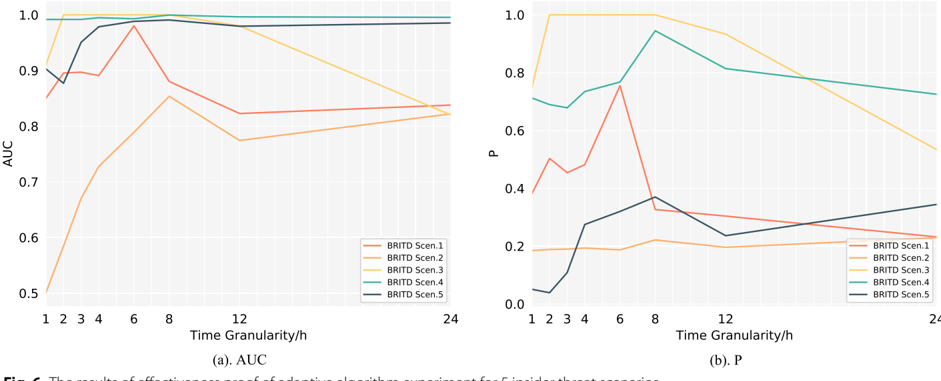
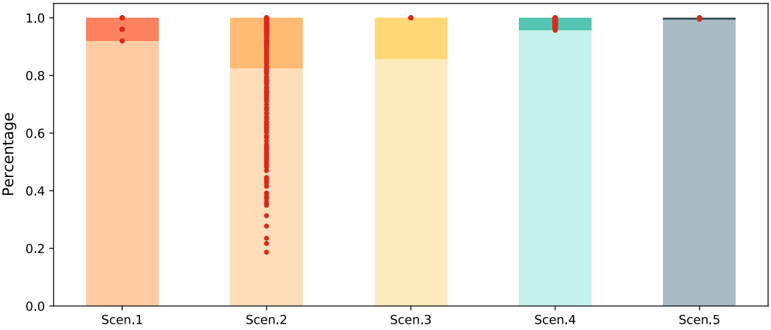
- The user-adaptive feature construction selects the `<G, b>` scheme maximizing feature-sequence covariance; selected optimal schemes were Scen.1 `<12 h, 7 h>`, Scen.2 `<12 h, 8 h>`, Scen.3 `<12 h, 5 h>`, Scen.4 `<12 h, 8 h>`, Scen.5 `<12 h, 8 h>`.
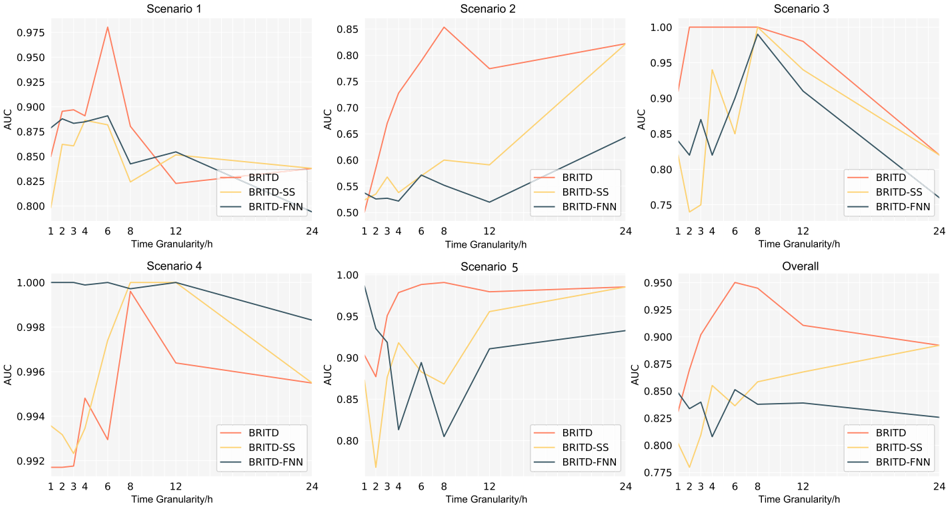
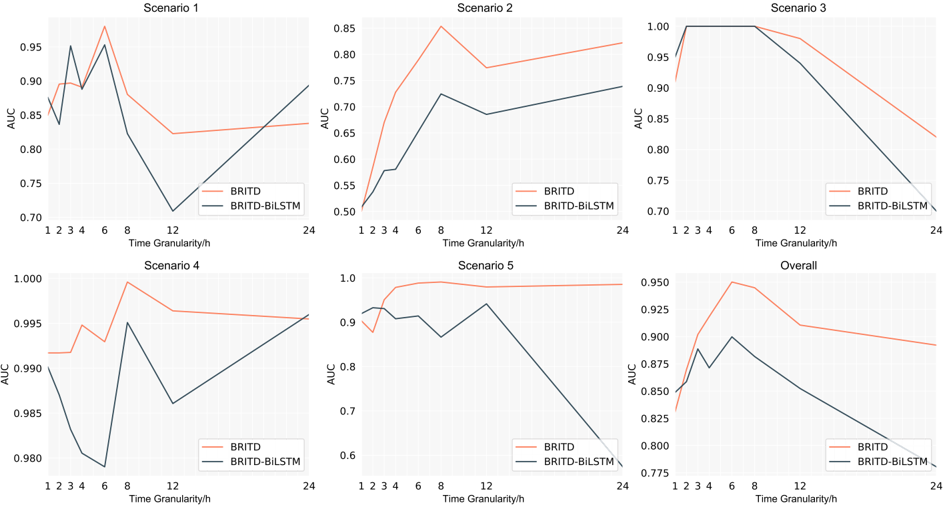
- Ablation shows stacked BiLSTM helps contextual and collective threat scenarios, while FNN improves detection of point, coarse-grained collective, and fine-grained collective threat behaviors; BRITD is best in most scenarios, with Scenario 4 showing slight overfitting because its threats are time-independent point threats.
- Runtime is reported as under 3 s total test time for all test instances of a single user; training time ranges from 426.71 s at 1-h granularity to 65.86 s at 24-h granularity, with 78.49 s at the selected 12-h granularity.
Methods
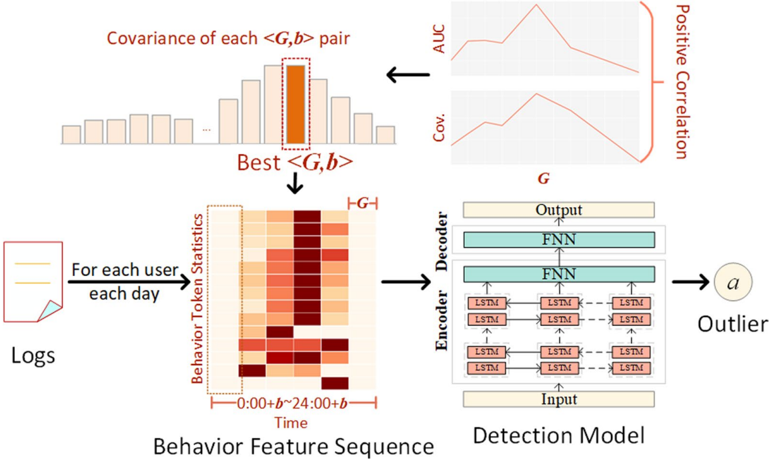
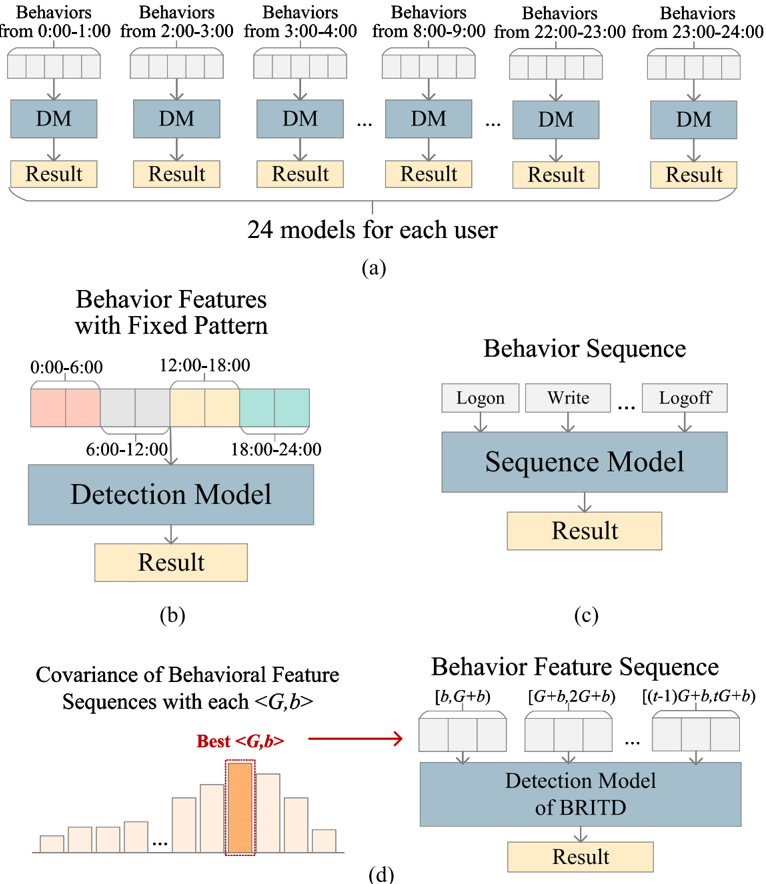
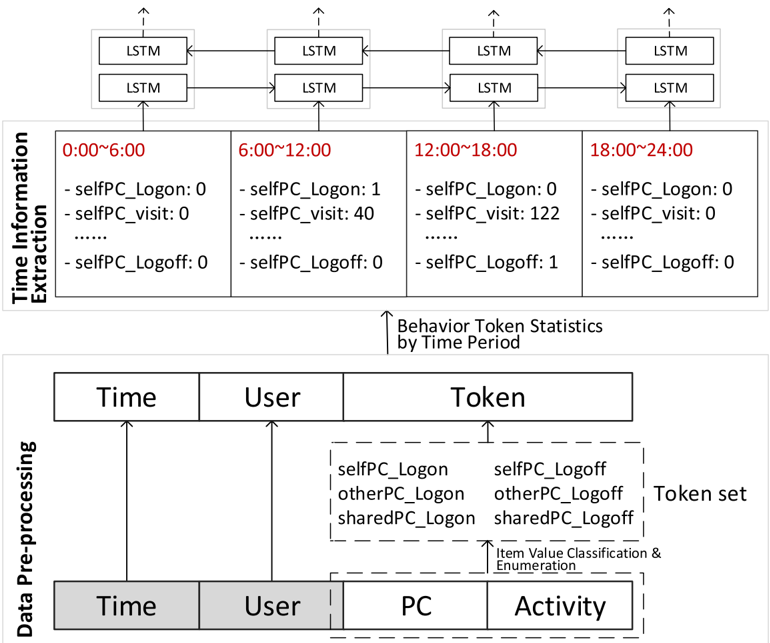
- Feature extraction keeps user id and time, converts other log attributes to behavior tokens, aggregates logs per user chronologically, divides 24 h into periods of granularity `G` with starting bias `b`, counts tokens per period into a 129-dimension statistical vector, and concatenates daily vectors chronologically so absolute time becomes position information.
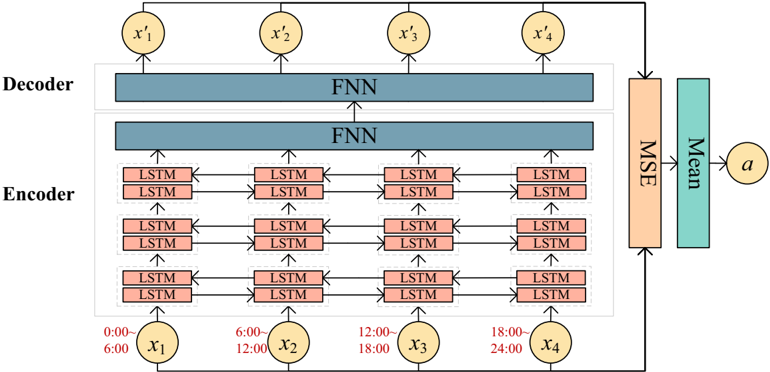
- The detection model is an autoencoder: encoder uses stacked BiLSTM plus FNN, decoder uses FNN; loss is mean squared reconstruction error, training is semi-supervised on data without insider threat instances, and reconstruction error is the outlier score.
- Experiments use CMU CERT v6.2 (4,000 employees over 516 days); a subset where each user generated insider threat behaviors covering all five scenarios is used, with the first 150 days per user for training and the rest for testing; metrics are AUC and precision (max precision when recall = 1), thresholded by the minimum anomaly value of true anomalies, evaluated at 24-h/day granularity and averaged over 10 replicates.
Limitations
- Paper-stated: detection granularity is not fine enough; accuracy and precision, especially in Scenario 2, still have room for improvement; user behavioral rhythms may change over time but the adaptive scheme does not account for this; and the CERT dataset is synthetic, making real-world effectiveness difficult to demonstrate.
- Paper-stated: optimal threshold selection still depends on the proportion of insider threat instances because the number of test instances is not large enough; adding self-attention can overfit when time granularity is larger and sequences are shorter; Scenario 4 shows slight overfitting because its threats are time-independent.
- Evident from Table 1: some scenario test sets are small (e.g., Scenario 3 has 7 test days), which may limit robustness of the per-scenario results.
Model-written summary. Check it against the paper before relying on it.
Integrity signals
Registry
Cites
Statistics
Figures

Verification
Claims the paper makes
5 Valid · 6 Not valid · 28 Not checked · 95 Own results and interpretations
The cited sources that could be checked couldn’t confirm or dispute this claim.
In the paper
“These studies have focused only on one type of time information, either absolute time information or relative time information.”
§ BRITD: behavior rhythm insider threat detection with time awareness and user adaptation > Introduction
What the sources say
- Not matchedcites Ye et al. (2020)
This doesn’t read as a citation we can look up.
- Not checked — no full text of the sourcecites Liu et al. (2018) matched to “Anomaly-Based Insider Threat Detection Using Deep Autoencoders” (2018) source
- Could not verifycites Tuor et al. (2017) matched to “Deep Learning for Unsupervised Insider Threat Detection in Structured Cybersecurity Data Streams” (2017) sourceExperimental — accuracy not yet measured
Our copy of Tuor et al. (2017) nowhere draws an absolute-vs-relative time distinction: searches for 'absolute time information versus relative time information', 'relative time elapsed since last event absolute timestamp feature', and 'limitations of prior insider threat studies temporal features' returned no such passage. Its Prior Work section characterizes prior studies' gaps along other axes (unstructured input features and lack of online training in Ryan et al. 1998 and Debar et al. 1992; Chandola et al. 2012 noting online and multivariate techniques are underdeveloped; 'each work surveyed below addresses some subset of these components' — namely concurrent multi-entity tracking, structured multivariate data, adaptation to shifting activity distributions, interpretable judgments), and its own time treatment is the 'same time step' vs 'next time step' prediction contrast plus daily aggregation granularity (Conclusions: 'explore different granularities of times'). Nothing in our copy supports the claim, but nothing contradicts it either, so the attribution cannot be checked against this source. (LLM, conf=0.70)
plain- Asserted: passes — The authors put it forward as true.
- Checkable: passes — It can be checked against evidence.
- Load-bearing: passes — The paper’s conclusions depend on it.
- Based: passes — The paper gives a reason why it holds.
- Not matched
The cited sources support only part of this claim — read each source’s verdict below.
In the paper
“Insider threat events were injected into the normal behavior logs.”
§ BRITD: behavior rhythm insider threat detection with time awareness and user adaptation > Experimental settings Dataset
What the sources say
- Partly supportedcites Glasser and Lindauer 2013 matched to “Bridging the Gap: A Pragmatic Approach to Generating Insider Threat Data” (2013) sourceExperimental — accuracy not yet measured
The Threat Scenarios passage says insider-threat incidents were instantiated as synthetic data in the same form and scope as normal background data, supporting the description of threat events appearing alongside normal activity logs. Our copy does not identify those data as the CMU CERT v6.2 dataset, so it does not support that dataset-specific part of the claim. (LLM, conf=0.85)
plain- Asserted: passes — The authors put it forward as true.
- Checkable: passes — It can be checked against evidence.
- Load-bearing: passes — The paper’s conclusions depend on it.
- Based: passes — The paper gives a reason why it holds.
- Partly supported
The cited sources support only part of this claim — read each source’s verdict below.
In the paper
“This dataset simulates a series of behavior logs (including login logs, HTTP logs, file logs, email logs, device logs, and so on) of 4,000 employees over 516 days.”
§ BRITD: behavior rhythm insider threat detection with time awareness and user adaptation > Experimental settings Dataset
What the sources say
- Partly supportedcites Glasser and Lindauer 2013 matched to “Bridging the Gap: A Pragmatic Approach to Generating Insider Threat Data” (2013) sourceExperimental — accuracy not yet measured
The Introduction (page unavailable) says the authors generated synthetic logs from workstations across a large organization for an approximately 500-day period; the Decoy Model section gives examples of logon and HTTP logs. Our copy does not identify the dataset as CMU CERT v6.2 or substantiate the precise figures of 4,000 employees and 516 days. (LLM, conf=0.85)
plain- Asserted: passes — The authors put it forward as true.
- Checkable: passes — It can be checked against evidence.
- Load-bearing: passes — The paper’s conclusions depend on it.
- Based: passes — The paper gives a reason why it holds.
- Partly supported
Every source the paper cites for this claim was checked and supports it.
In the paper
“the CERT dataset we used in the experiments is a synthetic dataset.”
§ BRITD: behavior rhythm insider threat detection with time awareness and user adaptation > Training and test time
What the sources say
- Supportedcites Glasser and Lindauer 2013 matched to “Bridging the Gap: A Pragmatic Approach to Generating Insider Threat Data” (2013) source
The Introduction says the authors’ task was to generate simulated organizational activity logs for the DARPA ADAMS program, and describes the resulting data as synthetic. The citing authors’ statement that they used the dataset in their experiments is about their own work, not a claim this source needs to establish. (LLM, conf=0.88)
plain- Asserted: passes — The authors put it forward as true.
- Checkable: passes — It can be checked against evidence.
- Load-bearing: passes — The paper’s conclusions depend on it.
- Based: passes — The paper gives a reason why it holds.
- Supported
None of the sources cited for this claim have been checked yet.
In the paper
“Without the need for labeled malicious instances, the F1 score of our scheme can still exceed the above two classification-based schemes.”
§ BRITD: behavior rhythm insider threat detection with time awareness and user adaptation > Comparison experiment with classification-based schemes
What the sources say
- Not checked — no full text of the sourcecites Yuan et al. 2020 matched to “Few-shot Insider Threat Detection” (2020) source
- Not matchedcites Chunhui Wu et al. 2021
An author–year citation the paper’s reference list doesn’t settle. We don’t search these by name.
plain- Asserted: passes — The authors put it forward as true.
- Checkable: passes — It can be checked against evidence.
- Load-bearing: passes — The paper’s conclusions depend on it.
- Based: passes — The paper gives a reason why it holds.
70 more claims
Create a free account to see all 134 claims and to verify the 15 references still open.
- Probably not a substantial claim. 34
- It may state two separate claims as one. 34
- The quote only partly states this claim. 2
Self-check
Percentages, sums and reported differences re-computed from the paper’s own numbers.
Each contradiction between two passages listed here was confirmed by an independent check.
Rated minor: it would not touch a result — a value no result rests on, a p-value that stays on the same side of the significance level, or a conflict that is clerical, resolved elsewhere in the paper, or outside its own findings.
In the paper
§ BRITD: behavior rhythm insider threat detection with time awareness and user adaptation > Comparison experiment with anomaly-based schemes
“In scenarios 1, 2, 3, and 5, our model achieves better experimental results than any other baselines”
§ BRITD: behavior rhythm insider threat detection with time awareness and user adaptation > HMM
“| BRITD* | 0.9957 | 0.9333 | 0.8707 | 0.2629 | 1.0000 | 1.0000 | 0.9999 | 0.9900 | 0.9985 | 0.8500 | 0.9730 | 0.8072 | | HMM-BRITD | 0.9152 | 0.4267 | 0.6310 | 0.1861 | 1.0000 | 1.0000 | 1.0000 | 1.0000 | 0.9049 | 0.0504 | 0.8902 | 0.5326 |”
Citations
Cites
Chandola, V., Banerjee, A., & Kumar, V. (2009) · ACM Computing Surveys · doi:10.1145/1541880.1541882 · Cited by 11,687 · cited 1×
“Referring to the classification of behavioral anomalies (Chandola et al. 2009), we classify the insider threat behaviors into the following four categories.”
MethodLSTM-based Encoder-Decoder for Multi-sensor Anomaly Detection
Malhotra, P., Ramakrishnan, A., Anand, G., Vig, L., Agarwal, P., & Shroff, G. (2016) · arXiv · doi:10.48550/arxiv.1607.00148 · Cited by 819 · cited 1×
“Input data can be reconstructed using the encoder-decoder structure and insider threat behaviors can be effectively detected with the help of reconstruction errors (Malhotra et al. 2016).”
BackgroundBridging the Gap: A Pragmatic Approach to Generating Insider Threat Data
Glasser, J., & Lindauer, B. (2013) · 2013 IEEE Security and Privacy Workshops · doi:10.1109/spw.2013.37 · Cited by 344 · cited 2×
“The CERT dataset simulates a series of operational behaviors of internal personnel in a virtual organization system using the relationship graph model, asset graph model, behavior model, psychological model, and topic model (Glasser and Lindauer 2013), Fig.”
MethodLiu, F., Wen, Y., Zhang, D., Jiang, X., Xing, X., & Meng, D. (2019) · Proceedings of the 2019 ACM SIGSAC Conference on Computer and Communications Security · doi:10.1145/3319535.3363224 · Cited by 319 · cited 3×
“Similarly, Soh et al. (2019) (Liu et al. 2019).”
BackgroundMethodDeep learning for insider threat detection: Review, challenges and opportunities
Yuan, S., & Wu, X. (2021) · Computers & Security · doi:10.1016/j.cose.2021.102221 · Cited by 271
Homoliak, I., Toffalini, F., Guarnizo, J., Elovici, Y., & Ochoa, M. (2020) · ACM Computing Surveys · doi:10.1145/3303771 · Cited by 255 · cited 2×
“Insider threat refers to the insider’s behaviors that violate the security policy of the organization (Homoliak et al. 2019), and it is currently widely affecting various enterprises and organizations.”
BackgroundTHREATRACE: Detecting and Tracing Host-Based Threats in Node Level Through Provenance Graph Learning
Wang, S., Wang, Z., Zhou, T., Sun, H., Yin, X., Han, D., Zhang, H., Shi, X., & Yang, J. (2022) · IEEE Transactions on Information Forensics and Security · doi:10.1109/tifs.2022.3208815 · Cited by 228 · cited 1×
“…produced a large number of outstanding research results in the fields of vulnerability mining (Zhang et al. 2021; Ispo-glou et al. 2020), malicious code defense (Lu et al. 2021a, b), APT attack detection (Wang et al. 2022; Alsaheel et al. 2021), and network traffic analysis (Khandait et al. 2021).”
BackgroundUnderstanding Insider Threat: A Framework for Characterising Attacks
Nurse, J. R. C., Buckley, O., Legg, P. A., Goldsmith, M., Creese, S., Wright, G. R. T., & Whitty, M. (2014) · 2014 IEEE Security and Privacy Workshops · doi:10.1109/spw.2014.38 · Cited by 212 · cited 1×
“According to the research of Nurse et al. (2014), users with insider threat risks may disable security tools to provide convenience for their possible threat activities, which can negatively affect the reliability of intrusion detection systems of the organization.”
BackgroundAl-Shehari, T., & Alsowail, R. A. (2021) · Entropy · doi:10.3390/e23101258 · Cited by 193 · cited 1×
“Al-Shehari and Alsowail (2021) implement seven commonly used machine learning algorithms to detect data leakage, with the synthetic minority oversampling technique (SMOTE) to address the data imbalance issue.”
MethodAnomaly Detection with Graph Convolutional Networks for Insider Threat and Fraud Detection
Jiang, J., Chen, J., Gu, T., Choo, K.-K. R., Liu, C., Yu, M., Huang, W., & Mohapatra, P. (2019) · MILCOM 2019 - 2019 IEEE Military Communications Conference (MILCOM) · doi:10.1109/milcom47813.2019.9020760 · Cited by 166 · cited 1×
“…2020), RNN (Zhang et al. 2018; Yuan et al. 2019; Tuor et al. 2017; Nasir et al. 2021; Dr et al. 2022; Villarreal-Vasquez et al. 2023), Transformer (Yuan et al. 2020), isomorphic graph representation learning (Jiang et al. 2019), heterogeneous graph representation learning (Liu et al. 2019), etc.”
BackgroundA New Take on Detecting Insider Threats: Exploring the Use of Hidden Markov Models
Rashid, T., Agrafiotis, I., & Nurse, J. R. C. (2016) · Proceedings of the 8th ACM CCS International Workshop on Managing Insider Security Threats · doi:10.1145/2995959.2995964 · Cited by 152 · cited 4×
“• HMM : We construct the HMM-BRITD as the base-line referring to Rashid et al. work (Rashid et al. 2016).”
MethodInfluentialBehavioral Based Insider Threat Detection Using Deep Learning
Nasir, R., Afzal, M., Latif, R., & Iqbal, W. (2021) · IEEE Access · doi:10.1109/access.2021.3118297 · Cited by 146 · cited 4×
“…et al. 2018), DBN (Lin et al. 2017), CNN (Hu et al. 2019; Bu and Cho 2020), RNN (Zhang et al. 2018; Yuan et al. 2019; Tuor et al. 2017; Nasir et al. 2021; Dr et al. 2022; Villarreal-Vasquez et al. 2023), Transformer (Yuan et al. 2020), isomorphic graph representation learning (Jiang…”
BackgroundMethodInfluentialBehavioral Analysis of Insider Threat: A Survey and Bootstrapped Prediction in Imbalanced Data
Azaria, A., Richardson, A., Kraus, S., & Subrahmanian, V. S. (2014) · IEEE Transactions on Computational Social Systems · doi:10.1109/tcss.2014.2377811 · Cited by 133 · cited 1×
“Azaria et al. (2014) construct seven algorithms combining support vector machine (SVM), Multinomial Naive Bayes (MultinomialNB), semi-supervised learning, and partially supervised classification, which can handle training data with the high imbalance and lacking labels.”
MethodScenario-Based Insider Threat Detection From Cyber Activities
Chattopadhyay, P., Wang, L., & Tan, Y.-P. (2018) · IEEE Transactions on Computational Social Systems · doi:10.1109/tcss.2018.2857473 · Cited by 115 · cited 2×
“Deep learning techniques currently utilized for detecting insider threats include deep autoencoder (Liu et al. 2018; Tuor et al. 2017; Chattopadhyay et al. 2018), DBN (Lin et al. 2017), CNN (Hu et al. 2019; Bu and Cho 2020), RNN (Zhang et al. 2018; Yuan et al. 2019; Tuor et al. 2017; Nasir et al.…”
MethodA multiple-kernel clustering based intrusion detection scheme for 5G and IoT networks
Hu, N., Tian, Z., Lu, H. D., Du, X., & Guizani, M. (2021) · International Journal of Machine Learning and Cybernetics · doi:10.1007/s13042-020-01253-w · Cited by 113
Wu, Y., & Zhang, Y. (2022) · Advanced Engineering Informatics · doi:10.1016/j.aei.2021.101522 · Cited by 98 · cited 1×
“Wu and Zhang (2022), Ayed et al. (2023) and Asif et al. (2022) on the other hand, propose trust management mechanisms based on blockchain for the supply chain, the Internet of Vehicles, and the Internet of Things, respectively.”
BackgroundSelf-citationBlockchain-Based Authentication and Trust Management Mechanism for Smart Cities
Asif, M., Aziz, Z., Ahmad, M. B., Khalid, A., Waris, H. A., & Gilani, A. (2022) · Sensors · doi:10.3390/s22072604 · Cited by 91
AutoD: Intelligent Blockchain Application Unpacking Based on JNI Layer Deception Call
Lu, H. D., Jin, C., Helu, X., Zhu, C., Guizani, N., & Tian, Z. (2020) · IEEE Network · doi:10.1109/mnet.011.2000467 · Cited by 90 · cited 1×
“…produced a large number of outstanding research results in the fields of vulnerability mining (Zhang et al. 2021; Ispo-glou et al. 2020), malicious code defense (Lu et al. 2021a, b), APT attack detection (Wang et al. 2022; Alsaheel et al. 2021), and network traffic analysis (Khandait et al. 2021).”
BackgroundA new intelligent multilayer framework for insider threat detection
Al-Mhiqani, M. N., Ahmad, R., Abidin, Z. Z., Abdulkareem, K. H., Mohammed, M. A., Gupta, D., & Shankar, K. (2022) · Computers and Electrical Engineering · doi:10.1016/j.compeleceng.2021.107597 · Cited by 87 · cited 1×
“Fortu-nately, noticing this research gap, Mohammed Nasser Al-Mhiqani et al. propose a machine learning-based hybrid insider threat detection scheme (Al-Mhiqani et al. 2022).”
BackgroundAn Insider Threat Detection Approach Based on Mouse Dynamics and Deep Learning
Hu, T., Niu, W., Zhang, X., Liu, X., Lu, J., & Liu, Y. (2019) · Security and Communication Networks · doi:10.1155/2019/3898951 · Cited by 83 · cited 2×
“Deep learning techniques currently utilized for detecting insider threats include deep autoencoder (Liu et al. 2018; Tuor et al. 2017; Chattopadhyay et al. 2018), DBN (Lin et al. 2017), CNN (Hu et al. 2019; Bu and Cho 2020), RNN (Zhang et al. 2018; Yuan et al. 2019; Tuor et al. 2017; Nasir et al. 2021; Dr et al. 2022;…”
BackgroundAnomaly-Based Insider Threat Detection Using Deep Autoencoders
Liu, L., De Vel, O., Chen, C., Zhang, J., & Xiang, Y. (2018) · 2018 IEEE International Conference on Data Mining Workshops (ICDMW) · doi:10.1109/icdmw.2018.00014 · Cited by 79 · cited 4×
“Deep learning techniques currently utilized for detecting insider threats include deep autoencoder (Liu et al. 2018; Tuor et al. 2017; Chattopadhyay et al. 2018), DBN (Lin et al. 2017), CNN (Hu et al. 2019; Bu and Cho 2020), RNN (Zhang et al. 2018; Yuan et al. 2019; Tuor et al. 2017; Nasir et al.…”
BackgroundMethodInfluentialBu, S.-J., & Cho, S.-B. (2019) · Information Sciences · doi:10.1016/j.ins.2019.09.055 · Cited by 78 · cited 1×
“…insider threats include deep autoencoder (Liu et al. 2018; Tuor et al. 2017; Chattopadhyay et al. 2018), DBN (Lin et al. 2017), CNN (Hu et al. 2019; Bu and Cho 2020), RNN (Zhang et al. 2018; Yuan et al. 2019; Tuor et al. 2017; Nasir et al. 2021; Dr et al. 2022; Villarreal-Vasquez et al. 2023),…”
BackgroundMeng, W., Li, W., Xiang, Y., & Choo, K.-K. R. (2017) · Journal of Network and Computer Applications · doi:10.1016/j.jnca.2016.11.012 · Cited by 76 · cited 2×
“Weizhi Meng et al. propose a trust management scheme based on Bayesian inference (Meng et al. 2017) to defend against insider attacks from medical smartphone networks (MSNs).”
BackgroundMethodDetecting insider attacks in medical cyber–physical networks based on behavioral profiling
Meng, W., Li, W., Wang, Y., & Au, M. H. (2020) · Future Generation Computer Systems · doi:10.1016/j.future.2018.06.007 · Cited by 75 · cited 4×
“Weizhi Meng et al. propose a trust management scheme based on Bayesian inference (Meng et al. 2017) to defend against insider attacks from medical smartphone networks (MSNs).”
BackgroundMethodResultInfluentialDetecting Insider Threat from Enterprise Social and Online Activity Data
Gavai, G., Sricharan, K., Gunning, D., Rolleston, R., Hanley, J., & Singhal, M. (2015) · Proceedings of the 7th ACM CCS International Workshop on Managing Insider Security Threats · doi:10.1145/2808783.2808784 · Cited by 69 · cited 1×
“Gavai et al. (2015) use IF to capture anomalies in user behaviors relative to their own historical behaviors and relative to their colleagues’ behaviors.”
BackgroundInsider Threat Detection Based on Deep Belief Network Feature Representation
Lin, L., Zhong, S., Jia, C., & Chen, K. (2017) · 2017 International Conference on Green Informatics (ICGI) · doi:10.1109/icgi.2017.37 · Cited by 64 · cited 3×
“Deep learning techniques currently utilized for detecting insider threats include deep autoencoder (Liu et al. 2018; Tuor et al. 2017; Chattopadhyay et al. 2018), DBN (Lin et al. 2017), CNN (Hu et al. 2019; Bu and Cho 2020), RNN (Zhang et al. 2018; Yuan et al. 2019; Tuor et al. 2017; Nasir et al. 2021; Dr et al. 2022;…”
MethodEmployee profiling via aspect-based sentiment and network for insider threats detection
Soh, C., Yu, S., Narayanan, A., Duraisamy, S., & Chen, L. (2019) · Expert Systems with Applications · doi:10.1016/j.eswa.2019.05.043 · Cited by 61 · cited 1×
“Similarly, Soh et al. (2019) (Liu et al. 2019).”
Enhancing intrusion detection with feature selection and neural network
Wu, C., & Li, W. (2021) · International Journal of Intelligent Systems · doi:10.1002/int.22397 · Cited by 53 · cited 3×
“In addition, we also compare our scheme (2020) propose a threat detection scheme based on the combination of Transformer and FNN considering time embedding; Wu and Li (2021) propose a threat detection scheme based on an ensemble of NN and RF.”
MethodBlockchain and trust-based clustering scheme for the IoV
Ayed, S., Hbaieb, A., & Fourati, L. C. (2023) · Ad Hoc Networks · doi:10.1016/j.adhoc.2023.103093 · Cited by 53
Hunting for Insider Threats Using LSTM-Based Anomaly Detection
Villarreal-Vasquez, M., Modelo-Howard, G., Dube, S., & Bhargava, B. (2023) · IEEE Transactions on Dependable and Secure Computing · doi:10.1109/tdsc.2021.3135639 · Cited by 52
Insider Threat Detection via Hierarchical Neural Temporal Point Processes
Yuan, S., Zheng, P., Wu, X., & Li, Q. (2019) · 2019 IEEE International Conference on Big Data (Big Data) · doi:10.1109/bigdata47090.2019.9005589 · Cited by 48 · cited 2×
“…et al. 2018; Tuor et al. 2017; Chattopadhyay et al. 2018), DBN (Lin et al. 2017), CNN (Hu et al. 2019; Bu and Cho 2020), RNN (Zhang et al. 2018; Yuan et al. 2019; Tuor et al. 2017; Nasir et al. 2021; Dr et al. 2022; Villarreal-Vasquez et al. 2023), Transformer (Yuan et al. 2020), isomorphic…”
BackgroundMethodPan, M., Huang, W., Li, Y., Zhou, X., Liu, Z., Song, R., Lu, H., Tian, Z., & Luo, J. (2020) · ACM Transactions on Intelligent Systems and Technology · doi:10.1145/3360312 · Cited by 47 · cited 1×
“User behaviors can be described as sequential decision-making processes (Pan et al. 2020).”
BackgroundIoTHunter: IoT network traffic classification using device specific keywords
Khandait, P., Hubballi, N., & Mazumdar, B. (2021) · IET Networks · doi:10.1049/ntw2.12007 · Cited by 39 · cited 1×
“…produced a large number of outstanding research results in the fields of vulnerability mining (Zhang et al. 2021; Ispo-glou et al. 2020), malicious code defense (Lu et al. 2021a, b), APT attack detection (Wang et al. 2022; Alsaheel et al. 2021), and network traffic analysis (Khandait et al. 2021).”
BackgroundFew-shot Insider Threat Detection
Yuan, S., Zheng, P., Wu, X., & Tong, H. (2020) · Proceedings of the 29th ACM International Conference on Information & Knowledge Management · doi:10.1145/3340531.3412161 · Cited by 36 · cited 5×
“Table 5 shows the detection performance comparison results of Yuan et al. (2020) scheme, Chunhui Wu et al. (2021) scheme, and our scheme.”
BackgroundMethodResultInfluentialRole-based Log Analysis Applying Deep Learning for Insider Threat Detection
Zhang, D., Zheng, Y., Wen, Y., Xu, Y., Wang, J., Yu, Y., & Meng, D. (2018) · Proceedings of the 1st Workshop on Security-Oriented Designs of Computer Architectures and Processors · doi:10.1145/3267494.3267495 · Cited by 35 · cited 3×
“…deep autoencoder (Liu et al. 2018; Tuor et al. 2017; Chattopadhyay et al. 2018), DBN (Lin et al. 2017), CNN (Hu et al. 2019; Bu and Cho 2020), RNN (Zhang et al. 2018; Yuan et al. 2019; Tuor et al. 2017; Nasir et al. 2021; Dr et al. 2022; Villarreal-Vasquez et al. 2023), Transformer (Yuan et al.…”
MethodResearch on Intelligent Detection of Command Level Stack Pollution for Binary Program Analysis
Lu, H. D., Jin, C., Helu, X., et al. (2020) · Mobile Networks and Applications · doi:10.1007/s11036-019-01507-0 · Cited by 35
Kandias, M., Gritzalis, D. A., Stavrou, V., & Nikoloulis, K. (2016) · Computers & Security · doi:10.1016/j.cose.2016.12.003 · Cited by 29
Training regime influences to semi-supervised learning for insider threat detection
Le, D. C., Zincir-Heywood, N., & Heywood, M. I. (2021) · IEEE Security and Privacy Workshops (SPW) · doi:10.1109/spw53761.2021.00010 · Cited by 28 · cited 1×
“Duc C. Le et al. apply three semi-supervised learning techniques, namely label propagation (LP), label spreading (LS), and self-training (ST), to insider threat detection to address the issue of data imbalance (Le et al. 2021).”
BackgroundG-SIR: An Insider Attack Resilient Geo-Social Access Control Framework
Baracaldo, N., Palanisamy, B., & Joshi, J. B. D. (2017) · IEEE Transactions on Dependable and Secure Computing · doi:10.1109/tdsc.2017.2654438 · Cited by 27 · cited 1×
“Nathalie Baracaldo et al. use geo-social feature-based user trustworthiness analysis to support authorization decisions (Baracaldo et al. 2019).”
BackgroundDr, J., Oh, H., Kim, M., & Jung, S. (2021) · IEEE Transactions on Industrial Informatics · doi:10.1109/tii.2021.3090362 · Cited by 26 · cited 4×
“Dr et al. (2022) propose an insider threat detection scheme based on Adversarial Recurrent Autoencoder (ARAE) that improves detection performance by making the encoding results close to a normal distribution.”
BackgroundResultInfluentialSIoTFuzzer: Fuzzing Web Interface in IoT Firmware via Stateful Message Generation
Zhang, H., Lü, K., Zhou, X., Yin, Q., Wang, P., & Yue, T. (2021) · Applied Sciences · doi:10.3390/app11073120 · Cited by 21 · cited 1×
“…threats have developed to date, and researchers have produced a large number of outstanding research results in the fields of vulnerability mining (Zhang et al. 2021; Ispo-glou et al. 2020), malicious code defense (Lu et al. 2021a, b), APT attack detection (Wang et al. 2022; Alsaheel et al.…”
BackgroundRauf, U., Shehab, M., Qamar, N., & Sameen, S. (2021) · Future Generation Computer Systems · doi:10.1016/j.future.2020.11.009 · Cited by 17 · cited 1×
“Takabi and Jafarian (2017) and Rauf et al. (2021) propose moving target defense (MTD) based and biological principle-based access con-trol schemes, respectively.”
BackgroundFeature Engineering Method Using Double-Layer Hidden Markov Model for Insider Threat Detection
Ye, X., Hong, S.-S., & Han, M.-M. (2020) · International Journal of Fuzzy Logic and Intelligent Systems · doi:10.5391/ijfis.2020.20.1.17 · Cited by 15 · cited 3×
“Ye et al. (2020), as shown in Fig.”
BackgroundInsider Threat Mitigation Using Moving Target Defense and Deception
Takabi, H., & Jafarian, J. H. (2017) · doi:10.1145/3139923.3139935 · Cited by 5 · cited 1×
“Takabi and Jafarian (2017) and Rauf et al. (2021) propose moving target defense (MTD) based and biological principle-based access con-trol schemes, respectively.”
BackgroundDeep Learning for Unsupervised Insider Threat Detection in Structured Cybersecurity Data Streams
Tuor, A., Kaplan, S., Hutchinson, B., Nichols, N., & Robinson, S. (2017) · arXiv · doi:10.48550/arxiv.1710.00811
Research works printed but not linked: 2
- 2. Alsaheel A, Nan Y, Ma S, Yu L, Walkup G, Celik ZB, Zhang X, Xu D (2021) ATLAS: A sequence-based learning approach for attack investigation. In: USENIX security symposium
- 35. Schlkopf B, Williamson RC, Smola A, Shawe-Taylor J, Platt J (1999) Support vec- tor method for novelty detection. Adv Neural Inf Process Syst, 12
Cited by
Panja, S., Mondal, S., Nag, A., Singh, J. P., Saikia, M. J., & Barman, A. K. (2025) · IEEE Access · doi:10.1109/access.2025.3526878 · Cited by 27
“In [23] researchers introduce a new approach for extracting characteristics of behavior.”
Insights into user behavioral-based insider threat detection: systematic review
Kamatchi, K., & Uma, E. (2025) · International Journal of Information Security · doi:10.1007/s10207-025-01002-6 · Cited by 48
“Among RNNs, LSTM networks have emerged as a dominant choice for UBITD studies [10, 126–128].”
Optimising insider threat prediction: Exploring BiLSTM networks and sequential features
Manoharan, P., Hong, W., Yin, J., Wang, H., Zhang, Y., & Ye, W. (2024) · Data Science and Engineering · doi:10.1007/s41019-024-00260-z · Cited by 22
“Song et al. [45] introduced BRITD (behavior rhythm insider threat detection), a novel approach that prioritises time awareness and user adaptation.”
Self-citationPrasad, P. S. S., Nayak, S. K., & Krishna, M. V. (2025) · International Research Journal of Multidisciplinary Technovation · doi:10.54392/irjmt2527 · Cited by 27
Handling imbalance dataset issue in insider threat detection using machine learning methods
Jaiswal, A., Dwivedi, P., & Dewang, R. K. (2024) · Computers & Electrical Engineering · doi:10.1016/j.compeleceng.2024.109726 · Cited by 18
Metadata
- Authors
- Song, S., Gao, N., Zhang, Y., & Ma, C.
- Affiliations
- Chinese Academy of Sciences (CN)
- Corresponding author
- Gao, Neng
- Venue
- Cybersecurity
- Published
- 2024-01-02
- Volume
- 7
- Issue
- 1
- ISSN
- 2523-3246 (ISSN-L)
- OpenAlex
- W4390486486
- Semantic Scholar
- a58ed23a81fc08a35371553f7c81e806c8e514f0
- Cited by
- 45
- References
- 43
- Citations by year
- 2026: 24 · 2025: 14 · 2024: 7
- FWCI
- 16.95
- Type
- journal article
- Language
- en
- Open access
- diamond
- doi.org
- Licence
- cc-by
- creativecommons.org/licenses/by/4.0 (tdm)
- creativecommons.org/licenses/by/4.0 (vor)
- Locations
- Cybersecurity (publishedVersion, cc-by)
- DOAJ (DOAJ: Directory of Open Access Journals) (submittedVersion, cc-by-sa)
- Funders
- National Key Research and Development Program of China
- Topics
- Physical Sciences › Computer Science › Information Systems › Information and Cyber Security
- Physical Sciences › Computer Science › Computer Networks and Communications › Network Security and Intrusion Detection
- Physical Sciences › Computer Science › Information Systems › User Authentication and Security Systems
- Keywords
- insider threat detection, user behavior analysis, user adaptation, stacked bidirectional LSTM
About these checks
Registry, retraction, Cites and statistics results are computed, not judged, with one exception: a printed reference that no index lists is read once by a model before it counts as a citation error. Claims are extracted by a model and kept only when their quote appears verbatim in the text; each cited source is then checked, with a model’s help, for whether it says what the claim relies on. Those verdicts can be wrong — read the claim’s quote and the cited source before relying on one.
The claim verdicts this report counts are experimental: their accuracy is not yet measured.
A language model drew the claims from the paper on 2026-10-10, under version 3 of the claim definition (model deepseek-v4.1-flash, prompt extract-v3).
A second model labelled each claim on 2026-10-10 (model jev-1.13-20260917, definition revision gold-guideline-v0.2).
Cited sources are checked with a language model’s help (qwen3.8-omni-flash and gpt-6-sol).
Statistics and arithmetic are recomputed, not judged.
Confidence bands are shown only for fields calibrated on our annotated test set. None is calibrated yet, so no band is shown.
What counts as a claim ›How we measure confidence ›How we check this ›
Are you an author, or do you see a problem with this page? Request a review
Data sources
Bibliographic data: Semantic Scholar, OpenAlex, Crossref.
Contains information from the Semantic Scholar Academic Graph Datasets, made available under the ODC Attribution License (ODC-BY 1.0).
Semantic Scholar’s data is described in: Kinney, R., et al. (2023). The Semantic Scholar Open Data Platform. arXiv:2301.10140.
