

Apolipoprotein E: structure determines function, from atherosclerosis to Alzheimer's disease to AIDS
Open accessThe DOI matches its Crossref record; 58 of the 58 references it cites were found in a registry or an index.
Abstract
Apolipoprotein (apo) E has roles beyond lipoprotein metabolism. The detrimental effects of apoE4 in cardiovascular, neurological, and infectious diseases correlate with its structural features (e.g., domain interaction) that distinguish it from apoE3 and apoE2. Structure/function studies revealed that apoE2 is severely defective in LDL receptor binding because of a structural difference that alters the receptor binding region and helped unravel the mechanism of type III hyperlipoproteinemia. ApoE4 is the major genetic risk factor for Alzheimer's disease and sets the stage for neuropathological disorders precipitated by genetic, metabolic, and environmental stressors. ApoE also influences susceptibility to parasitic, bacterial, and viral infections. In HIV-positive patients, apoE4 homozygosity hastens progression to AIDS and death and increases susceptibility to opportunistic infections. The next phase in our understanding of apoE will be characterized by clinical intervention to prevent or reverse the detrimental effects of apoE4 by modulating its structure or blocking the pathological processes it mediates.
Overview
The claims and statistics of this paper haven’t been checked yet.
Free: it reads the open-access text and checks the first 5 claims that cite a source we can check. Create a free account to check every claim.
Integrity signals
Registry
Cites
Statistics
Figures
Verification
Claims the paper makes
The claims and statistics of this paper haven’t been checked yet.
Free: it reads the open-access text and checks the first 5 claims that cite a source we can check. Create a free account to check every claim.
Claims other papers make about this one
Each is checked against this paper’s own text: does it say what the citing paper says it does?
The source backs part of the claim, not all of it — or backs it for a different population, condition or comparison.
In the citing paper
“APOE exerts toxic effects on the cerebrovascular system (694) and neurons (383, 384) and influences A 𝛃 clearance (60, 64, 98, 135, 256, 266, 278, 294, 315, 693), amyloid deposition (39, 256, 258, 266, 278, 314, 518, 612), and tau-related neurodegeneration (533) in an allele-dependent manner APOE4 > APOE3 > APOE2 .”
From Blood-Brain Barrier: From Physiology to Disease and Back (2019) · cites this paper as [384]
Experimental — accuracy not yet measuredThe source backs part of the claim, not all of it — or backs it for a different population, condition or comparison.
In the citing paper
“ApoE is a 34-kDa lipid carrier protein, which in the brain is produced by astrocytes and secreted as nascent, high-density lipoprotein-like particles [4].”
From Blocking the apoE/Aβ interaction ameliorates Aβ-related pathology in APOE ε2 and ε4 targeted replacement Alzheimer model mice (2014) · cites this paper as [4]
Experimental — accuracy not yet measuredThe source backs part of the claim, not all of it — or backs it for a different population, condition or comparison.
In the citing paper
“This notion may explain enhanced Aβ clearance in the setting of apoE2, which is defective in LDL receptor binding [4,5].”
From Blocking the apoE/Aβ interaction ameliorates Aβ-related pathology in APOE ε2 and ε4 targeted replacement Alzheimer model mice (2014) · cites this paper as [4]
Experimental — accuracy not yet measuredThe source backs part of the claim, not all of it — or backs it for a different population, condition or comparison.
In the citing paper
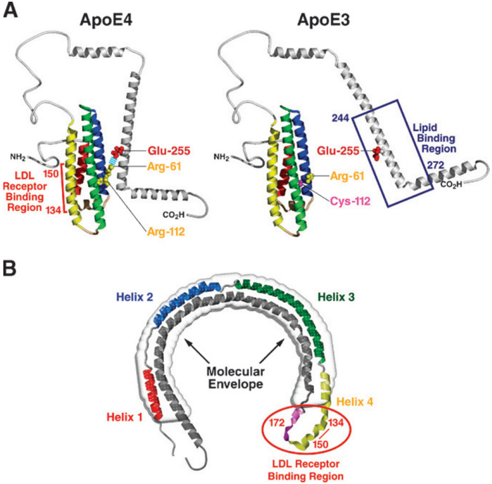
“Structurally, ApoE has two main domains that are connected by a hinge region (amino acids ∼165 to 215); the N-terminal domain (amino acids 1 to 191) forms the receptor binding region, and the C-terminal domain (amino acids ∼225 to 299) harbors the major lipid-binding region (amino acids ∼244 to 272) (Fig. 4, A and C) (20).”
From Secreted Apoe rewires melanoma cell state vulnerability to ferroptosis (2024) · cites this paper as [20]
Experimental — accuracy not yet measuredThe source backs part of the claim, not all of it — or backs it for a different population, condition or comparison.
In the citing paper
“Val254Glu and Arg269Gly are located in the lipid‐binding carboxyl‐terminal domain (amino acids ≈243 to 317). 28 , 42”
From APOE and dementia – resequencing and genotyping in 105,597 individuals (2020) · cites this paper as [42]
Experimental — accuracy not yet measured
15 more claims about this paper
Create a free account to see every claim other papers make about this one.
Self-check
Percentages, sums and reported differences re-computed from the paper’s own numbers.
The self-check needs the paper’s full text.
Citations
Cites
Corder, E. H., Saunders, A. M., Strittmatter, W. J., Schmechel, D. E., Gaskell, P. C., Small, G. W., Roses, A. D., Haines, J. L., & Pericak-Vance, M. A. (1993) · Science · doi:10.1126/science.8346443 · Cited by 9,429
Apolipoprotein E: Cholesterol Transport Protein with Expanding Role in Cell Biology
Mahley, R. W. (1988) · Science · doi:10.1126/science.3283935 · Cited by 4,028
Self-citationApolipoprotein E: Far More Than a Lipid Transport Protein
Mahley, R. W., & Rall, S. C. (2000) · Annual Review of Genomics and Human Genetics · doi:10.1146/annurev.genom.1.1.507 · Cited by 1,836
Self-citationMahley, R. W., Weisgraber, K. H., & Huang, Y. (2006) · Proceedings of the National Academy of Sciences · doi:10.1073/pnas.0600549103 · Cited by 912
Self-citationApolipoprotein E: Structure-Function Relationships
Weisgraber, K. H. (1994) · Advances in Protein Chemistry · doi:10.1016/s0065-3233(08)60642-7 · Cited by 830
Self-citationWeisgraber, K. H., Rall, S. C., & Mahley, R. W. (1981) · Journal of Biological Chemistry · doi:10.1016/s0021-9258(19)52510-8 · Cited by 777
Self-citationHuman apolipoprotein E. The complete amino acid sequence
Rall, S. C., Weisgraber, K. H., & Mahley, R. W. (1982) · Journal of Biological Chemistry · doi:10.1016/s0021-9258(18)34702-1 · Cited by 741
Self-citationThree-Dimensional Structure of the LDL Receptor-Binding Domain of Human Apolipoprotein E
Wilson, C., Wardell, M. R., Weisgraber, K. H., Mahley, R. W., & Agard, D. A. (1991) · Science · doi:10.1126/science.2063194 · Cited by 678
Self-citationHerpes simplex virus type 1 in brain and risk of Alzheimer's disease
Itzhaki, R. F., Lin, W.-R., Shang, D., Wilcock, G. K., Faragher, B., & Jamieson, G. A. (1997) · The Lancet · doi:10.1016/s0140-6736(96)10149-5 · Cited by 669
Polymorphism of apolipoprotein E and occurrence of dysbetalipoproteinaemia in man
UTERMANN, G., HEES, M., & STEINMETZ, A. (1977) · Nature · doi:10.1038/269604a0 · Cited by 666
Cited by
Items 301–400 of 581
Apolipoproteins as context-dependent regulators of lung inflammation
Figueroa, D. M., Gordon, E. M., Yao, X., & Levine, S. J. (2018) · Elsevier eBooks · doi:10.1016/b978-0-12-813553-2.00013-0 · Cited by 20
Dyk, K. V., Zhou, X., Small, B. J., Ahn, J., Zhai, W., Ahles, T. A., Graham, D. M. A., Jacobsen, P. B., Jim, H., McDonald, B. C., et al. (2021) · JNCI Cancer Spectrum · doi:10.1093/jncics/pkab013 · Cited by 16
Ras and Rab Interactor 3: From Cellular Mechanisms to Human Diseases
Shen, R., Murphy, C. J., Xu, X., Hu, M., Ding, J., & Wu, C. (2022) · Frontiers in Cell and Developmental Biology · doi:10.3389/fcell.2022.824961 · Cited by 19
Midlife Hypertension Risk and Cognition in the Non-Demented Oldest Old: Framingham Heart Study
Nishtala, A., Himali, J. J., Beiser, A., Murabito, J. M., Seshadri, S. S., Wolf, P. A., & Au, R. (2015) · Journal of Alzheimer s Disease · doi:10.3233/jad-141881 · Cited by 17
Begcevic Brkovic, I., Zöhrer, B., Scholz, M., Reinicke, M., Dittrich, J., Kamalsada, S., Baber, R., Beutner, F., Teren, A., Engel, C., et al. (2022) · Nutrients · doi:10.3390/nu14122474 · Cited by 13
The triggering receptor expressed on myeloid cells 2–apolipoprotein E signaling pathway in diseases
Lyu, S., Lan, Z., & Li, C. (2023) · Chinese Medical Journal · doi:10.1097/cm9.0000000000002167 · Cited by 15
Insights into the roles of Apolipoprotein E in adipocyte biology and obesity
Jiang, C., & Lin, F. (2024) · International Journal of Obesity · doi:10.1038/s41366-024-01549-9 · Cited by 14
Structural insights into human ABCA7-mediated lipid transport
Fang, S., Wang, L., Cheng, M., Xu, D., Chen, Z., Wang, J., Liao, W., Li, Y., Zhou, C., Hou, W., et al. (2025) · Structure · doi:10.1016/j.str.2024.12.015 · Cited by 16
Papaioannou, I., Simons, J. P., & Owen, J. S. (2012) · Cardiology Research and Practice · doi:10.1155/2012/148796 · Cited by 21
Towards a systems approach for chronic diseases, based on health state modeling
Rebhan, M. (2017) · F1000Research · doi:10.12688/f1000research.11085.1 · Cited by 18
Waldie, S., Sebastiani, F., Moulin, M., Giudice, R. D., Paracini, N., Roosen‐Runge, F., Gerelli, Y., Prévost, S. F., Voss, J. C., Darwish, T. A., et al. (2021) · Frontiers in Chemistry · doi:10.3389/fchem.2021.630152 · Cited by 16
The Interplay of Apoes with Syndecans in Influencing Key Cellular Events of Amyloid Pathology
Hudák, A., Jósvay, K., Domonkos, I., Letoha, A., Szilák, L., & Letoha, T. (2021) · International Journal of Molecular Sciences · doi:10.3390/ijms22137070 · Cited by 16
Plasma apolipoprotein E and severity of suicidal behaviour
Asellus, P., Nordström, P., Nordström, A., & Jokinen, J. (2015) · Journal of Affective Disorders · doi:10.1016/j.jad.2015.09.024 · Cited by 14
Genetic Loci Associated With Periodontitis: The FinnGen Study Based on National Health Registers
Salminen, A., Hyvärinen, K., Ritari, J., Caetano, A. J., Kambur, O., Mäntylä, P., Yılmaz, M., Sinisalo, J. P., FinnGen, Perola, M., et al. (2025) · Journal Of Clinical Periodontology · doi:10.1111/jcpe.14193 · Cited by 15
Rong, W., & Zhou, Y. (2025) · Frontiers in Cell and Developmental Biology · doi:10.3389/fcell.2025.1710474 · Cited by 17
Apolipoprotein E O-glycosylation is associated with amyloid plaques and APOE genotype
Lawler, P. E., Bollinger, J. G., Schindler, S. E., Hodge, C. R., Iglesias, N. J., Krishnan, V., Coulton, J. B., Li, Y., Holtzman, D. M., & Bateman, R. J. (2023) · Analytical Biochemistry · doi:10.1016/j.ab.2023.115156 · Cited by 12
Meuret, C. J., Hu, Y., Smadi, S., Bantugan, M. A., Xian, H., Martinez, A. E., Krauss, R. M., Ma, Q., Nedelkov, D., & Yassine, H. N. (2023) · Alzheimer s Research & Therapy · doi:10.1186/s13195-023-01239-0 · Cited by 13
Rani, S., Kaur, J., Kaur, A., Rohilla, R., Devi, S., Sandhir, R., & Prabhakar, N. (2024) · Journal of Molecular Structure · doi:10.1016/j.molstruc.2024.139174 · Cited by 14
Corsetti, J. P., Gansevoort, R. T., Bakker, S. J. L., & Dullaart, R. P. F. (2016) · Journal of clinical lipidology · doi:10.1016/j.jacl.2016.03.003 · Cited by 13
Secci, R., Hartmann, A., Walter, M., Grabe, H. J., der Auwera, S. V., Kowald, A., Palmer, D. H., Rimbach, G. H., Fuellen, G., & Barrantes, I. (2021) · Critical Reviews in Food Science and Nutrition · doi:10.1080/10408398.2021.1975638 · Cited by 11
Shim, J. T., Poulsen, C. B., Hagensen, M. K., Larsen, T., Heegaard, P. M. H., Christoffersen, C., Bolund, L., Schmidt, M. H., Liu, Y., Li, J., et al. (2017) · JACC Basic to Translational Science · doi:10.1016/j.jacbts.2017.06.004 · Cited by 12
Dafnis, I., Argyri, L., & Chroni, A. (2018) · Neuroscience · doi:10.1016/j.neuroscience.2018.10.026 · Cited by 12
Crosstalk Between Covid-19 and Associated Neurological Disorders: A Review
Ramachandran, A. K., Das, S., & Joseph, A. (2021) · Current Neuropharmacology · doi:10.2174/1570159x19666210113154342 · Cited by 12
Potempa, L. A., Qiu, W. Q., Stefanski, A., & Rajab, I. M. (2022) · Frontiers in Cardiovascular Medicine · doi:10.3389/fcvm.2022.979461 · Cited by 13
Guo, S., Gao, W., Zeng, M., Liu, F., Yang, Q., Chen, L., Wang, Z., Jin, Y., Xiang, P., Chen, H., et al. (2023) · Frontiers in Immunology · doi:10.3389/fimmu.2023.1163781 · Cited by 13
A haptoglobin (HP) structural variant alters the effect of APOE alleles on Alzheimer's disease
Bai, H., Naj, A. C., Benchek, P. H., Dumitrescu, L. C., Hohman, T. J., Hamilton‐Nelson, K. L., Kallianpur, A. R., Griswold, A. J., Vardarajan, B. N., Martin, E. R., et al. (2023) · Alzheimer s & Dementia · doi:10.1002/alz.13050 · Cited by 13
Interaction Between Primary Hyperlipidemias and Type 2 Diabetes: Therapeutic Implications
Zubirán, R., Cruz‐Bautista, I., & Aguilar-Salinas, C. A. (2024) · Diabetes Therapy · doi:10.1007/s13300-024-01626-2 · Cited by 13
Perks, C. M., Barker, R. M., Alhadrami, M., Alkahtani, O., Gill, E., Grishaw, M., Harland, A. J., Henley, P., Li, H., O’Sullivan, E., et al. (2025) · Genes · doi:10.3390/genes16030331 · Cited by 11
Apolipoprotein E derived from CD11c+ cells ameliorates atherosclerosis
Sauter, M., Sauter, M., Nording, H., Lin, C., Olbrich, M., Autenrieth, S. E., Gleissner, C. A., Thunemann, M., Otero, N., Lutgens, E., et al. (2021) · iScience · doi:10.1016/j.isci.2021.103677 · Cited by 13
The Potential of a Stratified Approach to Drug Repurposing in Alzheimer’s Disease
Anderson, C., Bucholc, M., McClean, P. L., & Zhang, S. (2023) · Biomolecules · doi:10.3390/biom14010011 · Cited by 16
Fabilane, C. S., Nguyen, P. N., Hernandez, R. V., Nirudodhi, S. N., Duong, M., Maier, C. S., & Narayanaswami, V. (2016) · Protein and Peptide Letters · doi:10.2174/0929866523666160223122257 · Cited by 11
Apolipoprotein E, a Crucial Cellular Protein in the Lifecycle of Hepatitis Viruses
Tréguier, Y., Bull-Maurer, A., & Roingeard, P. (2022) · International Journal of Molecular Sciences · doi:10.3390/ijms23073676 · Cited by 19
Tavori, H., Fan, D., Giunzioni, I., Zhu, L., Linton, M. F., Fogo, A. B., & Fazio, S. (2014) · Journal of Lipid Research · doi:10.1194/jlr.m049874 · Cited by 10
Гафаров, В. В., Громова, Е. А., Шахтшнейдер, Е. В., Gagulin, I. V., & Гафарова, А. В. (2023) · Journal of Personalized Medicine · doi:10.3390/jpm13091306 · Cited by 10
The Role of RIN3 Gene in Alzheimer’s Disease Pathogenesis: a Comprehensive Review
Meshref, M. M., Ghaith, H. S., Hammad, M. A., Shalaby, M. M. M., Ayasra, F., Monib, F. A., Attia, M. S., Ebada, M. A., Elsayed, H., Shalash, A., et al. (2023) · Molecular Neurobiology · doi:10.1007/s12035-023-03802-0 · Cited by 14
Wefel, J. S., Deshmukh, S., Brown, P. D., Grosshans, D. R., Sulman, E. P., Cerhan, J. H., Mehta, M. P., Khuntia, D., Shi, W., Mishra, M. V., et al. (2023) · International Journal of Radiation Oncology*Biology*Physics · doi:10.1016/j.ijrobp.2023.12.004 · Cited by 10
Insights from Murine Studies on the Site Specificity of Atherosclerosis
Getz, G. S., & Reardon, C. A. (2024) · International Journal of Molecular Sciences · doi:10.3390/ijms25126375 · Cited by 11
Cakir, Z., Lord, S. J., Zhou, Y. M., Jang, G. Μ., Polacco, B. J., Eckhardt, M., Jimenez‐Morales, D., Newton, B. W., Orr, A. L., Johnson, J. R., et al. (2023) · Molecular & Cellular Proteomics · doi:10.1016/j.mcpro.2023.100541 · Cited by 13
Self-citationReijnders, E., van der Laarse, A., Ruhaak, L. R., & Cobbaert, C. M. (2024) · Clinical Proteomics · doi:10.1186/s12014-024-09465-w · Cited by 12
Dressler, L. G. (2012) · Pharmacogenomics · doi:10.2217/pgs.12.59 · Cited by 10
Geffin, R., Martinez, R., Pozas, A. D. L., Issac, B., & McCarthy, M. (2017) · Journal of Neuroimmune Pharmacology · doi:10.1007/s11481-017-9734-9 · Cited by 10
Familial dysbetalipoproteinemia: highly atherogenic and underdiagnosed disorder
Блохина, А. В., Ershova, A. I., Meshkov, A. N., & Drapkina, O. M. (2021) · CARDIOVASCULAR THERAPY AND PREVENTION · doi:10.15829/1728-8800-2021-2893 · Cited by 10
Sahathevan, R. (2014) · Elsevier eBooks · doi:10.1016/b978-0-12-407824-6.00018-5 · Cited by 12
Nankar, S. A., & Pande, A. H. (2013) · Biochimica et Biophysica Acta (BBA) - Molecular and Cell Biology of Lipids · doi:10.1016/j.bbalip.2013.01.006 · Cited by 11
Optical Bio-Inspired Synaptic Devices
Li, P., Wang, K., Jiang, S., He, G., Zhang, H., Cheng, S., Li, Q., Zhu, Y., Fu, C., Wei, H., et al. (2024) · Nanomaterials · doi:10.3390/nano14191573 · Cited by 9
Johari, S., Sharma, A. K., Sinha, S., & Das, A. (2019) · Computational Biology and Chemistry · doi:10.1016/j.compbiolchem.2018.12.013 · Cited by 9
Building in vitro models of the brain to understand the role ofAPOEin Alzheimer’s disease
Pinals, R. L., & Tsai, L. (2022) · Life Science Alliance · doi:10.26508/lsa.202201542 · Cited by 10
The current state of apolipoprotein E in dyslipidemia
Rasmussen, K. L., & Frikke‐Schmidt, R. (2023) · Current Opinion in Lipidology · doi:10.1097/mol.0000000000000915 · Cited by 11
Corsetti, J. P., Sparks, C. E., Bakker, S. J. L., Gruppen, E. G., & Dullaart, R. P. F. (2017) · Clinical Biochemistry · doi:10.1016/j.clinbiochem.2017.11.010 · Cited by 12
Apolipoprotein E binds to and reduces serum levels of DNA-mimicking, pyrrolated proteins
Hirose, S., Hioki, Y., Miyashita, H., Hirade, N., Yoshitake, J., Shibata, T., Kikuchi, R., Matsushita, T., Chikazawa, M., Itakura, M., et al. (2019) · Journal of Biological Chemistry · doi:10.1074/jbc.ra118.006629 · Cited by 12
Risk Factors for Severe COVID-19 and Hepatitis C Infections: The Dual Role of Apolipoprotein E4
Lima, F. B., Bezerra, K. C., Nascimento, J. C. R., Meneses, G. C., & Oriá, R. B. (2022) · Frontiers in Immunology · doi:10.3389/fimmu.2022.721793 · Cited by 8
Endocytosis of AMPA receptors: Role in neurological conditions
Bencsik, N., Morales, C. O. O., Haußer, A., & Schlett, K. (2022) · Progress in molecular biology and translational science · doi:10.1016/bs.pmbts.2022.09.007 · Cited by 10
Apolipoprotein E: the resilience gene
James, L. M., Engdahl, B. E., & Georgopoulos, A. P. (2017) · Experimental Brain Research · doi:10.1007/s00221-017-4941-4 · Cited by 12
Initiative, A. D. N., Wang, J., Peng, G., Liu, P., Tan, X., & Luo, B. (2019) · Cognitive Neurodynamics · doi:10.1007/s11571-019-09536-x · Cited by 10
Recent Trends in Hydrogel-Based Biosensor Technology for the Diagnosis of Neurodegenerative Diseases
Ayçiçek, S., Cevher, Ş. C., & Acar, S. (2025) · ACS Applied Bio Materials · doi:10.1021/acsabm.5c00420 · Cited by 9
Interactions between TTYH2 and APOE facilitate endosomal lipid transfer
Sukalskaia, A., Karner, A., Pugnetti, A., Weber, F., Plochberger, B., & Dutzler, R. (2025) · Nature · doi:10.1038/s41586-025-09200-x · Cited by 11
Mulgrave, V. E., Alsayegh, A. A., Jaldi, A., Omire-Mayor, D., James, N., Ntekim, O. E., Walters, E., Akala, E. O., & Allard, J. S. (2022) · Neuropeptides · doi:10.1016/j.npep.2022.102307 · Cited by 10
The Tree Shrew Model of Parkinson Disease: A Cost-Effective Alternative to Nonhuman Primate Models
Li, H., Mei, L., Nie, X., Wu, L., Lv, L., Ren, X., Yang, J., Cao, H., Wu, J., Zhang, Y., et al. (2024) · Laboratory Investigation · doi:10.1016/j.labinv.2024.102145 · Cited by 13
Disrupted fatty acid distribution in HDL and LDL according to apolipoprotein E allele
Dang, T. M., Conway, V., & Plourde, M. (2014) · Nutrition · doi:10.1016/j.nut.2014.11.019 · Cited by 10
Chen, J., & Wang, J. (2011) · Journal of Biomolecular NMR · doi:10.1007/s10858-011-9526-0 · Cited by 8
Apolipoprotein E Gene Polymorphisms in Saudi Patients with Systemic Lupus Erythematosus
Rayes, H. A., Huraib, G. B., Julkhuf, S., Arfin, M., Tariq, M., & Al-Asmari, A. (2016) · Clinical Medicine Insights Arthritis and Musculoskeletal Disorders · doi:10.4137/cmamd.s38090 · Cited by 9
Maes, M., Vasupanrajit, A., Jirakran, K., Zhou, B., Tunvirachaisakul, C., & Almulla, A. F. (2024) · medRxiv · doi:10.1101/2024.01.01.24300688 · Cited by 11
Dafnis, I., Metso, J., Zannis, V. I., Jauhiainen, M., & Chroni, A. (2015) · Biochemistry · doi:10.1021/acs.biochem.5b00681 · Cited by 7
Finch, C. E., & Martin, G. M. (2016) · Springer eBooks · doi:10.1007/978-3-319-29716-3_19 · Cited by 9
Childhood trauma interacts with ApoE to influence neurocognitive function in women living with HIV
Womersley, J. S., Spies, G., Seedat, S., & Hemmings, S. M. J. (2018) · Journal of NeuroVirology · doi:10.1007/s13365-018-0700-y · Cited by 6
Conformational Reorganization of Apolipoprotein E Triggered by Phospholipid Assembly
Prakashchand, D. D., & Mondal, J. (2021) · The Journal of Physical Chemistry B · doi:10.1021/acs.jpcb.1c03011 · Cited by 7
LDLR expression in the cochlea suggests a role in endolymph homeostasis and cochlear amplification
Saume, A., Thiry, M., & Defourny, J. (2021) · Hearing Research · doi:10.1016/j.heares.2021.108311 · Cited by 9
Aguilar-Pineda, J. A., Paco-Coralla, S. G., Febres-Molina, C., Gamero-Begazo, P. L., Shrivastava, P., Vera-López, K. J., Dávila-Del-Carpio, G., López-Casaperalta, P., Gómez, B., & Cardenas, C. L. L. (2022) · Biomolecules · doi:10.3390/biom12040499 · Cited by 8
Touré, M., Diouf, N. N., Thiam, S., Diop, J. P. D., Coly, M. S., Mbengue, A., Sar, F. B., Bâ, A., Diallo, F. A., & Samb, A. (2022) · Cureus · doi:10.7759/cureus.24063 · Cited by 8
Ramachandran, A. K., Das, S., Shenoy, G. G., Mudgal, J., & Joseph, A. (2022) · CNS & Neurological Disorders - Drug Targets · doi:10.2174/1871527322666221226145141 · Cited by 8
Frisardi, V. (2012) · Journal of Alzheimer s Disease · doi:10.3233/jad-2012-111568 · Cited by 7
Animal Models of Atherosclerosis
Getz, G. S., & Reardon, C. A. (2017) · Elsevier eBooks · doi:10.1016/b978-0-12-809468-6.00008-5 · Cited by 9
Stapleton, M. C., Koch, S., Cortes, D. R. E., Wyman, S. K., Schwab, K. E., Mueller, S. G., McKennan, C. G., Boehm‐Sturm, P., & Wu, Y. L. (2023) · Frontiers in Neuroscience · doi:10.3389/fnins.2023.1183312 · Cited by 6
Pasquariello, A. (2014) · Journal of Genetic Disorders & Genetic Reports · doi:10.4172/2327-5790.1000113 · Cited by 6
Григорьева, И. Н., & Нотова, Т. Е. (2023) · Ateroscleroz · doi:10.52727/2078-256x-2023-19-1-47-56 · Cited by 9
The Impact of the Apolipoprotein E Genotype on Cardiovascular Disease and Cognitive Disorders
McMaster, M. W., Shah, A., Kangarlu, J., Cheikhali, R., Frishman, W. H., & Aronow, W. S. (2024) · Cardiology in Review · doi:10.1097/crd.0000000000000703 · Cited by 11
Mocciaro, G., George, A. L., Allison, M. E., Frontini, M., Huang‐Doran, I., Reiman, F., Gribble, F. M., Griffin, J. L., Vidal‐Puig, A., Azzu, V., et al. (2025) · Liver International · doi:10.1111/liv.16200 · Cited by 9
Smith, C. J., & Ashford, J. W. (2017) · Journal of Systems and Integrative Neuroscience · doi:10.15761/jsin.1000168 · Cited by 8
Are KIF6 and APOE polymorphisms associated with power and endurance athletes?
Wojciechowicz, B., Laguette, M.-J. N., Sawczuk, M., Humińska‐Lisowska, K., Maciejewska, A., Ficek, K., Michałowska‐Sawczyn, M., Leońska‐Duniec, A., Kaczmarczyk, M., Chycki, J., et al. (2020) · European Journal of Sport Science · doi:10.1080/17461391.2020.1817983 · Cited by 6
Etiopathogenesis of insulin resistance
Gupta, A. (2021) · Elsevier eBooks · doi:10.1016/b978-0-12-820234-0.00010-x · Cited by 9
Donen, G., Milad, N., & Bernatchez, P. N. (2023) · Journal of Neuromuscular Diseases · doi:10.3233/jnd-230126 · Cited by 10
Genetic testing and HIV dementia: teasing out the molecular mechanisms of disease
Rappaport, J., & Berger, J. R. (2010) · AIDS · doi:10.1097/qad.0b013e32833ac7e8 · Cited by 7
Apolipoprotein E (APOE) regulates the transport of monosialotetrahexosylganglioside (GM1)
Zhang, D. Y., Wang, J., Huang, G., Dokholyan, M., Willcox, S., Griffith, J. D., Ding, F., & Dokholyan, N. V. (2025) · Journal of Biological Chemistry · doi:10.1016/j.jbc.2025.110778 · Cited by 7
Recio, B. S., Pérez, W. A., Tjondropurnomo, R., Hsu, J., Ahmed, S., Parikh, S., Sun, J., Mitra, S., Goit, R. K., Brecha, N. C., et al. (2026) · Neurobiology of Aging · doi:10.1016/j.neurobiolaging.2025.12.007 · Cited by 5
Duerksen, J. M., Lopez, R. C. T., Tappia, P. S., Ramjiawan, B., & Mansouri, B. (2024) · Molecular and Cellular Biochemistry · doi:10.1007/s11010-024-05176-w · Cited by 8
Stratikos, E., & Chroni, A. (2014) · Clinical and Experimental Nephrology · doi:10.1007/s10157-013-0886-5 · Cited by 5
Liu, X., Zeng, Q., Luo, X., Li, K., Hong, H., Wang, S., Guan, X., Wu, J., Zhang, R., Zhang, T., et al. (2021) · Frontiers in Aging Neuroscience · doi:10.3389/fnagi.2021.591347 · Cited by 5
Why, after Chemotherapy, is it Necessary to Assess Memory Using Translational Testing?
Acevedo, S. F. (2012) · Breast Cancer Basic and Clinical Research · doi:10.4137/bcbcr.s10293 · Cited by 6
Suvatha, A., Kandi, S. M., Bhat, D. I., Rao, N., Vazhayil, V. V., & Chetan, G. K. (2017) · Cellular & Molecular Biology Letters · doi:10.1186/s11658-017-0059-8 · Cited by 6
Kazdal, F., Bahadorı, F., Çelik, B., Ertaş, A., & Topçu, G. (2019) · Current Pharmaceutical Biotechnology · doi:10.2174/1389201021666191210125851 · Cited by 7
Fukase, T., Dohi, T., Chikata, Y., Takahashi, N., Endo, H., Doi, S., Nishiyama, H., Kato, Y., Okai, I., Iwata, H., et al. (2021) · Atherosclerosis · doi:10.1016/j.atherosclerosis.2021.08.021 · Cited by 6
Singh, H. N., Swarup, V., Dubey, N. K., Jha, N. K., Singh, A. K., Lo, W., & Kumar, S. (2022) · Biomedicines · doi:10.3390/biomedicines10030611 · Cited by 8
Apolipoprotein E4 inhibits γ‐secretase activity via binding to the γ‐secretase complex
Sun, Y., Islam, S., Gao, Y., Nakamura, T., Zou, K., & Michikawa, M. (2023) · Journal of Neurochemistry · doi:10.1111/jnc.15750 · Cited by 6
Genetics of Alzheimer’s Disease
de la Torre, J. C. (2016) · Springer eBooks · doi:10.1007/978-3-319-34057-9_9 · Cited by 6
Illuminating the full spectrum of APOE variation
Hegele, R. A. (2023) · Atherosclerosis · doi:10.1016/j.atherosclerosis.2023.117311 · Cited by 6
Rodent models for dry eye syndrome (DES)
Zhu, J., Liu, L., Wu, J., & Bai, L. (2025) · Contact Lens and Anterior Eye · doi:10.1016/j.clae.2025.102383 · Cited by 4
Unraveling APOE4's Role in Alzheimer's Disease: Pathologies and Therapeutic Strategies
Tripathi, S., Sharma, Y., & Kumar, D. (2024) · Current Protein and Peptide Science · doi:10.2174/0113892037326839241014054430 · Cited by 6
S-Nitrosylation: Mechanistic Links between Nitric Oxide Signaling and Atherosclerosis
Xu, W., Chen, D., & Zhou, H. (2025) · Current Atherosclerosis Reports · doi:10.1007/s11883-025-01321-y · Cited by 5
Conformational analysis of apolipoprotein E3/E4 heteromerization
Tu, K., Abhari, D., & Narayanaswami, V. (2019) · The FEBS Journal · doi:10.1111/febs.14794 · Cited by 4
Metadata
- Authors
- Mahley, R. W., Weisgraber, K. H., & Huang, Y.
- Affiliations
- Gladstone Institutes (US)
- Corresponding author
- Mahley, Robert W.
- Venue
- Journal of Lipid Research
- Publisher
- Elsevier BV
- Published
- 2009-04
- Volume
- 50
- Pages
- S183-S188
- ISSN
- 0022-2275 (ISSN-L)
- PMC
- PMC2674716
- OpenAlex
- W2006599070
- Cited by
- 580
- References
- 58
- Citations by year
- 2026: 30 · 2025: 55 · 2024: 40 · 2023: 48 · 2022: 44 · 2021: 34 · 2020: 27 · 2019: 34 · 2018: 33 · 2017: 28 · 2016: 37 · 2015: 23 · 2014: 38 · 2013: 25 · 2012: 35
- FWCI
- 16.86
- Type
- journal article
- Language
- en
- Open access
- hybrid
- doi.org
- Licence
- cc-by
- www.elsevier.com/tdm/userlicense/1.0/ (tdm)
- creativecommons.org/licenses/by/4.0/ (vor, 4185 d)
- Locations
- Journal of Lipid Research (publishedVersion, cc-by)
- PubMed Central (publishedVersion)
- PubMed (publishedVersion)
- DOAJ (DOAJ: Directory of Open Access Journals) (submittedVersion, cc-by-sa)
- Funders
- Gladstone Institutes
- National Institutes of Health
- National Institute on Aging (R01AG028793, 2P01AG02207)
- Topics
- Health Sciences › Medicine › Cardiology and Cardiovascular Medicine › Lipoproteins and Cardiovascular Health
- Life Sciences › Neuroscience › Cellular and Molecular Neuroscience › Alzheimer's disease research and treatments
- Life Sciences › Biochemistry, Genetics and Molecular Biology › Biochemistry › Cholesterol and Lipid Metabolism
- Keywords
- apolipoprotein E, APOE ε4, APOE3, APOE2, protein structure-function relationship, LDL receptor binding, type III hyperlipoproteinemia, atherosclerosis, Alzheimer's disease, AIDS, HIV, opportunistic infections, genetic risk factors, lipoprotein metabolism
- MeSH terms
- Acquired Immunodeficiency Syndrome, Alzheimer Disease, Animals, Apolipoproteins E, Humans, Protein Binding, Atherosclerosis
About these checks
Registry, retraction, Cites and statistics results are computed, not judged, with one exception: a printed reference that no index lists is read once by a model before it counts as a citation error. Claims are extracted by a model and kept only when their quote appears verbatim in the text; each cited source is then checked, with a model’s help, for whether it says what the claim relies on. Those verdicts can be wrong — read the claim’s quote and the cited source before relying on one.
Statistics and arithmetic are recomputed, not judged.
Confidence bands are shown only for fields calibrated on our annotated test set. None is calibrated yet, so no band is shown.
What counts as a claim ›How we measure confidence ›How we check this ›
Are you an author, or do you see a problem with this page? Request a review
Data sources
Bibliographic data: Semantic Scholar, OpenAlex, Crossref.
Contains information from the Semantic Scholar Academic Graph Datasets, made available under the ODC Attribution License (ODC-BY 1.0).
Semantic Scholar’s data is described in: Kinney, R., et al. (2023). The Semantic Scholar Open Data Platform. arXiv:2301.10140.
