

Apolipoprotein E: structure determines function, from atherosclerosis to Alzheimer's disease to AIDS
Open accessThe DOI matches its Crossref record; 58 of the 58 references it cites were found in a registry or an index.
Abstract
Apolipoprotein (apo) E has roles beyond lipoprotein metabolism. The detrimental effects of apoE4 in cardiovascular, neurological, and infectious diseases correlate with its structural features (e.g., domain interaction) that distinguish it from apoE3 and apoE2. Structure/function studies revealed that apoE2 is severely defective in LDL receptor binding because of a structural difference that alters the receptor binding region and helped unravel the mechanism of type III hyperlipoproteinemia. ApoE4 is the major genetic risk factor for Alzheimer's disease and sets the stage for neuropathological disorders precipitated by genetic, metabolic, and environmental stressors. ApoE also influences susceptibility to parasitic, bacterial, and viral infections. In HIV-positive patients, apoE4 homozygosity hastens progression to AIDS and death and increases susceptibility to opportunistic infections. The next phase in our understanding of apoE will be characterized by clinical intervention to prevent or reverse the detrimental effects of apoE4 by modulating its structure or blocking the pathological processes it mediates.
Overview
The claims and statistics of this paper haven’t been checked yet.
Free: it reads the open-access text and checks the first 5 claims that cite a source we can check. Create a free account to check every claim.
Integrity signals
Registry
Cites
Statistics
Figures
Verification
Claims the paper makes
The claims and statistics of this paper haven’t been checked yet.
Free: it reads the open-access text and checks the first 5 claims that cite a source we can check. Create a free account to check every claim.
Claims other papers make about this one
Each is checked against this paper’s own text: does it say what the citing paper says it does?
The source backs part of the claim, not all of it — or backs it for a different population, condition or comparison.
In the citing paper
“APOE exerts toxic effects on the cerebrovascular system (694) and neurons (383, 384) and influences A 𝛃 clearance (60, 64, 98, 135, 256, 266, 278, 294, 315, 693), amyloid deposition (39, 256, 258, 266, 278, 314, 518, 612), and tau-related neurodegeneration (533) in an allele-dependent manner APOE4 > APOE3 > APOE2 .”
From Blood-Brain Barrier: From Physiology to Disease and Back (2019) · cites this paper as [384]
Experimental — accuracy not yet measuredThe source backs part of the claim, not all of it — or backs it for a different population, condition or comparison.
In the citing paper
“ApoE is a 34-kDa lipid carrier protein, which in the brain is produced by astrocytes and secreted as nascent, high-density lipoprotein-like particles [4].”
From Blocking the apoE/Aβ interaction ameliorates Aβ-related pathology in APOE ε2 and ε4 targeted replacement Alzheimer model mice (2014) · cites this paper as [4]
Experimental — accuracy not yet measuredThe source backs part of the claim, not all of it — or backs it for a different population, condition or comparison.
In the citing paper
“This notion may explain enhanced Aβ clearance in the setting of apoE2, which is defective in LDL receptor binding [4,5].”
From Blocking the apoE/Aβ interaction ameliorates Aβ-related pathology in APOE ε2 and ε4 targeted replacement Alzheimer model mice (2014) · cites this paper as [4]
Experimental — accuracy not yet measuredThe source backs part of the claim, not all of it — or backs it for a different population, condition or comparison.
In the citing paper
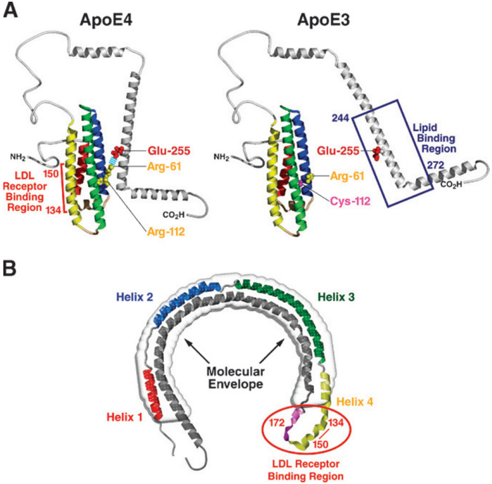
“Structurally, ApoE has two main domains that are connected by a hinge region (amino acids ∼165 to 215); the N-terminal domain (amino acids 1 to 191) forms the receptor binding region, and the C-terminal domain (amino acids ∼225 to 299) harbors the major lipid-binding region (amino acids ∼244 to 272) (Fig. 4, A and C) (20).”
From Secreted Apoe rewires melanoma cell state vulnerability to ferroptosis (2024) · cites this paper as [20]
Experimental — accuracy not yet measuredThe source backs part of the claim, not all of it — or backs it for a different population, condition or comparison.
In the citing paper
“Val254Glu and Arg269Gly are located in the lipid‐binding carboxyl‐terminal domain (amino acids ≈243 to 317). 28 , 42”
From APOE and dementia – resequencing and genotyping in 105,597 individuals (2020) · cites this paper as [42]
Experimental — accuracy not yet measured
15 more claims about this paper
Create a free account to see every claim other papers make about this one.
Self-check
Percentages, sums and reported differences re-computed from the paper’s own numbers.
The self-check needs the paper’s full text.
Citations
Cites
Corder, E. H., Saunders, A. M., Strittmatter, W. J., Schmechel, D. E., Gaskell, P. C., Small, G. W., Roses, A. D., Haines, J. L., & Pericak-Vance, M. A. (1993) · Science · doi:10.1126/science.8346443 · Cited by 9,429
Apolipoprotein E: Cholesterol Transport Protein with Expanding Role in Cell Biology
Mahley, R. W. (1988) · Science · doi:10.1126/science.3283935 · Cited by 4,028
Self-citationApolipoprotein E: Far More Than a Lipid Transport Protein
Mahley, R. W., & Rall, S. C. (2000) · Annual Review of Genomics and Human Genetics · doi:10.1146/annurev.genom.1.1.507 · Cited by 1,836
Self-citationMahley, R. W., Weisgraber, K. H., & Huang, Y. (2006) · Proceedings of the National Academy of Sciences · doi:10.1073/pnas.0600549103 · Cited by 912
Self-citationApolipoprotein E: Structure-Function Relationships
Weisgraber, K. H. (1994) · Advances in Protein Chemistry · doi:10.1016/s0065-3233(08)60642-7 · Cited by 830
Self-citationWeisgraber, K. H., Rall, S. C., & Mahley, R. W. (1981) · Journal of Biological Chemistry · doi:10.1016/s0021-9258(19)52510-8 · Cited by 777
Self-citationHuman apolipoprotein E. The complete amino acid sequence
Rall, S. C., Weisgraber, K. H., & Mahley, R. W. (1982) · Journal of Biological Chemistry · doi:10.1016/s0021-9258(18)34702-1 · Cited by 741
Self-citationThree-Dimensional Structure of the LDL Receptor-Binding Domain of Human Apolipoprotein E
Wilson, C., Wardell, M. R., Weisgraber, K. H., Mahley, R. W., & Agard, D. A. (1991) · Science · doi:10.1126/science.2063194 · Cited by 678
Self-citationHerpes simplex virus type 1 in brain and risk of Alzheimer's disease
Itzhaki, R. F., Lin, W.-R., Shang, D., Wilcock, G. K., Faragher, B., & Jamieson, G. A. (1997) · The Lancet · doi:10.1016/s0140-6736(96)10149-5 · Cited by 669
Polymorphism of apolipoprotein E and occurrence of dysbetalipoproteinaemia in man
UTERMANN, G., HEES, M., & STEINMETZ, A. (1977) · Nature · doi:10.1038/269604a0 · Cited by 666
Cited by
Items 401–500 of 581
APOE polymorphism status (E4) may help in predicting the risk of recurrent implantation failure
Mohtasebi, P., Eslami, M., Ramezanali, F., Boroujeni, P. B., Talab, Z. R., & Zamanian, M. (2021) · International Journal of Gynecology & Obstetrics · doi:10.1002/ijgo.14022 · Cited by 5
Prediction Model for Sensory Perception Abnormality in Autism Spectrum Disorder
Ma, Z., Xu, L., Li, Q., Li, X., Shi, Y., Zhang, X., Yang, Y., Wang, J., Fan, L., & Wu, L. (2023) · International Journal of Molecular Sciences · doi:10.3390/ijms24032367 · Cited by 5
Investigation of Domain Interaction in the Apolipoprotein E Isoforms by HDX-MS
Pal, S., Dolai, S., Deepa, S., & Garai, K. (2025) · Journal of Molecular Biology · doi:10.1016/j.jmb.2025.169036 · Cited by 5
Apolipoprotein E gene polymorphism in Egyptian acute coronary syndrome patients
Mahmoud, A. A., Yousef, L. M., & Zaki, N. A. E. (2015) · Egyptian Journal of Medical Human Genetics · doi:10.1016/j.ejmhg.2015.08.001 · Cited by 4
Georgiadou, D., Chroni, A., Drosatos, K., Kypreos, K. E., Zannis, V. I., & Stratikos, E. (2012) · Atherosclerosis · doi:10.1016/j.atherosclerosis.2012.11.013 · Cited by 5
Pharmacogenetics in Neurodegenerative Diseases: Implications for Clinical Trials
Tortelli, R., Seripa, D., Panza, F., Solfrizzi, V., & Logroscino, G. (2016) · Monographs in clinical neuroscience/Frontiers of neurology and neuroscience/Monographs in neural sciences · doi:10.1159/000445453 · Cited by 4
Role of APOE and IL18RAP gene polymorphisms in cervical spondylotic myelopathy in Indian population
Diptiranjan, S., Manjunath, H. S., Sibin, M. K., Arati, S., Chetan, G. K., & Bhat, D. I. (2019) · Journal of Clinical Neuroscience · doi:10.1016/j.jocn.2019.05.017 · Cited by 4
The Impact of Apolipoprotein E Allelic Variants on Alzheimer’s Disease
Serrano, E., Sanz, P. G., & Barrantes, F. J. (2021) · Springer eBooks · doi:10.1007/978-3-030-61721-9_29 · Cited by 5
Identifying Genetic Markers Associated with Susceptibility to Cardiovascular Diseases
Shukla, H., Mason, J. L., & Sabyah, A. (2021) · doi:10.1201/9781003180449-8 · Cited by 4
Fukase, T., Dohi, T., Nishio, R., Takeuchi, M., Takahashi, N., Chikata, Y., Endo, H., Doi, S., Nishiyama, H., Okai, I., et al. (2022) · Journal of Atherosclerosis and Thrombosis · doi:10.5551/jat.63535 · Cited by 6
Badrnya, S., Doherty, T., Richardson, C., McConnell, R. I., Lamont, J. V., Veitinger, M., Fitzgerald, S. P., Zellner, M., & Umlauf, E. (2017) · Clinical Chemistry and Laboratory Medicine (CCLM) · doi:10.1515/cclm-2017-0618 · Cited by 5
Macrophages in Lipid and Immune Homeostasis
Neyen, C. D., & Gordon, S. (2014) · Wiley eBooks · doi:10.1002/9780470015902.a0021029.pub2 · Cited by 7
Danter, W. R. (2024) · Research Square · doi:10.21203/rs.3.rs-4320367/v1 · Cited by 4
Aslan, M., Çırçırlı, B., Öztüzün, A., Tuzcu, H., Yılmaz, Ç., Çeker, T., & Elpek, G. Ö. (2025) · Journal of Cellular and Molecular Medicine · doi:10.1111/jcmm.70677 · Cited by 4
Ihoeghian, N. A., Abbas, U. L., Imam, I. A., & Shao, Q. (2026) · Physical Chemistry Chemical Physics · doi:10.1039/d5cp03829d · Cited by 3
Jiraanont, P., Wang, J. Y., Durbin-Johnson, B., Hwang, Y. H., Hessl, D. R., Rivera, S. M., Hagerman, R. J., & Tassone, F. (2026) · Neurobiology of Disease · doi:10.1016/j.nbd.2026.107292 · Cited by 3
Cognition in Patients With Memory Difficulties and Dementia Relative to APOE e4 Status
Hestad, K. A., Engedal, K., Horndalsveen, P. O., & Strand, B. H. (2021) · Frontiers in Psychology · doi:10.3389/fpsyg.2021.686036 · Cited by 6
Fukase, T., Dohi, T., Kato, Y., Chikata, Y., Takahashi, N., Endo, H., Doi, S., Nishiyama, H., Okai, I., Iwata, H., et al. (2021) · International Heart Journal · doi:10.1536/ihj.20-816 · Cited by 4
Mapping the APOE structurally on missense variants in elderly Brazilians
Pizzico, F. D. L., Máximo, R. B., Hirata, M. H., & Ferreira, G. M. (2024) · Journal of Biomolecular Structure and Dynamics · doi:10.1080/07391102.2024.2328743 · Cited by 3
Perspectives on the Role of APOE4 as a Therapeutic Target for Alzheimer’s Disease
Patel, K., Srivastava, S., Kushwah, S., & Mani, A. (2021) · Journal of Alzheimer s Disease Reports · doi:10.3233/adr-210027 · Cited by 5
Docosahexaenoic Acid Ester of Phloridzin Reduces Inflammation and Insulin Resistance via AMPK
Chen, J., Wu, Z., Wang, J., Si, X., Zhang, R., Sun, T., Dong, Q., Wu, W., & Qiu, Y. (2022) · Current Pharmaceutical Design · doi:10.2174/1381612828666220518102440 · Cited by 5
Perspectives for the application of neurogenetic research in programming Neurorehabilitation
Bagrowski, B. (2022) · Molecular Aspects of Medicine · doi:10.1016/j.mam.2022.101149 · Cited by 5
Endoplasmic Reticulum Stress in the Endothelium: A Contribution to Athero-Susceptibility
Stacchiotti, A., Favero, G., & Rezzani, R. (2013) · InTech eBooks · doi:10.5772/53024 · Cited by 5
Piskunowicz, M., Linkowska, K., Gołota, S., Grzybowski, T., Kędziora–Kornatowska, K., & Borkowska, A. (2017) · The International Journal of Aging and Human Development · doi:10.1177/0091415017724548 · Cited by 3
Diagnostic lipid changes in patients with visceral leishmaniasis
Tsimihodimos, V., Kei, A. A., Apostolou, F., & Elisaf, M. (2018) · Hospital Practice · doi:10.1080/21548331.2018.1483171 · Cited by 3
Aging, cognitive decline, apolipoprotein E and docosahexaenoic acid metabolism
Plourde, M. (2018) · OCL · doi:10.1051/ocl/2018032 · Cited by 7
Macrophages in Lipid and Immune Homeostasis
Neyen, C. D., & Gordon, S. (2008) · Wiley eBooks · doi:10.1002/9780470015902.a0021029 · Cited by 3
Coronavirus disease 2019, multisystem inflammatory syndrome in children, apolipoprotein E4, and race
Goldstein, M. R., Poland, G. A., & Graeber, C. W. (2020) · The Journal of Pediatrics · doi:10.1016/j.jpeds.2020.10.072 · Cited by 5
Georgiadou, D., & Chroni, A. (2026) · International Journal of Biological Macromolecules · doi:10.1016/j.ijbiomac.2025.149644 · Cited by 2
Saraceno, G. F., & Cione, E. (2025) · BioMedInformatics · doi:10.3390/biomedinformatics5010016 · Cited by 2
Apolipoprotein E selectively supports gammaherpesvirus replication in macrophages
Schmalzriedt, D. L., Aurubin, C. A., Rahlf, C. R., Brown, M., Bobek, J. M., Lange, P. T., Bradeen, X., Sahoo, D., & Tarakanova, V. L. (2025) · Journal of Virology · doi:10.1128/jvi.00480-25 · Cited by 2
Yong, S. J., Teoh, S. L., Parhar, I. S., Soga, T., Lim, W. L., & Chew, J. (2025) · Reviews in the Neurosciences · doi:10.1515/revneuro-2025-0034 · Cited by 3
Xu, J.-X., Wu, Y., Zhang, L., Wu, Y.-H., Li, C., & Lin, F. (2025) · World Journal of Cardiology · doi:10.4330/wjc.v17.i9.110278 · Cited by 2
Structural signature of plasma proteins classifies the status of Alzheimer’s disease
Son, A., Kim, H., Diedrich, J. K., Bamberger, C., Wilkins, H., Burns, J. M., Morris, J. K., Rissman, R. A., Swerdlow, R. H., & Yates, J. R. (2026) · Nature Aging · doi:10.1038/s43587-026-01078-2 · Cited by 6
Austad, S. N., & Finch, C. E. (2016) · Elsevier eBooks · doi:10.1016/b978-0-12-420190-3.00014-4 · Cited by 2
Lipid Profile in Anemic Patients: A Cross Sectional Study
Mittal, N., & Sharma, E. (2023) · East African Scholars Journal of Medical Sciences · doi:10.36349/easms.2023.v06i02.005 · Cited by 1
Association of the APOE gene variants with depression in type 2 diabetes
Klashami, Z. N., Yaghoobi, A., Panahi, N., & Amoli, M. M. (2023) · Journal of Diabetes & Metabolic Disorders · doi:10.1007/s40200-023-01271-9 · Cited by 2
Bekenova, N., Aitkaliyev, A., Vochshenkova, T. A., Kassiyeva, B., & Benberin, V. V. (2024) · Diagnostics · doi:10.3390/diagnostics14171978 · Cited by 2
Ciurleo, G. C. V., de Azevedo, O. G. R., Carvalho, C. G. M., Vitek, M. P., Warren, C. A., Guerrant, R. L., & Oriá, R. B. (2024) · Clinical Nutrition ESPEN · doi:10.1016/j.clnesp.2024.09.004 · Cited by 2
Pradhan, S., Mirdha, L., Sengupta, T., & Chakraborty, H. (2024) · ChemBioChem · doi:10.1002/cbic.202400469 · Cited by 2
Stefanini, E., Serrano‐Marín, J., Iglesias, A., Fernández, M. G., Sánchez-Navés, J., Alkozi, H. A., Bernal‐Casas, D., & Franco, R. (2025) · Exploration of Neuroprotective Therapy · doi:10.37349/ent.2025.100497 · Cited by 4
Chaudhary, S., Kumar, P., & Kaushik, M. (2025) · International Journal of Biological Macromolecules · doi:10.1016/j.ijbiomac.2025.142896 · Cited by 3
Summer, F. (2012) · InTech eBooks · doi:10.5772/48115 · Cited by 2
Nankar, S. A., Bajaj, P., Sravanthi, R., & Pande, A. H. (2013) · Biochimie · doi:10.1016/j.biochi.2013.01.011 · Cited by 2
Nephrotic syndrome associated with severe hypertriglyceridemia in a pediatric patient: Questions
Andrés, B. C., Muñoz-Calvo, M. T., Calero, O., Aparicio, C., Argente, J., & Calero, M. (2018) · Pediatric Nephrology · doi:10.1007/s00467-018-3894-6 · Cited by 3
Kaneva, A. M., & Bojko, E. R. (2017) · Medical academic journal · doi:10.17816/maj17141-50 · Cited by 5
Zhou, J., Jiang, L., Yuan, S., Huang, J., Shi, Q., Xie, Y., Deng, B., & Zhan, Y. (2021) · Frontiers in Neurology · doi:10.3389/fneur.2021.760126 · Cited by 2
Javadifar, A., Ghezeldasht, S. A., Rahimi, H., Valizadeh, N., Borojerdi, Z. R., Vahidi, Z., & Rezaee, S. A. (2022) · Gene Reports · doi:10.1016/j.genrep.2022.101531 · Cited by 2
Pradhan, S., Mirdha, L., Sengupta, T., & Chakraborty, H. (2024) · Langmuir · doi:10.1021/acs.langmuir.4c00178 · Cited by 3
Cakir, Z., Lord, S. J., Zhou, Y., Jang, G. Μ., Polacco, B. J., Eckhardt, M., Jimenez‐Morales, D., Newton, B. W., Orr, A. L., Johnson, J. R., et al. (2022) · bioRxiv (Cold Spring Harbor Laboratory) · doi:10.1101/2022.06.06.495052 · Cited by 2
Self-citationThe aging cardiovascular system
Şener, Y. Z., & Canpolat, U. (2022) · Elsevier eBooks · doi:10.1016/b978-0-323-98804-9.00033-5 · Cited by 2
chen, L., zhang, T., Rong, C., xu, Z., tang, X., & Hu, H. (2024) · Research Square · doi:10.21203/rs.3.rs-4237089/v1 · Cited by 2
Mechanism of the Regulation of Plasma Cholesterol Levels by PI(4,5)P2
Qin, Y., & Medina, M. W. (2023) · Advances in experimental medicine and biology · doi:10.1007/978-3-031-21547-6_3 · Cited by 1
Stout, J. A., Anderson, R. J., Mahzarnia, A., Han, Z. Y., Beck, K., Browndyke, J. N., Johnson, K. G., O’Brien, R., & Badea, A. (2025) · Brain Structure and Function · doi:10.1007/s00429-025-02905-9 · Cited by 2
Montenegro, R. C., Souza, P. F. N., & Mesquita, F. P. (2025) · Springer eBooks · doi:10.1007/978-3-031-52641-1_34-1 · Cited by 1
Lee, S., Kelly, R. S., Chen, Y., Waqas, M., Mendez, K. M., Hecker, J., Hahn, G., Lutz, S. M., Celedon, J. C., Clish, C. B., et al. (2025) · Metabolomics · doi:10.1007/s11306-025-02256-w · Cited by 1
Mahley, R. W. (2025) · Springer eBooks · doi:10.1007/978-3-031-52641-1_2-1 · Cited by 2
Self-citationJeevanandam, J., & Saraswathi, N. T. (2025) · Journal of Biomolecular Structure and Dynamics · doi:10.1080/07391102.2025.2584338 · Cited by 1
Structural Analysis of Missense Mutations on the Stability of APOE3 and APOE4
Anthony, M., Xie, Y., O’Neil, J. N., & Teng, S. (2025) · Genes · doi:10.3390/genes16121509 · Cited by 2
Lee, E.-G., Leong, L., Chen, S., Tulloch, J., & Yu, C. (2025) · International Journal of Molecular Sciences · doi:10.3390/ijms27010302 · Cited by 1
Koychev, I. G., Vaci, N., Moonen, J. E. F., Reid, G., Howgego, G., Yaffe, K. S., Nasrallah, I. M., Sidney, S., Jindra, C., Gallacher, J., et al. (2026) · Journal of Alzheimer s Disease · doi:10.1177/13872877251401482 · Cited by 1
Komkleow, S., Jaroenporn, S., Chokchaichamnankit, D., Bubparam, T., Yasom, S., Ruangjaroon, T., Svasti, J., Ittiudomrak, T., Sangvanich, P., Mutirangura, A., et al. (2026) · Scientific Reports · doi:10.1038/s41598-026-46747-9 · Cited by 1
Cell-type-specific APOE4 cascade across the Alzheimer’s disease continuum
Shostak, D. M., Liang, Z., & Huang, Y. (2026) · Neuron · doi:10.1016/j.neuron.2026.04.024 · Cited by 1
Self-citationApolipoprotein E and Cholesterol Metabolism
Marais, A. D. (2026) · Springer eBooks · doi:10.1007/978-3-031-96089-5_1 · Cited by 1
APOE, Human Ancestry, and Evolution
Smith, C. J., Ashford, J. W., & Perfetti, T. A. (2026) · Springer eBooks · doi:10.1007/978-3-031-96089-5_4 · Cited by 1
Hui, D. Y., Alagarsamy, J., Haller, A. M., Medvedovic, M., & Jaeschke, A. (2026) · International Journal of Molecular Sciences · doi:10.3390/ijms27125619 · Cited by 1
Saravanan, J., Easwaran, V., Selvaraj, D., Gunasekaran, V., Soumya, V., Thiruselvi, M., Prasanth, M. L., Singh, S., Ellaiyarasu, C., Rai, P. K., et al. (2026) · Molecular and Cellular Neuroscience · doi:10.1016/j.mcn.2026.104108 · Cited by 1
Aging of the Brain, Dementias, Role of Infectious Proteins: Facts and Theories
Morinet, F. (2014) · Interdisciplinary topics in gerontology and geriatrics · doi:10.1159/000358905 · Cited by 1
Radiative-SPR platform for the detection of apolipoprotein E for use in medical diagnostics
Sciacca, B., François, A., Penno, M. A. S., Brazzatti, J. A., Klingler‐Hoffmann, M., Hoffmann, P., & Monro, T. M. (2012) · Proceedings of SPIE, the International Society for Optical Engineering/Proceedings of SPIE · doi:10.1117/12.909681 · Cited by 1
Kaneva, A. M., Потолицына, Н. Н., & Bojko, E. R. (2014) · Clinical Chemistry and Laboratory Medicine (CCLM) · doi:10.1515/cclm-2014-0355 · Cited by 1
Risk Factors for Alzheimer’s Disease
Cai, D., & Gaamouch, F. E. (2016) · InTech eBooks · doi:10.5772/64270 · Cited by 2
Acevedo, S. F. (2013) · Journal of Womens Health Issues and Care · doi:10.4172/2325-9795.1000117 · Cited by 1
Ersonified diagnostic and correction dyslipidemia approach by profiling of apolipoproteins
Kachkovsky, M. A., Vvedenskaya, I. P., Vvedensky, V. Y., Supilnikov, A. A., Ponomareva, J. V., & Milyakova, M. N. (2020) · Bulletin of the Medical Institute REAVIZ (REHABILITATION DOCTOR AND HEALTH) · doi:10.20340/vmi-rvz.2020.4.11 · Cited by 1
Microfluidic Plasmonic Sensors: Theory and Applications
Arif, R. B., & Bora, T. (2022) · Lecture notes in nanoscale science and technology · doi:10.1007/978-3-030-99491-4_17 · Cited by 1
Hazarika, L., Sen, S., & Doshi, J. (2022) · Computational Biology and Bioinformatics · doi:10.11648/j.cbb.20221002.11 · Cited by 2
Carvalho-Rassbach, M., Ventura, L. H. D. A., Assis, L. O., Fabrini, S. P., Natividade, M. M. P., Silva, J. L., Gomes, K. B., Faria, A. M. C., & Alvarez-Leite, J. I. (2025) · Journal of Medical Microbiology · doi:10.1099/jmm.0.001951 · Cited by 2
ApoE, Human Fertility, and Reproduction
Fagla, B. M., Tai, L. M., & Buhimschi, I. A. (2025) · Springer eBooks · doi:10.1007/978-3-031-52641-1_67-1
Genner, R. M., Meredith, M., Daida, K., Moller, A., Weller, C. A., Ayuketah, A., Jerez, P. Á., Akeson, S., Malik, L., Baker, B., et al. (2026) · npj Dementia · doi:10.1038/s44400-026-00094-8 · Cited by 2
Apolipoprotein E4: A Risk Factor for Successful Cognitive Aging
Kwon, O. D. (2016) · Dementia and Neurocognitive Disorders · doi:10.12779/dnd.2016.15.3.61 · Cited by 1
Nawabi, A. Q., Yang, M., Cai, X., Gou, W., Hou, J., Nizami, V., & Dai, Q. (2019) · World Journal of Cardiovascular Diseases · doi:10.4236/wjcd.2019.911074 · Cited by 2
Disordini endocrino-metabolici da virus e COVID-19
Toni, R. (2020) · L Endocrinologo · doi:10.1007/s40619-020-00744-w · Cited by 1
Proteomics in Nutrition, Obesity and Diabetes Research
Ruiz‐Limón, P., Balongo, M., Insenser, M. R., Tinahones, F. J., & Murri, M. (2020) · Royal Society of Chemistry eBooks · doi:10.1039/9781839160608-00237 · Cited by 1
Dementia, A General Medical Practitioner’s Concern: A Review
M.V. Ravishankar1, P. K. (2020) · Indian Journal of Public Health Research & Development · doi:10.37506/ijphrd.v11i8.10897 · Cited by 1
Nephrotic syndrome associated with severe hypertriglyceridemia in a pediatric patient: Answers
Andrés, B. C., Muñoz-Calvo, M. T., Calero, O., Aparicio, C., Argente, J., & Calero, M. (2018) · Pediatric Nephrology · doi:10.1007/s00467-018-3919-1 · Cited by 2
Joska, J. A. (2010) · Open University of Cape Town (University of Cape Town) · Cited by 1
Soto, R. C. (2012) · UVaDOC UVaDOC University of Valladolid Documentary Repository (University of Valladolid) · doi:10.35376/10324/2675 · Cited by 1
Yang, Y., Zhang, H., & Wu, J. (2010) · The World Journal of Biological Psychiatry · doi:10.3109/15622975.2010.520334 · Cited by 1
Nemergut, M., Marques, S. M., Uhrík, L., Váňová, T., Nezvedová, M., Gadara, D. C., Jha, D., Tulis, J., Novakova, V., Planas-Iglesias, J., et al. (2022) · bioRxiv (Cold Spring Harbor Laboratory) · doi:10.1101/2022.10.09.511473 · Cited by 1
Vrba, S. M., Laaker, C. J., Limkar, A. R., Hsu, M., Ricke, W. A., Ulland, T. K., Pehar, M., Sándor, M., & Fábry, Z. (2025) · bioRxiv (Cold Spring Harbor Laboratory) · doi:10.1101/2025.05.15.654007 · Cited by 1
Gau, B. C. (2011) · Open Scholarship Institutional Repository (Washington University in St. Louis) · doi:10.7936/k72r3pq8 · Cited by 3
Lipoproteinstoffwechsel und koronare Herzkrankheit: Modellsysteme für komplexe Erkrankungen
Utermann, G. (2011) · Medizinische Genetik · doi:10.1007/s11825-010-0259-3
Genetics of metabolic syndrome and related traits
Henneman, P. (2010) · Leiden Repository (Leiden University)
Comment on: Cerebrospinal fluid apolipoprotein E concentration decreases after seizure
Wu, J., Liu, P., Lei, J., & Zhang, H. (2010) · Seizure · doi:10.1016/j.seizure.2010.04.009
Wikgren, M. (2011) · DiVA at Umeå University (Umeå University) · Cited by 2
Greco, D. (2013) · DSpaceUnipr (University of Parma) · Cited by 1
Wisam, N. I., Norsidah, K.-Z., Samsul, D., Zamzila, A., Rafidah, H. M., & At, N. (2015) · IIUM Medical Journal Malaysia · doi:10.31436/imjm.v14i2.434
Rodriguez, G. A. (2014) · DigitalGeorgetown (Georgetown University Library)
Contributions of Apolipoprotein E and Environmental Factors in Alzheimer’s Disease
McMullen, K. C. (2013) · Digital Commons (Liberty University)
Metadata
- Authors
- Mahley, R. W., Weisgraber, K. H., & Huang, Y.
- Affiliations
- Gladstone Institutes (US)
- Corresponding author
- Mahley, Robert W.
- Venue
- Journal of Lipid Research
- Publisher
- Elsevier BV
- Published
- 2009-04
- Volume
- 50
- Pages
- S183-S188
- ISSN
- 0022-2275 (ISSN-L)
- PMC
- PMC2674716
- OpenAlex
- W2006599070
- Cited by
- 580
- References
- 58
- Citations by year
- 2026: 30 · 2025: 55 · 2024: 40 · 2023: 48 · 2022: 44 · 2021: 34 · 2020: 27 · 2019: 34 · 2018: 33 · 2017: 28 · 2016: 37 · 2015: 23 · 2014: 38 · 2013: 25 · 2012: 35
- FWCI
- 16.86
- Type
- journal article
- Language
- en
- Open access
- hybrid
- doi.org
- Licence
- cc-by
- www.elsevier.com/tdm/userlicense/1.0/ (tdm)
- creativecommons.org/licenses/by/4.0/ (vor, 4185 d)
- Locations
- Journal of Lipid Research (publishedVersion, cc-by)
- PubMed Central (publishedVersion)
- PubMed (publishedVersion)
- DOAJ (DOAJ: Directory of Open Access Journals) (submittedVersion, cc-by-sa)
- Funders
- Gladstone Institutes
- National Institutes of Health
- National Institute on Aging (R01AG028793, 2P01AG02207)
- Topics
- Health Sciences › Medicine › Cardiology and Cardiovascular Medicine › Lipoproteins and Cardiovascular Health
- Life Sciences › Neuroscience › Cellular and Molecular Neuroscience › Alzheimer's disease research and treatments
- Life Sciences › Biochemistry, Genetics and Molecular Biology › Biochemistry › Cholesterol and Lipid Metabolism
- Keywords
- apolipoprotein E, APOE ε4, APOE3, APOE2, protein structure-function relationship, LDL receptor binding, type III hyperlipoproteinemia, atherosclerosis, Alzheimer's disease, AIDS, HIV, opportunistic infections, genetic risk factors, lipoprotein metabolism
- MeSH terms
- Acquired Immunodeficiency Syndrome, Alzheimer Disease, Animals, Apolipoproteins E, Humans, Protein Binding, Atherosclerosis
About these checks
Registry, retraction, Cites and statistics results are computed, not judged, with one exception: a printed reference that no index lists is read once by a model before it counts as a citation error. Claims are extracted by a model and kept only when their quote appears verbatim in the text; each cited source is then checked, with a model’s help, for whether it says what the claim relies on. Those verdicts can be wrong — read the claim’s quote and the cited source before relying on one.
Statistics and arithmetic are recomputed, not judged.
Confidence bands are shown only for fields calibrated on our annotated test set. None is calibrated yet, so no band is shown.
What counts as a claim ›How we measure confidence ›How we check this ›
Are you an author, or do you see a problem with this page? Request a review
Data sources
Bibliographic data: Semantic Scholar, OpenAlex, Crossref.
Contains information from the Semantic Scholar Academic Graph Datasets, made available under the ODC Attribution License (ODC-BY 1.0).
Semantic Scholar’s data is described in: Kinney, R., et al. (2023). The Semantic Scholar Open Data Platform. arXiv:2301.10140.
