

Apolipoprotein E: structure determines function, from atherosclerosis to Alzheimer's disease to AIDS
Open accessThe DOI matches its Crossref record; 58 of the 58 references it cites were found in a registry or an index.
Abstract
Apolipoprotein (apo) E has roles beyond lipoprotein metabolism. The detrimental effects of apoE4 in cardiovascular, neurological, and infectious diseases correlate with its structural features (e.g., domain interaction) that distinguish it from apoE3 and apoE2. Structure/function studies revealed that apoE2 is severely defective in LDL receptor binding because of a structural difference that alters the receptor binding region and helped unravel the mechanism of type III hyperlipoproteinemia. ApoE4 is the major genetic risk factor for Alzheimer's disease and sets the stage for neuropathological disorders precipitated by genetic, metabolic, and environmental stressors. ApoE also influences susceptibility to parasitic, bacterial, and viral infections. In HIV-positive patients, apoE4 homozygosity hastens progression to AIDS and death and increases susceptibility to opportunistic infections. The next phase in our understanding of apoE will be characterized by clinical intervention to prevent or reverse the detrimental effects of apoE4 by modulating its structure or blocking the pathological processes it mediates.
Overview
The claims and statistics of this paper haven’t been checked yet.
Free: it reads the open-access text and checks the first 5 claims that cite a source we can check. Create a free account to check every claim.
Integrity signals
Registry
Cites
Statistics
Figures
Verification
Claims the paper makes
The claims and statistics of this paper haven’t been checked yet.
Free: it reads the open-access text and checks the first 5 claims that cite a source we can check. Create a free account to check every claim.
Claims other papers make about this one
Each is checked against this paper’s own text: does it say what the citing paper says it does?
The source backs part of the claim, not all of it — or backs it for a different population, condition or comparison.
In the citing paper
“APOE exerts toxic effects on the cerebrovascular system (694) and neurons (383, 384) and influences A 𝛃 clearance (60, 64, 98, 135, 256, 266, 278, 294, 315, 693), amyloid deposition (39, 256, 258, 266, 278, 314, 518, 612), and tau-related neurodegeneration (533) in an allele-dependent manner APOE4 > APOE3 > APOE2 .”
From Blood-Brain Barrier: From Physiology to Disease and Back (2019) · cites this paper as [384]
Experimental — accuracy not yet measuredThe source backs part of the claim, not all of it — or backs it for a different population, condition or comparison.
In the citing paper
“ApoE is a 34-kDa lipid carrier protein, which in the brain is produced by astrocytes and secreted as nascent, high-density lipoprotein-like particles [4].”
From Blocking the apoE/Aβ interaction ameliorates Aβ-related pathology in APOE ε2 and ε4 targeted replacement Alzheimer model mice (2014) · cites this paper as [4]
Experimental — accuracy not yet measuredThe source backs part of the claim, not all of it — or backs it for a different population, condition or comparison.
In the citing paper
“This notion may explain enhanced Aβ clearance in the setting of apoE2, which is defective in LDL receptor binding [4,5].”
From Blocking the apoE/Aβ interaction ameliorates Aβ-related pathology in APOE ε2 and ε4 targeted replacement Alzheimer model mice (2014) · cites this paper as [4]
Experimental — accuracy not yet measuredThe source backs part of the claim, not all of it — or backs it for a different population, condition or comparison.
In the citing paper
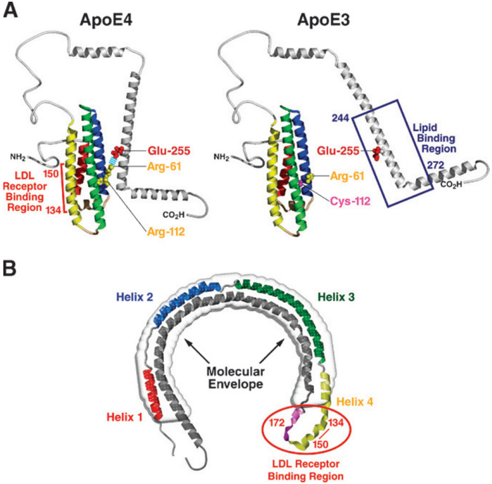
“Structurally, ApoE has two main domains that are connected by a hinge region (amino acids ∼165 to 215); the N-terminal domain (amino acids 1 to 191) forms the receptor binding region, and the C-terminal domain (amino acids ∼225 to 299) harbors the major lipid-binding region (amino acids ∼244 to 272) (Fig. 4, A and C) (20).”
From Secreted Apoe rewires melanoma cell state vulnerability to ferroptosis (2024) · cites this paper as [20]
Experimental — accuracy not yet measuredThe source backs part of the claim, not all of it — or backs it for a different population, condition or comparison.
In the citing paper
“Val254Glu and Arg269Gly are located in the lipid‐binding carboxyl‐terminal domain (amino acids ≈243 to 317). 28 , 42”
From APOE and dementia – resequencing and genotyping in 105,597 individuals (2020) · cites this paper as [42]
Experimental — accuracy not yet measured
15 more claims about this paper
Create a free account to see every claim other papers make about this one.
Self-check
Percentages, sums and reported differences re-computed from the paper’s own numbers.
The self-check needs the paper’s full text.
Citations
Cites
Corder, E. H., Saunders, A. M., Strittmatter, W. J., Schmechel, D. E., Gaskell, P. C., Small, G. W., Roses, A. D., Haines, J. L., & Pericak-Vance, M. A. (1993) · Science · doi:10.1126/science.8346443 · Cited by 9,429
Apolipoprotein E: Cholesterol Transport Protein with Expanding Role in Cell Biology
Mahley, R. W. (1988) · Science · doi:10.1126/science.3283935 · Cited by 4,028
Self-citationApolipoprotein E: Far More Than a Lipid Transport Protein
Mahley, R. W., & Rall, S. C. (2000) · Annual Review of Genomics and Human Genetics · doi:10.1146/annurev.genom.1.1.507 · Cited by 1,836
Self-citationMahley, R. W., Weisgraber, K. H., & Huang, Y. (2006) · Proceedings of the National Academy of Sciences · doi:10.1073/pnas.0600549103 · Cited by 912
Self-citationApolipoprotein E: Structure-Function Relationships
Weisgraber, K. H. (1994) · Advances in Protein Chemistry · doi:10.1016/s0065-3233(08)60642-7 · Cited by 830
Self-citationWeisgraber, K. H., Rall, S. C., & Mahley, R. W. (1981) · Journal of Biological Chemistry · doi:10.1016/s0021-9258(19)52510-8 · Cited by 777
Self-citationHuman apolipoprotein E. The complete amino acid sequence
Rall, S. C., Weisgraber, K. H., & Mahley, R. W. (1982) · Journal of Biological Chemistry · doi:10.1016/s0021-9258(18)34702-1 · Cited by 741
Self-citationThree-Dimensional Structure of the LDL Receptor-Binding Domain of Human Apolipoprotein E
Wilson, C., Wardell, M. R., Weisgraber, K. H., Mahley, R. W., & Agard, D. A. (1991) · Science · doi:10.1126/science.2063194 · Cited by 678
Self-citationHerpes simplex virus type 1 in brain and risk of Alzheimer's disease
Itzhaki, R. F., Lin, W.-R., Shang, D., Wilcock, G. K., Faragher, B., & Jamieson, G. A. (1997) · The Lancet · doi:10.1016/s0140-6736(96)10149-5 · Cited by 669
Polymorphism of apolipoprotein E and occurrence of dysbetalipoproteinaemia in man
UTERMANN, G., HEES, M., & STEINMETZ, A. (1977) · Nature · doi:10.1038/269604a0 · Cited by 666
Cited by
Items 101–200 of 581
The Oxygen Paradox, the French Paradox, and age-related diseases
Davies, J. M. S., Cillard, J., Friguet, B., Cadenas, E., Cadet, J., Cayce, R., Fishmann, A., Liao, D., Bulteau, A.-L., Derbré, F., et al. (2017) · GeroScience · doi:10.1007/s11357-017-0002-y · Cited by 82
Amyloid-Forming Properties of Human Apolipoproteins: Sequence Analyses and Structural Insights
Das, M., & Gursky, O. (2015) · Advances in experimental medicine and biology · doi:10.1007/978-3-319-17344-3_8 · Cited by 92
Brickman, A. M., Schupf, N., Manly, J. J., Stern, Y., Luchsinger, J. A., Provenzano, F. A., Narkhede, A., Razlighi, Q., Collins‐Praino, L., Artero, S., et al. (2014) · Alzheimer's & Dementia · doi:10.1016/j.jalz.2014.07.155 · Cited by 81
ApoE polymorphisms and diarrheal outcomes in Brazilian shanty town children
Oriá, R. B., Patrick, P. D., Oriá, M. O. B., Lorntz, B., Thompson, M. R., Azevedo, O. G. R., Lobo, R. N. B., Pinkerton, R. F., Guerrant, R. L., & Lima, A. A. M. (2010) · Brazilian Journal of Medical and Biological Research · doi:10.1590/s0100-879x2010007500003 · Cited by 81
Buttini, M., Masliah, E., Yu, G.-Q., Palop, J. J., Chang, S., Bernardo, A., Lin, C., Wyss-Coray, T., Huang, Y., & Mucke, L. (2010) · The American Journal of Pathology · doi:10.2353/ajpath.2010.090973 · Cited by 80
Self-citationAbsolute quantification of apolipoproteins and associated proteins on human plasma lipoproteins
von Zychlinski, A., Williams, M. J. A., McCormick, S. P. A., & Kleffmann, T. (2014) · Journal of Proteomics · doi:10.1016/j.jprot.2014.04.030 · Cited by 88
Genetic variants of ApoE and ApoER2 differentially modulate endothelial function
Ulrich, V., Konaniah, E. S., Herz, J., Gerard, R. D., Jung, E., Yuhanna, I. S., Ahmed, M., Hui, D. Y., Mineo, C., & Shaul, P. W. (2014) · Proceedings of the National Academy of Sciences · doi:10.1073/pnas.1402106111 · Cited by 76
Upregulation of RIN3 induces endosomal dysfunction in Alzheimer’s disease
Shen, R., Zhao, X., He, L., Ding, Y., Xu, W., Lin, S., Fang, S., Yang, W., Sung, K., Spencer, B., et al. (2020) · Translational Neurodegeneration · doi:10.1186/s40035-020-00206-1 · Cited by 75
Nuttall, J. R., & Oteiza, P. I. (2013) · Genes & Nutrition · doi:10.1007/s12263-013-0379-x · Cited by 80
APOE4 confers transcriptomic and functional alterations to primary mouse microglia
Machlovi, S. I., Neuner, S. M., Hemmer, B. M., Khan, R., Liu, Y., Huang, M., Zhu, J. D., Castellano, J. M., Cai, D., Marcora, E., et al. (2022) · Neurobiology of Disease · doi:10.1016/j.nbd.2022.105615 · Cited by 73
Hubin, E., Verghese, P. B., van Nuland, N., & Broersen, K. (2019) · FEBS Letters · doi:10.1002/1873-3468.13428 · Cited by 73
The role of amyloids in Alzheimer's and Parkinson's diseases
Salahuddin, P., Fatima, M. T., Uversky, V. N., Khan, R. H., Islam, Z., & Furkan, M. (2021) · International Journal of Biological Macromolecules · doi:10.1016/j.ijbiomac.2021.08.197 · Cited by 82
Li, H., Dhanasekaran, P., Alexander, E. T., Rader, D. J., Phillips, M. C., & Lund-Katz, S. (2013) · Arteriosclerosis, Thrombosis, and Vascular Biology · doi:10.1161/atvbaha.112.301193 · Cited by 74
Bartelt, A., Orlando, P., Mele, C., Ligresti, A., Toedter, K., Scheja, L., Heeren, J., & Marzo, V. D. (2011) · Diabetologia · doi:10.1007/s00125-011-2274-6 · Cited by 71
Risk Factors and Pathogenesis of HIV-Associated Neurocognitive Disorder: The Role of Host Genetics
Olivier, I. S., Cacabelos, R., & Naidoo, V. (2018) · International Journal of Molecular Sciences · doi:10.3390/ijms19113594 · Cited by 79
Gordon, E. M., Yao, X., Xu, H., Karkowsky, W., Kaler, M., Kalchiem-Dekel, O., Barochia, A. V., Gao, M., Keeran, K. J., Jeffries, K. R., et al. (2019) · Journal of Allergy and Clinical Immunology · doi:10.1016/j.jaci.2019.02.027 · Cited by 71
Epigenetic signature and enhancer activity of the human APOE gene
Yu, C.-E., Cudaback, E., Foraker, J., Thomson, Z., Leong, L., Lutz, F., Gill, J. A., Saxton, A., Kraemer, B., Navas, P., et al. (2013) · Human Molecular Genetics · doi:10.1093/hmg/ddt354 · Cited by 70
An optimized negative-staining protocol of electron microscopy for apoE4•POPC lipoprotein
Zhang, L., Song, J., Newhouse, Y., Zhang, S., Weisgraber, K. H., & Ren, G. (2010) · Journal of Lipid Research · doi:10.1194/jlr.d002493 · Cited by 69
Self-citationDysregulation of Rab5‐mediated endocytic pathways in Alzheimer's disease
Xu, W., Fang, F., Ding, J., & Wu, C. (2018) · Traffic · doi:10.1111/tra.12547 · Cited by 69
APOE interacts with ACE2 inhibiting SARS-CoV-2 cellular entry and inflammation in COVID-19 patients
Zhang, H., Shao, L., Lin, Z., Long, Q.-X., Yuan, H., Cai, L., Jiang, G., Guo, X., Yang, R., Zhang, Z., et al. (2022) · Signal Transduction and Targeted Therapy · doi:10.1038/s41392-022-01118-4 · Cited by 67
Primate aging in the mammalian scheme: the puzzle of extreme variation in brain aging
Finch, C. E., & Austad, S. N. (2012) · AGE · doi:10.1007/s11357-011-9355-9 · Cited by 77
Chouinard-Watkins, R., & Plourde, M. (2014) · Nutrients · doi:10.3390/nu6104452 · Cited by 67
DRlinker: Deep Reinforcement Learning for Optimization in Fragment Linking Design
Tan, Y., Dai, L., Huang, W., Guo, Y., Zheng, S., Lei, J., Chen, H., & Yang, Y. (2022) · Journal of Chemical Information and Modeling · doi:10.1021/acs.jcim.2c00982 · Cited by 84
APOE and dementia – resequencing and genotyping in 105,597 individuals
Rasmussen, K. L., Tybjærg‐Hansen, A., Nordestgaard, B. G., & Frikke‐Schmidt, R. (2020) · Alzheimer's & Dementia · doi:10.1002/alz.12165 · Cited by 64
Dias, D., Portugal, C. C., Relvas, J. B., & Socodato, R. (2025) · Cells · doi:10.3390/cells14040243 · Cited by 78
Human apolipoprotein E promotes hepatitis B virus infection and production
Qiao, L., & Luo, G. G. (2019) · PLoS Pathogens · doi:10.1371/journal.ppat.1007874 · Cited by 67
Thakre, T. P., Mamtani, M. R., & Kulkarni, H. (2009) · Sleep · doi:10.1093/sleep/32.11.1507 · Cited by 63
Apolipoprotein Mimetic Peptides: Potential New Therapies for Cardiovascular Diseases
Wolska, A., Reimund, M., Sviridov, D. O., Amar, M. J., & Remaley, A. T. (2021) · Cells · doi:10.3390/cells10030597 · Cited by 62
Apolipoprotein E and viral infection: Risks and Mechanisms
Chen, F., Ke, Q., Wei, W., Cui, L., & Wang, Y. (2023) · Molecular Therapy — Nucleic Acids · doi:10.1016/j.omtn.2023.07.031 · Cited by 64
Impact of aging immune system on neurodegeneration and potential immunotherapies
Liang, Z., Zhao, Y., Ruan, L., Zhu, L., Jin, K., Zhuge, Q., Su, D., & Zhao, Y. L. (2017) · Progress in Neurobiology · doi:10.1016/j.pneurobio.2017.07.006 · Cited by 67
Genetics of Alzheimer’s disease: From pathogenesis to clinical usage
Shao, W., Peng, D., & Wang, X. (2017) · Journal of Clinical Neuroscience · doi:10.1016/j.jocn.2017.06.074 · Cited by 81
Drenos, F., & Kirkwood, T. B. L. (2010) · PLoS ONE · doi:10.1371/journal.pone.0010022 · Cited by 59
Arrifano, G. D. P., Martín-Doimeadios, R. C. R., Jiménez-Moreno, M., Fernández-Trujillo, S., Augusto‐Oliveira, M., Monteiro, J. R. S., Macchi, B. D. M., Alvarez-Leite, J. I., do Nascimento, J. L. M., Amador, M. A. T., et al. (2018) · Frontiers in Genetics · doi:10.3389/fgene.2018.00285 · Cited by 85
Alzheimer's disease gene signature says: beware of brain viral infections
Porcellini, E., Carbone, I., Ianni, M., & Licastro, F. (2010) · Immunity & Ageing · doi:10.1186/1742-4933-7-16 · Cited by 58
Koopal, C., Retterstøl, K., Sjouke, B., Hovingh, G. K., Ros, E., de Graaf, J., Dullaart, R. P. F., Bertolini, S., & Visseren, F. L. J. (2015) · Atherosclerosis · doi:10.1016/j.atherosclerosis.2015.02.046 · Cited by 58
Raha-Chowdhury, R., Henderson, J. W., Raha, A. A., Vuono, R., Bickerton, A., Jones, E., Fincham, R., Allinson, K., Holland, A., & Zaman, S. H. (2019) · Journal of Alzheimer's Disease · doi:10.3233/jad-181179 · Cited by 57
Pankiewicz, J. E., Guridi, M., Kim, J., Asuni, A. A., Sanchez, S., Sullivan, P. M., Holtzman, D. M., & Sadowski, M. J. (2014) · Acta Neuropathologica Communications · doi:10.1186/s40478-014-0075-0 · Cited by 74
Garai, K., Baban, B., & Frieden, C. (2011) · Biochemistry · doi:10.1021/bi1020106 · Cited by 57
The Role of Apolipoprotein E in Guillain-Barré Syndrome and Experimental Autoimmune Neuritis
Zhang, H., Wu, J., & Zhu, J. (2010) · BioMed Research International · doi:10.1155/2010/357412 · Cited by 61
Apolipoprotein E: Remarkable Protein Sheds Light on Cardiovascular and Neurological Diseases
Mahley, R. W. (2017) · Clinical Chemistry · doi:10.1373/clinchem.2016.255695 · Cited by 53
Self-citationSciacca, B., François, A., Klingler‐Hoffmann, M., Brazzatti, J. A., Penno, M. A. S., Hoffmann, P., & Monro, T. M. (2012) · Nanomedicine Nanotechnology Biology and Medicine · doi:10.1016/j.nano.2012.10.007 · Cited by 58
The Exposome in Human Evolution: From Dust to Diesel
Trumble, B. C., & Finch, C. E. (2019) · The Quarterly Review of Biology · doi:10.1086/706768 · Cited by 53
Molecular Insight into the Therapeutic Promise of Targeting APOE4 for Alzheimer’s Disease
Mamun, A. A., Uddin, M. S., Bin Bashar, M. F., Zaman, S., Begum, Y., Bulbul, I. J., Islam, M. S., Sarwar, M. S., Mathew, B., Amran, M. S., et al. (2020) · Oxidative Medicine and Cellular Longevity · doi:10.1155/2020/5086250 · Cited by 53
Griffin, B. A., Walker, C. G., Jebb, S. A., Moore, C. S., Frost, G. S., Goff, L. M., Sanders, T. A. B., Lewis, F., Griffin, M., Gitau, R., et al. (2018) · Nutrients · doi:10.3390/nu10101524 · Cited by 60
Li, Z., Wang, Y., Zhu, J., Zhang, Y., Zhang, W., Zhou, M., Luo, C., Li, Z. J., Cai, B., Gui, S., et al. (2020) · Journal of Controlled Release · doi:10.1016/j.jconrel.2020.01.007 · Cited by 51
Mahley, R. W., & Huang, Y. (2009) · Annals of Neurology · doi:10.1002/ana.21736 · Cited by 58
Self-citationSciacca, B., François, A., Hoffmann, P., & Monro, T. M. (2013) · Sensors and Actuators B Chemical · doi:10.1016/j.snb.2013.03.131 · Cited by 51
Haplotype analysis of APOE intragenic SNPs
Babenko, V. N., Afonnikov, D. A., Ignatieva, E. V., Klimov, A. V., Gusev, F. E., & Rogaev, E. I. (2018) · BMC Neuroscience · doi:10.1186/s12868-018-0413-4 · Cited by 49
The potential applications of Apolipoprotein E in personalized medicine
Villeneuve, S., Brisson, D., Marchant, N. L., & Gaudet, D. (2014) · Frontiers in Aging Neuroscience · doi:10.3389/fnagi.2014.00154 · Cited by 48
Rao, A. T., Degnan, A. J., & Levy, L. M. (2013) · American Journal of Neuroradiology · doi:10.3174/ajnr.a3545 · Cited by 66
Redefining transcriptional regulation of the APOE gene and its association with Alzheimer’s disease
Lee, E.-G., Tulloch, J., Chen, S., Leong, L., Saxton, A. D., Kraemer, B., Darvas, M., Keene, C. D., Shutes-David, A., Todd, K., et al. (2020) · PLOS ONE · doi:10.1371/journal.pone.0227667 · Cited by 48
Plasma levels of apolipoprotein E and risk of ischemic heart disease in the general population
Rasmussen, K. L., Tybjærg-Hansen, A., Nordestgaard, B. G., & Frikke-Schmidt, R. (2016) · Atherosclerosis · doi:10.1016/j.atherosclerosis.2015.12.038 · Cited by 47
Wintjens, R., Bozon, D., Belabbas, K., MBou, F., Girardet, J.-P., Tounian, P., Jolly, M., Boccara, F., Cohen, A., Karsenty, A., et al. (2016) · Journal of Lipid Research · doi:10.1194/jlr.p055699 · Cited by 47
ApoE and cerebral insulin: Trafficking, receptors, and resistance
Rhea, E. M., Raber, J., & Banks, W. A. (2020) · Neurobiology of Disease · doi:10.1016/j.nbd.2020.104755 · Cited by 47
Abderrazak, A., Hadri, K. E., Bosc, E., Blondeau, B., Slimane, M.-N., Büchele, B., Simmet, T., Couchie, D., & Rouis, M. (2016) · Journal of Pharmacology and Experimental Therapeutics · doi:10.1124/jpet.116.232934 · Cited by 51
A multi‐hit hypothesis for an APOE4 ‐dependent pathophysiological state
Steele, O. G., Stuart, A. C., Minkley, L., Shaw, K., Bonnar, O., Anderle, S., Penn, A. C., Rusted, J., Serpell, L., Hall, C., et al. (2022) · European Journal of Neuroscience · doi:10.1111/ejn.15685 · Cited by 44
Sex differences in gene expression patterns associated with the APOE4 allele
Hsu, M., Dedhia, M., Crusio, W., & Delprato, A. (2019) · F1000Research · doi:10.12688/f1000research.18671.1 · Cited by 44
Polis, B., & Samson, A. O. (2024) · Journal of Alzheimer's Disease · doi:10.3233/jad-240058 · Cited by 43
Patel, A. B., Khumsupan, P., & Narayanaswami, V. (2010) · Biochemistry · doi:10.1021/bi901902e · Cited by 43
Sfyri, P., & Matsakas, A. (2017) · Journal of Biomedical Science · doi:10.1186/s12929-017-0346-8 · Cited by 49
Kuhel, D. G., Konaniah, E. S., Basford, J. E., McVey, C., Goodin, C. T., Chatterjee, T. K., Weintraub, N. L., & Hui, D. Y. (2013) · Diabetes · doi:10.2337/db12-0390 · Cited by 42
Henry, N., Krammer, E.-M., Stengel, F., Adams, Q., Van Liefferinge, F., Hubin, E., Chaves, R., Efremov, R., Aebersold, R., Vandenbussche, G., et al. (2018) · PLOS Computational Biology · doi:10.1371/journal.pcbi.1006165 · Cited by 42
Neuronal ApoE4 in Alzheimer’s disease and potential therapeutic targets
Zhang, L., Xia, Y., & Gui, Y. (2023) · Frontiers in Aging Neuroscience · doi:10.3389/fnagi.2023.1199434 · Cited by 41
Does apolipoprotein E genotype predict COVID-19 severity?
Goldstein, M. R., Poland, G. A., & Graeber, A. C. W. (2020) · QJM · doi:10.1093/qjmed/hcaa142 · Cited by 44
The Regulation of Triacylglycerol Metabolism and Lipoprotein Lipase Activity
Wen, Y., Chen, Y., & Konrad, R. J. (2022) · Advanced Biology · doi:10.1002/adbi.202200093 · Cited by 54
Lysosomal Fusion Dysfunction as a Unifying Hypothesis for Alzheimer's Disease Pathology
Funk, K. E., & Kuret, J. (2012) · International Journal of Alzheimer's Disease · doi:10.1155/2012/752894 · Cited by 41
Apolipoprotein E Mimetics and Cholesterol-Lowering Properties
Sharifov, O. F., Nayyar, G., Garber, D. W., Handattu, S. P., Mishra, V., Goldberg, D., Anantharamaiah, G. M., & Gupta, H. (2011) · American Journal of Cardiovascular Drugs · doi:10.2165/11594190-000000000-00000 · Cited by 41
Pietzuch, M., King, A. E., Ward, D. D., & Vickers, J. C. (2019) · Frontiers in Aging Neuroscience · doi:10.3389/fnagi.2019.00030 · Cited by 46
Associations of Alzheimer Disease–Protective APOE Variants With Age-Related Macular Degeneration
Rasmussen, K. L., Tybjærg-Hansen, A., Nordestgaard, B. G., & Frikke-Schmidt, R. (2023) · JAMA Ophthalmology · doi:10.1001/jamaophthalmol.2022.4602 · Cited by 40
The Role of Immunogenetics in COVID-19
Pojero, F., Candore, G., Caruso, C., Bona, D. D., Groneberg, D. A., Ligotti, M. E., Accardi, G., & Aiello, A. (2021) · International Journal of Molecular Sciences · doi:10.3390/ijms22052636 · Cited by 44
Genetics and Functional Imaging: Effects of APOE, BDNF, COMT, and KIBRA in Aging
Papenberg, G., Salami, A., Persson, J., Lindenberger, U., & Bäckman, L. (2015) · Neuropsychology Review · doi:10.1007/s11065-015-9279-8 · Cited by 39
Multi-functional role of apolipoprotein E in neurodegenerative diseases
Islam, S., Noorani, A. A., Sun, Y., Michikawa, M., & Zou, K. (2025) · Frontiers in Aging Neuroscience · doi:10.3389/fnagi.2025.1535280 · Cited by 47
Nissilä, E., Hakala, P., Leskinen, K., Roig, A., Syed, S., van Kessel, K. P. M., Metso, J., de Haas, C. J. C., Saavalainen, P., Meri, S., et al. (2018) · Frontiers in Immunology · doi:10.3389/fimmu.2018.02701 · Cited by 40
Smith, C. J., Ashford, J. W., & Perfetti, T. A. (2019) · Journal of Alzheimer s Disease · doi:10.3233/jad-181089 · Cited by 43
Human low-density lipoprotein receptor plays an important role in hepatitis B virus infection
Li, Y., & Luo, G. G. (2021) · PLoS Pathogens · doi:10.1371/journal.ppat.1009722 · Cited by 44
APOEgene and neuropsychiatric disorders and endophenotypes: A comprehensive review
Forero, D. A., López‐León, S., González‐Giraldo, Y., Dries, D. R., Pereira‐Morales, A. J., Jiménez, K. M., & Franco‐Restrepo, J. E. (2016) · American Journal of Medical Genetics Part B Neuropsychiatric Genetics · doi:10.1002/ajmg.b.32516 · Cited by 41
Shi, L., Du, X., Zhou, H., Tao, C., Liu, Y., Meng, F., Wu, G., Xiong, Y., Xia, C., Wang, Y., et al. (2014) · The International Journal of Neuropsychopharmacology · doi:10.1017/s1461145714000601 · Cited by 38
Dafnis, I., Argyri, L., Sagnou, M., Tzinia, A., Tsilibary, E. C., Stratikos, E., & Chroni, A. (2016) · Scientific Reports · doi:10.1038/srep30654 · Cited by 38
Sawmiller, D., Habib, A., Hou, H., Mori, T., Fan, A., Tian, J., Zeng, J., Giunta, B., Sanberg, P. R., Mattson, M. P., et al. (2019) · Biological Psychiatry · doi:10.1016/j.biopsych.2019.04.026 · Cited by 38
RetractedGeorgiadou, D., Stamatakis, K., Efthimiadou, E. K., Kordas, G., Gantz, D., Chroni, A., & Stratikos, E. (2013) · Journal of Lipid Research · doi:10.1194/jlr.m030965 · Cited by 37
Joska, J. A., Combrinck, M. I., Valcour, V., Hoare, J., Leisegang, F., Mahne, A. C., Myer, L., & Stein, D. J. (2010) · Journal of NeuroVirology · doi:10.3109/13550284.2010.513365 · Cited by 46
Haghani, A., Cacciottolo, M., Doty, K. R., D’Agostino, C., Thorwald, M. A., Safi, N., Levine, M. E., Sioutas, C., Town, T., Forman, H. J., et al. (2020) · eLife · doi:10.7554/elife.54822 · Cited by 43
Fujioka, H., Phelix, C. F., Friedland, R. P., Zhu, X., Perry, E. A., Castellani, R. J., & Perry, G. L. (2013) · Journal of Health Care for the Poor and Underserved · doi:10.1353/hpu.2014.0009 · Cited by 43
APOE and immunity: Research highlights
Kloske, C. M., Barnum, C. J., Batista, A. F., Bradshaw, E. M., Brickman, A. M., Bu, G., Dennison, J. L., Gearon, M. D., Goate, A., Haass, C., et al. (2023) · Alzheimer s & Dementia · doi:10.1002/alz.13020 · Cited by 46
Biological basis for amyloidogenesis in Alzheimer’S disease
Andreeva, T. V., Lukiw, W. J., & Rogaev, E. I. (2017) · Biochemistry (Moscow) · doi:10.1134/s0006297917020043 · Cited by 36
Getz, G. S., Wool, G. D., & Reardon, C. A. (2010) · Current Pharmaceutical Design · doi:10.2174/138161210793292492 · Cited by 37
The role of full-length apoE in clearance of Gram-negative bacteria and their endotoxins
Petruk, G., Elvén, M., Hartman, E., Davoudi, M., Schmidtchen, A., Puthia, M., & Petrlová, J. (2021) · Journal of Lipid Research · doi:10.1016/j.jlr.2021.100086 · Cited by 36
Cerebrospinal Fluid Particles in Alzheimer Disease and Parkinson Disease
Yang, Y., Keene, C. D., Peskind, E. R., Galasko, D. R., Hu, S.-C., Cudaback, E., Wilson, A. M., Li, G., Yu, C.-E., Montine, K. S., et al. (2015) · Journal of Neuropathology & Experimental Neurology · doi:10.1097/nen.0000000000000207 · Cited by 34
Koopal, C., Geerlings, M. I., Muller, M., de Borst, G. J., Algra, A., van der Graaf, Y., & Visseren, F. L. J. (2016) · Atherosclerosis · doi:10.1016/j.atherosclerosis.2016.01.009 · Cited by 37
Programmed ageing: decline of stem cell renewal, immunosenescence, and Alzheimer's disease
Lathe, R., & Clair, D. S. (2023) · Biological reviews/Biological reviews of the Cambridge Philosophical Society · doi:10.1111/brv.12959 · Cited by 40
Lane, R. F., Shineman, D. W., Steele, J., Lee, L. H., & Fillit, H. M. (2012) · Advances in pharmacology · doi:10.1016/b978-0-12-394816-8.00007-6 · Cited by 39
The Imbalance of Vascular Molecules in Alzheimer's Disease
Bell, R. D. (2012) · Journal of Alzheimer's Disease · doi:10.3233/jad-2012-121060 · Cited by 34
Kloske, C. M., Belloy, M. E., Blue, E. E., Bowman, G. R., Carrillo, M. C., Chen, X., Chiba‐Falek, O., Davis, A. A., Paolo, G. D., Garretti, F., et al. (2024) · Alzheimer's & Dementia · doi:10.1002/alz.13877 · Cited by 33
Self-citationBlood–Brain Barrier ( BBB ) Dysfunction in CNS Diseases: Paying Attention to Pericytes
Yu, T., Wang, Z., Chen, Y., Xiang, Y., Wu, M., Zhang, M., Yin, X., & Chen, Z. (2025) · CNS Neuroscience & Therapeutics · doi:10.1111/cns.70422 · Cited by 41
Apolipoprotein Mimetic Peptides: A New Approach for the Treatment of Asthma
Yao, X., Vitek, M. P., Remaley, A. T., & Levine, S. J. (2012) · Frontiers in Pharmacology · doi:10.3389/fphar.2012.00037 · Cited by 33
Genetic variants associated with neurodegenerative Alzheimer disease in natural models
Salazar, C., Valdivia, G., Ardiles, Á. O., Ewer, J., & Palacios, A. G. (2016) · Biological Research · doi:10.1186/s40659-016-0072-9 · Cited by 36
A small-molecule TLR4 antagonist reduced neuroinflammation in female E4FAD mice
Balu, D., Valencia-Olvera, A. C., Nguyen, A., Patnam, M., York, J., Peri, F., Neumann, F., LaDu, M. J., & Tai, L. M. (2023) · Alzheimer's Research & Therapy · doi:10.1186/s13195-023-01330-6 · Cited by 27
Hu, Y., Meuret, C., Go, S., Yassine, H. N., & Nedelkov, D. (2020) · Journal of Alzheimer’s Disease · doi:10.3233/jad-200203 · Cited by 32
Koopal, C., van der Graaf, Y., Asselbergs, F. W., Westerink, J., Visseren, F. L. J., & on behalf of the SMART study group (2014) · International Journal of Obesity · doi:10.1038/ijo.2014.105 · Cited by 36
New Genetic Approaches to AD: Lessons from APOE-TOMM40 Phylogenetics
Lutz, M. W., Crenshaw, D. G., Welsh-Bohmer, K. A., Burns, D. K., & Roses, A. D. (2016) · Current Neurology and Neuroscience Reports · doi:10.1007/s11910-016-0643-8 · Cited by 34
Metadata
- Authors
- Mahley, R. W., Weisgraber, K. H., & Huang, Y.
- Affiliations
- Gladstone Institutes (US)
- Corresponding author
- Mahley, Robert W.
- Venue
- Journal of Lipid Research
- Publisher
- Elsevier BV
- Published
- 2009-04
- Volume
- 50
- Pages
- S183-S188
- ISSN
- 0022-2275 (ISSN-L)
- PMC
- PMC2674716
- OpenAlex
- W2006599070
- Cited by
- 580
- References
- 58
- Citations by year
- 2026: 30 · 2025: 55 · 2024: 40 · 2023: 48 · 2022: 44 · 2021: 34 · 2020: 27 · 2019: 34 · 2018: 33 · 2017: 28 · 2016: 37 · 2015: 23 · 2014: 38 · 2013: 25 · 2012: 35
- FWCI
- 16.86
- Type
- journal article
- Language
- en
- Open access
- hybrid
- doi.org
- Licence
- cc-by
- www.elsevier.com/tdm/userlicense/1.0/ (tdm)
- creativecommons.org/licenses/by/4.0/ (vor, 4185 d)
- Locations
- Journal of Lipid Research (publishedVersion, cc-by)
- PubMed Central (publishedVersion)
- PubMed (publishedVersion)
- DOAJ (DOAJ: Directory of Open Access Journals) (submittedVersion, cc-by-sa)
- Funders
- Gladstone Institutes
- National Institutes of Health
- National Institute on Aging (R01AG028793, 2P01AG02207)
- Topics
- Health Sciences › Medicine › Cardiology and Cardiovascular Medicine › Lipoproteins and Cardiovascular Health
- Life Sciences › Neuroscience › Cellular and Molecular Neuroscience › Alzheimer's disease research and treatments
- Life Sciences › Biochemistry, Genetics and Molecular Biology › Biochemistry › Cholesterol and Lipid Metabolism
- Keywords
- apolipoprotein E, APOE ε4, APOE3, APOE2, protein structure-function relationship, LDL receptor binding, type III hyperlipoproteinemia, atherosclerosis, Alzheimer's disease, AIDS, HIV, opportunistic infections, genetic risk factors, lipoprotein metabolism
- MeSH terms
- Acquired Immunodeficiency Syndrome, Alzheimer Disease, Animals, Apolipoproteins E, Humans, Protein Binding, Atherosclerosis
About these checks
Registry, retraction, Cites and statistics results are computed, not judged, with one exception: a printed reference that no index lists is read once by a model before it counts as a citation error. Claims are extracted by a model and kept only when their quote appears verbatim in the text; each cited source is then checked, with a model’s help, for whether it says what the claim relies on. Those verdicts can be wrong — read the claim’s quote and the cited source before relying on one.
Statistics and arithmetic are recomputed, not judged.
Confidence bands are shown only for fields calibrated on our annotated test set. None is calibrated yet, so no band is shown.
What counts as a claim ›How we measure confidence ›How we check this ›
Are you an author, or do you see a problem with this page? Request a review
Data sources
Bibliographic data: Semantic Scholar, OpenAlex, Crossref.
Contains information from the Semantic Scholar Academic Graph Datasets, made available under the ODC Attribution License (ODC-BY 1.0).
Semantic Scholar’s data is described in: Kinney, R., et al. (2023). The Semantic Scholar Open Data Platform. arXiv:2301.10140.
