

Apolipoprotein E: structure determines function, from atherosclerosis to Alzheimer's disease to AIDS
Open accessThe DOI matches its Crossref record; 58 of the 58 references it cites were found in a registry or an index.
Abstract
Apolipoprotein (apo) E has roles beyond lipoprotein metabolism. The detrimental effects of apoE4 in cardiovascular, neurological, and infectious diseases correlate with its structural features (e.g., domain interaction) that distinguish it from apoE3 and apoE2. Structure/function studies revealed that apoE2 is severely defective in LDL receptor binding because of a structural difference that alters the receptor binding region and helped unravel the mechanism of type III hyperlipoproteinemia. ApoE4 is the major genetic risk factor for Alzheimer's disease and sets the stage for neuropathological disorders precipitated by genetic, metabolic, and environmental stressors. ApoE also influences susceptibility to parasitic, bacterial, and viral infections. In HIV-positive patients, apoE4 homozygosity hastens progression to AIDS and death and increases susceptibility to opportunistic infections. The next phase in our understanding of apoE will be characterized by clinical intervention to prevent or reverse the detrimental effects of apoE4 by modulating its structure or blocking the pathological processes it mediates.
Overview
The claims and statistics of this paper haven’t been checked yet.
Free: it reads the open-access text and checks the first 5 claims that cite a source we can check. Create a free account to check every claim.
Integrity signals
Registry
Cites
Statistics
Figures
Verification
Claims the paper makes
The claims and statistics of this paper haven’t been checked yet.
Free: it reads the open-access text and checks the first 5 claims that cite a source we can check. Create a free account to check every claim.
Claims other papers make about this one
Each is checked against this paper’s own text: does it say what the citing paper says it does?
The source backs part of the claim, not all of it — or backs it for a different population, condition or comparison.
In the citing paper
“APOE exerts toxic effects on the cerebrovascular system (694) and neurons (383, 384) and influences A 𝛃 clearance (60, 64, 98, 135, 256, 266, 278, 294, 315, 693), amyloid deposition (39, 256, 258, 266, 278, 314, 518, 612), and tau-related neurodegeneration (533) in an allele-dependent manner APOE4 > APOE3 > APOE2 .”
From Blood-Brain Barrier: From Physiology to Disease and Back (2019) · cites this paper as [384]
Experimental — accuracy not yet measuredThe source backs part of the claim, not all of it — or backs it for a different population, condition or comparison.
In the citing paper
“ApoE is a 34-kDa lipid carrier protein, which in the brain is produced by astrocytes and secreted as nascent, high-density lipoprotein-like particles [4].”
From Blocking the apoE/Aβ interaction ameliorates Aβ-related pathology in APOE ε2 and ε4 targeted replacement Alzheimer model mice (2014) · cites this paper as [4]
Experimental — accuracy not yet measuredThe source backs part of the claim, not all of it — or backs it for a different population, condition or comparison.
In the citing paper
“This notion may explain enhanced Aβ clearance in the setting of apoE2, which is defective in LDL receptor binding [4,5].”
From Blocking the apoE/Aβ interaction ameliorates Aβ-related pathology in APOE ε2 and ε4 targeted replacement Alzheimer model mice (2014) · cites this paper as [4]
Experimental — accuracy not yet measuredThe source backs part of the claim, not all of it — or backs it for a different population, condition or comparison.
In the citing paper
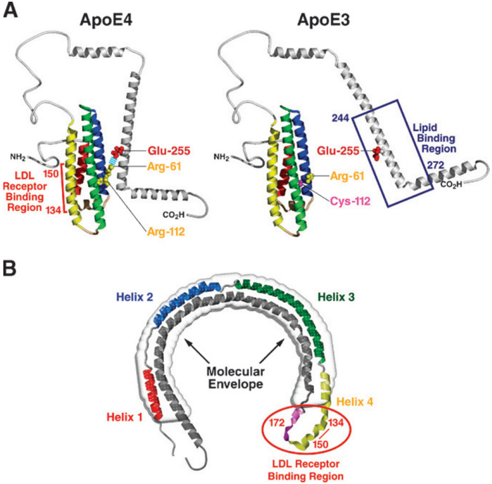
“Structurally, ApoE has two main domains that are connected by a hinge region (amino acids ∼165 to 215); the N-terminal domain (amino acids 1 to 191) forms the receptor binding region, and the C-terminal domain (amino acids ∼225 to 299) harbors the major lipid-binding region (amino acids ∼244 to 272) (Fig. 4, A and C) (20).”
From Secreted Apoe rewires melanoma cell state vulnerability to ferroptosis (2024) · cites this paper as [20]
Experimental — accuracy not yet measuredThe source backs part of the claim, not all of it — or backs it for a different population, condition or comparison.
In the citing paper
“Val254Glu and Arg269Gly are located in the lipid‐binding carboxyl‐terminal domain (amino acids ≈243 to 317). 28 , 42”
From APOE and dementia – resequencing and genotyping in 105,597 individuals (2020) · cites this paper as [42]
Experimental — accuracy not yet measured
15 more claims about this paper
Create a free account to see every claim other papers make about this one.
Self-check
Percentages, sums and reported differences re-computed from the paper’s own numbers.
The self-check needs the paper’s full text.
Citations
Cites
Corder, E. H., Saunders, A. M., Strittmatter, W. J., Schmechel, D. E., Gaskell, P. C., Small, G. W., Roses, A. D., Haines, J. L., & Pericak-Vance, M. A. (1993) · Science · doi:10.1126/science.8346443 · Cited by 9,429
Apolipoprotein E: Cholesterol Transport Protein with Expanding Role in Cell Biology
Mahley, R. W. (1988) · Science · doi:10.1126/science.3283935 · Cited by 4,028
Self-citationApolipoprotein E: Far More Than a Lipid Transport Protein
Mahley, R. W., & Rall, S. C. (2000) · Annual Review of Genomics and Human Genetics · doi:10.1146/annurev.genom.1.1.507 · Cited by 1,836
Self-citationMahley, R. W., Weisgraber, K. H., & Huang, Y. (2006) · Proceedings of the National Academy of Sciences · doi:10.1073/pnas.0600549103 · Cited by 912
Self-citationApolipoprotein E: Structure-Function Relationships
Weisgraber, K. H. (1994) · Advances in Protein Chemistry · doi:10.1016/s0065-3233(08)60642-7 · Cited by 830
Self-citationWeisgraber, K. H., Rall, S. C., & Mahley, R. W. (1981) · Journal of Biological Chemistry · doi:10.1016/s0021-9258(19)52510-8 · Cited by 777
Self-citationHuman apolipoprotein E. The complete amino acid sequence
Rall, S. C., Weisgraber, K. H., & Mahley, R. W. (1982) · Journal of Biological Chemistry · doi:10.1016/s0021-9258(18)34702-1 · Cited by 741
Self-citationThree-Dimensional Structure of the LDL Receptor-Binding Domain of Human Apolipoprotein E
Wilson, C., Wardell, M. R., Weisgraber, K. H., Mahley, R. W., & Agard, D. A. (1991) · Science · doi:10.1126/science.2063194 · Cited by 678
Self-citationHerpes simplex virus type 1 in brain and risk of Alzheimer's disease
Itzhaki, R. F., Lin, W.-R., Shang, D., Wilcock, G. K., Faragher, B., & Jamieson, G. A. (1997) · The Lancet · doi:10.1016/s0140-6736(96)10149-5 · Cited by 669
Polymorphism of apolipoprotein E and occurrence of dysbetalipoproteinaemia in man
UTERMANN, G., HEES, M., & STEINMETZ, A. (1977) · Nature · doi:10.1038/269604a0 · Cited by 666
Cited by
Mach, F., Baigent, C., Catapano, A. L., Koskinas, K. C., Casula, M., Badimon, L., Chapman, M. J., De Backer, G. G., Delgado, V., Ference, B. A., et al. (2020) · European Heart Journal · doi:10.1093/eurheartj/ehz455 · Cited by 8,961
Mach, F., Baigent, C., Catapano, A. L., Koskinas, K. C., Casula, M., Badimon, L., Chapman, M. J., De Backer, G. G., Delgado, V., Ference, B. A., et al. (2019) · Atherosclerosis · doi:10.1016/j.atherosclerosis.2019.08.014 · Cited by 4,854
Blood-Brain Barrier: From Physiology to Disease and Back
Sweeney, M. D., Zhao, Z., Montagne, A., Nelson, A. R., & Zlokovic, B. V. (2019) · Physiological Reviews · doi:10.1152/physrev.00050.2017 · Cited by 2,312
Apolipoprotein E controls cerebrovascular integrity via cyclophilin A
Bell, R. D., Winkler, E. A., Singh, I., Sagare, A. P., Deane, R., Wu, Z., Holtzman, D. M., Betsholtz, C., Armulik, A., Sallstrom, J., et al. (2012) · Nature · doi:10.1038/nature11087 · Cited by 1,293
Apolipoprotein E: from cardiovascular disease to neurodegenerative disorders
Mahley, R. W. (2016) · Journal of Molecular Medicine · doi:10.1007/s00109-016-1427-y · Cited by 837
Self-citationApoE in Alzheimer’s disease: pathophysiology and therapeutic strategies
Raulin, A.-C., Doss, S. V., Trottier, Z. A., Ikezu, T. C., Bu, G., & Liu, C.-C. (2022) · Molecular Neurodegeneration · doi:10.1186/s13024-022-00574-4 · Cited by 756
Function and therapeutic value of astrocytes in neurological diseases
Lee, H.-G., Wheeler, M. A., & Quintana, F. J. (2022) · Nature Reviews Drug Discovery · doi:10.1038/s41573-022-00390-x · Cited by 662
Animal Models of Atherosclerosis
Getz, G. S., & Reardon, C. A. (2012) · Arteriosclerosis, Thrombosis, and Vascular Biology · doi:10.1161/atvbaha.111.237693 · Cited by 630
Age, APOE and sex: triad of risk of Alzheimer’s disease.
Riedel, B. C., Thompson, P. M., & Brinton, R. D. (2016) · The Journal of Steroid Biochemistry and Molecular Biology · doi:10.1016/j.jsbmb.2016.03.012 · Cited by 627
ApoE and Aβ in Alzheimer’s Disease: Accidental Encounters or Partners?
Kanekiyo, T., Xu, H., & Bu, G. (2014) · Neuron · doi:10.1016/j.neuron.2014.01.045 · Cited by 608
Savelieff, M. G., Nam, G., Kang, J., Lee, H. J., Lee, M., & Lim, M. H. (2019) · Chemical Reviews · doi:10.1021/acs.chemrev.8b00138 · Cited by 581
Amyloid-β-independent regulators of tau pathology in Alzheimer disease
van der Kant, R., Goldstein, L. S. B., & Ossenkoppele, R. (2020) · Nature reviews. Neuroscience · doi:10.1038/s41583-019-0240-3 · Cited by 580
Microbes and Alzheimer’s Disease
Itzhaki, R. F., Lathe, R., Balin, B. J., Ball, M. J., Bearer, E. L., Braak, H., Bullido, M. J., Carter, C., Clerici, M., Cosby, S. L., et al. (2016) · Journal of Alzheimer’s Disease · doi:10.3233/jad-160152 · Cited by 532
Central Nervous System Lipoproteins: ApoE and Regulation of Cholesterol Metabolism
Mahley, R. W. (2016) · Arteriosclerosis, Thrombosis, and Vascular Biology · doi:10.1161/atvbaha.116.307023 · Cited by 516
Self-citationApoE4: an emerging therapeutic target for Alzheimer’s disease
Safieh, M., Korczyn, A. D., & Michaelson, D. M. (2019) · BMC Medicine · doi:10.1186/s12916-019-1299-4 · Cited by 449
Apolipoprotein e sets the stage: response to injury triggers neuropathology
Mahley, R. W., & Huang, Y. (2012) · Neuron · doi:10.1016/j.neuron.2012.11.020 · Cited by 412
Self-citationSebastiani, F., Yanez Arteta, M., Lerche, M., Porcar, L., Lang, C., Bragg, R. A., Elmore, C. S., Krishnamurthy, V. R., Russell, R. A., Darwish, T., et al. (2021) · ACS Nano · doi:10.1021/acsnano.0c10064 · Cited by 409
Finch, C. E. (2010) · Proceedings of the National Academy of Sciences · doi:10.1073/pnas.0909606106 · Cited by 407
Intraneuronal β-amyloid accumulation and synapse pathology in Alzheimer’s disease
Gouras, G. K., Tampellini, D., Takahashi, R. H., & Capetillo-Zarate, E. (2010) · Acta Neuropathologica · doi:10.1007/s00401-010-0679-9 · Cited by 372
Apolipoprotein E isoforms and lipoprotein metabolism
Phillips, M. C. (2014) · IUBMB Life · doi:10.1002/iub.1314 · Cited by 328
Apolipoprotein E: From lipid transport to neurobiology
Hauser, P. S., Narayanaswami, V., & Ryan, R. O. (2011) · Progress in Lipid Research · doi:10.1016/j.plipres.2010.09.001 · Cited by 320
Apoprotein E as a lipid transport and signaling protein in the blood, liver, and artery wall
Getz, G. S., & Reardon, C. A. (2009) · Journal of Lipid Research · doi:10.1194/jlr.r800058-jlr200 · Cited by 319
ApoE Cascade Hypothesis in the pathogenesis of Alzheimer’s disease and related dementias
Martens, Y. A., Zhao, N., Liu, C.-C., Kanekiyo, T., Yang, A. J., Goate, A. M., Holtzman, D. M., & Bu, G. (2022) · Neuron · doi:10.1016/j.neuron.2022.03.004 · Cited by 316
Genes associated with Alzheimer's disease: an overview and current status
Giri, M., Lü, Y., & Zhang, M. (2016) · Clinical Interventions in Aging · doi:10.2147/cia.s105769 · Cited by 311
ApoE attenuates unresolvable inflammation by complex formation with activated C1q
Yin, C., Ackermann, S., Ma, Z., Mohanta, S. K., Zhang, C., Li, Y., Nietzsche, S., Westermann, M., Peng, L., Hu, D., et al. (2019) · Nature Medicine · doi:10.1038/s41591-018-0336-8 · Cited by 305
Apolipoprotein E, Especially Apolipoprotein E4, Increases the Oligomerization of Amyloid β Peptide
Hashimoto, T., Serrano-Pozo, A., Hori, Y., Adams, K. W., Takeda, S., Banerji, A. O., Mitani, A., Joyner, D., Thyssen, D. H., Bacskai, B. J., et al. (2012) · The Journal of Neuroscience · doi:10.1523/jneurosci.1542-12.2012 · Cited by 294
Apolipoprotein E: Structural Insights and Links to Alzheimer Disease Pathogenesis
Chen, Y., Strickland, M. R., Soranno, A., & Holtzman, D. M. (2021) · Neuron · doi:10.1016/j.neuron.2020.10.008 · Cited by 298
Apolipoprotein E in lipid metabolism and neurodegenerative disease
Yang, L. G., March, Z. M., Stephenson, R. A., & Narayan, P. S. (2023) · Trends in Endocrinology & Metabolism · doi:10.1016/j.tem.2023.05.002 · Cited by 286
TREM2-Ligand Interactions in Health and Disease
Kober, D. L., & Brett, T. J. (2017) · Journal of Molecular Biology · doi:10.1016/j.jmb.2017.04.004 · Cited by 284
Topology of human apolipoprotein E3 uniquely regulates its diverse biological functions
Chen, J., Li, Q., & Wang, J. (2011) · Proceedings of the National Academy of Sciences · doi:10.1073/pnas.1106420108 · Cited by 283
Cerebrovascular Effects of Apolipoprotein E: Implications for Alzheimer Disease
Zlokovic, B. V. (2013) · JAMA Neurology · doi:10.1001/jamaneurol.2013.2152 · Cited by 263
High Density Lipoprotein Structure–Function and Role in Reverse Cholesterol Transport
Lund-Katz, S., & Phillips, M. C. (2010) · Subcellular Biochemistry · doi:10.1007/978-90-481-8622-8_7 · Cited by 262
Alzheimer’s Amyloid-β is an Antimicrobial Peptide: A Review of the Evidence
Gosztyla, M. L., Brothers, H. M., & Robinson, S. R. (2018) · Journal of Alzheimer’s Disease · doi:10.3233/jad-171133 · Cited by 245
The genetics and neuropathology of Alzheimer’s disease
Schellenberg, G. D., & Montine, T. J. (2012) · Acta Neuropathologica · doi:10.1007/s00401-012-0996-2 · Cited by 242
The Genetic Variability of APOE in Different Human Populations and Its Implications for Longevity
Abondio, P., Sazzini, M., Garagnani, P., Boattini, A., Monti, D., Franceschi, C., Luiselli, D., & Giuliani, C. (2019) · Genes · doi:10.3390/genes10030222 · Cited by 229
Dementia, stroke, and vascular risk factors; a review
Sahathevan, R., Brodtmann, A., & Donnan, G. A. (2012) · International Journal of Stroke · doi:10.1111/j.1747-4949.2011.00731.x · Cited by 230
Lipoprotein receptor signalling in atherosclerosis
Mineo, C. (2020) · Cardiovascular Research · doi:10.1093/cvr/cvz338 · Cited by 219
Chen, H.-K., Ji, Z.-S., Dodson, S. E., Miranda, R. D., Rosenblum, C. I., Reynolds, I. J., Freedman, S. B., Weisgraber, K. H., Huang, Y., & Mahley, R. W. (2011) · Journal of Biological Chemistry · doi:10.1074/jbc.m110.151084 · Cited by 209
Self-citationDual roles of astrocytes in plasticity and reconstruction after traumatic brain injury
Zhou, Y., Shao, A., Yao, Y., Tu, S., Deng, Y., & Zhang, J. (2020) · Cell Communication and Signaling · doi:10.1186/s12964-020-00549-2 · Cited by 204
Lee, S., Devanney, N. A., Golden, L. R., Smith, C. T., Schwartz, J. L., Walsh, A. E., Clarke, H. A., Goulding, D. S., Allenger, E. J., Morillo-Segovia, G., et al. (2023) · Cell Reports · doi:10.1016/j.celrep.2023.112196 · Cited by 203
Neuner, S. M., Heuer, S. E., Huentelman, M. J., O’Connell, K. M. S., & Kaczorowski, C. C. (2019) · Neuron · doi:10.1016/j.neuron.2018.11.040 · Cited by 202
Fleisher, A. S., Chen, K., Liu, X., Ayutyanont, N., Roontiva, A., Thiyyagura, P., Protas, H., Joshi, A. D., Sabbagh, M., Sadowsky, C. H., et al. (2013) · Neurobiology of Aging · doi:10.1016/j.neurobiolaging.2012.04.017 · Cited by 202
Anionic Lipid Nanoparticles Preferentially Deliver mRNA to the Hepatic Reticuloendothelial System
Pattipeiluhu, R., Arias‐Alpizar, G., Basha, G., Chan, K. Y. T., Bussmann, J., Sharp, T. H., Moradi, M., Sommerdijk, N., Harris, E. N., Cullis, P. R., et al. (2022) · Advanced Materials · doi:10.1002/adma.202201095 · Cited by 194
Gene-centric Association Signals for Lipids and Apolipoproteins Identified via the HumanCVD BeadChip
Talmud, P. J., Drenos, F., Shah, S., Shah, T., Palmen, J., Verzilli, C., Gaunt, T. R., Pallas, J., Lovering, R., Li, K., et al. (2009) · The American Journal of Human Genetics · doi:10.1016/j.ajhg.2009.10.014 · Cited by 191
The Role of APOE and TREM2 in Alzheimer′s Disease—Current Understanding and Perspectives
Wolfe, C. M., Fitz, N. F., Nam, K. N., Lefterov, I., & Koldamova, R. (2018) · International Journal of Molecular Sciences · doi:10.3390/ijms20010081 · Cited by 187
Tudorache, I. F., Trusca, V. G., & Gafencu, A. V. (2017) · Computational and Structural Biotechnology Journal · doi:10.1016/j.csbj.2017.05.003 · Cited by 186
On phagocytes and macular degeneration
Guillonneau, X., Eandi, C. M., Paques, M., Sahel, J.-A., Sapieha, P., & Sennlaub, F. (2017) · Progress in Retinal and Eye Research · doi:10.1016/j.preteyeres.2017.06.002 · Cited by 185
Suri, S., Heise, V., Trachtenberg, A. J., & Mackay, C. E. (2013) · Neuroscience & Biobehavioral Reviews · doi:10.1016/j.neubiorev.2013.10.010 · Cited by 183
Apolipoprotein E induces pathogenic senescent-like myeloid cells in prostate cancer
Bancaro, N., Calì, B., Troiani, M., Elia, A. R., Arzola, R. A., Attanasio, G., Lai, P., Crespo, M., Gurel, B., Pereira, R., et al. (2023) · Cancer Cell · doi:10.1016/j.ccell.2023.02.004 · Cited by 177
Atherosclerotic cardiovascular disease: a review of initiators and protective factors
Ellulu, M. S., Patimah, I., Khaza’ai, H., Rahmat, A., Abed, Y., & Ali, F. (2016) · Inflammopharmacology · doi:10.1007/s10787-015-0255-y · Cited by 173
Hepatitis C Virus Attachment Mediated by Apolipoprotein E Binding to Cell Surface Heparan Sulfate
Jiang, J., Cun, W., Wu, X., Shi, Q., Tang, H., & Luo, G. (2012) · Journal of Virology · doi:10.1128/jvi.07222-11 · Cited by 171
Therapeutic approaches targeting Apolipoprotein E function in Alzheimer’s disease
Williams, T., Borchelt, D. R., & Chakrabarty, P. (2020) · Molecular Neurodegeneration · doi:10.1186/s13024-020-0358-9 · Cited by 171
APOE gene variants in primary dyslipidemia
Khalil, Y. A., Rabès, J.-P., Boileau, C., & Varret, M. (2021) · Atherosclerosis · doi:10.1016/j.atherosclerosis.2021.05.007 · Cited by 170
Martínez-Morillo, E., Hansson, O., Atagi, Y., Bu, G., Minthon, L., Diamandis, E. P., & Nielsen, H. M. (2014) · Acta Neuropathologica · doi:10.1007/s00401-014-1266-2 · Cited by 168
Microglia versus Monocytes: Distinct Roles in Degenerative Diseases of the Retina
Yu, C., Roubeix, C., Sennlaub, F., & Saban, D. R. (2020) · Trends in Neurosciences · doi:10.1016/j.tins.2020.03.012 · Cited by 168
Tai, L. M., Ghura, S., Koster, K. P., Liakaite, V., Maienschein‐Cline, M., Kanabar, P., Collins, N., Ben‐Aissa, M., Lei, A. Z., Bahroos, N., et al. (2015) · Journal of Neurochemistry · doi:10.1111/jnc.13072 · Cited by 165
Yamazaki, Y., Painter, M. M., Bu, G., & Kanekiyo, T. (2016) · CNS Drugs · doi:10.1007/s40263-016-0361-4 · Cited by 164
Chen, H.-K., Liu, Z., Meyer-Franke, A., Brodbeck, J., Miranda, R. D., McGuire, J. G., Pleiss, M. A., Ji, Z.-S., Balestra, M. E., Walker, D. W., et al. (2012) · Journal of Biological Chemistry · doi:10.1074/jbc.m111.276162 · Cited by 163
Self-citationAlata, W., Ye, Y., St-Amour, I., Vandal, M., & Calon, F. (2015) · Journal of Cerebral Blood Flow & Metabolism · doi:10.1038/jcbfm.2014.172 · Cited by 161
Plasma levels of apolipoprotein Eand risk of dementia in the general population
Rasmussen, K. L., Tybjærg‐Hansen, A., Nordestgaard, B. G., & Frikke‐Schmidt, R. (2015) · Annals of Neurology · doi:10.1002/ana.24326 · Cited by 156
Yassine, H. N., Braskie, M. N., Mack, W. J., Castor, K. J., Fonteh, A. N., Schneider, L. S., Harrington, M. G., & Chui, H. C. (2017) · JAMA Neurology · doi:10.1001/jamaneurol.2016.4899 · Cited by 155
The APOE ɛ4 allele modulates brain white matter integrity in healthy adults
Heise, V, Filippini, N., Ebmeier, K. P., & Mackay, C. E. (2011) · Molecular Psychiatry · doi:10.1038/mp.2010.90 · Cited by 152
The Important Interface Between Apolipoprotein E and Neuroinflammation in Alzheimer’s Disease
Kloske, C. M., & Wilcock, D. M. (2020) · Frontiers in Immunology · doi:10.3389/fimmu.2020.00754 · Cited by 152
Interactions of SARS-CoV-2 with the Blood–Brain Barrier
Erickson, M. A., Rhea, E. M., Knopp, R. C., & Banks, W. A. (2021) · International Journal of Molecular Sciences · doi:10.3390/ijms22052681 · Cited by 166
APOE Stabilization by Exercise Prevents Aging Neurovascular Dysfunction and Complement Induction
Soto, I., Graham, L. C., Richter, H. J., Simeone, S. N., Radell, J. E., Grabowska, W., Funkhouser, W. K., Howell, M. C., & Howell, G. R. (2015) · PLOS Biology · doi:10.1371/journal.pbio.1002279 · Cited by 140
Guevara‐Cruz, M., Flores‐López, A. G., Aguilar‐López, M., Sánchez‐Tapia, M., Medina‐Vera, I., Díaz, D., Tovar, A. R., & Torres, N. (2019) · Journal of the American Heart Association · doi:10.1161/jaha.119.012401 · Cited by 140
Atherosclerosis and Alzheimer - diseases with a common cause? Inflammation, oxysterols, vasculature
Lathe, R., Sapronova, A., & Kotelevtsev, Y. (2014) · BMC Geriatrics · doi:10.1186/1471-2318-14-36 · Cited by 137
Frieden, C., Wang, H., & Ho, C. M. W. (2017) · Proceedings of the National Academy of Sciences · doi:10.1073/pnas.1705080114 · Cited by 134
Frieden, C., & Garai, K. (2012) · Proceedings of the National Academy of Sciences · doi:10.1073/pnas.1207022109 · Cited by 133
The genetic landscape of Alzheimer disease
Carmona, S., Hardy, J., & Guerreiro, R. J. (2018) · Handbook of clinical neurology · doi:10.1016/b978-0-444-64076-5.00026-0 · Cited by 155
Mahley, R. W., & Huang, Y. (2012) · Journal of Medicinal Chemistry · doi:10.1021/jm3008618 · Cited by 132
Self-citationYao, X., Gordon, E. M., Figueroa, D. M., Barochia, A. V., & Levine, S. J. (2016) · American Journal of Respiratory Cell and Molecular Biology · doi:10.1165/rcmb.2016-0060tr · Cited by 145
Cun, W., Jiang, J., & Luo, G. G. (2010) · Journal of Virology · doi:10.1128/jvi.01021-10 · Cited by 150
The bile acid TUDCA and neurodegenerative disorders: An overview
Zangerolamo, L., Vettorazzi, J. F., Rosa, L. R. D. O., Carneiro, E. M., & Barbosa, H. C. L. (2021) · Life Sciences · doi:10.1016/j.lfs.2021.119252 · Cited by 136
Genetic architecture of Alzheimer's disease
Neuner, S. M., TCW, J., & Goate, A. M. (2020) · Neurobiology of Disease · doi:10.1016/j.nbd.2020.104976 · Cited by 126
Rasmussen, K. L. (2016) · Atherosclerosis · doi:10.1016/j.atherosclerosis.2016.10.037 · Cited by 125
Heffernan, A. L., Chidgey, C., Peng, P., Masters, C. L., & Roberts, B. R. (2016) · Journal of Molecular Neuroscience · doi:10.1007/s12031-016-0804-x · Cited by 113
Lee, J., & Freeman, J. L. (2014) · NeuroToxicology · doi:10.1016/j.neuro.2014.03.008 · Cited by 127
Reduction in DHA transport to the brain of mice expressing human APOE 4 compared to APOE 2
Vandal, M., Alata, W., Tremblay, C., Rioux‐Perreault, C., Salem, N., Calon, F., & Plourde, M. (2014) · Journal of Neurochemistry · doi:10.1111/jnc.12640 · Cited by 110
Kyrtsos, C. R., & Baras, J. S. (2015) · PLOS ONE · doi:10.1371/journal.pone.0139574 · Cited by 108
Reynoso-García, J., Miranda-Santiago, A. E., Meléndez-Vázquez, N. M., Acosta-Pagán, K. T., Rosado, M. R. S., Díaz-Rivera, J., Rosado-Quiñones, A. M., Acevedo-Márquez, L., Cruz-Roldán, L., Tosado-Rodríguez, E. L., et al. (2022) · Frontiers in Systems Biology · doi:10.3389/fsysb.2022.951403 · Cited by 125
Orr, A. L., Kim, C., Jimenez-Morales, D., Newton, B. W., Johnson, J. R., Krogan, N. J., Swaney, D. L., & Mahley, R. W. (2019) · Journal of Alzheimer's Disease · doi:10.3233/jad-181184 · Cited by 103
Self-citationNeuroprotective Sirtuin ratio reversed by ApoE4
Theendakara, V., Patent, A., Peters Libeu, C. A., Philpot, B., Flores, S., Descamps, O., Poksay, K. S., Zhang, Q., Cailing, G., Hart, M., et al. (2013) · Proceedings of the National Academy of Sciences · doi:10.1073/pnas.1314145110 · Cited by 101
Apolipoprotein E, amyloid-beta, and neuroinflammation in Alzheimer’s disease
Dorey, E., Chang, N., Liu, Q. Y., Yang, Z., & Zhang, W. (2014) · Neuroscience Bulletin · doi:10.1007/s12264-013-1422-z · Cited by 116
APOE Isoforms Control Pathogenic Subretinal Inflammation in Age-Related Macular Degeneration
Levy, O., Lavalette, S., Hu, S. J., Housset, M., Raoul, W., Eandi, C., Sahel, J.-A., Sullivan, P. M., Guillonneau, X., & Sennlaub, F. (2015) · The Journal of Neuroscience · doi:10.1523/jneurosci.2468-15.2015 · Cited by 97
Cardiovascular Aging and Longevity
Pietri, P. G., & Stefanadis, C. (2021) · Journal of the American College of Cardiology · doi:10.1016/j.jacc.2020.11.023 · Cited by 113
Zhang, H., Wu, J., & Zhu, J. (2010) · Journal of Immunology Research · doi:10.1155/2010/186813 · Cited by 128
Cash, J. G., Kuhel, D. G., Basford, J. E., Jaeschke, A., Chatterjee, T. K., Weintraub, N. L., & Hui, D. Y. (2012) · Journal of Biological Chemistry · doi:10.1074/jbc.m112.377549 · Cited by 98
Yao, X., Fredriksson, K., Yu, Z., Xu, X., Raghavachari, N., Keeran, K. J., Nugent, G. Z., Kwak, M., Amar, M. J., Remaley, A. T., et al. (2010) · American Journal of Respiratory and Critical Care Medicine · doi:10.1164/rccm.201002-0308oc · Cited by 99
The Apolipoprotein B/Apolipoprotein A-I Ratio as a Potential Marker of Plasma Atherogenicity
Kaneva, A. M., Потолицына, Н. Н., Bojko, E. R., & Odland, J. Ø. (2015) · Disease Markers · doi:10.1155/2015/591454 · Cited by 107
Risk and protective factors for cognitive impairment in persons aged 85 years and older
Roberts, R. O., Cha, R. H., Mielke, M. M., Geda, Y. E., Boeve, B. F., Machulda, M. M., Knopman, D. S., & Petersen, R. C. (2015) · Neurology · doi:10.1212/wnl.0000000000001537 · Cited by 91
Revisiting the critical roles of reactive astrocytes in neurodegeneration
Qian, K., Jiang, X., Liu, Z., Zhang, J., Fu, P. F., Su, Y., Brazhe, N. A., Liu, D., & Zhu, L. (2023) · Molecular Psychiatry · doi:10.1038/s41380-023-02061-8 · Cited by 109
Nguyen, D., Dhanasekaran, P., Nickel, M., Nakatani, R., Saito, H., Phillips, M. C., & Lund-Katz, S. (2010) · Biochemistry · doi:10.1021/bi1017655 · Cited by 89
Wu, Y., Pang, J., Peng, J., Cao, F., Guo, Z., Jiang, L., Teng, Z., Huang, Z., Cheng, C., Jiang, Y. Q., et al. (2019) · Oxidative Medicine and Cellular Longevity · doi:10.1155/2019/3832648 · Cited by 92
Hyperlipoproteinemia Type 3: The Forgotten Phenotype
Hopkins, P. N., Brinton, E. A., & Nanjee, M. N. (2014) · Current Atherosclerosis Reports · doi:10.1007/s11883-014-0440-2 · Cited by 93
Getz, G. S., & Reardon, C. A. (2016) · Journal of Lipid Research · doi:10.1194/jlr.r067249 · Cited by 97
Identifying Common Genetic Risk Factors of Diabetic Neuropathies
Witzel, I.-I., Jelinek, H. F., Khalaf, K., Lee, S., Khandoker, A. H., & Alsafar, H. (2015) · Frontiers in Endocrinology · doi:10.3389/fendo.2015.00088 · Cited by 86
Gamache, J., Yun, Y., & Chiba-Falek, O. (2020) · Disease Models & Mechanisms · doi:10.1242/dmm.045211 · Cited by 84
Apolipoprotein E in Cardiometabolic and Neurological Health and Diseases
Alagarsamy, J., Jaeschke, A., & Hui, D. Y. (2022) · International Journal of Molecular Sciences · doi:10.3390/ijms23179892 · Cited by 96
APOE ε 4 is associated with higher vitamin D levels in targeted replacement mice and humans
Huebbe, P., Nebel, A., Siegert, S., Moehring, J., Boesch‐Saadatmandi, C., Most, E., Pallauf, J., Egert, S., Müller, M. J., Schreiber, S., et al. (2011) · The FASEB Journal · doi:10.1096/fj.11-180935 · Cited by 83
Metadata
- Authors
- Mahley, R. W., Weisgraber, K. H., & Huang, Y.
- Affiliations
- Gladstone Institutes (US)
- Corresponding author
- Mahley, Robert W.
- Venue
- Journal of Lipid Research
- Publisher
- Elsevier BV
- Published
- 2009-04
- Volume
- 50
- Pages
- S183-S188
- ISSN
- 0022-2275 (ISSN-L)
- PMC
- PMC2674716
- OpenAlex
- W2006599070
- Cited by
- 580
- References
- 58
- Citations by year
- 2026: 30 · 2025: 55 · 2024: 40 · 2023: 48 · 2022: 44 · 2021: 34 · 2020: 27 · 2019: 34 · 2018: 33 · 2017: 28 · 2016: 37 · 2015: 23 · 2014: 38 · 2013: 25 · 2012: 35
- FWCI
- 16.86
- Type
- journal article
- Language
- en
- Open access
- hybrid
- doi.org
- Licence
- cc-by
- www.elsevier.com/tdm/userlicense/1.0/ (tdm)
- creativecommons.org/licenses/by/4.0/ (vor, 4185 d)
- Locations
- Journal of Lipid Research (publishedVersion, cc-by)
- PubMed Central (publishedVersion)
- PubMed (publishedVersion)
- DOAJ (DOAJ: Directory of Open Access Journals) (submittedVersion, cc-by-sa)
- Funders
- Gladstone Institutes
- National Institutes of Health
- National Institute on Aging (R01AG028793, 2P01AG02207)
- Topics
- Health Sciences › Medicine › Cardiology and Cardiovascular Medicine › Lipoproteins and Cardiovascular Health
- Life Sciences › Neuroscience › Cellular and Molecular Neuroscience › Alzheimer's disease research and treatments
- Life Sciences › Biochemistry, Genetics and Molecular Biology › Biochemistry › Cholesterol and Lipid Metabolism
- Keywords
- apolipoprotein E, APOE ε4, APOE3, APOE2, protein structure-function relationship, LDL receptor binding, type III hyperlipoproteinemia, atherosclerosis, Alzheimer's disease, AIDS, HIV, opportunistic infections, genetic risk factors, lipoprotein metabolism
- MeSH terms
- Acquired Immunodeficiency Syndrome, Alzheimer Disease, Animals, Apolipoproteins E, Humans, Protein Binding, Atherosclerosis
About these checks
Registry, retraction, Cites and statistics results are computed, not judged, with one exception: a printed reference that no index lists is read once by a model before it counts as a citation error. Claims are extracted by a model and kept only when their quote appears verbatim in the text; each cited source is then checked, with a model’s help, for whether it says what the claim relies on. Those verdicts can be wrong — read the claim’s quote and the cited source before relying on one.
Statistics and arithmetic are recomputed, not judged.
Confidence bands are shown only for fields calibrated on our annotated test set. None is calibrated yet, so no band is shown.
What counts as a claim ›How we measure confidence ›How we check this ›
Are you an author, or do you see a problem with this page? Request a review
Data sources
Bibliographic data: Semantic Scholar, OpenAlex, Crossref.
Contains information from the Semantic Scholar Academic Graph Datasets, made available under the ODC Attribution License (ODC-BY 1.0).
Semantic Scholar’s data is described in: Kinney, R., et al. (2023). The Semantic Scholar Open Data Platform. arXiv:2301.10140.
