

Vagotomy and Parkinson disease: A Swedish register–based matched-cohort study
Open accessThe DOI matches its Crossref record, with a small difference in title or year; 30 of the 30 references it cites were found in a registry or an index.
Abstract
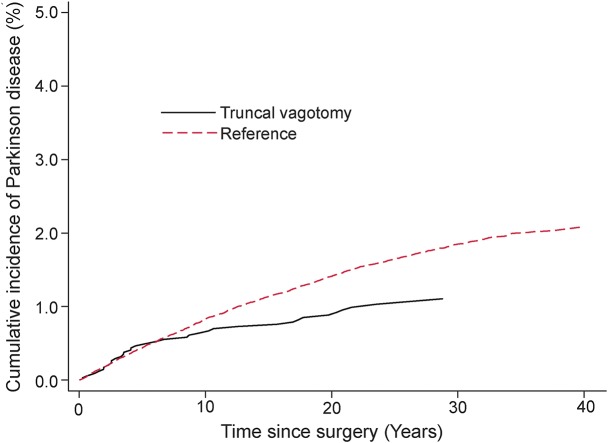
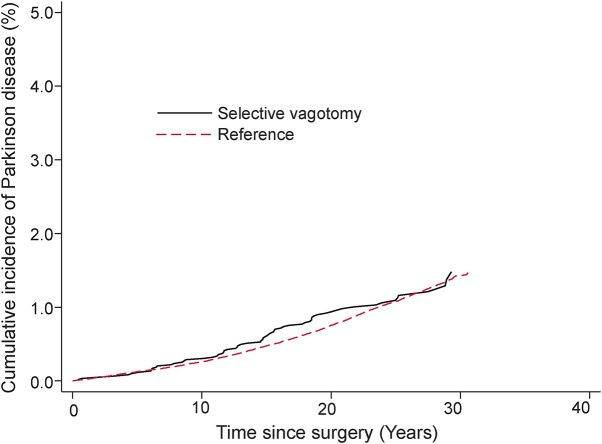
OBJECTIVE: To examine whether vagotomy decreases the risk of Parkinson disease (PD). METHODS: Using data from nationwide Swedish registers, we conducted a matched-cohort study of 9,430 vagotomized patients (3,445 truncal and 5,978 selective) identified between 1970 and 2010 and 377,200 reference individuals from the general population individually matched to vagotomized patients by sex and year of birth with a 40:1 ratio. Participants were followed up from the date of vagotomy until PD diagnosis, death, emigration out of Sweden, or December 31, 2010, whichever occurred first. Vagotomy and PD were identified from the Swedish Patient Register. We estimated hazard ratios (HRs) with 95% confidence intervals (CIs) using Cox models stratified by matching variables, adjusting for country of birth, chronic obstructive pulmonary disease, diabetes mellitus, vascular diseases, rheumatologic disease, osteoarthritis, and comorbidity index. RESULTS: A total of 4,930 cases of incident PD were identified during 7.3 million person-years of follow-up. PD incidence (per 100,000 person-years) was 61.8 among vagotomized patients (80.4 for truncal and 55.1 for selective) and 67.5 among reference individuals. Overall, vagotomy was not associated with PD risk (HR 0.96, 95% CI 0.78-1.17). However, there was a suggestion of lower risk among patients with truncal vagotomy (HR 0.78, 95% CI 0.55-1.09), which may be driven by truncal vagotomy at least 5 years before PD diagnosis (HR 0.59, 95% CI 0.37-0.93). Selective vagotomy was not related to PD risk in any analyses. CONCLUSIONS: Although overall vagotomy was not associated the risk of PD, we found suggestive evidence for a potential protective effect of truncal, but not selective, vagotomy against PD development.
Overview
The claims and statistics of this paper haven’t been checked yet.
Free: it reads the open-access text and checks the first 5 claims that cite a source we can check. Create a free account to check every claim.
Integrity signals
Registry
Cites
Statistics
Figures
Verification
Claims the paper makes
The claims and statistics of this paper haven’t been checked yet.
Free: it reads the open-access text and checks the first 5 claims that cite a source we can check. Create a free account to check every claim.
Claims other papers make about this one
Each is checked against this paper’s own text: does it say what the citing paper says it does?
The source backs part of the claim, not all of it — or backs it for a different population, condition or comparison.
In the citing paper
“This proposition gained mixed support from two large epidemiological studies showing that full truncal but not selective vagotomy decreases the risk of PD [57, 58].”
From The gut–brain axis in early Parkinson’s disease: from prodrome to prevention (2025) · cites this paper as [58]
Experimental — accuracy not yet measuredThe cited source says what the claim attributes to it.
In the citing paper
“In contrast, another study with a follow-up of patients after vagotomy argued that vagotomy was not associated with the risk of Parkinson's disease in Sweden.144”
From The role of gut dysbiosis in Parkinson’s disease: mechanistic insights and therapeutic options (2021) · cites this paper as [144]
The cited source says what the claim attributes to it.
In the citing paper
“Large epidemiologic studies also suggest that truncal vagotomy is associated with a reduced risk of subsequent PD, supporting a potential gut–brain contribution to pathogenesis (Liu et al., 2017).”
From Autonomic nervous system and gastrointestinal manifestations with an emphasis on gastric dysfunction (2026) · cites this paper as Liu et al., 2017
In the citing paper
“While this pattern of α-synuclein spreading is not observed in all cases of sporadic PD, vagotomy may be associated with reduced risk of developing PD in humans, potentially implicating peripheral influences on disease development (Svensson et al., 2015; Liu et al., 2017).”
From Microbiome–microglia connections via the gut–brain axis (2019) · cites this paper as Liu et al., 2017
Self-check
Percentages, sums and reported differences re-computed from the paper’s own numbers.
The self-check needs the paper’s full text.
Citations
Cites
Charlson, M. E., Pompei, P., Ales, K. L., & MacKenzie, C. R. (1987) · Journal of Chronic Diseases · doi:10.1016/0021-9681(87)90171-8 · Cited by 49,742
Coding algorithms for defining comorbidities in ICD-9-CM and ICD-10 administrative data
Quan, H., Sundararajan, V., Halfon, P., Fong, A., Burnand, B., Luthi, J.-C., Saunders, L. D., Beck, C. A., Feasby, T. E., & Ghali, W. A. (2005) · Medical Care · doi:10.1097/01.mlr.0000182534.19832.83 · Cited by 10,669
Adapting a clinical comorbidity index for use with ICD-9-CM administrative databases
DEYO, R. (1992) · Journal of Clinical Epidemiology · doi:10.1016/0895-4356(92)90133-8 · Cited by 10,452
External review and validation of the Swedish national inpatient register
Ludvigsson, J. F., Andersson, E., Ekbom, A., Feychting, M., Kim, J.-L., Reuterwall, C., Heurgren, M., & Olausson, P. O. (2011) · BMC Public Health · doi:10.1186/1471-2458-11-450 · Cited by 5,055 · cited 4×
“Primary health care visits are not yet included in the Patient Register.(18) Swedish Population and Housing Censuses were conducted every 5 years from 1960 to 1990 by Statistics Sweden(19) and were mandatory for Swedish residents $16 years of age.”
BackgroundInfluentialSelf-citationStages in the development of Parkinson’s disease-related pathology
Braak, H., Ghebremedhin, E., Rüb, U., Bratzke, H., & Del Tredici, K. (2004) · Cell and Tissue Research · doi:10.1007/s00441-004-0956-9 · Cited by 2,689
Li, J.-Y., Englund, E., Holton, J. L., Soulet, D., Hagell, P., Lees, A. J., Lashley, T., Quinn, N. P., Rehncrona, S., Björklund, A., et al. (2008) · Nature Medicine · doi:10.1038/nm1746 · Cited by 1,845
Lewy body–like pathology in long-term embryonic nigral transplants in Parkinson's disease
Kordower, J. H., Chu, Y., Hauser, R. A., Freeman, T. B., & Olanow, C. W. (2008) · Nature Medicine · doi:10.1038/nm1747 · Cited by 1,722
Braak, H., R�b, U., Gai, W. P., & Del Tredici, K. (2003) · Journal of Neural Transmission · doi:10.1007/s00702-002-0808-2 · Cited by 1,683
Inclusion formation and neuronal cell death through neuron-to-neuron transmission of α-synuclein
Desplats, P., Lee, H.-J., Bae, E.-J., Patrick, C., Rockenstein, E., Crews, L., Spencer, B., Masliah, E., & Lee, S.-J. (2009) · Proceedings of the National Academy of Sciences · doi:10.1073/pnas.0903691106 · Cited by 1,485 · cited 1×
“Furthermore, cell-to-cell a-synuclein transmission has been observed in both grafted neurons in patients with PD(8,9) and transplanted neurons in a transgenic mouse model of PD.(10) In murine models, injection of human a-synuclein into the intestinal wall led to a later a-synuclein observation in the vagus nerve.”
BackgroundBraak, H., de Vos, R. A. I., Bohl, J., & Del Tredici, K. (2006) · Neuroscience Letters · doi:10.1016/j.neulet.2005.11.012 · Cited by 1,354
Research works printed but not linked: 5
- Statistics Sweden. Täckningsgrad för den somatiska och psykiatriska slutenvården [online]. Available at: http://www.scb.se/sv_/Hitta-statistik/Regional-statistik-och-kartor/Regionala-indelningar/Lan-och-kommuner/Lan-och-kommuner-i-kodnummerordning/. Accessed April 9, 2016.
- Statistics Sweden. The National Patient Register [online]. Available at: http://www.socialstyrelsen.se/register/halsodataregister/patientregistret/inenglish. Accessed May 9, 2015.
- Statistics Sweden. Folk- och bostadsräkningen 1965–1990 [online]. Available at: http://www.scb.se/sv_/Hitta-statistik/Historisk-statistik/Statistik-efter-serie/Sveriges-officiella-statistik-SOS-utg-1912-/Folk-och-bostadsrakningarna-1860-1990/Folk-och-bostadsrakningen-1965-1990/. Accessed May 9, 2015.
- Statistics Sweden. SCB-data för Forskning 2012/Microdata at Statistic Sweden for Research Purposes 2012 [online]. Available at: http://www.scb.se/statistik/_publikationer/OV9999_2012A01_BR_X104BR1201.pdf. Accessed May 9, 2015.
- Gao X, Chen H, Schwarzschild M, Ascherio A. Use of non-steroidal anti-inflammatory drugs and risk of Parkinson's disease: a prospective study and meta-analysis. Neurology 2010; 74: A103.
Cited by
Items 201–300 of 444
A neuroscience perspective of the gut theory of Parkinson's disease
Smith, L. M., & Parr‐Brownlie, L. C. (2018) · European Journal of Neuroscience · doi:10.1111/ejn.13869 · Cited by 26
Dementia and vagotomy in Taiwan: a population-based cohort study
Lin, S.-Y., Lin, C.-L., Wang, I.-K., Lin, C.-C., Lin, C.-H., Hsu, W.-H., & Kao, C.-H. (2018) · BMJ Open · doi:10.1136/bmjopen-2017-019582 · Cited by 23
Jia, X., Chen, Q., Zhang, Y., & Asakawa, T. (2023) · Frontiers in Cellular and Infection Microbiology · doi:10.3389/fcimb.2023.1296713 · Cited by 22
“More evidence has indicated that the vagus nerve is a route by which a -syn pathology can spread both to and from the brain (Pan-Montojo et al., 2012; Matteoli and Boeckxstaens, 2013; Gray et al., 2014; Liu et al., 2017).”
BackgroundChetty, D., Abrahams, S., van Coller, R., Carr, J. A., Kenyon, C. P., & Bardien, S. (2021) · European Journal of Neuroscience · doi:10.1111/ejn.15324 · Cited by 23
The gut microbiome: an important role in neurodegenerative diseases and their therapeutic advances
Li, S., Zhao, L., Xiao, J., Guo, Y., Fu, R., Zhang, Y., & Xu, S. (2023) · Molecular and Cellular Biochemistry · doi:10.1007/s11010-023-04853-6 · Cited by 29
Park, S. J., Kim, K. W., & Lee, E. J. (2024) · Neural Regeneration Research · doi:10.4103/nrr.nrr-d-24-00994 · Cited by 28
Imaging Parkinson’s disease below the neck
Borghammer, P., Knudsen, K., Fedorova, T. D., & Brooks, D. J. (2017) · npj Parkinson s Disease · doi:10.1038/s41531-017-0017-1 · Cited by 25
Imaging the Autonomic Nervous System in Parkinson’s Disease
Knudsen, K., & Borghammer, P. (2018) · Current Neurology and Neuroscience Reports · doi:10.1007/s11910-018-0889-4 · Cited by 23
Bottoms up: the role of gut microbiota in brain health
Radisavljevic, N., Cirstea, M., & Brett Finlay, B. (2019) · Environmental Microbiology · doi:10.1111/1462-2920.14506 · Cited by 22
The cross-sectional area of the vagus nerve is not reduced in Parkinson's disease patients
Sijben, L. C. J., Mess, W. H., Walter, U., Janssen, A. M. L., Kuijf, M. L., Oosterloo, M., Weber, W. E. J., & Janssen, M. L. F. (2022) · eNeurologicalSci · doi:10.1016/j.ensci.2022.100400 · Cited by 24
Macdonald, J. A., Chen, J. L., Masuda‐Suzukake, M., Schweighauser, M., Jaunmuktane, Z., Warner, T. T., Holton, J. L., Grossman, A., Berks, R., Lavenir, I., et al. (2021) · Acta Neuropathologica Communications · doi:10.1186/s40478-021-01291-7 · Cited by 22
Pasricha, T. S., Guerrero-López, I., & Kuo, B. (2024) · Journal of Clinical Gastroenterology · doi:10.1097/mcg.0000000000001961 · Cited by 31
Ríos, J. P., Madrid-Navarro, C. J., Navarro, M., Tapia, M. J. C., Vera, M. J. P., Arillo, V. M. C., García, M. R. G., Mínguez‐Castellanos, A., & Sevilla, F. E. (2019) · BMJ Open · doi:10.1136/bmjopen-2018-025574 · Cited by 25
Virus-like particles and enterovirus antigen found in the brainstem neurons of Parkinson’s disease
Dourmashkin, R. R., McCall, S. A., Dourmashkin, N., & Hannah, M. J. (2018) · F1000Research · doi:10.12688/f1000research.13626.1 · Cited by 20
Luo, S., Pan, M., Fu, G., Meng, X., Zhao, Z., Yu, H., Yue, G.-X., & Lei, T. (2025) · Pharmacological Research · doi:10.1016/j.phrs.2025.107974 · Cited by 20
Parkinson’s disease: Are gut microbes involved?
Bhattarai, Y., & Kashyap, P. (2020) · American Journal of Physiology-Gastrointestinal and Liver Physiology · doi:10.1152/ajpgi.00058.2020 · Cited by 21
Hill, A. E., Wade‐Martins, R., & Burnet, P. W. J. (2021) · Frontiers in Neuroscience · doi:10.3389/fnins.2021.708587 · Cited by 20
Interactions of Gut Endocrine Cells with Epithelium and Neurons
Liddle, R. A. (2018) · Comprehensive physiology · doi:10.1002/cphy.c170044 · Cited by 23
The Role of the Gastrointestinal Microbiota in Parkinson’s Disease
Gabrielli, M., Verme, L. Z. D., Zocco, M. A., Nista, E. C., Ojetti, V., & Gasbarrini, A. (2024) · Biomolecules · doi:10.3390/biom15010026 · Cited by 21
Structural Mimicry in Microbial and Antimicrobial Amyloids
Golan, N., Engelberg, Y., & Landau, M. (2022) · Annual Review of Biochemistry · doi:10.1146/annurev-biochem-032620-105157 · Cited by 20
The gastrointestinal tract and Parkinson’s disease
Higinbotham, A. S., & Kilbane, C. (2024) · Frontiers in Cellular and Infection Microbiology · doi:10.3389/fcimb.2023.1158986 · Cited by 25
Defining Dysbiosis in Disorders of Movement and Motivation
Fields, C. T., Sampson, T. R., Bruce‐Keller, A. J., Kiraly, D. D., Hsiao, E. Y., & Vries, G. J. D. (2018) · Journal of Neuroscience · doi:10.1523/jneurosci.1672-18.2018 · Cited by 21
What substance P might tell us about the prognosis and mechanism of Parkinson's disease?
Tirassa, P., Schirinzi, T., Raspa, M., Ralli, M., Greco, A., Polimeni, A., Possenti, R., Mercuri, N. B., & Severini, C. (2021) · Neuroscience & Biobehavioral Reviews · doi:10.1016/j.neubiorev.2021.10.008 · Cited by 22
Ternák, G., Németh, M., Rozanovic, M., Márovics, G., & Bogár, L. (2022) · Antibiotics · doi:10.3390/antibiotics11091145 · Cited by 20
The Role of The Gut Microbiome in Parkinson’s Disease
Gallop, A., Weagley, J. S., Paracha, S.-U.-R., & Grossberg, G. T. (2021) · Journal of Geriatric Psychiatry and Neurology · doi:10.1177/08919887211018268 · Cited by 20
Gut instincts in neuroimmunity from the eighteenth to twenty-first centuries
Nguyen, M. T., & Palm, N. W. (2022) · Seminars in Immunopathology · doi:10.1007/s00281-022-00948-2 · Cited by 21
Does Parkinson's disease start in the gut?
Gershanik, O. S. (2018) · Arquivos de Neuro-Psiquiatria · doi:10.1590/0004-282x20170188 · Cited by 21
The gut-brain connection in the pathogenicity of Parkinson disease: Putative role of autophagy
Kakoty, V., Sarathlal, K. C., Dubey, S. K., Yang, C. H., Kesharwani, P., & Taliyan, R. (2021) · Neuroscience Letters · doi:10.1016/j.neulet.2021.135865 · Cited by 20
Parkinson Disease and the Gut: A Primer for Gastroenterologists
Sharma, A., Voigt, R. M., Goetz, C. G., & Keshavarzian, A. (2025) · The American Journal of Gastroenterology · doi:10.14309/ajg.0000000000003508 · Cited by 19
Zheng, H., Shi, C., Luo, H., Fan, L., Yang, Z., Hu, X., Zhang, Z., Zhang, S., Hu, Z., Fan, Y., et al. (2020) · The Neuroscientist · doi:10.1177/1073858420943180 · Cited by 23
Wittung-Stafshede, P. E. (2021) · Current Opinion in Structural Biology · doi:10.1016/j.sbi.2021.07.009 · Cited by 17
2021 Workshop: Neurodegenerative Diseases in the Gut-Brain Axis—Parkinson's Disease
Mawe, G. M., Browning, K. N., Manfredsson, F. P., Camilleri, M., Hamilton, F. A., Hollander, J. A., Sieber, B.-A., Greenwel, P., Shea‐Donohue, T., & Wiley, J. W. (2022) · Gastroenterology · doi:10.1053/j.gastro.2022.02.004 · Cited by 19
Epidemiological Evidence for an Immune Component of Parkinson’s Disease
González-Latapí, P., & Marras, C. (2022) · Journal of Parkinson s Disease · doi:10.3233/jpd-223180 · Cited by 20
The Interface between Inflammatory Bowel Disease, Neuroinflammation, and Neurological Disorders
Hey, G. E., Vedam‐Mai, V., Beke, M., Amaris, M. A., & Ramirez‐Zamora, A. (2023) · Seminars in Neurology · doi:10.1055/s-0043-1771467 · Cited by 16
Modulation of Neuroinflammation by the Gut Microbiota in Prion and Prion-Like Diseases
Trichka, J., & Zou, W. (2021) · Pathogens · doi:10.3390/pathogens10070887 · Cited by 18
Lai, Y., Dhingra, R., Zhang, Z., Ball, L. M., Zylka, M. J., & Lü, K. (2021) · Biochemistry · doi:10.1021/acs.biochem.1c00656 · Cited by 23
Hajare, S., & Kulkarni, Y. A. (2025) · Brain Research · doi:10.1016/j.brainres.2025.149975 · Cited by 19
Gut-to-brain spreading of pathology in synucleinopathies: A focus on molecular signalling mediators
Schmitt, V., Masanetz, R. K., Weidenfeller, M., Ebbinghaus, L. S., Süß, P., Rosshart, S. P., von Hörsten, S., Zunke, F., Winkler, J., & Xiang, W. (2023) · Behavioural Brain Research · doi:10.1016/j.bbr.2023.114574 · Cited by 17
Regulation of Pain Perception by Microbiota in Parkinson Disease
Manjarres, Z., Calvo, M., & Pacheco, R. (2023) · Pharmacological Reviews · doi:10.1124/pharmrev.122.000674 · Cited by 15
Liu, J. Y. H., Sun, M. Y. Y., Sommerville, N. R., Ngan, M. P., Ponomarev, E. D., Lin, G., & Rudd, J. A. (2020) · Food and Chemical Toxicology · doi:10.1016/j.fct.2020.111396 · Cited by 17
Gut microbiome in neuropsychiatric disorders
Granados, D. M. M., Villasana‐Salazar, B., Coan, A. C., Rizzi, L., Balthazar, M. L. F., Godoi, A. B., do Canto, A. M., da Rosa, D. C., Silva, L. S., Tacla, R., et al. (2022) · Arquivos de Neuro-Psiquiatria · doi:10.1590/0004-282x-anp-2021-0052 · Cited by 22
Takahashi, R., Yamakado, H., Uemura, N., Taguchi, T., & Ueda, J. (2025) · International Journal of Molecular Sciences · doi:10.3390/ijms26093994 · Cited by 18
Manole, E., Dumitrescu, L., Niculite, C. M., Popescu, B. O., & Ceafalan, L. C. (2021) · Biocell · doi:10.32604/biocell.2021.013452 · Cited by 15
Gut Microbes and Neuropathology: Is There a Causal Nexus?
Dinan, K., & Dinan, T. G. (2022) · Pathogens · doi:10.3390/pathogens11070796 · Cited by 17
Peters, M., Hegelmaier, T., Wegner, F., Höllerhage, M., Ye, L., Niesmann, C., Schneidereit, I. V., Haghikia, A., & Klietz, M. (2025) · Journal of Neurology · doi:10.1007/s00415-025-13545-8 · Cited by 16
Andriolo, I. R. L., Longo, B. C., de Melo, D. M., de Souza, M. M., Prediger, R. D., & da Silva, L. M. (2024) · CNS & Neurological Disorders - Drug Targets · doi:10.2174/0118715273289138240306050532 · Cited by 20
Sano, T., Nagata, T., Ebihara, S., Yoshida‐Tanaka, K., Nakamura, A., Sasaki, A., Shimozawa, A., Mochizuki, H., Uchihara, T., Hasegawa, M., et al. (2024) · Acta Neuropathologica Communications · doi:10.1186/s40478-024-01766-3 · Cited by 16
Machado Joseph disease severity is linked with gut microbiota alterations in transgenic mice
Gamage, H. K. A. H., Robinson, K. J., Luu, L., Paulsen, I. T., & Laird, A. S. (2023) · Neurobiology of Disease · doi:10.1016/j.nbd.2023.106051 · Cited by 13
Gut Dysbiosis: A Target for Protective Interventions against Parkinson’s Disease
Lima, I. S., Pêgo, A. C., Martins, A. C., Prada, A. R., Barros, J. T., Martins, G., & Gozzelino, R. (2023) · Microorganisms · doi:10.3390/microorganisms11040880 · Cited by 15
Iroquois Homeobox Protein 2 Identified as a Potential Biomarker for Parkinson’s Disease
Sim, H., Lee, J., Yoo, H. M., Cho, S., Lee, H., Baek, A., Kim, J., Seo, H., Kweon, M., Kim, H., et al. (2020) · International Journal of Molecular Sciences · doi:10.3390/ijms21103455 · Cited by 14
The role of the gut microbiota in the pathophysiology of mental and neurological disorders
Pusceddu, M. M., & Bas-Prior, J. M. D. (2020) · Psychiatric Genetics · doi:10.1097/ypg.0000000000000255 · Cited by 15
Yoon, S. Y., Shin, J., Heo, S., Chang, J. S., Sunwoo, M. K., & Kim, Y. W. (2021) · Journal of Neurology · doi:10.1007/s00415-021-10688-2 · Cited by 15
Host–gut microbiota interactions in health and disease: mechanisms and intervention strategies
Han, Y., Wang, Z., Xie, J., Yang, G., Su, M., Wang, S., Yang, M., Yu, H., Li, M., Wang, L., et al. (2026) · Frontiers in Microbiology · doi:10.3389/fmicb.2026.1785607 · Cited by 17
The major histocompatibility complex participates in Parkinson’s disease
Gu, R., Pan, J., Awan, M. U. N., Sun, X., Fang, Y., Bai, L., & Bai, J. (2024) · Pharmacological Research · doi:10.1016/j.phrs.2024.107168 · Cited by 17
Lewy body diseases and the gut
Sampson, T. R., Tansey, M. G., West, A. B., & Liddle, R. A. (2025) · Molecular Neurodegeneration · doi:10.1186/s13024-025-00804-5 · Cited by 14
Christensen, L. F. B., Alijanvand, S. H., Burdukiewicz, M., Herbst, F., Kjeldal, H., Dueholm, M. S., & Otzen, D. E. (2021) · Protein Science · doi:10.1002/pro.4137 · Cited by 11
Cholecystectomy and subsequent risk of Parkinson’s disease: a nationwide retrospective cohort study
Kim, R., Lee, J., Park, S. H., Han, K., & Shin, C. M. (2021) · npj Parkinson s Disease · doi:10.1038/s41531-021-00245-z · Cited by 15
Impact of environmental toxicants exposure on gut-brain axis in Parkinson disease
Olubodun-Obadun, T. G., Ishola, I. O., & Adeyemi, O. O. (2022) · Drug Metabolism and Personalized Therapy · doi:10.1515/dmpt-2021-0144 · Cited by 13
The Microbiome–Neurodegeneration Interface: Mechanisms, Evidence, and Future Directions
Böckels, L., Alexa, D., Antal, D. C., Gațcan, C., Alecu, C., Kacani, K., Cretu, R. A., Piseru, E.-A., Bîlcu, R. V., & Cuciureanu, D. I. (2026) · Cells · doi:10.3390/cells15020135 · Cited by 13
Cui, H., Elford, J. D., Alitalo, O., Perez‐Pardo, P., Tampio, J., Huttunen, K. M., Kraneveld, A. D., Forsberg, M., Myöhänen, T. T., & Jalkanen, A. J. (2023) · Neurobiology of Aging · doi:10.1016/j.neurobiolaging.2023.05.007 · Cited by 16
Vagotomy and the risk of mental disorders: A nationwide population‐based study
Bunyoz, A. H., Christensen, R. H. B., Orlovska‐Waast, S., Nordentoft, M., Mortensen, P. B., Petersen, L. V., & Benros, M. E. (2021) · Acta Psychiatrica Scandinavica · doi:10.1111/acps.13343 · Cited by 11
Johnson, A. M., Ou, Z.-Y. A., Gordon, R., & Saminathan, H. (2021) · The International Journal of Biochemistry & Cell Biology · doi:10.1016/j.biocel.2021.106113 · Cited by 11
Real, C. C., Binda, K. H., Thomsen, M. B., Lillethorup, T. P., Brooks, D. J., & Landau, A. M. (2023) · Current Neuropharmacology · doi:10.2174/1570159x21666230216101659 · Cited by 11
Fang, X. (2018) · Metabolic Brain Disease · doi:10.1007/s11011-018-0239-x · Cited by 11
Preventing Parkinson disease by vagotomy: Fact or fiction?
Borghammer, P., & Hamani, C. (2017) · Neurology · doi:10.1212/wnl.0000000000003969 · Cited by 17
Jin, X., Wei, J., Min, X., Fan, Y., Yuan, Z., Du, Z., Su, Z., Xun, T., Du, Q., Liang, T., et al. (2025) · iScience · doi:10.1016/j.isci.2025.114185 · Cited by 18
Wang, Y., Xie, D., Ma, S., Shao, N., Zhang, X., & Wang, X. (2024) · Frontiers in Immunology · doi:10.3389/fimmu.2024.1347415 · Cited by 13
Ageing, proteostasis, and the gut: Insights into neurological health and disease
Akbar, M., Toppo, P., & Nazir, A. (2024) · Ageing Research Reviews · doi:10.1016/j.arr.2024.102504 · Cited by 15
Jagodic, A., Kršek, A., Schleicher, L. M. S., & Batičić, L. (2025) · Gastrointestinal Disorders · doi:10.3390/gidisord7020028 · Cited by 12
Alpha-synuclein as therapeutic target in Parkinson’s disease
Richter, F. (2019) · e-Neuroforum · doi:10.1515/nf-2018-0029 · Cited by 10
Initiation and Transmission of α-Synuclein Pathology in Parkinson’s Disease
Mazurskyy, A., & Howitt, J. A. (2019) · Neurochemical Research · doi:10.1007/s11064-019-02896-0 · Cited by 12
Li, C., Hou, Y., Wang, X., Li, Y.-X., Li, F., Zhang, C., & Li, W. (2021) · Frontiers in Neurology · doi:10.3389/fneur.2021.653833 · Cited by 11
Endres, K. (2020) · Molecules · doi:10.3390/molecules25040925 · Cited by 11
Dendritic cells in Parkinson's disease: Regulatory role and therapeutic potential
Mula, A. R. A., Yuan, X., & Lu, J. (2024) · European Journal of Pharmacology · doi:10.1016/j.ejphar.2024.176690 · Cited by 12
Neurotoxicology of dopamine: Victim or assailant?
Bucher, M. L., Dicent, J., & Miller, G. W. (2024) · NeuroToxicology · doi:10.1016/j.neuro.2024.06.001 · Cited by 13
Gut neuropeptide involvement in Parkinson’s disease
Templeton, H., Tobet, S. A., & Schwerdtfeger, L. (2025) · American Journal of Physiology-Gastrointestinal and Liver Physiology · doi:10.1152/ajpgi.00383.2024 · Cited by 11
Faecal microbiota transplant for Parkinson’s disease: promises and future directions
Tan, E. K., Wang, J. D. J., Pettersson, S., Wang, Q., Takahashi, R., Poewe, W. H., Jankovic, J. J., & Rascol, O. (2025) · Brain · doi:10.1093/brain/awaf419 · Cited by 12
Comparative efficacy of surgical approaches to disease modification in Parkinson disease
Rahimpour, S., Zhang, S., Vitek, J. L., Mitchell, K. T., & Turner, D. A. (2022) · npj Parkinson s Disease · doi:10.1038/s41531-022-00296-w · Cited by 11
Parkinson’s disease. Focus on early stages
Катунина, Е. А., Zalyalova, Z. A., Похабов, Д. В., Ivanova, M. Z. I., & Semenova, A. M. (2023) · Neurology neuropsychiatry Psychosomatics · doi:10.14412/2074-2711-2023-3-95-103 · Cited by 13
Grahl, M. V. C., Andrade, B. D. S., Perin, A. P. A., Neves, G. A., Duarte, L. D. S., Uberti, A. F., Hohl, K. S., Follmer, C., & Carlini, C. R. (2023) · Microorganisms · doi:10.3390/microorganisms11082042 · Cited by 15
Choi, Y. J., Choi, I. Y., Jang, W., Jeong, S., Park, S. H., Han, K., Lee, Y., Lee, D. H., & Shin, D. W. (2021) · Parkinsonism & Related Disorders · doi:10.1016/j.parkreldis.2020.12.026 · Cited by 10
Body-first Parkinson’s disease and variant Creutzfeldt–Jakob disease – similar or different?
Woerman, A. L., & Tamgüney, G. (2022) · Neurobiology of Disease · doi:10.1016/j.nbd.2022.105625 · Cited by 9
Nutrition and Gut–Brain Pathways Impacting the Onset of Parkinson’s Disease
Terenzi, D., Muth, A.-K., & Park, S. Q. (2022) · Nutrients · doi:10.3390/nu14142781 · Cited by 12
Cheng, Y.-K., & Chiang, H.-S. (2025) · Neurological Sciences · doi:10.1007/s10072-025-08114-w · Cited by 8
Microbiome: A Key Regulator of Body-Brain Interactions
O’Riordan, K. J., Aburto, M. R., Nagpal, J. K., Clarke, G. A., & Cryan, J. F. (2025) · Advances in experimental medicine and biology · doi:10.1007/978-3-031-89525-8_6 · Cited by 10
Disease mechanisms as subtypes: Microbiome
Bonvegna, S., & Cilia, R. (2023) · Handbook of clinical neurology · doi:10.1016/b978-0-323-85555-6.00006-0 · Cited by 8
Approach to the patient with early Parkinson disease: diagnosis and management
Kimber, T. E. (2021) · Internal Medicine Journal · doi:10.1111/imj.15148 · Cited by 9
Microbiota–Gut–Brain Axis: Pathophysiological Mechanism in Neuropsychiatric Disorders
Shin, C., & Kim, Y. (2023) · Advances in experimental medicine and biology · doi:10.1007/978-981-19-7376-5_2 · Cited by 11
An Overview of Gastrointestinal Dysfunction in Parkinsonian Syndromes
Talman, L. S., & Safarpour, D. (2023) · Seminars in Neurology · doi:10.1055/s-0043-1771461 · Cited by 8
Tian, C., Yang, M., Chen, K., Luo, D., Yue, N.-N., Zhao, H., Zhang, Y., Lu, J., Liang, Y.-J., Song, Y., et al. (2025) · Journal of Inflammation Research · doi:10.2147/jir.s514838 · Cited by 9
Morais, L. H., Stiles, L., Freeman, M., Oguienko, A. D., Hoang, J. D., Ji, J., Jones, J. J., Quan, B., Devine, J., Bois, J. S., et al. (2025) · npj Parkinson's Disease · doi:10.1038/s41531-025-01142-5 · Cited by 10
Fan, Y., Xiao, B., Zhou, H., Liu, Z., Wang, L., Jin, W., Yin, Y., & Mao, X. (2025) · Pharmacological Research · doi:10.1016/j.phrs.2025.108031 · Cited by 7
Luan, M., Jin, J., Wang, Y., Li, X., & Xie, A. (2022) · Neuroscience Letters · doi:10.1016/j.neulet.2022.136547 · Cited by 7
Emerging Targets for the Diagnosis of Parkinson’S Disease: Examination of Systemic Biomarkers
Cheslow, L., Snook, A. E., & Waldman, S. A. (2021) · Biomarkers in Medicine · doi:10.2217/bmm-2020-0654 · Cited by 8
Microorganisms associated with increased risk of Parkinson’s disease
Fernández‐Espejo, E. (2022) · Neurología (English Edition) · doi:10.1016/j.nrleng.2020.08.023 · Cited by 9
Experimental models of gut‐first Parkinson's disease: A systematic review
Videlock, E. J., Xing, T., Yehya, A. H. S., & Travagli, R. A. (2023) · Neurogastroenterology & Motility · doi:10.1111/nmo.14604 · Cited by 10
GUCY2C signaling limits dopaminergic neuron vulnerability to toxic insults
Cheslow, L., Byrne, M. D., Kopenhaver, J. S., Iacovitti, L., Smeyne, R. J., Snook, A. E., & Waldman, S. A. (2024) · npj Parkinson s Disease · doi:10.1038/s41531-024-00697-z · Cited by 8
Finberg, J. P. M., Aluf, Y., Loboda, Y., Nakhleh, M. K., Jeries, R., Abud-Hawa, M., Zubedat, S., Avital, A., Khatib, S., Vaya, J., et al. (2017) · ACS Chemical Neuroscience · doi:10.1021/acschemneuro.7b00318 · Cited by 7
The gut–brain axis in Parkinson's disease: A focus on the transport of α‐Synuclein
Sundaram, S. M., & Garg, P. (2019) · Movement Disorders · doi:10.1002/mds.27842 · Cited by 7
Systemic disorders that affect gastrointestinal motility
Lee, Y. Y., Haque, M. M., Lawenko, R. M., & Sharma, A. (2019) · Elsevier eBooks · doi:10.1016/b978-0-12-813037-7.00043-1 · Cited by 8
Metadata
- Authors
- Liu, B., Fang, F., Pedersen, N. L., Tillander, A., Ludvigsson, J. F., Ekbom, A., Svenningsson, P., Chen, H., & Wirdefeldt, K.
- Affiliations
- University of Southern California (US)
- Corresponding author
- Liu, Bojing
- ORCID
- Venue
- Neurology
- Published
- 2017-05-23
- Volume
- 88
- Issue
- 21
- Pages
- 1996-2002
- ISSN
- 0028-3878 (ISSN-L)
- 1526-632X
- PMC
- PMC5440238
- OpenAlex
- W2607991581
- Semantic Scholar
- 491be6d474e175bdc935f387d11b267e2de3d004
- Cited by
- 447
- References
- 29
- Citations by year
- 2026: 39 · 2025: 45 · 2024: 39 · 2023: 51 · 2022: 50 · 2021: 78 · 2020: 42 · 2019: 43 · 2018: 41 · 2017: 17
- FWCI
- 27.24
- Type
- journal article
- Language
- en
- Open access
- hybrid
- doi.org
- Licence
- cc-by-nc-nd
- Locations
- Neurology (publishedVersion, cc-by-nc-nd)
- Europe PMC (PubMed Central) (publishedVersion, other-oa)
- PubMed Central (publishedVersion, cc-by-nc-nd)
- PubMed (publishedVersion)
- Funders
- Forskningsrådet om Hälsa, Arbetsliv och Välfärd
- Topics
- Health Sciences › Medicine › Clinical Neurology › Parkinson's Disease Mechanisms and Treatments
- Health Sciences › Medicine › Clinical Neurology › Deep Brain Stimulation and Movement Disorders
- Life Sciences › Neuroscience › Neurology › Vagus Nerve Stimulation Research
- Keywords
- vagotomy, Parkinson's disease, truncal vagotomy, selective vagotomy, neuroprotection, gastric surgery, postoperative outcomes
- MeSH terms
- Adolescent, Adult, Aged, Female, Follow-Up Studies, Humans, Male, Middle Aged, Parkinson Disease, Registries, Risk, Sweden, Vagotomy, Comorbidity, Incidence, Proportional Hazards Models, Young Adult
About these checks
Registry, retraction, Cites and statistics results are computed, not judged, with one exception: a printed reference that no index lists is read once by a model before it counts as a citation error. Claims are extracted by a model and kept only when their quote appears verbatim in the text; each cited source is then checked, with a model’s help, for whether it says what the claim relies on. Those verdicts can be wrong — read the claim’s quote and the cited source before relying on one.
Statistics and arithmetic are recomputed, not judged.
Confidence bands are shown only for fields calibrated on our annotated test set. None is calibrated yet, so no band is shown.
What counts as a claim ›How we measure confidence ›How we check this ›
Are you an author, or do you see a problem with this page? Request a review
Data sources
Bibliographic data: Semantic Scholar, OpenAlex, Crossref.
Contains information from the Semantic Scholar Academic Graph Datasets, made available under the ODC Attribution License (ODC-BY 1.0).
Semantic Scholar’s data is described in: Kinney, R., et al. (2023). The Semantic Scholar Open Data Platform. arXiv:2301.10140.
