

Vagotomy and Parkinson disease: A Swedish register–based matched-cohort study
Open accessThe DOI matches its Crossref record, with a small difference in title or year; 30 of the 30 references it cites were found in a registry or an index.
Abstract
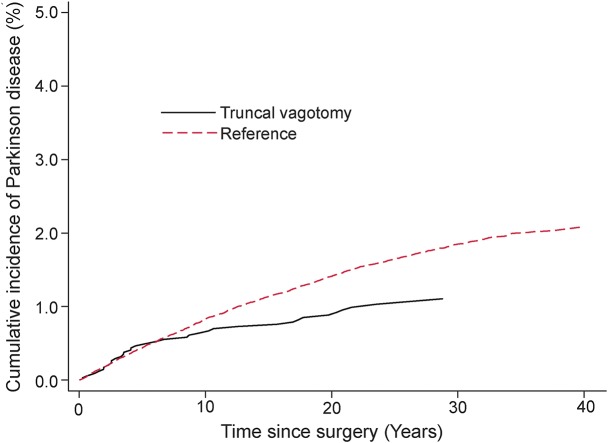
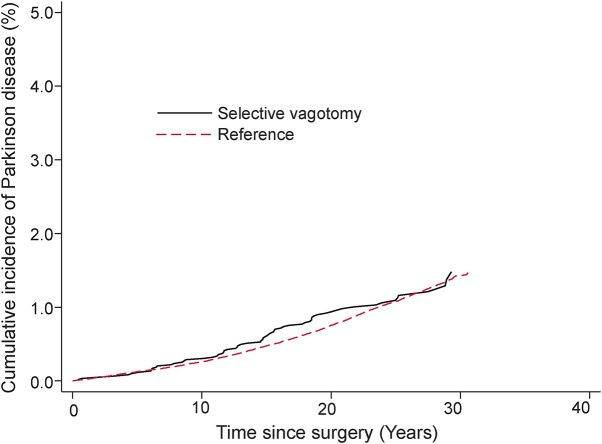
OBJECTIVE: To examine whether vagotomy decreases the risk of Parkinson disease (PD). METHODS: Using data from nationwide Swedish registers, we conducted a matched-cohort study of 9,430 vagotomized patients (3,445 truncal and 5,978 selective) identified between 1970 and 2010 and 377,200 reference individuals from the general population individually matched to vagotomized patients by sex and year of birth with a 40:1 ratio. Participants were followed up from the date of vagotomy until PD diagnosis, death, emigration out of Sweden, or December 31, 2010, whichever occurred first. Vagotomy and PD were identified from the Swedish Patient Register. We estimated hazard ratios (HRs) with 95% confidence intervals (CIs) using Cox models stratified by matching variables, adjusting for country of birth, chronic obstructive pulmonary disease, diabetes mellitus, vascular diseases, rheumatologic disease, osteoarthritis, and comorbidity index. RESULTS: A total of 4,930 cases of incident PD were identified during 7.3 million person-years of follow-up. PD incidence (per 100,000 person-years) was 61.8 among vagotomized patients (80.4 for truncal and 55.1 for selective) and 67.5 among reference individuals. Overall, vagotomy was not associated with PD risk (HR 0.96, 95% CI 0.78-1.17). However, there was a suggestion of lower risk among patients with truncal vagotomy (HR 0.78, 95% CI 0.55-1.09), which may be driven by truncal vagotomy at least 5 years before PD diagnosis (HR 0.59, 95% CI 0.37-0.93). Selective vagotomy was not related to PD risk in any analyses. CONCLUSIONS: Although overall vagotomy was not associated the risk of PD, we found suggestive evidence for a potential protective effect of truncal, but not selective, vagotomy against PD development.
Overview
The claims and statistics of this paper haven’t been checked yet.
Free: it reads the open-access text and checks the first 5 claims that cite a source we can check. Create a free account to check every claim.
Integrity signals
Registry
Cites
Statistics
Figures
Verification
Claims the paper makes
The claims and statistics of this paper haven’t been checked yet.
Free: it reads the open-access text and checks the first 5 claims that cite a source we can check. Create a free account to check every claim.
Claims other papers make about this one
Each is checked against this paper’s own text: does it say what the citing paper says it does?
The source backs part of the claim, not all of it — or backs it for a different population, condition or comparison.
In the citing paper
“This proposition gained mixed support from two large epidemiological studies showing that full truncal but not selective vagotomy decreases the risk of PD [57, 58].”
From The gut–brain axis in early Parkinson’s disease: from prodrome to prevention (2025) · cites this paper as [58]
Experimental — accuracy not yet measuredThe cited source says what the claim attributes to it.
In the citing paper
“In contrast, another study with a follow-up of patients after vagotomy argued that vagotomy was not associated with the risk of Parkinson's disease in Sweden.144”
From The role of gut dysbiosis in Parkinson’s disease: mechanistic insights and therapeutic options (2021) · cites this paper as [144]
The cited source says what the claim attributes to it.
In the citing paper
“Large epidemiologic studies also suggest that truncal vagotomy is associated with a reduced risk of subsequent PD, supporting a potential gut–brain contribution to pathogenesis (Liu et al., 2017).”
From Autonomic nervous system and gastrointestinal manifestations with an emphasis on gastric dysfunction (2026) · cites this paper as Liu et al., 2017
In the citing paper
“While this pattern of α-synuclein spreading is not observed in all cases of sporadic PD, vagotomy may be associated with reduced risk of developing PD in humans, potentially implicating peripheral influences on disease development (Svensson et al., 2015; Liu et al., 2017).”
From Microbiome–microglia connections via the gut–brain axis (2019) · cites this paper as Liu et al., 2017
Self-check
Percentages, sums and reported differences re-computed from the paper’s own numbers.
The self-check needs the paper’s full text.
Citations
Cites
Charlson, M. E., Pompei, P., Ales, K. L., & MacKenzie, C. R. (1987) · Journal of Chronic Diseases · doi:10.1016/0021-9681(87)90171-8 · Cited by 49,742
Coding algorithms for defining comorbidities in ICD-9-CM and ICD-10 administrative data
Quan, H., Sundararajan, V., Halfon, P., Fong, A., Burnand, B., Luthi, J.-C., Saunders, L. D., Beck, C. A., Feasby, T. E., & Ghali, W. A. (2005) · Medical Care · doi:10.1097/01.mlr.0000182534.19832.83 · Cited by 10,669
Adapting a clinical comorbidity index for use with ICD-9-CM administrative databases
DEYO, R. (1992) · Journal of Clinical Epidemiology · doi:10.1016/0895-4356(92)90133-8 · Cited by 10,452
External review and validation of the Swedish national inpatient register
Ludvigsson, J. F., Andersson, E., Ekbom, A., Feychting, M., Kim, J.-L., Reuterwall, C., Heurgren, M., & Olausson, P. O. (2011) · BMC Public Health · doi:10.1186/1471-2458-11-450 · Cited by 5,055 · cited 4×
“Primary health care visits are not yet included in the Patient Register.(18) Swedish Population and Housing Censuses were conducted every 5 years from 1960 to 1990 by Statistics Sweden(19) and were mandatory for Swedish residents $16 years of age.”
BackgroundInfluentialSelf-citationStages in the development of Parkinson’s disease-related pathology
Braak, H., Ghebremedhin, E., Rüb, U., Bratzke, H., & Del Tredici, K. (2004) · Cell and Tissue Research · doi:10.1007/s00441-004-0956-9 · Cited by 2,689
Li, J.-Y., Englund, E., Holton, J. L., Soulet, D., Hagell, P., Lees, A. J., Lashley, T., Quinn, N. P., Rehncrona, S., Björklund, A., et al. (2008) · Nature Medicine · doi:10.1038/nm1746 · Cited by 1,845
Lewy body–like pathology in long-term embryonic nigral transplants in Parkinson's disease
Kordower, J. H., Chu, Y., Hauser, R. A., Freeman, T. B., & Olanow, C. W. (2008) · Nature Medicine · doi:10.1038/nm1747 · Cited by 1,722
Braak, H., R�b, U., Gai, W. P., & Del Tredici, K. (2003) · Journal of Neural Transmission · doi:10.1007/s00702-002-0808-2 · Cited by 1,683
Inclusion formation and neuronal cell death through neuron-to-neuron transmission of α-synuclein
Desplats, P., Lee, H.-J., Bae, E.-J., Patrick, C., Rockenstein, E., Crews, L., Spencer, B., Masliah, E., & Lee, S.-J. (2009) · Proceedings of the National Academy of Sciences · doi:10.1073/pnas.0903691106 · Cited by 1,485 · cited 1×
“Furthermore, cell-to-cell a-synuclein transmission has been observed in both grafted neurons in patients with PD(8,9) and transplanted neurons in a transgenic mouse model of PD.(10) In murine models, injection of human a-synuclein into the intestinal wall led to a later a-synuclein observation in the vagus nerve.”
BackgroundBraak, H., de Vos, R. A. I., Bohl, J., & Del Tredici, K. (2006) · Neuroscience Letters · doi:10.1016/j.neulet.2005.11.012 · Cited by 1,354
Gastrointestinal Dysfunction in Parkinson’s Disease
Fasano, A., Visanji, N. P., Liu, L. W. C., Lang, A. E., & Pfeiffer, R. F. (2015) · The Lancet Neurology · doi:10.1016/s1474-4422(15)00007-1 · Cited by 1,016
Direct evidence of Parkinson pathology spread from the gastrointestinal tract to the brain in rats
Holmqvist, S., Chutna, O., Bousset, L., Aldrin-Kirk, P., Li, W., Björklund, T., Wang, Z.-Y., Roybon, L., Melki, R., & Li, J.-Y. (2014) · Acta Neuropathologica · doi:10.1007/s00401-014-1343-6 · Cited by 925 · cited 1×
“In murine models, injection of human a-synuclein into the intestinal wall led to a later a-synuclein observation in the vagus nerve.(11) Intragastric injection of rotenone initiated a-synuclein accumulation in the enteric nerve system that subsequently spread to the vagal”
BackgroundGastrointestinal dysfunction in Parkinson's disease
Pfeiffer, R. F. (2003) · The Lancet Neurology · doi:10.1016/s1474-4422(03)00307-7 · Cited by 925
Arizona Parkinson’s Disease Consortium, Beach, T. G., Adler, C. H., Sue, L. I., Vedders, L., Lue, L., White III, C. L., Akiyama, H., Caviness, J. N., Shill, H. A., et al. (2010) · Acta Neuropathologica · doi:10.1007/s00401-010-0664-3 · Cited by 911
Vagotomy and subsequent risk of Parkinson's disease
Svensson, E., Horváth‐Puhó, E., Thomsen, R. W., Djurhuus, J. C., Pedersen, L., Borghammer, P., & Sørensen, H. T. (2015) · Annals of Neurology · doi:10.1002/ana.24448 · Cited by 806 · cited 5×
“Empiric evidence to date, however, is scarce and inconsistent.(14,15) We therefore evaluated the association of vagotomy with PD risk using data from Swedish nationwide registers.”
BackgroundMethodResultInfluentialPan-Montojo, F., Anichtchik, O., Dening, Y., Knels, L., Pursche, S., Jung, R., Jackson, S., Gille, G., Spillantini, M. G., Reichmann, H., et al. (2010) · PLoS ONE · doi:10.1371/journal.pone.0008762 · Cited by 524 · cited 1×
“dorsal motor nuclei and substantia nigra pars compacta.(12) Resection of the vagus nerve before rotenone treatment stopped the spread of PD-like pathology.”
BackgroundPathological α‐synuclein in gastrointestinal tissues from prodromal Parkinson disease patients
Stokholm, M. G., Danielsen, E. H., Hamilton‐Dutoit, S. J., & Borghammer, P. (2016) · Annals of Neurology · doi:10.1002/ana.24648 · Cited by 415
Pan-Montojo, F., Schwarz, M., Winkler, C., Arnhold, M., O'Sullivan, G. A., Pal, A., Said, J., Marsico, G., Verbavatz, J.-M., Rodrigo-Angulo, M., et al. (2012) · Scientific Reports · doi:10.1038/srep00898 · Cited by 405 · cited 2×
“Indeed, in murine models of PD, vagotomy slowed the spreading of synucleinopathy to the brainstem that was initiated by gastrointestinal administration of rotenone, a pesticide known to induce parkinsonism.(13) In clinical practice, there are 3 types of vagotomy.”
BackgroundResultHilton, D., Stephens, M., Kirk, L., Edwards, P., Potter, R., Zajicek, J., Broughton, E., Hagan, H., & Carroll, C. (2014) · Acta Neuropathologica · doi:10.1007/s00401-013-1214-6 · Cited by 345
Are synucleinopathies prion-like disorders?
Angot, E., Steiner, J. A., Hansen, C., Li, J.-Y., & Brundin, P. (2010) · The Lancet Neurology · doi:10.1016/s1474-4422(10)70213-1 · Cited by 251
Meta-analyses on prevalence of selected Parkinson's nonmotor symptoms before and after diagnosis
Chen, H., Zhao, E. J., Zhang, W., Lu, Y., Liu, R., Huang, X., Ciesielski-Jones, A. J., Justice, M. A., Cousins, D. S., & Peddada, S. (2015) · Translational Neurodegeneration · doi:10.1186/2047-9158-4-1 · Cited by 212 · cited 1×
“Gastrointestinal symptoms, in particular constipation, are among the most common nonmotor symptoms of Parkinson disease (PD).(1,2) Furthermore, Braak and others hypothesized that in PD the Lewy pathology may start in peripheral nerves such as the enteric nervous system and later spread to the CNS through the vagus ner…”
BackgroundSelf-citationFloch, M. H. (2010) · Journal of Clinical Gastroenterology · doi:10.1097/mcg.0b013e3181b64b0c · Cited by 168
Autoimmune disease and risk for Parkinson disease: A population-based case-control study
Rugbjerg, K., Friis, S., Ritz, B., Schernhammer, E. S., Korbo, L., & Olsen, J. H. (2009) · Neurology · doi:10.1212/wnl.0b013e3181c06635 · Cited by 120
Does vagotomy reduce the risk of Parkinson's disease?
Tysnes, O., Kenborg, L., Herlofson, K., Steding‐Jessen, M., Horn, A., Olsen, J. H., & Reichmann, H. (2015) · Annals of Neurology · doi:10.1002/ana.24531 · Cited by 102
View point: Etiology in Parkinson's disease. Dual hit or spreading intoxication
Reichmann, H. (2011) · Journal of the Neurological Sciences · doi:10.1016/j.jns.2011.04.016 · Cited by 76
Accuracy and Sensitivity of Parkinsonian Disorder Diagnoses in Two Swedish National Health Registers
Feldman, A. L., Johansson, A. L. V., Gatz, M., Flensburg, M., Petzinger, G. M., Widner, H., Lew, M. F., Pedersen, N. L., & Wirdefeldt, K. (2012) · Neuroepidemiology · doi:10.1159/000336356 · Cited by 74
Self-citationOlfactory pathogenesis of idiopathic Parkinson disease revisited
Lerner, A., & Bagic, A. (2008) · Movement Disorders · doi:10.1002/mds.22066 · Cited by 73
Risk for Parkinson's disease among patients with osteoarthritis: A Danish cohort study
Rugbjerg, K., Friis, S., Jørgensen, T. L., Ritz, B. R., Korbo, L., & Olsen, J. H. (2010) · Movement Disorders · doi:10.1002/mds.23274 · Cited by 25
Surgery for Peptic Ulcer Disease and Postgastrectomy Syndromes
Glasgow, R. E., & Mulvihill, S. J. (2008) · Textbook of Gastroenterology · doi:10.1002/9781444303254.ch44 · Cited by 8
Surgery for Peptic Ulcer Disease and Postgastrectomy Syndromes
Glasgow, R. E., & Mulvihill, S. J. (2009) · Atlas of Gastroenterology · doi:10.1002/9781444303414.ch25 · Cited by 5 · cited 1×
“The truncal vagotomy denervates multiple organs, including the stomach, liver, gall bladder, pancreas, small intestine, and proximal colon; selective vagotomy eliminates innervation to the stomach; and highly selective vagotomy eliminates only innervation to the stomach body while preserving innervation to the antrum…”
Background
Research works printed but not linked: 5
- Statistics Sweden. Täckningsgrad för den somatiska och psykiatriska slutenvården [online]. Available at: http://www.scb.se/sv_/Hitta-statistik/Regional-statistik-och-kartor/Regionala-indelningar/Lan-och-kommuner/Lan-och-kommuner-i-kodnummerordning/. Accessed April 9, 2016.
- Statistics Sweden. The National Patient Register [online]. Available at: http://www.socialstyrelsen.se/register/halsodataregister/patientregistret/inenglish. Accessed May 9, 2015.
- Statistics Sweden. Folk- och bostadsräkningen 1965–1990 [online]. Available at: http://www.scb.se/sv_/Hitta-statistik/Historisk-statistik/Statistik-efter-serie/Sveriges-officiella-statistik-SOS-utg-1912-/Folk-och-bostadsrakningarna-1860-1990/Folk-och-bostadsrakningen-1965-1990/. Accessed May 9, 2015.
- Statistics Sweden. SCB-data för Forskning 2012/Microdata at Statistic Sweden for Research Purposes 2012 [online]. Available at: http://www.scb.se/statistik/_publikationer/OV9999_2012A01_BR_X104BR1201.pdf. Accessed May 9, 2015.
- Gao X, Chen H, Schwarzschild M, Ascherio A. Use of non-steroidal anti-inflammatory drugs and risk of Parkinson's disease: a prospective study and meta-analysis. Neurology 2010; 74: A103.
Cited by
Cryan, J. F., O'Riordan, K. J., Cowan, C. S. M., Sandhu, K. V., Bastiaanssen, T. F. S., Boehme, M., Codagnone, M. G., Cussotto, S., Fulling, C., Golubeva, A. V., et al. (2019) · Physiological Reviews · doi:10.1152/physrev.00018.2018 · Cited by 5,286
The gut microbiota–brain axis in behaviour and brain disorders
Morais, L. H., Schreiber, H. L., & Mazmanian, S. K. (2021) · Nature Reviews Microbiology · doi:10.1038/s41579-020-00460-0 · Cited by 2,149
Kim, S., Kwon, S.-H., Kam, T.-I., Panicker, N., Karuppagounder, S. S., Lee, S., Lee, J. H., Kim, W. R., Kook, M., Foss, C. A., et al. (2019) · Neuron · doi:10.1016/j.neuron.2019.05.035 · Cited by 1,397
“In cohort studies with follow-up from northern Europe, individuals who underwent truncal vagotomy had a lower risk for developing PD than age- and sex-matched control individuals (Liu et al., 2017; Svensson et al., 2015; Tysnes et al., 2015).”
BackgroundThe gut microbiome in neurological disorders
Cryan, J. F., O'Riordan, K. J., Sandhu, K., Peterson, V., & Dinan, T. G. (2020) · The Lancet Neurology · doi:10.1016/s1474-4422(19)30356-4 · Cited by 1,336
Brain-first versus body-first Parkinson’s disease: a multimodal imaging case-control study
Horsager, J., Andersen, K. B., Knudsen, K., Skjærbæk, C., Fedorova, T. D., Okkels, N., Schaeffer, E., Bonkat, S. K., Geday, J., Otto, M., et al. (2020) · Brain · doi:10.1093/brain/awaa238 · Cited by 782
Metadata
- Authors
- Liu, B., Fang, F., Pedersen, N. L., Tillander, A., Ludvigsson, J. F., Ekbom, A., Svenningsson, P., Chen, H., & Wirdefeldt, K.
- Affiliations
- University of Southern California (US)
- Corresponding author
- Liu, Bojing
- ORCID
- Venue
- Neurology
- Published
- 2017-05-23
- Volume
- 88
- Issue
- 21
- Pages
- 1996-2002
- ISSN
- 0028-3878 (ISSN-L)
- 1526-632X
- PMC
- PMC5440238
- OpenAlex
- W2607991581
- Semantic Scholar
- 491be6d474e175bdc935f387d11b267e2de3d004
- Cited by
- 447
- References
- 29
- Citations by year
- 2026: 39 · 2025: 45 · 2024: 39 · 2023: 51 · 2022: 50 · 2021: 78 · 2020: 42 · 2019: 43 · 2018: 41 · 2017: 17
- FWCI
- 27.24
- Type
- journal article
- Language
- en
- Open access
- hybrid
- doi.org
- Licence
- cc-by-nc-nd
- Locations
- Neurology (publishedVersion, cc-by-nc-nd)
- Europe PMC (PubMed Central) (publishedVersion, other-oa)
- PubMed Central (publishedVersion, cc-by-nc-nd)
- PubMed (publishedVersion)
- Funders
- Forskningsrådet om Hälsa, Arbetsliv och Välfärd
- Topics
- Health Sciences › Medicine › Clinical Neurology › Parkinson's Disease Mechanisms and Treatments
- Health Sciences › Medicine › Clinical Neurology › Deep Brain Stimulation and Movement Disorders
- Life Sciences › Neuroscience › Neurology › Vagus Nerve Stimulation Research
- Keywords
- vagotomy, Parkinson's disease, truncal vagotomy, selective vagotomy, neuroprotection, gastric surgery, postoperative outcomes
- MeSH terms
- Adolescent, Adult, Aged, Female, Follow-Up Studies, Humans, Male, Middle Aged, Parkinson Disease, Registries, Risk, Sweden, Vagotomy, Comorbidity, Incidence, Proportional Hazards Models, Young Adult
About these checks
Registry, retraction, Cites and statistics results are computed, not judged, with one exception: a printed reference that no index lists is read once by a model before it counts as a citation error. Claims are extracted by a model and kept only when their quote appears verbatim in the text; each cited source is then checked, with a model’s help, for whether it says what the claim relies on. Those verdicts can be wrong — read the claim’s quote and the cited source before relying on one.
Statistics and arithmetic are recomputed, not judged.
Confidence bands are shown only for fields calibrated on our annotated test set. None is calibrated yet, so no band is shown.
What counts as a claim ›How we measure confidence ›How we check this ›
Are you an author, or do you see a problem with this page? Request a review
Data sources
Bibliographic data: Semantic Scholar, OpenAlex, Crossref.
Contains information from the Semantic Scholar Academic Graph Datasets, made available under the ODC Attribution License (ODC-BY 1.0).
Semantic Scholar’s data is described in: Kinney, R., et al. (2023). The Semantic Scholar Open Data Platform. arXiv:2301.10140.
