

Vagotomy and Parkinson disease: A Swedish register–based matched-cohort study
Open accessThe DOI matches its Crossref record, with a small difference in title or year; 30 of the 30 references it cites were found in a registry or an index.
Abstract
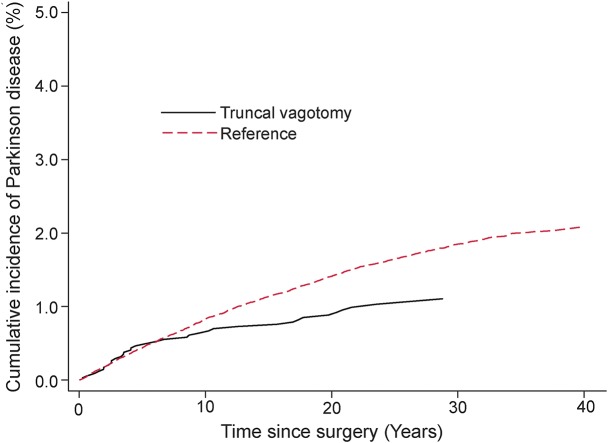
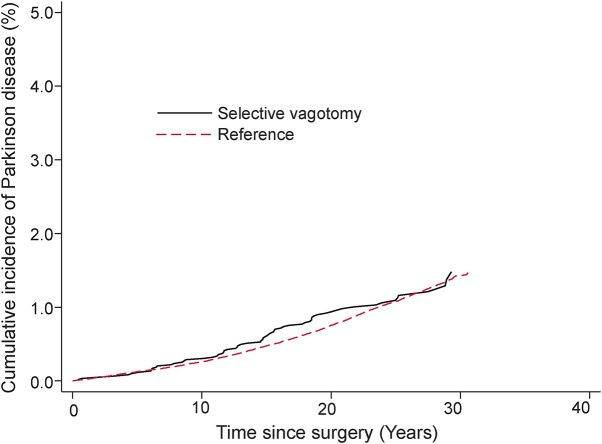
OBJECTIVE: To examine whether vagotomy decreases the risk of Parkinson disease (PD). METHODS: Using data from nationwide Swedish registers, we conducted a matched-cohort study of 9,430 vagotomized patients (3,445 truncal and 5,978 selective) identified between 1970 and 2010 and 377,200 reference individuals from the general population individually matched to vagotomized patients by sex and year of birth with a 40:1 ratio. Participants were followed up from the date of vagotomy until PD diagnosis, death, emigration out of Sweden, or December 31, 2010, whichever occurred first. Vagotomy and PD were identified from the Swedish Patient Register. We estimated hazard ratios (HRs) with 95% confidence intervals (CIs) using Cox models stratified by matching variables, adjusting for country of birth, chronic obstructive pulmonary disease, diabetes mellitus, vascular diseases, rheumatologic disease, osteoarthritis, and comorbidity index. RESULTS: A total of 4,930 cases of incident PD were identified during 7.3 million person-years of follow-up. PD incidence (per 100,000 person-years) was 61.8 among vagotomized patients (80.4 for truncal and 55.1 for selective) and 67.5 among reference individuals. Overall, vagotomy was not associated with PD risk (HR 0.96, 95% CI 0.78-1.17). However, there was a suggestion of lower risk among patients with truncal vagotomy (HR 0.78, 95% CI 0.55-1.09), which may be driven by truncal vagotomy at least 5 years before PD diagnosis (HR 0.59, 95% CI 0.37-0.93). Selective vagotomy was not related to PD risk in any analyses. CONCLUSIONS: Although overall vagotomy was not associated the risk of PD, we found suggestive evidence for a potential protective effect of truncal, but not selective, vagotomy against PD development.
Overview
The claims and statistics of this paper haven’t been checked yet.
Free: it reads the open-access text and checks the first 5 claims that cite a source we can check. Create a free account to check every claim.
Integrity signals
Registry
Cites
Statistics
Figures
Verification
Claims the paper makes
The claims and statistics of this paper haven’t been checked yet.
Free: it reads the open-access text and checks the first 5 claims that cite a source we can check. Create a free account to check every claim.
Claims other papers make about this one
Each is checked against this paper’s own text: does it say what the citing paper says it does?
The source backs part of the claim, not all of it — or backs it for a different population, condition or comparison.
In the citing paper
“This proposition gained mixed support from two large epidemiological studies showing that full truncal but not selective vagotomy decreases the risk of PD [57, 58].”
From The gut–brain axis in early Parkinson’s disease: from prodrome to prevention (2025) · cites this paper as [58]
Experimental — accuracy not yet measuredThe cited source says what the claim attributes to it.
In the citing paper
“In contrast, another study with a follow-up of patients after vagotomy argued that vagotomy was not associated with the risk of Parkinson's disease in Sweden.144”
From The role of gut dysbiosis in Parkinson’s disease: mechanistic insights and therapeutic options (2021) · cites this paper as [144]
The cited source says what the claim attributes to it.
In the citing paper
“Large epidemiologic studies also suggest that truncal vagotomy is associated with a reduced risk of subsequent PD, supporting a potential gut–brain contribution to pathogenesis (Liu et al., 2017).”
From Autonomic nervous system and gastrointestinal manifestations with an emphasis on gastric dysfunction (2026) · cites this paper as Liu et al., 2017
In the citing paper
“While this pattern of α-synuclein spreading is not observed in all cases of sporadic PD, vagotomy may be associated with reduced risk of developing PD in humans, potentially implicating peripheral influences on disease development (Svensson et al., 2015; Liu et al., 2017).”
From Microbiome–microglia connections via the gut–brain axis (2019) · cites this paper as Liu et al., 2017
Self-check
Percentages, sums and reported differences re-computed from the paper’s own numbers.
The self-check needs the paper’s full text.
Citations
Cites
Charlson, M. E., Pompei, P., Ales, K. L., & MacKenzie, C. R. (1987) · Journal of Chronic Diseases · doi:10.1016/0021-9681(87)90171-8 · Cited by 49,742
Coding algorithms for defining comorbidities in ICD-9-CM and ICD-10 administrative data
Quan, H., Sundararajan, V., Halfon, P., Fong, A., Burnand, B., Luthi, J.-C., Saunders, L. D., Beck, C. A., Feasby, T. E., & Ghali, W. A. (2005) · Medical Care · doi:10.1097/01.mlr.0000182534.19832.83 · Cited by 10,669
Adapting a clinical comorbidity index for use with ICD-9-CM administrative databases
DEYO, R. (1992) · Journal of Clinical Epidemiology · doi:10.1016/0895-4356(92)90133-8 · Cited by 10,452
External review and validation of the Swedish national inpatient register
Ludvigsson, J. F., Andersson, E., Ekbom, A., Feychting, M., Kim, J.-L., Reuterwall, C., Heurgren, M., & Olausson, P. O. (2011) · BMC Public Health · doi:10.1186/1471-2458-11-450 · Cited by 5,055 · cited 4×
“Primary health care visits are not yet included in the Patient Register.(18) Swedish Population and Housing Censuses were conducted every 5 years from 1960 to 1990 by Statistics Sweden(19) and were mandatory for Swedish residents $16 years of age.”
BackgroundInfluentialSelf-citationStages in the development of Parkinson’s disease-related pathology
Braak, H., Ghebremedhin, E., Rüb, U., Bratzke, H., & Del Tredici, K. (2004) · Cell and Tissue Research · doi:10.1007/s00441-004-0956-9 · Cited by 2,689
Li, J.-Y., Englund, E., Holton, J. L., Soulet, D., Hagell, P., Lees, A. J., Lashley, T., Quinn, N. P., Rehncrona, S., Björklund, A., et al. (2008) · Nature Medicine · doi:10.1038/nm1746 · Cited by 1,845
Lewy body–like pathology in long-term embryonic nigral transplants in Parkinson's disease
Kordower, J. H., Chu, Y., Hauser, R. A., Freeman, T. B., & Olanow, C. W. (2008) · Nature Medicine · doi:10.1038/nm1747 · Cited by 1,722
Braak, H., R�b, U., Gai, W. P., & Del Tredici, K. (2003) · Journal of Neural Transmission · doi:10.1007/s00702-002-0808-2 · Cited by 1,683
Inclusion formation and neuronal cell death through neuron-to-neuron transmission of α-synuclein
Desplats, P., Lee, H.-J., Bae, E.-J., Patrick, C., Rockenstein, E., Crews, L., Spencer, B., Masliah, E., & Lee, S.-J. (2009) · Proceedings of the National Academy of Sciences · doi:10.1073/pnas.0903691106 · Cited by 1,485 · cited 1×
“Furthermore, cell-to-cell a-synuclein transmission has been observed in both grafted neurons in patients with PD(8,9) and transplanted neurons in a transgenic mouse model of PD.(10) In murine models, injection of human a-synuclein into the intestinal wall led to a later a-synuclein observation in the vagus nerve.”
BackgroundBraak, H., de Vos, R. A. I., Bohl, J., & Del Tredici, K. (2006) · Neuroscience Letters · doi:10.1016/j.neulet.2005.11.012 · Cited by 1,354
Research works printed but not linked: 5
- Statistics Sweden. Täckningsgrad för den somatiska och psykiatriska slutenvården [online]. Available at: http://www.scb.se/sv_/Hitta-statistik/Regional-statistik-och-kartor/Regionala-indelningar/Lan-och-kommuner/Lan-och-kommuner-i-kodnummerordning/. Accessed April 9, 2016.
- Statistics Sweden. The National Patient Register [online]. Available at: http://www.socialstyrelsen.se/register/halsodataregister/patientregistret/inenglish. Accessed May 9, 2015.
- Statistics Sweden. Folk- och bostadsräkningen 1965–1990 [online]. Available at: http://www.scb.se/sv_/Hitta-statistik/Historisk-statistik/Statistik-efter-serie/Sveriges-officiella-statistik-SOS-utg-1912-/Folk-och-bostadsrakningarna-1860-1990/Folk-och-bostadsrakningen-1965-1990/. Accessed May 9, 2015.
- Statistics Sweden. SCB-data för Forskning 2012/Microdata at Statistic Sweden for Research Purposes 2012 [online]. Available at: http://www.scb.se/statistik/_publikationer/OV9999_2012A01_BR_X104BR1201.pdf. Accessed May 9, 2015.
- Gao X, Chen H, Schwarzschild M, Ascherio A. Use of non-steroidal anti-inflammatory drugs and risk of Parkinson's disease: a prospective study and meta-analysis. Neurology 2010; 74: A103.
Cited by
Items 401–444 of 444
Pathophysiological Basis of Neurodegeneration in Parkinson’s Disease
Galindo, L. S. M., González‐Escamilla, G., & Groppa, S. (2024) · Neuromethods · doi:10.1007/978-1-0716-4083-8_1
Raju, V. R., & Devi, G. N. R. (2024) · IP Indian Journal of Neurosciences · doi:10.18231/j.ijn.2024.042
Autonomic Dysfunction in Parkinson’s Disease
Boogers, A., Leta, V., Raeder, V., & Chaudhuri, К. R. (2025) · Cambridge University Press eBooks · doi:10.1017/9781108989855.014
Triadafilopoulos, G. (2024) · Springer eBooks · doi:10.1007/978-3-031-77171-2_1 · Cited by 1
An In Vivo Model of α-Synuclein Spread from Gut to BrainPreprint
Barnhill, L. M., Khuansuwan, S., El-Nachef, W. N., Ha, S. M., Arellano, M., Hasan, K. M. M., Kim, A., & Bronstein, J. M. (2025) · bioRxiv (Cold Spring Harbor Laboratory) · doi:10.1101/2025.03.13.643189
Study of gut microbiota in the context of neurological disorders
Roubalová, R., & Procházková, P. (2025) · Neurologie pro praxi · doi:10.36290/neu.2024.042
Mondhe, D., Jayabalan, N., Tamang, M. K., Suescun, J., & Gordon, R. (2025) · bioRxiv (Cold Spring Harbor Laboratory) · doi:10.1101/2025.03.18.644066
Neurological Disorders and the Gut-Brain Axis
Chattopadhyay, M., Laskar, A., Rahaman, S. S., & Chanda, A. (2025) · BENTHAM SCIENCE PUBLISHERS eBooks · doi:10.2174/9789815324549125010010
Camilleri, M. (2025) · Clinical Autonomic Research · doi:10.1007/s10286-025-01137-5
Toxin-induced animal models in Parkinson's disease: Recent updates
Singh, V., Sethi, A. K., Rath, S., Kumari, N., Shukla, D., & Mishra, V. N. (2025) · Elsevier eBooks · doi:10.1016/b978-0-443-33877-9.00006-9
Sharma, B. J., & Mustaque, A. S. (2025) · Research Square · doi:10.21203/rs.3.rs-7498682/v1
Sharma, B. J. (2025) · Research Square · doi:10.21203/rs.3.rs-7608549/v1
Saravanan, S., Malligarjunan, N., & Subramanian, G. (2025) · Journal of Natural Remedies · doi:10.18311/jnr/2025/50499
The role of gut brain axis in the pathogenesis of Parkinson's disease
Su, Z. (2025) · MedScien · doi:10.61173/ncvcev37
Brainstem origin of Parkinson's disease symptoms
Tissone, A. I., & Esposito, M. S. (2025) · Handbook of behavioral neuroscience · doi:10.1016/b978-0-443-21992-4.00011-7
Sano, T., Nagata, T., Ebihara, S., Yoshida‐Tanaka, K., Nakamura, A., Sasaki, A., Shimozawa, A., Mochizuki, H., Uchihara, T., Hasegawa, M., et al. (2024) · Figshare · doi:10.6084/m9.figshare.26720163
Cheng, Y., Tong, Q., Yuan, Y., Song, X., Jiang, W., Wang, Y., Li, W., Li, Y., & Zhang, K. (2024) · Figshare · doi:10.6084/m9.figshare.26568502
Parkinson’s Disease and Gut Microbiota
Swathi, N. L., Umar, T. P., Elenien, W. I. A., Bhagat, S., Sakini, A. S. A., & Nand, S. (2025) · Interdisciplinary biotechnological advances · doi:10.1007/978-981-95-2104-3_6
In situ NMR and integrative proteomics reveal the interaction signature of serum α-synuclein
Huang, J., Ahmed, R., Akimoto, M., Bozelli, J. C., Epand, R. M., & Melacini, G. (2026) · Proceedings of the National Academy of Sciences · doi:10.1073/pnas.2521639123
Wolff, A. W., Feneberg, E., Shakhtour, J., Steiger, K., Schmid, R. M., Haller, B., Reinhardt, N., Middelhoff, M. A., Schult, D., & Lingor, P. (2026) · PLoS ONE · doi:10.1371/journal.pone.0340182 · Cited by 1
Yamagchi, A., Ishikawa, K.-I., & Akamatsu, W. (2026) · bioRxiv (Cold Spring Harbor Laboratory) · doi:10.64898/2026.02.07.704302
Peltz, Z., Wiblin, R., Kattunga, V. M., Pai, C., Andersen, J. K., & Chinta, S. J. (2026) · Metabolic Brain Disease · doi:10.1007/s11011-026-01801-3
Air pollution and neurotoxicity: The role of environmental pollutants in movement disorders
Paul, K. C., & Bronstein, J. M. (2026) · International review of movement disorders · doi:10.1016/bs.irmvd.2026.02.001
Wang, S., Zhu, Y., Wang, J., Jin, W., Li, N., Li, Z., Chang, Y., Jiang, C. Q., & Wang, T. (2026) · Scientific Reports · doi:10.1038/s41598-026-43865-2
Arotçarena, M.-L. (2019) · theses.fr (ABES) · doi:10.70675/fc7ae442z6823z43c3z8ebazd4960299833b
Li, Y., Guo, L., Yu, X., & Peng, C. (2026) · Ageing and Neurodegenerative Diseases · doi:10.20517/and.2025.31 · Cited by 1
The Role of Inflammation in the Brain: A Gut-Driven Phenomenon
Mahbub, N. U., Islam, M. M., & Hong, S. T. (2026) · Springer eBooks · doi:10.1007/978-981-95-7494-0_9
Hatano, T., Lin, C., & Cardoso, F. (2026) · Journal of Neurochemistry · doi:10.1111/jnc.70491 · Cited by 1
Zhou, L. E. T. A. O., Luo, X., Bao, T., Sun, H., He, C., Yang, Y., & Xia, Y. (2026) · Chinese Medical Journal · doi:10.1097/cm9.0000000000004144
Cheng, Y.-K., & Chiang, H.-S. (2026) · Elsevier eBooks · doi:10.1016/b978-0-443-40306-4.00004-1
Dore, M. P., Lasaracina, G., Pes, G. M., Solla, P., & Merola, E. (2026) · Reviews in the Neurosciences · doi:10.1515/revneuro-2026-0072
Gut microbiota and brain health: Disease-specific pathways and emerging therapeutic strategies
Oriquat, G., Rizaev, J., Abdulqader, A. F., Kadhim, A. A., Jamuna, K. V., Singhal, D. K., Bainsal, N., & Mansurova, N. (2026) · Multiple Sclerosis and Related Disorders · doi:10.1016/j.msard.2026.107407
Wang, M., Sun, G., Wan, P., Wang, Z., Nie, Y., Liu, H., Geng, M., Liu, M., & Zhang, Y. (2026) · Brain Sciences · doi:10.3390/brainsci16080804
Balsamo, J. M., & Bess, E. N. (2026) · ACS Bio & Med Chem Au · doi:10.1021/acsbiomedchemau.6c00110
Overlapping pathologies in different dementia-causing diseases
Spires‐Jones, T. L. (2026) · Oxford University Press eBooks · doi:10.1093/9780198995296.003.0004
Gastrointestinal manifestations of Parkinson's disease
Pfeiffer, R. F., & Quigley, E. M. M. (2026) · Autonomic Neuroscience · doi:10.1016/j.autneu.2026.103475
Bowler, B., Nasir, A. R., Szewczyk, A., Ocañas, S. R., Unnikrishnan, A., & Nouh, C. D. (2026) · Pathophysiology · doi:10.3390/pathophysiology33040074
The microbiota–proteostasis axis: implications in neurodegenerative diseases
Czyż, D. M., & Brown, B. M. (2026) · Philosophical Transactions of the Royal Society B Biological Sciences · doi:10.1098/rstb.2025.0265
Parkinson's disease pathogenesis: From molecular insights to novel therapies
Ramli, M. D. C., Abidin, Z. Z., Okunsai, B., Umbar, G. S. A., & Mauta, T. E. (2026) · Elsevier eBooks · doi:10.1016/b978-0-443-27702-3.00027-3
Koterba, M., Skiba, A., Kler, A., Błaszczyk, K., Woźny, M., Stefaniak, O., & Nowicka, J. (2026) · Biomedicines · doi:10.3390/biomedicines14102256
Liu, X., Wang, S., Long, W., Tan, X., Li, W., & Gao, L. (2026) · Frontiers in Aging Neuroscience · doi:10.3389/fnagi.2026.1926883
Metadata
- Authors
- Liu, B., Fang, F., Pedersen, N. L., Tillander, A., Ludvigsson, J. F., Ekbom, A., Svenningsson, P., Chen, H., & Wirdefeldt, K.
- Affiliations
- University of Southern California (US)
- Corresponding author
- Liu, Bojing
- ORCID
- Venue
- Neurology
- Published
- 2017-05-23
- Volume
- 88
- Issue
- 21
- Pages
- 1996-2002
- ISSN
- 0028-3878 (ISSN-L)
- 1526-632X
- PMC
- PMC5440238
- OpenAlex
- W2607991581
- Semantic Scholar
- 491be6d474e175bdc935f387d11b267e2de3d004
- Cited by
- 447
- References
- 29
- Citations by year
- 2026: 39 · 2025: 45 · 2024: 39 · 2023: 51 · 2022: 50 · 2021: 78 · 2020: 42 · 2019: 43 · 2018: 41 · 2017: 17
- FWCI
- 27.24
- Type
- journal article
- Language
- en
- Open access
- hybrid
- doi.org
- Licence
- cc-by-nc-nd
- Locations
- Neurology (publishedVersion, cc-by-nc-nd)
- Europe PMC (PubMed Central) (publishedVersion, other-oa)
- PubMed Central (publishedVersion, cc-by-nc-nd)
- PubMed (publishedVersion)
- Funders
- Forskningsrådet om Hälsa, Arbetsliv och Välfärd
- Topics
- Health Sciences › Medicine › Clinical Neurology › Parkinson's Disease Mechanisms and Treatments
- Health Sciences › Medicine › Clinical Neurology › Deep Brain Stimulation and Movement Disorders
- Life Sciences › Neuroscience › Neurology › Vagus Nerve Stimulation Research
- Keywords
- vagotomy, Parkinson's disease, truncal vagotomy, selective vagotomy, neuroprotection, gastric surgery, postoperative outcomes
- MeSH terms
- Adolescent, Adult, Aged, Female, Follow-Up Studies, Humans, Male, Middle Aged, Parkinson Disease, Registries, Risk, Sweden, Vagotomy, Comorbidity, Incidence, Proportional Hazards Models, Young Adult
About these checks
Registry, retraction, Cites and statistics results are computed, not judged, with one exception: a printed reference that no index lists is read once by a model before it counts as a citation error. Claims are extracted by a model and kept only when their quote appears verbatim in the text; each cited source is then checked, with a model’s help, for whether it says what the claim relies on. Those verdicts can be wrong — read the claim’s quote and the cited source before relying on one.
Statistics and arithmetic are recomputed, not judged.
Confidence bands are shown only for fields calibrated on our annotated test set. None is calibrated yet, so no band is shown.
What counts as a claim ›How we measure confidence ›How we check this ›
Are you an author, or do you see a problem with this page? Request a review
Data sources
Bibliographic data: Semantic Scholar, OpenAlex, Crossref.
Contains information from the Semantic Scholar Academic Graph Datasets, made available under the ODC Attribution License (ODC-BY 1.0).
Semantic Scholar’s data is described in: Kinney, R., et al. (2023). The Semantic Scholar Open Data Platform. arXiv:2301.10140.
