

Vagotomy and Parkinson disease: A Swedish register–based matched-cohort study
Open accessThe DOI matches its Crossref record, with a small difference in title or year; 30 of the 30 references it cites were found in a registry or an index.
Abstract
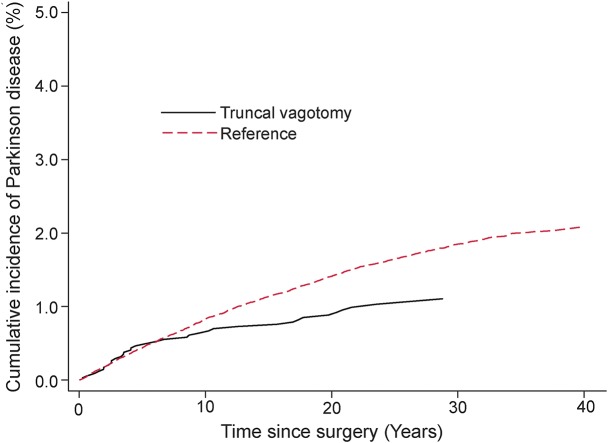
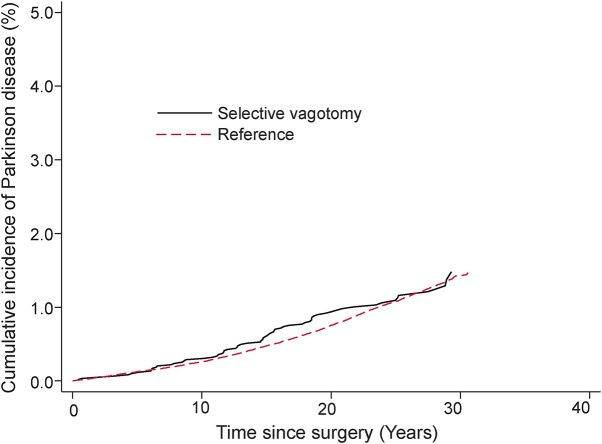
OBJECTIVE: To examine whether vagotomy decreases the risk of Parkinson disease (PD). METHODS: Using data from nationwide Swedish registers, we conducted a matched-cohort study of 9,430 vagotomized patients (3,445 truncal and 5,978 selective) identified between 1970 and 2010 and 377,200 reference individuals from the general population individually matched to vagotomized patients by sex and year of birth with a 40:1 ratio. Participants were followed up from the date of vagotomy until PD diagnosis, death, emigration out of Sweden, or December 31, 2010, whichever occurred first. Vagotomy and PD were identified from the Swedish Patient Register. We estimated hazard ratios (HRs) with 95% confidence intervals (CIs) using Cox models stratified by matching variables, adjusting for country of birth, chronic obstructive pulmonary disease, diabetes mellitus, vascular diseases, rheumatologic disease, osteoarthritis, and comorbidity index. RESULTS: A total of 4,930 cases of incident PD were identified during 7.3 million person-years of follow-up. PD incidence (per 100,000 person-years) was 61.8 among vagotomized patients (80.4 for truncal and 55.1 for selective) and 67.5 among reference individuals. Overall, vagotomy was not associated with PD risk (HR 0.96, 95% CI 0.78-1.17). However, there was a suggestion of lower risk among patients with truncal vagotomy (HR 0.78, 95% CI 0.55-1.09), which may be driven by truncal vagotomy at least 5 years before PD diagnosis (HR 0.59, 95% CI 0.37-0.93). Selective vagotomy was not related to PD risk in any analyses. CONCLUSIONS: Although overall vagotomy was not associated the risk of PD, we found suggestive evidence for a potential protective effect of truncal, but not selective, vagotomy against PD development.
Overview
The claims and statistics of this paper haven’t been checked yet.
Free: it reads the open-access text and checks the first 5 claims that cite a source we can check. Create a free account to check every claim.
Integrity signals
Registry
Cites
Statistics
Figures
Verification
Claims the paper makes
The claims and statistics of this paper haven’t been checked yet.
Free: it reads the open-access text and checks the first 5 claims that cite a source we can check. Create a free account to check every claim.
Claims other papers make about this one
Each is checked against this paper’s own text: does it say what the citing paper says it does?
The source backs part of the claim, not all of it — or backs it for a different population, condition or comparison.
In the citing paper
“This proposition gained mixed support from two large epidemiological studies showing that full truncal but not selective vagotomy decreases the risk of PD [57, 58].”
From The gut–brain axis in early Parkinson’s disease: from prodrome to prevention (2025) · cites this paper as [58]
Experimental — accuracy not yet measuredThe cited source says what the claim attributes to it.
In the citing paper
“In contrast, another study with a follow-up of patients after vagotomy argued that vagotomy was not associated with the risk of Parkinson's disease in Sweden.144”
From The role of gut dysbiosis in Parkinson’s disease: mechanistic insights and therapeutic options (2021) · cites this paper as [144]
The cited source says what the claim attributes to it.
In the citing paper
“Large epidemiologic studies also suggest that truncal vagotomy is associated with a reduced risk of subsequent PD, supporting a potential gut–brain contribution to pathogenesis (Liu et al., 2017).”
From Autonomic nervous system and gastrointestinal manifestations with an emphasis on gastric dysfunction (2026) · cites this paper as Liu et al., 2017
In the citing paper
“While this pattern of α-synuclein spreading is not observed in all cases of sporadic PD, vagotomy may be associated with reduced risk of developing PD in humans, potentially implicating peripheral influences on disease development (Svensson et al., 2015; Liu et al., 2017).”
From Microbiome–microglia connections via the gut–brain axis (2019) · cites this paper as Liu et al., 2017
Self-check
Percentages, sums and reported differences re-computed from the paper’s own numbers.
The self-check needs the paper’s full text.
Citations
Cites
Charlson, M. E., Pompei, P., Ales, K. L., & MacKenzie, C. R. (1987) · Journal of Chronic Diseases · doi:10.1016/0021-9681(87)90171-8 · Cited by 49,742
Coding algorithms for defining comorbidities in ICD-9-CM and ICD-10 administrative data
Quan, H., Sundararajan, V., Halfon, P., Fong, A., Burnand, B., Luthi, J.-C., Saunders, L. D., Beck, C. A., Feasby, T. E., & Ghali, W. A. (2005) · Medical Care · doi:10.1097/01.mlr.0000182534.19832.83 · Cited by 10,669
Adapting a clinical comorbidity index for use with ICD-9-CM administrative databases
DEYO, R. (1992) · Journal of Clinical Epidemiology · doi:10.1016/0895-4356(92)90133-8 · Cited by 10,452
External review and validation of the Swedish national inpatient register
Ludvigsson, J. F., Andersson, E., Ekbom, A., Feychting, M., Kim, J.-L., Reuterwall, C., Heurgren, M., & Olausson, P. O. (2011) · BMC Public Health · doi:10.1186/1471-2458-11-450 · Cited by 5,055 · cited 4×
“Primary health care visits are not yet included in the Patient Register.(18) Swedish Population and Housing Censuses were conducted every 5 years from 1960 to 1990 by Statistics Sweden(19) and were mandatory for Swedish residents $16 years of age.”
BackgroundInfluentialSelf-citationStages in the development of Parkinson’s disease-related pathology
Braak, H., Ghebremedhin, E., Rüb, U., Bratzke, H., & Del Tredici, K. (2004) · Cell and Tissue Research · doi:10.1007/s00441-004-0956-9 · Cited by 2,689
Li, J.-Y., Englund, E., Holton, J. L., Soulet, D., Hagell, P., Lees, A. J., Lashley, T., Quinn, N. P., Rehncrona, S., Björklund, A., et al. (2008) · Nature Medicine · doi:10.1038/nm1746 · Cited by 1,845
Lewy body–like pathology in long-term embryonic nigral transplants in Parkinson's disease
Kordower, J. H., Chu, Y., Hauser, R. A., Freeman, T. B., & Olanow, C. W. (2008) · Nature Medicine · doi:10.1038/nm1747 · Cited by 1,722
Braak, H., R�b, U., Gai, W. P., & Del Tredici, K. (2003) · Journal of Neural Transmission · doi:10.1007/s00702-002-0808-2 · Cited by 1,683
Inclusion formation and neuronal cell death through neuron-to-neuron transmission of α-synuclein
Desplats, P., Lee, H.-J., Bae, E.-J., Patrick, C., Rockenstein, E., Crews, L., Spencer, B., Masliah, E., & Lee, S.-J. (2009) · Proceedings of the National Academy of Sciences · doi:10.1073/pnas.0903691106 · Cited by 1,485 · cited 1×
“Furthermore, cell-to-cell a-synuclein transmission has been observed in both grafted neurons in patients with PD(8,9) and transplanted neurons in a transgenic mouse model of PD.(10) In murine models, injection of human a-synuclein into the intestinal wall led to a later a-synuclein observation in the vagus nerve.”
BackgroundBraak, H., de Vos, R. A. I., Bohl, J., & Del Tredici, K. (2006) · Neuroscience Letters · doi:10.1016/j.neulet.2005.11.012 · Cited by 1,354
Research works printed but not linked: 5
- Statistics Sweden. Täckningsgrad för den somatiska och psykiatriska slutenvården [online]. Available at: http://www.scb.se/sv_/Hitta-statistik/Regional-statistik-och-kartor/Regionala-indelningar/Lan-och-kommuner/Lan-och-kommuner-i-kodnummerordning/. Accessed April 9, 2016.
- Statistics Sweden. The National Patient Register [online]. Available at: http://www.socialstyrelsen.se/register/halsodataregister/patientregistret/inenglish. Accessed May 9, 2015.
- Statistics Sweden. Folk- och bostadsräkningen 1965–1990 [online]. Available at: http://www.scb.se/sv_/Hitta-statistik/Historisk-statistik/Statistik-efter-serie/Sveriges-officiella-statistik-SOS-utg-1912-/Folk-och-bostadsrakningarna-1860-1990/Folk-och-bostadsrakningen-1965-1990/. Accessed May 9, 2015.
- Statistics Sweden. SCB-data för Forskning 2012/Microdata at Statistic Sweden for Research Purposes 2012 [online]. Available at: http://www.scb.se/statistik/_publikationer/OV9999_2012A01_BR_X104BR1201.pdf. Accessed May 9, 2015.
- Gao X, Chen H, Schwarzschild M, Ascherio A. Use of non-steroidal anti-inflammatory drugs and risk of Parkinson's disease: a prospective study and meta-analysis. Neurology 2010; 74: A103.
Cited by
Cryan, J. F., O'Riordan, K. J., Cowan, C. S. M., Sandhu, K. V., Bastiaanssen, T. F. S., Boehme, M., Codagnone, M. G., Cussotto, S., Fulling, C., Golubeva, A. V., et al. (2019) · Physiological Reviews · doi:10.1152/physrev.00018.2018 · Cited by 5,286
The gut microbiota–brain axis in behaviour and brain disorders
Morais, L. H., Schreiber, H. L., & Mazmanian, S. K. (2021) · Nature Reviews Microbiology · doi:10.1038/s41579-020-00460-0 · Cited by 2,149
Kim, S., Kwon, S.-H., Kam, T.-I., Panicker, N., Karuppagounder, S. S., Lee, S., Lee, J. H., Kim, W. R., Kook, M., Foss, C. A., et al. (2019) · Neuron · doi:10.1016/j.neuron.2019.05.035 · Cited by 1,397
“In cohort studies with follow-up from northern Europe, individuals who underwent truncal vagotomy had a lower risk for developing PD than age- and sex-matched control individuals (Liu et al., 2017; Svensson et al., 2015; Tysnes et al., 2015).”
BackgroundThe gut microbiome in neurological disorders
Cryan, J. F., O'Riordan, K. J., Sandhu, K., Peterson, V., & Dinan, T. G. (2020) · The Lancet Neurology · doi:10.1016/s1474-4422(19)30356-4 · Cited by 1,336
Brain-first versus body-first Parkinson’s disease: a multimodal imaging case-control study
Horsager, J., Andersen, K. B., Knudsen, K., Skjærbæk, C., Fedorova, T. D., Okkels, N., Schaeffer, E., Bonkat, S. K., Geday, J., Otto, M., et al. (2020) · Brain · doi:10.1093/brain/awaa238 · Cited by 782
Gut microbes and metabolites as modulators of blood-brain barrier integrity and brain health
Parker, A., Fonseca, S., & Carding, S. R. (2020) · Gut Microbes · doi:10.1080/19490976.2019.1638722 · Cited by 702
Microbiome–microglia connections via the gut–brain axis
Abdel-Haq, R., Schlachetzki, J. C. M., Glass, C. K., & Mazmanian, S. K. (2019) · Journal of Experimental Medicine · doi:10.1084/jem.20180794 · Cited by 471
A gut bacterial amyloid promotes α-synuclein aggregation and motor impairment in mice
Sampson, T. R., Challis, C., Jain, N., Moiseyenko, A., Ladinsky, M. S., Shastri, G. G., Thron, T., Needham, B. D., Horvath, I., Debelius, J. W., et al. (2020) · eLife · doi:10.7554/elife.53111 · Cited by 439
Microbiota-Gut-Brain Axis: New Therapeutic Opportunities
Long-Smith, C., O'Riordan, K. J., Clarke, G., Stanton, C., Dinan, T. G., & Cryan, J. F. (2020) · Annual Review of Pharmacology and Toxicology · doi:10.1146/annurev-pharmtox-010919-023628 · Cited by 419
Brain-First versus Gut-First Parkinson’s Disease: A Hypothesis
Borghammer, P., & Van Den Berge, N. (2019) · Journal of Parkinson’s Disease · doi:10.3233/jpd-191721 · Cited by 419
Unraveling gut microbiota in Parkinson's disease and atypical parkinsonism
Barichella, M., Severgnini, M., Cilia, R., Cassani, E., Bolliri, C., Caronni, S., Ferri, V., Cancello, R., Ceccarani, C., Faierman, S., et al. (2019) · Movement Disorders · doi:10.1002/mds.27581 · Cited by 393
The microbiome–gut–brain axis in Parkinson disease — from basic research to the clinic
Tan, A. H., Lim, S. Y., & Lang, A. E. (2022) · Nature Reviews Neurology · doi:10.1038/s41582-022-00681-2 · Cited by 392
Meta‐Analysis of Gut Dysbiosis in Parkinson's Disease
Nishiwaki, H., Ito, M., Ishida, T., Hamaguchi, T., Maeda, T., Kashihara, K., Tsuboi, Y., Ueyama, J., Shimamura, T., Mori, H., et al. (2020) · Movement Disorders · doi:10.1002/mds.28119 · Cited by 370
Neurodegeneration and Inflammation—An Interesting Interplay in Parkinson’s Disease
Marogianni, C., Sokratous, M., Dardiotis, E., Hadjigeorgiou, G. M., Bogdanos, D., & Xiromerisiou, G. (2020) · International Journal of Molecular Sciences · doi:10.3390/ijms21228421 · Cited by 366
Chen, Z., Li, G., & Liu, J. (2020) · Neurobiology of Disease · doi:10.1016/j.nbd.2019.104700 · Cited by 363
Metagenomics of Parkinson’s disease implicates the gut microbiome in multiple disease mechanisms
Wallen, Z. D., Demirkan, A., Twa, G., Cohen, G., Dean, M. N., Standaert, D. G., Sampson, T. R., & Payami, H. (2022) · Nature Communications · doi:10.1038/s41467-022-34667-x · Cited by 346
Uemura, N., Yagi, H., Uemura, M. T., Hatanaka, Y., Yamakado, H., & Takahashi, R. (2018) · Molecular Neurodegeneration · doi:10.1186/s13024-018-0257-5 · Cited by 328
Knudsen, K., Fedorova, T. D., Hansen, A. K., Sommerauer, M., Otto, M., Svendsen, K. B., Nahimi, A., Stokholm, M. G., Pavese, N., Beier, C. P., et al. (2018) · The Lancet Neurology · doi:10.1016/s1474-4422(18)30162-5 · Cited by 309
“PD 10/8 62±8 1·7±0·6 19 (6-26) 0/14/2/0 29 (27-30) - 6 (1-14) 7 (2-14)”
InfluentialVan Den Berge, N., Ferreira, N., Gram, H., Mikkelsen, T. W., Alstrup, A. K. O., Casadei, N., Tsung-Pin, P., Riess, O., Nyengaard, J. R., Tamgüney, G., et al. (2019) · Acta Neuropathologica · doi:10.1007/s00401-019-02040-w · Cited by 300
Changes of colonic bacterial composition in Parkinson's disease and other neurodegenerative diseases
Gerhardt, S., & Mohajeri, M. H. (2018) · Nutrients · doi:10.3390/nu10060708 · Cited by 298
“Also, in humans, there is some evidence supporting the role of the gut–brain axis in PD pathophysiology, for example that truncal vagotomy reduces the risk for PD [21].”
A Role for Neuronal Alpha-Synuclein in Gastrointestinal Immunity
Stolzenberg, E., Berry, D., Yang, D., Lee, E. Y., Kroemer, A., Kaufman, S., Wong, G. C. L., Oppenheim, J. J., Sen, S., Fishbein, T., et al. (2017) · Journal of Innate Immunity · doi:10.1159/000477990 · Cited by 284
The role of gut dysbiosis in Parkinson’s disease: mechanistic insights and therapeutic options
Wang, Q., Luo, Y., Ray Chaudhuri, K., Reynolds, R., Tan, E.-K., & Pettersson, S. (2021) · Brain · doi:10.1093/brain/awab156 · Cited by 281
The vermiform appendix impacts the risk of developing Parkinson’s disease
Killinger, B. A., Madaj, Z., Sikora, J. W., Rey, N., Haas, A. J., Vepa, Y., Lindqvist, D., Chen, H., Thomas, P. M., Brundin, P., et al. (2018) · Science Translational Medicine · doi:10.1126/scitranslmed.aar5280 · Cited by 279
Self-citationBorghammer, P. (2021) · Journal of Parkinson's Disease · doi:10.3233/jpd-202481 · Cited by 259
Wallen, Z. D., Appah, M., Dean, M. N., Sesler, C. L., Factor, S. A., Molho, E., Zabetian, C. P., Standaert, D. G., & Payami, H. (2020) · npj Parkinson s Disease · doi:10.1038/s41531-020-0112-6 · Cited by 252
Unexpected Roles for the Second Brain: Enteric Nervous System as Master Regulator of Bowel Function
Schneider, S., Wright, C. M., & Heuckeroth, R. O. (2019) · Annual Review of Physiology · doi:10.1146/annurev-physiol-021317-121515 · Cited by 238
Motor and non-motor circuit disturbances in early Parkinson disease: which happens first?
Blesa, J., Foffani, G., Dehay, B., Bezard, E., & Obeso, J. A. (2022) · Nature Reviews Neuroscience · doi:10.1038/s41583-021-00542-9 · Cited by 232
Making Sense of … the Microbiome in Psychiatry
Bastiaanssen, T. F. S., Cowan, C. S. M., Claesson, M. J., Dinan, T. G., & Cryan, J. F. (2019) · International Journal of Neuropsychopharmacology · doi:10.1093/ijnp/pyy067 · Cited by 222
“Large-scale investigations using the extensive patient records in Denmark and Sweden have shown that vagotomy (or more specifically truncal vagotomy), which removes one of the major routes for microbiota to brain communication, is protective against PD (Svensson et al., 2015; Liu et al., 2017).”
BackgroundParkinson’s disease from the gut
Liddle, R. A. (2018) · Brain Research · doi:10.1016/j.brainres.2018.01.010 · Cited by 219
Neuropathological evidence of body-first vs. brain-first Lewy body disease
Borghammer, P., Horsager, J., Andersen, K., Van Den Berge, N., Raunio, A., Murayama, S., Parkkinen, L., & Myllykangas, L. (2021) · Neurobiology of Disease · doi:10.1016/j.nbd.2021.105557 · Cited by 214
Gastrointestinal motility disorders in neurologic disease
Camilleri, M. (2021) · Journal of Clinical Investigation · doi:10.1172/jci143771 · Cited by 211
The role of the microbiota-gut-brain axis in neuropsychiatric disorders
Generoso, J. S., Giridharan, V. V., Lee, J., Macedo, D., & Barichello, T. (2021) · Brazilian Journal of Psychiatry · doi:10.1590/1516-4446-2020-0987 · Cited by 211
Manfredsson, F. P., Luk, K. C., Benskey, M. J., Gezer, A., Garcia, J., Kuhn, N. C., Sandoval, I. M., Patterson, J. R., O'Mara, A., Yonkers, R., et al. (2018) · Neurobiology of Disease · doi:10.1016/j.nbd.2018.01.008 · Cited by 199
Disorders of the enteric nervous system — a holistic view
Niesler, B., Kuerten, S., Demir, I. E., & Schäfer, K.-H. (2021) · Nature Reviews Gastroenterology & Hepatology · doi:10.1038/s41575-020-00385-2 · Cited by 196
Gut–brain axis and the spread of α‐synuclein pathology: Vagal highway or dead end?
Breen, D. P., Halliday, G. M., & Lang, A. E. (2019) · Movement Disorders · doi:10.1002/mds.27556 · Cited by 193
“A recent Swedish study used several nationwide registries to compare the risk of developing PD in patients who underwent vagotomy (n = 9430) when compared with age- and sex-matched controls (n = 377,200).(24) Surgical codes were reviewed by a gastroenterologist before classifying vagotomy cases as truncal or selective…”
MethodParkinson’s disease and gut microbiota: from clinical to mechanistic and therapeutic studies
Zhang, X., Tang, B., & Guo, J. (2023) · Translational Neurodegeneration · doi:10.1186/s40035-023-00392-8 · Cited by 187
Neuroinflammation and Parkinson’s Disease—From Neurodegeneration to Therapeutic Opportunities
Araújo, B., Caridade-Silva, R., Soares-Guedes, C., Martins-Macedo, J., Gomes, E. D., Monteiro, S., & Teixeira, F. G. (2022) · Cells · doi:10.3390/cells11182908 · Cited by 187
The Gut–Brain Axis and Its Relation to Parkinson’s Disease: A Review
Klann, E. M., Dissanayake, U., Gurrala, A., Farrer, M., Shukla, A. W., Ramirez-Zamora, A., Mai, V., & Vedam-Mai, V. (2022) · Frontiers in Aging Neuroscience · doi:10.3389/fnagi.2021.782082 · Cited by 182
Does Parkinson’s disease start in the gut?
Lionnet, A., Leclair-Visonneau, L., Neunlist, M., Murayama, S., Takao, M., Adler, C. H., Derkinderen, P., & Beach, T. G. (2018) · Acta Neuropathologica · doi:10.1007/s00401-017-1777-8 · Cited by 176
Parkinson’s Disease and the Gastrointestinal Microbiome
Lubomski, M., Tan, A. H., Lim, S.-Y., Holmes, A. J., Davis, R. L., & Sue, C. M. (2020) · Journal of Neurology · doi:10.1007/s00415-019-09320-1 · Cited by 172
“Further evidence from follow-up cohort studies in Danish [48] and Swedish [49] populations showed that only a full truncal vagotomy could decrease the risk of developing PD compared to a control population.”
BackgroundBoertien, J. M., Pereira, P. A. B., Aho, V. T. E., & Scheperjans, F. (2019) · Journal of Parkinson’s Disease · doi:10.3233/jpd-191711 · Cited by 170
The Role of the Gut Microbiota in the Pathogenesis of Parkinson's Disease
Yang, D., Zhao, D., Ali Shah, S. Z., Wu, W., Lai, M., Zhang, X., Li, J., Guan, Z., Zhao, H., Li, W., et al. (2019) · Frontiers in Neurology · doi:10.3389/fneur.2019.01155 · Cited by 162
Peterson, C. T. (2020) · Journal of Evidence-Based Integrative Medicine · doi:10.1177/2515690x20957225 · Cited by 160
Extracellular Interactions of Alpha-Synuclein in Multiple System Atrophy
Valdinocci, D., Radford, R. A. W., Goulding, M., Hayashi, J., Chung, R. S., & Pountney, D. L. (2018) · International Journal of Molecular Sciences · doi:10.3390/ijms19124129 · Cited by 160
“Two such studies investigated the risk of PD in subjects who had undergone either a selective or full truncal vagotomy using data from Danish [135] and Swedish registries [136].”
MethodImplications of the Gut Microbiome in Parkinson's Disease
Elfil, M., Kamel, S., Kandil, M., Koo, B. B., & Schaefer, S. M. (2020) · Movement Disorders · doi:10.1002/mds.28004 · Cited by 151
Inflammatory bowel disease and Parkinson’s disease: common pathophysiological links
Lee, H.-S., Lobbestael, E., Vermeire, S., Sabino, J., & Cleynen, I. (2021) · Gut · doi:10.1136/gutjnl-2020-322429 · Cited by 151
VEGF Signaling in Neurological Disorders
Shim, J. W., & Madsen, J. R. (2018) · International Journal of Molecular Sciences · doi:10.3390/ijms19010275 · Cited by 159
Cell-to-Cell Transmission of Tau and α-Synuclein
Uemura, N., Uemura, M. T., Luk, K. C., Lee, V. M.-Y., & Trojanowski, J. Q. (2020) · Trends in Molecular Medicine · doi:10.1016/j.molmed.2020.03.012 · Cited by 149
Diet in Parkinson’s Disease: Critical Role for the Microbiome
Jackson, A., Forsyth, C. B., Shaikh, M., Voigt, R. M., Engen, P. A., Ramirez, V., & Keshavarzian, A. (2019) · Frontiers in Neurology · doi:10.3389/fneur.2019.01245 · Cited by 145
The Gut and Parkinson's Disease—A Bidirectional Pathway
Santos, S. F., de Oliveira, H. L., Yamada, E. S., Neves, B. C., & Pereira, A. (2019) · Frontiers in Neurology · doi:10.3389/fneur.2019.00574 · Cited by 140
Inflammatory bowel diseases and Parkinson's disease
Brudek, T. (2019) · Journal of Parkinson’s Disease · doi:10.3233/jpd-191729 · Cited by 139
Alpha-Synuclein: Mechanisms of Release and Pathology Progression in Synucleinopathies
Brás, I. C., & Outeiro, T. F. (2021) · Cells · doi:10.3390/cells10020375 · Cited by 136
How does parkinson's disease begin? Perspectives on neuroanatomical pathways, prions, and histology
Borghammer, P. (2018) · Movement Disorders · doi:10.1002/mds.27138 · Cited by 134
The vagus nerve: An old but new player in brain–body communication
Ma, L., Wang, H., & Hashimoto, K. (2024) · Brain Behavior and Immunity · doi:10.1016/j.bbi.2024.11.023 · Cited by 166
Using Rotenone to Model Parkinson’s Disease in Mice: A Review of the Role of Pharmacokinetics
Innos, J., & Hickey, M. A. (2021) · Chemical Research in Toxicology · doi:10.1021/acs.chemrestox.0c00522 · Cited by 146
Cholinergic Modulation of Glial Function During Aging and Chronic Neuroinflammation
Gamage, R., Wagnon, I., Rossetti, I., Childs, R., Niedermayer, G., Chesworth, R., & Gyengesi, E. (2020) · Frontiers in Cellular Neuroscience · doi:10.3389/fncel.2020.577912 · Cited by 131
The heterogeneity of Parkinson’s disease
Wüllner, U., Borghammer, P., Choe, C., Csóti, I., Falkenburger, B. H., Gasser, T., Lingor, P., & Riederer, P. F. (2023) · Journal of Neural Transmission · doi:10.1007/s00702-023-02635-4 · Cited by 158
Air Pollution and the Risk of Parkinson's Disease: A Review
Murata, H., Barnhill, L. M., & Bronstein, J. M. (2022) · Movement Disorders · doi:10.1002/mds.28922 · Cited by 141
Bicknell, B. T., Liebert, A. D., Borody, T. J., Herkes, G., McLachlan, C. S., & Kiat, H. (2023) · International Journal of Molecular Sciences · doi:10.3390/ijms24119577 · Cited by 148
The Prion-Like Spreading of Alpha-Synuclein in Parkinson’s Disease: Update on Models and Hypotheses
Jan, A., Gonçalves, N. P., Vægter, C. B., Jensen, P. H., & Ferreira, N. (2021) · International Journal of Molecular Sciences · doi:10.3390/ijms22158338 · Cited by 144
Hegelmaier, T., Lebbing, M., Duscha, A., Tomaske, L., Tönges, L., Holm, J. B., Bjørn Nielsen, H., Gatermann, S. G., Przuntek, H., & Haghikia, A. (2020) · Cells · doi:10.3390/cells9020376 · Cited by 118
“Nevertheless, a sub analysis revealed a reduced risk through a truncal vagotomy [16].”
Backgroundα-Synuclein in Parkinson’s disease: causal or bystander?
Riederer, P. F., Berg, D., Casadei, N., Cheng, F., Claßen, J., Dresel, C., Jost, W. H., Krüger, R., Müller, T., Reichmann, H., et al. (2019) · Journal of Neural Transmission · doi:10.1007/s00702-019-02025-9 · Cited by 131
Ageing promotes pathological alpha-synuclein propagation and autonomic dysfunction in wild-type rats
Van Den Berge, N., Ferreira, N., Mikkelsen, T. W., Alstrup, A. K. O., Tamgüney, G., Karlsson, P., Terkelsen, A. J., Nyengaard, J. R., Jensen, P. H., & Borghammer, P. (2021) · Brain · doi:10.1093/brain/awab061 · Cited by 117
The Gut-Brain Axis: Two Ways Signaling in Parkinson’s Disease
Dogra, N., Mani, R. J., & Katare, D. P. (2021) · Cellular and Molecular Neurobiology · doi:10.1007/s10571-021-01066-7 · Cited by 133
Kishimoto, Y., Zhu, W., Hosoda, W., Sen, J. M., & Mattson, M. P. (2019) · NeuroMolecular Medicine · doi:10.1007/s12017-019-08539-5 · Cited by 114
Gut microbiome and Parkinson's disease: Perspective on pathogenesis and treatment
Salim, S., Ahmad, F. A., Banu, A., & Mohammad, F. (2022) · Journal of Advanced Research · doi:10.1016/j.jare.2022.10.013 · Cited by 134
Altered Gut Microbiome and Intestinal Pathology in Parkinson’s Disease
Chiang, H.-L., & Lin, C.-H. (2019) · Journal of Movement Disorders · doi:10.14802/jmd.18067 · Cited by 104
Neurodegenerative disorders and gut-brain interactions
Singh, A., Dawson, T. M., & Kulkarni, S. (2021) · Journal of Clinical Investigation · doi:10.1172/jci143775 · Cited by 109
α-Synuclein pathology as a target in neurodegenerative diseases
Park, H.-J., Kam, T., Dawson, V. L., & Dawson, T. M. (2024) · Nature Reviews Neurology · doi:10.1038/s41582-024-01043-w · Cited by 126
TLR2 and TLR4 in Parkinson’s disease pathogenesis: The environment takes a toll on the gut
Gorecki, A. M., Anyaegbu, C. C., & Anderton, R. S. (2021) · Translational Neurodegeneration · doi:10.1186/s40035-021-00271-0 · Cited by 103
Synucleinopathies: Where we are and where we need to go
Brás, I. C., Dominguez‐Meijide, A., Gerhardt, E., Koss, D., Lázaro, D. F., Santos, P. I., Vasili, E., Xylaki, M., & Outeiro, T. F. (2020) · Journal of Neurochemistry · doi:10.1111/jnc.14965 · Cited by 101
The gut microbiome in Parkinson's disease: A culprit or a bystander?
(2020) · Progress in Brain Research · doi:10.1016/bs.pbr.2020.01.004 · Cited by 103
Potential roles of gut microbiota and microbial metabolites in Parkinson’s disease
Zheng, S.-Y., Li, H.-X., Xu, R.-C., Miao, W.-T., Dai, M.-Y., Ding, S.-T., & Liu, H.-D. (2021) · Ageing Research Reviews · doi:10.1016/j.arr.2021.101347 · Cited by 101
Role of Gut Microbiota in Neurological Disorders and Its Therapeutic Significance
Tiwari, P., Dwivedi, R., Bansal, M., Tripathi, M., & Dada, R. (2023) · Journal of Clinical Medicine · doi:10.3390/jcm12041650 · Cited by 117
Chen, C., Wang, G., Li, D., & Zhang, F. (2025) · Molecular Biomedicine · doi:10.1186/s43556-025-00307-1 · Cited by 148
Biological and Clinical Implications of Comorbidities in Parkinson’s Disease
Santiago, J. A., Bottero, V., & Potashkin, J. A. (2017) · Frontiers in Aging Neuroscience · doi:10.3389/fnagi.2017.00394 · Cited by 95
Prion-like propagation of pathology in Parkinson disease
(2018) · Handbook of Clinical Neurology · doi:10.1016/b978-0-444-63945-5.00017-9 · Cited by 94
Gut Microbiota, an Additional Hallmark of Human Aging and Neurodegeneration
Molinero, N., Antón‐Fernández, A., Hernández, F., Ávila, J., Bartolomé, B., & Moreno-Arribas, M. V. (2023) · Neuroscience · doi:10.1016/j.neuroscience.2023.02.014 · Cited by 110
Dissecting the Role of Subtypes of Gastrointestinal Vagal Afferents
Wang, Y. B., de Lartigue, G., & Page, A. J. (2020) · Frontiers in Physiology · doi:10.3389/fphys.2020.00643 · Cited by 104
Suzuki, A., Ito, M., Hamaguchi, T., Mori, H., Takeda, Y., Baba, R., Watanabe, T., Kurokawa, K., Asakawa, S., Hirayama, M., et al. (2018) · PLOS ONE · doi:10.1371/journal.pone.0208313 · Cited by 88
Savitt, D., & Jankovic, J. J. (2019) · Drugs · doi:10.1007/s40265-019-01104-1 · Cited by 105
The Gut and Parkinson’s Disease: Hype or Hope?
Scheperjans, F., Derkinderen, P., & Borghammer, P. (2018) · Journal of Parkinson’s Disease · doi:10.3233/jpd-181477 · Cited by 86
Therapeutics for neurodegenerative diseases by targeting the gut microbiome: from bench to bedside
Ma, Y., Li, X., Yu, J., & Wang, Y. (2024) · Translational Neurodegeneration · doi:10.1186/s40035-024-00404-1 · Cited by 105
Stomaching the Possibility of a Pathogenic Role for Helicobacter pylori in Parkinson’s Disease
McGee, D. J., Lu, X.-H., & Disbrow, E. A. (2018) · Journal of Parkinson’s Disease · doi:10.3233/jpd-181327 · Cited by 86
Atrophy of the Vagus Nerve in Parkinson's Disease Revealed by High-Resolution Ultrasonography
Walter, U., Tsiberidou, P., Kersten, M., Storch, A., & Löhle, M. (2018) · Frontiers in Neurology · doi:10.3389/fneur.2018.00805 · Cited by 96
Gastrointestinal Dysfunction in Parkinson’s Disease
Skjærbæk, C., Knudsen, K., Horsager, J., & Borghammer, P. (2021) · Journal of Clinical Medicine · doi:10.3390/jcm10030493 · Cited by 98
Is Parkinson’s disease a chronic low-grade inflammatory bowel disease?
Rolli‐Derkinderen, M., Leclair‐Visonneau, L., Bourreille, A., Coron, E., Neunlist, M., & Derkinderen, P. (2019) · Journal of Neurology · doi:10.1007/s00415-019-09321-0 · Cited by 98
Schaeffer, E., Kluge, A., Böttner, M., Zunke, F., Cossais, F., Berg, D., & Arnold, P. (2020) · Frontiers in Cell and Developmental Biology · doi:10.3389/fcell.2020.573696 · Cited by 81
A prebiotic diet modulates microglial states and motor deficits in α-synuclein overexpressing mice
Abdel-Haq, R., Schlachetzki, J. C., Boktor, J. C., Cantu-Jungles, T. M., Thron, T., Zhang, M., Bostick, J. W., Khazaei, T., Chilakala, S., Morais, L. H., et al. (2022) · eLife · doi:10.7554/elife.81453 · Cited by 82
Parkinson's disease outside the brain: targeting the autonomic nervous system
Sharabi, Y., Vatine, G. D., & Ashkenazi, A. (2021) · The Lancet Neurology · doi:10.1016/s1474-4422(21)00219-2 · Cited by 97
Gut microbiota dysbiosis in Parkinson disease: A systematic review and pooled analysis
Kleine Bardenhorst, S., Cereda, E., Severgnini, M., Barichella, M., Pezzoli, G., Keshavarzian, A., Desideri, A., Pietrucci, D., Aho, V. T. E., Scheperjans, F., et al. (2023) · European Journal of Neurology · doi:10.1111/ene.15671 · Cited by 81
The gut-brain axis and Parkinson disease: Clinical and pathogenetic relevance
Menozzi, E., Macnaughtan, J., & Schapira, A. H. V. (2021) · Annals of Medicine · doi:10.1080/07853890.2021.1890330 · Cited by 81
Faraji, N., Payami, B., Ebadpour, N., & Gorji, A. (2024) · Neuroscience & Biobehavioral Reviews · doi:10.1016/j.neubiorev.2024.105990 · Cited by 95
Lu, C.-S., Chang, H.-C., Weng, Y.-H., Chen, C.-C., Kuo, Y.-S., & Tsai, Y.-C. (2021) · Frontiers in Nutrition · doi:10.3389/fnut.2021.650053 · Cited by 80
Review of microbiota gut brain axis and innate immunity in inflammatory and infective diseases
Yuan, C., He, Y., Xie, K., Feng, L., Gao, S., & Cai, L. (2023) · Frontiers in Cellular and Infection Microbiology · doi:10.3389/fcimb.2023.1282431 · Cited by 96
Can infections trigger alpha-synucleinopathies?
Tulisiak, C. T., Mercado, G., Peelaerts, W., Brundin, L., & Brundin, P. (2019) · Progress in molecular biology and translational science · doi:10.1016/bs.pmbts.2019.06.002 · Cited by 80
How microbiota shape microglial phenotypes and epigenetics
Erny, D., & Prinz, M. (2020) · Glia · doi:10.1002/glia.23822 · Cited by 75
Review: The Role of Intestinal Dysbiosis in Parkinson’s Disease
Huang, Y., Liao, J., Liu, X., Zhong, Y., Cai, X., & Long, L. (2021) · Frontiers in Cellular and Infection Microbiology · doi:10.3389/fcimb.2021.615075 · Cited by 75
Zhong, H., Xu, J., Yang, M., Hussain, M., Liu, X., Feng, F., & Guan, R. (2023) · Nutrients · doi:10.3390/nu15030496 · Cited by 88
Chen, S., & Lin, C. (2022) · Journal of Biomedical Science · doi:10.1186/s12929-022-00839-6 · Cited by 93
Metadata
- Authors
- Liu, B., Fang, F., Pedersen, N. L., Tillander, A., Ludvigsson, J. F., Ekbom, A., Svenningsson, P., Chen, H., & Wirdefeldt, K.
- Affiliations
- University of Southern California (US)
- Corresponding author
- Liu, Bojing
- ORCID
- Venue
- Neurology
- Published
- 2017-05-23
- Volume
- 88
- Issue
- 21
- Pages
- 1996-2002
- ISSN
- 0028-3878 (ISSN-L)
- 1526-632X
- PMC
- PMC5440238
- OpenAlex
- W2607991581
- Semantic Scholar
- 491be6d474e175bdc935f387d11b267e2de3d004
- Cited by
- 447
- References
- 29
- Citations by year
- 2026: 39 · 2025: 45 · 2024: 39 · 2023: 51 · 2022: 50 · 2021: 78 · 2020: 42 · 2019: 43 · 2018: 41 · 2017: 17
- FWCI
- 27.24
- Type
- journal article
- Language
- en
- Open access
- hybrid
- doi.org
- Licence
- cc-by-nc-nd
- Locations
- Neurology (publishedVersion, cc-by-nc-nd)
- Europe PMC (PubMed Central) (publishedVersion, other-oa)
- PubMed Central (publishedVersion, cc-by-nc-nd)
- PubMed (publishedVersion)
- Funders
- Forskningsrådet om Hälsa, Arbetsliv och Välfärd
- Topics
- Health Sciences › Medicine › Clinical Neurology › Parkinson's Disease Mechanisms and Treatments
- Health Sciences › Medicine › Clinical Neurology › Deep Brain Stimulation and Movement Disorders
- Life Sciences › Neuroscience › Neurology › Vagus Nerve Stimulation Research
- Keywords
- vagotomy, Parkinson's disease, truncal vagotomy, selective vagotomy, neuroprotection, gastric surgery, postoperative outcomes
- MeSH terms
- Adolescent, Adult, Aged, Female, Follow-Up Studies, Humans, Male, Middle Aged, Parkinson Disease, Registries, Risk, Sweden, Vagotomy, Comorbidity, Incidence, Proportional Hazards Models, Young Adult
About these checks
Registry, retraction, Cites and statistics results are computed, not judged, with one exception: a printed reference that no index lists is read once by a model before it counts as a citation error. Claims are extracted by a model and kept only when their quote appears verbatim in the text; each cited source is then checked, with a model’s help, for whether it says what the claim relies on. Those verdicts can be wrong — read the claim’s quote and the cited source before relying on one.
Statistics and arithmetic are recomputed, not judged.
Confidence bands are shown only for fields calibrated on our annotated test set. None is calibrated yet, so no band is shown.
What counts as a claim ›How we measure confidence ›How we check this ›
Are you an author, or do you see a problem with this page? Request a review
Data sources
Bibliographic data: Semantic Scholar, OpenAlex, Crossref.
Contains information from the Semantic Scholar Academic Graph Datasets, made available under the ODC Attribution License (ODC-BY 1.0).
Semantic Scholar’s data is described in: Kinney, R., et al. (2023). The Semantic Scholar Open Data Platform. arXiv:2301.10140.
