

Clinical value of neurofilament and phospho-tau/tau ratio in the frontotemporal dementia spectrum
Open accessThe DOI matches its Crossref record; 42 of the 42 references it cites were found in a registry or an index.
Abstract
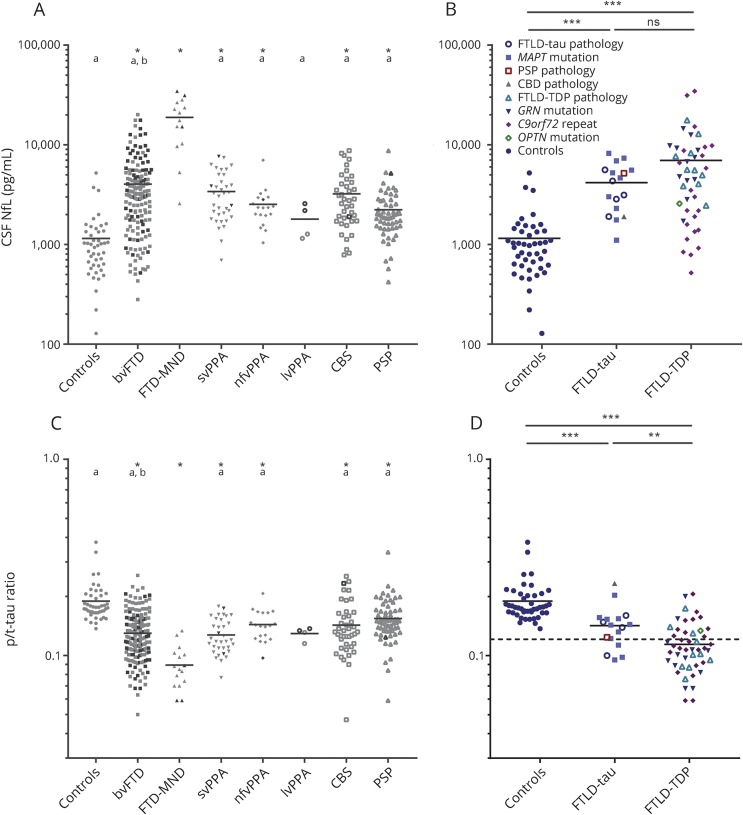
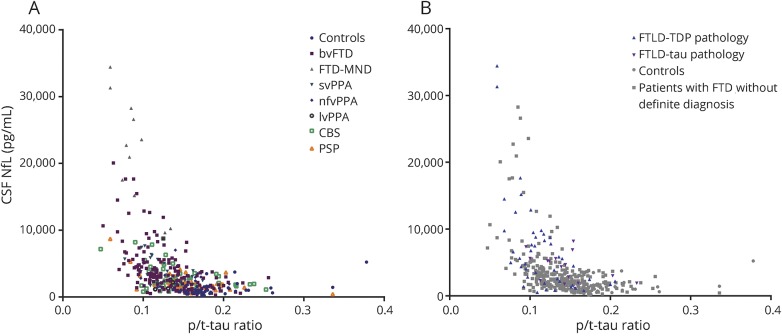
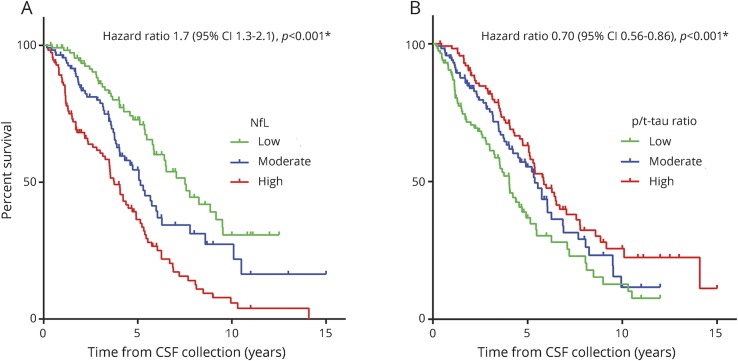
OBJECTIVE: To examine the clinical value of neurofilament light chain (NfL) and the phospho-tau/total tau ratio (p/t-tau) across the entire frontotemporal dementia (FTD) spectrum in a large, well-defined cohort. METHODS: CSF NfL and p/t-tau levels were studied in 361 patients with FTD: 179 behavioral variant FTD, 17 FTD with motor neuron disease (FTD-MND), 36 semantic variant primary progressive aphasia (PPA), 19 nonfluent variant PPA, 4 logopenic variant PPA (lvPPA), 42 corticobasal syndrome, and 64 progressive supranuclear palsy. Forty-five cognitively healthy controls were also included. Definite pathology was known in 68 patients (49 frontotemporal lobar degeneration [FTLD]-TDP, 18 FTLD-tau, 1 FTLD-FUS). RESULTS: NfL was higher in all diagnoses, except lvPPA (n = 4), than in controls, equally elevated in behavioral variant FTD, semantic variant PPA, nonfluent variant PPA, and corticobasal syndrome, and highest in FTD-MND. The p/t-tau was lower in all clinical groups, except lvPPA, than in controls and lowest in FTD-MND. NfL did not discriminate between TDP and tau pathology, while the p/t-tau ratio had a good specificity (76%) and moderate sensitivity (67%). Both high NfL and low p/t-tau were associated with poor survival (hazard ratio on tertiles 1.7 for NfL, 0.7 for p/t-tau). CONCLUSION: NfL and p/t-tau similarly discriminated FTD from controls, but not between clinical subtypes, apart from FTD-MND. Both markers predicted survival and are promising monitoring biomarkers for clinical trials. Of note, p/t-tau, but not NfL, was specific to discriminate TDP from tau pathology in vivo. CLASSIFICATION OF EVIDENCE: This study provides Class III evidence that for patients with cognitive issues, CSF NfL and p/t-tau levels discriminate between those with and without FTD spectrum disorders.
Overview
The claims and statistics of this paper haven’t been checked yet.
Free: it reads the open-access text and checks the first 5 claims that cite a source we can check. Create a free account to check every claim.
Integrity signals
Registry
Cites
Statistics
Figures
Verification
Claims the paper makes
The claims and statistics of this paper haven’t been checked yet.
Free: it reads the open-access text and checks the first 5 claims that cite a source we can check. Create a free account to check every claim.
Claims other papers make about this one
Each is checked against this paper’s own text: does it say what the citing paper says it does?
The source backs part of the claim, not all of it — or backs it for a different population, condition or comparison.
In the citing paper
“Several studies have already indicated that baseline NfL concentrations in both CSF and blood could reflect the aggressiveness of the disease as it can predict rate of disease progression in the different clinicopathological phenotypes in both sporadic and familial FTD.”
From New developments of biofluid‐based biomarkers for routine diagnosis and disease trajectories in frontotemporal dementia (2022) · cites this paper as [96]
Experimental — accuracy not yet measuredIn the citing paper
“In FTD patients it has been shown to be increased in CSF and serum, compared to cognitively healthy controls [23–26]”
In the citing paper
“Cross-sectional studies on other AD-related proteins showed alternations in bvFTD as well, such as plasma tau and the phosphorylated-tau/total-tau ratio (Foiani et al., 2018; Meeter et al., 2018).”
From The pursuit for markers of disease progression in behavioral variant frontotemporal dementia: a scoping review to optimize outcome measures for clinical trials (2024) · cites this paper as Meeter et al., 2018
In the citing paper
“they do not have much potential to measure disease progression (Foiani et al., 2018; Meeter et al., 2018)”
From The pursuit for markers of disease progression in behavioral variant frontotemporal dementia: a scoping review to optimize outcome measures for clinical trials (2024) · cites this paper as Meeter et al., 2018
In the citing paper
“since these protein profiles are not specific to bvFTD, and did not correlate with important progression measures such as whole brain volume, GM atrophy, neurofilament light chain (NfL), or disease duration”
From The pursuit for markers of disease progression in behavioral variant frontotemporal dementia: a scoping review to optimize outcome measures for clinical trials (2024) · cites this paper as Meeter et al., 2018
Self-check
Percentages, sums and reported differences re-computed from the paper’s own numbers.
The self-check needs the paper’s full text.
Citations
Cites
Hanley, J. A., & McNeil, B. J. (1983) · Radiology · doi:10.1148/radiology.148.3.6878708 · Cited by 7,016 · cited 1×
“Diagnostic performance was compared between the markers by the Hanley & McNeil method in MedCalc (Ostend, Belgium).(23) Biomarkers were correlated to clinical variables using Spearman correlation coefficient (rs).”
MethodSensitivity of revised diagnostic criteria for the behavioural variant of frontotemporal dementia
Rascovsky, K., Hodges, J. R., Knopman, D., Mendez, M. F., Kramer, J. H., Neuhaus, J., van Swieten, J. C., Seelaar, H., Dopper, E. G. P., Onyike, C. U., et al. (2011) · Brain · doi:10.1093/brain/awr179 · Cited by 5,221 · cited 2×
“Frontotemporal dementia (FTD) is a heterogeneous disease encompassing behavioral variant FTD (bvFTD) and the primary progressive aphasias (PPAs): the semantic variant (svPPA), the nonfluent variant (nfvPPA), and the logopenic variant (lvPPA).(1,2) Motor neuron disease (MND), progressive supranuclear palsy (PSP), and c…”
BackgroundMethodSelf-citationClassification of primary progressive aphasia and its variants
Gorno-Tempini, M. L., Hillis, A. E., Weintraub, S., Kertesz, A., Mendez, M., Cappa, S. F., Ogar, J. M., Rohrer, J. D., Black, S., Boeve, B. F., et al. (2011) · Neurology · doi:10.1212/wnl.0b013e31821103e6 · Cited by 5,141 · cited 1×
“Frontotemporal dementia (FTD) is a heterogeneous disease encompassing behavioral variant FTD (bvFTD) and the primary progressive aphasias (PPAs): the semantic variant (svPPA), the nonfluent variant (nfvPPA), and the logopenic variant (lvPPA).(1,2) Motor neuron disease (MND), progressive supranuclear palsy (PSP), and c…”
BackgroundAdvancing research diagnostic criteria for Alzheimer's disease: the IWG-2 criteria
Dubois, B., Feldman, H. H., Jacova, C., Hampel, H., Molinuevo, J. L., Blennow, K., DeKosky, S. T., Gauthier, S., Selkoe, D., Bateman, R., et al. (2014) · The Lancet Neurology · doi:10.1016/s1474-4422(14)70090-0 · Cited by 3,321 · cited 1×
“Patients with CSF results suggesting Alzheimer disease (AD) (low CSF β-amyloid 1–42 [Aβ42] and high p- or t-tau level, applying local laboratory standards) were not included, unless a definite FTD diagnosis was established (n = 3).(1,19) As control group (n = 45), we used controls and participants with subjective memo…”
MethodMontine, T. J., Phelps, C. H., Beach, T. G., Bigio, E. H., Cairns, N. J., Dickson, D. W., Duyckaerts, C., Frosch, M. P., Masliah, E., Mirra, S. S., et al. (2012) · Acta Neuropathologica · doi:10.1007/s00401-011-0910-3 · Cited by 2,894 · cited 1×
“) as low (n = 21, ABC score “not” or “low”) or high (n = 4, ABC score “intermediate” or “high”).(20) For 1 of 26 autopsied patients, insufficient information was available for this scoring.”
BackgroundAppelhof, B., Bakker, C., Van Duinen-van den Ijssel, J. C. L., Zwijsen, S. A., Smalbrugge, M., Verhey, F. R. J., de Vugt, M. E., Zuidema, S. U., & Koopmans, R. T. C. M. (2017) · Dementia and Geriatric Cognitive Disorders · doi:10.1159/000477087 · Cited by 2,760
Litvan, I., Agid, Y., Calne, D., Campbell, G., Dubois, B., Duvoisin, R. C., Goetz, C. G., Golbe, L. I., Grafman, J., Growdon, J. H., et al. (1996) · Neurology · doi:10.1212/wnl.47.1.1 · Cited by 2,538
Qualitative Assessment of Verbal Fluency Performance in Frontotemporal Dementia
van den Berg, E., Jiskoot, L. C., Grosveld, M. J. H., van Swieten, J. C., & Papma, J. M. (2017) · Dementia and Geriatric Cognitive Disorders · doi:10.1159/000477538 · Cited by 2,046
Criteria for the diagnosis of corticobasal degeneration
Armstrong, M. J., Litvan, I., Lang, A. E., Bak, T. H., Bhatia, K. P., Borroni, B., Boxer, A. L., Dickson, D. W., Grossman, M., Hallett, M., et al. (2013) · Neurology · doi:10.1212/wnl.0b013e31827f0fd1 · Cited by 1,904
Mackenzie, I. R. A., Neumann, M., Bigio, E. H., Cairns, N. J., Alafuzoff, I., Kril, J., Kovacs, G. G., Ghetti, B., Halliday, G., Holm, I. E., et al. (2010) · Acta Neuropathologica · doi:10.1007/s00401-009-0612-2 · Cited by 1,012 · cited 1×
“The underlying pathology, frontotemporal lobar degeneration (FTLD), is heterogeneous with tau (FTLD-tau), TAR DNAbinding protein 43 (FTLD-TDP), or fused in sarcoma inclusions (FTLD-FUS).(4) Underlying pathology can only be predicted in genetic FTD: microtubule-associated protein tau (MAPT) mutations cause FTLD-tau, an…”
BackgroundNeurofilament light chain: A prognostic biomarker in amyotrophic lateral sclerosis
Lu, C.-H., Macdonald-Wallis, C., Gray, E., Pearce, N., Petzold, A., Norgren, N., Giovannoni, G., Fratta, P., Sidle, K., Fish, M., et al. (2015) · Neurology · doi:10.1212/wnl.0000000000001642 · Cited by 563
Rosso, S. M. (2003) · Brain · doi:10.1093/brain/awg204 · Cited by 507
Zetterberg, H., Skillbäck, T., Mattsson, N., Trojanowski, J. Q., Portelius, E., Shaw, L. M., Weiner, M. W., Blennow, K., & Initiative, F. T. A. D. N. (2016) · JAMA Neurology · doi:10.1001/jamaneurol.2015.3037 · Cited by 487
Neuropathological background of phenotypical variability in frontotemporal dementia
Josephs, K. A., Hodges, J. R., Snowden, J. S., Mackenzie, I. R., Neumann, M., Mann, D. M., & Dickson, D. W. (2011) · Acta Neuropathologica · doi:10.1007/s00401-011-0839-6 · Cited by 459 · cited 1×
“The svPPA and FTD-MND are often associated with FTLD-TDP, and PSP with FTLD-tau, whereas underlying pathology can poorly be predicted in bvFTD.(6)”
BackgroundBacioglu, M., Maia, L. F., Preische, O., Schelle, J., Apel, A., Kaeser, S. A., Schweighauser, M., Eninger, T., Lambert, M., Pilotto, A., et al. (2016) · Neuron · doi:10.1016/j.neuron.2016.05.018 · Cited by 435
Serum neurofilament light chain protein is a measure of disease intensity in frontotemporal dementia
Rohrer, J. D., Woollacott, I. O. C., Dick, K. M., Brotherhood, E., Gordon, E., Fellows, A., Toombs, J., Druyeh, R., Cardoso, M. J., Ourselin, S., et al. (2016) · Neurology · doi:10.1212/wnl.0000000000003154 · Cited by 432 · cited 2×
“Lastly, these biomarkers—especially NfL—could serve as surrogate endpoints in therapeutic trials, supported by the association with disease severity we show, as in earlier reports.(7,9,27) For example, in multiple sclerosis, a dynamical decrease of CSF NfL was observed after treatment intervention.”
ResultOptimizing Patient Care and Research: The Amsterdam Dementia Cohort
van der Flier, W. M., Pijnenburg, Y. A. L., Prins, N., Lemstra, A. W., Bouwman, F. H., Teunissen, C. E., van Berckel, B. N. M., Stam, C. J., Barkhof, F., Visser, P. J., et al. (2014) · Journal of Alzheimer's Disease · doi:10.3233/jad-132306 · Cited by 398
Self-citationdel Campo, M., Mollenhauer, B., Bertolotto, A., Engelborghs, S., Hampel, H., Simonsen, A. H., Kapaki, E., Kruse, N., Le Bastard, N., Lehmann, S., et al. (2012) · Biomarkers in Medicine · doi:10.2217/bmm.12.46 · Cited by 343 · cited 1×
“CSF analyses CSF was collected and stored at −80°C until analyses according to international consensus protocols.(21) All measurements were performed blinded to clinical information and in one single center.”
MethodSelf-citationNeurofilaments in the diagnosis of motoneuron diseases: a prospective study on 455 patients
Steinacker, P., Feneberg, E., Weishaupt, J., Brettschneider, J., Tumani, H., Andersen, P. M., von Arnim, C. A. F., Böhm, S., Kassubek, J., Kubisch, C., et al. (2015) · Journal of Neurology, Neurosurgery & Psychiatry · doi:10.1136/jnnp-2015-311387 · Cited by 317
CSF neurofilament light differs in neurodegenerative diseases and predicts severity and survival
Skillbäck, T., Farahmand, B., Bartlett, J. W., Rosén, C., Mattsson, N., Nägga, K., Kilander, L., Religa, D., Wimo, A., Winblad, B., et al. (2014) · Neurology · doi:10.1212/wnl.0000000000001015 · Cited by 263
Neurofilament light chain: a biomarker for genetic frontotemporal dementia
Meeter, L. H., Dopper, E. G., Jiskoot, L. C., Sanchez‐Valle, R., Graff, C., Benussi, L., Ghidoni, R., Pijnenburg, Y. A., Borroni, B., Galimberti, D., et al. (2016) · Annals of Clinical and Translational Neurology · doi:10.1002/acn3.325 · Cited by 263 · cited 2×
“As control group (n = 45), we used controls and participants with subjective memory complaints with normal CSF Aβ42 levels (>550 pg/mL) from previous studies.(9,10) A definite diagnosis was ascertained in 68 patients based on known FTD-causing mutations (genotyping was performed when family history was positive) or au…”
MethodResultSelf-citationScherling, C. S., Hall, T., Berisha, F., Klepac, K., Karydas, A., Coppola, G., Kramer, J. H., Rabinovici, G., Ahlijanian, M., Miller, B. L., et al. (2014) · Annals of Neurology · doi:10.1002/ana.24052 · Cited by 249 · cited 2×
“Lastly, these biomarkers—especially NfL—could serve as surrogate endpoints in therapeutic trials, supported by the association with disease severity we show, as in earlier reports.(7,9,27) For example, in multiple sclerosis, a dynamical decrease of CSF NfL was observed after treatment intervention.”
ResultLashley, T., Rohrer, J. D., Mead, S., & Revesz, T. (2015) · Neuropathology and Applied Neurobiology · doi:10.1111/nan.12250 · Cited by 220 · cited 6×
“NfL did not discriminate underlying TDP from tau pathology, or improve the performance of the ratio, which contrasts to smaller studies showing high NfL levels in FTLD-TDP.10,30 In our sample, NfL levels strongly varied in patients with C9orf72 repeat expansions, including a considerable number of patients with low le…”
BackgroundInfluentialImaging and fluid biomarkers in frontotemporal dementia
Meeter, L. H., Kaat, L. D., Rohrer, J. D., & van Swieten, J. C. (2017) · Nature Reviews Neurology · doi:10.1038/nrneurol.2017.75 · Cited by 210 · cited 1×
“Motor neuron disease (MND), progressive supranuclear palsy (PSP), and corticobasal syndrome (CBS) are considered as part of the FTD spectrum.(3) The underlying pathology, frontotemporal lobar degeneration (FTLD), is heterogeneous with tau (FTLD-tau), TAR DNAbinding protein 43 (FTLD-TDP), or fused in sarcoma inclusions…”
BackgroundSelf-citationPlasma neurofilament light chain predicts progression in progressive supranuclear palsy
Rojas, J. C., Karydas, A., Bang, J., Tsai, R. M., Blennow, K., Liman, V., Kramer, J. H., Rosen, H., Miller, B. L., Zetterberg, H., et al. (2016) · Annals of Clinical and Translational Neurology · doi:10.1002/acn3.290 · Cited by 206
Fingolimod and CSF neurofilament light chain levels in relapsing-remitting multiple sclerosis
Kuhle, J., Disanto, G., Lorscheider, J., Stites, T., Chen, Y., Dahlke, F., Francis, G., Shrinivasan, A., Radue, E.-W., Giovannoni, G., et al. (2015) · Neurology · doi:10.1212/wnl.0000000000001491 · Cited by 175 · cited 1×
“For example, in multiple sclerosis, a dynamical decrease of CSF NfL was observed after treatment intervention.(38) A similar application in dementia is endorsed by an amyloidosis mouse model, in which BACE1-inhibitor treatment reduced the Aβ deposits along with CSF NfL levels.”
BackgroundCerebrospinal fluid neurofilament light chain protein levels in subtypes of frontotemporal dementia
Landqvist Waldö, M., Frizell Santillo, A., Passant, U., Zetterberg, H., Rosengren, L., Nilsson, C., & Englund, E. (2013) · BMC Neurology · doi:10.1186/1471-2377-13-54 · Cited by 127 · cited 7×
“NfL did not discriminate underlying TDP from tau pathology, or improve the performance of the ratio, which contrasts to smaller studies showing high NfL levels in FTLD-TDP.(10,30) In our sample, NfL levels strongly varied in patients with C9orf72 repeat expansions, including a considerable number of patients with low…”
ResultInfluentialCSF sAPPβ, YKL-40, and neurofilament light in frontotemporal lobar degeneration
Alcolea, D., Vilaplana, E., Suárez-Calvet, M., Illán-Gala, I., Blesa, R., Clarimón, J., Lladó, A., Sánchez-Valle, R., Molinuevo, J. L., García-Ribas, G., et al. (2017) · Neurology · doi:10.1212/wnl.0000000000004088 · Cited by 123
Reduced CSF p-Tau 181 to Tau ratio is a biomarker for FTLD-TDP
Hu, W. T., Watts, K., Grossman, M., Glass, J., Lah, J. J., Hales, C., Shelnutt, M., Van Deerlin, V., Trojanowski, J. Q., & Levey, A. I. (2013) · Neurology · doi:10.1212/01.wnl.0000436625.63650.27 · Cited by 113 · cited 2×
“For pathology-specific therapies, biomarkers predicting pathology are paramount, and lower phospho-tau181 to total tau (p/t-tau) ratios were found in small series of patients with FTLD-TDP compared to FTLD-tau.(10,13,14) However, both biomarkers have scarcely been validated and directly compared in large series across…”
ResultPhosphorylated Tau as a Candidate Biomarker for Amyotrophic Lateral Sclerosis
Grossman, M., Elman, L., McCluskey, L., McMillan, C. T., Boller, A., Powers, J., Rascovsky, K., Hu, W., Shaw, L., Irwin, D. J., et al. (2014) · JAMA Neurology · doi:10.1001/jamaneurol.2013.6064 · Cited by 94
Pijnenburg, Y. A. L., Verwey, N. A., van der Flier, W. M., Scheltens, P., & Teunissen, C. E. (2015) · Alzheimer's & Dementia: Diagnosis, Assessment & Disease Monitoring · doi:10.1016/j.dadm.2015.11.001 · Cited by 91
Self-citationNeurofilament as a blood marker for diagnosis and monitoring of primary progressive aphasias
Steinacker, P., Semler, E., Anderl-Straub, S., Diehl-Schmid, J., Schroeter, M. L., Uttner, I., Foerstl, H., Landwehrmeyer, B., von Arnim, C. A. F., Kassubek, J., et al. (2017) · Neurology · doi:10.1212/wnl.0000000000003688 · Cited by 89 · cited 1×
“Indeed, NfL levels were comparable across bvFTD, nfvPPA, svPPA, and CBS, in concordance with prior results in other series.(7,27,30,34) This study demonstrates a similar pattern for the p/t-tau ratio for the first time.”
ResultNeurofilament light chain in FTD is elevated not only in cerebrospinal fluid, but also in serum
Wilke, C., Preische, O., Deuschle, C., Roeben, B., Apel, A., Barro, C., Maia, L., Maetzler, W., Kuhle, J., & Synofzik, M. (2016) · Journal of Neurology, Neurosurgery & Psychiatry · doi:10.1136/jnnp-2015-312972 · Cited by 79
Csf p-tau181/tau ratio as biomarker for TDP pathology in frontotemporal dementia
Borroni, B., Benussi, A., Archetti, S., Galimberti, D., Parnetti, L., Nacmias, B., Sorbi, S., Scarpini, E., & Padovani, A. (2015) · Amyotrophic Lateral Sclerosis and Frontotemporal Degeneration · doi:10.3109/21678421.2014.971812 · Cited by 77 · cited 2×
“For pathology-specific therapies, biomarkers predicting pathology are paramount, and lower phospho-tau181 to total tau (p/t-tau) ratios were found in small series of patients with FTLD-TDP compared to FTLD-tau.(10,13,14) However, both biomarkers have scarcely been validated and directly compared in large series across…”
ResultSkillbäck, T., Mattsson, N., Blennow, K., & Zetterberg, H. (2017) · Amyotrophic Lateral Sclerosis and Frontotemporal Degeneration · doi:10.1080/21678421.2017.1281962 · Cited by 73
Irwin, D. J., Lleó, A., Xie, S. X., McMillan, C. T., Wolk, D. A., Lee, E. B., Van Deerlin, V. M., Shaw, L. M., Trojanowski, J. Q., & Grossman, M. (2017) · Annals of Neurology · doi:10.1002/ana.24996 · Cited by 67 · cited 6×
“NfL did not discriminate underlying TDP from tau pathology, or improve the performance of the ratio, which contrasts to smaller studies showing high NfL levels in FTLD-TDP.10,30 In our sample, NfL levels strongly varied in patients with C9orf72 repeat expansions, including a considerable number of patients with low le…”
BackgroundInfluentialBoxer, A. L., Gold, M., Huey, E., Hu, W. T., Rosen, H., Kramer, J., Gao, F., Burton, E. A., Chow, T., Kao, A., et al. (2013) · Alzheimer's & Dementia · doi:10.1016/j.jalz.2012.03.003 · Cited by 54
Vijverberg, E. G. B., Dols, A., Krudop, W. A., Del Campo Milan, M., Kerssens, C. J., Gossink, F., Prins, N. D., Stek, M. L., Scheltens, P., Teunissen, C. E., et al. (2017) · Alzheimer's & Dementia: Diagnosis, Assessment & Disease Monitoring · doi:10.1016/j.dadm.2017.01.009 · Cited by 46
Self-citationKuiperij, H. B., Versleijen, A. A. M., Beenes, M., Verwey, N. A., Benussi, L., Paterlini, A., Binetti, G., Teunissen, C. E., Raaphorst, J., Schelhaas, H. J., et al. (2016) · Journal of Alzheimer's Disease · doi:10.3233/jad-160386 · Cited by 46 · cited 2×
“The pathophysiologic background of a low p/t-tau ratio is not entirely clear; the p/t-tau ratio differed between patients and controls because of elevated t-tau levels—representing neuronal loss—in concordance with prior studies.(10,33,36) In contrast, the observed differences between underlying TDP and tau pathology…”
ResultSelf-citationWilke, C., Deuschle, C., Rattay, T. W., Maetzler, W., & Synofzik, M. (2014) · Neurobiology of Aging · doi:10.1016/j.neurobiolaging.2014.10.019 · Cited by 42 · cited 1×
“The pathophysiologic background of a low p/t-tau ratio is not entirely clear; the p/t-tau ratio differed between patients and controls because of elevated t-tau levels—representing neuronal loss—in concordance with prior studies.(10,33,36) In contrast, the observed differences between underlying TDP and tau pathology…”
ResultLlorens, F., Karch, A., Golańska, E., Schmitz, M., Lange, P., Sikorska, B., Liberski, P. P., & Zerr, I. (2017) · Dementia and Geriatric Cognitive Disorders · doi:10.1159/000454802 · Cited by 22
(1950) · doi:10.1002/1097-0142(1950)3:1<32::aid-cncr2820030106>3.0.co;2-3
Cited by
Neurofilament light chain as a biomarker in neurological disorders
Gaetani, L., Blennow, K., Calabresi, P., Di Filippo, M., Parnetti, L., & Zetterberg, H. (2019) · Journal of Neurology, Neurosurgery & Psychiatry · doi:10.1136/jnnp-2018-320106 · Cited by 1,334
Advancing Research and Treatment for Frontotemporal Lobar Degeneration (ARTFL) investigators, Thijssen, E. H., La Joie, R., Wolf, A., Strom, A., Wang, P., Iaccarino, L., Bourakova, V., Cobigo, Y., Heuer, H., et al. (2020) · Nature Medicine · doi:10.1038/s41591-020-0762-2 · Cited by 761
Self-citationA multicentre validation study of the diagnostic value of plasma neurofilament light.
Ashton, N. J., Janelidze, S., Al Khleifat, A., Leuzy, A., van der Ende, E. L., Karikari, T. K., Benedet, A. L., Pascoal, T. A., Lleó, A., Parnetti, L., et al. (2021) · Nature Communications · doi:10.1038/s41467-021-23620-z · Cited by 545
Ducharme, S., Dols, A., Laforce, R., Devenney, E., Kumfor, F., van den Stock, J., Dallaire-Théroux, C., Seelaar, H., Gossink, F., Vijverberg, E., et al. (2020) · Brain · doi:10.1093/brain/awaa018 · Cited by 320
Self-citationSchöll, M., Maass, A., Mattsson, N., Ashton, N. J., Blennow, K., Zetterberg, H., & Jagust, W. (2019) · Molecular and Cellular Neuroscience · doi:10.1016/j.mcn.2018.12.001 · Cited by 229
Metadata
- Authors
- Meeter, L. H. H., Vijverberg, E. G., Del Campo, M., Rozemuller, A. J. M., Donker Kaat, L., de Jong, F. J., van der Flier, W. M., Teunissen, C. E., van Swieten, J. C., & Pijnenburg, Y. A. L.
- Affiliations
- Erasmus MC (NL)
- From the Alzheimer Center and Department of Neurology (L.H.H.M., L.D.K., F.J.d.J., J.C.v.S.), Erasmus Medical Center, Rotterdam; Alzheimer Center and Department of Neurology (E.G.V., W.M.v.d.F., Y.A.L.P.), Neurochemistry Laboratory, Department of Clinical Chemistry (M.D.C., C.E.T.), Department of Pathology (A.J.M.R.), and Department of Clinical Genetics (J.C.v.S.), Neuroscience Campus Amsterdam, VU University Medical Center, Amsterdam, the Netherlands.
- Corresponding author
- Meeter, Lieke H.H.
- ORCID
- Venue
- Neurology
- Published
- 2018-04-03
- Volume
- 90
- Issue
- 14
- Pages
- e1231-e1239
- ISSN
- 0028-3878 (ISSN-L)
- 1526-632X
- PMC
- PMC5890612
- OpenAlex
- W2790169598
- Semantic Scholar
- 27db5bccfd24ba2e17df4f8c4c7cf9e6c51ecee9
- Cited by
- 122
- References
- 42
- Citations by year
- 2026: 5 · 2025: 11 · 2024: 12 · 2023: 9 · 2022: 27 · 2021: 14 · 2020: 12 · 2019: 24 · 2018: 8
- FWCI
- 11.41
- Type
- journal article
- Language
- en
- Open access
- hybrid
- doi.org
- Licence
- cc-by-nc-nd
- Locations
- Neurology (publishedVersion, cc-by-nc-nd)
- Europe PMC (PubMed Central) (publishedVersion, cc-by-nc-nd)
- PubMed Central (publishedVersion, cc-by-nc-nd)
- PubMed (publishedVersion)
- Pure Amsterdam UMC (publishedVersion, cc-by)
- Amsterdam UMC (VU Amsterdam) - Institutional Repository (publishedVersion, other-oa)
- EUR Research Repository (Erasmus University Rotterdam) (acceptedVersion, other-oa)
- EUR Research Repository (Erasmus University Rotterdam) (submittedVersion, other-oa)
- Data Archiving and Networked Services (DANS) (submittedVersion, other-oa)
- Funders
- ZonMw (733051024)
- Topics
- Health Sciences › Medicine › Psychiatry and Mental health › Dementia and Cognitive Impairment Research
- Health Sciences › Medicine › Clinical Neurology › Amyotrophic Lateral Sclerosis Research
- Life Sciences › Neuroscience › Cellular and Molecular Neuroscience › Alzheimer's disease research and treatments
- Keywords
- frontotemporal dementia, neurofilament light chain, cerebrospinal fluid biomarkers, behavioral variant frontotemporal dementia, primary progressive aphasia, corticobasal syndrome, progressive supranuclear palsy, tau pathology, survival prediction, disease progression monitoring
- MeSH terms
- Aged, Female, Humans, Male, Middle Aged, Phosphorylation, Prognosis, Sensitivity and Specificity, Supranuclear Palsy, Progressive, Cohort Studies, Biomarkers, Case-Control Studies, Motor Neuron Disease, tau Proteins, Neurofilament Proteins, Aphasia, Primary Progressive, Kaplan-Meier Estimate, Frontotemporal Dementia
About these checks
Registry, retraction, Cites and statistics results are computed, not judged, with one exception: a printed reference that no index lists is read once by a model before it counts as a citation error. Claims are extracted by a model and kept only when their quote appears verbatim in the text; each cited source is then checked, with a model’s help, for whether it says what the claim relies on. Those verdicts can be wrong — read the claim’s quote and the cited source before relying on one.
Statistics and arithmetic are recomputed, not judged.
Confidence bands are shown only for fields calibrated on our annotated test set. None is calibrated yet, so no band is shown.
What counts as a claim ›How we measure confidence ›How we check this ›
Are you an author, or do you see a problem with this page? Request a review
Data sources
Bibliographic data: Semantic Scholar, OpenAlex, Crossref.
Contains information from the Semantic Scholar Academic Graph Datasets, made available under the ODC Attribution License (ODC-BY 1.0).
Semantic Scholar’s data is described in: Kinney, R., et al. (2023). The Semantic Scholar Open Data Platform. arXiv:2301.10140.
