

Clinical value of neurofilament and phospho-tau/tau ratio in the frontotemporal dementia spectrum
Open accessThe DOI matches its Crossref record; 42 of the 42 references it cites were found in a registry or an index.
Abstract
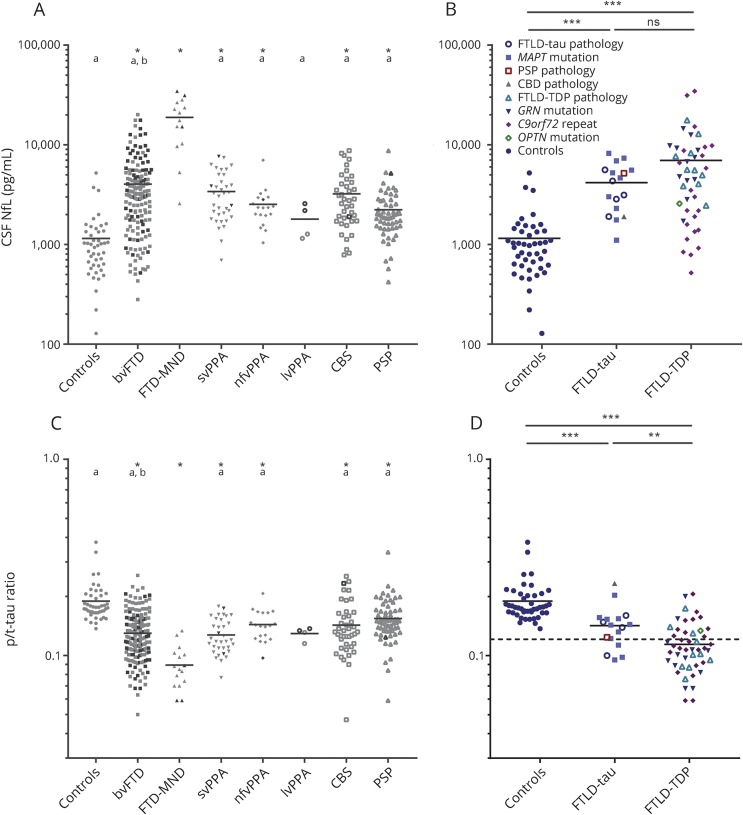
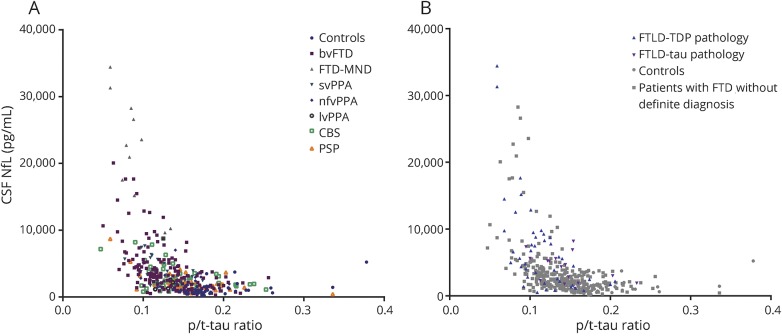
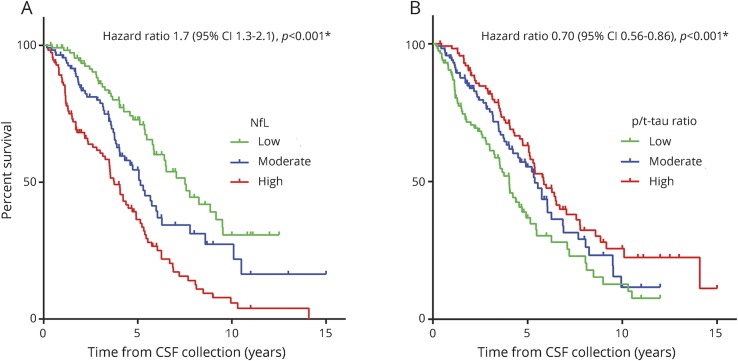
OBJECTIVE: To examine the clinical value of neurofilament light chain (NfL) and the phospho-tau/total tau ratio (p/t-tau) across the entire frontotemporal dementia (FTD) spectrum in a large, well-defined cohort. METHODS: CSF NfL and p/t-tau levels were studied in 361 patients with FTD: 179 behavioral variant FTD, 17 FTD with motor neuron disease (FTD-MND), 36 semantic variant primary progressive aphasia (PPA), 19 nonfluent variant PPA, 4 logopenic variant PPA (lvPPA), 42 corticobasal syndrome, and 64 progressive supranuclear palsy. Forty-five cognitively healthy controls were also included. Definite pathology was known in 68 patients (49 frontotemporal lobar degeneration [FTLD]-TDP, 18 FTLD-tau, 1 FTLD-FUS). RESULTS: NfL was higher in all diagnoses, except lvPPA (n = 4), than in controls, equally elevated in behavioral variant FTD, semantic variant PPA, nonfluent variant PPA, and corticobasal syndrome, and highest in FTD-MND. The p/t-tau was lower in all clinical groups, except lvPPA, than in controls and lowest in FTD-MND. NfL did not discriminate between TDP and tau pathology, while the p/t-tau ratio had a good specificity (76%) and moderate sensitivity (67%). Both high NfL and low p/t-tau were associated with poor survival (hazard ratio on tertiles 1.7 for NfL, 0.7 for p/t-tau). CONCLUSION: NfL and p/t-tau similarly discriminated FTD from controls, but not between clinical subtypes, apart from FTD-MND. Both markers predicted survival and are promising monitoring biomarkers for clinical trials. Of note, p/t-tau, but not NfL, was specific to discriminate TDP from tau pathology in vivo. CLASSIFICATION OF EVIDENCE: This study provides Class III evidence that for patients with cognitive issues, CSF NfL and p/t-tau levels discriminate between those with and without FTD spectrum disorders.
Overview
The claims and statistics of this paper haven’t been checked yet.
Free: it reads the open-access text and checks the first 5 claims that cite a source we can check. Create a free account to check every claim.
Integrity signals
Registry
Cites
Statistics
Figures
Verification
Claims the paper makes
The claims and statistics of this paper haven’t been checked yet.
Free: it reads the open-access text and checks the first 5 claims that cite a source we can check. Create a free account to check every claim.
Claims other papers make about this one
Each is checked against this paper’s own text: does it say what the citing paper says it does?
The source backs part of the claim, not all of it — or backs it for a different population, condition or comparison.
In the citing paper
“Several studies have already indicated that baseline NfL concentrations in both CSF and blood could reflect the aggressiveness of the disease as it can predict rate of disease progression in the different clinicopathological phenotypes in both sporadic and familial FTD.”
From New developments of biofluid‐based biomarkers for routine diagnosis and disease trajectories in frontotemporal dementia (2022) · cites this paper as [96]
Experimental — accuracy not yet measuredIn the citing paper
“In FTD patients it has been shown to be increased in CSF and serum, compared to cognitively healthy controls [23–26]”
In the citing paper
“Cross-sectional studies on other AD-related proteins showed alternations in bvFTD as well, such as plasma tau and the phosphorylated-tau/total-tau ratio (Foiani et al., 2018; Meeter et al., 2018).”
From The pursuit for markers of disease progression in behavioral variant frontotemporal dementia: a scoping review to optimize outcome measures for clinical trials (2024) · cites this paper as Meeter et al., 2018
In the citing paper
“they do not have much potential to measure disease progression (Foiani et al., 2018; Meeter et al., 2018)”
From The pursuit for markers of disease progression in behavioral variant frontotemporal dementia: a scoping review to optimize outcome measures for clinical trials (2024) · cites this paper as Meeter et al., 2018
In the citing paper
“since these protein profiles are not specific to bvFTD, and did not correlate with important progression measures such as whole brain volume, GM atrophy, neurofilament light chain (NfL), or disease duration”
From The pursuit for markers of disease progression in behavioral variant frontotemporal dementia: a scoping review to optimize outcome measures for clinical trials (2024) · cites this paper as Meeter et al., 2018
Self-check
Percentages, sums and reported differences re-computed from the paper’s own numbers.
The self-check needs the paper’s full text.
Citations
Cites
Hanley, J. A., & McNeil, B. J. (1983) · Radiology · doi:10.1148/radiology.148.3.6878708 · Cited by 7,016 · cited 1×
“Diagnostic performance was compared between the markers by the Hanley & McNeil method in MedCalc (Ostend, Belgium).(23) Biomarkers were correlated to clinical variables using Spearman correlation coefficient (rs).”
MethodSensitivity of revised diagnostic criteria for the behavioural variant of frontotemporal dementia
Rascovsky, K., Hodges, J. R., Knopman, D., Mendez, M. F., Kramer, J. H., Neuhaus, J., van Swieten, J. C., Seelaar, H., Dopper, E. G. P., Onyike, C. U., et al. (2011) · Brain · doi:10.1093/brain/awr179 · Cited by 5,221 · cited 2×
“Frontotemporal dementia (FTD) is a heterogeneous disease encompassing behavioral variant FTD (bvFTD) and the primary progressive aphasias (PPAs): the semantic variant (svPPA), the nonfluent variant (nfvPPA), and the logopenic variant (lvPPA).(1,2) Motor neuron disease (MND), progressive supranuclear palsy (PSP), and c…”
BackgroundMethodSelf-citationClassification of primary progressive aphasia and its variants
Gorno-Tempini, M. L., Hillis, A. E., Weintraub, S., Kertesz, A., Mendez, M., Cappa, S. F., Ogar, J. M., Rohrer, J. D., Black, S., Boeve, B. F., et al. (2011) · Neurology · doi:10.1212/wnl.0b013e31821103e6 · Cited by 5,141 · cited 1×
“Frontotemporal dementia (FTD) is a heterogeneous disease encompassing behavioral variant FTD (bvFTD) and the primary progressive aphasias (PPAs): the semantic variant (svPPA), the nonfluent variant (nfvPPA), and the logopenic variant (lvPPA).(1,2) Motor neuron disease (MND), progressive supranuclear palsy (PSP), and c…”
BackgroundAdvancing research diagnostic criteria for Alzheimer's disease: the IWG-2 criteria
Dubois, B., Feldman, H. H., Jacova, C., Hampel, H., Molinuevo, J. L., Blennow, K., DeKosky, S. T., Gauthier, S., Selkoe, D., Bateman, R., et al. (2014) · The Lancet Neurology · doi:10.1016/s1474-4422(14)70090-0 · Cited by 3,321 · cited 1×
“Patients with CSF results suggesting Alzheimer disease (AD) (low CSF β-amyloid 1–42 [Aβ42] and high p- or t-tau level, applying local laboratory standards) were not included, unless a definite FTD diagnosis was established (n = 3).(1,19) As control group (n = 45), we used controls and participants with subjective memo…”
MethodMontine, T. J., Phelps, C. H., Beach, T. G., Bigio, E. H., Cairns, N. J., Dickson, D. W., Duyckaerts, C., Frosch, M. P., Masliah, E., Mirra, S. S., et al. (2012) · Acta Neuropathologica · doi:10.1007/s00401-011-0910-3 · Cited by 2,894 · cited 1×
“) as low (n = 21, ABC score “not” or “low”) or high (n = 4, ABC score “intermediate” or “high”).(20) For 1 of 26 autopsied patients, insufficient information was available for this scoring.”
BackgroundAppelhof, B., Bakker, C., Van Duinen-van den Ijssel, J. C. L., Zwijsen, S. A., Smalbrugge, M., Verhey, F. R. J., de Vugt, M. E., Zuidema, S. U., & Koopmans, R. T. C. M. (2017) · Dementia and Geriatric Cognitive Disorders · doi:10.1159/000477087 · Cited by 2,760
Litvan, I., Agid, Y., Calne, D., Campbell, G., Dubois, B., Duvoisin, R. C., Goetz, C. G., Golbe, L. I., Grafman, J., Growdon, J. H., et al. (1996) · Neurology · doi:10.1212/wnl.47.1.1 · Cited by 2,538
Qualitative Assessment of Verbal Fluency Performance in Frontotemporal Dementia
van den Berg, E., Jiskoot, L. C., Grosveld, M. J. H., van Swieten, J. C., & Papma, J. M. (2017) · Dementia and Geriatric Cognitive Disorders · doi:10.1159/000477538 · Cited by 2,046
Criteria for the diagnosis of corticobasal degeneration
Armstrong, M. J., Litvan, I., Lang, A. E., Bak, T. H., Bhatia, K. P., Borroni, B., Boxer, A. L., Dickson, D. W., Grossman, M., Hallett, M., et al. (2013) · Neurology · doi:10.1212/wnl.0b013e31827f0fd1 · Cited by 1,904
Mackenzie, I. R. A., Neumann, M., Bigio, E. H., Cairns, N. J., Alafuzoff, I., Kril, J., Kovacs, G. G., Ghetti, B., Halliday, G., Holm, I. E., et al. (2010) · Acta Neuropathologica · doi:10.1007/s00401-009-0612-2 · Cited by 1,012 · cited 1×
“The underlying pathology, frontotemporal lobar degeneration (FTLD), is heterogeneous with tau (FTLD-tau), TAR DNAbinding protein 43 (FTLD-TDP), or fused in sarcoma inclusions (FTLD-FUS).(4) Underlying pathology can only be predicted in genetic FTD: microtubule-associated protein tau (MAPT) mutations cause FTLD-tau, an…”
Background
Cited by
Neurofilament light chain as a biomarker in neurological disorders
Gaetani, L., Blennow, K., Calabresi, P., Di Filippo, M., Parnetti, L., & Zetterberg, H. (2019) · Journal of Neurology, Neurosurgery & Psychiatry · doi:10.1136/jnnp-2018-320106 · Cited by 1,334
Advancing Research and Treatment for Frontotemporal Lobar Degeneration (ARTFL) investigators, Thijssen, E. H., La Joie, R., Wolf, A., Strom, A., Wang, P., Iaccarino, L., Bourakova, V., Cobigo, Y., Heuer, H., et al. (2020) · Nature Medicine · doi:10.1038/s41591-020-0762-2 · Cited by 761
Self-citationA multicentre validation study of the diagnostic value of plasma neurofilament light.
Ashton, N. J., Janelidze, S., Al Khleifat, A., Leuzy, A., van der Ende, E. L., Karikari, T. K., Benedet, A. L., Pascoal, T. A., Lleó, A., Parnetti, L., et al. (2021) · Nature Communications · doi:10.1038/s41467-021-23620-z · Cited by 545
Ducharme, S., Dols, A., Laforce, R., Devenney, E., Kumfor, F., van den Stock, J., Dallaire-Théroux, C., Seelaar, H., Gossink, F., Vijverberg, E., et al. (2020) · Brain · doi:10.1093/brain/awaa018 · Cited by 320
Self-citationSchöll, M., Maass, A., Mattsson, N., Ashton, N. J., Blennow, K., Zetterberg, H., & Jagust, W. (2019) · Molecular and Cellular Neuroscience · doi:10.1016/j.mcn.2018.12.001 · Cited by 229
Xia, Y., Prokop, S., & Giasson, B. I. (2021) · Molecular Neurodegeneration · doi:10.1186/s13024-021-00460-5 · Cited by 218
Frontotemporal lobar degeneration
Grossman, M., Seeley, W. W., Boxer, A. L., Hillis, A. E., Knopman, D. S., Ljubenov, P. A., Miller, B., Piguet, O., Rademakers, R., Whitwell, J. L., et al. (2023) · Nature Reviews Disease Primers · doi:10.1038/s41572-023-00447-0 · Cited by 178
Forgrave, L. M., Ma, M., Best, J. R., & DeMarco, M. L. (2019) · Alzheimer's & Dementia: Diagnosis, Assessment & Disease Monitoring · doi:10.1016/j.dadm.2019.08.009 · Cited by 177
CSF biomarkers of neuroinflammation in distinct forms and subtypes of neurodegenerative dementia
Abu-Rumeileh, S., Steinacker, P., Polischi, B., Mammana, A., Bartoletti-Stella, A., Oeckl, P., Baiardi, S., Zenesini, C., Huss, A., Cortelli, P., et al. (2020) · Alzheimer's Research & Therapy · doi:10.1186/s13195-019-0562-4 · Cited by 154
Serum NFL discriminates Parkinson disease from atypical parkinsonisms
Marques, T. M., van Rumund, A., Oeckl, P., Kuiperij, H. B., Esselink, R. A. J., Bloem, B. R., Otto, M., & Verbeek, M. M. (2019) · Neurology · doi:10.1212/wnl.0000000000007179 · Cited by 153
Neurofilament Light Chain as Biomarker for Amyotrophic Lateral Sclerosis and Frontotemporal Dementia
Verde, F., Otto, M., & Silani, V. (2021) · Frontiers in Neuroscience · doi:10.3389/fnins.2021.679199 · Cited by 152
“Meeter et al. (2018b) 361 FTD patients (179 bvFTD, 17 FTD-MND, 36 svPPA, 19 nfvPPA, 4 lvPPA, 42 CBS, 64 PSP), 45 HCs. Definite pathology known in 68 patients (49 FTLD-TDP, 18 FTLD-tau, 1 FTLD-FUS) CSF ELISA All clinical entities except for lvPPA have higher CSF NFL levels compared with HCs, with…”
BackgroundMethodResultInfluentialFrontotemporal Dementia, Where Do We Stand? A Narrative Review
Antonioni, A., Raho, E. M., Lopriore, P., Pace, A. P., Latino, R. R., Assogna, M., Mancuso, M., Gragnaniello, D., Granieri, E., Pugliatti, M., et al. (2023) · International Journal of Molecular Sciences · doi:10.3390/ijms241411732 · Cited by 145
“…NfL values in the CSF [187] and blood values [183] show utility from a prognostic point of view, as values at baseline correlate with the progression of cognitive deficits, assessed by the mini-mental-state examination (MMSE) and clinical dementia rating (CDR), as well as with survival [179,188].”
BackgroundMethodAlirezaei, Z., Pourhanifeh, M. H., Borran, S., Nejati, M., Mirzaei, H., & Hamblin, M. R. (2020) · Molecular Neurobiology · doi:10.1007/s12035-019-01698-3 · Cited by 142
Vermunt, L., Otte, M., Verberk, I. M. W., Killestein, J., Lemstra, A. W., van der Flier, W. M., Pijnenburg, Y. A. L., Vijverberg, E. G. B., Bouwman, F. H., Gravesteijn, G., et al. (2022) · Annals of Clinical and Translational Neurology · doi:10.1002/acn3.51676 · Cited by 135
Self-citationMattsson-Carlgren, N., Grinberg, L. T., Boxer, A., Ossenkoppele, R., Jonsson, M., Seeley, W., Ehrenberg, A., Spina, S., Janelidze, S., Rojas-Martinex, J., et al. (2022) · Neurology · doi:10.1212/wnl.0000000000200040 · Cited by 128
Development of disease-modifying drugs for frontotemporal dementia spectrum disorders
Panza, F., Lozupone, M., Seripa, D., Daniele, A., Watling, M., Giannelli, G., & Imbimbo, B. P. (2020) · Nature Reviews Neurology · doi:10.1038/s41582-020-0330-x · Cited by 122
Zhao, Y., Xin, Y., Meng, S., He, Z., & Hu, W. (2019) · Neuroscience & Biobehavioral Reviews · doi:10.1016/j.neubiorev.2019.04.014 · Cited by 105
Wang, S.-Y., Chen, W., Xu, W., Li, J., Hou, X., Ou, Y., Yu, J., & Tan, L. (2019) · Journal of Alzheimer s Disease · doi:10.3233/jad-190615 · Cited by 99
Zhu, N., Santos-Santos, M., Illán-Gala, I., Montal, V., Estellés, T., Barroeta, I., Altuna, M., Arranz, J., Muñoz, L., Belbin, O., et al. (2021) · Translational Neurodegeneration · doi:10.1186/s40035-021-00275-w · Cited by 86
P-tau217 as a Reliable Blood-Based Marker of Alzheimer’s Disease
Lai, R., Li, B., & Bishnoi, R. J. (2024) · Biomedicines · doi:10.3390/biomedicines12081836 · Cited by 90
“In fact, FTD is associated with lower p/t-tau compared to non-AD controls [76].”
BackgroundBoReALS, Abu‐Rumeileh, S., Vacchiano, V., Zenesini, C., Polischi, B., Pasqua, S. D., Fileccia, E., Mammana, A., Stasi, V. D., Capellari, S., et al. (2020) · Journal of Neurology · doi:10.1007/s00415-020-09761-z · Cited by 83
Gendron, T. F., Heckman, M. G., White, L. J., Veire, A. M., Pedraza, O., Burch, A. R., Bozoki, A. C., Dickerson, B. C., Domoto-Reilly, K., Foroud, T., et al. (2022) · Cell Reports Medicine · doi:10.1016/j.xcrm.2022.100607 · Cited by 70
Neurofilaments: The C-Reactive Protein of Neurology
Lambertsen, K. L., Soares, C. B., Gaist, D., & Nielsen, H. H. (2020) · Brain Sciences · doi:10.3390/brainsci10010056 · Cited by 73
Significance of CSF NfL and tau in ALS
Schreiber, S., Spotorno, N., Schreiber, F., Acosta‐Cabronero, J., Kaufmann, J., Machts, J., Dębska–Vielhaber, G., Garz, C., Bittner, D., Hensiek, N., et al. (2018) · Journal of Neurology · doi:10.1007/s00415-018-9043-0 · Cited by 73
Serum and CSF neurofilament light chain levels in antibody-mediated encephalitis
Mariotto, S., Gajofatto, A., Zuliani, L., Zoccarato, M., Gastaldi, M., Franciotta, D. M., Cantalupo, G., Piardi, F., Polo, A., Alberti, D., et al. (2019) · Journal of Neurology · doi:10.1007/s00415-019-09306-z · Cited by 69
Abu-Rumeileh, S., Mometto, N., Bartoletti-Stella, A., Polischi, B., Oppi, F., Poda, R., Stanzani-Maserati, M., Cortelli, P., Liguori, R., Capellari, S., et al. (2018) · Journal of Alzheimer's Disease · doi:10.3233/jad-180409 · Cited by 65
The path to biomarker-based diagnostic criteria for the spectrum of neurodegenerative diseases
Baldacci, F., Mazzucchi, S., Vecchia, A. D., Giampietri, L., Giannini, N., Koronyo‐Hamaoui, M., Ceravolo, R., Siciliano, G., Bonuccelli, U., Elahi, F. M., et al. (2020) · Expert Review of Molecular Diagnostics · doi:10.1080/14737159.2020.1731306 · Cited by 69
“Notably, low CSF p/t-tau ratio may contribute to the discrimination of nfvPPA and svPPA from controls, and it shows correlation with survival [209].”
BackgroundBiomarkers for diseases with TDP-43 pathology
Steinacker, P., Barschke, P., & Otto, M. (2019) · Molecular and Cellular Neuroscience · doi:10.1016/j.mcn.2018.10.003 · Cited by 57
Clinico-genetic findings in 509 frontotemporal dementia patients
Wagner, M., Lorenz, G., Volk, A. E., Brunet, T., Edbauer, D., Berutti, R., Zhao, C., Anderl‐Straub, S., Bertram, L., Danek, A., et al. (2021) · Molecular Psychiatry · doi:10.1038/s41380-021-01271-2 · Cited by 61
Conca, F., Esposito, V., Giusto, G., Cappa, S. F., & Catricalà, E. (2022) · Ageing Research Reviews · doi:10.1016/j.arr.2022.101760 · Cited by 54
del Campo, M., Zetterberg, H., Gandy, S., Onyike, C. U., Oliveira, F., Udeh‐Momoh, C., Lleó, A., Teunissen, C. E., & Pijnenburg, Y. (2022) · Alzheimer's & Dementia · doi:10.1002/alz.12643 · Cited by 52
Self-citationCerebrospinal fluid biomarkers predict frontotemporal dementia trajectory
Ljubenkov, P. A., Staffaroni, A. M., Rojas, J. C., Allen, I. E., Wang, P., Heuer, H., Karydas, A., Kornak, J., Cobigo, Y., Seeley, W. W., et al. (2018) · Annals of Clinical and Translational Neurology · doi:10.1002/acn3.643 · Cited by 49
Review: Fluid biomarkers for frontotemporal dementias
Zetterberg, H., van Swieten, J. C., Boxer, A. L., & Rohrer, J. D. (2019) · Neuropathology and Applied Neurobiology · doi:10.1111/nan.12530 · Cited by 48
Biomarker discovery and development for frontotemporal dementia and amyotrophic lateral sclerosis
Katzeff, J. S., Bright, F., Phan, K., Kril, J. J., Ittner, L. M., Kassiou, M., Hodges, J. R., Piguet, O., Kiernan, M. C., Halliday, G. M., et al. (2022) · Brain · doi:10.1093/brain/awac077 · Cited by 48
Distinguishing Frontotemporal Lobar Degeneration Tau From TDP-43 Using Plasma Biomarkers
Cousins, K. A. Q., Shaw, L. M., Chen-Plotkin, A., Wolk, D. A., Van Deerlin, V. M., Lee, E. B., McMillan, C. T., Grossman, M., & Irwin, D. J. (2022) · JAMA Neurology · doi:10.1001/jamaneurol.2022.3265 · Cited by 45
TDP-43 Proteinopathy Specific Biomarker Development
Cordts, I., Wachinger, A., Scialò, C., Lingor, P., Polymenidou, M., Buratti, E., & Feneberg, E. (2023) · Cells · doi:10.3390/cells12040597 · Cited by 55
Progressive supranuclear palsy
Giagkou, N., Höglinger, G. U., & Stamelou, M. (2019) · International review of neurobiology · doi:10.1016/bs.irn.2019.10.013 · Cited by 62
Allison, S. L., Koscik, R. L., Cary, R. P., Jonaitis, E. M., Rowley, H. A., Chin, N. A., Zetterberg, H., Blennow, K., Carlsson, C. M., Asthana, S., et al. (2019) · NeuroImage Clinical · doi:10.1016/j.nicl.2019.101895 · Cited by 45
“, 2014) and certain clinical variants of frontotemporal dementia (Meeter et al., 2018), treating CSF measures of total tau and ptau181 as reflecting N and T, respectively, may be less helpful in terms of staging individuals across the AD continuum given their strong association.”
BackgroundCerebrospinal Fluid Biomarkers in Neurodegenerative Disorders
Robey, T. T., & Panegyres, P. K. (2019) · Future Neurology · doi:10.2217/fnl-2018-0029 · Cited by 38
Bolsewig, K., Hok-A-Hin, Y. S., Sepe, F. N., Boonkamp, L., Jacobs, D., Bellomo, G., Paoletti, F. P., Vanmechelen, E., Teunissen, C. E., Parnetti, L., et al. (2022) · Journal of Alzheimer's Disease · doi:10.3233/jad-220318 · Cited by 36
Self-citationNeurofilaments contribution in clinic: state of the art
Delaby, C., Bousiges, O., Bouvier, D., Fillée, C., Fourier, A., Mondésert, E., Nezry, N., Omar, S., Quadrio, I., Rucheton, B., et al. (2022) · Frontiers in Aging Neuroscience · doi:10.3389/fnagi.2022.1034684 · Cited by 39
Foiani, M. S., Cicognola, C., Ermann, N., Woollacott, I. O. C., Heller, C., Heslegrave, A. J., Keshavan, A., Paterson, R. W., Ye, K., Kornhuber, J., et al. (2019) · Journal of Neurology, Neurosurgery & Psychiatry · doi:10.1136/jnnp-2018-319266 · Cited by 36
Oh, S., Jang, Y., & Na, C. H. (2023) · Biomedicines · doi:10.3390/biomedicines11051250 · Cited by 38
“Many of these proteins await rigorous validation [27].”
BackgroundGossye, H., Van Broeckhoven, C., & Engelborghs, S. (2019) · Frontiers in Neuroscience · doi:10.3389/fnins.2019.00757 · Cited by 34
The Role of Tau beyond Alzheimer’s Disease: A Narrative Review
Virgilio, E., Marchi, F. D., Contaldi, E., Dianzani, U., Cantello, R. M., Mazzini, L., & Comi, C. (2022) · Biomedicines · doi:10.3390/biomedicines10040760 · Cited by 36
Light, V., Jones, S. L., Rahme, E., Rousseau, K., de Boer, S., Vermunt, L., Soltaninejad, M., Teunissen, C. E., Pijnenburg, Y. A. L., Ducharme, S., et al. (2024) · American Journal of Geriatric Psychiatry · doi:10.1016/j.jagp.2024.03.008 · Cited by 37
Self-citationPressman, P. S., Matlock, D., & Ducharme, S. (2021) · The Journal of Neuropsychiatry and Clinical Neurosciences · doi:10.1176/appi.neuropsych.20090238 · Cited by 30
Novel CSF biomarkers to discriminate FTLD and its pathological subtypes
del Campo, M., Galimberti, D., Elias, N., Boonkamp, L., Pijnenburg, Y. A., van Swieten, J. C., Watts, K., Paciotti, S., Beccari, T., Hu, W., et al. (2018) · Annals of Clinical and Translational Neurology · doi:10.1002/acn3.629 · Cited by 30
Self-citationRecent advances in understanding frontotemporal degeneration
Borroni, B., & Benussi, A. (2019) · F1000Research · doi:10.12688/f1000research.20330.1 · Cited by 32
Novel decision algorithm to discriminate parkinsonism with combined blood and imaging biomarkers
Mangesius, S., Mariotto, S., Ferrari, S., Pereverzyev, S., Lerchner, H., Haider, L., Gizewski, E. R., Wenning, G. K., Seppi, K., Reindl, M., et al. (2020) · Parkinsonism & Related Disorders · doi:10.1016/j.parkreldis.2020.05.033 · Cited by 35
Clinical utility of cerebrospinal fluid biomarkers measured by LUMIPULSE ® system
Nojima, H., Itō, S., Kushida, A., Abe, A., Motsuchi, W., Verbel, D., Vandijck, M. L. J., Jannes, G., Vandenbroucke, I., & Aoyagi, K. (2022) · Annals of Clinical and Translational Neurology · doi:10.1002/acn3.51681 · Cited by 31
A framework for translating tauopathy therapeutics: Drug discovery to clinical trials
Feldman, H., Cummings, J. L., Boxer, A. L., Staffaroni, A. M., Knopman, D. S., Rizzo, S. J. S., Territo, P. R., Arnold, S. E., Ballard, C. G., Beher, D., et al. (2024) · Alzheimer s & Dementia · doi:10.1002/alz.14250 · Cited by 28
Logroscino, G., Imbimbo, B. P., Lozupone, M., Sardone, R., Capozzo, R., Battista, P., Zecca, C., Dibello, V., Giannelli, G., Bellomo, A., et al. (2019) · Expert Opinion on Pharmacotherapy · doi:10.1080/14656566.2019.1598377 · Cited by 39
“discriminate TDP-43-mediated FTD from tau-mediated FTD in vivo [46].”
BackgroundBiomarkers in frontotemporal dementia: Current landscape and future directions
Gifford, A., Praschan, N. C., Newhouse, A. L., & Chemali, Z. N. (2023) · Biomarkers in Neuropsychiatry · doi:10.1016/j.bionps.2023.100065 · Cited by 33
Alosco, M. L., Tripodis, Y., Koerte, I. K., Jackson, J., Chua, A. S., Mariani, M. L., Haller, O., Foley, É. M., Martin, B. M., Palmisano, J. N., et al. (2019) · Frontiers in Human Neuroscience · doi:10.3389/fnhum.2019.00440 · Cited by 27
Abu-Rumeileh, S., & Parchi, P. (2021) · Frontiers in Neuroscience · doi:10.3389/fnins.2021.648743 · Cited by 21
Blood Biomarkers for the Diagnosis of Neurodegenerative Dementia: A Systematic Review
Santos, F., Cabreira, V., Rocha, S., & Massano, J. (2023) · Journal of Geriatric Psychiatry and Neurology · doi:10.1177/08919887221141651 · Cited by 24
Fourier, A., Formaglio, M., Kaczorowski, F., Mollion, H., Perret‐Liaudet, A., Sauvée, M., & Quadrio, I. (2020) · European Journal of Neurology · doi:10.1111/ene.14247 · Cited by 22
“according to each neurodegenerative condition [15,16].”
Campese, N., Palermo, G., Gamba, C. D., Beatino, M. F., Galgani, A., Belli, E., Prete, E. D., Vecchia, A. D., Vergallo, A., Siciliano, G., et al. (2021) · Expert Review of Proteomics · doi:10.1080/14789450.2021.1886929 · Cited by 23
Clinical value of cerebrospinal fluid neurofilament light chain in semantic dementia
Meeter, L. H. H., Steketee, R. M. E., Salkovic, D., Vos, M. E., Grossman, M., McMillan, C. T., Irwin, D. J., Boxer, A. L., Rojas, J. C., Olney, N. T., et al. (2019) · Journal of Neurology Neurosurgery & Psychiatry · doi:10.1136/jnnp-2018-319784 · Cited by 24
Self-citationSilva‐Spínola, A., Lima, M., Leitão, M. J., Durães, J., Tábuas‐Pereira, M., Almeida, M. R., Santana, I. J., & Baldeiras, I. (2021) · European Journal of Neurology · doi:10.1111/ene.15058 · Cited by 23
Marelli, C., Hourregue, C., Gutierrez, L.-A., Paquet, C., Menjot de Champfleur, N., De Verbizier, D., Jacob, M., Dubois, J., Maleska, A. M., Hirtz, C., et al. (2020) · Journal of Alzheimer's Disease · doi:10.3233/jad-190378 · Cited by 21
CSF Neurofilament Light Chain Concentrations Predict Outcome in Bacterial Meningitis
Chekrouni, N., van Soest, T. M., Brouwer, M. C., Willemse, E. A. J., Teunissen, C. E., & van de Beek, D. (2021) · Neurology Neuroimmunology & Neuroinflammation · doi:10.1212/nxi.0000000000001123 · Cited by 23
Self-citationPredictors of survival in frontotemporal lobar degeneration syndromes
El‐Wahsh, S., Finger, E. C., Piguet, O., Mok, V., Rohrer, J. D., Kiernan, M. C., & Ahmed, R. M. (2021) · Journal of Neurology Neurosurgery & Psychiatry · doi:10.1136/jnnp-2020-324349 · Cited by 22
CSF placental growth factor – a novel candidate biomarker of frontotemporal dementia
Hansson, O., Santillo, A. F., Meeter, L. H. H., Nilsson, K. H., Waldö, M. L., Nilsson, C., Blennow, K., Swieten, J. C. V., & Janelidze, S. (2019) · Annals of Clinical and Translational Neurology · doi:10.1002/acn3.763 · Cited by 20
Self-citationBlood-Based Biomarkers in Frontotemporal Dementia: A Narrative Review
Liampas, I., Kyriakoulopoulou, P., Karakoida, V., Kavvoura, P. A., Sgantzos, M. N., Bogdanos, D. P., Stamati, P., Dardiotis, E., & Siokas, V. (2024) · International Journal of Molecular Sciences · doi:10.3390/ijms252111838 · Cited by 25
“…hazard of progression to full-blown dementia and could discriminate converters from non-converters [36,53,55,57–59, 61 , 62] ( Table In parallel, some studies have found that FTD patients had higher Nfl levels than AD [43,47,56,66,67,69] and could even separate svPPA/nfvPPA from lvPPA [49,50,70].”
ResultKou, W., Li, S., Yan, R., Zhang, J., Wan, Z., & Feng, T. (2025) · Journal of Neurology · doi:10.1007/s00415-025-13051-x · Cited by 25
“In the NMA of CSF NfL, 34 studies were included [8–15, 18, 27, 28, 30, 49, 50, 53, 54, 56, 57, 59–62, 64, 66, 70, 71, 75, 78, 80, 83, 84, 88, 89, 95], involving 6,013 participants (1,599 controls, 2,353 PD, 98 PDD, 527 MSA, 507 PSP, 646 DLB, 264 CBS, 0 ET, and 19 iRBD).”
A Convenient Prognostic Tool and Staging System for Progressive Supranuclear Palsy
Golbe, L. I., Ohman‐Strickland, P., Beisser, E. B., & Elghoul, F. T. (2020) · Movement Disorders Clinical Practice · doi:10.1002/mdc3.13010 · Cited by 21
“Richardson’s disease phenotype(13,14); sleep disturbances(15); higher cerebrospinal fluid neurofilament light chain or total tau(16); and lower cerebrospinal fluid phospho-tau/total tau ratio.(19) An excellent literature review(20) analyzing a total of 1911 previously reported patients with PSP concluded that shorter…”
BackgroundFrontotemporal dementia. How to deal with its diagnostic complexity?
Antonioni, A., Raho, E. M., Granieri, E., & Koch, G. (2025) · Expert Review of Neurotherapeutics · doi:10.1080/14737175.2025.2461758 · Cited by 25
“While some biomarkers, in the early stages (at least based on current knowledge), appear to be altered only in carriers of genetic mutations (e.g. NPTX2), studies consistently show that NfL levels rise early, even in the blood, in response to neuropathological damage [94,101].”
Clinical usefulness of cerebrospinal fluid biomarkers in Alzheimer's disease
Peña‐Bautista, C., Álvarez‐Sánchez, L., Pascual, R., Moreno, M. J., Baquero, M., & Cháfer‐Pericás, C. (2022) · European Journal of Clinical Investigation · doi:10.1111/eci.13910 · Cited by 18
Reyes‐Leiva, D., Dols‐Icardo, O., Sirisi, S., Cortés‐Vicente, E., Turón‐Sans, J., de Luna, N., Blesa, R., Belbin, O., Montal, V., Alcolea, D. A., et al. (2022) · Frontiers in Neurology · doi:10.3389/fneur.2021.750543 · Cited by 19
Prodromal and Early bvFTD: Evaluating Clinical Features and Current Biomarkers
Katisko, K., Cajanus, A., Korhonen, T., Remes, A. M., Haapasalo, A., & Solje, E. (2019) · Frontiers in Neuroscience · doi:10.3389/fnins.2019.00658 · Cited by 22
Stascheit, F., Aigner, A., Mergenthaler, P., Hotter, B. A., Hoffmann, S., Lehnerer, S., Meisel, C., & Meisel, A. (2023) · Frontiers in Neurology · doi:10.3389/fneur.2022.1056322 · Cited by 19
Vivash, L. E., Malpas, C. B., Meletis, C., Gollant, M., Eratne, D., Li, Q., McDonald, S. J., O’Brien, W. T., Brodtmann, A. G., Darby, D., et al. (2022) · Alzheimer s & Dementia Translational Research & Clinical Interventions · doi:10.1002/trc2.12299 · Cited by 18
Biomarkers in ALS trials: from discovery to clinical utility
Roy, T., Al‐Chalabi, A., Iacoangeli, A., & Khleifat, A. A. (2025) · Frontiers in Neuroscience · doi:10.3389/fnins.2025.1636303 · Cited by 19
High altitude is associated with pTau deposition, neuroinflammation, and myelin loss
Iacono, D., Murphy, E. K., Sherman, P. M., Chapapas, H., Cerqueira, B., Christensen, C. L., Perl, D. P., & Sladky, J. H. (2022) · Scientific Reports · doi:10.1038/s41598-022-10881-x · Cited by 14
Predictive value of phospho-tau/total-tau ratio in amyloid-negative Mild Cognitive Impairment
Tondelli, M., Salemme, S., Vinceti, G., Bedin, R., Trenti, T., Molinari, M. A., Chiari, A., & Zamboni, G. (2022) · Neuroscience Letters · doi:10.1016/j.neulet.2022.136811 · Cited by 14
microRNA‐based predictor for diagnosis of frontotemporal dementia
Magen, I., Yacovzada, N., Warren, J. D., Heller, C., Swift, I., Bobeva, Y., Malaspina, A., Rohrer, J. D., Fratta, P., & Hornstein, E. (2023) · Neuropathology and Applied Neurobiology · doi:10.1111/nan.12916 · Cited by 12
Plasma proteome profiling identifies changes associated to AD but not to FTD
Mofrad, R. B., del Campo, M., Peeters, C. F. W., Meeter, L. H. H., Seelaar, H., Simmelink, M. J. A., Ramakers, I. H. G. B., Middelkoop, H. A. M., Deyn, P. P. D., Claassen, J. A. H. R., et al. (2022) · Acta Neuropathologica Communications · doi:10.1186/s40478-022-01458-w · Cited by 13
Self-citationSaunders, T. S., Gadd, D. A., Spires‐Jones, T. L., King, D., Ritchie, C. W., & Terrera, G. M. (2022) · European Journal of Neuroscience · doi:10.1111/ejn.15656 · Cited by 13
Rizzi, L., & Grinberg, L. T. (2024) · Acta Neuropathologica Communications · doi:10.1186/s40478-024-01744-9 · Cited by 13
“However, phospho-tau-based biomarkers proved to have limited utility in discriminating among tauopathies [72].”
BackgroundMilos, T., Vuić, B., Balic, N., Farkaš, V., Erjavec, G. N., Štrac, D. Š., Perković, M. N., & Pivac, N. (2024) · Expert Review of Neurotherapeutics · doi:10.1080/14737175.2024.2400683 · Cited by 12
“Even though p-tau 181 is elevated in AD, in other types of dementia, such as FTD, it is significantly decreased compared to healthy controls [69,70].”
Giannakis, A., Konitsiotis, S., & Sioka, C. (2025) · Medicina · doi:10.3390/medicina61040701 · Cited by 14
“Moreover, exceptionally high NfL levels may be more indicative of ALS than of PSP or CBS [114].”
InfluentialBendstrup, N., Hejl, A., & Salvesen, L. (2022) · Journal of Alzheimer s Disease · doi:10.3233/jad-215616 · Cited by 12
Relationships between PET and blood plasma biomarkers in corticobasal syndrome
Singh, N. A., Alnobani, A., Graff‐Radford, J., Machulda, M. M., Mielke, M. M., Schwarz, C. G., Senjem, M. L., Jack, C. R., Lowe, V. J., Kanekiyo, T., et al. (2024) · Alzheimer s & Dementia · doi:10.1002/alz.13914 · Cited by 9
CCCDTD5: Clinical role of neuroimaging and liquid biomarkers in patients with cognitive impairment
Brisson, M., Brodeur, C., Guillon, L. L., Masellis, M., Stoessl, A. J., Tamm, A., Zukotynski, K., Ismail, Z., Gauthier, S. G., Rosa‐Neto, P., et al. (2020) · Alzheimer s & Dementia Translational Research & Clinical Interventions · doi:10.1002/trc2.12098 · Cited by 11
Laforce, R. J., Dallaire‐Théroux, C., Racine, A. M., Dent, G. W., Salinas, C. A., Poulin, É., Cayer, A., Bédard‐Tremblay, D., Rouleau-Bonenfant, T., St‐Onge, F., et al. (2022) · Journal of Neurology · doi:10.1007/s00415-022-10970-x · Cited by 13
Norise, C., Ungrady, M., Halpin, A., Jester, C., McMillan, C. T., Irwin, D. J., Cousins, K. A., & Grossman, M. (2019) · Frontiers in Neurology · doi:10.3389/fneur.2019.00485 · Cited by 9
Hok‐A‐Hin, Y. S., Vermunt, L., Peeters, C. F. W., van der Ende, E. L., de Boer, S. C. M., Meeter, L. H. H., Houwer, J. F. H. D., Seelaar, H., Swieten, J. C. V., Hu, W. T., et al. (2025) · Molecular Neurodegeneration · doi:10.1186/s13024-025-00882-5 · Cited by 20
“Several studies have shown that the CSF pTau/tTau ratio could demarcate the main FTLD subtypes but with limited diagnostic accuracy [22, 23].”
Self-citationHaußmann, R., Homeyer, P., Brandt, M. D., & Donix, M. (2022) · Der Nervenarzt · doi:10.1007/s00115-022-01339-6 · Cited by 11
Remoli, G., Schilke, E. D., Magi, A., Ancidoni, A., Negro, G., Re, F. D., Frigo, M., Giordano, M., Vanacore, N., Canevelli, M., et al. (2024) · Neurological Research and Practice · doi:10.1186/s42466-023-00294-0 · Cited by 9
“In other studies, 12 CBS patients showed higher levels of T-Tau and P-Tau compared to 21 PSP, and 28 PD patients [15], 42 CBS patients showed higher levels of T-Tau and P-Tau compared to 64 PSP patients, but the difference was not significant [24].”
BackgroundResultInfluentialFieldhouse, J. L. P., van Paassen, D. N., van Engelen, M.-P. E., De Boer, S. C. M., Hartog, W. L., Braak, S., Schoonmade, L. J., Schouws, S. N. T. M., Krudop, W. A., Oudega, M. L., et al. (2024) · Frontiers in Aging Neuroscience · doi:10.3389/fnagi.2024.1382593 · Cited by 8
Self-citationPreclinical and Prodromal Frontotemporal Dementia: Challenges and Opportunities
Palacino, F., Manganotti, P., & Benussi, A. (2025) · International Journal of Translational Medicine · doi:10.3390/ijtm5040052 · Cited by 7
Neurofilament Light Chain Related to Longitudinal Decline in Frontotemporal Lobar Degeneration
Zhang, J. V., Irwin, D. J., Blennow, K., Zetterberg, H., Lee, E. B., Shaw, L. M. J., Rascovsky, K., Massimo, L. M., McMillan, C. T., Chen‐Plotkin, A. S., et al. (2020) · Neurology Clinical Practice · doi:10.1212/cpj.0000000000000959 · Cited by 7
Lower CSF amyloid-beta1–42 predicts a higher mortality rate in frontotemporal dementia
Vieira, D., Durães, J., Baldeiras, I., Santiago, B., Duro, D., Lima, M., Leitão, M. J., Tábuas-Pereira, M., & Santana, I. (2019) · Diagnostics · doi:10.3390/diagnostics9040162 · Cited by 6
Zubizarreta, I. K., Manero-Azua, Á., Afonso-Agüera, J., & de Nanclares, G. P. (2023) · Journal of Personalized Medicine · doi:10.3390/jpm13091396 · Cited by 9
Cellular prion protein offers neuroprotection in astrocytes submitted to amyloid β oligomer toxicity
Marques, C. M. S., Gomes, R. N., Pedron, T., Batista, B. L., & Cerchiaro, G. (2022) · Molecular and Cellular Biochemistry · doi:10.1007/s11010-022-04631-w · Cited by 6
“To investigate if this susceptibility was due to protein aggregation, corroborating with data reported in the literature [48, 76, 77], an experiment with native acrylamide gel electrophoresis was performed.”
ResultTDP ‐43 proteinopathies and neurodegeneration: insights from Caenorhabditis elegans models
Pir, G. J., Buddenkotte, J., Alam, M. A., Own, A. M., Eck, R. J., Kraemer, B. C., Mandelkow�, E., & Steinhoff, M. S. (2025) · FEBS Journal · doi:10.1111/febs.70239 · Cited by 6
“The lack of specificity [60] and sensitivity in detecting circulating TDP-43 levels in early-stage ALS or atypical cases [61], that limited its diagnostic value particularly in distinguishing between ALS and other TDP-43 proteinopathies, have been largely addressed by: (a) recent technological…”
Honey, M. I. J., Hok‐A‐Hin, Y. S., Thijssen, E. H., Cousins, K. A. Q., van der Weijden, B., Veld, L. I. ‘., Stoops, E., de Boer, S. C. M., Duits, F. H., Houwer, J. F. H. D., et al. (2026) · Nature Medicine · doi:10.1038/s41591-026-04341-6 · Cited by 8
Self-citationBartoshyk, P., & Ó’Caoimh, R. (2025) · NeuroSci · doi:10.3390/neurosci6040114 · Cited by 5
“…outcomes often prioritized in ALS cohorts and cognitive and behavioral measures emphasized for FTD participants, although shared biomarkers, such as neurofilament light chain (NfL) levels or imaging markers, are increasingly being used to assess treatment response across both conditions [12,13].”
Metadata
- Authors
- Meeter, L. H. H., Vijverberg, E. G., Del Campo, M., Rozemuller, A. J. M., Donker Kaat, L., de Jong, F. J., van der Flier, W. M., Teunissen, C. E., van Swieten, J. C., & Pijnenburg, Y. A. L.
- Affiliations
- Erasmus MC (NL)
- From the Alzheimer Center and Department of Neurology (L.H.H.M., L.D.K., F.J.d.J., J.C.v.S.), Erasmus Medical Center, Rotterdam; Alzheimer Center and Department of Neurology (E.G.V., W.M.v.d.F., Y.A.L.P.), Neurochemistry Laboratory, Department of Clinical Chemistry (M.D.C., C.E.T.), Department of Pathology (A.J.M.R.), and Department of Clinical Genetics (J.C.v.S.), Neuroscience Campus Amsterdam, VU University Medical Center, Amsterdam, the Netherlands.
- Corresponding author
- Meeter, Lieke H.H.
- ORCID
- Venue
- Neurology
- Published
- 2018-04-03
- Volume
- 90
- Issue
- 14
- Pages
- e1231-e1239
- ISSN
- 0028-3878 (ISSN-L)
- 1526-632X
- PMC
- PMC5890612
- OpenAlex
- W2790169598
- Semantic Scholar
- 27db5bccfd24ba2e17df4f8c4c7cf9e6c51ecee9
- Cited by
- 122
- References
- 42
- Citations by year
- 2026: 5 · 2025: 11 · 2024: 12 · 2023: 9 · 2022: 27 · 2021: 14 · 2020: 12 · 2019: 24 · 2018: 8
- FWCI
- 11.41
- Type
- journal article
- Language
- en
- Open access
- hybrid
- doi.org
- Licence
- cc-by-nc-nd
- Locations
- Neurology (publishedVersion, cc-by-nc-nd)
- Europe PMC (PubMed Central) (publishedVersion, cc-by-nc-nd)
- PubMed Central (publishedVersion, cc-by-nc-nd)
- PubMed (publishedVersion)
- Pure Amsterdam UMC (publishedVersion, cc-by)
- Amsterdam UMC (VU Amsterdam) - Institutional Repository (publishedVersion, other-oa)
- EUR Research Repository (Erasmus University Rotterdam) (acceptedVersion, other-oa)
- EUR Research Repository (Erasmus University Rotterdam) (submittedVersion, other-oa)
- Data Archiving and Networked Services (DANS) (submittedVersion, other-oa)
- Funders
- ZonMw (733051024)
- Topics
- Health Sciences › Medicine › Psychiatry and Mental health › Dementia and Cognitive Impairment Research
- Health Sciences › Medicine › Clinical Neurology › Amyotrophic Lateral Sclerosis Research
- Life Sciences › Neuroscience › Cellular and Molecular Neuroscience › Alzheimer's disease research and treatments
- Keywords
- frontotemporal dementia, neurofilament light chain, cerebrospinal fluid biomarkers, behavioral variant frontotemporal dementia, primary progressive aphasia, corticobasal syndrome, progressive supranuclear palsy, tau pathology, survival prediction, disease progression monitoring
- MeSH terms
- Aged, Female, Humans, Male, Middle Aged, Phosphorylation, Prognosis, Sensitivity and Specificity, Supranuclear Palsy, Progressive, Cohort Studies, Biomarkers, Case-Control Studies, Motor Neuron Disease, tau Proteins, Neurofilament Proteins, Aphasia, Primary Progressive, Kaplan-Meier Estimate, Frontotemporal Dementia
About these checks
Registry, retraction, Cites and statistics results are computed, not judged, with one exception: a printed reference that no index lists is read once by a model before it counts as a citation error. Claims are extracted by a model and kept only when their quote appears verbatim in the text; each cited source is then checked, with a model’s help, for whether it says what the claim relies on. Those verdicts can be wrong — read the claim’s quote and the cited source before relying on one.
Statistics and arithmetic are recomputed, not judged.
Confidence bands are shown only for fields calibrated on our annotated test set. None is calibrated yet, so no band is shown.
What counts as a claim ›How we measure confidence ›How we check this ›
Are you an author, or do you see a problem with this page? Request a review
Data sources
Bibliographic data: Semantic Scholar, OpenAlex, Crossref.
Contains information from the Semantic Scholar Academic Graph Datasets, made available under the ODC Attribution License (ODC-BY 1.0).
Semantic Scholar’s data is described in: Kinney, R., et al. (2023). The Semantic Scholar Open Data Platform. arXiv:2301.10140.
