

Insomnia symptoms and risk of cardiovascular diseases among 0.5 million adults: A 10-year cohort
The DOI matches its Crossref record; 40 of the 40 references it cites were found in a registry or an index.
Abstract
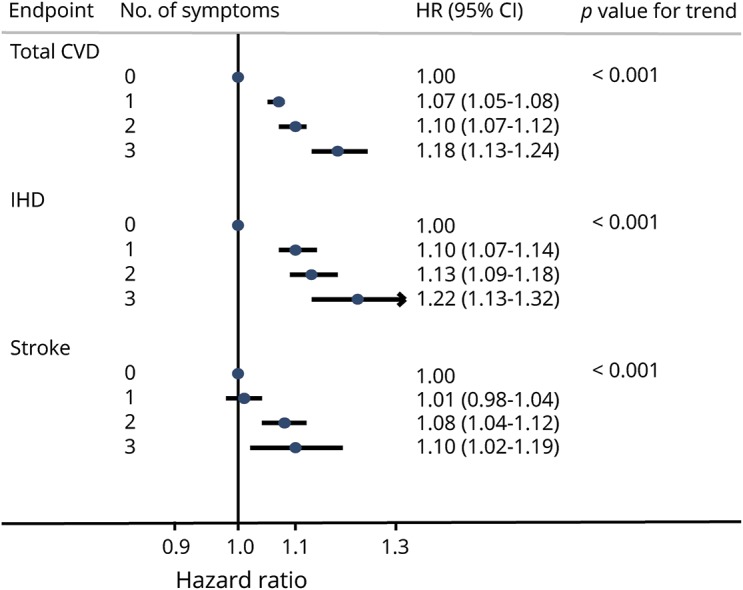
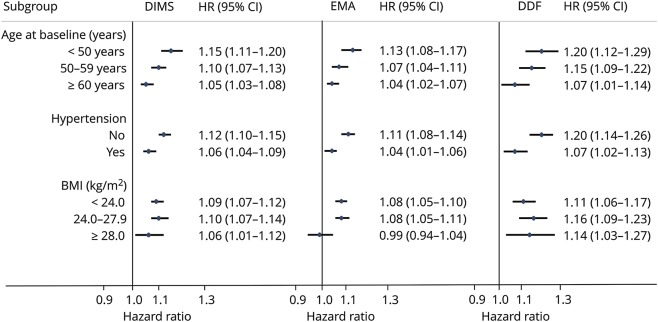
ObjectiveTo examine the associations of individual insomnia symptoms with risks of incident cardio-cerebral vascular diseases (CVD) and possible moderating factors among Chinese adults. MethodsThe China Kadoorie Biobank is a prospective cohort study that recruited participants from 10 areas across China. Data from 487,200 adults 30 to 79 years of age who were free of stroke, coronary heart disease, and cancer at baseline were analyzed. Three insomnia symptoms were assessed with self-reported difficulties in initiating or maintaining sleep, early morning awakening, and daytime dysfunction for at least 3 d/wk at baseline. Incidences of CVD were followed up through disease registries and national health insurance databases until 2016. ResultsDuring a median of 9.6 years of follow-up, 130,032 cases of CVD were documented. Cox regressions showed that 3 insomnia symptoms were associated with increased risk of total CVD, with respective adjusted hazard ratios (HRs) and 95% confidence intervals (CIs) of 1.09 (95% CI 1.07–1.11), 1.07 (95% CI 1.05–1.09), and 1.13 (95% CI 1.09–1.18). Participants with individual symptoms also had higher risks of ischemic heart disease (IHD; HR 1.13, 1.09, and 1.17) and ischemic stroke but not hemorrhagic stroke. Participants with all 3 symptoms were at an 18%, 22%, or 10% higher risk of CVD, IHD, or ischemic stroke compared to nonsymptomatic adults. Associations between 3 symptoms and CVD incidence were consistently stronger in younger adults or those without baseline hypertension (p for interaction <0.05). ConclusionsIndividual and coexisting insomnia symptoms are independent risk factors for CVD incidence, especially among young adults or adults who have not developed hypertension.
Overview
The claims and statistics of this paper haven’t been checked yet.
Free: it reads the open-access text and checks the first 5 claims that cite a source we can check. Create a free account to check every claim.
Integrity signals
Registry
Cites
Statistics
Figures
Verification
Claims the paper makes
The claims and statistics of this paper haven’t been checked yet.
Free: it reads the open-access text and checks the first 5 claims that cite a source we can check. Create a free account to check every claim.
Claims other papers make about this one
Each is checked against this paper’s own text: does it say what the citing paper says it does?
The source backs part of the claim, not all of it — or backs it for a different population, condition or comparison.
In the citing paper
“More recently, insomnia has also been shown to represent an independent risk factor for some neurological disorders such as stroke and dementia (Damsgard et al., 2022; Zheng et al., 2019).”
From The European Insomnia Guideline: An update on the diagnosis and treatment of insomnia 2023 (2023) · cites this paper as Zheng et al., 2019
Experimental — accuracy not yet measured
Self-check
Percentages, sums and reported differences re-computed from the paper’s own numbers.
The self-check needs the paper’s full text.
Citations
Cites
International Classification of Sleep Disorders-Third Edition
Sateia, M. J. (2014) · Chest · doi:10.1378/chest.14-0970 · Cited by 3,860
Epidemiology of insomnia: what we know and what we still need to learn
Ohayon, M. M. (2002) · Sleep Medicine Reviews · doi:10.1053/smrv.2002.0186 · Cited by 3,743
Impact of sleep debt on metabolic and endocrine function
Spiegel, K., Leproult, R., & Van Cauter, E. (1999) · The Lancet · doi:10.1016/s0140-6736(99)01376-8 · Cited by 3,668 · cited 1×
“Previous experimental and epidemiologic studies suggested that insomnia was related to elevated levels of inflammatory cytokines(29) and sympathetic nervous activation(30) and could lead to metabolic and endocrine disruptions.(31,32) There was also evidence that sleep deprivation or poor sleep quality was related to l…”
Backgroundvan Asch, C. J., Luitse, M. J., Rinkel, G. J., van der Tweel, I., Algra, A., & Klijn, C. J. (2010) · The Lancet Neurology · doi:10.1016/s1474-4422(09)70340-0 · Cited by 2,658
National Sleep Foundation’s updated sleep duration recommendations: final report
Hirshkowitz, M., Whiton, K., Albert, S. M., Alessi, C., Bruni, O., DonCarlos, L., Hazen, N., Herman, J., Adams Hillard, P. J., Katz, E. S., et al. (2015) · Sleep Health · doi:10.1016/j.sleh.2015.10.004 · Cited by 2,348
Irwin, M. R., Olmstead, R., & Carroll, J. E. (2016) · Biological Psychiatry · doi:10.1016/j.biopsych.2015.05.014 · Cited by 2,085
Qaseem, A., Kansagara, D., Forciea, M. A., Cooke, M., Denberg, T. D., & for the Clinical Guidelines Committee of the American College of Physicians* (2016) · Annals of Internal Medicine · doi:10.7326/m15-2175 · Cited by 1,965 · cited 1×
“Moreover, it is reasonable that insomnia symptoms are more modifiable and precisely targetable through behavioral therapies before developing into clinically significant insomnia disorder.(38) Therefore, future clinical trials or community-based intervention studies should be conducted to test whether lifestyle or sle…”
BackgroundJavaheri, S., Barbe, F., Campos-Rodriguez, F., Dempsey, J. A., Khayat, R., Javaheri, S., Malhotra, A., Martinez-Garcia, M. A., Mehra, R., Pack, A. I., et al. (2017) · Journal of the American College of Cardiology · doi:10.1016/j.jacc.2016.11.069 · Cited by 1,434
St-Onge, M.-P., Grandner, M. A., Brown, D., Conroy, M. B., Jean-Louis, G., Coons, M., & Bhatt, D. L. (2016) · Circulation · doi:10.1161/cir.0000000000000444 · Cited by 1,044
Edinger, J. D., Bonnet, M. H., Bootzin, R. R., Doghramji, K., Dorsey, C. M., Espie, C. A., Jamieson, A. O., McCall, W. V., Morin, C. M., & Stepanski, E. J. (2004) · Sleep · doi:10.1093/sleep/27.8.1567 · Cited by 1,039 · cited 1×
“At present, the clinical diagnostic criteria for insomnia are inconsistent,(16) and there is a lack of widely accepted criteria for the classification of insomnia phenotypes.(36,37) In contrast, individual insomnia symptoms are better defined and more feasible to assess with questionnaires in large-scale population st…”
BackgroundChen, Z., Chen, J., Collins, R., Guo, Y., Peto, R., Wu, F., Li, L., & on behalf of the China Kadoorie Biobank (CKB) collaborative group (2011) · International Journal of Epidemiology · doi:10.1093/ije/dyr120 · Cited by 1,034 · cited 2×
“Ascertainment of CVD outcomes Information on CVD incidence was collected through linkages with established disease registries, the new national health insurance claim databases, and local residential records.(15) Electronic linkage to the national health insurance databases has covered 95% of the participants in 2013…”
MethodSelf-citationAssociations between Sleep Loss and Increased Risk of Obesity and Diabetes
Knutson, K. L., & Van Cauter, E. (2008) · Annals of the New York Academy of Sciences · doi:10.1196/annals.1417.033 · Cited by 810
Cardiovascular, inflammatory, and metabolic consequences of sleep deprivation
Mullington, J. M., Haack, M., Toth, M., Serrador, J. M., & Meier-Ewert, H. K. (2009) · Progress in Cardiovascular Diseases · doi:10.1016/j.pcad.2008.10.003 · Cited by 783 · cited 1×
“Previous experimental and epidemiologic studies suggested that insomnia was related to elevated levels of inflammatory cytokines(29) and sympathetic nervous activation(30) and could lead to metabolic and endocrine disruptions.(31,32) There was also evidence that sleep deprivation or poor sleep quality was related to l…”
BackgroundInsomnia with Objective Short Sleep Duration is Associated with a High Risk for Hypertension
Vgontzas, A. N., Liao, D., Bixler, E. O., Chrousos, G. P., & Vela-Bueno, A. (2009) · Sleep · doi:10.1093/sleep/32.4.491 · Cited by 748
Insomnia and risk of cardiovascular disease: a meta-analysis
Sofi, F., Cesari, F., Casini, A., Macchi, C., Abbate, R., & Gensini, G. F. (2014) · European Journal of Preventive Cardiology · doi:10.1177/2047487312460020 · Cited by 713 · cited 2×
“However, the comparability across those studies was compromised by the inconsistency in the definitions of insomnia.(10) A previous study of 23,447 US men investigated associations between individual insomnia symptoms and CVDmortality.”
BackgroundEvaluation of Chronic Insomnia
Sateia, M. J., Doghramji, K., Hauri, P. J., & Morin, C. M. (2000) · Sleep · doi:10.1093/sleep/23.2.1l · Cited by 466
Cohort Profile: The Kadoorie Study of Chronic Disease in China (KSCDC)
Chen, Z., Lee, L., Chen, J., Collins, R., Wu, F., Guo, Y., Linksted, P., & Peto, R. (2005) · International Journal of Epidemiology · doi:10.1093/ije/dyi174 · Cited by 456
Self-citationInsomnia and the Risk of Acute Myocardial Infarction: A Population Study
Laugsand, L. E., Vatten, L. J., Platou, C., & Janszky, I. (2011) · Circulation · doi:10.1161/circulationaha.111.025858 · Cited by 438 · cited 2×
“009).(20) Two Swedish cohort studies also found that difficulty maintaining sleep or any insomnia symptoms was associated with increased risks of cardiovascular events only in women.”
BackgroundMeng, L., Zheng, Y., & Hui, R. (2013) · Hypertension Research · doi:10.1038/hr.2013.70 · Cited by 370 · cited 1×
“One possible explanation for themoderating effects of BMI and baseline hypertension is that the relationship between insomnia and future CVD risk could be mediated through developing obesity and hypertension during follow-up.(27,28) Therefore, the associations were weakened among participants with preexisting obesity…”
BackgroundChien, K.-L., Chen, P.-C., Hsu, H.-C., Su, T.-C., Sung, F.-C., Chen, M.-F., & Lee, Y.-T. (2010) · SLEEP · doi:10.1093/sleep/33.2.177 · Cited by 350 · cited 1×
“Our study identified moderate associations between insomnia symptoms and total CVD incidence, which were consistent with findings from a number of previous cohort studies.(6,18) A systematic review of 13 cohort studies with a combination of 122,501 participants indicated that insomnia disorder determined an increased…”
ResultVitiello, M. V., Larsen, L. H., & Moe, K. E. (2004) · Journal of Psychosomatic Research · doi:10.1016/s0022-3999(04)00023-6 · Cited by 341
Sleep disturbance is associated with cardiovascular and metabolic disorders
GRANDNER, M. A., JACKSON, N. J., PAK, V. M., & GEHRMAN, P. R. (2012) · Journal of Sleep Research · doi:10.1111/j.1365-2869.2011.00990.x · Cited by 337
Insomnia and its Impact on Physical and Mental Health
Fernandez-Mendoza, J., & Vgontzas, A. N. (2013) · Current Psychiatry Reports · doi:10.1007/s11920-013-0418-8 · Cited by 326
Chandola, T., Ferrie, J. E., Perski, A., Akbaraly, T., & Marmot, M. G. (2010) · Sleep · doi:10.1093/sleep/33.6.739 · Cited by 284
Gender differences in insomnia—a study in the Hong Kong Chinese population
Li, R. H. Y., Wing, Y. K., Ho, S. C., & Fong, S. Y. Y. (2002) · Journal of Psychosomatic Research · doi:10.1016/s0022-3999(02)00437-3 · Cited by 262
Association Between Insomnia Symptoms and Mortality: A Prospective Study of US Men
Li, Y., Zhang, X., Winkelman, J. W., Redline, S., Hu, F. B., Stampfer, M., Ma, J., & Gao, X. (2014) · Circulation · doi:10.1161/circulationaha.113.004500 · Cited by 247
Chung, K.-F., Yeung, W.-F., Ho, F. Y.-Y., Yung, K.-P., Yu, Y.-M., & Kwok, C.-W. (2015) · Sleep Medicine · doi:10.1016/j.sleep.2014.10.018 · Cited by 226 · cited 1×
“Assessment of insomnia symptoms The baseline survey of CKB study included questions pertaining to specific insomnia symptoms for at least 3 d/wk in the past month, the frequency threshold of which was in compliance with established clinical diagnostic criteria.(16) Subjects were classified as having DIMS if they repor…”
MethodInsomnia and risk of cardiovascular disease: a meta-analysis of cohort studies
Li, M., Zhang, X.-W., Hou, W.-S., & Tang, Z.-Y. (2014) · International Journal of Cardiology · doi:10.1016/j.ijcard.2014.07.284 · Cited by 201 · cited 2×
“55).(9) Another cohort study of 52,610 Norwegian adults associated experiencing DIMS almost every night with an increase in acute MI incidence (HR 1.”
BackgroundRozanski, A. (2014) · Journal of the American College of Cardiology · doi:10.1016/j.jacc.2014.03.047 · Cited by 162
Nilsson, P. M., Nilsson, J. ‐., Hedblad, B., & Berglund, G. (2001) · Journal of Internal Medicine · doi:10.1046/j.1365-2796.2001.00913.x · Cited by 161
Wang, D., Ruan, W., Chen, Z., Peng, Y., & Li, W. (2018) · European Journal of Preventive Cardiology · doi:10.1177/2047487318783892 · Cited by 149
Self-citationSleep characteristics and cardiovascular events in a large Swedish cohort
Westerlund, A., Bellocco, R., Sundström, J., Adami, H., Åkerstedt, T., & Lagerros, Y. T. (2013) · European Journal of Epidemiology · doi:10.1007/s10654-013-9802-2 · Cited by 144
Insomnia Subtypes and the Subsequent Risks of Stroke: Report From a Nationally Representative Cohort
Wu, M.-P., Lin, H.-J., Weng, S.-F., Ho, C.-H., Wang, J.-J., & Hsu, Y.-W. (2014) · Stroke · doi:10.1161/strokeaha.113.003675 · Cited by 141
Edinger, J. D. (2011) · Archives of General Psychiatry · doi:10.1001/archgenpsychiatry.2011.64 · Cited by 130
Association of Insomnia and Short Sleep Duration With Atherosclerosis Risk in the Elderly
Nakazaki, C., Noda, A., Koike, Y., Yamada, S., Murohara, T., & Ozaki, N. (2012) · American Journal of Hypertension · doi:10.1038/ajh.2012.107 · Cited by 96
Zhang, J., Lamers, F., Hickie, I. B., He, J.-P., Feig, E., & Merikangas, K. R. (2013) · Sleep · doi:10.5665/sleep.2624 · Cited by 90
Canivet, C., Nilsson, P. M., Lindeberg, S. I., Karasek, R., & Östergren, P.-O. (2014) · Journal of Psychosomatic Research · doi:10.1016/j.jpsychores.2014.02.001 · Cited by 78 · cited 2×
“There is also limited and controversial evidence regarding whether the insomnia-CVD associations vary by age, sex, or other population characteristics.(7,8,13) Therefore, to comprehensively clarify the relationships between individual insomnia symptoms and CVD incidence and potential effect modifiers, this study was c…”
BackgroundMethodThe Epidemiology of Stroke in the East Asian Region: A Literature-Based Review
Burke, T. A., & Venketasubramanian, R. N. (2006) · International Journal of Stroke · doi:10.1111/j.1747-4949.2006.00060.x · Cited by 61
Circadian rhythms of early morning awakening insomniacs
LACK, L. C., MERCER, J. D., & WRIGHT, H. (1996) · Journal of Sleep Research · doi:10.1111/j.1365-2869.1996.00211.x · Cited by 57
Loponen, M., Hublin, C., Kalimo, R., Mänttäri, M., & Tenkanen, L. (2009) · Journal of Psychosomatic Research · doi:10.1016/j.jpsychores.2009.07.022 · Cited by 24
Research works printed but not linked: 1
- Yin P, Zhang M, Li Y, Jiang Y, Wang L, Zhao W. A study on risk factors for poor sleep quality among Chinese residents aged 15-69 years [in Chinese]. Chin J Prev Contr Chron Dis 2011; 19: 224– 225.
Cited by
The European Insomnia Guideline: An update on the diagnosis and treatment of insomnia 2023
Riemann, D., Espie, C. A., Altena, E., Arnardottir, E. S., Baglioni, C., Bassetti, C. L. A., Bastien, C., Berzina, N., Bjorvatn, B., Dikeos, D., et al. (2023) · Journal of Sleep Research · doi:10.1111/jsr.14035 · Cited by 834
Genetics of circadian rhythms and sleep in human health and disease
Lane, J. M., Qian, J., Mignot, E., Redline, S., Scheer, F. A. J. L., & Saxena, R. (2023) · Nature Reviews Genetics · doi:10.1038/s41576-022-00519-z · Cited by 236
Metadata
- Authors
- Zheng, B., Yu, C., Lv, J., Guo, Y., Bian, Z., Zhou, M., Yang, L., Chen, Y., Li, X., Zou, J., Ning, F., Chen, J., Chen, Z., Li, L., & on behalf of the China Kadoorie Biobank Collaborative Group
- Affiliations
- From the Department of Epidemiology and Biostatistics (B.Z., C.Y., J.L., M.Z., L.L.), School of Public Health, Peking University Health Science Center, Beijing, China; Neuroepidemiology and Aging Research Unit (B.Z.), School of Public Health, Imperial College London, UK; Chinese Academy of Medical Sciences (Y.G., Z.B., L.L.), Beijing; Clinical Trial Service Unit & Epidemiological Studies Unit (L.Y., Y.C., Z.C.), Nuffield Department of Population Health, University of Oxford, UK; Jili Community...
- Venue
- Neurology
- Published
- 2019-12-03
- Volume
- 93
- Issue
- 23
- ISSN
- 0028-3878
- 1526-632X
- PMC
- PMC6937485
- Semantic Scholar
- db992f16bb95f530240f112309a92aacbcd2acdc
- Cited by
- 132
- References
- 40
- Language
- en
About these checks
Registry, retraction, Cites and statistics results are computed, not judged, with one exception: a printed reference that no index lists is read once by a model before it counts as a citation error. Claims are extracted by a model and kept only when their quote appears verbatim in the text; each cited source is then checked, with a model’s help, for whether it says what the claim relies on. Those verdicts can be wrong — read the claim’s quote and the cited source before relying on one.
Statistics and arithmetic are recomputed, not judged.
Confidence bands are shown only for fields calibrated on our annotated test set. None is calibrated yet, so no band is shown.
What counts as a claim ›How we measure confidence ›How we check this ›
Are you an author, or do you see a problem with this page? Request a review
Data sources
Bibliographic data: Semantic Scholar, OpenAlex, Crossref.
Contains information from the Semantic Scholar Academic Graph Datasets, made available under the ODC Attribution License (ODC-BY 1.0).
Semantic Scholar’s data is described in: Kinney, R., et al. (2023). The Semantic Scholar Open Data Platform. arXiv:2301.10140.
