

Nine-year prospective efficacy and safety of brain-responsive neurostimulation for focal epilepsy
Open accessThe DOI matches its Crossref record; 47 of the 49 references it cites were found in a registry or an index.
Abstract
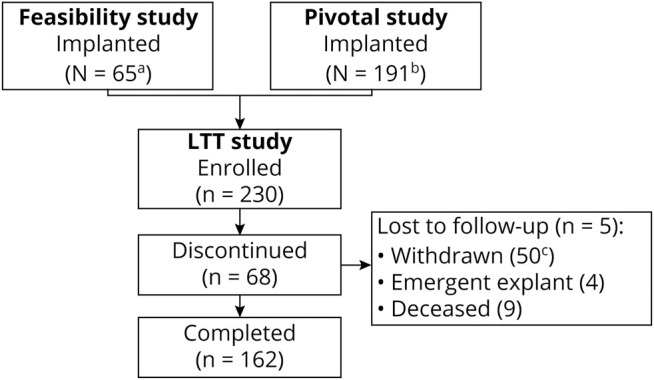
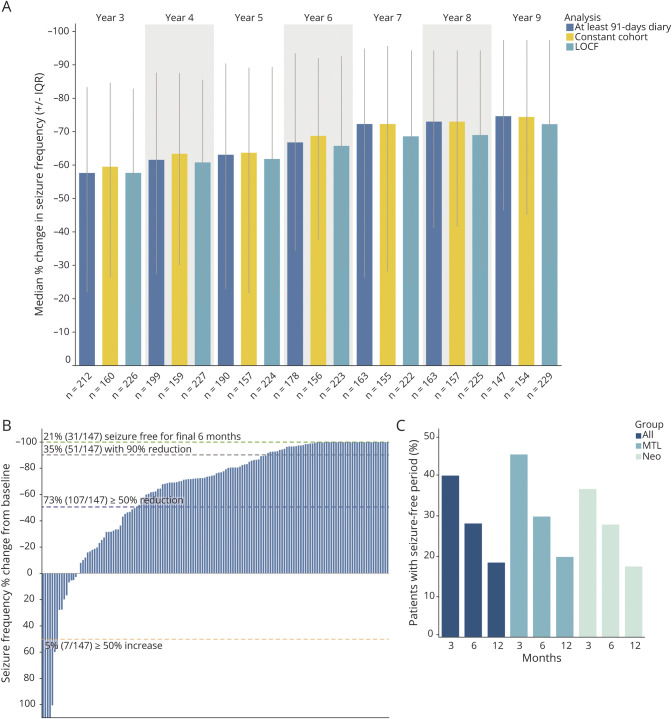
ObjectiveTo prospectively evaluate safety and efficacy of brain-responsive neurostimulation in adults with medically intractable focal onset seizures (FOS) over 9 years. MethodsAdults treated with brain-responsive neurostimulation in 2-year feasibility or randomized controlled trials were enrolled in a long-term prospective open label trial (LTT) to assess safety, efficacy, and quality of life (QOL) over an additional 7 years. Safety was assessed as adverse events (AEs), efficacy as median percent change in seizure frequency and responder rate, and QOL with the Quality of Life in Epilepsy (QOLIE-89) inventory. ResultsOf 256 patients treated in the initial trials, 230 participated in the LTT. At 9 years, the median percent reduction in seizure frequency was 75% (p < 0.0001, Wilcoxon signed rank), responder rate was 73%, and 35% had a ≥90% reduction in seizure frequency. We found that 18.4% (47 of 256) experienced ≥1 year of seizure freedom, with 62% (29 of 47) seizure-free at the last follow-up and an average seizure-free period of 3.2 years (range 1.04–9.6 years). Overall QOL and epilepsy-targeted and cognitive domains of QOLIE-89 remained significantly improved (p < 0.05). There were no serious AEs related to stimulation, and the sudden unexplained death in epilepsy (SUDEP) rate was significantly lower than predefined comparators (p < 0.05, 1-tailed χ2). ConclusionsAdjunctive brain-responsive neurostimulation provides significant and sustained reductions in the frequency of FOS with improved QOL. Stimulation was well tolerated; implantation-related AEs were typical of other neurostimulation devices; and SUDEP rates were low. Classification of evidenceThis study provides Class IV evidence that brain-responsive neurostimulation significantly reduces focal seizures with acceptable safety over 9 years.
Overview
The claims and statistics of this paper haven’t been checked yet.
Free: it reads the open-access text and checks the first 5 claims that cite a source we can check. Create a free account to check every claim.
Integrity signals
Registry
Cites
Statistics
Figures
Verification
Claims the paper makes
The claims and statistics of this paper haven’t been checked yet.
Free: it reads the open-access text and checks the first 5 claims that cite a source we can check. Create a free account to check every claim.
Claims other papers make about this one
Each is checked against this paper’s own text: does it say what the citing paper says it does?
The source backs part of the claim, not all of it — or backs it for a different population, condition or comparison.
In the citing paper
“Previously, data on the long-term safety and stability of ECoG primarily came from its application in epilepsy82,90–92, including the paddle-style surface strip electrodes with the Neuropace responsive neurostimulation system, which has demonstrated safety and signal stability for at least 9 years92.”
From The speech neuroprosthesis (2024) · cites this paper as [92]
Experimental — accuracy not yet measured
Self-check
Percentages, sums and reported differences re-computed from the paper’s own numbers.
The self-check needs the paper’s full text.
Citations
Cites
A Randomized, Controlled Trial of Surgery for Temporal-Lobe Epilepsy
Wiebe, S., Blume, W. T., Girvin, J. P., & Eliasziw, M. (2001) · New England Journal of Medicine · doi:10.1056/nejm200108023450501 · Cited by 3,525
Electrical stimulation of the anterior nucleus of thalamus for treatment of refractory epilepsy
Fisher, R., Salanova, V., Witt, T., Worth, R., Henry, T., Gross, R., Oommen, K., Osorio, I., Nazzaro, J., Labar, D., et al. (2010) · Epilepsia · doi:10.1111/j.1528-1167.2010.02536.x · Cited by 1,918 · cited 2×
“This compares favorably to other neurostimulation therapies that use a pectorally implanted pulse generator such as VNS(28) and DBS for Parkinson disease(24) or epilepsy.(6,7)”
BackgroundSelf-citationDalgleish, T. (2004) · Nature Reviews Neuroscience · doi:10.1038/nrn1432 · Cited by 1,849
Weaver, F. M. (2009) · JAMA · doi:10.1001/jama.2008.929 · Cited by 1,525
Responsive cortical stimulation for the treatment of medically intractable partial epilepsy
Morrell, M. J. (2011) · Neurology · doi:10.1212/wnl.0b013e3182302056 · Cited by 1,282
Self-citationDevinsky, O., & Pacia, S. (1993) · Neurologic Clinics · doi:10.1016/s0733-8619(18)30132-4 · Cited by 1,175
Engel, J., Wiebe, S., French, J., Sperling, M., Williamson, P., Spencer, D., Gumnit, R., Zahn, C., Westbrook, E., & Enos, B. (2003) · Neurology · doi:10.1212/01.wnl.0000055086.35806.2d · Cited by 904
Self-citationLong-term efficacy and safety of thalamic stimulation for drug-resistant partial epilepsy
Salanova, V., Witt, T., Worth, R., Henry, T. R., Gross, R. E., Nazzaro, J. M., Labar, D., Sperling, M. R., Sharan, A., Sandok, E., et al. (2015) · Neurology · doi:10.1212/wnl.0000000000001334 · Cited by 821
Self-citationChronic epilepsy and cognition: A longitudinal study in temporal lobe epilepsy
Helmstaedter, C., Kurthen, M., Lux, S., Reuber, M., & Elger, C. E. (2003) · Annals of Neurology · doi:10.1002/ana.10692 · Cited by 717
Heck, C. N., King‐Stephens, D., Massey, A. D., Nair, D. R., Jobst, B. C., Barkley, G. L., Salanova, V., Cole, A. J., Smith, M. C., Gwinn, R. P., et al. (2014) · Epilepsia · doi:10.1111/epi.12534 · Cited by 651
Self-citationLong-term treatment with responsive brain stimulation in adults with refractory partial seizures
Bergey, G. K., Morrell, M. J., Mizrahi, E. M., Goldman, A., King-Stephens, D., Nair, D., Srinivasan, S., Jobst, B., Gross, R. E., Shields, D. C., et al. (2015) · Neurology · doi:10.1212/wnl.0000000000001280 · Cited by 634 · cited 1×
“The physician adjusts detection and stimulation parameters for each patient as needed for seizure reduction.(8)”
MethodSelf-citationDevelopment of the Quality of Life in Epilepsy Inventory
Devinsky, O., Vickrey, B. G., Cramer, J., Perrine, K., Hermann, B., Meador, K., & Hays, R. D. (1995) · Epilepsia · doi:10.1111/j.1528-1157.1995.tb00467.x · Cited by 634 · cited 1×
“Quality of life (QOL) was assessed yearly by the Quality of Life in Epilepsy (QOLIE-89).(12) Safety was assessed as spontaneously reported AEs, which were categorized by the investigator as mild or serious and as device related, of uncertain device relation, or not device related.”
MethodMulti-day rhythms modulate seizure risk in epilepsy
Baud, M. O., Kleen, J. K., Mirro, E. A., Andrechak, J. C., King-Stephens, D., Chang, E. F., & Rao, V. R. (2018) · Nature Communications · doi:10.1038/s41467-017-02577-y · Cited by 532 · cited 1×
“In addition, it may be possible to use an individual patient’s ECoG data to identify periods of heightened seizure risk.(44,45) In the future, these data may be used to supplement the patient’s clinical report.”
MethodSudden unexpected death in epilepsy
Shorvon, S., & Tomson, T. (2011) · The Lancet · doi:10.1016/s0140-6736(11)60176-1 · Cited by 501
Prospective Long‐Term Study of Vagus Nerve Stimulation for the Treatment of Refractory Seizures
DeGiorgio, C. M., Schachter, S. C., Handforth, A., Salinsky, M., Thompson, J., Uthman, B., Reed, R., Collin, S., Tecoma, E., Morris, G. L., et al. (2000) · Epilepsia · doi:10.1111/j.1528-1157.2000.tb00325.x · Cited by 479
Self-citationEngel, J., Wiebe, S., French, J., Sperling, M., Williamson, P., Spencer, D., Gumnit, R., Zahn, C., Westbrook, E., & Enos, B. (2003) · Epilepsia · doi:10.1046/j.1528-1157.2003.48202.x · Cited by 400
Self-citationRyvlin, P., Cucherat, M., & Rheims, S. (2011) · The Lancet Neurology · doi:10.1016/s1474-4422(11)70193-4 · Cited by 338
Surgical and Neurological Complications in a Series of 708 Epilepsy Surgery Procedures
Behrens, E., Schramm, J., Zentner, J., & König, R. (1997) · Neurosurgery · doi:10.1097/00006123-199707000-00004 · Cited by 294
Depression in Epilepsy: Etiology, Phenomenology, and Treatment
Lambert, M. V., & Robertson, M. M. (1999) · Epilepsia · doi:10.1111/j.1528-1157.1999.tb00884.x · Cited by 293
The RNS System: responsive cortical stimulation for the treatment of refractory partial epilepsy
Sun, F. T., & Morrell, M. J. (2014) · Expert Review of Medical Devices · doi:10.1586/17434440.2014.947274 · Cited by 266
Self-citationDeterminants of quality of life in epilepsy
Loring, D. W., Meador, K. J., & Lee, G. P. (2004) · Epilepsy & Behavior · doi:10.1016/j.yebeh.2004.08.019 · Cited by 260 · cited 1×
“These are areas of function that are often profoundly affected in persons with intractable seizures.(17,18)”
BackgroundVagus Nerve Stimulation for Treatment of Partial Seizures: 2. Safety, Side Effects, and Tolerability
Ramsay, R. E., Uthman, B. M., Augustinsson, L. E., Upton, A. R. M., Naritoku, D., Willis, J., Treig, T., Barolat, G., Wernicke, J. F., & First International Vagus Nerve Stimulation Study Group (1994) · Epilepsia · doi:10.1111/j.1528-1157.1994.tb02483.x · Cited by 260
Löscher, W., & Schmidt, D. (2006) · Epilepsia · doi:10.1111/j.1528-1167.2006.00607.x · Cited by 239
Gleissner, U., Helmstaedter, C., Schramm, J., & Elger, C. E. (2002) · Epilepsia · doi:10.1046/j.1528-1157.2002.24101.x · Cited by 214
West, S., Nolan, S. J., Cotton, J., Gandhi, S., Weston, J., Sudan, A., Ramirez, R., & Newton, R. (2015) · Cochrane Database of Systematic Reviews · doi:10.1002/14651858.cd010541.pub2 · Cited by 206
Dasheiff, R. M. (1991) · PubMed · Cited by 190
Dasheiff, R. M. (1991) · Journal of Clinical Neurophysiology · doi:10.1097/00004691-199104000-00010 · Cited by 188
Loring, D. W., Kapur, R., Meador, K. J., & Morrell, M. J. (2015) · Epilepsia · doi:10.1111/epi.13191 · Cited by 169
Self-citationKokkinos, V., Sisterson, N. D., Wozny, T. A., & Richardson, R. M. (2019) · JAMA Neurology · doi:10.1001/jamaneurol.2019.0658 · Cited by 164 · cited 1×
“In addition, recent studies have shown that features in the ECoG data may provide objective biomarkers that can be used to assess the clinical response to stimulation.(42,43) In addition, it may be possible to use an individual patient’s ECoG data to identify periods of heightened seizure risk.”
BackgroundWong, C., Birkett, J., Byth, K., Dexter, M. A. J., Somerville, E. R., Gill, D. S., Chaseling, R., Fearnside, M. R., & Bleasel, A. (2009) · Acta Neurochirurgica · doi:10.1007/s00701-008-0171-7 · Cited by 151
Donos, C., Breier, J. I., Friedman, E. R., Rollo, P. S., Johnson, J., Moss, L. E., Thompson, S. A., Thomas, M. S., Hope, O. A., Slater, J. D., et al. (2018) · Epilepsia · doi:10.1111/epi.14443 · Cited by 144 · cited 1×
“Small but statistically significant cognitive declines in verbal and narrative memory have also been reported after laser interstitial thermal therapy for mesial temporal lobe epilepsy, particularly in the dominant hemisphere.(34)”
BackgroundMeador, K. J., Kapur, R., Loring, D. W., Kanner, A. M., & Morrell, M. J. (2015) · Epilepsy & Behavior · doi:10.1016/j.yebeh.2015.01.012 · Cited by 141 · cited 1×
“Validated inventories of depression (Beck Depression Inventory, Center for Epidemiologic Studies Depression) showed that there was no deterioration in mood in patients treated with the RNS System during the randomized controlled trial,(10) and there were modest group improvements.(30) Patients in the RNS System trials…”
MethodSelf-citationComplications of vagal nerve stimulation for drug-resistant epilepsy
Kahlow, H., & Olivecrona, M. (2013) · Seizure · doi:10.1016/j.seizure.2013.06.011 · Cited by 132
Responsive neurostimulation: Candidates and considerations
Ma, B. B., & Rao, V. R. (2018) · Epilepsy & Behavior · doi:10.1016/j.yebeh.2018.09.032 · Cited by 88
DiLorenzo, D. J., Mangubat, E. Z., Rossi, M. A., & Byrne, R. W. (2014) · Journal of neurosurgery · doi:10.3171/2014.1.jns131592 · Cited by 79
Baud, M. O., & Rao, V. R. (2018) · Neurology · doi:10.1212/wnl.0000000000006548 · Cited by 76 · cited 1×
“In addition, it may be possible to use an individual patient’s ECoG data to identify periods of heightened seizure risk.(44,45) In the future, these data may be used to supplement the patient’s clinical report.”
MethodSudden unexpected death in epilepsy in patients treated with brain‐responsive neurostimulation
Devinsky, O., Friedman, D. J., Duckrow, R. B., Fountain, N. B., Gwinn, R. P., Leiphart, J. W., Murro, A. M., & Ness, P. C. V. (2018) · Epilepsia · doi:10.1111/epi.13998 · Cited by 75
Self-citationSkarpaas, T. L., Tcheng, T. K., & Morrell, M. J. (2018) · Epilepsy & Behavior · doi:10.1016/j.yebeh.2018.04.003 · Cited by 68
Self-citationSubdural grid implantation for intracranial EEG recording: CT and MR appearance.
Silberbusch, M. A., Rothman, M. I., Bergey, G. K., Zoarski, G. H., & Zagardo, M. T. (1998) · PubMed Central · Cited by 53
Self-citationDesai, S. A., Tcheng, T. K., & Morrell, M. J. (2019) · Clinical Neurophysiology · doi:10.1016/j.clinph.2019.05.017 · Cited by 47
Self-citationLaser interstitial thermal therapy in drug-resistant epilepsy
Shimamoto, S. A., Wu, C., & Sperling, M. R. (2019) · Current Opinion in Neurology · doi:10.1097/wco.0000000000000662 · Cited by 41
Self-citationWeber, P. B., Kapur, R., Gwinn, R. P., Zimmerman, R. S., Courtney, T. A., & Morrell, M. J. (2017) · Stereotactic and Functional Neurosurgery · doi:10.1159/000479288 · Cited by 34 · cited 2×
“All but 1 of the infections involved only soft tissue, and cultures most often indicated skin flora; there were no instances of meningitis or brain parenchymal infection.(13,14)”
BackgroundSelf-citationBattery longevity of neurostimulators in Parkinson disease: A historic cohort study
Sette, A. L., Seigneuret, É., Reymond, F., Chabardès, S., Castrioto, A., Boussat, B., Moro, E., François, P., & Fraix, V. (2019) · Brain stimulation · doi:10.1016/j.brs.2019.02.006 · Cited by 32 · cited 1×
“6 years, respectively.(36) However, the newest neurostimulator model (RNS-320) is anticipated to increase battery longevity to 8 years at moderate stimulation use.”
BackgroundWei, Z., Gordon, C. R., Bergey, G. K., Sacks, J. M., & Anderson, W. S. (2015) · World Neurosurgery · doi:10.1016/j.wneu.2015.11.106 · Cited by 27
Self-citationMackow, M., Krishnan, B., Bingaman, W. E., Najm, I., Alexopoulos, A. V., & Nair, D. R. (2016) · Clinical Neurophysiology · doi:10.1016/j.clinph.2016.03.012 · Cited by 26
Self-citationEnatsu, R., Alexopoulos, A. V., Bingaman, W. E., & Nair, D. R. (2012) · Epilepsy & Behavior · doi:10.1016/j.yebeh.2012.06.009 · Cited by 19
Self-citationHealth concerns predicts poor quality of life in well-controlled epilepsy
Hessen, E., Lossius, M. I., & Gjerstad, L. (2009) · Seizure · doi:10.1016/j.seizure.2009.04.008 · Cited by 19 · cited 1×
“These are areas of function that are often profoundly affected in persons with intractable seizures.(17,18)”
Background
Research works printed but not linked: 1
- RNS System User Manual (RNS-300M). Mountain View: NeuroPace, Inc; 2018.
Cited by
Neuromodulation in epilepsy: state-of-the-art approved therapies
Ryvlin, P., Rheims, S., Hirsch, L. J., Sokolov, A., & Jehi, L. (2021) · The Lancet Neurology · doi:10.1016/s1474-4422(21)00300-8 · Cited by 314
Self-citationThe Pharmacoresistant Epilepsy: An Overview on Existent and New Emerging Therapies
Fattorusso, A., Matricardi, S., Mencaroni, E., Dell'Isola, G. B., Di Cara, G., Striano, P., & Verrotti, A. (2021) · Frontiers in Neurology · doi:10.3389/fneur.2021.674483 · Cited by 269
Towards network-guided neuromodulation for epilepsy
Piper, R. J., Richardson, R. M., Worrell, G., Carmichael, D. W., Baldeweg, T., Litt, B., Denison, T., & Tisdall, M. M. (2022) · Brain · doi:10.1093/brain/awac234 · Cited by 242
“This may provide a mechanistic explanation for the observations from both RNS and DBS long-term clinical studies showing that seizure frequency often gradually decreases over time.(60,74) This concept of stimulation-induced plasticity agrees with the observations from the literature on dystonia showing gradual improve…”
ResultSelf-citationJehi, L., Jette, N., Kwon, C., Josephson, C. B., Burneo, J. G., Cendes, F., Sperling, M. R., Baxendale, S., Busch, R. M., Triki, C. C., et al. (2022) · Epilepsia · doi:10.1111/epi.17350 · Cited by 183
Self-citationSeizure Cycles in Focal Epilepsy
Leguia, M. G., Andrzejak, R. G., Rummel, C., Fan, J. M., Mirro, E. A., Tcheng, T. K., Rao, V. R., & Baud, M. O. (2021) · JAMA Neurology · doi:10.1001/jamaneurol.2020.5370 · Cited by 185
Metadata
- Authors
- Nair, D. R., Laxer, K. D., Weber, P. B., Murro, A. M., Park, Y. D., Barkley, G. L., Smith, B. J., Gwinn, R. P., Doherty, M. J., Noe, K. H., Zimmerman, R. S., Bergey, G. K., Anderson, W. S., Heck, C., Liu, C. Y., Lee, R. W., Sadler, T., Duckrow, R. B., Hirsch, L. J., Wharen, R. E., Tatum, W., Srinivasan, S., McKhann, G. M., Agostini, M. A., Alexopoulos, A. V., Jobst, B. C., Roberts, D. W., Salanova, V., Witt, T. C., Cash, S. S., Cole, A. J., Worrell, G. A., Lundstrom, B. N., Edwards, J. C., Halford, J. J., Spencer, D. C., Ernst, L., Skidmore, C. T., Sperling, M. R., Miller, I., Geller, E. B., Berg, M. J., Fessler, A. J., Rutecki, P., Goldman, A. M., Mizrahi, E. M., Gross, R. E., Shields, D. C., Schwartz, T. H., Labar, D. R., Fountain, N. B., Elias, W. J., Olejniczak, P. W., Villemarette-Pittman, N. R., Eisenschenk, S., Roper, S. N., Boggs, J. G., Courtney, T. A., Sun, F. T., Seale, C. G., Miller, K. L., Skarpaas, T. L., Morrell, M. J., & Study, O. B. O. T. R. S. L.
- Affiliations
- Cleveland Clinic (US)
- Corresponding author
- Morrell, Martha J.
- ORCID
- Nair, Dileep R.
- Laxer, Kenneth D.
- Gwinn, Ryder P.
- Doherty, Michael J.
- Noe, Katherine H.
- Zimmerman, Richard S.
- Bergey, Gregory K.
- Anderson, William S.
- Liu, Charles Y.
- Lee, Ricky W.
- Hirsch, Lawrence J.
- Wharen, Robert E.
- Tatum, William
- McKhann, Guy M.
- Alexopoulos, Andreas V.
- Jobst, Barbara C.
- Roberts, David W.
- Salanova, Vicenta
- Cash, Sydney S.
- Cole, Andrew J.
- Worrell, Gregory A.
- Lundstrom, Brian N.
- Edwards, Jonathan C.
- Halford, Jonathan J.
- Spencer, David C.
- Ernst, Lia
- Skidmore, Christopher T.
- Sperling, Michael R.
- Miller, Ian
- Rutecki, Paul
- Goldman, Alica M.
- Gross, Robert E.
- Shields, Donald C.
- Schwartz, Theodore H.
- Fountain, Nathan B.
- Villemarette-Pittman, Nicole R.
- Eisenschenk, Stephan
- Roper, Steven N.
- Boggs, Jane G.
- Seale, Cairn G.
- Skarpaas, Tara L.
- Morrell, Martha J.
- Venue
- Neurology
- Published
- 2020-09
- Volume
- 95
- Issue
- 9
- Pages
- e1244-e1256
- ISSN
- 0028-3878 (ISSN-L)
- 1526-632X
- PMC
- PMC7538230
- OpenAlex
- W3044132865
- Cited by
- 490
- References
- 49
- Citations by year
- 2026: 65 · 2025: 100 · 2024: 87 · 2023: 93 · 2022: 84 · 2021: 45 · 2020: 15
- FWCI
- 43.23
- Type
- journal article
- Language
- en
- Open access
- hybrid
- doi.org
- Licence
- cc-by-nc-nd
- Locations
- Neurology (publishedVersion, cc-by-nc-nd)
- PubMed Central (publishedVersion, cc-by-nc-nd)
- PubMed (publishedVersion)
- Digital Commons-TMC (Texas Medical Center) (submittedVersion)
- Funders
- National Science Foundation
- U.S. Department of Defense
- American Epilepsy Society
- Epilepsy Foundation
- Citizens United for Research in Epilepsy
- Pfizer
- Brigham and Women's Hospital
- Massachusetts General Hospital
- Yale University
- Biogen
- Emory University
- George Washington University
- Wake Forest University
- Cleveland Clinic
- Cleveland Clinic Foundation
- Johns Hopkins University
- University of Rochester
- Dartmouth College
- Boston Scientific Corporation
- Thomas Jefferson University
- Rush University
- University of South Carolina
- Sunovion
- Dravet Syndrome Foundation
- DUSA Pharmaceuticals
- Augusta University
- Zogenix
- Ultragenyx Pharmaceutical
- GW Pharmaceuticals
- Acorda Therapeutics
- Sage Therapeutics
- Adamas Pharmaceuticals
- Boston Pharmaceuticals
- SK Life Science
- NeuroPace
- Upsher-Smith
- Martin Family Foundation
- University of Oxford
- Carl Zeiss Meditec AG
- Eisai
- H. Lundbeck A/S
- Epilepsy Society
- National Institutes of Health (UL1TR001863)
- Centers for Disease Control and Prevention
- U.S. Food and Drug Administration
- Genentech
- St. Jude Medical
- Weill Cornell Medical College
- School of Medicine, Emory University
- Advanced Research Projects Agency
- Audrey and Theodor Geisel School of Medicine at Dartmouth
- Medical Center, University of Rochester
- School of Medicine, Indiana University
- UCB US
- Greenwich Biosciences
- National Cancer Institute (P30CA023108)
- National Center for Advancing Translational Sciences
- UCB Pharma
- Medical Research and Materiel Command
- Topics
- Health Sciences › Medicine › Clinical Neurology › Epilepsy research and treatment
- Life Sciences › Neuroscience › Neurology › Vagus Nerve Stimulation Research
- Health Sciences › Medicine › Clinical Neurology › Deep Brain Stimulation and Movement Disorders
- Keywords
- focal epilepsy, drug-resistant epilepsy, focal seizures, seizure frequency reduction, seizure freedom, quality of life, sudden unexpected death in epilepsy, long-term safety, adjunctive therapy
- MeSH terms
- Drug Resistant Epilepsy, Sudden Unexpected Death in Epilepsy, Adolescent, Adult, Aged, Depressive Disorder, Electric Stimulation Therapy, Epilepsies, Partial, Female, Follow-Up Studies, Humans, Male, Memory Disorders, Middle Aged, Prospective Studies, Quality of Life, Status Epilepticus, Suicide, Randomized Controlled Trials as Topic, Prosthesis-Related Infections, Treatment Outcome, Intracranial Hemorrhages, Young Adult, Implantable Neurostimulators
About these checks
Registry, retraction, Cites and statistics results are computed, not judged, with one exception: a printed reference that no index lists is read once by a model before it counts as a citation error. Claims are extracted by a model and kept only when their quote appears verbatim in the text; each cited source is then checked, with a model’s help, for whether it says what the claim relies on. Those verdicts can be wrong — read the claim’s quote and the cited source before relying on one.
Statistics and arithmetic are recomputed, not judged.
Confidence bands are shown only for fields calibrated on our annotated test set. None is calibrated yet, so no band is shown.
What counts as a claim ›How we measure confidence ›How we check this ›
Are you an author, or do you see a problem with this page? Request a review
Data sources
Bibliographic data: Semantic Scholar, OpenAlex, Crossref.
Contains information from the Semantic Scholar Academic Graph Datasets, made available under the ODC Attribution License (ODC-BY 1.0).
Semantic Scholar’s data is described in: Kinney, R., et al. (2023). The Semantic Scholar Open Data Platform. arXiv:2301.10140.
