

Nine-year prospective efficacy and safety of brain-responsive neurostimulation for focal epilepsy
Open accessThe DOI matches its Crossref record; 47 of the 49 references it cites were found in a registry or an index.
Abstract
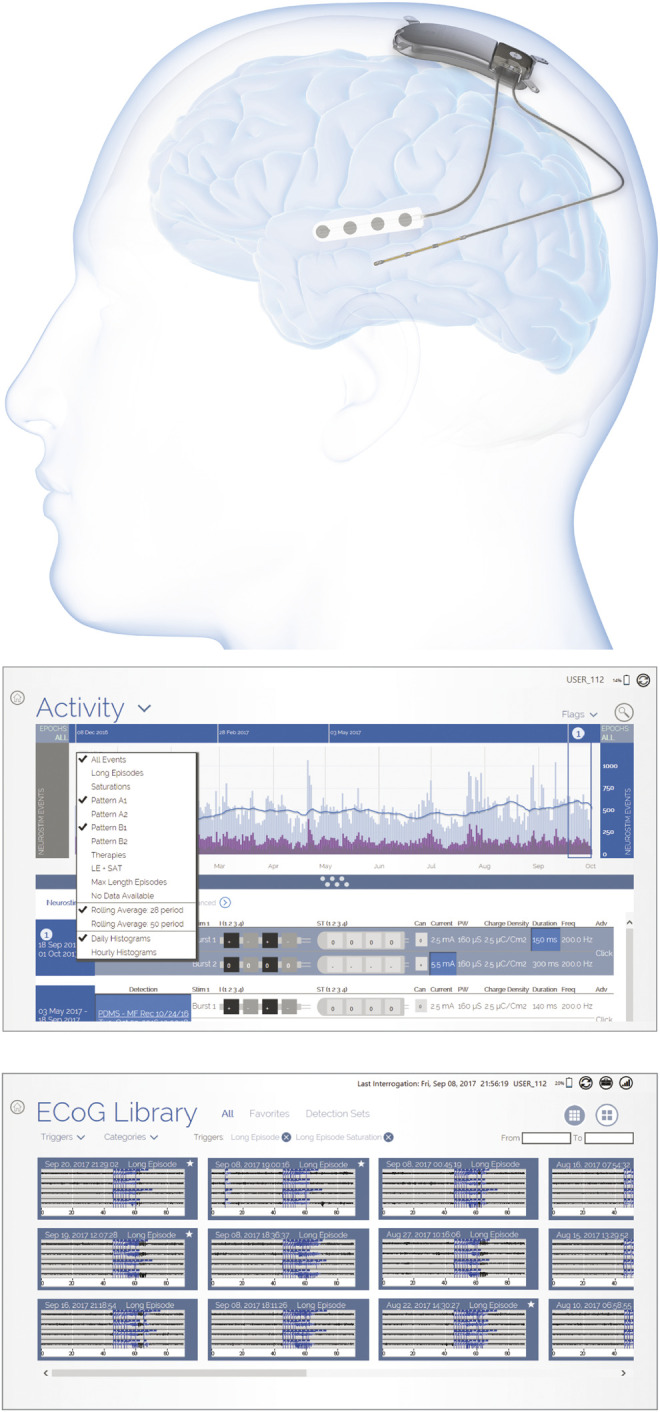
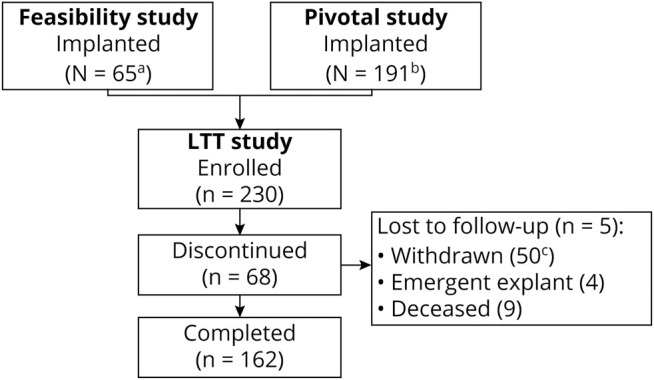
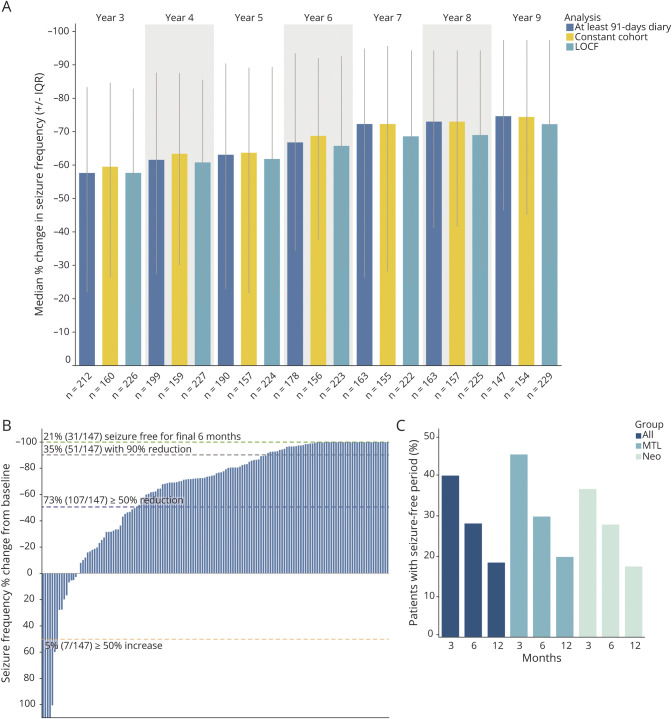
ObjectiveTo prospectively evaluate safety and efficacy of brain-responsive neurostimulation in adults with medically intractable focal onset seizures (FOS) over 9 years. MethodsAdults treated with brain-responsive neurostimulation in 2-year feasibility or randomized controlled trials were enrolled in a long-term prospective open label trial (LTT) to assess safety, efficacy, and quality of life (QOL) over an additional 7 years. Safety was assessed as adverse events (AEs), efficacy as median percent change in seizure frequency and responder rate, and QOL with the Quality of Life in Epilepsy (QOLIE-89) inventory. ResultsOf 256 patients treated in the initial trials, 230 participated in the LTT. At 9 years, the median percent reduction in seizure frequency was 75% (p < 0.0001, Wilcoxon signed rank), responder rate was 73%, and 35% had a ≥90% reduction in seizure frequency. We found that 18.4% (47 of 256) experienced ≥1 year of seizure freedom, with 62% (29 of 47) seizure-free at the last follow-up and an average seizure-free period of 3.2 years (range 1.04–9.6 years). Overall QOL and epilepsy-targeted and cognitive domains of QOLIE-89 remained significantly improved (p < 0.05). There were no serious AEs related to stimulation, and the sudden unexplained death in epilepsy (SUDEP) rate was significantly lower than predefined comparators (p < 0.05, 1-tailed χ2). ConclusionsAdjunctive brain-responsive neurostimulation provides significant and sustained reductions in the frequency of FOS with improved QOL. Stimulation was well tolerated; implantation-related AEs were typical of other neurostimulation devices; and SUDEP rates were low. Classification of evidenceThis study provides Class IV evidence that brain-responsive neurostimulation significantly reduces focal seizures with acceptable safety over 9 years.
Overview
The claims and statistics of this paper haven’t been checked yet.
Free: it reads the open-access text and checks the first 5 claims that cite a source we can check. Create a free account to check every claim.
Integrity signals
Registry
Cites
Statistics
Figures
Verification
Claims the paper makes
The claims and statistics of this paper haven’t been checked yet.
Free: it reads the open-access text and checks the first 5 claims that cite a source we can check. Create a free account to check every claim.
Claims other papers make about this one
Each is checked against this paper’s own text: does it say what the citing paper says it does?
The source backs part of the claim, not all of it — or backs it for a different population, condition or comparison.
In the citing paper
“Previously, data on the long-term safety and stability of ECoG primarily came from its application in epilepsy82,90–92, including the paddle-style surface strip electrodes with the Neuropace responsive neurostimulation system, which has demonstrated safety and signal stability for at least 9 years92.”
From The speech neuroprosthesis (2024) · cites this paper as [92]
Experimental — accuracy not yet measured
Self-check
Percentages, sums and reported differences re-computed from the paper’s own numbers.
The self-check needs the paper’s full text.
Citations
Cites
A Randomized, Controlled Trial of Surgery for Temporal-Lobe Epilepsy
Wiebe, S., Blume, W. T., Girvin, J. P., & Eliasziw, M. (2001) · New England Journal of Medicine · doi:10.1056/nejm200108023450501 · Cited by 3,525
Electrical stimulation of the anterior nucleus of thalamus for treatment of refractory epilepsy
Fisher, R., Salanova, V., Witt, T., Worth, R., Henry, T., Gross, R., Oommen, K., Osorio, I., Nazzaro, J., Labar, D., et al. (2010) · Epilepsia · doi:10.1111/j.1528-1167.2010.02536.x · Cited by 1,918 · cited 2×
“This compares favorably to other neurostimulation therapies that use a pectorally implanted pulse generator such as VNS(28) and DBS for Parkinson disease(24) or epilepsy.(6,7)”
BackgroundSelf-citationDalgleish, T. (2004) · Nature Reviews Neuroscience · doi:10.1038/nrn1432 · Cited by 1,849
Weaver, F. M. (2009) · JAMA · doi:10.1001/jama.2008.929 · Cited by 1,525
Responsive cortical stimulation for the treatment of medically intractable partial epilepsy
Morrell, M. J. (2011) · Neurology · doi:10.1212/wnl.0b013e3182302056 · Cited by 1,282
Self-citationDevinsky, O., & Pacia, S. (1993) · Neurologic Clinics · doi:10.1016/s0733-8619(18)30132-4 · Cited by 1,175
Engel, J., Wiebe, S., French, J., Sperling, M., Williamson, P., Spencer, D., Gumnit, R., Zahn, C., Westbrook, E., & Enos, B. (2003) · Neurology · doi:10.1212/01.wnl.0000055086.35806.2d · Cited by 904
Self-citationLong-term efficacy and safety of thalamic stimulation for drug-resistant partial epilepsy
Salanova, V., Witt, T., Worth, R., Henry, T. R., Gross, R. E., Nazzaro, J. M., Labar, D., Sperling, M. R., Sharan, A., Sandok, E., et al. (2015) · Neurology · doi:10.1212/wnl.0000000000001334 · Cited by 821
Self-citationChronic epilepsy and cognition: A longitudinal study in temporal lobe epilepsy
Helmstaedter, C., Kurthen, M., Lux, S., Reuber, M., & Elger, C. E. (2003) · Annals of Neurology · doi:10.1002/ana.10692 · Cited by 717
Heck, C. N., King‐Stephens, D., Massey, A. D., Nair, D. R., Jobst, B. C., Barkley, G. L., Salanova, V., Cole, A. J., Smith, M. C., Gwinn, R. P., et al. (2014) · Epilepsia · doi:10.1111/epi.12534 · Cited by 651
Self-citation
Research works printed but not linked: 1
- RNS System User Manual (RNS-300M). Mountain View: NeuroPace, Inc; 2018.
Cited by
Neuromodulation in epilepsy: state-of-the-art approved therapies
Ryvlin, P., Rheims, S., Hirsch, L. J., Sokolov, A., & Jehi, L. (2021) · The Lancet Neurology · doi:10.1016/s1474-4422(21)00300-8 · Cited by 314
Self-citationThe Pharmacoresistant Epilepsy: An Overview on Existent and New Emerging Therapies
Fattorusso, A., Matricardi, S., Mencaroni, E., Dell'Isola, G. B., Di Cara, G., Striano, P., & Verrotti, A. (2021) · Frontiers in Neurology · doi:10.3389/fneur.2021.674483 · Cited by 269
Towards network-guided neuromodulation for epilepsy
Piper, R. J., Richardson, R. M., Worrell, G., Carmichael, D. W., Baldeweg, T., Litt, B., Denison, T., & Tisdall, M. M. (2022) · Brain · doi:10.1093/brain/awac234 · Cited by 242
“This may provide a mechanistic explanation for the observations from both RNS and DBS long-term clinical studies showing that seizure frequency often gradually decreases over time.(60,74) This concept of stimulation-induced plasticity agrees with the observations from the literature on dystonia showing gradual improve…”
ResultSelf-citationJehi, L., Jette, N., Kwon, C., Josephson, C. B., Burneo, J. G., Cendes, F., Sperling, M. R., Baxendale, S., Busch, R. M., Triki, C. C., et al. (2022) · Epilepsia · doi:10.1111/epi.17350 · Cited by 183
Self-citationSeizure Cycles in Focal Epilepsy
Leguia, M. G., Andrzejak, R. G., Rummel, C., Fan, J. M., Mirro, E. A., Tcheng, T. K., Rao, V. R., & Baud, M. O. (2021) · JAMA Neurology · doi:10.1001/jamaneurol.2020.5370 · Cited by 185
Forecasting seizure risk in adults with focal epilepsy: a development and validation study
Proix, T., Truccolo, W., Leguia, M. G., Tcheng, T. K., King-Stephens, D., Rao, V. R., & Baud, M. O. (2021) · The Lancet Neurology · doi:10.1016/s1474-4422(20)30396-3 · Cited by 179
Vetkas, A., Fomenko, A., Germann, J., Sarica, C., Iorio‐Morin, C., Samuel, N., Yamamoto, K., Milano, V., Cheyuo, C., Zemmar, A., et al. (2022) · Epilepsia · doi:10.1111/epi.17157 · Cited by 188
Khambhati, A. N., Shafi, A., Rao, V. R., & Chang, E. F. (2021) · Science Translational Medicine · doi:10.1126/scitranslmed.abf6588 · Cited by 163
Neuromodulation techniques – From non-invasive brain stimulation to deep brain stimulation
Davidson, B., Bhattacharya, A., Sarica, C., Darmani, G., Raies, N., Chen, R. E., & Lozano, A. M. (2024) · Neurotherapeutics · doi:10.1016/j.neurot.2024.e00330 · Cited by 190
Drug-resistant epilepsy: Definition, pathophysiology, and management
Mesraoua, B., Brigo, F., Lattanzi, S., Abou-Khalil, B. W., Hail, H. A., & Asadi‐Pooya, A. A. (2023) · Journal of the Neurological Sciences · doi:10.1016/j.jns.2023.120766 · Cited by 159
Touma, L., Dansereau, B., Chan, A. Y., Jetté, N., Kwon, C., Braun, K. P. J., Friedman, D., Jehi, L. E., Rolston, J. D., Vadera, S., et al. (2022) · Epilepsia · doi:10.1111/epi.17243 · Cited by 137
Practical considerations in epilepsy neurostimulation
Simpson, H. D., Schulze‐Bonhage, A., Cascino, G. D., Fisher, R. S., Jobst, B. C., Sperling, M. R., & Lundstrom, B. N. (2022) · Epilepsia · doi:10.1111/epi.17329 · Cited by 140
Self-citationBurdette, D. E., Mirro, E. A., Lawrence, M., & Patra, S. (2021) · Epilepsia Open · doi:10.1002/epi4.12524 · Cited by 121
The RNS System: brain-responsive neurostimulation for the treatment of epilepsy
Jarosiewicz, B., & Morrell, M. (2021) · Expert Review of Medical Devices · doi:10.1080/17434440.2019.1683445 · Cited by 110
Self-citationAvila, E. K., Tobochnik, S. D., Inati, S. K., Koekkoek, J. A. F., McKhann, G. M., Riviello, J. J., Rudà, R., Schiff, D., Tatum, W. O., Templer, J. W., et al. (2023) · Neuro-Oncology · doi:10.1093/neuonc/noad154 · Cited by 130
Self-citationSilva, A. B., Littlejohn, K. T., Liu, J. R., Moses, D. A., & Chang, E. F. (2024) · Nature Reviews Neuroscience · doi:10.1038/s41583-024-00819-9 · Cited by 103
“Previously, data on the long-term safety and stability of ECoG primarily came from its application in epilepsy 82,90–92 , including the paddle-style surface strip electrodes with the Neuropace responsive neurostimulation system, which has demonstrated safety and signal stability for at least 9…”
Shoeibi, A., Moridian, P., Khodatars, M., Ghassemi, N., Jafari, M., Alizadehsani, R., Kong, Y., Górriz, J. M., Ramírez, J., Khosravi, A., et al. (2022) · Computers in Biology and Medicine · doi:10.1016/j.compbiomed.2022.106053 · Cited by 136
“, 2018a; Gloor and Fariello, 1988), focal (Nair et al., 2020; Frauscher and Gotman, 2019), and epilepsy with unknown onset (Ngoh and Parker, 2017), each of which has various types.”
BackgroundCentromedian thalamic responsive neurostimulation for Lennox‐Gastaut epilepsy and autism
Kwon, C., Schüpper, A. J., Fields, M. C., Marcuse, L. V., Vega‐Talbott, M. L., Panov, F. E., & Ghatan, S. (2020) · Annals of Clinical and Translational Neurology · doi:10.1002/acn3.51173 · Cited by 95
“Long-term data have shown that RNS provides sustained seizure reduction with continued improvement with each year of treatment including favorable safety and efficacy results.(2) RNS as a closed-loop system requires less electrical stimulation compared to the open-loop DBS system, thus providing higher efficacy, lower…”
BackgroundSarica, C., Iorio‐Morin, C., Aguirre-Padilla, D. H., Najjar, A. A., Paff, M. R., Fomenko, A., Yamamoto, K., Zemmar, A., Lipsman, N., Ibrahim, G. M., et al. (2021) · Frontiers in Human Neuroscience · doi:10.3389/fnhum.2021.708481 · Cited by 99
“…by FDA in 2013 for epilepsy and has been under use and/or investigation for the treatment of various diseases including epilepsy, Tourette syndrome, binge eating disorder, major depression, posttraumatic stress disorder, and anxiety disorders (Nair et al., 2020; Jarosiewicz and Morrell, 2021).”
BackgroundInterim Safety Profile From the Feasibility Study of the BrainGate Neural Interface System
Rubin, D. B., Ajiboye, A. B., Barefoot, L., Bowker, M., Cash, S. S., Chen, D., Donoghue, J. P., Eskandar, E. N., Friehs, G., Grant, C., et al. (2023) · Neurology · doi:10.1212/wnl.0000000000201707 · Cited by 81
Self-citationNeurostimulation in generalized epilepsy: A systematic review and meta‐analysis
Haneef, Z., & Skrehot, H. C. (2023) · Epilepsia · doi:10.1111/epi.17524 · Cited by 92
Cross-Frequency Coupling and Intelligent Neuromodulation
Yeh, C.-H., Zhang, C., Shi, W., Lo, M., Tinkhauser, G., & Oswal, A. (2023) · Cyborg and Bionic Systems · doi:10.34133/cbsystems.0034 · Cited by 97
Ambulatory seizure forecasting with a wrist-worn device using long-short term memory deep learning
Nasseri, M., Attia, T. P., Joseph, B., Gregg, N. M., Nurse, E. S., Viana, P. F., Worrell, G. A., Dümpelmann, M., Richardson, M. P., Freestone, D. R., et al. (2021) · Scientific Reports · doi:10.1038/s41598-021-01449-2 · Cited by 90
“May progress to generalized convulsions Levetiracetam XR, 4500 1640 242 207 55 (4) 152 (3)”
BackgroundSelf-citationClosed-loop stimulation in periods with less epileptiform activity drives improved epilepsy outcomes
Anderson, D. N., Charlebois, C. M., Smith, E. H., Davis, T. S., Peters, A. Y., Newman, B. J., Arain, A. M., Wilcox, K. S., Butson, C. R., & Rolston, J. D. (2023) · Brain · doi:10.1093/brain/awad343 · Cited by 87
Unearthing the mechanisms of responsive neurostimulation for epilepsy
Rao, V. R., & Rolston, J. D. (2023) · Communications Medicine · doi:10.1038/s43856-023-00401-x · Cited by 97
“Randomized controlled trials have established the ef fi cacy of RNS for drug-resistant epilepsy involving one or two seizure foci, with patients experiencing an average reduction in seizure frequency of 75% after nine years of therapy 12 .”
InfluentialChiang, S., Picard, R. W., Chiong, W., Moss, R., Worrell, G. A., Rao, V. R., & Goldenholz, D. M. (2021) · Neurology · doi:10.1212/wnl.0000000000012570 · Cited by 82
Self-citationPaulk, A. C., Zelmann, R., Crocker, B., Widge, A. S., Dougherty, D. D., Eskandar, E. N., Weisholtz, D. S., Richardson, R. M., Cosgrove, G. R., Williams, Z. M., et al. (2022) · Brain stimulation · doi:10.1016/j.brs.2022.02.017 · Cited by 73
Self-citationZhu, B., Shin, U., & Shoaran, M. (2021) · IEEE Transactions on Biomedical Circuits and Systems · doi:10.1109/tbcas.2021.3112756 · Cited by 67
“The recently published results of a nine-year, multi-center chronic study of RNS device on 230 patients in 34 epilepsy centers [79] showed significant reductions in seizure rates: 75% median reduction, at least 50% reduction in 73% of patients.”
BackgroundNon-invasive wearable seizure detection using long–short-term memory networks with transfer learning
Nasseri, M., Pal Attia, T., Joseph, B., Gregg, N. M., Nurse, E. S., Viana, P. F., Schulze-Bonhage, A., Dümpelmann, M., Worrell, G., Freestone, D. R., et al. (2021) · Journal of Neural Engineering · doi:10.1088/1741-2552/abef8a · Cited by 66
“The algorithm, which was re-trained on data from the wrist-worn wearable device, was finally tested on long-term ambulatory data acquired from patients who had simultaneous recordings made by a clinical invasive EEG device (Neuropace RNS, Mountain View, CA) [28].”
MethodSelf-citationBrain stimulation treatments in epilepsy: Basic mechanisms and clinical advances
Foutz, T. J., & Wong, M. (2021) · Biomedical Journal · doi:10.1016/j.bj.2021.08.010 · Cited by 82
“Deep Brain Stimulation (DBS) [9,10], Responsive Neural Stimulation (RNS) [11], and Vagus Nerve Stimulation (VNS) are safe and effective neurostimulation therapies used to treat refractory epilepsy.”
BackgroundResultInfluentialScheid, B. H., Bernabei, J. M., Khambhati, A. N., Mouchtaris, S., Jeschke, J., Bassett, D. S., Becker, D. A., Davis, K. A., Lucas, T. H., Doyle, W., et al. (2022) · Epilepsia · doi:10.1111/epi.17163 · Cited by 70
Beaudreault, C. P., Muh, C. R., Naftchi, A., Spirollari, E., Das, A., Vazquez, S. M., Sukul, V., Overby, P. J., Tobias, M. E., McGoldrick, P. E., et al. (2022) · Frontiers in Human Neuroscience · doi:10.3389/fnhum.2022.876204 · Cited by 64
Paschen, E., Elgueta, C., Heining, K., Vieira, D. M., Kleis, P., Orcinha, C. R., Häussler, U., Bartos, M., Egert, U., Janz, P., et al. (2020) · eLife · doi:10.7554/elife.54518 · Cited by 64
“The fluorescence signal was developed with tyramide signal amplification (TSA) Plus Cyanine 3 System kit (PerkinElmer, Waltham, Massachusetts, USA) as described previously (Tulke et al., 2019).”
BackgroundInfluentialBurdette, D. E., Haykal, M. A., Jarosiewicz, B., Fabris, R. R., Heredia, G., Elisevich, K. V., & Patra, S. (2020) · Epilepsy & Behavior · doi:10.1016/j.yebeh.2020.107354 · Cited by 61
“Randomized controlled trials in medically intractable focal epilepsy from one or two foci demonstrate long-term efficacy of direct brainresponsive neurostimulation [8,9].”
Stieve, B. J., Richner, T. J., Krook-Magnuson, C., Netoff, T. I., & Krook-Magnuson, E. I. (2022) · Brain · doi:10.1093/brain/awac051 · Cited by 63
Centromedian thalamic deep brain stimulation for drug-resistant epilepsy: single-center experience
Yang, J. C., Bullinger, K. L., Isbaine, F., Alwaki, A., Opri, E., Willie, J. T., & Gross, R. E. (2022) · Journal of neurosurgery · doi:10.3171/2022.2.jns212237 · Cited by 62
Self-citationLowet, E., Kondabolu, K., Zhou, S. L., Mount, R. A., Wang, Y., Ravasio, C. R., & Han, X. (2022) · Nature Communications · doi:10.1038/s41467-022-35314-1 · Cited by 66
“Recent long-term clinical studies reported an impressive reduction of seizure frequency by closed-loop responsive neuro-stimulation that targeted subject-speci fi c abnormal intracranial electroencephalogram patterns in epilepsy patients 24,25 .”
Wireless Deep Brain Stimulation by Ultrasound-Responsive Molecular Piezoelectric Nanogenerators
Chen, P., Cheng, C., Yang, X., Sha, T., Zou, X., Zhang, F., Jiang, W., Xu, Y., Cao, X., You, Y., et al. (2023) · ACS Nano · doi:10.1021/acsnano.3c10227 · Cited by 60
Welch, W. P., Hect, J. L., & Abel, T. J. (2021) · Frontiers in Neurology · doi:10.3389/fneur.2021.656585 · Cited by 61
“RNS stimulation of the CM has been applied in adult patients for the treatment of drugresistant regional neocortical epilepsy (37), generalized epilepsy (26), Lennox-Gastaut Syndrome (10, 38), and drug-resistant focal onset-seizures (39).”
BackgroundKhan, M., Paktiawal, J., Piper, R. J., Chari, A., & Tisdall, M. M. (2021) · Journal of Neurosurgery Pediatrics · doi:10.3171/2021.8.peds21201 · Cited by 65
Responsive neurostimulation with low‐frequency stimulation
Alcalá-Zermeño, J. L., Starnes, K., Gregg, N. M., Worrell, G. A., & Lundstrom, B. N. (2022) · Epilepsia · doi:10.1111/epi.17467 · Cited by 62
Self-citationClosed-loop neurostimulation for the treatment of psychiatric disorders
Sellers, K. K., Cohen, J. L., Khambhati, A. N., Fan, J. M., Lee, A. M., Chang, E. F., & Krystal, A. D. (2023) · Neuropsychopharmacology · doi:10.1038/s41386-023-01631-2 · Cited by 65
“Instead, studies carried out to date suggest that treatment leads to sustained reduction in symptoms over the course of multiple closed-loop stimulation events delivered chronically [94, 136].”
BackgroundSchulze‐Bonhage, A., Hirsch, M., Knake, S., Kaufmann, E., Kegele, J., Rademacher, M., Vonck, K. E. J., Coenen, V. A., Glaser, M. B., Jenkner, C., et al. (2023) · JAMA Neurology · doi:10.1001/jamaneurol.2023.0066 · Cited by 60
The Role of Neuroinflammation and Network Anomalies in Drug-Resistant Epilepsy
Shi, J., Xie, J., Li, Z., He, X., Wei, P., Sander, J. W. A. S., & Zhao, G. (2025) · Neuroscience Bulletin · doi:10.1007/s12264-025-01348-w · Cited by 61
“With its capacity for real-time responses to evolving network dynamics, clinical studies have shown that RNS can substantially reduce seizure frequency, improving the quality of life for individuals [244, 245].”
Sladky, V., Nejedlý, P., Mívalt, F., Brinkmann, B. H., Kim, I., Louis, E. K. S., Gregg, N. M., Lundstrom, B. N., Crowe, C. M., Attia, T. P., et al. (2022) · Brain Communications · doi:10.1093/braincomms/fcac115 · Cited by 58
Self-citationChiang, S., Khambhati, A. N., Wang, E. T., Vannucci, M., Chang, E. F., & Rao, V. R. (2021) · Brain stimulation · doi:10.1016/j.brs.2021.01.023 · Cited by 57
“However, a critical observation from long-term clinical trials is that the efficacy of RNS improves over time [1,2], suggesting chronic, neuromodulatory effects in addition to acute seizure-terminating effects.”
InfluentialAnterior nucleus of the thalamus seizure detection in ambulatory humans
Gregg, N. M., Marks, V. S., Sladky, V., Lundstrom, B. N., Klassen, B. T., Messina, S. A., Brinkmann, B. H., Miller, K. J., Gompel, J. J. V., Křemen, V., et al. (2021) · Epilepsia · doi:10.1111/epi.17047 · Cited by 52
Self-citationRheims, S., Sperling, M. R., & Ryvlin, P. (2022) · Epilepsia · doi:10.1111/epi.17413 · Cited by 58
Self-citationSeizure occurrence is linked to multiday cycles in diverse physiological signals
Gregg, N. M., Attia, T. P., Nasseri, M., Joseph, B., Karoly, P. J., Cui, J., Stirling, R. E., Viana, P. F., Richner, T. J., Nurse, E. S., et al. (2023) · Epilepsia · doi:10.1111/epi.17607 · Cited by 61
Self-citationNeuromodulation for Refractory Epilepsy
Ryvlin, P., & Jehi, L. E. (2021) · Epiliepsy currents/Epilepsy currents · doi:10.1177/15357597211065587 · Cited by 60
“Infection at the RNS implant site amounts to 4% per surgical procedure and 12% of patients overall after 9 years of followup.(51) It usually only involves soft tissue, but still requires explantation in half of cases.”
BackgroundMethodResultInfluentialResponsive Neurostimulation of the Thalamus for the Treatment of Refractory Epilepsy
Roa, J. A., Abramova, M., Fields, M. C., Vega‐Talbott, M. L., Yoo, J. Y., Marcuse, L. V., Wolf, S. M., McGoldrick, P. E., Ghatan, S., & Panov, F. E. (2022) · Frontiers in Human Neuroscience · doi:10.3389/fnhum.2022.926337 · Cited by 53
“, 2020), and drug-resistant focal onset-seizures (Nair et al., 2020).”
Landscape and future directions of machine learning applications in closed-loop brain stimulation
Chandrabhatla, A. S., Pomeraniec, I. J., Horgan, T. M., Wat, E. K., & Ksendzovsky, A. (2023) · npj Digital Medicine · doi:10.1038/s41746-023-00779-x · Cited by 67
“At the 9-year follow-up of 230 patients with the RNS, 73% of patients were responders with a median reduction in seizure frequency of 75% 102 .”
Sabé, M., Sulstarova, A., Chen, C., Hyde, J., Poulet, E., Aleman, A., Downar, J. H., Brandt, V. C., Mallet, L., Sentissi, O., et al. (2023) · Neuroscience & Biobehavioral Reviews · doi:10.1016/j.neubiorev.2023.105300 · Cited by 55
Fields, M. C., Eka, O., Schreckinger, C., Dugan, P. C., Asaad, W. F., Blum, A. S., Bullinger, K. L., Willie, J. T., Burdette, D. E., Anderson, C. T., et al. (2023) · Frontiers in Neurology · doi:10.3389/fneur.2023.1202631 · Cited by 49
“In this multicenter review, the 25 RNS patients with thalamic RNS leads had seizure reduction profiles similar to that of the larger group of patients with cortical (non-thalamic) RNS studied in the long-term prospective open label trial (38).”
Developing Collaborative Platforms to Advance Neurotechnology and Its Translation
Borton, D. A., Dawes, H. E., Worrell, G. A., Starr, P. A., & Denison, T. (2020) · Neuron · doi:10.1016/j.neuron.2020.10.001 · Cited by 57
“Furthermore, the capacity for greater programming complexity, such as adaptive and responsive neurostimulation, shows promise for improving efficacy but can place additional burden both on the programming clinician and the broader care team (Nair et al., 2020).”
BackgroundSelf-citationInvasive neuromodulation for epilepsy: Comparison of multiple approaches from a single center
Alcalá-Zermeño, J. L., Gregg, N. M., Starnes, K., Mandrekar, J. N., Gompel, J. J. V., Miller, K. J., Worrell, G. A., & Lundstrom, B. N. (2022) · Epilepsy & Behavior · doi:10.1016/j.yebeh.2022.108951 · Cited by 52
Self-citationNeuro-stimulation in focal epilepsy: A systematic review and meta-analysis
Skrehot, H. C., Englot, D. J., & Haneef, Z. (2023) · Epilepsy & Behavior · doi:10.1016/j.yebeh.2023.109182 · Cited by 76
Bergeron, D., Iorio‐Morin, C., Bonizzato, M., Lajoie, G., Gaucher, N. O., Racine, É., & Weil, A. G. (2023) · Journal of Child Neurology · doi:10.1177/08830738231167736 · Cited by 61
“Responsive Neurostimulation (Neuropace), a closedloop neurostimulation device used to treat drug-resistant epilepsy that continuously monitors electrocorticograph activity through implanted electrodes connected to a programmer and delivers targeted neurostimulation through leads when abnormal patterns are detected.(42…”
BackgroundUnder-sampling in epilepsy: Limitations of conventional EEG
Baud, M. O., Schindler, K. A., & Rao, V. R. (2020) · Clinical Neurophysiology Practice · doi:10.1016/j.cnp.2020.12.002 · Cited by 53
Network connectivity predicts effectiveness of responsive neurostimulation in focal epilepsy
Fan, J. M., Lee, A. T., Kudo, K., Ranasinghe, K. G., Morise, H., Findlay, A. M., Kirsch, H. E., Chang, E. F., Nagarajan, S. S., & Rao, V. R. (2022) · Brain Communications · doi:10.1093/braincomms/fcac104 · Cited by 51
Neuromodulation in drug‐resistant epilepsy: A review of current knowledge
Xue, T., Chen, S., Bai, Y., Han, C., Yang, A., & Zhang, J. (2022) · Acta Neurologica Scandinavica · doi:10.1111/ane.13696 · Cited by 52
Seizure forecasting: Bifurcations in the long and winding road
Baud, M. O., Proix, T., Gregg, N. M., Brinkmann, B. H., Nurse, E. S., Cook, M. J., & Karoly, P. J. (2022) · Epilepsia · doi:10.1111/epi.17311 · Cited by 59
“As the company actively engages in collaborations with academia, longitudinal data collected in >200 participants 41– 43 over the 12 years (2006– 2018) of the clinical trials has yielded invaluable insights into focal epilepsy and its treatment by cortical stimulation, 2,10,44– 49 and data continue…”
BackgroundMerk, T., Köhler, R. M., Brotons, T. M., Vossberg, S. R., Peterson, V., Lyra, L. F., Vanhoecke, J., Chikermane, M., Binns, T. S., Li, N., et al. (2025) · Nature Biomedical Engineering · doi:10.1038/s41551-025-01467-9 · Cited by 52
“Responsive neurostimulation (RNS; Neuropace) is a closed-loop stimulation device for treatment of medication-resistant epilepsy 28 .”
Bioelectronic Medicine: a multidisciplinary roadmap from biophysics to precision therapies
González‐González, M. A., Conde, S. V., Latorre, R., Thébault, S. C., Pratelli, M., Spitzer, N. C., Verkhratsky, A., Tremblay, M., Akçora, C. G., Hernandez-Reynoso, A. G., et al. (2024) · Frontiers in Integrative Neuroscience · doi:10.3389/fnint.2024.1321872 · Cited by 50
Kaufmann, E., Peltola, J., Colon, A., Lehtimäki, K. A., Majtanik, M., Mai, J. K., Bóné, B., Bentes, C. C., Coenen, V. A., Gil‐Nagel, A., et al. (2024) · Epilepsia · doi:10.1111/epi.18003 · Cited by 50
Seizure freedom as an outcome in epilepsy treatment clinical trials
Halford, J. J., & Edwards, J. C. (2020) · Acta Neurologica Scandinavica · doi:10.1111/ane.13257 · Cited by 51
Self-citationVignali, V., Hines, P. A., Cruz, A. G., Ziętek, B., & Herold, R. (2022) · Frontiers in Medicine · doi:10.3389/fmed.2022.1064003 · Cited by 50
Singh, R. K. R., Eschbach, K. L., Samanta, D., Perry, M. S., Liu, G., Alexander, A., Wong‐Kisiel, L. C., Ostendorf, A. P., Tatachar, P., Reddy, S. B., et al. (2023) · Pediatric Neurology · doi:10.1016/j.pediatrneurol.2023.03.001 · Cited by 45
Wong, J. K., Deuschl, G., Wolke, R., Bergman, H., Muthuraman, M., Groppa, S., Sheth, S. A., Bronte-Stewart, H. M., Wilkins, K. B., Petrucci, M. N., et al. (2022) · Frontiers in Human Neuroscience · doi:10.3389/fnhum.2022.813387 · Cited by 50
“…in the Medtronic Percept TM PC in Japan, where early published results are promising and continue to build upon the evidence of aDBS patient benefit demonstrated by several previous investigational trials (Little et al., 2013; Arlotti et al., 2018; Velisar et al., 2019; Nakajima et al., 2021).”
ResultSelf-citationCharlebois, C. M., Anderson, D. N., Johnson, K. A., Philip, B. J., Davis, T. S., Newman, B. J., Peters, A. Y., Arain, A. M., Dorval, A. D., Rolston, J. D., et al. (2022) · Epilepsia · doi:10.1111/epi.17298 · Cited by 46
Kerezoudis, P., Gyftopoulos, A., Alexander, A. Y., Starnes, K., Nickels, K. C., Worrell, G. A., Wirrell, E. C., Lundstrom, B. N., Gompel, J. J. V., & Miller, K. J. (2022) · Epilepsy & Behavior · doi:10.1016/j.yebeh.2022.108646 · Cited by 44
Self-citationMultimodal evaluation of network activity and optogenetic interventions in human hippocampal slices
Andrews, J. P., Geng, J., Voitiuk, K., Elliott, M. A. T., Shin, D. S., Robbins, A., Spaeth, A., Wang, A., Li, L., Solis, D., et al. (2024) · Nature Neuroscience · doi:10.1038/s41593-024-01782-5 · Cited by 45
“However, permanent implantation of electrodes and power sources into patients with refractory epilepsy and other functional neurologic diseases is now routinely practiced 90–97 .”
Embedding digital chronotherapy into bioelectronic medicines
Fleming, J. E., Křemen, V., Gilron, R., Gregg, N. M., Zamora, M., Dijk, D., Starr, P. A., Worrell, G. A., Little, S. J., & Denison, T. J. (2022) · iScience · doi:10.1016/j.isci.2022.104028 · Cited by 40
Self-citationYang, J. C., Bullinger, K. L., Dickey, A. S., Karakis, I., Alwaki, A., Cabaniss, B. T., Winkel, D., Rodríguez, A., Willie, J. T., & Gross, R. E. (2022) · Epilepsia · doi:10.1111/epi.17331 · Cited by 40
Self-citationThe critical dynamics of hippocampal seizures
Lepeu, G., van Maren, E., Slabeva, K., Friedrichs‐Maeder, C., Fuchs, M., Z'Graggen, W. J., Pollo, C., Schindler, K. A., Adamantidis, A., Proix, T., et al. (2024) · Nature Communications · doi:10.1038/s41467-024-50504-9 · Cited by 48
“More broadly, such a principled dynamical approach may be core to the development of next-generation implantable neurostimulators to treat psychiatric and neurological disorders 57 – 59 .”
BackgroundAdvances in Therapy for Refractory Epilepsy
Jehi, L. E. (2024) · Annual Review of Medicine · doi:10.1146/annurev-med-050522-034458 · Cited by 47
Kumar, R., Sporn, K., Ong, J., Waisberg, E., Paladugu, P., Vaja, S., Hage, T. R., Sekhar, T. C., Vadhera, A. S., Ngo, A., et al. (2025) · Bioengineering · doi:10.3390/bioengineering12050513 · Cited by 47
“The FDA found that only 50% of devices underwent dynamic clinical validation.”
Ahn, S. S., Edmonds, B. D., Rajaraman, R. R., Rao, L. M., Hussain, S. A., Matsumoto, J. H., Sankar, R., Salamon, N., Fallah, A., & Nariai, H. (2024) · Epilepsia · doi:10.1111/epi.18031 · Cited by 41
Rao, V. R. (2021) · Expert Review of Medical Devices · doi:10.1080/17434440.2021.1994388 · Cited by 42
“achieving a period of seizure freedom lasting at least 1 year [25].”
BackgroundMethodRoa, J. A., Marcuse, L. V., Fields, M. C., Vega‐Talbott, M. L., Yoo, J. Y., Wolf, S. M., McGoldrick, P. E., Ghatan, S., & Panov, F. E. (2023) · Journal of neurosurgery · doi:10.3171/2023.2.jns222116 · Cited by 35
Transcutaneous vagus nerve stimulation in the treatment of drug-resistant epilepsy
von Wrede, R. D., & Surges, R. (2021) · Autonomic Neuroscience · doi:10.1016/j.autneu.2021.102840 · Cited by 35
Nine decades of electrocorticography: A comparison between epidural and subdural recordings
Branco, M. P., Geukes, S. H., Aarnoutse, E. J., Ramsey, N. F., & Vansteensel, M. J. (2023) · European Journal of Neuroscience · doi:10.1111/ejn.15941 · Cited by 44
“…et al., 2014; Martens et al., 2014; Murguialday et al., 2011; Soekadar et al., 2013) and sub-dural (Bergey et al., 2015; Morrell, 2011, p. 19; Nair et al., 2020; Pels et al., 2019; Swann et al., 2018; Vansteensel et al., 2016) ECoG implants for BCI or neuromodulation purposes, impedance…”
BackgroundRestoring Speech Using Brain–Computer Interfaces
Stavisky, S. D. (2025) · Annual Review of Biomedical Engineering · doi:10.1146/annurev-bioeng-110122-012818 · Cited by 52
Chemogenetics as a neuromodulatory approach to treating neuropsychiatric diseases and disorders
Song, J., Patel, R. V., Sharif, M. S., Ashokan, A., & Michaelides, M. (2021) · Molecular Therapy · doi:10.1016/j.ymthe.2021.11.019 · Cited by 37
Zamora, M., Meller, S., Kajin, F., Sermon, J. J., Toth, R. A., Benjaber, M., Dijk, D., Bogacz, R., Worrell, G. A., Valentín, A., et al. (2021) · Frontiers in Neuroscience · doi:10.3389/fnins.2021.734265 · Cited by 32
Self-citationElectrical brain stimulation and continuous behavioral state tracking in ambulatory humans
Mívalt, F., Křemen, V., Sladky, V., Balzekas, I., Nejedlý, P., Gregg, N. M., Lundstrom, B. N., Lepkova, K., Pridalova, T., Brinkmann, B. H., et al. (2022) · Journal of Neural Engineering · doi:10.1088/1741-2552/ac4bfd · Cited by 34
Self-citationDeep brain–machine interfaces: sensing and modulating the human deep brain
Sui, Y., Yu, H., Zhang, C., Chen, Y., Jiang, C., & Li, L. (2022) · National Science Review · doi:10.1093/nsr/nwac212 · Cited by 39
“Another applicable closed-loop DBMI system is the responsive neurostimulation (RNS) device, which was approved for the treatment of partialonset medication refractory epilepsy in 2013 [87].”
Sun, J., Barth, K., Qiao, S., Chiang, C.-H., Wang, C., Rahimpour, S., Trumpis, M., Duraivel, S., Dubey, A., Wingel, K. E., et al. (2022) · Brain Communications · doi:10.1093/braincomms/fcac122 · Cited by 31
“4,9,10 Resection, ablation (e.g. 11 – 14 Diagnostic tools currently used to identify the EZ include neuroimaging, seizure semiology, scalp EEG, electrocortico-graphy (ECoG) and stereo-electroencephalography (sEEG).”
Putative roles for homeostatic plasticity in epileptogenesis
Issa, N. P., Nunn, K. C., Wu, S., Haider, H. A., & Tao, J. X. (2023) · Epilepsia · doi:10.1111/epi.17500 · Cited by 33
Current state of the epilepsy drug and device pipeline
Terman, S. W., Kirkpatrick, L. A., Akiyama, L. F., Baajour, W., Atilgan, D., Dorotan, M. K., Choi, H. W., & French, J. A. (2024) · Epilepsia · doi:10.1111/epi.17884 · Cited by 33
Attia, T. P., Crepeau, D., Křemen, V., Nasseri, M., Guragain, H., Steele, S. W., Sladky, V., Nejedlý, P., Mívalt, F., Herron, J. A., et al. (2021) · Frontiers in Neurology · doi:10.3389/fneur.2021.704170 · Cited by 32
Self-citationTsai, C., Chang, S.-F., Li, C.-C., & Chang, H. C. (2022) · Neurophotonics · doi:10.1117/1.nph.9.1.015006 · Cited by 32
“approved responsive neurostimulation (RNS) system (NeuroPace) had been applied to patients with medically intractable focal onset seizures, and the RNS indeed reduced focal seizures and improved quality of life.(43) According to our previous study(5) and current study, tPBM might play roles in CSE prevention with comb…”
MethodChiang, S., Fan, J. M., & Rao, V. R. (2021) · Epilepsia · doi:10.1111/epi.17113 · Cited by 31
Learning to generalize seizure forecasts
Leguia, M. G., Rao, V. R., Tcheng, T. K., Duun‐Henriksen, J., Kjær, T. W., Proix, T., & Baud, M. O. (2022) · Epilepsia · doi:10.1111/epi.17406 · Cited by 34
Gutman, B., Shmilovitch, A.-H., Aran, D., & Shelly, S. (2024) · JMIR Neurotechnology · doi:10.2196/59556 · Cited by 38
“…optogenetic approaches have shown promise in restoring visual perception in individuals with blindness, as can be seen from the launching of 2 electrical retinal prostheses in the last 2 decades, as well as preclinical and early clinical trials of gene therapies in the field of optogenetics [157].”
Hsieh, J. K., Pucci, F. G., Sundar, S. J., Kondylis, E. D., Sharma, A., Sheikh, S. R., Vegh, D. T., Moosa, A. N. V., Gupta, A., Najm, I., et al. (2022) · Epilepsia · doi:10.1111/epi.17445 · Cited by 37
Effective connectivity relates seizure outcome to electrode placement in responsive neurostimulation
Kobayashi, K., Taylor, K. N., Shahabi, H., Krishnan, B., Joshi, A. A., Mackow, M., Feldman, L. M., Zamzam, O., Medani, T., Bulacio, J. C., et al. (2023) · Brain Communications · doi:10.1093/braincomms/fcae035 · Cited by 32
“66,69,70 14-16 Furthermore, one study found that modulation of the epileptic network over time appeared to correlate with changes noted in regions remote to the sites of stimulation.”
Self-citationBrain Networks for Cortical Atrophy and Responsive Neurostimulation in Temporal Lobe Epilepsy
Larivière, S., Schaper, F. L. W. V. J., Royer, J., Rodríguez‐Cruces, R., Xie, K., DeKraker, J., Ngo, A., Sahlas, E., Chen, J., Tavakol, S., et al. (2024) · JAMA Neurology · doi:10.1001/jamaneurol.2024.2952 · Cited by 31
Curtis, K. A., Hect, J. L., Harford, E. E., Welch, W. P., & Abel, T. J. (2022) · Neurosurgical FOCUS · doi:10.3171/2022.7.focus22331 · Cited by 29
“NEUROSURGICAL FOCUS Neurosurg Focus 53 (4):E10, 2022”
BackgroundEthical gaps in closed-loop neurotechnology: a scoping review
Haag, L., Starke, G., Ploner, M., & Ienca, M. (2025) · npj Digital Medicine · doi:10.1038/s41746-025-01908-4 · Cited by 32
“Among them, 15 studies referenced side effects of alternative treatments 9,27 – 30, 32 – 34,43 , 46 Adverse events related to suicidality were reported in 4 papers 37,39,41,42 .”
Influential
Metadata
- Authors
- Nair, D. R., Laxer, K. D., Weber, P. B., Murro, A. M., Park, Y. D., Barkley, G. L., Smith, B. J., Gwinn, R. P., Doherty, M. J., Noe, K. H., Zimmerman, R. S., Bergey, G. K., Anderson, W. S., Heck, C., Liu, C. Y., Lee, R. W., Sadler, T., Duckrow, R. B., Hirsch, L. J., Wharen, R. E., Tatum, W., Srinivasan, S., McKhann, G. M., Agostini, M. A., Alexopoulos, A. V., Jobst, B. C., Roberts, D. W., Salanova, V., Witt, T. C., Cash, S. S., Cole, A. J., Worrell, G. A., Lundstrom, B. N., Edwards, J. C., Halford, J. J., Spencer, D. C., Ernst, L., Skidmore, C. T., Sperling, M. R., Miller, I., Geller, E. B., Berg, M. J., Fessler, A. J., Rutecki, P., Goldman, A. M., Mizrahi, E. M., Gross, R. E., Shields, D. C., Schwartz, T. H., Labar, D. R., Fountain, N. B., Elias, W. J., Olejniczak, P. W., Villemarette-Pittman, N. R., Eisenschenk, S., Roper, S. N., Boggs, J. G., Courtney, T. A., Sun, F. T., Seale, C. G., Miller, K. L., Skarpaas, T. L., Morrell, M. J., & Study, O. B. O. T. R. S. L.
- Affiliations
- Cleveland Clinic (US)
- Corresponding author
- Morrell, Martha J.
- ORCID
- Nair, Dileep R.
- Laxer, Kenneth D.
- Gwinn, Ryder P.
- Doherty, Michael J.
- Noe, Katherine H.
- Zimmerman, Richard S.
- Bergey, Gregory K.
- Anderson, William S.
- Liu, Charles Y.
- Lee, Ricky W.
- Hirsch, Lawrence J.
- Wharen, Robert E.
- Tatum, William
- McKhann, Guy M.
- Alexopoulos, Andreas V.
- Jobst, Barbara C.
- Roberts, David W.
- Salanova, Vicenta
- Cash, Sydney S.
- Cole, Andrew J.
- Worrell, Gregory A.
- Lundstrom, Brian N.
- Edwards, Jonathan C.
- Halford, Jonathan J.
- Spencer, David C.
- Ernst, Lia
- Skidmore, Christopher T.
- Sperling, Michael R.
- Miller, Ian
- Rutecki, Paul
- Goldman, Alica M.
- Gross, Robert E.
- Shields, Donald C.
- Schwartz, Theodore H.
- Fountain, Nathan B.
- Villemarette-Pittman, Nicole R.
- Eisenschenk, Stephan
- Roper, Steven N.
- Boggs, Jane G.
- Seale, Cairn G.
- Skarpaas, Tara L.
- Morrell, Martha J.
- Venue
- Neurology
- Published
- 2020-09
- Volume
- 95
- Issue
- 9
- Pages
- e1244-e1256
- ISSN
- 0028-3878 (ISSN-L)
- 1526-632X
- PMC
- PMC7538230
- OpenAlex
- W3044132865
- Semantic Scholar
- 547079eede15c79fc8e9c5ecf806d09dc4419025
- Cited by
- 490
- References
- 49
- Citations by year
- 2026: 65 · 2025: 100 · 2024: 87 · 2023: 93 · 2022: 84 · 2021: 45 · 2020: 15
- FWCI
- 43.23
- Type
- journal article
- Language
- en
- Open access
- hybrid
- doi.org
- Licence
- cc-by-nc-nd
- Locations
- Neurology (publishedVersion, cc-by-nc-nd)
- PubMed Central (publishedVersion, cc-by-nc-nd)
- PubMed (publishedVersion)
- Digital Commons-TMC (Texas Medical Center) (submittedVersion)
- Funders
- National Science Foundation
- U.S. Department of Defense
- American Epilepsy Society
- Epilepsy Foundation
- Citizens United for Research in Epilepsy
- Pfizer
- Brigham and Women's Hospital
- Massachusetts General Hospital
- Yale University
- Biogen
- Emory University
- George Washington University
- Wake Forest University
- Cleveland Clinic
- Cleveland Clinic Foundation
- Johns Hopkins University
- University of Rochester
- Dartmouth College
- Boston Scientific Corporation
- Thomas Jefferson University
- Rush University
- University of South Carolina
- Sunovion
- Dravet Syndrome Foundation
- DUSA Pharmaceuticals
- Augusta University
- Zogenix
- Ultragenyx Pharmaceutical
- GW Pharmaceuticals
- Acorda Therapeutics
- Sage Therapeutics
- Adamas Pharmaceuticals
- Boston Pharmaceuticals
- SK Life Science
- NeuroPace
- Upsher-Smith
- Martin Family Foundation
- University of Oxford
- Carl Zeiss Meditec AG
- Eisai
- H. Lundbeck A/S
- Epilepsy Society
- National Institutes of Health (UL1TR001863)
- Centers for Disease Control and Prevention
- U.S. Food and Drug Administration
- Genentech
- St. Jude Medical
- Weill Cornell Medical College
- School of Medicine, Emory University
- Advanced Research Projects Agency
- Audrey and Theodor Geisel School of Medicine at Dartmouth
- Medical Center, University of Rochester
- School of Medicine, Indiana University
- UCB US
- Greenwich Biosciences
- National Cancer Institute (P30CA023108)
- National Center for Advancing Translational Sciences
- UCB Pharma
- Medical Research and Materiel Command
- Topics
- Health Sciences › Medicine › Clinical Neurology › Epilepsy research and treatment
- Life Sciences › Neuroscience › Neurology › Vagus Nerve Stimulation Research
- Health Sciences › Medicine › Clinical Neurology › Deep Brain Stimulation and Movement Disorders
- Keywords
- focal epilepsy, drug-resistant epilepsy, focal seizures, seizure frequency reduction, seizure freedom, quality of life, sudden unexpected death in epilepsy, long-term safety, adjunctive therapy
- MeSH terms
- Drug Resistant Epilepsy, Sudden Unexpected Death in Epilepsy, Adolescent, Adult, Aged, Depressive Disorder, Electric Stimulation Therapy, Epilepsies, Partial, Female, Follow-Up Studies, Humans, Male, Memory Disorders, Middle Aged, Prospective Studies, Quality of Life, Status Epilepticus, Suicide, Randomized Controlled Trials as Topic, Prosthesis-Related Infections, Treatment Outcome, Intracranial Hemorrhages, Young Adult, Implantable Neurostimulators
About these checks
Registry, retraction, Cites and statistics results are computed, not judged, with one exception: a printed reference that no index lists is read once by a model before it counts as a citation error. Claims are extracted by a model and kept only when their quote appears verbatim in the text; each cited source is then checked, with a model’s help, for whether it says what the claim relies on. Those verdicts can be wrong — read the claim’s quote and the cited source before relying on one.
Statistics and arithmetic are recomputed, not judged.
Confidence bands are shown only for fields calibrated on our annotated test set. None is calibrated yet, so no band is shown.
What counts as a claim ›How we measure confidence ›How we check this ›
Are you an author, or do you see a problem with this page? Request a review
Data sources
Bibliographic data: Semantic Scholar, OpenAlex, Crossref.
Contains information from the Semantic Scholar Academic Graph Datasets, made available under the ODC Attribution License (ODC-BY 1.0).
Semantic Scholar’s data is described in: Kinney, R., et al. (2023). The Semantic Scholar Open Data Platform. arXiv:2301.10140.
