

Disruption of State Estimation in the Human Lateral Cerebellum
Open accessThe DOI matches its Crossref record; 69 of the 69 references it cites were found in a registry or an index.
Abstract
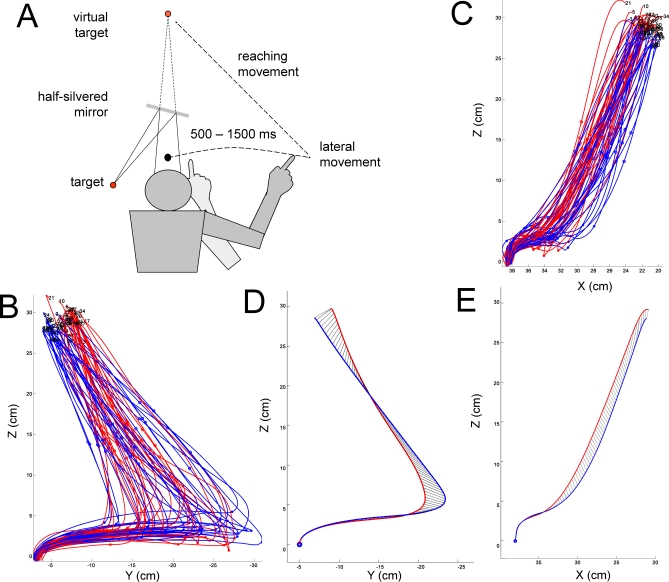
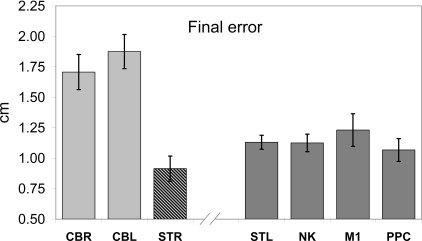
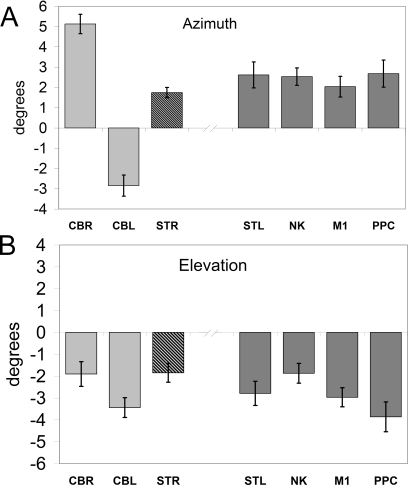
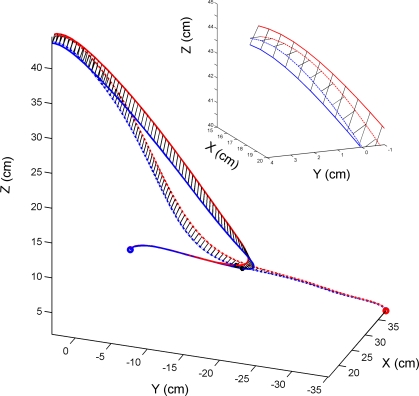
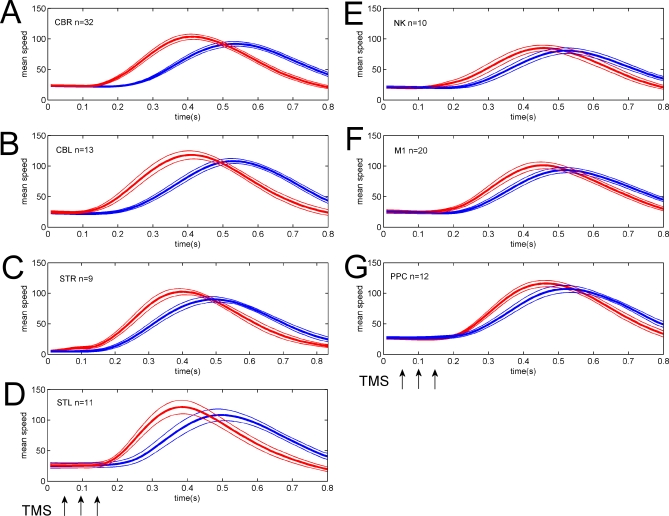
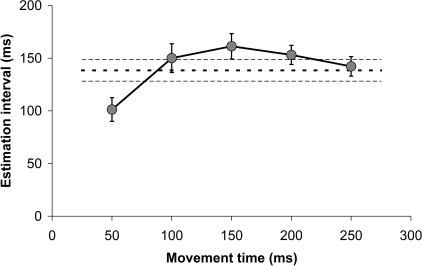
The cerebellum has been proposed to be a crucial component in the state estimation process that combines information from motor efferent and sensory afferent signals to produce a representation of the current state of the motor system. Such a state estimate of the moving human arm would be expected to be used when the arm is rapidly and skillfully reaching to a target. We now report the effects of transcranial magnetic stimulation (TMS) over the ipsilateral cerebellum as healthy humans were made to interrupt a slow voluntary movement to rapidly reach towards a visually defined target. Errors in the initial direction and in the final finger position of this reach-to-target movement were significantly higher for cerebellar stimulation than they were in control conditions. The average directional errors in the cerebellar TMS condition were consistent with the reaching movements being planned and initiated from an estimated hand position that was 138 ms out of date. We suggest that these results demonstrate that the cerebellum is responsible for estimating the hand position over this time interval and that TMS disrupts this state estimate.
Overview
The claims and statistics of this paper haven’t been checked yet.
Free: it reads the open-access text and checks the first 5 claims that cite a source we can check. Create a free account to check every claim.
Integrity signals
Registry
Cites
Statistics
Figures
Verification
Claims the paper makes
The claims and statistics of this paper haven’t been checked yet.
Free: it reads the open-access text and checks the first 5 claims that cite a source we can check. Create a free account to check every claim.
Claims other papers make about this one
Each is checked against this paper’s own text: does it say what the citing paper says it does?
The cited source says what the claim attributes to it.
In the citing paper
“The cerebellum has been proposed to be a crucial component in the state estimation process that combines information from motor efferent and sensory afferent signals to produce a representation of the current state of the motor system (Kawato, 1999; Miall et al., 2007).”
From Impulsive action: emotional impulses and their control (2014) · cites this paper as Miall et al., 2007
The cited source says what the claim attributes to it.
In the citing paper
“Finally, transient cerebellar disruption using transcranial magnetic stimulation induces movement perturbations that can be accounted for by the cerebellum making a prediction of the kinematic state of the arm at a lead time of 130 ms (Miall et al., 2007), as expected if the cerebellum implements a forward internal model.”
From Cerebellum, Predictions and Errors (2019) · cites this paper as Miall et al., 2007
The cited source says what the claim attributes to it.
In the citing paper
“Disrupting the lateral cerebellum with transcranial magnetic stimulation in healthy subjects alters on-line control of the ongoing movement (Miall et al., 2007).”
From The Forward Model: A Unifying Theory for the Role of the Cerebellum in Motor Control and Sense of Agency (2021) · cites this paper as Miall et al., 2007
Self-check
Percentages, sums and reported differences re-computed from the paper’s own numbers.
The self-check needs the paper’s full text.
Citations
Cites
An internal model for sensorimotor integration
Wolpert, D. M., Ghahramani, Z., & Jordan, M. I. (1995) · Science · doi:10.1126/science.7569931 · Cited by 3,553
Internal models for motor control and trajectory planning.
Kawato, M. (1999) · Current Opinion in Neurobiology · doi:10.1016/s0959-4388(99)00028-8 · Cited by 2,685 · cited 1×
“Another important postulated function is in inverse dynamic modelling, with a functional role for the cerebellum in generating motor commands rather than in predicting their outcome [7,33,40].”
Internal models in the cerebellum
Wolpert, D. M., Miall, R. C., & Kawato, M. (1998) · Trends in Cognitive Sciences · doi:10.1016/s1364-6613(98)01221-2 · Cited by 2,469 · cited 3×
“of the cerebellum [7,12,13], and the cerebellum has been specifically linked to state estimation [14,15], possibly in conjunction with the superior parietal cortex [4,16–18].”
Self-citationForward Models for Physiological Motor Control
Miall, R. C., & Wolpert, D. M. (1996) · Neural Networks · doi:10.1016/s0893-6080(96)00035-4 · Cited by 2,260 · cited 2×
“The process of translating an efferent copy of a motor command into predicted sensory reafference is encapsulated by the idea of a forward model [7,11].”
Self-citationComputational principles of movement neuroscience
Wolpert, D. M., & Ghahramani, Z. (2000) · Nature Neuroscience · doi:10.1038/81497 · Cited by 2,122 · cited 1×
“The state estimation process is likely to be iterative [8], with the current state being updated by an optimised weighting of afferent proprioceptive and visual information and by efferent motor commands.”
SPACE AND ATTENTION IN PARIETAL CORTEX
Colby, C. L., & Goldberg, M. E. (1999) · Annual Review of Neuroscience · doi:10.1146/annurev.neuro.22.1.319 · Cited by 1,710 · cited 1×
“The PPC also contributes to the representation of target positions [61], and hence it is important to distinguish loss-ofstate estimation from errors in localizing the remembered target.”
Cerebellar loops with motor cortex and prefrontal cortex of a nonhuman primate
Kelly, R. M., & Strick, P. L. (2003) · The Journal of Neuroscience · doi:10.1523/jneurosci.23-23-08432.2003 · Cited by 1,595 · cited 2×
“parietal cortex [55], which may hold a representation of the current state estimate [16], as well as from cortical motor areas, sending an efferent copy of descending commands [56].”
Forward modeling allows feedback control for fast reaching movements
Desmurget, M., & Grafton, S. (2000) · Trends in Cognitive Sciences · doi:10.1016/s1364-6613(00)01537-0 · Cited by 1,300 · cited 2×
“of the cerebellum [7,12,13], and the cerebellum has been specifically linked to state estimation [14,15], possibly in conjunction with the superior parietal cortex [4,16–18].”
Wolpert, D. M., & Flanagan, J. R. (2001) · Current Biology · doi:10.1016/s0960-9822(01)00432-8 · Cited by 1,257
Abnormalities in the awareness and control of action
Frith, C. D., Blakemore, S.-J., & Wolpert, D. M. (2000) · Philosophical Transactions of the Royal Society of London. Series B: Biological Sciences · doi:10.1098/rstb.2000.0734 · Cited by 1,200 · cited 1×
“It has also been proposed as a locus of the state estimate [16,17,50] and has been recently implicated in the sense of agency and the mental representation of [51,52]; agency is also dependent on forward modelling [53].”
Research works printed but not linked: 2
- Buneo CA Andersen RA 2006 The posterior parietal cortex: sensorimotor interface for the planning and online control of visually guided movements Neuropsychologia 44 2594 2606 16300804 · DOI · Paper page
- Critchley M 1953 Disorders of the body image Critchley M The parietal lobe New York Hafner Press 225 255
Cited by
Items 201–300 of 339
Ludolph, N., Giese, M. A., & Ilg, W. (2017) · Scientific Reports · doi:10.1038/s41598-017-13510-0 · Cited by 9
Role of the Cerebellum in the Construction of Functional and Geometrical Spaces
Torkhani, E., Bennequin, D., & de Marco, G. (2024) · The Cerebellum · doi:10.1007/s12311-024-01693-y · Cited by 10
Juggling with the brain — thought and action in the human motor system
Wolfensteller, U. (2009) · Progress in brain research · doi:10.1016/s0079-6123(09)01323-5 · Cited by 9
Takamuku, S., Forbes, P., Hamilton, A. F. D. C., & Gomi, H. (2018) · Autism Research · doi:10.1002/aur.1961 · Cited by 7
General Management of Cerebellar Disorders: An Overview
Ilg, W., & Timmann, D. (2012) · Springer eBooks · doi:10.1007/978-94-007-1333-8_105 · Cited by 6
Purohit, R., Wang, S., & Bhatt, T. S. (2023) · Biomechanics · doi:10.3390/biomechanics3010003 · Cited by 6
Toward a neural theory of goal-directed reaching movements
Schöner, G., Bildheim, L., & Zhang, L. (2024) · Elsevier eBooks · doi:10.1016/b978-0-443-23987-8.00008-0 · Cited by 9
Chemical exchange saturation transfer imaging in hepatic encephalopathy
Zöllner, H. J., Butz, M., Jördens, M. S., Füllenbach, N.-D., Häussinger, D., Schmitt, B., Wittsack, H., & Schnitzler, A. (2019) · NeuroImage Clinical · doi:10.1016/j.nicl.2019.101743 · Cited by 6
The effect of self-position and posture information on reaction time
Tanaka, K., Hasegawa, M., Kataoka, T., & Katz, L. (2010) · Institutional Repositories DataBase (IRDB) · Cited by 7
Reward-based improvements in motor control are driven by multiple error-reducing mechanismsPreprint
Codol, O., Holland, P. J., Manohar, S., & Galea, J. M. (2019) · bioRxiv (Cold Spring Harbor Laboratory) · doi:10.1101/792598 · Cited by 6
A cerebellar internal model calibrates a feedback controller involved in sensorimotor controlPreprint
Markov, D. A., Petrucco, L., Kist, A. M., & Portugues, R. (2020) · bioRxiv (Cold Spring Harbor Laboratory) · doi:10.1101/2020.02.12.945956 · Cited by 6
Continuous manipulation of mental representations is compromised in cerebellar degenerationPreprint
McDougle, S. D., Tsay, J. S., Pitt, B., King, M. B., Saban, W., Taylor, J. A., & Ivry, R. B. (2020) · bioRxiv (Cold Spring Harbor Laboratory) · doi:10.1101/2020.04.08.032409 · Cited by 6
Dynamical Feedback Control: Motor Cortex as an Optimal Feedback Controller Based on Neural DynamicsPreprint
Versteeg, C., & Miller, L. E. (2022) · Preprints.org · doi:10.20944/preprints202201.0428.v1 · Cited by 7
Furmanek, M. P., Schettino, L. F., Yarossi, M. P., Mangalam, M., Lockwood, K., Adamovich, S., & Tunik, E. (2025) · Journal of Neuroscience · doi:10.1523/jneurosci.0173-24.2025 · Cited by 6
Dynamic inferior olive activation in a cognitive task: an fMRI study
Mundorf, A., Rice, L. C., Peterburs, J., & Desmond, J. E. (2025) · Brain Structure and Function · doi:10.1007/s00429-025-02933-5 · Cited by 5
Burgess, J. D., Major, B. P., McNeel, C., Clark, G. M., Lum, J. A. G., & Enticott, P. G. (2019) · Frontiers in Human Neuroscience · doi:10.3389/fnhum.2019.00215 · Cited by 5
Impaired Lower Limb Proprioception in Spinocerebellar Ataxia Type 3 and Its Affected Factors
Liu, X., Wang, Z., Li, Y., Xu, H., Sikandar, A., Ni, J., & Gan, S. (2022) · Frontiers in Neurology · doi:10.3389/fneur.2022.833908 · Cited by 7
Shyr, M. C., & Joshi, S. S. (2021) · IEEE International Conference on Human-Machine Systems (ICHMS) · doi:10.1109/ichms53169.2021.9582639 · Cited by 6
Infants and children with spina bifida
Taylor, H. B., Landry, S. H., English, L. H., & Barnes, M. A. (2010) · Cambridge University Press eBooks · doi:10.1017/cbo9780511674815.014 · Cited by 5
Disentangling acute motor deficits and adaptive responses evoked by the loss of cerebellar outputPreprint
Sinha, N., Israely, S., Harosh, O. B., Harel, R., Dewald, J. P. A., & Prut, Y. (2025) · eLife · doi:10.7554/elife.105152 · Cited by 6
Embodied Sensorimotor Control: Computational Modeling of the Neural Control of Movement
Almani, M. N., Lazzari, J., Walker, J. D., & Saxena, S. (2026) · Annual Review of Biomedical Engineering · doi:10.1146/annurev-bioeng-102723-020454 · Cited by 7
Cerebellar contributions to action and cognition: Prediction, timescale, and continuity
Tsay, J. S., & Ivry, R. B. (2026) · Proceedings of the National Academy of Sciences · doi:10.1073/pnas.2524258123 · Cited by 6
“For example, predictions can arise from recalling prior associations in episodic memory: upon entering a favorite coffee shop, I might confidently The error observed after cerebellar TMS suggests that planning is made from the actual hand position at tone onset (yellow dot) rather than the…”
Avraham, C., Avraham, G., Mussa-Ivaldi, F. A., & Nisky, I. (2018) · Frontiers in Human Neuroscience · doi:10.3389/fnhum.2018.00335 · Cited by 4
Dean, P., Jörntell, H., & Porrill, J. (2012) · Springer eBooks · doi:10.1007/978-94-007-1333-8_58 · Cited by 4
Erroneous Compensation for Long-Latency Feedback Delays as Origin of Essential Tremor
Blondiaux, F., Colmant, L., Lebrun, L., Hanseeuw, B. J., & Crevecoeur, F. (2024) · Journal of Neuroscience · doi:10.1523/jneurosci.0069-24.2024 · Cited by 6
The Sensorimotor Posterior Parietal Cortex: From Intention to Action
Sirigu, A., & Desmurget, M. (2020) · Elsevier eBooks · doi:10.1016/b978-0-12-809324-5.24205-3 · Cited by 4
Current Movement Follows Previous Nontarget Movement With Somatosensory Stimulation
Oda, H., Sawaguchi, Y., Kunimura, H., Kawasaki, T., & Hiraoka, K. (2021) · Motor Control · doi:10.1123/mc.2020-0057 · Cited by 4
Neural Predictive Computation in the Cerebellum
Tanaka, H., Ishikawa, T., & Kakei, S. (2021) · Contemporary clinical neuroscience · doi:10.1007/978-3-030-75817-2_18 · Cited by 5
Ishikawa, T., & Sakaguchi, Y. (2013) · PLoS ONE · doi:10.1371/journal.pone.0055801 · Cited by 4
Tükel, Ş. (2020) · Elsevier eBooks · doi:10.1016/b978-0-12-812162-7.00025-4 · Cited by 7
General Management of Cerebellar Disorders: An Overview
Timmann, D. (2012) · Cited by 4
Zhang, X., Hancock, R., & Santaniello, S. (2025) · Journal of Neural Engineering · doi:10.1088/1741-2552/add76c · Cited by 4
Greenwell, D., McCallion, Q., Poston, B., & Riley, Z. A. (2025) · Brain Research · doi:10.1016/j.brainres.2025.149884 · Cited by 3
Estimate of body motion during voluntary body sway movements
Couture, É. J., & Simoneau, M. (2013) · Gait & Posture · doi:10.1016/j.gaitpost.2013.05.028 · Cited by 3
Ganesh, G., & Ikegami, T. (2015) · Springer tracts in advanced robotics · doi:10.1007/978-3-319-25739-6_7 · Cited by 4
Cerebellar anodal tDCS does not facilitate visuomotor adaptation or retention
Nettekoven, C., Jurdon, R., Nandi, T., Jenkinson, N., & Stagg, C. J. (2022) · Brain stimulation · doi:10.1016/j.brs.2022.10.006 · Cited by 5
A triple distinction of cerebellar function for oculomotor learning and fatigue compensation
Masselink, J., Cheviet, A., Tilikete, C., Pélisson, D., & Lappe, M. (2023) · PLoS Computational Biology · doi:10.1371/journal.pcbi.1011322 · Cited by 4
Inferring control objectives in a virtual balancing task in humans and monkeys
Sadeghi, M., Razavian, R. S., Bazzi, S., Chowdhury, R. H., Batista, A. P., Loughlin, P. J., & Sternad, D. (2024) · eLife · doi:10.7554/elife.88514 · Cited by 3
“…underpinnings of control objectives have been pursued in research on both humans and non-human primates ( Benyamini and Zacksenhouse, 2015 ; Cross et al., 2023 ; Croxson et al., 2009 ; Desrochers et al., 2015 ; Kao et al., 2021 ; Miall et al., 2007 ; Nashed et al., 2014 ; Omrani et al., 2016 ).”
Generalization in motor adaptation: A computational perspective on recent developments
Tanaka, H. (2010) · Japanese Psychological Research · doi:10.1111/j.1468-5884.2010.00430.x · Cited by 4
Künzell, S. (2021) · Springer eBooks · doi:10.1007/978-3-662-53386-4_56-1 · Cited by 5
Impairments of saccadic and reaching adaptation in essential tremor are linked to movement execution
Blondiaux, F., Lebrun, L., Hanseeuw, B. J., & Crevecoeur, F. (2023) · Journal of Neurophysiology · doi:10.1152/jn.00165.2023 · Cited by 6
Signaling of Predictive and Feedback Information in Purkinje Cell Simple Spike Activity
Popa, L. S., Streng, M. L., & Ebner, T. J. (2016) · Elsevier eBooks · doi:10.1016/b978-0-12-801386-1.00001-0 · Cited by 5
General Management of Cerebellar Disorders: An Overview
Ilg, W., & Timmann, D. (2021) · Springer eBooks · doi:10.1007/978-3-030-23810-0_105 · Cited by 3
Dean, P., Jörntell, H., & Porrill, J. (2019) · Springer eBooks · doi:10.1007/978-3-319-97911-3_58-2 · Cited by 3
The Input-Output Organization of the Cerebrocerebellum as Kalman Filter
Kakei, S., Tanaka, H., Ishikawa, T., Tomatsu, S., & Lee, J. (2021) · Contemporary clinical neuroscience · doi:10.1007/978-3-030-75817-2_19 · Cited by 6
Even with exposure to errors, motor imagery cannot update internal models
Rowe, J. M., Cramer, B. C., & Boe, S. G. (2025) · Psychological Research · doi:10.1007/s00426-025-02138-9 · Cited by 2
Disentangling acute motor deficits and adaptive responses evoked by the loss of cerebellar output
Sinha, N., Israely, S., Harosh, O. B., Harel, R., Dewald, J. P. A., & Prut, Y. (2025) · eLife · doi:10.7554/elife.105152.4 · Cited by 3
Cerebellum and Internal Models
Popa, L. S., & Ebner, T. J. (2021) · Springer eBooks · doi:10.1007/978-3-030-23810-0_56 · Cited by 5
Künzell, S. (2023) · Springer eBooks · doi:10.1007/978-3-662-53410-6_56 · Cited by 2
Sensomotorisches System und Gleichgewichtskontrolle
Grüber, M., Assländer, L., Giboin, L., & Kramer, A. (2023) · Springer eBooks · doi:10.1007/978-3-662-53410-6_59 · Cited by 2
Evidence for an efferent-based prediction contributing to implicit motor adaptation
Szarka, A., Kim, H. E., Inglis, J. T., & Chua, R. (2025) · PLoS ONE · doi:10.1371/journal.pone.0322627 · Cited by 2
How Might the Cerebellum Participate in Motor Control, if Life Without One is Possible?
Pope, P. A. (2011) · Cited by 2
Neurophysiologie du mouvement. Apprentissage moteur
Cheron, G. A. (2011) · EMC - Kinésithérapie - Médecine physique - Réadaptation · doi:10.1016/s1283-0887(11)56630-7 · Cited by 2
Cerebellar ataxia impairs modulation of arm stiffness during postural maintenance
Gibo, T. L., Bastian, A. J., & Okamura, A. M. (2013) · Journal of Neurophysiology · doi:10.1152/jn.00294.2013 · Cited by 3
“For movement control, the cerebellum may act as a forward model to predict the consequences of motor output (Ebner and Pasalar 2008; Miall et al. 2007).”
Dynamical Spiking Networks for Distributed Control of Nonlinear Systems
Huang, F., & Ching, S. (2018) · Proceedings of the ... American Control Conference/Proceedings of the American Control Conference · doi:10.23919/acc.2018.8430996 · Cited by 2
Forward model deficits and enhanced motor noise in Tourette syndrome?
Stenner, M., Ostendorf, F., & Ganos, C. (2019) · Brain · doi:10.1093/brain/awz266 · Cited by 3
Kiyota, T., & Fujiwara, K. (2022) · Journal of PHYSIOLOGICAL ANTHROPOLOGY · doi:10.1186/s40101-022-00295-z · Cited by 1
Jamieson, G. A. (2025) · International review of neurobiology · doi:10.1016/bs.irn.2025.10.001 · Cited by 3
Neurofisiologia del movimento. Apprendimento motorio
Cheron, G. A. (2011) · EMC - Medicina Riabilitativa · doi:10.1016/s1283-078x(11)70692-7 · Cited by 1
Hermosillo, R. J. M., Carmody, J., Ugoalah, N., Lee, J.-H., Binsted, G., & van Donkelaar, P. (2016) · Journal of Motor Behavior · doi:10.1080/00222895.2016.1169982 · Cited by 1
Giangiardi, V. F., de Freitas, S. M. S. F., Silva, F. P. D. P., Banjai, R. M., & Alouche, S. R. (2017) · Behavioural Neurology · doi:10.1155/2017/8980103 · Cited by 2
Neurofisiología del movimiento. Oscilaciones neuronales y aprendizaje motor
Cheron, G. A. (2018) · EMC - Kinesiterapia - Medicina Física · doi:10.1016/s1293-2965(18)89812-7 · Cited by 3
States Are A-Changing, Complex Spikes Proclaim
Popa, L. S., Aronson, J. D., & Ebner, T. J. (2021) · Contemporary clinical neuroscience · doi:10.1007/978-3-030-75817-2_12 · Cited by 2
State Estimation and the Cerebellum
Hardwick, R. M., Dagioglou, M., & Miall, R. C. (2021) · Springer eBooks · doi:10.1007/978-3-030-23810-0_57 · Cited by 1
Self-citationA Simplified Model of Motor Control
Arora, K., & Chakrabarty, S. (2023) · Journal of Vision · doi:10.1167/jov.23.9.4708 · Cited by 1
Kakei, S., Manto, M. U., Tanaka, H., & Mitoma, H. (2023) · Contemporary clinical neuroscience · doi:10.1007/978-3-031-26128-2_4 · Cited by 1
Palidis, D. J., McGregor, H. R., Vo, A., MacDonald, P. A., & Gribble, P. L. (2020) · bioRxiv (Cold Spring Harbor Laboratory) · doi:10.1101/2020.11.19.390302 · Cited by 2
High Cognitive Violation of Expectations is Compromised in Cerebellar AtaxiaPreprint
Leonardo Daniel, A., Vakil, E., & Saban, W. (2025) · eLife · doi:10.7554/elife.105864.1 · Cited by 1
Corrective sub-movements link feedback to feedforward control in the cerebellumPreprint
Dobrott, C. I., Becker, M. I., & Person, A. L. (2025) · bioRxiv (Cold Spring Harbor Laboratory) · doi:10.1101/2025.08.01.668191 · Cited by 1
Tactile suppression during movement as optimal integration of somatosensory feedback across timePreprint
Tatai, F., Voudouris, D., Straub, D., Fiehler, K., & Rothkopf, C. A. (2026) · bioRxiv (Cold Spring Harbor Laboratory) · doi:10.64898/2026.02.25.707903 · Cited by 1
“The cerebellum, which tracks body state and implements forward models [63–66], is a likely candidate for the uncertainty-dependent integration we describe.”
Abstract Representations of Sensorimotor Transformations in Human Premotor CortexPreprint
Kang, S., Trach, J. E., & McDougle, S. D. (2026) · bioRxiv (Cold Spring Harbor Laboratory) · doi:10.64898/2026.08.12.744241 · Cited by 1
“Internal models are thought to support the gradual and implicit calibration of motor commands in response to sensory prediction errors 13 and are closely linked to cerebellar circuits 10,14 .”
Debas, K. (2013) · Papyrus : Institutional Repository (Université de Montréal) · doi:10.71781/19238
da Guarda, S. N. F. (2013) · Digital Library of Theses and Dissertations (Universidade de São Paulo) · doi:10.11606/t.5.2013.tde-01112013-161055 · Cited by 3
Motor variability as a characteristic of the control of reaching movements
Krüger, M. (2013) · doi:10.5282/edoc.16122 · Cited by 1
Neurofisiología del movimiento. Aprendizaje motor
Cheron, G. A. (2011) · EMC - Kinesiterapia - Medicina Física · doi:10.1016/s1293-2965(11)71169-0 · Cited by 2
Investigation of Motor Adaptation to Mirror Visual Feedback
Khlestova, E. (2015) · Brandeis Institutional Repository · doi:10.48617/etd.879
Kuang, S. (2013) · eDiss (Georg-August-Universität Göttingen) · doi:10.53846/goediss-4067
Does cerebellar cortex function as a forward internal model for motor control
Hewitt, A. L. (2013) · University of Minnesota Digital Conservancy (University of Minnesota)
Criscimagna-Hemminger, S. E., & Hemminger, S. (2010) · Cited by 2
SOPHISTICATED FEEDBACK PROCESSING IN MOTOR CONTROL
Omrani, M. (2015) · QSpace (Queen's University Library)
Cognitive-affective syndromes in children with cerebellar tumor
Lacusta, V., & Litovchenko, А. I. (2011) · Ukrainian Neurosurgical Journal · doi:10.25305/unj.57566
Awareness of the Outcome of Self-Initiated Pointing ActionsPreprint
Goréa, A., Granjon, L., & Sagi, D. (2017) · bioRxiv (Cold Spring Harbor Laboratory) · doi:10.1101/234369
Neurofisiologia del movimento. Oscillazioni neuronali e apprendimento motorio
Cheron, G. A. (2018) · EMC - Medicina Riabilitativa · doi:10.1016/s1283-078x(18)89762-0 · Cited by 1
Kitchen, N. M. (2018) · University of Birmingham Institutional Research Archive (University of Birmingham) · Cited by 2
Brain Imaging Correlates of Developmental Coordination Disorder and Associated Impairments
Bonthrone, A. F. (2018) · UCL Discovery (University College London) · Cited by 1
A influência de pistas visuais em processos de adaptação sensório-motora
da Costa, V. T. (2019) · doi:10.14393/ufu.di.2019.2336 · Cited by 1
Feedback Control in the Cerebellum
Edwards, A. M. (2017)
A Visuomotor Model Enhances Human Position SensePreprint
Omprakash, C., Razavizadeh, S., & Stenner, M. (2020) · bioRxiv (Cold Spring Harbor Laboratory) · doi:10.1101/2020.07.20.211490
Weeks, H. M. (2016)
The role of cerebellum in action acquisition and motor learning
Dagioglou, M. (2014) · University of Birmingham Institutional Research Archive (University of Birmingham)
Krakauer, J. W. (2013) · Faculty Opinions – Post-Publication Peer Review of the Biomedical Literature · doi:10.3410/f.717967252.793470698
(2008) · Current Opinion in Neurology · doi:10.1097/wco.0b013e32831cbb85
General Management of Cerebellar Disorders: An Overview
Ilg, W., & Timmann, D. (2020) · Springer eBooks · doi:10.1007/978-3-319-97911-3_105-2
Sensomotorisches System und Gleichgewichtskontrolle
Grüber, M., Assländer, L., Giboin, L., & Kramer, A. (2021) · Springer eBooks · doi:10.1007/978-3-662-53386-4_59-1
Künzell, S. (2022) · Springer eBooks · doi:10.1007/978-3-662-53386-4_56-2
Abrupt, but not gradual, motor adaptation biases saccadic target selection
Teunissen, L., Selen, L. P. J., & Medendorp, W. P. (2023) · Journal of Neurophysiology · doi:10.1152/jn.00223.2022
The Effect of High Fraction of Inspired Oxygen on Human Motor Learning Processes
Wang, Z. (2023) · Louisiana State University · doi:10.31390/gradschool_dissertations.6070
Author Response: Inferring control objectives in a virtual balancing task in humans and monkeys
Sadeghi, M., Razavian, R. S., Bazzi, S., Chowdhury, R. H., Batista, A. P., Loughlin, P. J., & Sternad, D. (2024) · eLife · doi:10.7554/elife.88514.2.sa3
Metadata
- Authors
- Miall, R. C., Christensen, L. O. D., Cain, O., & Stanley, J.
- Affiliations
- University of Birmingham (GB)
- University of Oxford (GB)
- Corresponding author
- Miall, R. Chris
- Venue
- PLoS Biology
- Publisher
- Public Library of Science (PLoS)
- Published
- 2007-11-27
- Volume
- 5
- Issue
- 11
- Pages
- e316
- ISSN
- 1544-9173 (ISSN-L)
- 1545-7885
- PMC
- PMC2229864
- OpenAlex
- W2109582716
- Semantic Scholar
- 666d1b4752909424427a5a0cea64d3572d83c30d
- Cited by
- 338
- References
- 69
- Citations by year
- 2026: 10 · 2025: 20 · 2024: 26 · 2023: 20 · 2022: 13 · 2021: 21 · 2020: 15 · 2019: 22 · 2018: 20 · 2017: 15 · 2016: 17 · 2015: 17 · 2014: 17 · 2013: 28 · 2012: 20
- FWCI
- 5.68
- Type
- journal article
- Language
- en
- Open access
- gold
- doi.org
- Locations
- PLoS Biology (publishedVersion, cc-by)
- PubMed Central (publishedVersion, cc-by)
- PubMed (publishedVersion)
- University of Birmingham Institutional Research Archive (University of Birmingham) (acceptedVersion)
- DOAJ (DOAJ: Directory of Open Access Journals) (submittedVersion)
- University of Birmingham Research Portal (University of Birmingham) (submittedVersion, other-oa)
- Funders
- Wellcome Trust
- Topics
- Life Sciences › Neuroscience › Cognitive Neuroscience › Motor Control and Adaptation
- Life Sciences › Neuroscience › Neurology › Transcranial Magnetic Stimulation Studies
- Life Sciences › Neuroscience › Neurology › Vestibular and auditory disorders
- Keywords
- cerebellum, state estimation, reaching movements, transcranial magnetic stimulation, hand position estimation, motor control, motor planning, arm movement, sensory feedback
- MeSH terms
- Adult, Arm, Cerebellum, Female, Humans, Magnetics, Male, Middle Aged, Movement, Psychomotor Performance, Space Perception, Evoked Potentials, Motor, Transcranial Magnetic Stimulation
About these checks
Registry, retraction, Cites and statistics results are computed, not judged, with one exception: a printed reference that no index lists is read once by a model before it counts as a citation error. Claims are extracted by a model and kept only when their quote appears verbatim in the text; each cited source is then checked, with a model’s help, for whether it says what the claim relies on. Those verdicts can be wrong — read the claim’s quote and the cited source before relying on one.
Statistics and arithmetic are recomputed, not judged.
Confidence bands are shown only for fields calibrated on our annotated test set. None is calibrated yet, so no band is shown.
What counts as a claim ›How we measure confidence ›How we check this ›
Are you an author, or do you see a problem with this page? Request a review
Data sources
Bibliographic data: Semantic Scholar, OpenAlex, Crossref.
Contains information from the Semantic Scholar Academic Graph Datasets, made available under the ODC Attribution License (ODC-BY 1.0).
Semantic Scholar’s data is described in: Kinney, R., et al. (2023). The Semantic Scholar Open Data Platform. arXiv:2301.10140.
