

Disruption of State Estimation in the Human Lateral Cerebellum
Open accessThe DOI matches its Crossref record; 69 of the 69 references it cites were found in a registry or an index.
Abstract
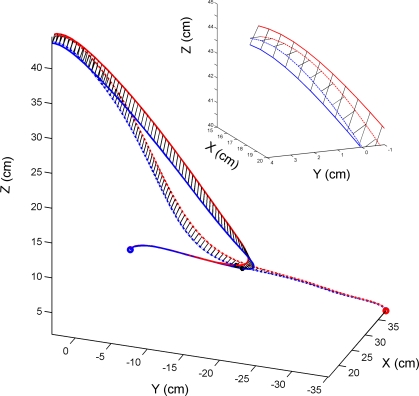
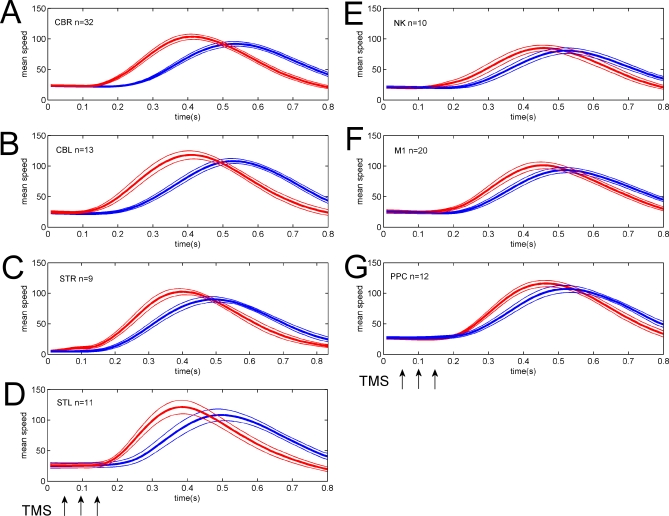
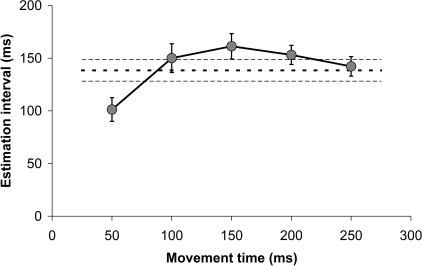
The cerebellum has been proposed to be a crucial component in the state estimation process that combines information from motor efferent and sensory afferent signals to produce a representation of the current state of the motor system. Such a state estimate of the moving human arm would be expected to be used when the arm is rapidly and skillfully reaching to a target. We now report the effects of transcranial magnetic stimulation (TMS) over the ipsilateral cerebellum as healthy humans were made to interrupt a slow voluntary movement to rapidly reach towards a visually defined target. Errors in the initial direction and in the final finger position of this reach-to-target movement were significantly higher for cerebellar stimulation than they were in control conditions. The average directional errors in the cerebellar TMS condition were consistent with the reaching movements being planned and initiated from an estimated hand position that was 138 ms out of date. We suggest that these results demonstrate that the cerebellum is responsible for estimating the hand position over this time interval and that TMS disrupts this state estimate.
Overview
The claims and statistics of this paper haven’t been checked yet.
Free: it reads the open-access text and checks the first 5 claims that cite a source we can check. Create a free account to check every claim.
Integrity signals
Registry
Cites
Statistics
Figures
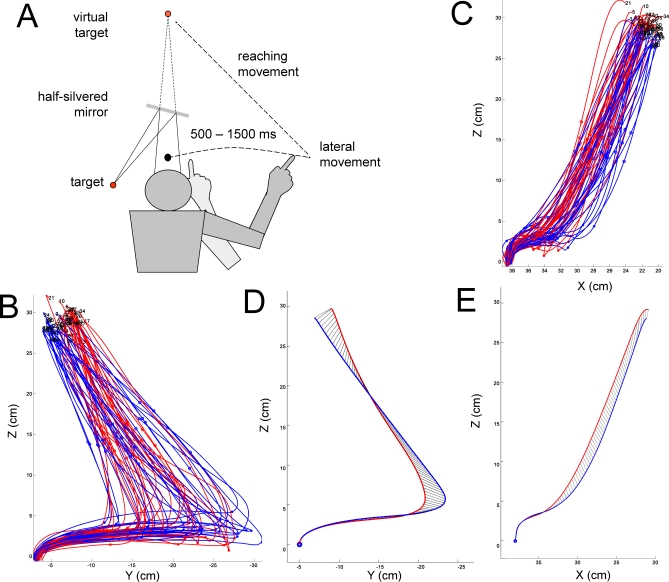
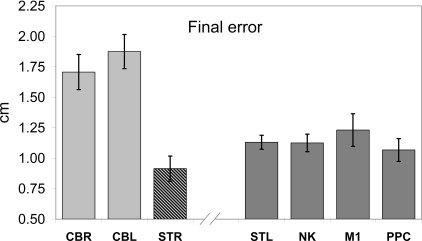
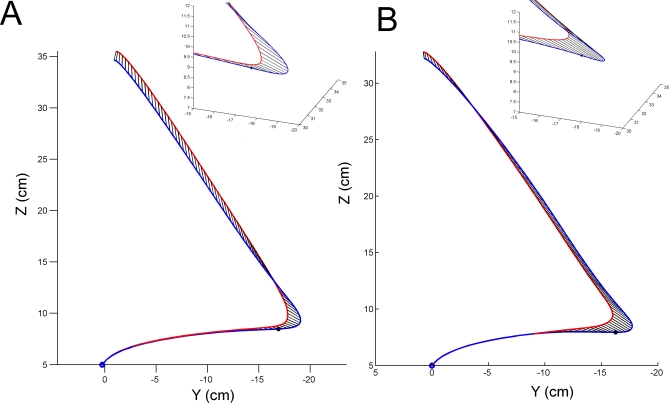
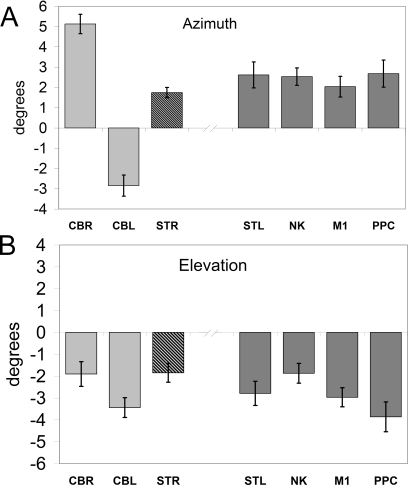
Verification
Claims the paper makes
The claims and statistics of this paper haven’t been checked yet.
Free: it reads the open-access text and checks the first 5 claims that cite a source we can check. Create a free account to check every claim.
Claims other papers make about this one
Each is checked against this paper’s own text: does it say what the citing paper says it does?
The cited source says what the claim attributes to it.
In the citing paper
“The cerebellum has been proposed to be a crucial component in the state estimation process that combines information from motor efferent and sensory afferent signals to produce a representation of the current state of the motor system (Kawato, 1999; Miall et al., 2007).”
From Impulsive action: emotional impulses and their control (2014) · cites this paper as Miall et al., 2007
The cited source says what the claim attributes to it.
In the citing paper
“Finally, transient cerebellar disruption using transcranial magnetic stimulation induces movement perturbations that can be accounted for by the cerebellum making a prediction of the kinematic state of the arm at a lead time of 130 ms (Miall et al., 2007), as expected if the cerebellum implements a forward internal model.”
From Cerebellum, Predictions and Errors (2019) · cites this paper as Miall et al., 2007
The cited source says what the claim attributes to it.
In the citing paper
“Disrupting the lateral cerebellum with transcranial magnetic stimulation in healthy subjects alters on-line control of the ongoing movement (Miall et al., 2007).”
From The Forward Model: A Unifying Theory for the Role of the Cerebellum in Motor Control and Sense of Agency (2021) · cites this paper as Miall et al., 2007
Self-check
Percentages, sums and reported differences re-computed from the paper’s own numbers.
The self-check needs the paper’s full text.
Citations
Cites
An internal model for sensorimotor integration
Wolpert, D. M., Ghahramani, Z., & Jordan, M. I. (1995) · Science · doi:10.1126/science.7569931 · Cited by 3,553
Internal models for motor control and trajectory planning.
Kawato, M. (1999) · Current Opinion in Neurobiology · doi:10.1016/s0959-4388(99)00028-8 · Cited by 2,685 · cited 1×
“Another important postulated function is in inverse dynamic modelling, with a functional role for the cerebellum in generating motor commands rather than in predicting their outcome [7,33,40].”
Internal models in the cerebellum
Wolpert, D. M., Miall, R. C., & Kawato, M. (1998) · Trends in Cognitive Sciences · doi:10.1016/s1364-6613(98)01221-2 · Cited by 2,469 · cited 3×
“of the cerebellum [7,12,13], and the cerebellum has been specifically linked to state estimation [14,15], possibly in conjunction with the superior parietal cortex [4,16–18].”
Self-citationForward Models for Physiological Motor Control
Miall, R. C., & Wolpert, D. M. (1996) · Neural Networks · doi:10.1016/s0893-6080(96)00035-4 · Cited by 2,260 · cited 2×
“The process of translating an efferent copy of a motor command into predicted sensory reafference is encapsulated by the idea of a forward model [7,11].”
Self-citationComputational principles of movement neuroscience
Wolpert, D. M., & Ghahramani, Z. (2000) · Nature Neuroscience · doi:10.1038/81497 · Cited by 2,122 · cited 1×
“The state estimation process is likely to be iterative [8], with the current state being updated by an optimised weighting of afferent proprioceptive and visual information and by efferent motor commands.”
SPACE AND ATTENTION IN PARIETAL CORTEX
Colby, C. L., & Goldberg, M. E. (1999) · Annual Review of Neuroscience · doi:10.1146/annurev.neuro.22.1.319 · Cited by 1,710 · cited 1×
“The PPC also contributes to the representation of target positions [61], and hence it is important to distinguish loss-ofstate estimation from errors in localizing the remembered target.”
Cerebellar loops with motor cortex and prefrontal cortex of a nonhuman primate
Kelly, R. M., & Strick, P. L. (2003) · The Journal of Neuroscience · doi:10.1523/jneurosci.23-23-08432.2003 · Cited by 1,595 · cited 2×
“parietal cortex [55], which may hold a representation of the current state estimate [16], as well as from cortical motor areas, sending an efferent copy of descending commands [56].”
Forward modeling allows feedback control for fast reaching movements
Desmurget, M., & Grafton, S. (2000) · Trends in Cognitive Sciences · doi:10.1016/s1364-6613(00)01537-0 · Cited by 1,300 · cited 2×
“of the cerebellum [7,12,13], and the cerebellum has been specifically linked to state estimation [14,15], possibly in conjunction with the superior parietal cortex [4,16–18].”
Wolpert, D. M., & Flanagan, J. R. (2001) · Current Biology · doi:10.1016/s0960-9822(01)00432-8 · Cited by 1,257
Abnormalities in the awareness and control of action
Frith, C. D., Blakemore, S.-J., & Wolpert, D. M. (2000) · Philosophical Transactions of the Royal Society of London. Series B: Biological Sciences · doi:10.1098/rstb.2000.0734 · Cited by 1,200 · cited 1×
“It has also been proposed as a locus of the state estimate [16,17,50] and has been recently implicated in the sense of agency and the mental representation of [51,52]; agency is also dependent on forward modelling [53].”
Research works printed but not linked: 2
- Buneo CA Andersen RA 2006 The posterior parietal cortex: sensorimotor interface for the planning and online control of visually guided movements Neuropsychologia 44 2594 2606 16300804 · DOI · Paper page
- Critchley M 1953 Disorders of the body image Critchley M The parietal lobe New York Hafner Press 225 255
Cited by
Items 101–200 of 339
Wasaka, T., & Kakigi, R. (2011) · NeuroImage · doi:10.1016/j.neuroimage.2011.08.024 · Cited by 46
Role of the cerebellum in adaptation to delayed action effects
Cao, L., Veniero, D., Thut, G., & Gross, J. (2017) · Current Biology · doi:10.1016/j.cub.2017.06.074 · Cited by 43
Adaptive coupling of inferior olive neurons in cerebellar learning
Tokuda, I. T., Hoang, H., Schweighofer, N., & Kawato, M. (2012) · Neural Networks · doi:10.1016/j.neunet.2012.12.006 · Cited by 45
Yavari, F., Mahdavi, S., Towhidkhah, F., Ahmadi‐Pajouh, M. A., Ekhtiari, H., & Darainy, M. (2015) · Experimental Brain Research · doi:10.1007/s00221-015-4523-2 · Cited by 50
Internal Models in Control, Biology and Neuroscience
Huang, J., Isidori, A., Marconi, L., Mischiati, M., Sontag, E. D., & Wonham, W. M. (2018) · IEEE Conference on Decision and Control (CDC) · doi:10.1109/cdc.2018.8619624 · Cited by 50
Skilled throwers use physics to time ball release to the nearest millisecond
Hore, J., & Watts, S. (2011) · Journal of Neurophysiology · doi:10.1152/jn.00059.2011 · Cited by 42
Adaptive Cancelation of Self-Generated Sensory Signals in a Whisking Robot
Anderson, S., Pearson, M. J., Pipe, T., Prescott, T. J., Dean, P., & Porrill, J. (2010) · IEEE Transactions on Robotics · doi:10.1109/tro.2010.2069990 · Cited by 45
Prism adaptation and generalization during visually guided locomotor tasks
Alexander, M. S., Flodin, B. W. G., & Marigold, D. S. (2011) · Journal of Neurophysiology · doi:10.1152/jn.01040.2010 · Cited by 49
Separating Predicted and Perceived Sensory Consequences of Motor Learning
Hart, B. M. ’., & Henriques, D. Y. P. (2016) · PLoS ONE · doi:10.1371/journal.pone.0163556 · Cited by 50
Buetler, K. A., Penalver-Andres, J. A., Özen, Ö., Ferriroli, L., Müri, R. M., Cazzoli, D., & Marchal–Crespo, L. (2022) · Frontiers in Human Neuroscience · doi:10.3389/fnhum.2021.787487 · Cited by 50
Online and post-trial feedback differentially affect implicit adaptation to a visuomotor rotation
Schween, R., Taube, W., Gollhofer, A., & Leukel, C. (2014) · Experimental Brain Research · doi:10.1007/s00221-014-3992-z · Cited by 44
Cerebellar patients have intact feedback control that can be leveraged to improve reaching
Zimmet, A. M., Cao, D., Bastian, A. J., & Cowan, N. J. (2020) · eLife · doi:10.7554/elife.53246 · Cited by 39
The basal ganglia select the expected sensory input used for predictive coding
Colder, B. W. (2015) · Frontiers in Computational Neuroscience · doi:10.3389/fncom.2015.00119 · Cited by 46
The cerebellum contributes to proprioception during motion
Weeks, H. M., Therrien, A. S., & Bastian, A. J. (2017) · Journal of Neurophysiology · doi:10.1152/jn.00417.2016 · Cited by 41
Disruption of Cerebellar Prediction in Verbal Working Memory
Sheu, Y.-S., Liang, Y., & Desmond, J. E. (2019) · Frontiers in Human Neuroscience · doi:10.3389/fnhum.2019.00061 · Cited by 41
Cerebellar circuit computations for predictive motor control
Nguyen, K. P., & Person, A. L. (2025) · Nature reviews. Neuroscience · doi:10.1038/s41583-025-00936-z · Cited by 44
Purkinje Cell Representations of Behavior: Diary of a Busy Neuron
Popa, L. S., Streng, M. L., & Ebner, T. J. (2018) · The Neuroscientist · doi:10.1177/1073858418785628 · Cited by 45
Continuous manipulation of mental representations is compromised in cerebellar degeneration
McDougle, S. D., Tsay, J. S., Pitt, B., King, M. B., Saban, W., Taylor, J. A., & Ivry, R. B. (2022) · Brain · doi:10.1093/brain/awac072 · Cited by 51
Minks, E., Mareček, R., Pavlík, T., Ovesná, P., & Bareš, M. (2011) · The Cerebellum · doi:10.1007/s12311-011-0290-1 · Cited by 37
Skilled forelimb movements and internal copy motor circuits
Azim, E., & Alstermark, B. (2015) · Current Opinion in Neurobiology · doi:10.1016/j.conb.2014.12.009 · Cited by 40
Evaluating the adaptive‐filter model of the cerebellum
Dean, P., & Porrill, J. (2011) · The Journal of Physiology · doi:10.1113/jphysiol.2010.201574 · Cited by 39
Contribution of the cerebellum to predictive motor control and its evaluation in ataxic patients
Kakei, S., Lee, J., Mitoma, H., Tanaka, H., Manto, M., & Hampe, C. S. (2019) · Frontiers in Human Neuroscience · doi:10.3389/fnhum.2019.00216 · Cited by 34
Handedness Matters for Motor Control But Not for Prediction
Mathew, J., Sarlegna, F. R., Bernier, P., & Danion, F. (2019) · eNeuro · doi:10.1523/eneuro.0136-19.2019 · Cited by 38
Pazen, M., Uhlmann, L., van Kemenade, B. M., Steinsträter, O., Straube, B., & Kircher, T. T. J. (2019) · NeuroImage · doi:10.1016/j.neuroimage.2019.116309 · Cited by 35
Takamuku, S., & Gomi, H. (2015) · Proceedings of the Royal Society B Biological Sciences · doi:10.1098/rspb.2015.0864 · Cited by 39
Honda, T., Hagura, N., Yoshioka, T., & Imamizu, H. (2013) · Frontiers in Psychology · doi:10.3389/fpsyg.2013.00760 · Cited by 44
Adaptive processing in electrosensory systems: Links to cerebellar plasticity and learning
Sawtell, N. B., & Bell, C. C. (2008) · Journal of Physiology-Paris · doi:10.1016/j.jphysparis.2008.10.009 · Cited by 32
Kakei, S., Manto, M. U., Tanaka, H., & Mitoma, H. (2021) · Frontiers in Neurology · doi:10.3389/fneur.2021.694653 · Cited by 36
Transcranial magnetic stimulation of the cerebellum.
Minks, E., Kopickova, M., Mareček, R., Streitová, H., & Bareš, M. (2010) · Biomedical papers of the Medical Faculty of the University Palacky, Olomouc, Czechoslovakia · doi:10.5507/bp.2010.020 · Cited by 34
Sensory expectations shape neural population dynamics in motor circuits
Michaels, J. A., Kashefi, M., Zheng, J., Codol, O., Weiler, J., Kersten, R., Lau, J. C., Gribble, P. L., Diedrichsen, J., & Pruszynski, J. A. (2025) · Nature · doi:10.1038/s41586-025-09690-9 · Cited by 39
Predicting Future Sensorimotor States Influences Current Temporal Decision Making
Hermosillo, R. J. M., Ritterband‐Rosenbaum, A., & van Donkelaar, P. (2011) · Journal of Neuroscience · doi:10.1523/jneurosci.0037-11.2011 · Cited by 36
Limb motion dictates how motor learning arises from arbitrary environmental dynamics
Sing, G. C., Orozco, S. P., & Smith, M. A. (2013) · Journal of Neurophysiology · doi:10.1152/jn.00497.2011 · Cited by 32
Freedman, E. G., & Foxe, J. J. (2017) · European Journal of Neuroscience · doi:10.1111/ejn.13625 · Cited by 34
Foot placement relies on state estimation during visually guided walking
Maeda, R. S., O’Connor, S. M., Donelan, J. M., & Marigold, D. S. (2016) · Journal of Neurophysiology · doi:10.1152/jn.00015.2016 · Cited by 31
A leg to stand on: computational models of proprioception
Dallmann, C. J., Karashchuk, P., Brunton, B. W., & Tuthill, J. C. (2021) · Current Opinion in Physiology · doi:10.1016/j.cophys.2021.03.001 · Cited by 29
Emulation as an integrating principle for cognition
Colder, B. W. (2011) · Frontiers in Human Neuroscience · doi:10.3389/fnhum.2011.00054 · Cited by 32
Contributions of efference copy to limb localization: Evidence from deafferentation
Medina, J., Jax, S. A., Brown, M. J., & Coslett, H. B. (2010) · Brain Research · doi:10.1016/j.brainres.2010.07.063 · Cited by 32
Development of state estimation explains improvements in sensorimotor performance across childhood
King, B. R., de Oliveira, M. A., Contreras-Vidal, J. L., & Clark, J. E. (2012) · Journal of Neurophysiology · doi:10.1152/jn.00932.2011 · Cited by 33
Trial-by-Trial Motor Cortical Correlates of a Rapidly Adapting Visuomotor Internal Model
Stavisky, S. D., Kao, J. C., Ryu, S. I., & Shenoy, K. V. (2017) · Journal of Neuroscience · doi:10.1523/jneurosci.1091-16.2016 · Cited by 31
Parrell, B., Kim, H. E., Breska, A., Saxena, A., & Ivry, R. B. (2021) · Journal of Neuroscience · doi:10.1523/jneurosci.0739-21.2021 · Cited by 30
Cerebellum and Internal Models
Ebner, T. J. (2012) · Springer eBooks · doi:10.1007/978-94-007-1333-8_56 · Cited by 30
Contribution of Cerebellar Sensorimotor Adaptation to Hippocampal Spatial Memory
Passot, J.-B., Sheynikhovich, D., Duvelle, É., & Arleo, A. (2012) · PLoS ONE · doi:10.1371/journal.pone.0032560 · Cited by 30
Differential motor learning via reward and punishment
Song, Y., Lu, S., & Smiley‐Oyen, A. L. (2019) · Quarterly Journal of Experimental Psychology · doi:10.1177/1747021819871173 · Cited by 31
Hiraoka, K., Horino, K., Yagura, A., & Matsugi, A. (2010) · The Cerebellum · doi:10.1007/s12311-010-0187-4 · Cited by 27
Proprioceptive Localization Deficits in People With Cerebellar Damage
Weeks, H. M., Therrien, A. S., & Bastian, A. J. (2016) · The Cerebellum · doi:10.1007/s12311-016-0819-4 · Cited by 26
Sensorimotor feedback loops are selectively sensitive to reward
Codol, O., Kashefi, M., Forgaard, C. J., Galea, J. M., Pruszynski, J. A., & Gribble, P. L. (2023) · eLife · doi:10.7554/elife.81325 · Cited by 25
Kilteni, K., Houborg, C., & Ehrsson, H. H. (2023) · Journal of Neuroscience · doi:10.1523/jneurosci.1743-22.2023 · Cited by 26
MicroRNAs: Genetically Sensitized Worms Reveal New Secrets
Ambros, V. (2010) · Current Biology · doi:10.1016/j.cub.2010.05.054 · Cited by 24
Error-based and reinforcement learning in basketball free throw shooting
Truong, C., Ruffino, C., Crognier, A., Païzis, C., Crognier, L., & Papaxanthis, C. (2023) · Scientific Reports · doi:10.1038/s41598-022-26568-2 · Cited by 29
Decorrelation Learning in the Cerebellum
Dean, P., & Porrill, J. (2014) · Progress in brain research · doi:10.1016/b978-0-444-63356-9.00007-8 · Cited by 32
“…for a wide range of active sensing and motor control tasks (e.g., Bastian, 2011; Bhanpuri et al., 2013; Cerminara et al., 2009; Imamizu et al., 2003; Izawa et al., 2012; Knolle et al., 2012; Miall et al., 2007; Roth et al., 2013; Schlerf et al., 2012; Shmuelof et al., 2012; Tseng et al., 2007).”
Wasaka, T., & Kakigi, R. (2012) · BMC Neuroscience · doi:10.1186/1471-2202-13-138 · Cited by 23
Leib, R., Howard, I. S., Millard, M., & Franklin, D. W. (2023) · Comprehensive physiology · doi:10.1002/cphy.c220032 · Cited by 27
The Hippocampus Preorders Movements for Skilled Action Sequences
Yewbrey, R., & Kornysheva, K. (2024) · Journal of Neuroscience · doi:10.1523/jneurosci.0832-24.2024 · Cited by 23
Yavari, F., Towhidkhah, F., & Ahmadi‐Pajouh, M. A. (2013) · Medical Hypotheses · doi:10.1016/j.mehy.2013.07.009 · Cited by 24
Visuospatial Organization and Recall in Cerebellar Ataxia
Slapik, M. B., Kronemer, S. I., Morgan, O. P., Bloes, R., Lieberman, S., Mandel, J. A., Rosenthal, L. S., & Marvel, C. L. (2018) · The Cerebellum · doi:10.1007/s12311-018-0948-z · Cited by 21
Aoki, S., Sato, Y., & Yanagihara, D. (2013) · Journal of Neurophysiology · doi:10.1152/jn.01048.2012 · Cited by 25
Matsugi, A., Iwata, Y., Mori, N., Horino, H., & Hiraoka, K. (2012) · The Cerebellum · doi:10.1007/s12311-012-0402-6 · Cited by 18
Taking the brakes off the learning curve
Gheysen, F., Lasne, G., Pélégrini‐Issac, M., Albouy, G., Meunier, S., Benali, H., Doyon, J., & Popa, T. (2016) · Human Brain Mapping · doi:10.1002/hbm.23489 · Cited by 22
Zobeiri, O. A., & Cullen, K. E. (2024) · Nature Communications · doi:10.1038/s41467-024-48376-0 · Cited by 23
Gueugneau, N., Cabe, S. I. M., Villalta, J. I., Grafton, S. T., & Della‐Maggiore, V. (2015) · Journal of Neurophysiology · doi:10.1152/jn.00416.2014 · Cited by 19
Filtering Compensation for Delays and Prediction Errors during Sensorimotor Control
Crevecoeur, F., & GEVERS, M. R. (2019) · Neural Computation · doi:10.1162/neco_a_01170 · Cited by 21
Reinforcement Signaling Can Be Used to Reduce Elements of Cerebellar Reaching Ataxia
Therrien, A. S., Statton, M. A., & Bastian, A. J. (2020) · The Cerebellum · doi:10.1007/s12311-020-01183-x · Cited by 19
Passot, J.-B., Luque, N. R., & Arleo, A. (2013) · Frontiers in Computational Neuroscience · doi:10.3389/fncom.2013.00095 · Cited by 21
Lin, C.-W., Lin, H., Lo, Y., Chen, Y.-J., Hsu, Y., Chen, Y., Tseng, W. I., & Gau, S. S. (2018) · Progress in Neuro-Psychopharmacology and Biological Psychiatry · doi:10.1016/j.pnpbp.2018.11.008 · Cited by 16
Palidis, D. J., McGregor, H. E., Vo, A., MacDonald, P. A., & Gribble, P. L. (2021) · Journal of Neurophysiology · doi:10.1152/jn.00696.2020 · Cited by 17
Motor Control and Learning Theories
Alessandro, C., Beckers, N., Goebel, P. M., Resquín, F., González, J., & Osu, R. (2015) · Biosystems & biorobotics · doi:10.1007/978-3-319-24901-8_9 · Cited by 17
Adaptive tuning functions arise from visual observation of past movement
Howard, I. S., & Franklin, D. W. (2016) · Scientific Reports · doi:10.1038/srep28416 · Cited by 19
Pointing to one’s moving hand: putative internal models do not contribute to proprioceptive acuity
Darling, W. G., Wall, B. M., Coffman, C. R., & Capaday, C. (2018) · Frontiers in Human Neuroscience · doi:10.3389/fnhum.2018.00177 · Cited by 16
Dissociable contributions of motor-execution and action-observation to intramanual transfer
Hayes, S. J., Elliott, D., Andrew, M., Roberts, J. W., & Bennett, S. J. (2012) · Experimental Brain Research · doi:10.1007/s00221-012-3188-3 · Cited by 16
The cerebellum acts as the analog to the medial temporal lobe for sensorimotor memory
Hadjiosif, A. M., Gibo, T. L., & Smith, M. A. (2024) · Proceedings of the National Academy of Sciences · doi:10.1073/pnas.2411459121 · Cited by 18
Cerebellar damage limits reinforcement learning
Miall, R. C., & Galea, J. M. (2016) · Brain · doi:10.1093/brain/awv343 · Cited by 15
Self-citationCerebellar Degeneration Impairs Strategy Discovery but Not Strategy Recall
Tsay, J. S., Schuck, L., & Ivry, R. B. (2022) · The Cerebellum · doi:10.1007/s12311-022-01500-6 · Cited by 19
Development of internal models and predictive abilities for visual tracking during childhood
Ego, C., Yüksel, D., de Xivry, J. O., & Lefèvre, P. (2015) · Journal of Neurophysiology · doi:10.1152/jn.00534.2015 · Cited by 16
Sensorimotor control: computing the immediate future from the delayed present
Sargolzaei, A., Abdelghani, M., Yen, K. K., & Sargolzaei, S. (2016) · BMC Bioinformatics · doi:10.1186/s12859-016-1098-2 · Cited by 14
Reliability of Visual and Somatosensory Feedback in Skilled Movement: The Role of the Cerebellum
Mizelle, J. C., Oparah, A., & Wheaton, L. A. (2015) · Brain Topography · doi:10.1007/s10548-015-0446-2 · Cited by 17
Representing delayed force feedback as a combination of current and delayed states
Avraham, G., Mawase, F., Karniel, A., Shmuelof, L., Donchin, O., Mussa-Ivaldi, F. A., & Nisky, I. (2017) · Journal of Neurophysiology · doi:10.1152/jn.00347.2017 · Cited by 14
State Estimation and the Cerebellum
Hardwick, R. M., Dagioglou, M., & Miall, R. C. (2012) · Springer eBooks · doi:10.1007/978-94-007-1333-8_57 · Cited by 13
Self-citationIkegami, T., & Ganesh, G. (2017) · eNeuro · doi:10.1523/eneuro.0341-17.2017 · Cited by 16
Kilteni, K., & Ehrsson, H. H. (2024) · Communications Biology · doi:10.1038/s42003-024-06188-4 · Cited by 17
Huang, Q., Yeung, M. K.-C., Fong, K. N. K., & Chien, C. (2024) · Journal of NeuroEngineering and Rehabilitation · doi:10.1186/s12984-024-01465-z · Cited by 13
Cognitive & motor skill transfer across speeds: A video game study
Gianferrara, P. G., Betts, S., & Anderson, J. R. (2021) · PLoS ONE · doi:10.1371/journal.pone.0258242 · Cited by 14
CSF1R antagonism results in increased supraspinal infiltration in EAE
Wang, M., Caryotakis, S. E., Smith, G., Nguyen, A. V., Pleasure, D., & Soulika, A. M. (2024) · Journal of Neuroinflammation · doi:10.1186/s12974-024-03063-1 · Cited by 13
Tradeoffs in optimal control capture patterns of human sensorimotor control and adaptationPreprint
Cluff, T., Crevecoeur, F., & Scott, S. H. (2019) · bioRxiv (Cold Spring Harbor Laboratory) · doi:10.1101/730713 · Cited by 14
Motor imagery, forward models and the cerebellum: a commentary on Rieger et al., 2023
Miall, R. C. (2024) · Psychological Research · doi:10.1007/s00426-023-01916-7 · Cited by 10
Self-citationStevenson, J. K. R., Lee, C., Lee, B., TalebiFard, P., Ty, E., Aseeva, K., Oishi, M., & McKeown, M. J. (2014) · Frontiers in Neurology · doi:10.3389/fneur.2014.00008 · Cited by 11
Just Do It: Action-Dependent Learning Allows Sensory Prediction
Novick, I., & Vaadia, E. (2011) · PLoS ONE · doi:10.1371/journal.pone.0026020 · Cited by 10
Cerebellum and Internal Models
Popa, L. S., & Ebner, T. J. (2019) · Springer eBooks · doi:10.1007/978-3-319-97911-3_56-2 · Cited by 11
Motor Control: Correcting Errors and Learning from Mistakes
Miall, R. C. (2010) · Current Biology · doi:10.1016/j.cub.2010.05.030 · Cited by 12
Self-citationNeural Correlates of Internal Models: Figure 1.
de Xivry, J. O., & Ethier, V. (2008) · Journal of Neuroscience · doi:10.1523/jneurosci.2426-08.2008 · Cited by 10
Hadjiosif, A. M., Krakauer, J. W., & Haith, A. M. (2020) · bioRxiv (Cold Spring Harbor Laboratory) · doi:10.1101/2020.01.22.914473 · Cited by 14
Kitchen, N. M., Kim, K. S., Wang, P. Z., Hermosillo, R. J. M., & Max, L. (2022) · Journal of Neurophysiology · doi:10.1152/jn.00167.2022 · Cited by 9
Optimization of the Anticipatory Reflexes of a Computational Model of the Cerebellum
Brandi, S., Herreros, I., & Verschure, P. F. M. J. (2014) · Lecture notes in computer science · doi:10.1007/978-3-319-09435-9_2 · Cited by 8
Cutaneous reflex modulation and self-induced reflex attenuation in cerebellar patients
Hoogkamer, W., Calenbergh, F. V., Swinnen, S. P., & Duysens, J. (2014) · Journal of Neurophysiology · doi:10.1152/jn.00381.2014 · Cited by 10
Energy exchanges at contact events guide sensorimotor integration
Farshchiansadegh, A., Sciutti, A., Pressman, A., Nisky, I., & Mussa-Ivaldi, F. A. (2018) · eLife · doi:10.7554/elife.32587 · Cited by 9
Decoding the view expectation during learned maze navigation from human fronto-parietal network
Shikauchi, Y., & Ishii, S. (2015) · Scientific Reports · doi:10.1038/srep17648 · Cited by 9
The cerebellum monitors errors and entrains executive networks
André, P., Cantore, N., Lucibello, L., Migliaccio, P., Rossi, B., Carboncini, M. C., Aloisi, A. M., Manzoni, D., & Arrighi, P. (2023) · Brain Research · doi:10.1016/j.brainres.2023.148730 · Cited by 9
Zöllner, H. J., Thiel, T. A., Füllenbach, N.-D., Jördens, M. S., Ahn, S., Wilms, L. M., Ljimani, A., Häussinger, D., Butz, M., Wittsack, H., et al. (2023) · Metabolic Brain Disease · doi:10.1007/s11011-023-01174-x · Cited by 8
Kumar, N., & Mutha, P. K. (2016) · Journal of Neurophysiology · doi:10.1152/jn.00850.2015 · Cited by 7
Forward Modeling Mediates Motor Awareness
Carota, F., Desmurget, M., & Sirigu, A. (2010) · Oxford University Press eBooks · doi:10.1093/acprof:oso/9780195381641.003.0010 · Cited by 7
Sensorimotor mapping of the human cerebellum during pineal region surgery
Mottolèse, C., Szathmári, A., Beuriat, P.-A., Sirigu, A., & Desmurget, M. (2014) · Neurochirurgie · doi:10.1016/j.neuchi.2013.05.004 · Cited by 10
Metadata
- Authors
- Miall, R. C., Christensen, L. O. D., Cain, O., & Stanley, J.
- Affiliations
- University of Birmingham (GB)
- University of Oxford (GB)
- Corresponding author
- Miall, R. Chris
- Venue
- PLoS Biology
- Publisher
- Public Library of Science (PLoS)
- Published
- 2007-11-27
- Volume
- 5
- Issue
- 11
- Pages
- e316
- ISSN
- 1544-9173 (ISSN-L)
- 1545-7885
- PMC
- PMC2229864
- OpenAlex
- W2109582716
- Cited by
- 338
- References
- 69
- Citations by year
- 2026: 10 · 2025: 20 · 2024: 26 · 2023: 20 · 2022: 13 · 2021: 21 · 2020: 15 · 2019: 22 · 2018: 20 · 2017: 15 · 2016: 17 · 2015: 17 · 2014: 17 · 2013: 28 · 2012: 20
- FWCI
- 5.68
- Type
- journal article
- Language
- en
- Open access
- gold
- doi.org
- Locations
- PLoS Biology (publishedVersion, cc-by)
- PubMed Central (publishedVersion, cc-by)
- PubMed (publishedVersion)
- University of Birmingham Institutional Research Archive (University of Birmingham) (acceptedVersion)
- DOAJ (DOAJ: Directory of Open Access Journals) (submittedVersion)
- University of Birmingham Research Portal (University of Birmingham) (submittedVersion, other-oa)
- Funders
- Wellcome Trust
- Topics
- Life Sciences › Neuroscience › Cognitive Neuroscience › Motor Control and Adaptation
- Life Sciences › Neuroscience › Neurology › Transcranial Magnetic Stimulation Studies
- Life Sciences › Neuroscience › Neurology › Vestibular and auditory disorders
- Keywords
- cerebellum, state estimation, reaching movements, transcranial magnetic stimulation, hand position estimation, motor control, motor planning, arm movement, sensory feedback
- MeSH terms
- Adult, Arm, Cerebellum, Female, Humans, Magnetics, Male, Middle Aged, Movement, Psychomotor Performance, Space Perception, Evoked Potentials, Motor, Transcranial Magnetic Stimulation
About these checks
Registry, retraction, Cites and statistics results are computed, not judged, with one exception: a printed reference that no index lists is read once by a model before it counts as a citation error. Claims are extracted by a model and kept only when their quote appears verbatim in the text; each cited source is then checked, with a model’s help, for whether it says what the claim relies on. Those verdicts can be wrong — read the claim’s quote and the cited source before relying on one.
Statistics and arithmetic are recomputed, not judged.
Confidence bands are shown only for fields calibrated on our annotated test set. None is calibrated yet, so no band is shown.
What counts as a claim ›How we measure confidence ›How we check this ›
Are you an author, or do you see a problem with this page? Request a review
Data sources
Bibliographic data: Semantic Scholar, OpenAlex, Crossref.
Contains information from the Semantic Scholar Academic Graph Datasets, made available under the ODC Attribution License (ODC-BY 1.0).
Semantic Scholar’s data is described in: Kinney, R., et al. (2023). The Semantic Scholar Open Data Platform. arXiv:2301.10140.
