

Disruption of State Estimation in the Human Lateral Cerebellum
Open accessThe DOI matches its Crossref record; 69 of the 69 references it cites were found in a registry or an index.
Abstract
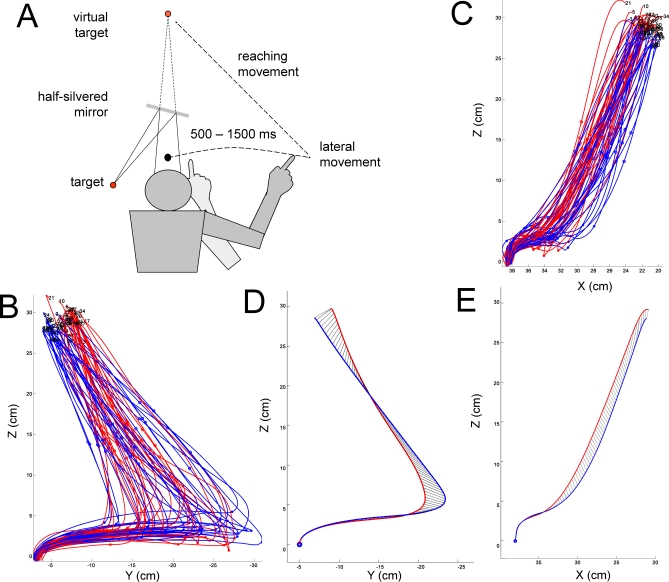
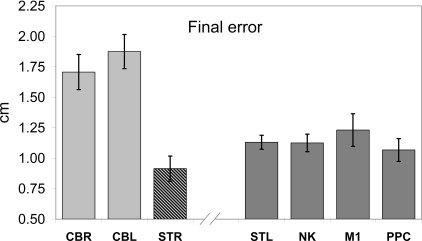
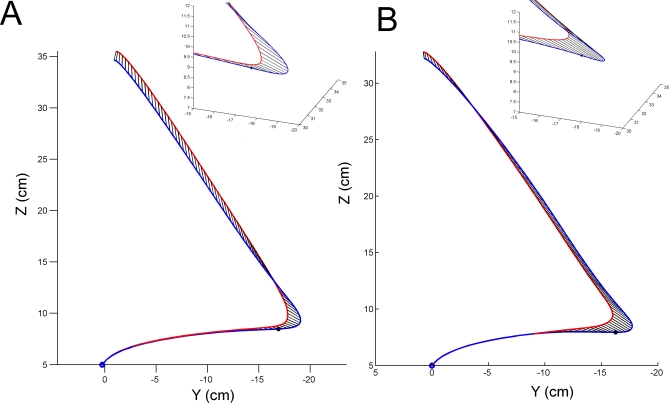
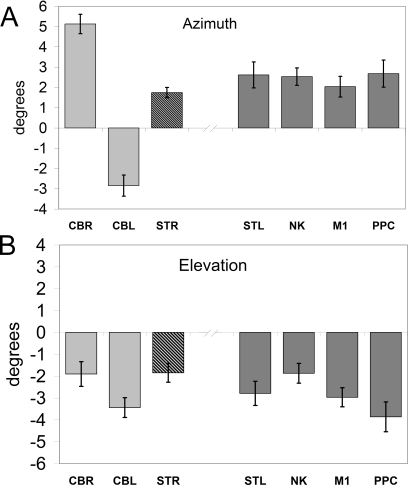
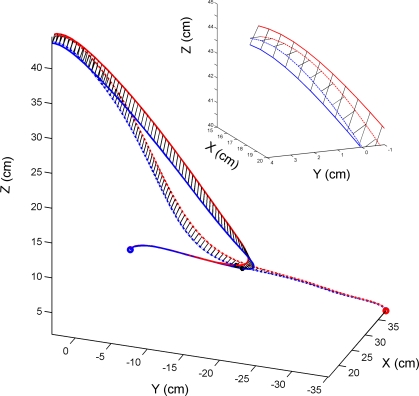
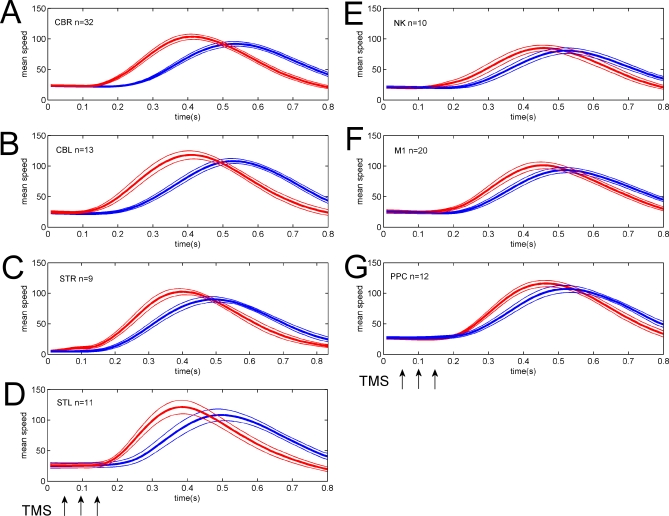
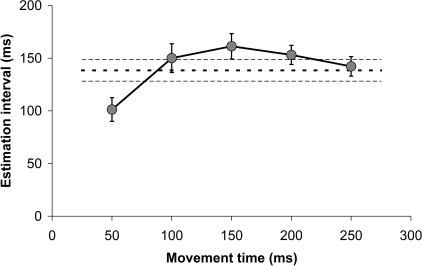
The cerebellum has been proposed to be a crucial component in the state estimation process that combines information from motor efferent and sensory afferent signals to produce a representation of the current state of the motor system. Such a state estimate of the moving human arm would be expected to be used when the arm is rapidly and skillfully reaching to a target. We now report the effects of transcranial magnetic stimulation (TMS) over the ipsilateral cerebellum as healthy humans were made to interrupt a slow voluntary movement to rapidly reach towards a visually defined target. Errors in the initial direction and in the final finger position of this reach-to-target movement were significantly higher for cerebellar stimulation than they were in control conditions. The average directional errors in the cerebellar TMS condition were consistent with the reaching movements being planned and initiated from an estimated hand position that was 138 ms out of date. We suggest that these results demonstrate that the cerebellum is responsible for estimating the hand position over this time interval and that TMS disrupts this state estimate.
Overview
The claims and statistics of this paper haven’t been checked yet.
Free: it reads the open-access text and checks the first 5 claims that cite a source we can check. Create a free account to check every claim.
Integrity signals
Registry
Cites
Statistics
Figures
Verification
Claims the paper makes
The claims and statistics of this paper haven’t been checked yet.
Free: it reads the open-access text and checks the first 5 claims that cite a source we can check. Create a free account to check every claim.
Claims other papers make about this one
Each is checked against this paper’s own text: does it say what the citing paper says it does?
The cited source says what the claim attributes to it.
In the citing paper
“The cerebellum has been proposed to be a crucial component in the state estimation process that combines information from motor efferent and sensory afferent signals to produce a representation of the current state of the motor system (Kawato, 1999; Miall et al., 2007).”
From Impulsive action: emotional impulses and their control (2014) · cites this paper as Miall et al., 2007
The cited source says what the claim attributes to it.
In the citing paper
“Finally, transient cerebellar disruption using transcranial magnetic stimulation induces movement perturbations that can be accounted for by the cerebellum making a prediction of the kinematic state of the arm at a lead time of 130 ms (Miall et al., 2007), as expected if the cerebellum implements a forward internal model.”
From Cerebellum, Predictions and Errors (2019) · cites this paper as Miall et al., 2007
The cited source says what the claim attributes to it.
In the citing paper
“Disrupting the lateral cerebellum with transcranial magnetic stimulation in healthy subjects alters on-line control of the ongoing movement (Miall et al., 2007).”
From The Forward Model: A Unifying Theory for the Role of the Cerebellum in Motor Control and Sense of Agency (2021) · cites this paper as Miall et al., 2007
Self-check
Percentages, sums and reported differences re-computed from the paper’s own numbers.
The self-check needs the paper’s full text.
Citations
Cites
An internal model for sensorimotor integration
Wolpert, D. M., Ghahramani, Z., & Jordan, M. I. (1995) · Science · doi:10.1126/science.7569931 · Cited by 3,553
Internal models for motor control and trajectory planning.
Kawato, M. (1999) · Current Opinion in Neurobiology · doi:10.1016/s0959-4388(99)00028-8 · Cited by 2,685 · cited 1×
“Another important postulated function is in inverse dynamic modelling, with a functional role for the cerebellum in generating motor commands rather than in predicting their outcome [7,33,40].”
Internal models in the cerebellum
Wolpert, D. M., Miall, R. C., & Kawato, M. (1998) · Trends in Cognitive Sciences · doi:10.1016/s1364-6613(98)01221-2 · Cited by 2,469 · cited 3×
“of the cerebellum [7,12,13], and the cerebellum has been specifically linked to state estimation [14,15], possibly in conjunction with the superior parietal cortex [4,16–18].”
Self-citationForward Models for Physiological Motor Control
Miall, R. C., & Wolpert, D. M. (1996) · Neural Networks · doi:10.1016/s0893-6080(96)00035-4 · Cited by 2,260 · cited 2×
“The process of translating an efferent copy of a motor command into predicted sensory reafference is encapsulated by the idea of a forward model [7,11].”
Self-citationComputational principles of movement neuroscience
Wolpert, D. M., & Ghahramani, Z. (2000) · Nature Neuroscience · doi:10.1038/81497 · Cited by 2,122 · cited 1×
“The state estimation process is likely to be iterative [8], with the current state being updated by an optimised weighting of afferent proprioceptive and visual information and by efferent motor commands.”
SPACE AND ATTENTION IN PARIETAL CORTEX
Colby, C. L., & Goldberg, M. E. (1999) · Annual Review of Neuroscience · doi:10.1146/annurev.neuro.22.1.319 · Cited by 1,710 · cited 1×
“The PPC also contributes to the representation of target positions [61], and hence it is important to distinguish loss-ofstate estimation from errors in localizing the remembered target.”
Cerebellar loops with motor cortex and prefrontal cortex of a nonhuman primate
Kelly, R. M., & Strick, P. L. (2003) · The Journal of Neuroscience · doi:10.1523/jneurosci.23-23-08432.2003 · Cited by 1,595 · cited 2×
“parietal cortex [55], which may hold a representation of the current state estimate [16], as well as from cortical motor areas, sending an efferent copy of descending commands [56].”
Forward modeling allows feedback control for fast reaching movements
Desmurget, M., & Grafton, S. (2000) · Trends in Cognitive Sciences · doi:10.1016/s1364-6613(00)01537-0 · Cited by 1,300 · cited 2×
“of the cerebellum [7,12,13], and the cerebellum has been specifically linked to state estimation [14,15], possibly in conjunction with the superior parietal cortex [4,16–18].”
Wolpert, D. M., & Flanagan, J. R. (2001) · Current Biology · doi:10.1016/s0960-9822(01)00432-8 · Cited by 1,257
Abnormalities in the awareness and control of action
Frith, C. D., Blakemore, S.-J., & Wolpert, D. M. (2000) · Philosophical Transactions of the Royal Society of London. Series B: Biological Sciences · doi:10.1098/rstb.2000.0734 · Cited by 1,200 · cited 1×
“It has also been proposed as a locus of the state estimate [16,17,50] and has been recently implicated in the sense of agency and the mental representation of [51,52]; agency is also dependent on forward modelling [53].”
Research works printed but not linked: 2
- Buneo CA Andersen RA 2006 The posterior parietal cortex: sensorimotor interface for the planning and online control of visually guided movements Neuropsychologia 44 2594 2606 16300804 · DOI · Paper page
- Critchley M 1953 Disorders of the body image Critchley M The parietal lobe New York Hafner Press 225 255
Cited by
Items 301–339 of 339
Hand reaching: From motor control to intention and awareness
Bardi, L., Coudé, G., & Desmurget, M. (2024) · Elsevier eBooks · doi:10.1016/b978-0-12-820480-1.00108-x
Author response: Inferring control objectives in a virtual balancing task in humans and monkeys
Sadeghi, M., Razavian, R. S., Bazzi, S., Chowdhury, R. H., Batista, A. P., Loughlin, P. J., & Sternad, D. (2024) · eLife · doi:10.7554/elife.88514.3.sa3
Zimmermann, M., & Lingnau, A. (2024) · Elsevier eBooks · doi:10.1016/b978-0-12-820480-1.00205-9
High cognitive violation of expectations is compromised in cerebellar ataxia
Daniel, L., Vakil, E., & Saban, W. (2025) · eLife · doi:10.7554/elife.105864.3
Disentangling acute motor deficits and adaptive responses evoked by the loss of cerebellar outputPreprint
Sinha, N., Israely, S., Harosh, O. B., Harel, R., Dewald, J. P. A., & Prut, Y. (2025) · eLife · doi:10.7554/elife.105152.1
Motor markers of congenital cerebellar hypoplasia
Straulino, E., Devita, M., Sartori, L., Ravelli, A., RUI, M. D., Bendini, M., Pini, L., Spoto, A., Betti, S., Marinuzzi, E., et al. (2025) · Neuropsychologia · doi:10.1016/j.neuropsychologia.2025.109121
High cognitive violation of expectations is compromised in cerebellar ataxiaPreprint
Leonardo Daniel, A., Vakil, E., & Saban, W. (2025) · eLife · doi:10.7554/elife.105864 · Cited by 3
Disentangling acute motor deficits and adaptive responses evoked by the loss of cerebellar outputPreprint
Sinha, N., Israely, S., Harosh, O. B., Harel, R., Dewald, J. P. A., & Prut, Y. (2025) · eLife · doi:10.7554/elife.105152.2
Disentangling acute motor deficits and adaptive responses evoked by the loss of cerebellar outputPreprint
Sinha, N., Israely, S., Harosh, O. B., Harel, R., Dewald, J. P. A., & Prut, Y. (2025) · eLife · doi:10.7554/elife.105152.3
High Cognitive Violation of Expectations is Compromised in Cerebellar AtaxiaPreprint
Daniel, L., Vakil, E., & Saban, W. (2025) · eLife · doi:10.7554/elife.105864.2
Babu, R., Matharu, R. K., Lo, C., & Block, H. J. (2025) · Journal of Neurophysiology · doi:10.1152/jn.00493.2024
eLife Assessment: High cognitive violation of expectations is compromised in cerebellar ataxia
Diedrichsen, J. (2025) · eLife · doi:10.7554/elife.105864.3.sa0
Additional file 5 of CSF1R antagonism results in increased supraspinal infiltration in EAE
Wang, M., Caryotakis, S. E., Smith, G., Nguyen, A. V., Pleasure, D., & Soulika, A. M. (2024) · Figshare · doi:10.6084/m9.figshare.26709314
Additional file 1 of CSF1R antagonism results in increased supraspinal infiltration in EAE
Wang, M., Caryotakis, S. E., Smith, G., Nguyen, A. V., Pleasure, D., & Soulika, A. M. (2024) · Figshare · doi:10.6084/m9.figshare.25658576
Additional file 3 of CSF1R antagonism results in increased supraspinal infiltration in EAE
Wang, M., Caryotakis, S. E., Smith, G., Nguyen, A. V., Pleasure, D., & Soulika, A. M. (2024) · Figshare · doi:10.6084/m9.figshare.26709308
Additional file 7 of CSF1R antagonism results in increased supraspinal infiltration in EAE
Wang, M., Caryotakis, S. E., Smith, G., Nguyen, A. V., Pleasure, D., & Soulika, A. M. (2024) · Figshare · doi:10.6084/m9.figshare.26709320
Additional file 8 of CSF1R antagonism results in increased supraspinal infiltration in EAE
Wang, M., Caryotakis, S. E., Smith, G., Nguyen, A. V., Pleasure, D., & Soulika, A. M. (2024) · Figshare · doi:10.6084/m9.figshare.26709323
Additional file 4 of CSF1R antagonism results in increased supraspinal infiltration in EAE
Wang, M., Caryotakis, S. E., Smith, G., Nguyen, A. V., Pleasure, D., & Soulika, A. M. (2024) · Figshare · doi:10.6084/m9.figshare.26709311
Additional file 2 of CSF1R antagonism results in increased supraspinal infiltration in EAE
Wang, M., Caryotakis, S. E., Smith, G., Nguyen, A. V., Pleasure, D., & Soulika, A. M. (2024) · Figshare · doi:10.6084/m9.figshare.25658669
Additional file 6 of CSF1R antagonism results in increased supraspinal infiltration in EAE
Wang, M., Caryotakis, S. E., Smith, G., Nguyen, A. V., Pleasure, D., & Soulika, A. M. (2024) · Figshare · doi:10.6084/m9.figshare.26709317
伊藤, 翔., & Itô, S. (2024) · Institutional Repositories DataBase (IRDB)
La construction du schéma corporel dans un cerveau en développement
Fontan, A. (2017) · theses.fr (ABES) · doi:10.70675/cd3cc99fz444az42edza564za00a8aa3e9f5 · Cited by 7
Torrecillos, F. (2016) · theses.fr (ABES) · doi:10.70675/aa66f432z8f86z4821za5e2z30e11c35f2a4
Gao, H., Fukuda, S., Futamura, M., Kawasaki, T., Hamada, N., Mori, N., Hosomi, K., & Hiraoka, K. (2026) · The Cerebellum · doi:10.1007/s12311-026-01992-6
Mikula, L. (2018) · theses.fr (ABES) · doi:10.70675/c3b55de0zd022z41ecz8ed7zd87fd79213ef · Cited by 1
Experimental validation of an information theoretic model of cognitive effort
Lam, S. Y. (2022) · theses.fr (ABES) · doi:10.70675/0da97426z292bz4ef5z9e97zee60262b89da
Marchetti, R. (2022) · theses.fr (ABES) · doi:10.70675/e0b6207dz067cz4c77zaac1z78180f13f628
Baune, N. A., Marchal, N., Frey, S. H., & Valyear, K. F. (2026) · NeuroImage · doi:10.1016/j.neuroimage.2026.122004
“Our results and interpretations also align with evidence implicating the cerebellum as critical for state estimation (Desmurget and Grafton, 2000; Diedrichsen et al., 2007; Kawato, 1999; Miall et al., 2007; Wolpert, Miall, et al., 1998).”
Yaghoubi, N., Shah, H. P., Berman, B. D., & Dexheimer, B. (2026) · Elsevier eBooks · doi:10.1016/b978-0-443-45068-6.00015-9
Memory Emerges as an Adaptive Temporal Basis in Delayed Sensorimotor DynamicsPreprint
Yamaki, N., & Churiki, T. (2026) · SSRN Electronic Journal · doi:10.2139/ssrn.7382206
Functional Objectives Shape the Temporal Organization of Memory in Delayed Sensorimotor SystemsPreprint
Yamaki, N., & Churiki, T. (2026) · SSRN Electronic Journal · doi:10.2139/ssrn.7403122
Ito, S. (2024) · Institutional Repositories DataBase (IRDB)
Functional Objectives Shape the Temporal Organization of Memory in Delayed Sensorimotor SystemsPreprint
Yamaki, N., & Churiki, T. (2026) · SSRN Electronic Journal · doi:10.2139/ssrn.7601194
Metadata
- Authors
- Miall, R. C., Christensen, L. O. D., Cain, O., & Stanley, J.
- Affiliations
- University of Birmingham (GB)
- University of Oxford (GB)
- Corresponding author
- Miall, R. Chris
- Venue
- PLoS Biology
- Publisher
- Public Library of Science (PLoS)
- Published
- 2007-11-27
- Volume
- 5
- Issue
- 11
- Pages
- e316
- ISSN
- 1544-9173 (ISSN-L)
- 1545-7885
- PMC
- PMC2229864
- OpenAlex
- W2109582716
- Cited by
- 338
- References
- 69
- Citations by year
- 2026: 10 · 2025: 20 · 2024: 26 · 2023: 20 · 2022: 13 · 2021: 21 · 2020: 15 · 2019: 22 · 2018: 20 · 2017: 15 · 2016: 17 · 2015: 17 · 2014: 17 · 2013: 28 · 2012: 20
- FWCI
- 5.68
- Type
- journal article
- Language
- en
- Open access
- gold
- doi.org
- Locations
- PLoS Biology (publishedVersion, cc-by)
- PubMed Central (publishedVersion, cc-by)
- PubMed (publishedVersion)
- University of Birmingham Institutional Research Archive (University of Birmingham) (acceptedVersion)
- DOAJ (DOAJ: Directory of Open Access Journals) (submittedVersion)
- University of Birmingham Research Portal (University of Birmingham) (submittedVersion, other-oa)
- Funders
- Wellcome Trust
- Topics
- Life Sciences › Neuroscience › Cognitive Neuroscience › Motor Control and Adaptation
- Life Sciences › Neuroscience › Neurology › Transcranial Magnetic Stimulation Studies
- Life Sciences › Neuroscience › Neurology › Vestibular and auditory disorders
- Keywords
- cerebellum, state estimation, reaching movements, transcranial magnetic stimulation, hand position estimation, motor control, motor planning, arm movement, sensory feedback
- MeSH terms
- Adult, Arm, Cerebellum, Female, Humans, Magnetics, Male, Middle Aged, Movement, Psychomotor Performance, Space Perception, Evoked Potentials, Motor, Transcranial Magnetic Stimulation
About these checks
Registry, retraction, Cites and statistics results are computed, not judged, with one exception: a printed reference that no index lists is read once by a model before it counts as a citation error. Claims are extracted by a model and kept only when their quote appears verbatim in the text; each cited source is then checked, with a model’s help, for whether it says what the claim relies on. Those verdicts can be wrong — read the claim’s quote and the cited source before relying on one.
Statistics and arithmetic are recomputed, not judged.
Confidence bands are shown only for fields calibrated on our annotated test set. None is calibrated yet, so no band is shown.
What counts as a claim ›How we measure confidence ›How we check this ›
Are you an author, or do you see a problem with this page? Request a review
Data sources
Bibliographic data: Semantic Scholar, OpenAlex, Crossref.
Contains information from the Semantic Scholar Academic Graph Datasets, made available under the ODC Attribution License (ODC-BY 1.0).
Semantic Scholar’s data is described in: Kinney, R., et al. (2023). The Semantic Scholar Open Data Platform. arXiv:2301.10140.
