

Dynamic Assignment and Maintenance of Positional Identity in the Ventral Neural Tube by the Morphogen Sonic Hedgehog
Open accessThe DOI matches its Crossref record; 84 of the 85 references it cites were found in a registry or an index.
Abstract
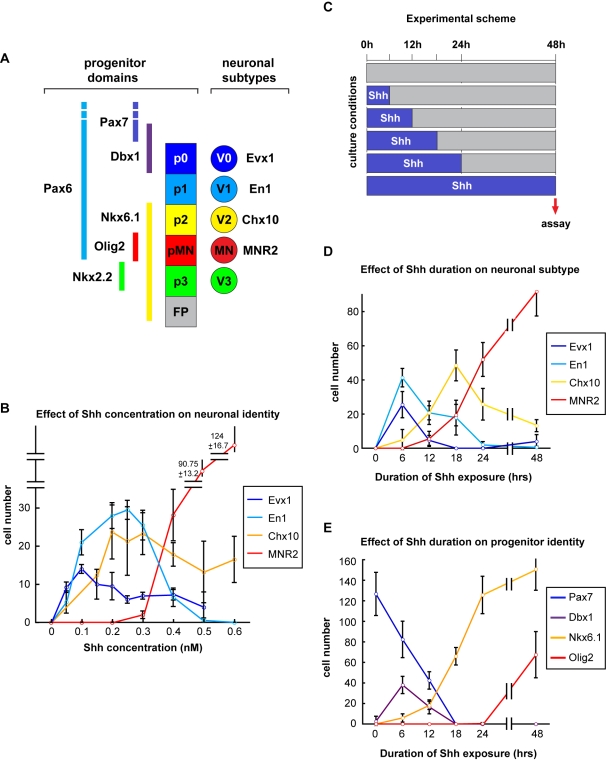
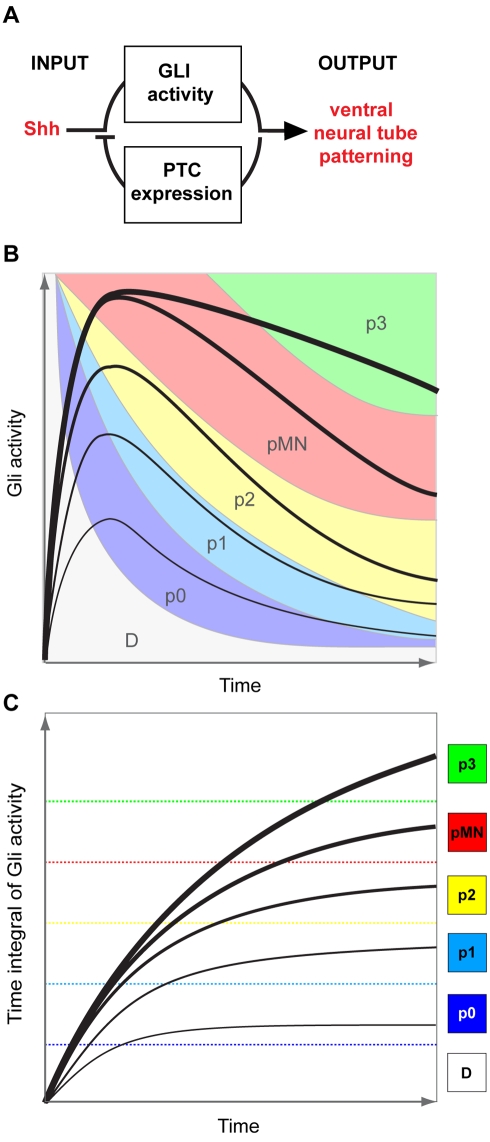
Morphogens are secreted signalling molecules that act in a graded manner to control the pattern of cellular differentiation in developing tissues. An example is Sonic hedgehog (Shh), which acts in several developing vertebrate tissues, including the central nervous system, to provide positional information during embryonic patterning. Here we address how Shh signalling assigns the positional identities of distinct neuronal subtype progenitors throughout the ventral neural tube. Assays of intracellular signal transduction and gene expression indicate that the duration as well as level of signalling is critical for morphogen interpretation. Progenitors of the ventral neuronal subtypes are established sequentially, with progressively more ventral identities requiring correspondingly higher levels and longer periods of Shh signalling. Moreover, cells remain sensitive to changes in Shh signalling for an extended time, reverting to antecedent identities if signalling levels fall below a threshold. Thus, the duration of signalling is important not only for the assignment but also for the refinement and maintenance of positional identity. Together the data suggest a dynamic model for ventral neural tube patterning in which positional information corresponds to the time integral of Shh signalling. This suggests an alternative to conventional models of morphogen action that rely solely on the level of signalling.
Overview
The claims and statistics of this paper haven’t been checked yet.
Free: it reads the open-access text and checks the first 5 claims that cite a source we can check. Create a free account to check every claim.
Integrity signals
Registry
Cites
Statistics
Figures
Verification
Claims the paper makes
The claims and statistics of this paper haven’t been checked yet.
Free: it reads the open-access text and checks the first 5 claims that cite a source we can check. Create a free account to check every claim.
Claims other papers make about this one
Each is checked against this paper’s own text: does it say what the citing paper says it does?
The cited source says what the claim attributes to it.
In the citing paper
“it emerged that the successive ventral to dorsal transcriptional domains are defined by the integrals over duration and intensity of Hh signalling, rather than simply on ‘morphogen concentration’, as always assumed previously.”
From Emerging properties of animal gene regulatory networks (2010) · cites this paper as [77]
Self-check
Percentages, sums and reported differences re-computed from the paper’s own numbers.
The self-check needs the paper’s full text.
Citations
Cites
Generalized lacZ expression with the ROSA26 Cre reporter strain
Soriano, P. (1999) · Nature Genetics · doi:10.1038/5007 · Cited by 4,859 · cited 2×
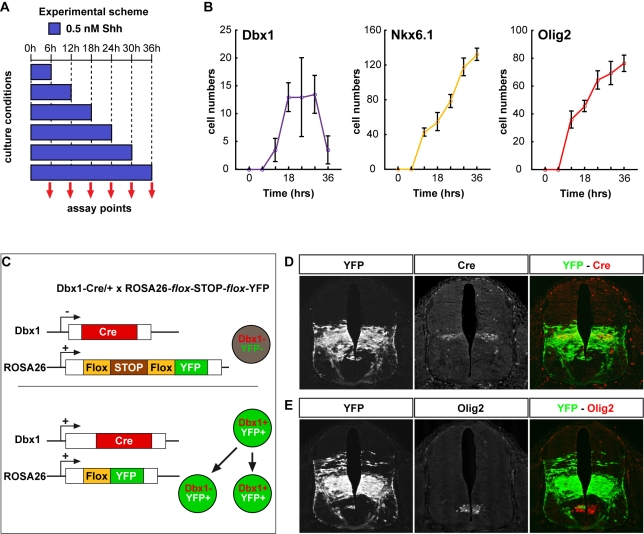
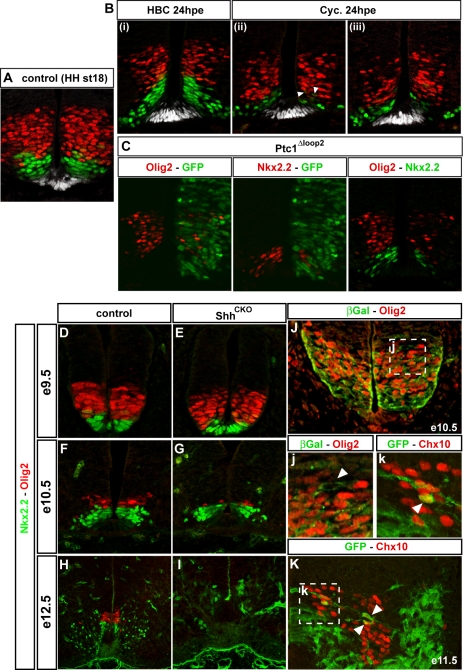
“5 mice embryos harbouring the Olig2cre allele and the ROSA26-flox-STOP-flox-lacZ or the ROSA26-floxSTOP-flox-GFP lineage tracers [51] revealed cells expressing the lineage marker within the pMN domain and their MN progeny (Figure 5J, 5K).”
BackgroundCre reporter strains produced by targeted insertion of EYFP and ECFP into the ROSA26 locus
Srinivas, S., Watanabe, T., Lin, C.-S., William, C. M., Tanabe, Y., Jessell, T. M., & Costantini, F. (2001) · BMC Developmental Biology · doi:10.1186/1471-213x-1-4 · Cited by 3,121 · cited 4×
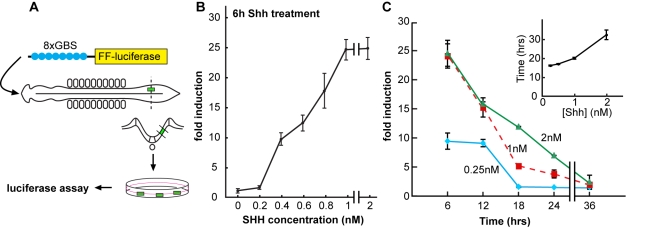
“PLoS Biology | www.plosbiology.org 2 June 2010 | Volume 8 | Issue 6 | e1000382 Hamilton (HH) stage 10 chick embryos in ovo electroporated with a Gli reporter (GBS-luc; Figure 1A; see Materials and Methods; [24]) and normalization plasmids were cultured in the presence of 0.1–2 nM Shh.”
BackgroundMethodInfluentialSonic hedgehog mediates the polarizing activity of the ZPA
Riddle, R. D., Johnson, R. L., Laufer, E., & Tabin, C. (1993) · Cell · doi:10.1016/0092-8674(93)90626-2 · Cited by 2,307 · cited 1×
“tube and underlying notochord [8,9,10,11,12,13] and spreads to”
Echelard, Y., Epstein, D. J., St-Jacques, B., Shen, L., Mohler, J., McMahon, J. A., & McMahon, A. P. (1993) · Cell · doi:10.1016/0092-8674(93)90627-3 · Cited by 2,154 · cited 1×
“tube and underlying notochord [8,9,10,11,12,13] and spreads to”
Neuronal specification in the spinal cord: inductive signals and transcriptional codes
Jessell, T. M. (2000) · Nature Reviews Genetics · doi:10.1038/35049541 · Cited by 2,089
Structure and function of the feed-forward loop network motif
Mangan, S., & Alon, U. (2003) · Proceedings of the National Academy of Sciences · doi:10.1073/pnas.2133841100 · Cited by 1,827 · cited 1×
“This strategy for morphogen dependent gene regulation has been referred to as ‘‘sequential cell context’’ [73] and represents an example of a feedforward loop [74].”
BackgroundAltered Neural Cell Fates and Medulloblastoma in Mouse patched Mutants
Goodrich, L. V., Milenković, L., Higgins, K. M., & Scott, M. P. (1997) · Science · doi:10.1126/science.277.5329.1109 · Cited by 1,696 · cited 1×
“The gradual adaptation of cells to Shh is controlled, at least in part, by the Shh mediated upregulation of Ptc1, the receptor for Shh that is also a negative regulator of the pathway [26,27,28,29,30,31].”
BackgroundEffects of oncogenic mutations in Smoothened and Patched can be reversed by cyclopamine
Taipale, J., Chen, J. K., Cooper, M. K., Wang, B., Mann, R. K., Milenkovic, L., Scott, M. P., & Beachy, P. A. (2000) · Nature · doi:10.1038/35023008 · Cited by 1,311 · cited 2×
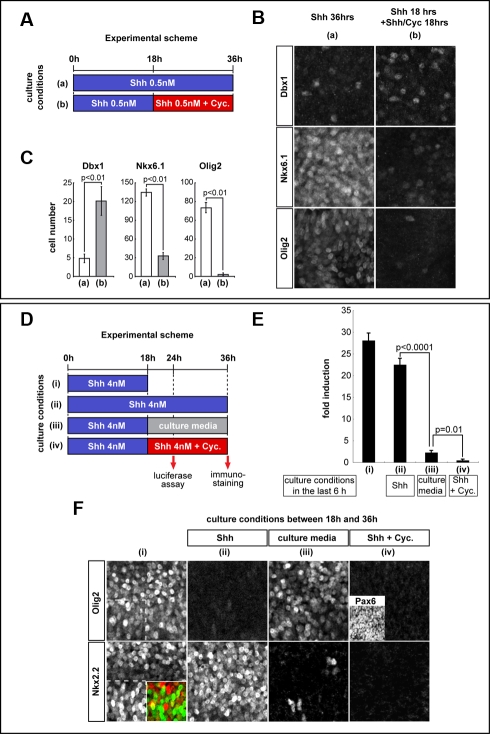
“To test this, we blocked Shh signalling in explants at different time points using the inhibitor cyclopamine [32,44], an antagonist of Smoothened, the essential intracellular transducer of the pathway [45,46].”
BackgroundMethodRobustness in bacterial chemotaxis
Alon, U., Surette, M. G., Barkai, N., & Leibler, S. (1999) · Nature · doi:10.1038/16483 · Cited by 1,129 · cited 1×
“The use of integral feedback control has been noted in several biological systems where it can act as a ‘‘gain’’ control to allow sensing over large concentration ranges or as a means to re-establish homeostasis after a system is disturbed [75,76,77].”
BackgroundBriscoe, J., Pierani, A., Jessell, T. M., & Ericson, J. (2000) · Cell · doi:10.1016/s0092-8674(00)80853-3 · Cited by 1,112
Self-citation
Cited by
Positional Information and Pattern Formation
Wolpert, L. (2016) · Current Topics in Developmental Biology · doi:10.1016/bs.ctdb.2015.11.008 · Cited by 649
Morphogen Gradients: From Generation to Interpretation
Rogers, K. W., & Schier, A. F. (2011) · Annual Review of Cell and Developmental Biology · doi:10.1146/annurev-cellbio-092910-154148 · Cited by 626
“…factors: (a) the concentration of Shh, (b) the length of exposure to Shh, (c) feedback loops between the pathway and target genes, and (d ) complex cross-regulatory interactions between target genes (Chamberlain et al. 2008; Dessaud et al. 2007, 2008, 2010; Lek et al. 2010; Ribes & Briscoe 2009).”
BackgroundInfluentialEmerging properties of animal gene regulatory networks
Davidson, E. H. (2010) · Nature · doi:10.1038/nature09645 · Cited by 579
Morphogen rules: design principles of gradient-mediated embryo patterning
Briscoe, J., & Small, S. (2015) · Development · doi:10.1242/dev.129452 · Cited by 490
Self-citationBalaskas, N., Ribeiro, A., Panovska, J., Dessaud, E., Sasai, N., Page, K. M., Briscoe, J., & Ribes, V. (2012) · Cell · doi:10.1016/j.cell.2011.10.047 · Cited by 463
“Previous in vitro studies predict that neural cells adapt to continuous exposure to Shh by progressively becoming less responsive (Dessaud et al., 2007; 2010; Jeong and McMahon, 2005).”
BackgroundResultInfluentialSelf-citation
Metadata
- Authors
- Dessaud, E., Ribes, V., Balaskas, N., Yang, L. L., Pierani, A., Kicheva, A., Novitch, B. G., Briscoe, J., & Sasai, N.
- Affiliations
- National Institute for Medical Research (GB)
- University of California, Los Angeles (US)
- Institut Jacques Monod (FR)
- Corresponding author
- Briscoe, James
- ORCID
- Venue
- PLoS Biology
- Publisher
- Public Library of Science (PLoS)
- Published
- 2010-06-01
- Volume
- 8
- Issue
- 6
- Pages
- e1000382
- ISSN
- 1544-9173 (ISSN-L)
- 1545-7885
- PMC
- PMC2879390
- OpenAlex
- W1975129643
- Cited by
- 203
- References
- 85
- Citations by year
- 2026: 4 · 2025: 8 · 2024: 7 · 2023: 7 · 2022: 9 · 2021: 10 · 2020: 15 · 2019: 10 · 2018: 9 · 2017: 13 · 2016: 12 · 2015: 23 · 2014: 13 · 2013: 15 · 2012: 23
- FWCI
- 8.20
- Type
- journal article
- Language
- en
- Open access
- gold
- doi.org
- Locations
- PLoS Biology (publishedVersion, cc-by)
- Europe PMC (PubMed Central) (publishedVersion, cc-by)
- PubMed Central (publishedVersion, cc-by)
- PubMed (publishedVersion)
- DOAJ (DOAJ: Directory of Open Access Journals) (submittedVersion, cc-by-sa)
- eScholarship (California Digital Library) (submittedVersion)
- eScholarship (California Digital Library) (submittedVersion, cc-by)
- Figshare (submittedVersion, cc-by)
- Funders
- March of Dimes Foundation
- Whitehall Foundation
- Muscular Dystrophy Association
- Association pour la Recherche sur le Cancer
- Wellcome Trust (219939, 080630)
- Centre National de la Recherche Scientifique
- Mochida Memorial Foundation for Medical and Pharmaceutical Research
- Medical Research Council
- National Institute of Neurological Disorders and Stroke (R01NS053976, NS053976)
- Topics
- Life Sciences › Biochemistry, Genetics and Molecular Biology › Molecular Biology › Hedgehog Signaling Pathway Studies
- Life Sciences › Biochemistry, Genetics and Molecular Biology › Molecular Biology › Developmental Biology and Gene Regulation
- Life Sciences › Neuroscience › Developmental Neuroscience › Neurogenesis and neuroplasticity mechanisms
- Keywords
- Sonic hedgehog, morphogen signalling, ventral neural tube, positional identity, embryonic patterning, signal duration, signal level, signal transduction, central nervous system development
- MeSH terms
- Animals, Vertebrates, Signal Transduction, Hedgehog Proteins, Neural Tube
About these checks
Registry, retraction, Cites and statistics results are computed, not judged, with one exception: a printed reference that no index lists is read once by a model before it counts as a citation error. Claims are extracted by a model and kept only when their quote appears verbatim in the text; each cited source is then checked, with a model’s help, for whether it says what the claim relies on. Those verdicts can be wrong — read the claim’s quote and the cited source before relying on one.
Statistics and arithmetic are recomputed, not judged.
Confidence bands are shown only for fields calibrated on our annotated test set. None is calibrated yet, so no band is shown.
What counts as a claim ›How we measure confidence ›How we check this ›
Are you an author, or do you see a problem with this page? Request a review
How to cite
Cite CoChat for the checks on this page, and the paper for its own findings.
- This page
- CoChat. (2026). Citation check: Dynamic Assignment and Maintenance of Positional Identity in the Ventral Neural Tube by the Morphogen Sonic Hedgehog. https://app.cochat.ai/papers/10.1371/journal.pbio.1000382
- The paper
- Dessaud, E., Ribes, V., Balaskas, N., Yang, L. L., Pierani, A., Kicheva, A., Novitch, B. G., Briscoe, J., & Sasai, N. (2010). Dynamic Assignment and Maintenance of Positional Identity in the Ventral Neural Tube by the Morphogen Sonic Hedgehog. PLoS Biology. https://doi.org/10.1371/journal.pbio.1000382
Data sources
Bibliographic data: Semantic Scholar, OpenAlex, Crossref.
Contains information from the Semantic Scholar Academic Graph Datasets, made available under the ODC Attribution License (ODC-BY 1.0).
Semantic Scholar’s data is described in: Kinney, R., et al. (2023). The Semantic Scholar Open Data Platform. arXiv:2301.10140.
