

Localizing Recent Adaptive Evolution in the Human Genome.
Open accessThe DOI matches its Crossref record; 65 of the 66 references it cites were found in a registry or an index.
Abstract
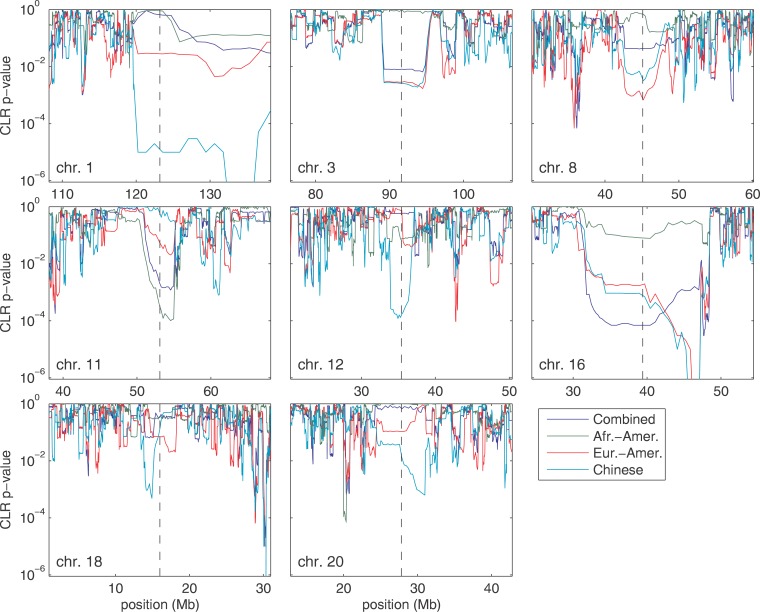
Identifying genomic locations that have experienced selective sweeps is an important first step toward understanding the molecular basis of adaptive evolution. Using statistical methods that account for the confounding effects of population demography, recombination rate variation, and single-nucleotide polymorphism ascertainment, while also providing fine-scale estimates of the position of the selected site, we analyzed a genomic dataset of 1.2 million human single-nucleotide polymorphisms genotyped in African-American, European-American, and Chinese samples. We identify 101 regions of the human genome with very strong evidence (p < 10(-5)) of a recent selective sweep and where our estimate of the position of the selective sweep falls within 100 kb of a known gene. Within these regions, genes of biological interest include genes in pigmentation pathways, components of the dystrophin protein complex, clusters of olfactory receptors, genes involved in nervous system development and function, immune system genes, and heat shock genes. We also observe consistent evidence of selective sweeps in centromeric regions. In general, we find that recent adaptation is strikingly pervasive in the human genome, with as much as 10% of the genome affected by linkage to a selective sweep.
Overview
The claims and statistics of this paper haven’t been checked yet.
Free: it reads the open-access text and checks the first 5 claims that cite a source we can check. Create a free account to check every claim.
Integrity signals
Registry
Cites
Statistics
Figures
Verification
Claims the paper makes
The claims and statistics of this paper haven’t been checked yet.
Free: it reads the open-access text and checks the first 5 claims that cite a source we can check. Create a free account to check every claim.
Claims other papers make about this one
Each is checked against this paper’s own text: does it say what the citing paper says it does?
The source backs part of the claim, not all of it — or backs it for a different population, condition or comparison.
In the citing paper
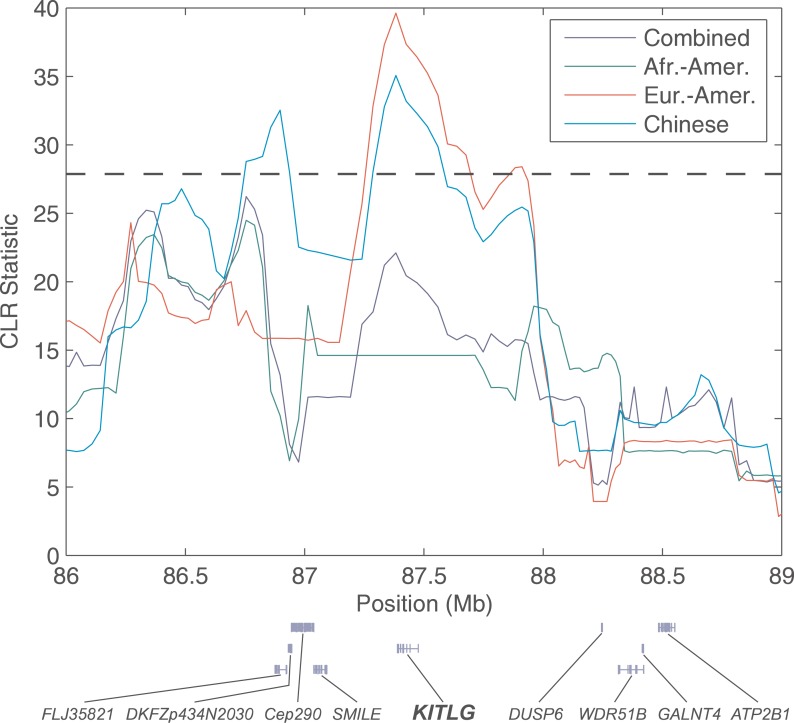
“Some genes, such as KITLG, have derived alleles (associated with lighter pigmentation) that reach high frequencies both in European and East Asian populations and likely began to be selected in a proto Eurasian population (Lao et al. 2007;Williamson et al. 2007;Pickrell et al. 2009).”
From The timing of pigmentation lightening in Europeans (2013) · cites this paper as Williamson et al. 2007
Experimental — accuracy not yet measuredThe cited source says what the claim attributes to it.
In the citing paper
“The SLC30A9 gene (chr4: 41,990,502–42,090,461; GRCh38) has been repeatedly reported as a top candidate region for positive selection in several genome-wide scans of selection, mostly in East Asian populations [14,16–20].”
From Human genetic adaptation related to cellular zinc homeostasis (2023) · cites this paper as [20]
The cited source says what the claim attributes to it.
In the citing paper
“The motivation for this study was the previous detection of strong signatures of positive selection in the SLC30A9 region [13,14,16,17,20,25].”
From Human genetic adaptation related to cellular zinc homeostasis (2023) · cites this paper as [20]
The check wasn’t confident either way, so it gives no verdict — never disputed.
In the citing paper
“Analysis of SNP variation between diverse human populations shows evidence of selection of the EDAR locus in East Asian and American populations [56],[57].”
From Zebrafish eda and edar Mutants Reveal Conserved and Ancestral Roles of Ectodysplasin Signaling in Vertebrates (2008) · cites this paper as [57]
Experimental — accuracy not yet measured
Self-check
Percentages, sums and reported differences re-computed from the paper’s own numbers.
The self-check needs the paper’s full text.
Citations
Cites
Controlling the False Discovery Rate: A Practical and Powerful Approach to Multiple Testing
Benjamini, Y., & Hochberg, Y. (1995) · Journal of the Royal Statistical Society Series B: Statistical Methodology · doi:10.1111/j.2517-6161.1995.tb02031.x · Cited by 109,482 · cited 3×
“Also, the present analysis is one of the first to fully correct for the bias introduced by SNP discovery protocols, and we account for the effects of multiple hypothesis testing using a false discovery rate approach [23,24].”
MethodStatistical significance for genomewide studies
Storey, J. D., & Tibshirani, R. (2003) · Proceedings of the National Academy of Sciences · doi:10.1073/pnas.1530509100 · Cited by 9,692 · cited 4×
“One modification to the approach outlined by Storey and Tishirani [24] is the method we use for selecting the tuning parameter, k.”
MethodInfluentialThe Neutral Theory of Molecular Evolution
Kimura, M. (1979) · Scientific American · doi:10.1038/scientificamerican1179-98 · Cited by 7,666
The Neutral Theory of Molecular Evolution
Kimura, M. (1983) · Cambridge University Press eBooks · doi:10.1017/cbo9780511623486 · Cited by 6,347
A haplotype map of the human genome
The International HapMap Consortium (2005) · Nature · doi:10.1038/nature04226 · Cited by 5,858
THE GENETIC BASIS OF EVOLUTIONARY CHANGE
Felsenstein, J. (1975) · Evolution · doi:10.1111/j.1558-5646.1975.tb00851.x · Cited by 3,912
A novel MHC class I-like gene is mutated in patients with hereditary haemochromatosis
Feder, J. N., Gnirke, A., Thomas, W., Tsuchihashi, Z., Ruddy, D. A., Basava, A., Dormishian, F., Domingo, R., Ellis, M. C., Fullan, A., et al. (1996) · Nature Genetics · doi:10.1038/ng0896-399 · Cited by 3,664 · cited 1×
“HFE contains a relatively high-frequency recessive mutation, C282Y, which causes hereditary hemochromatosis [44], an iron-overload disorder.”
BackgroundA Map of Recent Positive Selection in the Human Genome
Voight, B. F., Kudaravalli, S., Wen, X., & Pritchard, J. K. (2006) · PLoS Biology · doi:10.1371/journal.pbio.0040072 · Cited by 2,893
Generating samples under a Wright–Fisher neutral model of genetic variation
Hudson, R. R. (2002) · Bioinformatics · doi:10.1093/bioinformatics/18.2.337 · Cited by 2,364 · cited 1×
“Because allele frequencies of linked SNPs are not statistically independent, we determine the null (selectively neutral) distributions of all test statistics using coalescent simulations [60].”
MethodThe UCSC Table Browser data retrieval tool
Karolchik, D. (2004) · Nucleic Acids Research · doi:10.1093/nar/gkh103 · Cited by 2,316 · cited 1×
“are then recorded along with the genomic position of the center of the window. We repeat this procedure for every tenth window of 200 SNPs across all autosomes. Chromosomal positions of genes and genetic map estimates of local recombination rates were retrieved using the July 2003 build of the human genome on the Univ…”
Method
Cited by
Items 401–500 of 506
Coalescent theory and species trees
Yang, Z. (2014) · Oxford University Press eBooks · doi:10.1093/acprof:oso/9780199602605.003.0009 · Cited by 1
Global Landscapes of Human Phenotypic Variation in Inherited Traits
Kimura, R. (2017) · Evolutionary studies · doi:10.1007/978-4-431-56603-8_11 · Cited by 1
Evidence of Contemporary Modern Human Evolution Contained Within the Human Genome
Platter, B. E. (2009) · Open ULeth Scholarship (OPUS) (University of Lethbridge) · Cited by 2
The cultured brain: interplay of genes, brain, and culture
Ali, F., & Penney, T. B. (2012) · Oxford University Press eBooks · doi:10.1093/oxfordhb/9780199541850.013.0004 · Cited by 1
A red queen model of personality
Roy, D. J., & Roy, B. (2018) · Evolution Mind and Behaviour · doi:10.1556/2050.2018.0001 · Cited by 3
“More generally, there is accumulating evidence that there has been much selection acting on human genes in even recent times (Voight et al., 2006; Williamson et al., 2007) and that much of this appears to involve genes expressed in the brain (Voight et al.”
BackgroundEl Transhumanismo: El Triunfo del culturalismo y el fin de la selección natural
Llanos, H. (2021) · Futuro Hoy · doi:10.52749/fh.v2i2.2
On Identifying Signatures of Positive Selection in Human Populations: A Dissertation
Crisci, J. L. (2013) · The Journal of the American Medical Association (JAMA) Network (American Medical Association) · doi:10.13028/m2q88f · Cited by 1
“To detect recent selective sweeps in human populations we used ascertainmentcorrected polymorphism data from Perlegen, in African-American, European-American, and Chinese populations (Williamson et al. 2007).”
MethodInfluentialGene Evolution and Human Adaptation
Harris, E. E. (2013) · Wiley eBooks · doi:10.1002/9780470015902.a0020773.pub2 · Cited by 2
Gers, M. (2011) · Open Access Victoria University of Wellington | Te Herenga Waka (Figshare) · doi:10.26686/wgtn.16993045.v1 · Cited by 1
Identifying Regions of the Human Genome that Exhibit Evidence of Positive Selection
Kimura, R., & Ohashi, J. (2013) · Wiley eBooks · doi:10.1002/9780470015902.a0020850.pub2 · Cited by 1
Yang, Z. (2014) · Oxford University Press eBooks · doi:10.1093/acprof:oso/9780199602605.003.0004 · Cited by 1
Gene Evolution and Human Adaptation
Harris, E. E. (2008) · Wiley eBooks · doi:10.1002/9780470015902.a0020773 · Cited by 1
Diet, Changes in Gene Expression and Human Evolution
Luca, F. (2012) · Wiley eBooks · doi:10.1002/9780470015902.a0023644
Jordan, I. K., & Koonin, E. V. (2008) · Wiley eBooks · doi:10.1002/9780470015902.a0005296.pub2
Positive Selection and the Evolution of Prodynorphin
Rockman, M. V. (2008) · Wiley eBooks · doi:10.1002/9780470015902.a0020790
Searching for genes involved in the adaptation of Drosophila melanogaster to the European climate
Svetec, N. (2009) · Elektronische Hochschulschriften der LMU München (Ludwig-Maximilians-Universität München) · doi:10.5282/edoc.10047
Ross‐Ibarra, J., Wright, S., Foxe, J. P., Kawabe, A., DeRose-Wilson, L., Gos, G., Charlesworth, D., & Gaut, B. S. (2010) · PLoS ONE · doi:10.1371/annotation/83559ebe-03be-4bf7-a1b8-b34b2903742a
Genome Sciences and Anthropology
Oota, H. (2007) · Anthropological Science (Japanese Series) · doi:10.1537/asj.115.73
To be Free or not to be Free: A Theory Regarding Mans Question of Free Will
Wall, R. D. (2012) · NeuroQuantology · doi:10.14704/nq.2013.11.2.589
Correction: Gene Regulation in Primates Evolves under Tissue-Specific Selection Pressures
Blekhman, R., Oshlack, A., Chabot, A. E., Smyth, G. K., & Gilad, Y. (2009) · PLoS Genetics · doi:10.1371/annotation/06105fdb-f0fa-4fe2-88d0-db9f6036509f
Natural selection associated with color vision defects in some population groups of Eurasia
Evsyukov, A. N. (2014) · Russian Journal of Genetics · doi:10.1134/s1022795414010049
Expressionsanalysen geprägter Gene in der Prader-Willi-/Angelman-Syndrom-Region
Wawrzik, M. (2010) · DuEPublico (University of Duisburg-Essen)
Casals, F., Laayouni, H., Montanucci, L., Lazarus, R. M., & Bertranpetit, J. (2011)
Tools and Approaches for an End-to-End Expression Array Analysis
Platts, A. E., & Krawetz, S. A. (2008) · Humana Press eBooks · doi:10.1007/978-1-59745-440-7_13
“Distinct populations can, for instance, share genetic traits that will differentiate their expression profiles [ 26 ] relative to the species average.”
BackgroundMaretty, L., Sibbesen, J. A., & Krogh, A. (2014)
On Characterizing Adaptive Events Unique to Modern Humans Authors
Crisci, J. L., Wong, A., Good, J. M., & Jensen, J. D. (2011)
Sequencing and analysis of an Irish human
Tong, P., Prendergast, J. G. D., Lohan, A. J., Farrington, S. M., Cronin, S., Friel, N., Bradley, D. G., Hardiman, O. M., Evans, A. C. O., Wilson, J. F., et al. (2010)
On Characterizing Adaptive Events Unique to Modern
Crisci, J. L., Wong, A., Good, J. M., & Jensen, J. D. (2011)
comparative and population genetic data
Zhai, W., Nielsen, R., & Slatkin, M. (2008)
Self-citationBates, T. C. (2013) · Princeton University Press eBooks · doi:10.2307/j.ctt3fgxz9.14
Evolutionary Genetics of Coloration in Primates and Other Vertebrates
Mundy, N. I. (2011) · Primatology monographs · doi:10.1007/978-4-431-53892-9_14
Using exome sequencing to study adaptive evolution in non-human primates and human populations
George, R. D. (2012) · ResearchWorks at the University of Washington (University of Washington)
Disease prevalence and conformity
Murray, D. R. (2009) · cIRcle (University of British Columbia) · doi:10.14288/1.0067556
Constructing genomic maps of positive selection in humans: Where do we go from here?
Akey, J. M. (2009) · Genome Research · doi:10.1101/gr.086652.108 · Cited by 426
a complex demographic history and identify candidate genes under positive natural selection 2
Hsieh, P., Veeramah, K. R., Lachance, J., Tishkoff, S. A., Wall, J. D., Hammer, M. F., & Gutenkunst, R. N. (2015)
The evolution of the repertoire and structure of G protein-coupled receptors
Schöneberg, T., Schröck, K., Stäubert, C., & Russ, A. (2010) · Cambridge University Press eBooks · doi:10.1017/cbo9780511760334.002
Yang, Z. (2014) · Oxford University Press eBooks · doi:10.1093/acprof:oso/9780199602605.003.0007 · Cited by 1
Comparison of phylogenetic methods and tests on trees
Yang, Z. (2014) · Oxford University Press eBooks · doi:10.1093/acprof:oso/9780199602605.003.0005
Evaluation of MERTK evolution and efferocytosis signalling
Evans, A. (2016) · Scholarship@Western (Western University)
Kim, S. A., Kim, S.-R., & Yoo, Y. J. (2016) · IEEE International Conference on Bioinformatics and Biomedicine (BIBM) · doi:10.1109/bibm.2016.7822784
Onuki, R., Yamaguchi, R., Shibuya, T., Kanehisa, M. I., & Goto, S. (2017) · PLoS ONE · doi:10.1371/journal.pone.0176530
Understanding skin color variations as an adaptation by detecting gene-environment interactions
Anno, S., Ohshima, K., & Abe, T. (2016) · doi:10.4032/9789814669641
Detecting Natural Selection in the Genome
Kelley, J. L. (2017) · Oxford University Press eBooks · doi:10.1093/obo/9780199941728-0088
Identification of Deleterious and Disease Alleles in a General Population and Preterm Labor Patients
Chun, S. (2012) · Open Scholarship Institutional Repository (Washington University in St. Louis) · doi:10.7936/k7tq5zjk
Chapter 4. Tracing domestication and selection in animal genomes
Qanbari, S., & Tapio, M. (2017) · Wageningen Academic Publishers eBooks · doi:10.3920/978-90-8686-850-6_4
Genetic Footprints of Natural Selection and Drift in Human Evolution
Somel, M., & Sezgın, E. (2010) · Hacettepe Journal of Biology and Chemistry
Genomic analysis of divergently selected experimental lines in rabbit
Sosa‐Madrid, B. S. (2020) · RiuNet (Universitat Politècnica de València) · doi:10.4995/thesis/10251/141376
Fatakia, S. N. (2017) · bioRxiv (Cold Spring Harbor Laboratory) · doi:10.1101/213124
“gain-of-function (adaptation) or loss-of-function [48, 49] or perhaps remain benign without any perceptible change at the genome-level [50, 51].”
BackgroundNatural Selection, Genetic Variation, and Human Diversity
Emery, L. S., & Akey, J. M. (2021) · Springer eBooks · doi:10.1007/978-3-030-61646-5_9
Rowan, T. N. (2020) · MOspace Institutional Repository (University of Missouri) · doi:10.32469/10355/81564
Carlson, J. (2018) · Deep Blue (University of Michigan)
Lohmueller, K. E. (2010) · eCommons (Cornell University)
Mitchell‐Olds, T. (2008) · Faculty Opinions – Post-Publication Peer Review of the Biomedical Literature · doi:10.3410/f.1120459.576660
Yang, Z. (2014) · Oxford University Press eBooks · doi:10.1093/acprof:oso/9780199602605.003.0006
(2014) · Elsevier eBooks · doi:10.1016/b978-0-12-800165-3.00023-0
Yang, Z. (2014) · Oxford University Press eBooks · doi:10.1093/acprof:oso/9780199602605.003.0013
Molecular clock and estimation of species divergence times
Yang, Z. (2014) · Oxford University Press eBooks · doi:10.1093/acprof:oso/9780199602605.003.0010
(2007) · Nature Reviews Genetics · doi:10.1038/nrg2155
Stephan, W., & Hörger, A. C. (2019) · Springer eBooks · doi:10.1007/978-3-662-59428-5_8
Yang, Z. (2014) · Oxford University Press eBooks · doi:10.1093/acprof:oso/9780199602605.003.0008
Phylogeny reconstruction: overview
Yang, Z. (2014) · Oxford University Press eBooks · doi:10.1093/acprof:oso/9780199602605.003.0003
Random genetic drift and “ deterministic” selection
(2009) · CRC Press eBooks · doi:10.1201/9781420078879.ch6
Detect Positive Selection in Type IIL Restriction Enzyme Using PAML
Pu, Y. (2018) · doi:10.18130/v3x63b48p
“By long-range LD, widespread signals for recent positive selection were found in the human genome (Voight et al., 2006; Sabeti et al., 2007; Williamson et al., 2007).”
Background(2007) · Nature Genetics · doi:10.1038/ng0707-825
Understanding Skin Color Variations as an Adaptation by Detecting Gene–Environment Interactions
Anno, S., Ohshima, K., & Abe, T. (2016) · Pan Stanford eBooks · doi:10.1201/b19969-2
(2014) · Oxford University Press eBooks · doi:10.1093/acprof:oso/9780199602605.002.0005
(2014) · Oxford University Press eBooks · doi:10.1093/acprof:oso/9780199602605.002.0003
(2014) · Oxford University Press eBooks · doi:10.1093/acprof:oso/9780199602605.002.0004
Brāzma, A. (2023) · Oxford University Press eBooks · doi:10.1093/oso/9780192871947.003.0006
(2023) · Oxford University Press eBooks · doi:10.1093/oso/9780192871947.002.0004
Brāzma, A. (2023) · Oxford University Press eBooks · doi:10.1093/oso/9780192871947.003.0001
Brāzma, A. (2023) · Oxford University Press eBooks · doi:10.1093/oso/9780192871947.003.0007
Brāzma, A. (2023) · Oxford University Press eBooks · doi:10.1093/oso/9780192871947.003.0010
Brāzma, A. (2023) · Oxford University Press eBooks · doi:10.1093/oso/9780192871947.003.0005
Brāzma, A. (2023) · Oxford University Press eBooks · doi:10.1093/oso/9780192871947.003.0002
Brāzma, A. (2023) · Oxford University Press eBooks · doi:10.1093/oso/9780192871947.003.0009
(2023) · Oxford University Press eBooks · doi:10.1093/oso/9780192871947.002.0005
(2023) · Oxford University Press eBooks · doi:10.1093/oso/9780192871947.002.0008
Brāzma, A. (2023) · Oxford University Press eBooks · doi:10.1093/oso/9780192871947.003.0004
Evolution as a Ratchet of Information
Brāzma, A. (2023) · Oxford University Press eBooks · doi:10.1093/oso/9780192871947.003.0008
(2023) · Oxford University Press eBooks · doi:10.1093/oso/9780192871947.002.0003
Brāzma, A. (2023) · Oxford University Press eBooks · doi:10.1093/oso/9780192871947.003.0003
Santos, J. R. L., Sun, W., Befus, A. D., & Marcet‐Palacios, M. (2024) · bioRxiv (Cold Spring Harbor Laboratory) · doi:10.1101/2024.05.03.592313
“Moreover, comprehensive studies have identified 101 specific regions within 100 kb of known genes in the human genome that have recently undergone adaptive evolution, including genes in the immune system and heat shock genes(56).”
BackgroundEvolutionäre Verhaltenswissenschaften
Međedović, J. M. (2024) · Springer eBooks · doi:10.1007/978-3-031-52846-0_3
Dreams and dreaming: Stone Age defence mechanisms or by-products of sleep?
Mbũgua, K. (2025) · South African Journal of Philosophy · doi:10.1080/02580136.2025.2465135
“A 2007 genome study found that recent adaptations are widespread, with a linkage to a selective sweep affecting up to 10% of the human genome (Williamson et al. 2007).”
Faroese whole genomes provide insight into ancestry and recent selection
Hamid, I., Mortensen, Ó., Refoyo-Martínez, A., Lydersen, L. N., Emde, A., Hendershott, M. C., Apol, K. D., Andorsdóttir, G., Meisner, J., Wasik, K. A., et al. (2026) · eLife · doi:10.7554/elife.107428.3 · Cited by 1
Neutral Evolution, Population Genetic Tests of
Huber, C. D., & Lohmueller, K. E. (2025) · Elsevier eBooks · doi:10.1016/b978-0-443-15750-9.00161-0
Faroese Whole Genomes Provide Insight into Ancestry and Recent SelectionPreprint
Hamid, I., Mortensen, Ó., Refoyo-Martínez, A., Lydersen, L. N., Emde, A., Hendershott, M. C., Apol, K. D., Andorsdóttir, G., Meisner, J., Wasik, K. A., et al. (2025) · eLife · doi:10.7554/elife.107428.1
Faroese whole genomes provide insight into ancestry and recent selectionPreprint
Hamid, I., Mortensen, Ó., Refoyo-Martínez, A., Lydersen, L. N., Emde, A., Hendershott, M. C., Apol, K. D., Andorsdóttir, G., Meisner, J., Wasik, K. A., et al. (2026) · eLife · doi:10.7554/elife.107428
In Defense of the “Orthodoxy”: Who We Really Are and Why Some Folks Have a Problem with It
Graves, J. L. (2020) · Emerald Group Publishing Limited eBooks · doi:10.1108/978-1-64802-133-620251009
Herrera, R. J., & Garcia‐Bertrand, R. (2025) · Elsevier eBooks · doi:10.1016/b978-0-443-28919-4.00003-9
Mahdabi, E. R., Esmailizadeh, A., Mehrgardi, A. A., & Fozi, M. A. (2021) · Figshare · doi:10.6084/m9.figshare.16599608
Faroese Whole Genomes Provide Insight into Ancestry and Recent SelectionPreprint
Hamid, I., Mortensen, Ó., Refoyo-Martínez, A., Lydersen, L. N., Emde, A., Hendershott, M. C., Apol, K. D., Andorsdóttir, G., Meisner, J., Wasik, K. A., et al. (2026) · eLife · doi:10.7554/elife.107428.2
Metadata
- Authors
- Williamson, S. H., Hubisz, M. J., Clark, A. G., Payseur, B. A., Bustamante, C. D., & Nielsen, R.
- Affiliations
- Cornell University (US)
- University of Copenhagen (DK)
- Corresponding author
- Williamson, Scott H
- Venue
- PLoS Genetics
- Publisher
- Public Library of Science (PLoS)
- Published
- 2007-06-01
- Volume
- 3
- Issue
- 6
- Pages
- e90
- ISSN
- 1553-7390 (ISSN-L)
- 1553-7404
- PMC
- PMC1885279
- OpenAlex
- W2010131461
- Semantic Scholar
- 743101193237dd8766b23c8c22d8f2062b047af6
- Cited by
- 507
- References
- 66
- Citations by year
- 2026: 7 · 2025: 13 · 2024: 9 · 2023: 24 · 2022: 8 · 2021: 14 · 2020: 17 · 2019: 8 · 2018: 19 · 2017: 19 · 2016: 26 · 2015: 26 · 2014: 42 · 2013: 28 · 2012: 37
- FWCI
- 29.93
- Type
- journal article
- Language
- en
- Open access
- gold
- doi.org
- Licence
- cc-by
- Locations
- PLoS Genetics (publishedVersion, cc-by)
- Europe PMC (PubMed Central) (publishedVersion, cc-by)
- PubMed Central (publishedVersion, cc-by)
- PubMed (publishedVersion)
- eScholarship (California Digital Library) (submittedVersion, cc-by)
- DOAJ (DOAJ: Directory of Open Access Journals) (submittedVersion, cc-by-sa)
- eScholarship (California Digital Library) (submittedVersion)
- Figshare (submittedVersion, cc-by)
- Research at the University of Copenhagen (University of Copenhagen) (submittedVersion)
- Funders
- National Human Genome Research Institute (R01HG003229)
- Topics
- Life Sciences › Biochemistry, Genetics and Molecular Biology › Genetics › Forensic and Genetic Research
- Life Sciences › Biochemistry, Genetics and Molecular Biology › Genetics › Genetic Associations and Epidemiology
- Life Sciences › Biochemistry, Genetics and Molecular Biology › Genetics › Evolution and Genetic Dynamics
- Keywords
- selective sweeps, human genome, single nucleotide polymorphisms, demography, recombination rate variation, pigmentation genes, olfactory receptor genes, dystrophin complex, immune system genes, heat shock genes, centromeric region, linkage disequilibrium
- MeSH terms
- Adaptation, Biological, Humans, Genome, Human, Evolution, Molecular, Polymorphism, Single Nucleotide
About these checks
Registry, retraction, Cites and statistics results are computed, not judged, with one exception: a printed reference that no index lists is read once by a model before it counts as a citation error. Claims are extracted by a model and kept only when their quote appears verbatim in the text; each cited source is then checked, with a model’s help, for whether it says what the claim relies on. Those verdicts can be wrong — read the claim’s quote and the cited source before relying on one.
Statistics and arithmetic are recomputed, not judged.
Confidence bands are shown only for fields calibrated on our annotated test set. None is calibrated yet, so no band is shown.
What counts as a claim ›How we measure confidence ›How we check this ›
Are you an author, or do you see a problem with this page? Request a review
Data sources
Bibliographic data: Semantic Scholar, OpenAlex, Crossref.
Contains information from the Semantic Scholar Academic Graph Datasets, made available under the ODC Attribution License (ODC-BY 1.0).
Semantic Scholar’s data is described in: Kinney, R., et al. (2023). The Semantic Scholar Open Data Platform. arXiv:2301.10140.
