

Localizing Recent Adaptive Evolution in the Human Genome.
Open accessThe DOI matches its Crossref record; 65 of the 66 references it cites were found in a registry or an index.
Abstract
Identifying genomic locations that have experienced selective sweeps is an important first step toward understanding the molecular basis of adaptive evolution. Using statistical methods that account for the confounding effects of population demography, recombination rate variation, and single-nucleotide polymorphism ascertainment, while also providing fine-scale estimates of the position of the selected site, we analyzed a genomic dataset of 1.2 million human single-nucleotide polymorphisms genotyped in African-American, European-American, and Chinese samples. We identify 101 regions of the human genome with very strong evidence (p < 10(-5)) of a recent selective sweep and where our estimate of the position of the selective sweep falls within 100 kb of a known gene. Within these regions, genes of biological interest include genes in pigmentation pathways, components of the dystrophin protein complex, clusters of olfactory receptors, genes involved in nervous system development and function, immune system genes, and heat shock genes. We also observe consistent evidence of selective sweeps in centromeric regions. In general, we find that recent adaptation is strikingly pervasive in the human genome, with as much as 10% of the genome affected by linkage to a selective sweep.
Overview
The claims and statistics of this paper haven’t been checked yet.
Free: it reads the open-access text and checks the first 5 claims that cite a source we can check. Create a free account to check every claim.
Integrity signals
Registry
Cites
Statistics
Figures
Verification
Claims the paper makes
The claims and statistics of this paper haven’t been checked yet.
Free: it reads the open-access text and checks the first 5 claims that cite a source we can check. Create a free account to check every claim.
Claims other papers make about this one
Each is checked against this paper’s own text: does it say what the citing paper says it does?
The source backs part of the claim, not all of it — or backs it for a different population, condition or comparison.
In the citing paper
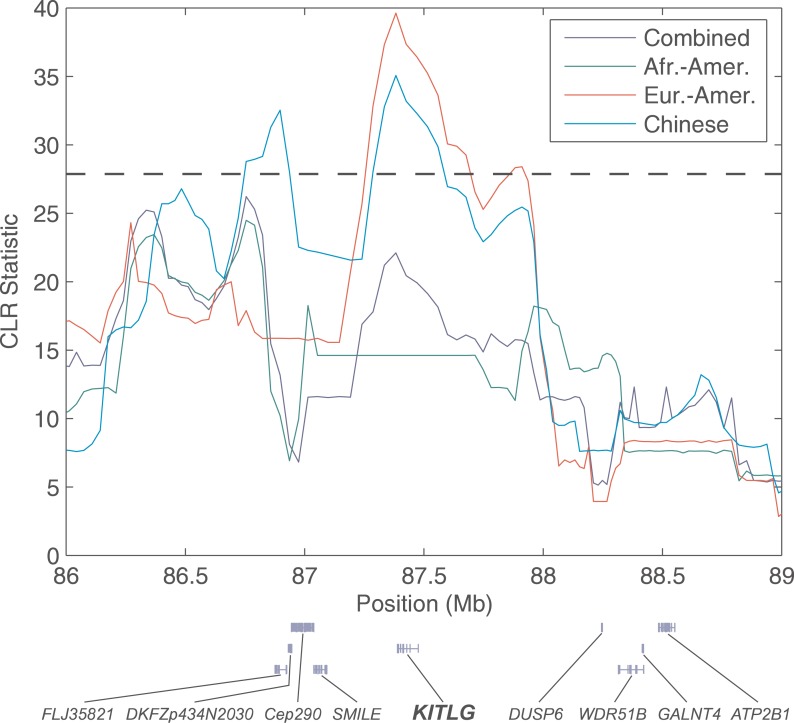
“Some genes, such as KITLG, have derived alleles (associated with lighter pigmentation) that reach high frequencies both in European and East Asian populations and likely began to be selected in a proto Eurasian population (Lao et al. 2007;Williamson et al. 2007;Pickrell et al. 2009).”
From The timing of pigmentation lightening in Europeans (2013) · cites this paper as Williamson et al. 2007
Experimental — accuracy not yet measuredThe cited source says what the claim attributes to it.
In the citing paper
“The SLC30A9 gene (chr4: 41,990,502–42,090,461; GRCh38) has been repeatedly reported as a top candidate region for positive selection in several genome-wide scans of selection, mostly in East Asian populations [14,16–20].”
From Human genetic adaptation related to cellular zinc homeostasis (2023) · cites this paper as [20]
The cited source says what the claim attributes to it.
In the citing paper
“The motivation for this study was the previous detection of strong signatures of positive selection in the SLC30A9 region [13,14,16,17,20,25].”
From Human genetic adaptation related to cellular zinc homeostasis (2023) · cites this paper as [20]
The check wasn’t confident either way, so it gives no verdict — never disputed.
In the citing paper
“Analysis of SNP variation between diverse human populations shows evidence of selection of the EDAR locus in East Asian and American populations [56],[57].”
From Zebrafish eda and edar Mutants Reveal Conserved and Ancestral Roles of Ectodysplasin Signaling in Vertebrates (2008) · cites this paper as [57]
Experimental — accuracy not yet measured
Self-check
Percentages, sums and reported differences re-computed from the paper’s own numbers.
The self-check needs the paper’s full text.
Citations
Cites
Controlling the False Discovery Rate: A Practical and Powerful Approach to Multiple Testing
Benjamini, Y., & Hochberg, Y. (1995) · Journal of the Royal Statistical Society Series B: Statistical Methodology · doi:10.1111/j.2517-6161.1995.tb02031.x · Cited by 109,482 · cited 3×
“Also, the present analysis is one of the first to fully correct for the bias introduced by SNP discovery protocols, and we account for the effects of multiple hypothesis testing using a false discovery rate approach [23,24].”
MethodStatistical significance for genomewide studies
Storey, J. D., & Tibshirani, R. (2003) · Proceedings of the National Academy of Sciences · doi:10.1073/pnas.1530509100 · Cited by 9,692 · cited 4×
“One modification to the approach outlined by Storey and Tishirani [24] is the method we use for selecting the tuning parameter, k.”
MethodInfluentialThe Neutral Theory of Molecular Evolution
Kimura, M. (1979) · Scientific American · doi:10.1038/scientificamerican1179-98 · Cited by 7,666
The Neutral Theory of Molecular Evolution
Kimura, M. (1983) · Cambridge University Press eBooks · doi:10.1017/cbo9780511623486 · Cited by 6,347
A haplotype map of the human genome
The International HapMap Consortium (2005) · Nature · doi:10.1038/nature04226 · Cited by 5,858
THE GENETIC BASIS OF EVOLUTIONARY CHANGE
Felsenstein, J. (1975) · Evolution · doi:10.1111/j.1558-5646.1975.tb00851.x · Cited by 3,912
A novel MHC class I-like gene is mutated in patients with hereditary haemochromatosis
Feder, J. N., Gnirke, A., Thomas, W., Tsuchihashi, Z., Ruddy, D. A., Basava, A., Dormishian, F., Domingo, R., Ellis, M. C., Fullan, A., et al. (1996) · Nature Genetics · doi:10.1038/ng0896-399 · Cited by 3,664 · cited 1×
“HFE contains a relatively high-frequency recessive mutation, C282Y, which causes hereditary hemochromatosis [44], an iron-overload disorder.”
BackgroundA Map of Recent Positive Selection in the Human Genome
Voight, B. F., Kudaravalli, S., Wen, X., & Pritchard, J. K. (2006) · PLoS Biology · doi:10.1371/journal.pbio.0040072 · Cited by 2,893
Generating samples under a Wright–Fisher neutral model of genetic variation
Hudson, R. R. (2002) · Bioinformatics · doi:10.1093/bioinformatics/18.2.337 · Cited by 2,364 · cited 1×
“Because allele frequencies of linked SNPs are not statistically independent, we determine the null (selectively neutral) distributions of all test statistics using coalescent simulations [60].”
MethodThe UCSC Table Browser data retrieval tool
Karolchik, D. (2004) · Nucleic Acids Research · doi:10.1093/nar/gkh103 · Cited by 2,316 · cited 1×
“are then recorded along with the genomic position of the center of the window. We repeat this procedure for every tenth window of 200 SNPs across all autosomes. Chromosomal positions of genes and genetic map estimates of local recombination rates were retrieved using the July 2003 build of the human genome on the Univ…”
Method
Cited by
Genome-wide detection and characterization of positive selection in human populations
The International HapMap Consortium, Sabeti, P. C., Varilly, P., Fry, B., Lohmueller, J., Hostetter, E., Cotsapas, C., Xie, X., Byrne, E. H., McCarroll, S. A., et al. (2007) · Nature · doi:10.1038/nature06250 · Cited by 2,131
Worldwide Human Relationships Inferred from Genome-Wide Patterns of Variation
Li, J. Z., Absher, D. M., Tang, H., Southwick, A. M., Casto, A. M., Ramachandran, S., Cann, H. M., Barsh, G. S., Feldman, M., Cavalli-Sforza, L. L., et al. (2008) · Science · doi:10.1126/science.1153717 · Cited by 1,941
Population Genomics of Parallel Adaptation in Threespine Stickleback using Sequenced RAD Tags
Hohenlohe, P. A., Bassham, S., Etter, P. D., Stiffler, N., Johnson, E. A., & Cresko, W. A. (2010) · PLoS Genetics · doi:10.1371/journal.pgen.1000862 · Cited by 1,395
Status and Prospects of Association Mapping in Plants
Zhu, C., Gore, M., Buckler, E. S., & Yu, J. (2008) · The Plant Genome · doi:10.3835/plantgenome2008.02.0089 · Cited by 1,343
The genetics of human adaptation: hard sweeps, soft sweeps, and polygenic adaptation
Pritchard, J. K., Pickrell, J. K., & Coop, G. (2010) · Current Biology · doi:10.1016/j.cub.2009.11.055 · Cited by 932
Population differentiation as a test for selective sweeps
Chen, H., Patterson, N., & Reich, D. (2010) · Genome Research · doi:10.1101/gr.100545.109 · Cited by 888
How culture shaped the human genome: bringing genetics and the human sciences together
Laland, K. N., Odling-Smee, J., & Myles, S. (2010) · Nature Reviews Genetics · doi:10.1038/nrg2734 · Cited by 864
“Estimates for the number of human genes that have been subject to recent rapid evolution range from a few hundred to two thousand: Williamson et al.14 conclude that up to 10% of the human genome may be affected by linkage to targets of positive selection.”
BackgroundInfluentialCampbell, M. C., & Tishkoff, S. A. (2008) · Annual Review of Genomics and Human Genetics · doi:10.1146/annurev.genom.9.081307.164258 · Cited by 861
Beyond beliefs: Religions bind individuals into moral communities
Graham, J., & Haidt, J. (2010) · Personality and Social Psychology Review · doi:10.1177/1088868309353415 · Cited by 842
“The authors thank Sarah Estes Graham, Carlee Hawkins, Selin Kesebir, Jason Kisling, Nicole Lindner, J. Patrick Seder, Constantine Sedikides, Gary Sherman, and two anonymous reviewers for their helpful comments.”
Detecting loci under selection in a hierarchically structured population
Excoffier, L., Hofer, T., & Foll, M. (2009) · Heredity · doi:10.1038/hdy.2009.74 · Cited by 777
“Note that only two of the genes reported in Table 5 have been reported to be under selection in previous studies: PHACTR1 (Williamson et al., 2007; Foll and Gaggiotti, 2008) and E2F6 (Kayser et al.”
ResultGenetic determinants of hair, eye and skin pigmentation in Europeans
Sulem, P., Gudbjartsson, D. F., Stacey, S. N., Helgason, A., Rafnar, T., Magnusson, K. P., Manolescu, A., Karason, A., Palsson, A., Thorleifsson, G., et al. (2007) · Nature Genetics · doi:10.1038/ng.2007.13 · Cited by 750
Identifying autism loci and genes by tracing recent shared ancestry
Morrow, E. M., Yoo, S.-Y., Flavell, S. W., Kim, T.-K., Lin, Y., Hill, R. S., Mukaddes, N. M., Balkhy, S., Gascon, G., Hashmi, A., et al. (2008) · Science · doi:10.1126/science.1157657 · Cited by 737
Signals of recent positive selection in a worldwide sample of human populations
Pickrell, J. K., Coop, G., Novembre, J., Kudaravalli, S., Li, J. Z., Absher, D., Srinivasan, B. S., Barsh, G. S., Myers, R. M., Feldman, M. W., et al. (2009) · Genome Research · doi:10.1101/gr.087577.108 · Cited by 717
Schaller, M., & Murray, D. R. (2008) · Journal of Personality and Social Psychology · doi:10.1037/0022-3514.95.1.212 · Cited by 647
“It’s also clear that infectious diseases can pose a powerful selective force on gene frequencies within different human populations (Williamson et al., 2007).”
BackgroundThe evolutionary genetics of personality
Penke, L., Denissen, J. J. A., & Miller, G. F. (2007) · European Journal of Personality · doi:10.1002/per.629 · Cited by 610
Consanguinity, human evolution, and complex diseases
Bittles, A. H., & Black, M. L. (2010) · Proceedings of the National Academy of Sciences · doi:10.1073/pnas.0906079106 · Cited by 604
Natural selection has driven population differentiation in modern humans
Barreiro, L. B., Laval, G., Quach, H., Patin, E., & Quintana-Murci, L. (2008) · Nature Genetics · doi:10.1038/ng.78 · Cited by 605
Fumagalli, M., Sironi, M., Pozzoli, U., Ferrer-Admettla, A., Pattini, L., & Nielsen, R. (2011) · PLoS Genetics · doi:10.1371/journal.pgen.1002355 · Cited by 600
“presumably due to the different needs for skin protection in regions with different UV radiation intensity [4-8].”
BackgroundMethodSelf-citationGenomic Patterns of Homozygosity in Worldwide Human Populations
Pemberton, T. J., Absher, D., Feldman, M. W., Myers, R. M., Rosenberg, N. A., & Li, J. Z. (2012) · The American Journal of Human Genetics · doi:10.1016/j.ajhg.2012.06.014 · Cited by 597
“Among the next nine top hotspots, four have been identified in previous genomic surveys as probable targets of recent positive selection.(33,57,59,60) For example, the third-ranked hotspot, which has a pronounced elevation”
BackgroundInfluentialPatterns of Positive Selection in Six Mammalian Genomes
Kosiol, C., Vinař, T., da Fonseca, R. R., Hubisz, M. J., Bustamante, C. D., Nielsen, R., & Siepel, A. (2008) · PLoS Genetics · doi:10.1371/journal.pgen.1000144 · Cited by 576
“Within mammals, several genome-wide scans for positive selection on protein-coding genes have been conducted, using both phylogenetic [4,5,6,7,8,9] and population genetic [10,11,12,13,14,15] methods (reviewed in [16]).”
MethodSelf-citationChallenges and opportunities of genetic approaches to biological conservation
Frankham, R. (2010) · Biological Conservation · doi:10.1016/j.biocon.2010.05.011 · Cited by 569
From evolutionary genetics to human immunology: how selection shapes host defence genes
Barreiro, L. B., & Quintana-Murci, L. (2010) · Nature Reviews Genetics · doi:10.1038/nrg2698 · Cited by 558
Natural selection and infectious disease in human populations
Karlsson, E. K., Kwiatkowski, D. P., & Sabeti, P. C. (2014) · Nature Reviews Genetics · doi:10.1038/nrg3734 · Cited by 534
Which evolutionary processes influence natural genetic variation for phenotypic traits?
Mitchell-Olds, T., Willis, J. H., & Goldstein, D. B. (2007) · Nature Reviews Genetics · doi:10.1038/nrg2207 · Cited by 514
“At the molecular level, genome-wide studies have documented vast stores of segregating nucleotide polymorphism, and have begun to elucidate the evolutionary processes that shape this variatio”
BackgroundA Composite of Multiple Signals Distinguishes Causal Variants in Regions of Positive Selection
Grossman, S. R., Shylakhter, I., Karlsson, E. K., Byrne, E. H., Morales, S., Frieden, G., Hostetter, E., Angelino, E., Garber, M., Zuk, O., et al. (2010) · Science · doi:10.1126/science.1183863 · Cited by 512
Recent and ongoing selection in the human genome
Nielsen, R., Hellmann, I., Hubisz, M., Bustamante, C., & Clark, A. G. (2007) · Nature Reviews Genetics · doi:10.1038/nrg2187 · Cited by 500
Self-citationComparative studies of gene expression and the evolution of gene regulation
Romero, I. G., Ruvinsky, I., & Gilad, Y. (2012) · Nature Reviews Genetics · doi:10.1038/nrg3229 · Cited by 488
Population genomics of rapid adaptation by soft selective sweeps
Messer, P. W., & Petrov, D. A. (2013) · Trends in Ecology & Evolution · doi:10.1016/j.tree.2013.08.003 · Cited by 487
A population genetic signal of polygenic adaptation
Berg, J. J., & Coop, G. (2014) · PLoS Genetics · doi:10.1371/journal.pgen.1004412 · Cited by 487
“…least consistent with a history of selection, especially in light of the multiple alternative lines of evidence for adaptation on the basis of skin pigmentation (Jablonski and Chaplin, 2000; Sabeti et al., 2007; Lao et al., 2007; Williamson et al., 2007; Sturm, 2009; Jablonski and Chaplin, 2010).”
Recent acceleration of human adaptive evolution
Hawks, J., Wang, E. T., Cochran, G. M., Harpending, H. C., & Moyzis, R. K. (2007) · Proceedings of the National Academy of Sciences · doi:10.1073/pnas.0707650104 · Cited by 471
Widespread Genomic Signatures of Natural Selection in Hominid Evolution
McVicker, G., Gordon, D., Davis, C., & Green, P. (2009) · PLoS Genetics · doi:10.1371/journal.pgen.1000471 · Cited by 456
“Widespread positive selection [39], fluctuating selection (which tends to amplify hitchhiking effects [40]), or biased gene conversion that increases the frequency of deleterious alleles [41,42] may also contribute to the diversity reduction.”
BackgroundClassic Selective Sweeps Were Rare in Recent Human Evolution
Hernandez, R. D., Kelley, J. L., Elyashiv, E., Melton, S. C., Auton, A., McVean, G., 1000 Genomes Project, Sella, G., & Przeworski, M. (2011) · Science · doi:10.1126/science.1198878 · Cited by 446
Runs of homozygosity reveal highly penetrant recessive loci in schizophrenia
Lencz, T., Lambert, C., DeRosse, P., Burdick, K. E., Morgan, T. V., Kane, J. M., Kucherlapati, R., & Malhotra, A. K. (2007) · Proceedings of the National Academy of Sciences · doi:10.1073/pnas.0710021104 · Cited by 429
The role of geography in human adaptation
Coop, G., Pickrell, J. K., Novembre, J., Kudaravalli, S., Li, J., Absher, D., Myers, R. M., Cavalli-Sforza, L. L., Feldman, M. W., & Pritchard, J. K. (2009) · PLoS Genetics · doi:10.1371/journal.pgen.1000500 · Cited by 412
“selection, rather than being extreme outliers in the neutral distribution [34]; however, simulations generally show that extreme values of various test statistics are more abundant in the real data than would be expected under neutral models [16,17,28,35].”
BackgroundResultInfluentialDetection of human adaptation during the past 2000 years
Field, Y., Boyle, E. A., Telis, N., Gao, Z., Gaulton, K. J., Golan, D., Yengo, L., Rocheleau, G., Froguel, P., McCarthy, M. I., et al. (2016) · Science · doi:10.1126/science.aag0776 · Cited by 383
Rabbit genome analysis reveals a polygenic basis for phenotypic change during domestication
Carneiro, M., Rubin, C.-J., Di Palma, F., Albert, F. W., Alföldi, J., Barrio, A. M., Pielberg, G., Rafati, N., Sayyab, S., Turner-Maier, J., et al. (2014) · Science · doi:10.1126/science.1253714 · Cited by 404
“S1 to S7 Databases S1 to S5 References (20-61)”
BackgroundInfluentialEyre-Walker, A., & Keightley, P. D. (2009) · Molecular Biology and Evolution · doi:10.1093/molbev/msp119 · Cited by 404
“However, these methods are expected to give downwardly biased estimates of a if there are slightly deleterious mutations, because these inflate polymorphism relative to divergence.”
BackgroundMiller, C. T., Beleza, S., Pollen, A. A., Schluter, D., Kittles, R. A., Shriver, M. D., & Kingsley, D. M. (2007) · Cell · doi:10.1016/j.cell.2007.10.055 · Cited by 388
“Some of the strongest signatures of positive selection in the human genome map to the region of the KITLG gene (The Chimpanzee Sequencing and Analysis Consortium, 2005; Lao et al., 2007; Williamson et al., 2007; Figure 7A).”
BackgroundGoing global by adapting local: A review of recent human adaptation
Fan, S., Hansen, M. E. B., Lo, Y., & Tishkoff, S. A. (2016) · Science · doi:10.1126/science.aaf5098 · Cited by 385
Molecular genetics of human pigmentation diversity
Sturm, R. A. (2009) · Human Molecular Genetics · doi:10.1093/hmg/ddp003 · Cited by 379
“A combination of these approaches has found clear evidence for the selection of pigmentation-related genes in different populations (9,11,12,32).”
BackgroundOn Detecting Incomplete Soft or Hard Selective Sweeps Using Haplotype Structure
Ferrer-Admetlla, A., Liang, M., Korneliussen, T., & Nielsen, R. (2014) · Molecular Biology and Evolution · doi:10.1093/molbev/msu077 · Cited by 376
“…numerous studies have been published identifying genes in the human genome that have been targeted by selection (Bustamante et al. 2005; Carlson et al. 2005; Kelley et al. 2006; Voight et al. 2006; Wang et al. 2006; Kimura et al. 2007; Sabeti et al. 2007; Tang et al. 2007; Williamson et al. 2007).”
BackgroundMethodSelf-citationIdentifying Recent Adaptations in Large-Scale Genomic Data
Grossman, S. R., Andersen, K. G., Shlyakhter, I., Tabrizi, S., Winnicki, S., Yen, A., Park, D. J., Griesemer, D., Karlsson, E. K., Wong, S. H., et al. (2013) · Cell · doi:10.1016/j.cell.2013.01.035 · Cited by 368
“Over the last decade, genome-wide scans for selection have been frequently reported, finding several hundred loci that show patterns of variation characteristic of new beneficial mutations that have spread quickly through the population (Akey, 2009; Akey et al., 2002; Bustamante et al., 2005; Frazer et al., 2007; Pick…”
BackgroundGenetic basis of fitness differences in natural populations
Ellegren, H., & Sheldon, B. C. (2008) · Nature · doi:10.1038/nature06737 · Cited by 356
Evidence of widespread selection on standing variation in Europe at height-associated SNPs
Turchin, M. C., Chiang, C. W., Palmer, C. D., Sankararaman, S., Reich, D., Genetic Investigation of ANthropometric Traits (GIANT) Consortium, & Hirschhorn, J. N. (2012) · Nature Genetics · doi:10.1038/ng.2368 · Cited by 329
Haidt, J., & Kesebir, S. (2010) · Handbook of Social Psychology · doi:10.1002/9780470561119.socpsy002022 · Cited by 325
S weep F inder 2: increased sensitivity, robustness and flexibility
DeGiorgio, M., Huber, C. D., Hubisz, M. J., Hellmann, I., & Nielsen, R. (2016) · Bioinformatics · doi:10.1093/bioinformatics/btw051 · Cited by 320
“S WEEP F INDER (Nielsen et al. 2005) is a widely used program (Williamson et al .”
BackgroundMethodSelf-citationForensically Relevant SNP Classes
Budowle, B., & van Daal, A. (2008) · BioTechniques · doi:10.2144/000112806 · Cited by 298
“Association of the Kit ligand (KITLG) gene with skin pigmentation was found by searching candidate pigmentation genes for evidence of recent population-specific selective sweeps (65).”
BackgroundBateman's principles and human sex roles
Brown, G. R., Laland, K. N., & Mulder, M. B. (2009) · Trends in Ecology & Evolution · doi:10.1016/j.tree.2009.02.005 · Cited by 295
“Extensive recent data reveal that many hundreds of human genes (up to 10% of the genome, [ 73 ]) have been favoured by recent”
BackgroundRecent de novo origin of human protein-coding genes
Knowles, D. G., & McLysaght, A. (2009) · Genome Research · doi:10.1101/gr.095026.109 · Cited by 291
Molecular Evolution: A Statistical Approach
Yang, Z. (2014) · doi:10.1093/acprof:oso/9780199602605.001.0001 · Cited by 273
Adaptations to Climate in Candidate Genes for Common Metabolic Disorders
Hancock, A. M., Witonsky, D. B., Gordon, A. S., Eshel, G., Pritchard, J. K., Coop, G., & Di Rienzo, A. (2008) · PLoS Genetics · doi:10.1371/journal.pgen.0040032 · Cited by 272
“These SNPs were reported to carry a signature of positive natural selection based on either haplotype structure or inter-population differentiation [13–18].”
BackgroundPopulation genetic inference from genomic sequence variation
Pool, J. E., Hellmann, I., Jensen, J. D., & Nielsen, R. (2010) · Genome Research · doi:10.1101/gr.079509.108 · Cited by 268
“For example, several studies (e.g., Carlson et al. 2005; Williamson et al. 2007; Nielsen et al. 2009) have used the distribution of human SNP frequencies along chromosomes to scan for completed sweeps.”
BackgroundSelf-citationTargets of Balancing Selection in the Human Genome
Andres, A. M., Hubisz, M. J., Indap, A., Torgerson, D. G., Degenhardt, J. D., Boyko, A. R., Gutenkunst, R. N., White, T. J., Green, E. D., Bustamante, C. D., et al. (2009) · Molecular Biology and Evolution · doi:10.1093/molbev/msp190 · Cited by 268
“…selection in shaping the evolution of genes, particularly in humans (Clark et al. 2003; Akey et al. 2004; Bustamante et al. 2005; Chimpanzee Genome and Analysis Consortium 2005; Nielsen, Bustamante, et al. 2005; Sabeti et al. 2006; Voight et al. 2006; Williamson et al. 2007; Barreiro et al. 2008).”
BackgroundSelf-citationAmeur, A., Enroth, S., Johansson, Å., Zaboli, G., Igl, W., Johansson, A. C. V., Rivas, M. A., Daly, M. J., Schmitz, G., Hicks, A. A., et al. (2012) · The American Journal of Human Genetics · doi:10.1016/j.ajhg.2012.03.014 · Cited by 261
Human adaptations to diet, subsistence, and ecoregion are due to subtle shifts in allele frequency
Hancock, A. M., Witonsky, D. B., Ehler, E., Alkorta-Aranburu, G., Beall, C., Gebremedhin, A., Sukernik, R., Utermann, G., Pritchard, J., Coop, G., et al. (2010) · Proceedings of the National Academy of Sciences · doi:10.1073/pnas.0914625107 · Cited by 258
“These studies detected outliers on the basis of differentiation of allele frequencies between broadly defined populations (2, 3), extended regions of haplotype homozygosity (4–6), frequency spectrum-based statistics (7, 8), or some combination of these methods (9, 10).”
BackgroundEvolutionary Adaptations to Dietary Changes
Luca, F., Perry, G. H., & Di Rienzo, A. (2010) · Annual Review of Nutrition · doi:10.1146/annurev-nutr-080508-141048 · Cited by 257
“Additional evidence for adaptations in OR genes was provided by genome-wide scans for signals of selection based on signals of complete selective sweeps in human populations (169), on the ratio of nonsynonymous to synonymous substitutions in humans compared to chimpanzee (27, 112), and on EHH in genes involved in olfa…”
The Neutral Theory of Molecular Evolution in the Genomic Era
Nei, M., Suzuki, Y., & Nozawa, M. (2010) · Annual Review of Genomics and Human Genetics · doi:10.1146/annurev-genom-082908-150129 · Cited by 251
“Akey (2) compared the positively selected regions identified by nine genome-wide studies (3, 17, 72, 78, 141, 153, 159, 160, 162).”
BackgroundGenes, Culture, and Agriculture: An Example of Human Niche Construction
O’Brien, M. J., & Laland, K. N. (2012) · Current Anthropology · doi:10.1086/666585 · Cited by 244
“…their origins respectively to NCT (NCTrHNCT) and behavioral ecology (BErHBE), NCT is a much more recently emerged and robust perspective (Odling-Smee, Laland, and Feldman 1996, 2003), and the initial application of HNCT in anthropology dates to the middle of the last decade (B. D. Smith 2007a).”
BackgroundDarwin in Mind: New Opportunities for Evolutionary Psychology
Bolhuis, J. J., Brown, G. R., Richardson, R. C., & Laland, K. N. (2011) · PLoS Biology · doi:10.1371/journal.pbio.1001109 · Cited by 242
Andrés, A. M., Dennis, M. Y., Kretzschmar, W. W., Cannons, J. L., Lee-Lin, S.-Q., Hurle, B., Program, N. C. S., Schwartzberg, P. L., Williamson, S. H., Bustamante, C. D., et al. (2010) · PLoS Genetics · doi:10.1371/journal.pgen.1001157 · Cited by 236
“Immune-related genes are subject to natural selection in humans [71–74], although the relative importance of positive and balancing selection is not fully defined (reviewed in [75]).”
BackgroundSelf-citationBranca, A., Paape, T. D., Zhou, P., Briskine, R., Farmer, A. D., Mudge, J., Bharti, A. K., Woodward, J. E., May, G. D., Gentzbittel, L., et al. (2011) · Proceedings of the National Academy of Sciences · doi:10.1073/pnas.1104032108 · Cited by 232
Eyre-Walker, A. (2010) · Proceedings of the National Academy of Sciences · doi:10.1073/pnas.0906182107 · Cited by 229
“It is possible that positive selection may increase the frequency of mutations, either directly because some mutations are advantageous, or indirectly through genetic “hitchhiking” (26), and this will have consequences for the variance in the trait.”
BackgroundHarris, M. P., Rohner, N., Schwarz, H., Perathoner, S., Konstantinidis, P., & Nüsslein-Volhard, C. (2008) · PLoS Genetics · doi:10.1371/journal.pgen.1000206 · Cited by 224
“Analysis of SNP variation between diverse human populations shows evidence of selection of the EDAR locus in East Asian and American populations [56,57].”
BackgroundPavlidis, P., Jensen, J. D., Stephan, W., & Stamatakis, A. (2012) · Molecular Biology and Evolution · doi:10.1093/molbev/mss136 · Cited by 221
“Itisworth noting that the overlap between lists of candidate genes for positive selection from various studies in the human populations is limited (e.g., Nielsen et al. 2005; Bustamante et al. 2005; Voight et al. 2006; Williamson et al. 2007; see also Oleksyk et al. 2010 for a recent review).”
BackgroundGenome sequencing reveals complex speciation in the Drosophila simulans clade
Garrigan, D., Kingan, S. B., Geneva, A. J., Andolfatto, P., Clark, A. G., Thornton, K. R., & Presgraves, D. C. (2012) · Genome Research · doi:10.1101/gr.130922.111 · Cited by 208
“Like the composite likelihood ratio test used by Williamson et al. (2007), our test is also conservative and reliably shows an excess of P-values that are close to one (Supplemental Figs.”
MethodSelf-citationHuman pigmentation genes under environmental selection
Sturm, R. A., & Duffy, D. L. (2012) · Genome Biology · doi:10.1186/gb-2012-13-9-248 · Cited by 182
The Human Condition—A Molecular Approach
Pääbo, S. (2014) · Cell · doi:10.1016/j.cell.2013.12.036 · Cited by 197
“Nevertheless, three organ systems seem to have been particularly susceptible to positive selection affecting few or single genes: the immune system, the digestive tract, and the skin with its appendages (hair, sweat glands, and sensory organs) (Grossman et al., 2013; Williamson et al., 2007).”
BackgroundInfluentialHigh Rate of Recent Transposable Element–Induced Adaptation in Drosophila melanogaster
González, J., Lenkov, K., Lipatov, M., Macpherson, J. M., & Petrov, D. A. (2008) · PLoS Biology · doi:10.1371/journal.pbio.0060251 · Cited by 195
“including natural populations and domesticated plants and animals [1–12].”
BackgroundWalsh, C. A., Morrow, E. M., & Rubenstein, J. L. R. (2008) · Cell · doi:10.1016/j.cell.2008.10.015 · Cited by 196
Patterns of Polymorphism and Demographic History in Natural Populations of Arabidopsis lyrata
Ross-Ibarra, J., Wright, S. I., Foxe, J. P., Kawabe, A., DeRose-Wilson, L., Gos, G., Charlesworth, D., & Gaut, B. S. (2008) · PLoS ONE · doi:10.1371/journal.pone.0002411 · Cited by 192
“Large, multi-locus studies of patterns of genetic diversity have proven helpful for inferring the demographic histories of Drosophila [2] and humans [3], but, apart from Arabidopsis thaliana [4] and domesticated crops [5], such studies remain rare in plants.”
BackgroundMapping signatures of positive selection in the genome of livestock
Qanbari, S., & Simianer, H. (2014) · Livestock Science · doi:10.1016/j.livsci.2014.05.003 · Cited by 189
Spatial patterns of variation due to natural selection in humans
Novembre, J., & Di Rienzo, A. (2009) · Nature Reviews Genetics · doi:10.1038/nrg2632 · Cited by 205
Adaptive evolution of genes underlying schizophrenia
Crespi, B., Summers, K., & Dorus, S. (2007) · Proceedings of the Royal Society B: Biological Sciences · doi:10.1098/rspb.2007.0876 · Cited by 186
“For example, the great majority of positively selected alleles in humans and other mammals are non-coding (Williamson et al. 2007; Resch et al. 2007), such that recent selective sweeps are expected to involve mainly non-coding regions that will be detected only by analyses based on HapMap data.”
BackgroundDuforet-Frebourg, N., Luu, K., Laval, G., Bazin, E., & Blum, M. G. B. (2016) · Molecular Biology and Evolution · doi:10.1093/molbev/msv334 · Cited by 186
“APPBPP2 is a nervous system gene that has been associated with Alzheimer disease, and it may have experienced a selective sweep (Williamson et al. 2007).”
BackgroundEvidence for Polygenic Adaptation to Pathogens in the Human Genome
Daub, J. T., Hofer, T., Cutivet, E., Dupanloup, I., Quintana-Murci, L., Robinson-Rechavi, M., & Excoffier, L. (2013) · Molecular Biology and Evolution · doi:10.1093/molbev/mst080 · Cited by 183
“Until recently, the search for evidence of adaptive evolution in humans has mainly focused on single mutations or on haplotypes restricted to small genomic regions (Nielsen et al. 2005; Voight et al. 2006; Wang et al. 2006; Williamson et al. 2007).”
BackgroundS/HIC: Robust Identification of Soft and Hard Sweeps Using Machine Learning
Schrider, D. R., & Kern, A. D. (2016) · PLOS Genetics · doi:10.1371/journal.pgen.1005928 · Cited by 183
“We focused this search on chromosome 18, where several putative selective sweeps have been identified in Europeans [57].”
BackgroundMethodResultInfluentialLife‐threatening infectious diseases of childhood: single‐gene inborn errors of immunity?
Alcaïs, A., Quintana‐Murci, L., Thaler, D. S., Schurr, E., Abel, L., & Casanova, J. (2010) · Annals of the New York Academy of Sciences · doi:10.1111/j.1749-6632.2010.05834.x · Cited by 181
Selective Sweep at a Quantitative Trait Locus in the Presence of Background Genetic Variation
Chevin, L.-M., & Hospital, F. (2008) · Genetics · doi:10.1534/genetics.108.093351 · Cited by 175
“On the one hand, genome scans search for recent (Glinka et al. 2003; Akey et al. 2004; Nielsen et al. 2005; Williamson et al. 2007) or ongoing (Voight et al. 2006; Tang et al. 2007) selection by genotyping many markers distributed throughout the genome and using the properties of the polymorphism…”
BackgroundSoft Sweeps Are the Dominant Mode of Adaptation in the Human Genome
Schrider, D. R., & Kern, A. D. (2017) · Molecular Biology and Evolution · doi:10.1093/molbev/msx154 · Cited by 176
“…of these studies searched primarily for partial selective sweeps—the signature of a beneficial mutation currently sweeping through a population (see Williamson et al. 2007 for a notable exception)—and rightly so, as these sweeps can reveal the targets of ongoing adaptation in human populations.”
BackgroundGenetics of autoimmune diseases: Insights from population genetics
Ramos, P. S., Shedlock, A. M., & Langefeld, C. D. (2015) · Journal of Human Genetics · doi:10.1038/jhg.2015.94 · Cited by 173
Developmental mechanisms underlying the evolution of human cortical circuits
Vanderhaeghen, P., & Polleux, F. (2023) · Nature Reviews Neuroscience · doi:10.1038/s41583-023-00675-z · Cited by 173
Hofer, T., Ray, N., Wegmann, D., & Excoffier, L. (2009) · Annals of Human Genetics · doi:10.1111/j.1469-1809.2008.00489.x · Cited by 169
“These are TCF15 (Storz et al. 2004), KRTAP23–1 (Williamson et al. 2007), PHACTR1 (Williamson et al. 2007), C20orf26 (Williamson et al. 2007), ANTXR2 (Kimura et al. 2007), UTRN (Tang et al. 2007), TYRP1 (Izagirre et al. 2006, Lao et al. 2007), LYST (Izagirre et al. 2006), DMD (Nachman & Crowell, 2000), SEMA4F (Nielsen…”
BackgroundResultInfluentialGenome-wide signals of positive selection in human evolution
Enard, D., Messer, P. W., & Petrov, D. A. (2014) · Genome Research · doi:10.1101/gr.164822.113 · Cited by 168
“…hand, recent studies have identified a large number of loci showing signatures of recent selective sweeps (Voight et al. 2006; Sabeti et al. 2007; Williamson et al. 2007; Pickrell et al. 2009; Grossman et al. 2013), and McDonald-Kreitman (MK) analyses inferred that ;10%–20% of amino acid changes…”
BackgroundResultInfluentialAuton, A., Bryc, K., Boyko, A. R., Lohmueller, K. E., Novembre, J., Reynolds, A., Indap, A., Wright, M. H., Degenhardt, J. D., Gutenkunst, R. N., et al. (2009) · Genome Research · doi:10.1101/gr.088898.108 · Cited by 166
“Analysis of dense genotype data has greatly expanded our understanding of the role natural selection has played in the recent evolution of our species (Voight et al. 2006; Sabeti et al. 2007; Williamson et al. 2007), the nature and causes of recombination rate variation (Myers et al.”
BackgroundSelf-citationLópez Herráez, D., Bauchet, M., Tang, K., Theunert, C., Pugach, I., Li, J., Nandineni, M. R., Gross, A., Scholz, M., & Stoneking, M. (2009) · PLoS ONE · doi:10.1371/journal.pone.0007888 · Cited by 162
“The GO analysis identified several classes of genes previously hypothesized to be subject to selection [10,32], including: immunity and defense related genes; sensory perception genes; membrane proteins; and signal receptors.”
BackgroundGonzález, J., Karasov, T. L., Messer, P. W., & Petrov, D. A. (2010) · PLoS Genetics · doi:10.1371/journal.pgen.1000905 · Cited by 162
“Several studies on different organisms such as bacteria, fruit flies, maize and humans suggest that positive selection is an important force shaping the genome [1–5].”
BackgroundHaasl, R. J., & Payseur, B. A. (2016) · Molecular Ecology · doi:10.1111/mec.13339 · Cited by 158
“…STR Kelley et al. (2006) GWSS Homo sapiens SFS SNP Zhang et al. (2006) GWSS Homo sapiens WGLRH SNP Bubb et al. (2006) GWSS Homo sapiens High SNP density WGS Williamson et al. (2007) GLMM Homo sapiens CLRT SNP International HapMap Consortium (2007) GWSS Homo sapiens iHS; EHH SNP Sabeti et al.…”
BackgroundSelf-citationGene Regulation in Primates Evolves under Tissue-Specific Selection Pressures
Blekhman, R., Oshlack, A., Chabot, A. E., Smyth, G. K., & Gilad, Y. (2008) · PLoS Genetics · doi:10.1371/journal.pgen.1000271 · Cited by 158
“In humans, in particular, this question is of interest both for what it will reveal about human specific traits [1–4] and because of the emerging links between adaptation and disease susceptibility [5,6].”
BackgroundThe timing of pigmentation lightening in Europeans
Beleza, S., Santos, A. M., McEvoy, B., Alves, I., Martinho, C., Cameron, E., Shriver, M. D., Parra, E. J., & Rocha, J. (2013) · Molecular Biology and Evolution · doi:10.1093/molbev/mss207 · Cited by 156
Lohmueller, K. E., Albrechtsen, A., Li, Y., Kim, S. Y., Korneliussen, T., Vinckenbosch, N., Tian, G., Huerta-Sanchez, E., Feder, A. F., Grarup, N., et al. (2011) · PLoS Genetics · doi:10.1371/journal.pgen.1002326 · Cited by 155
“Because several studies have suggested that 0–10% of the genome has been affected by a selective sweep [9,10,14,16,20,21], we next examined a model where 5% of the simulated windows included positive selection.”
BackgroundSelf-citationDarwinian and demographic forces affecting human protein coding genes
Nielsen, R., Hubisz, M. J., Hellmann, I., Torgerson, D., Andrés, A. M., Albrechtsen, A., Gutenkunst, R., Adams, M. D., Cargill, M., Boyko, A., et al. (2009) · Genome Research · doi:10.1101/gr.088336.108 · Cited by 152
Self-citationPrunier, J., Laroche, J., Beaulieu, J., & Bousquet, J. (2011) · Molecular Ecology · doi:10.1111/j.1365-294x.2011.05045.x · Cited by 171
“…populations of randomly mating individuals (Luikart et al. 2003; Wright & Gaut 2005; Thornton et al. 2007) and are increasingly being used with large genome scans to identify candidate genes for adaptation (e.g. Kelley et al. 2006; Williamson et al. 2007; Namroud et al. 2008; Eckert et al. 2010).”
BackgroundSelection signatures in livestock genome: A review of concepts, approaches and applications
Saravanan, K. A., Panigrahi, M., Kumar, H., Bhushan, B., Dutt, T., & Mishra, B. P. (2020) · Livestock Science · doi:10.1016/j.livsci.2020.104257 · Cited by 194
Pybus, M., Dall’Olio, G. M., Luisi, P., Uzkudun, M., Carreño-Torres, A., Pavlidis, P., Laayouni, H., Bertranpetit, J., & Engelken, J. (2014) · Nucleic Acids Research · doi:10.1093/nar/gkt1188 · Cited by 142
“CLR is a multi-locus, composite likelihood ratio test (4,35).”
BackgroundAdaptations to new environments in humans: the role of subtle allele frequency shifts
Hancock, A. M., Alkorta-Aranburu, G., Witonsky, D. B., & Di Rienzo, A. (2010) · Philosophical Transactions of the Royal Society B: Biological Sciences · doi:10.1098/rstb.2010.0032 · Cited by 140
Signatures of Long-Term Balancing Selection in Human Genomes
Bitarello, B. D., de Filippo, C., Teixeira, J. C., Schmidt, J. M., Kleinert, P., Meyer, D., & Andrés, A. M. (2018) · Genome Biology and Evolution · doi:10.1093/gbe/evy054 · Cited by 141
“NCD statistic In the tradition of neutrality tests analyzing the SFS directly (e.g. Nielsen et al. 2005; Williamson et al. 2007; Nielsen et al. 2009), we propose and define the statistic “Non-Central Deviation” (NCD) which measures the degree to which the local SFS deviates from a pre-specified…”
Jarvis, J. P., Scheinfeldt, L. B., Soi, S., Lambert, C., Omberg, L., Ferwerda, B., Froment, A., Bodo, J.-M., Beggs, W., Hoffman, G., et al. (2012) · PLoS Genetics · doi:10.1371/journal.pgen.1002641 · Cited by 139
“Indeed, this region has been previously implicated in genome-wide scans for selection in Hapmap populations from Europe, Asia, and Africa [23,28,29,41,42,43].”
BackgroundIntegration of multi-omics data and deep phenotyping enables prediction of cytokine responses
Bakker, O. B., Aguirre‐Gamboa, R., Sanna, S., Oosting, M., Smeekens, S. P., Jaeger, M., Zorro, M. M., Võsa, U., Withoff, S., Netea-Maier, R. T., et al. (2018) · Nature Immunology · doi:10.1038/s41590-018-0121-3 · Cited by 171
“Our study thus agrees with the idea that infections have a strong selective impact on the genetic control of immune responses33–40.”
Laland, K. N. (2008) · Philosophical Transactions of the Royal Society B: Biological Sciences · doi:10.1098/rstb.2008.0132 · Cited by 135
“One such set of analyses are attempts, by mathematically minded geneticists, to detect statistical signatures in the genome of recent, rapid selection—genes favoured by natural selection over the last 100 000 years (Sabeti et al. 2006, 2007; Voight et al. 2006; Wang et al. 2006; Nielsen et al. 2007; Williamson et al.…”
BackgroundGenetics and the understanding of selection
Hurst, L. D. (2009) · Nature Reviews Genetics · doi:10.1038/nrg2506 · Cited by 153
“However, the current genomic age is likely to lead to a discovery mode of research, and the development of new genome scan”
Background
Metadata
- Authors
- Williamson, S. H., Hubisz, M. J., Clark, A. G., Payseur, B. A., Bustamante, C. D., & Nielsen, R.
- Affiliations
- Cornell University (US)
- University of Copenhagen (DK)
- Corresponding author
- Williamson, Scott H
- Venue
- PLoS Genetics
- Publisher
- Public Library of Science (PLoS)
- Published
- 2007-06-01
- Volume
- 3
- Issue
- 6
- Pages
- e90
- ISSN
- 1553-7390 (ISSN-L)
- 1553-7404
- PMC
- PMC1885279
- OpenAlex
- W2010131461
- Semantic Scholar
- 743101193237dd8766b23c8c22d8f2062b047af6
- Cited by
- 507
- References
- 66
- Citations by year
- 2026: 7 · 2025: 13 · 2024: 9 · 2023: 24 · 2022: 8 · 2021: 14 · 2020: 17 · 2019: 8 · 2018: 19 · 2017: 19 · 2016: 26 · 2015: 26 · 2014: 42 · 2013: 28 · 2012: 37
- FWCI
- 29.93
- Type
- journal article
- Language
- en
- Open access
- gold
- doi.org
- Licence
- cc-by
- Locations
- PLoS Genetics (publishedVersion, cc-by)
- Europe PMC (PubMed Central) (publishedVersion, cc-by)
- PubMed Central (publishedVersion, cc-by)
- PubMed (publishedVersion)
- eScholarship (California Digital Library) (submittedVersion, cc-by)
- DOAJ (DOAJ: Directory of Open Access Journals) (submittedVersion, cc-by-sa)
- eScholarship (California Digital Library) (submittedVersion)
- Figshare (submittedVersion, cc-by)
- Research at the University of Copenhagen (University of Copenhagen) (submittedVersion)
- Funders
- National Human Genome Research Institute (R01HG003229)
- Topics
- Life Sciences › Biochemistry, Genetics and Molecular Biology › Genetics › Forensic and Genetic Research
- Life Sciences › Biochemistry, Genetics and Molecular Biology › Genetics › Genetic Associations and Epidemiology
- Life Sciences › Biochemistry, Genetics and Molecular Biology › Genetics › Evolution and Genetic Dynamics
- Keywords
- selective sweeps, human genome, single nucleotide polymorphisms, demography, recombination rate variation, pigmentation genes, olfactory receptor genes, dystrophin complex, immune system genes, heat shock genes, centromeric region, linkage disequilibrium
- MeSH terms
- Adaptation, Biological, Humans, Genome, Human, Evolution, Molecular, Polymorphism, Single Nucleotide
About these checks
Registry, retraction, Cites and statistics results are computed, not judged, with one exception: a printed reference that no index lists is read once by a model before it counts as a citation error. Claims are extracted by a model and kept only when their quote appears verbatim in the text; each cited source is then checked, with a model’s help, for whether it says what the claim relies on. Those verdicts can be wrong — read the claim’s quote and the cited source before relying on one.
Statistics and arithmetic are recomputed, not judged.
Confidence bands are shown only for fields calibrated on our annotated test set. None is calibrated yet, so no band is shown.
What counts as a claim ›How we measure confidence ›How we check this ›
Are you an author, or do you see a problem with this page? Request a review
Data sources
Bibliographic data: Semantic Scholar, OpenAlex, Crossref.
Contains information from the Semantic Scholar Academic Graph Datasets, made available under the ODC Attribution License (ODC-BY 1.0).
Semantic Scholar’s data is described in: Kinney, R., et al. (2023). The Semantic Scholar Open Data Platform. arXiv:2301.10140.
