

Localizing Recent Adaptive Evolution in the Human Genome.
Open accessThe DOI matches its Crossref record; 65 of the 66 references it cites were found in a registry or an index.
Abstract
Identifying genomic locations that have experienced selective sweeps is an important first step toward understanding the molecular basis of adaptive evolution. Using statistical methods that account for the confounding effects of population demography, recombination rate variation, and single-nucleotide polymorphism ascertainment, while also providing fine-scale estimates of the position of the selected site, we analyzed a genomic dataset of 1.2 million human single-nucleotide polymorphisms genotyped in African-American, European-American, and Chinese samples. We identify 101 regions of the human genome with very strong evidence (p < 10(-5)) of a recent selective sweep and where our estimate of the position of the selective sweep falls within 100 kb of a known gene. Within these regions, genes of biological interest include genes in pigmentation pathways, components of the dystrophin protein complex, clusters of olfactory receptors, genes involved in nervous system development and function, immune system genes, and heat shock genes. We also observe consistent evidence of selective sweeps in centromeric regions. In general, we find that recent adaptation is strikingly pervasive in the human genome, with as much as 10% of the genome affected by linkage to a selective sweep.
Overview
The claims and statistics of this paper haven’t been checked yet.
Free: it reads the open-access text and checks the first 5 claims that cite a source we can check. Create a free account to check every claim.
Integrity signals
Registry
Cites
Statistics
Figures
Verification
Claims the paper makes
The claims and statistics of this paper haven’t been checked yet.
Free: it reads the open-access text and checks the first 5 claims that cite a source we can check. Create a free account to check every claim.
Claims other papers make about this one
Each is checked against this paper’s own text: does it say what the citing paper says it does?
The source backs part of the claim, not all of it — or backs it for a different population, condition or comparison.
In the citing paper
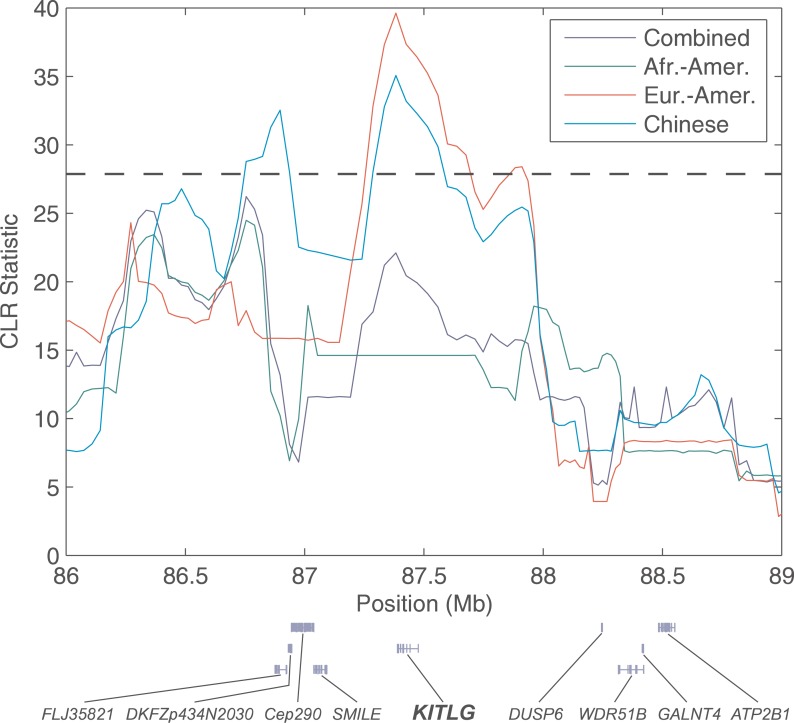
“Some genes, such as KITLG, have derived alleles (associated with lighter pigmentation) that reach high frequencies both in European and East Asian populations and likely began to be selected in a proto Eurasian population (Lao et al. 2007;Williamson et al. 2007;Pickrell et al. 2009).”
From The timing of pigmentation lightening in Europeans (2013) · cites this paper as Williamson et al. 2007
Experimental — accuracy not yet measuredThe cited source says what the claim attributes to it.
In the citing paper
“The SLC30A9 gene (chr4: 41,990,502–42,090,461; GRCh38) has been repeatedly reported as a top candidate region for positive selection in several genome-wide scans of selection, mostly in East Asian populations [14,16–20].”
From Human genetic adaptation related to cellular zinc homeostasis (2023) · cites this paper as [20]
The cited source says what the claim attributes to it.
In the citing paper
“The motivation for this study was the previous detection of strong signatures of positive selection in the SLC30A9 region [13,14,16,17,20,25].”
From Human genetic adaptation related to cellular zinc homeostasis (2023) · cites this paper as [20]
The check wasn’t confident either way, so it gives no verdict — never disputed.
In the citing paper
“Analysis of SNP variation between diverse human populations shows evidence of selection of the EDAR locus in East Asian and American populations [56],[57].”
From Zebrafish eda and edar Mutants Reveal Conserved and Ancestral Roles of Ectodysplasin Signaling in Vertebrates (2008) · cites this paper as [57]
Experimental — accuracy not yet measured
Self-check
Percentages, sums and reported differences re-computed from the paper’s own numbers.
The self-check needs the paper’s full text.
Citations
Cites
Controlling the False Discovery Rate: A Practical and Powerful Approach to Multiple Testing
Benjamini, Y., & Hochberg, Y. (1995) · Journal of the Royal Statistical Society Series B: Statistical Methodology · doi:10.1111/j.2517-6161.1995.tb02031.x · Cited by 109,482 · cited 3×
“Also, the present analysis is one of the first to fully correct for the bias introduced by SNP discovery protocols, and we account for the effects of multiple hypothesis testing using a false discovery rate approach [23,24].”
MethodStatistical significance for genomewide studies
Storey, J. D., & Tibshirani, R. (2003) · Proceedings of the National Academy of Sciences · doi:10.1073/pnas.1530509100 · Cited by 9,692 · cited 4×
“One modification to the approach outlined by Storey and Tishirani [24] is the method we use for selecting the tuning parameter, k.”
MethodInfluentialThe Neutral Theory of Molecular Evolution
Kimura, M. (1979) · Scientific American · doi:10.1038/scientificamerican1179-98 · Cited by 7,666
The Neutral Theory of Molecular Evolution
Kimura, M. (1983) · Cambridge University Press eBooks · doi:10.1017/cbo9780511623486 · Cited by 6,347
A haplotype map of the human genome
The International HapMap Consortium (2005) · Nature · doi:10.1038/nature04226 · Cited by 5,858
THE GENETIC BASIS OF EVOLUTIONARY CHANGE
Felsenstein, J. (1975) · Evolution · doi:10.1111/j.1558-5646.1975.tb00851.x · Cited by 3,912
A novel MHC class I-like gene is mutated in patients with hereditary haemochromatosis
Feder, J. N., Gnirke, A., Thomas, W., Tsuchihashi, Z., Ruddy, D. A., Basava, A., Dormishian, F., Domingo, R., Ellis, M. C., Fullan, A., et al. (1996) · Nature Genetics · doi:10.1038/ng0896-399 · Cited by 3,664 · cited 1×
“HFE contains a relatively high-frequency recessive mutation, C282Y, which causes hereditary hemochromatosis [44], an iron-overload disorder.”
BackgroundA Map of Recent Positive Selection in the Human Genome
Voight, B. F., Kudaravalli, S., Wen, X., & Pritchard, J. K. (2006) · PLoS Biology · doi:10.1371/journal.pbio.0040072 · Cited by 2,893
Generating samples under a Wright–Fisher neutral model of genetic variation
Hudson, R. R. (2002) · Bioinformatics · doi:10.1093/bioinformatics/18.2.337 · Cited by 2,364 · cited 1×
“Because allele frequencies of linked SNPs are not statistically independent, we determine the null (selectively neutral) distributions of all test statistics using coalescent simulations [60].”
MethodThe UCSC Table Browser data retrieval tool
Karolchik, D. (2004) · Nucleic Acids Research · doi:10.1093/nar/gkh103 · Cited by 2,316 · cited 1×
“are then recorded along with the genomic position of the center of the window. We repeat this procedure for every tenth window of 200 SNPs across all autosomes. Chromosomal positions of genes and genetic map estimates of local recombination rates were retrieved using the July 2003 build of the human genome on the Univ…”
Method
Cited by
Items 501–506 of 506
Sastre, P. (2011) · theses.fr (ABES) · doi:10.70675/1294017cz28d6z4b78z8112z99722d8737cd · Cited by 3
Origins and adaptation in humans : a case study of taste and lifestyle
Sjöstrand, A. E. (2015) · theses.fr (ABES) · doi:10.70675/0b1e0427za184z4d38z84f3zaf79e3d63d76 · Cited by 5
“and eye pigmentation and have also been the targets of adaptation (Lamason et al. 2005; Voight et al. 2006; Miller et al. 2007; Norton et al. 2007; Williamson et al. 2007; Coop et al. 2009; Pickrell et al. 2009).”
BackgroundRevisiting neanderthal ancestry: Evolutionary insights and biomedical relevance
Bu, S., & Zhang, Z. (2026) · The Innovation Life · doi:10.59717/j.xinn-life.2026.100228
The escape artist: deimatic behavior in a South American grasshopper, Paramastax nigraPreprint
Rubio, A. O., Muell, M. R., Dye, A. M., Nguyen, J. V., Aglyamova, G. V., Stuckert, A. M. M., & Summers, K. (2026) · Research Square · doi:10.21203/rs.3.rs-10109271/v1
Flex-sweep 2.0: more flexible and faster selective sweeps detectionPreprint
Murga-Moreno, J., & Enard, D. (2026) · bioRxiv (Cold Spring Harbor Laboratory) · doi:10.64898/2026.08.06.743046
Genomic insights into natural selection in recent human history
Skoglund, P., & Mathieson, I. (2026) · Nature Reviews Genetics · doi:10.1038/s41576-026-01010-9
Metadata
- Authors
- Williamson, S. H., Hubisz, M. J., Clark, A. G., Payseur, B. A., Bustamante, C. D., & Nielsen, R.
- Affiliations
- Cornell University (US)
- University of Copenhagen (DK)
- Corresponding author
- Williamson, Scott H
- Venue
- PLoS Genetics
- Publisher
- Public Library of Science (PLoS)
- Published
- 2007-06-01
- Volume
- 3
- Issue
- 6
- Pages
- e90
- ISSN
- 1553-7390 (ISSN-L)
- 1553-7404
- PMC
- PMC1885279
- OpenAlex
- W2010131461
- Semantic Scholar
- 743101193237dd8766b23c8c22d8f2062b047af6
- Cited by
- 507
- References
- 66
- Citations by year
- 2026: 7 · 2025: 13 · 2024: 9 · 2023: 24 · 2022: 8 · 2021: 14 · 2020: 17 · 2019: 8 · 2018: 19 · 2017: 19 · 2016: 26 · 2015: 26 · 2014: 42 · 2013: 28 · 2012: 37
- FWCI
- 29.93
- Type
- journal article
- Language
- en
- Open access
- gold
- doi.org
- Licence
- cc-by
- Locations
- PLoS Genetics (publishedVersion, cc-by)
- Europe PMC (PubMed Central) (publishedVersion, cc-by)
- PubMed Central (publishedVersion, cc-by)
- PubMed (publishedVersion)
- eScholarship (California Digital Library) (submittedVersion, cc-by)
- DOAJ (DOAJ: Directory of Open Access Journals) (submittedVersion, cc-by-sa)
- eScholarship (California Digital Library) (submittedVersion)
- Figshare (submittedVersion, cc-by)
- Research at the University of Copenhagen (University of Copenhagen) (submittedVersion)
- Funders
- National Human Genome Research Institute (R01HG003229)
- Topics
- Life Sciences › Biochemistry, Genetics and Molecular Biology › Genetics › Forensic and Genetic Research
- Life Sciences › Biochemistry, Genetics and Molecular Biology › Genetics › Genetic Associations and Epidemiology
- Life Sciences › Biochemistry, Genetics and Molecular Biology › Genetics › Evolution and Genetic Dynamics
- Keywords
- selective sweeps, human genome, single nucleotide polymorphisms, demography, recombination rate variation, pigmentation genes, olfactory receptor genes, dystrophin complex, immune system genes, heat shock genes, centromeric region, linkage disequilibrium
- MeSH terms
- Adaptation, Biological, Humans, Genome, Human, Evolution, Molecular, Polymorphism, Single Nucleotide
About these checks
Registry, retraction, Cites and statistics results are computed, not judged, with one exception: a printed reference that no index lists is read once by a model before it counts as a citation error. Claims are extracted by a model and kept only when their quote appears verbatim in the text; each cited source is then checked, with a model’s help, for whether it says what the claim relies on. Those verdicts can be wrong — read the claim’s quote and the cited source before relying on one.
Statistics and arithmetic are recomputed, not judged.
Confidence bands are shown only for fields calibrated on our annotated test set. None is calibrated yet, so no band is shown.
What counts as a claim ›How we measure confidence ›How we check this ›
Are you an author, or do you see a problem with this page? Request a review
Data sources
Bibliographic data: Semantic Scholar, OpenAlex, Crossref.
Contains information from the Semantic Scholar Academic Graph Datasets, made available under the ODC Attribution License (ODC-BY 1.0).
Semantic Scholar’s data is described in: Kinney, R., et al. (2023). The Semantic Scholar Open Data Platform. arXiv:2301.10140.
