

SREBP Coordinates Iron and Ergosterol Homeostasis to Mediate Triazole Drug and Hypoxia Responses in the Human Fungal Pathogen Aspergillus fumigatus
Open accessThe DOI matches its Crossref record; 62 of the 62 references it cites were found in a registry or an index.
Abstract
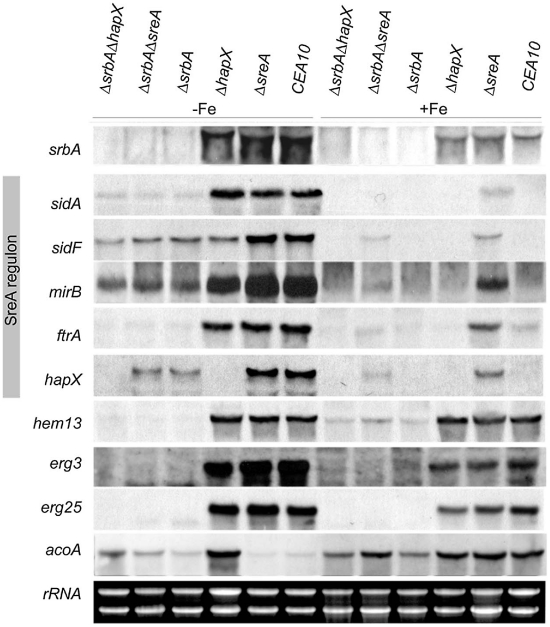
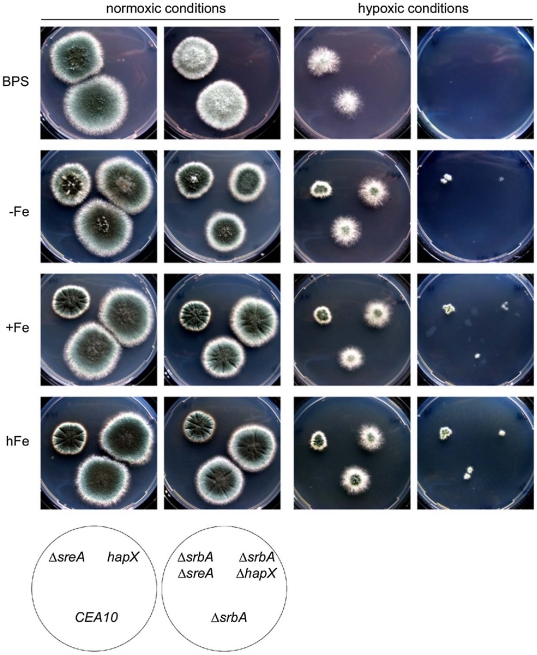
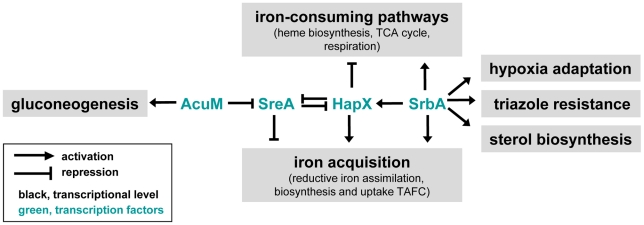
Sterol regulatory element binding proteins (SREBPs) are a class of basic helix-loop-helix transcription factors that regulate diverse cellular responses in eukaryotes. Adding to the recognized importance of SREBPs in human health, SREBPs in the human fungal pathogens Cryptococcus neoformans and Aspergillus fumigatus are required for fungal virulence and susceptibility to triazole antifungal drugs. To date, the exact mechanism(s) behind the role of SREBP in these observed phenotypes is not clear. Here, we report that A. fumigatus SREBP, SrbA, mediates regulation of iron acquisition in response to hypoxia and low iron conditions. To further define SrbA's role in iron acquisition in relation to previously studied fungal regulators of iron metabolism, SreA and HapX, a series of mutants were generated in the ΔsrbA background. These data suggest that SrbA is activated independently of SreA and HapX in response to iron limitation, but that HapX mRNA induction is partially dependent on SrbA. Intriguingly, exogenous addition of high iron or genetic deletion of sreA in the ΔsrbA background was able to partially rescue the hypoxia growth, triazole drug susceptibility, and decrease in ergosterol content phenotypes of ΔsrbA. Thus, we conclude that the fungal SREBP, SrbA, is critical for coordinating genes involved in iron acquisition and ergosterol biosynthesis under hypoxia and low iron conditions found at sites of human fungal infections. These results support a role for SREBP-mediated iron regulation in fungal virulence, and they lay a foundation for further exploration of SREBP's role in iron homeostasis in other eukaryotes.
Overview
The claims and statistics of this paper haven’t been checked yet.
Free: it reads the open-access text and checks the first 5 claims that cite a source we can check. Create a free account to check every claim.
Integrity signals
Registry
Cites
Statistics
Figures
Verification
Claims the paper makes
The claims and statistics of this paper haven’t been checked yet.
Free: it reads the open-access text and checks the first 5 claims that cite a source we can check. Create a free account to check every claim.
Claims other papers make about this one
Each is checked against this paper’s own text: does it say what the citing paper says it does?
In the citing paper
“For example, the TF SrbA also activates siderophore-mediated iron uptake in response to hypoxia and iron starvation (357).”
From Aspergillus fumigatus and Aspergillosis in 2019 (2019) · cites this paper as [357]
In the citing paper
“Hypoxic fungal growth is under the control of the common hypoxia regulator Hif1α (211, 393), but it is also associated with other major cellular pathways, such as sterol and siderophore biosynthesis and mitochondrial respiration (357, 394–396).”
From Aspergillus fumigatus and Aspergillosis in 2019 (2019) · cites this paper as [357]
Self-check
Percentages, sums and reported differences re-computed from the paper’s own numbers.
The self-check needs the paper’s full text.
Citations
Cites
The Genetics of Aspergillus nidulans
Pontecorvo, G., Roper, J. A., Chemmons, L. M., Macdonald, K. D., & Bufton, A. W. J. (1953) · Advances in Genetics · doi:10.1016/s0065-2660(08)60408-3 · Cited by 2,302 · cited 1×
“[54] containing 1% glucose as carbon source and 20 mM glutamine as nitrogen source or glucose minimal medium (GMM) with 1% glucose as carbon source as previously described [19].”
MethodYokoyama, C., Wang, X., Briggs, M. R., Admon, A., Wu, J., Hua, X., Goldstein, J. L., & Brown, M. S. (1993) · Cell · doi:10.1016/0092-8674(93)90690-r · Cited by 981
Lee, P. J., Jiang, B.-H., Chin, B. Y., Iyer, N. V., Alam, J., Semenza, G. L., & Choi, A. K. (1997) · Journal of Biological Chemistry · doi:10.1074/jbc.272.9.5375 · Cited by 782 · cited 1×
“been found to regulate several genes involved in iron metabolism [11,12,13,14].”
BackgroundTontonoz, P., Kim, J. B., Graves, R. A., & Spiegelman, B. M. (1993) · Molecular and Cellular Biology · doi:10.1128/mcb.13.8.4753 · Cited by 611
Schrettl, M., Bignell, E., Kragl, C., Joechl, C., Rogers, T., Arst, H. N., Haynes, K., & Haas, H. (2004) · The Journal of Experimental Medicine · doi:10.1084/jem.20041242 · Cited by 493 · cited 3×
“As production of extra- and intracellular siderophores plays a crucial role in adaptation to iron starvation [4,5], these data explain, at least in part, the observed growth and morphological defects of DsrbA during iron starvation.”
BackgroundSelf-citationDistinct Roles for Intra- and Extracellular Siderophores during Aspergillus fumigatus Infection
Schrettl, M., Bignell, E., Kragl, C., Sabiha, Y., Loss, O., Eisendle, M., Wallner, A., Arst, H. N., Haynes, K., & Haas, H. (2007) · PLoS Pathogens · doi:10.1371/journal.ppat.0030128 · Cited by 405 · cited 3×
“As production of extra- and intracellular siderophores plays a crucial role in adaptation to iron starvation [4,5], these data explain, at least in part, the observed growth and morphological defects of DsrbA during iron starvation.”
BackgroundSelf-citationOxygen-regulated transferrin expression is mediated by hypoxia-inducible factor-1
Rolfs, A., Kvietikova, I., Gassmann, M., & Wenger, R. H. (1997) · Journal of Biological Chemistry · doi:10.1074/jbc.272.32.20055 · Cited by 401 · cited 1×
“transferrin, which increases iron availability to host cells under hypoxic stress [10].”
BackgroundWillger, S. D., Puttikamonkul, S., Kim, K.-H., Burritt, J. B., Grahl, N., Metzler, L. J., Barbuch, R., Bard, M., Lawrence, C. B., & Cramer, R. A. (2008) · PLoS Pathogens · doi:10.1371/journal.ppat.1000200 · Cited by 345 · cited 7×
“fumigatus SrbA SREBPs appear to be key regulators of Erg25 and sterol biosynthesis [19,30,47] (Figure 1B, Figure 2, and Figure 5).”
BackgroundMethodInfluentialSelf-citationA High-Affinity Iron Permease Essential for Candida albicans Virulence
Ramanan, N., & Wang, Y. (2000) · Science · doi:10.1126/science.288.5468.1062 · Cited by 336
The SREBP pathway — insights from insigs and insects
Rawson, R. B. (2003) · Nature Reviews Molecular Cell Biology · doi:10.1038/nrm1174 · Cited by 323
Research works printed but not linked: 2
- Chun CD Liu OW Madhani HD 2007 A link between virulence and homeostatic responses to hypoxia during infection by the human fungal pathogen Cryptococcus neoformans. PLoS Pathog 3 e22 doi: 10.1371/journal.ppat.0030022 17319742 PMC1803011 · DOI · Paper page
- Todd BL Stewart EV Burg JS Hughes AL Espenshade PJ 2006 Sterol regulatory element binding protein is a principal regulator of anaerobic gene expression in fission yeast. Molecular and cellular biology 26 2817 2831 16537923 PMC1430309 · DOI · Paper page
Cited by
Items 101–175 of 175
Kroll, K., Shekhova, E., Mattern, D. J., Thywissen, A., Jacobsen, I. D., Strassburger, M., Heinekamp, T., Shelest, E., Brakhage, A. A., & Kniemeyer, O. (2016) · Molecular Microbiology · doi:10.1111/mmi.13377 · Cited by 22
“As aforementioned, this SREBP transcriptional regulator is known to mediate cellular responses against azoles and hypoxia in A. fumigatus (Blatzer et al., 2011).”
BackgroundMethodInfluentialFunctional Analysis of Sterol Transporter Orthologues in the Filamentous Fungus Aspergillus nidulans
Bühler, N., Hagiwara, D., & Takeshita, N. (2015) · Eukaryotic Cell · doi:10.1128/ec.00027-15 · Cited by 25
“fumigatus, and the total ergosterol level was reduced in the srbA-null mutant (73, 74).”
BackgroundVicentefranqueira, R., Leal, F., Marín, L., Sánchez, C. I., & Calera, J. A. (2019) · Environmental Microbiology · doi:10.1111/1462-2920.14618 · Cited by 22
Aspergillosis and stem cell transplantation: An overview of experimental pathogenesis studies
Al-Bader, N., & Sheppard, D. C. (2016) · Virulence · doi:10.1080/21505594.2016.1231278 · Cited by 29
Comparative Genomics of Cochliobolus Phytopathogens
Condon, B. J., Wu, D. L., Kraševec, N., Horwitz, B. A., & Turgeon, B. G. (2014) · Springer eBooks · doi:10.1007/978-3-662-44053-7_2 · Cited by 23
De-repression of CSP-1 activates adaptive responses to antifungal azoles.
Chen, X., Xue, W., Zhou, J., Zhang, Z., Wei, S., Liu, X., Sun, X., Wang, W., & Li, S. (2016) · Scientific Reports · doi:10.1038/srep19447 · Cited by 20
“Many genes involved in ergosterol biosynthesis have transcriptional responses to azole stress 10,30,31 .”
Phenotypic landscape of a fungal meningitis pathogen reveals its unique biology
Boucher, M. J., Banerjee, S., Joshi, M. B., Wei, A. L., Nalley, M. J., Huang, M. Y., Lei, S., Ciranni, M., Condon, A., Langen, A., et al. (2024) · Cell · doi:10.1016/j.cell.2025.05.017 · Cited by 36
Gómez, M., Campusano, S., Gutiérrez, M. S., Sepúlveda, D., Barahona, S., Baeza, M., Cifuentes, V., & Alcaíno, J. (2020) · Journal of Lipid Research · doi:10.1194/jlr.ra120000975 · Cited by 25
Phosphoproteomics of Aspergillus fumigatus Exposed to the Antifungal Drug Caspofungin
Mattos, E. C., Palmisano, G., & Goldman, G. H. (2020) · mSphere · doi:10.1128/msphere.00365-20 · Cited by 22
“We previously observed that a ΔhapB mutant (AFUA_2G14720, encoding a CAAT-binding TF) (30) and a ΔatfA mutant (AFUA_3G11330) were more susceptible to caspofungin at 0.”
BackgroundInfluentialYap, A., Volz, R., Paul, S. K., Moye-Rowley, S., & Haas, H. (2023) · mBio · doi:10.1128/mbio.00757-23 · Cited by 17
“1), as shown previously and confirmed here for the DsrbA strain (28).”
BackgroundMethodResultInfluentialSelf-citationDoyle, S., Jones, G. W., & Dolan, S. K. (2017) · Fungal Biology · doi:10.1016/j.funbio.2017.12.007 · Cited by 18
Zhang, Z., Fan, J., Long, C., He, B., Hu, Z., Jiang, C., Li, Y., Ma, L., Wen, J., Zou, X., et al. (2019) · Journal of Industrial Microbiology & Biotechnology · doi:10.1007/s10295-019-02236-9 · Cited by 19
“Further studies revealed that the GATA factor SreA is associated with iron absorption and also hypoxia, and that SreA and the principal regulators of hypoxia adaptation have common target genes [6, 8].”
BackgroundAzole Resistance-Associated Regulatory Motifs within the Promoter of cyp51A in Aspergillus fumigatus
Kühbacher, A., Peiffer, M., Hortschansky, P., Merschak, P., Bromley, M., Haas, H., Brakhage, A. A., & Gsaller, F. (2022) · Microbiology Spectrum · doi:10.1128/spectrum.01209-22 · Cited by 19
“physiologically most relevant in vivo binding sites despite the presence of further predicted SrbA 141 binding motifs within Pcyp51A (13, 24, 25).”
Self-citationKröber, A., Scherlach, K., Hortschansky, P., Shelest, E., Staib, P., Kniemeyer, O., & Brakhage, A. A. (2016) · PLoS ONE · doi:10.1371/journal.pone.0150701 · Cited by 21
Govic, Y. L., Papon, N., Gal, S. L., Lelièvre, B., Bouchara, J., & Vandeputte, P. (2018) · Frontiers in Microbiology · doi:10.3389/fmicb.2018.00827 · Cited by 21
“Aspergillus fumigatus genome harbors 15 putative metalloreductase genes, but only one, namely freB, is involved in iron metabolism (Blatzer et al., 2011b).”
BackgroundInfluentialSong, J., Zhai, P., & Lü, L. (2017) · Applied Microbiology and Biotechnology · doi:10.1007/s00253-016-8072-9 · Cited by 16
Escobar, N., Valdes, I. D., Keizer, E., Ordoñez, S. R., Ohm, R. A., Wösten, H. A. B., & de Cock, H. (2018) · BMC Genomics · doi:10.1186/s12864-018-4895-3 · Cited by 17
Sen, P., Gupta, L., Vijay, M., Sarin, M. V., Shankar, J., Hameed, S., & Vijayaraghavan, P. (2023) · Frontiers in Cellular and Infection Microbiology · doi:10.3389/fcimb.2023.1103957 · Cited by 14
“Sterol biosynthesis is directly impacted by iron and oxygen levels and reductions in these key molecules stimulates ergosterol biosynthesis gene expression through SrbA dependent mechanisms (Blatzer et al., 2011).”
BackgroundInmunopatología de las micosis invasivas por hongos filamentosos
García‐Vidal, C., & Salavert, M. (2014) · Revista Iberoamericana de Micología · doi:10.1016/j.riam.2014.09.001 · Cited by 26
“El hierro es básico para la síntesis de ergosterol, los procesos de resis-tencia a los azoles, la adaptación a la hipoxia y la interacción directa con el sistema inmunitario 7,8,33,57 .”
Deletion of cox7c Results in Pan-Azole Resistance in Aspergillus fumigatus
Chen, M., Zhong, G., Wang, S., Chen, P., & Li, L. (2022) · Antimicrobial Agents and Chemotherapy · doi:10.1128/aac.00151-22 · Cited by 16
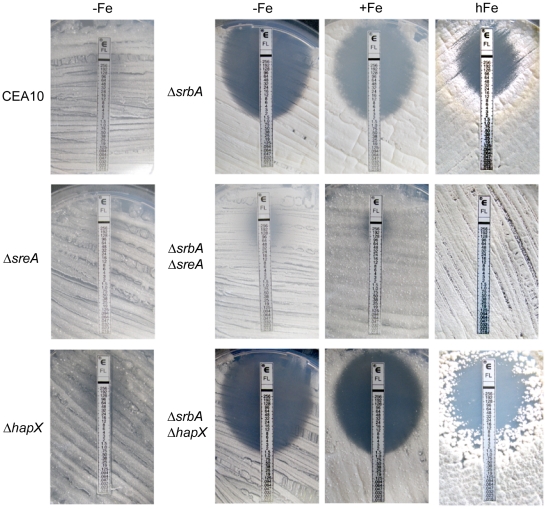
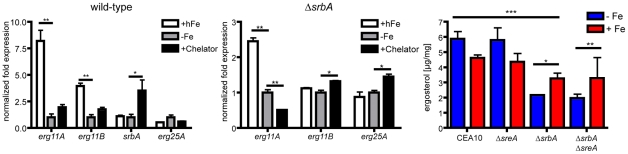
“addition of high iron partially rescues the triazole susceptibility and decrease in ergosterol content phenotypes of DsrbA (37).”
BackgroundChaudhary, R., Balhara, M., Jangir, D. K., Dangi, M., Narwal, M. D., & Chhillar, A. K. (2018) · Current Topics in Medicinal Chemistry · doi:10.2174/1568026619666181120150633 · Cited by 13
Chung, H., Kim, S., Kim, K., Hwang, B., Kim, H. J., Lee, S. J., & Lee, Y. (2019) · Environmental Microbiology · doi:10.1111/1462-2920.14563 · Cited by 12
Chong, R., & Espenshade, P. J. (2013) · Journal of Biological Chemistry · doi:10.1074/jbc.m113.482224 · Cited by 14
“These findings demonstrate a role for this conserved glycineleucinemotif in fungal SREBP cleavage activation, provide tools for dissecting the mechanism of SREBP cleavage, and identify the SREBP C terminus as a target for antifungal therapy for pathogenic fungi that contain a relevant conserved SREBP pathway (5, 7, 9,…”
BackgroundGutierrez-Perez, C., Puerner, C. T. S., Jones, J. T., Vellanki, S., Vesely, E. M., Xatse, M. A., Viera, A. F. C., Olsen, C. P., Attiku, K. O., Cardinale, S. C., et al. (2024) · mBio · doi:10.1128/mbio.01166-24 · Cited by 18
“…biological factors contribute to poor treatment outcomes, including biofilm formation and physiological adaptation to hypoxia in host tissues, which are regulated by a genetic network controlled by the A. fumigatus sterol-regulatory element binding protein transcription factor, SrbA (14–18).”
BackgroundSelf-citationBrookheart, R. T., Lee, C.-Y. S., & Espenshade, P. J. (2013) · Journal of Biological Chemistry · doi:10.1074/jbc.m113.511899 · Cited by 12
Research progress on the basic helix-loop-helix transcription factors of Aspergillus species
Wang, B., Yu, X., Zhu, Y., Zhuang, M., Zhang, Z., Jin, L., & Jin, F. (2019) · Advances in applied microbiology · doi:10.1016/bs.aambs.2019.09.001 · Cited by 12
Zhao, Y., Zhang, L., Ju, C., Zhang, X., & Huang, J. (2022) · BMC Genomics · doi:10.1186/s12864-022-08372-4 · Cited by 11
Lingo, D. E., Shukla, N., Osmani, A. H., & Osmani, S. A. (2021) · Molecular Biology of the Cell · doi:10.1091/mbc.e20-11-0734 · Cited by 10
“The pathways SrbA controls are known to be expansive and diverse, and SrbA is involved in fungal virulence and azole drug resistance (Willger et al., 2008; Blatzer et al., 2011; Chung et al., 2014; Gsaller et al., 2016).”
BackgroundZhang, C., Gao, L., Ren, Y., Gu, H., Zhang, Y., & Lü, L. (2021) · MicrobiologyOpen · doi:10.1002/mbo3.1249 · Cited by 10
Shepardson, K. M., & Cramer, R. A. (2013) · Current Opinion in Microbiology · doi:10.1016/j.mib.2013.03.003 · Cited by 13
Self-citationPaul, S. K., Ror, S., McDonald, W. H., & Moye-Rowley, S. (2022) · mSphere · doi:10.1128/msphere.00476-22 · Cited by 8
“NcaA may not be involved in AtrR-dependent activation at the cyp51A promoter or the partially compromised phenotype triggered by the ncaAΔ allele may be suppressed by the presence of normal SrbA.”
BackgroundInfluentialPiombo, E., Tzelepis, G. D., Ruus, A. G., Rafiei, V., Jensen, D. F., Karlsson, M., & Dubey, M. K. (2024) · Microbiological Research · doi:10.1016/j.micres.2024.127922 · Cited by 9
Characterization of a heme-protein responsive to hypoxia in Paracoccidioides brasiliensis
Oliveira, L. N., Gonçales, R. A., Silva, M. G., Lima, R. M., Tomazett, M. V., de Curcio, J. S., Paccez, J. D., Cruz-Leite, V. R. M., Rodrigues, F. J. S., Lima, P. D. S., et al. (2020) · Fungal Genetics and Biology · doi:10.1016/j.fgb.2020.103446 · Cited by 10
Phenotypic landscape of a fungal meningitis pathogen reveals its unique biologyPreprint
Boucher, M. J., Banerjee, S., Joshi, M., Wei, A. L., Huang, M. Y., Lei, S., Ciranni, M., Condon, A., Langen, A., Goddard, T. D., et al. (2024) · bioRxiv (Cold Spring Harbor Laboratory) · doi:10.1101/2024.10.22.619677 · Cited by 9
Bauer, I., Abt, B., Yap, A., Leuchtle, B., & Haas, H. (2022) · Journal of Fungi · doi:10.3390/jof8101013 · Cited by 12
“The most likely explanations are that the significantly higher biomass formation in liquid shake conditions increases iron limitation by iron consumption and that liquid shake culturing decreases the oxygen supply, which might play a particular role for the ∆srbA mutant, which shows a hypoxic growth defect [22].”
BackgroundMethodInfluentialSelf-citationLinking calcium signaling and mitochondrial function in fungal drug resistance
Bowyer, P., Bromley, M., & Denning, D. W. (2020) · Proceedings of the National Academy of Sciences · doi:10.1073/pnas.1920497117 · Cited by 10
Aspergillus fumigatus Hypoxia Adaptation Is Critical for the Establishment of Fungal Keratitis
Lightfoot, J. D., Adams, E. M., Kamath, M. M., Wells, B. L., & Fuller, K. K. (2024) · Investigative Ophthalmology & Visual Science · doi:10.1167/iovs.65.4.31 · Cited by 10
Wangsanut, T., Amsri, A., Kalawil, T., Sukantamala, P., Jeenkeawpieam, J., Andrianopoulos, A., & Pongpom, M. (2024) · PLoS neglected tropical diseases · doi:10.1371/journal.pntd.0012145 · Cited by 7
Proteomic Differences between Azole-Susceptible and -Resistant Aspergillus fumigatus Strains
Vermeulen, E., Carpentier, S., Kniemeyer, O., Sillen, M., Maertens, J. A., & Lagrou, K. (2018) · Advances in Microbiology · doi:10.4236/aim.2018.81007 · Cited by 8
“[1] [43] [48] B0Y6F1 Afu4g09600 GPI anchoredprotein, putative Genes regulated by SrbA, plays a role in ergosterol biosynthesis and which mediates resistance to azole antifungals (fluconazole susceptibility, lover voriconazole MIC in SrbA null mutant) Idi1 is connected to isoprenoid biosynthesis (precursors for bio…”
BackgroundEffect of Soil Water Potential on Growth of Apple Trees Infected with Pratylenchus penetrans.
Jaffee, B. A., & Mai, W. F. (1979) · PubMed · Cited by 11
Biofilm formation in Zymoseptoria triticiPreprint
Tyzack, T. E., Hacker, C., Thomas, G., & Fones, H. N. (2023) · bioRxiv (Cold Spring Harbor Laboratory) · doi:10.1101/2023.07.26.550639 · Cited by 10
Wangsanut, T., Khamto, N., Alinejad‐Rokny, H., & Pongpom, M. (2025) · Frontiers in Cellular and Infection Microbiology · doi:10.3389/fcimb.2025.1717070 · Cited by 5
Poudyal, N. R., Mehlem, R., Doneparthi, P., Cady, T., Kaufman, G., Willger, S. D., Ortiz, M., Noorai, R. E., Stajich, J., & Dhingra, S. (2026) · Genetics · doi:10.1093/genetics/iyag152 · Cited by 5
“SrbA also regulates ergosterol biosynthesis by transcriptional regulation of erg3 , erg25 , and erg24 genes (Blatzer et al. 2011; Blosser and Cramer 2012).”
Self-citationBirštonas, L., Hortschansky, P., Bauer, I., Alcanzo, E. M., Kühbacher, A., Mertens, B., Müller, C., Brakhage, A. A., & Gsaller, F. (2025) · mBio · doi:10.1128/mbio.01854-25 · Cited by 5
“In A. fumigatus, SrbA and AtrR are crucial for the activation of multiple ergosterol biosynthesis genes (28–30 , 58).”
Approaches to understanding protein hypersecretion in fungi
Reilly, M. C., Magnuson, J. K., & Baker, S. (2016) · Fungal Biology Reviews · doi:10.1016/j.fbr.2016.06.002 · Cited by 5
Zhang, H., Zhu, Z., Peng, M., Liu, S., Gong, X., Chen, T., Hu, Q., Li, L., Dun-zhu, Z.-X., Drol-ga, L.-Z., et al. (2025) · Mycopathologia · doi:10.1007/s11046-025-00992-0 · Cited by 4
“In contrast, expression levels of the ergosterol biosynthesis-specific transcription factors srbA and atrF , as well as the azole target genes cyp51A and cyp51B , remained unchanged [36–38] (Fig.”
Rajasenan, S., Osmani, A. H., & Osmani, S. A. (2022) · Fungal Genetics and Biology · doi:10.1016/j.fgb.2022.103739 · Cited by 3
Zhai, P., Ma, Y., Du, W., & Lü, L. (2022) · Frontiers in Microbiology · doi:10.3389/fmicb.2022.1062282 · Cited by 4
“Many studies have shown that the high expression of the azole target Erg11A and the content of its substrate ergosterol are important reasons for the development of azole resistance in fungal pathogens (Blatzer et al., 2011; Gsaller et al., 2016).”
BackgroundRuan, R., Chung, K.-R., & Li, H. (2017) · Microbiological Research · doi:10.1016/j.micres.2017.07.005 · Cited by 4
Absent regulation of iron acquisition by the copper regulator Mac1 in A. fumigatus
Yap, A., Misslinger, M., & Haas, H. (2020) · Biochemical Journal · doi:10.1042/bcj20200286 · Cited by 3
Self-citationIdentification of Potential New Genes Related to the SREBP Pathway in Xanthophyllomyces dendrorhous
Venegas, M., Durán, A., Campusano, S., Barahona, S., Sepúlveda, D., Baeza, M., Cifuentes, V., & Alcaíno, J. (2024) · Biomolecules · doi:10.3390/biom14070778 · Cited by 2
“Additionally, while strain CBS. cyp61 - shows resistance to azole compounds, mutants of the SREBP pathway, such as sre1 - and stp1 - , do not, as the SREBP pathway mediates resistance to these compounds in fungi [13,52,53].”
BackgroundFan, Y., Liu, X., Zhang, Y., Gai, Y., Li, X. Z., & Song, L. M. (2026) · Journal of Oceanology and Limnology · doi:10.1007/s00343-025-5109-x · Cited by 1
“Human pathogenic fungi, such as Cryptococcus neoformans and Aspergillus fumigatus , respond to low oxygen levels by modulating the expression of regulatory factors like SRE1 from the SREBP (sterol regulatory element-binding protein) family (Chang et al., 2007; Blatzer et al., 2011).”
Genotype–Phenotype Relationships in Azole-Resistant Aspergillus: Two Sides of the Same Coin
van Haren, M. H. I., Melchers, W. J. G., Zhang, J., Dellière, S., Bii, C. C., Stanford, F. A., Voetz, M., White, P. L., Dyer, P. S., Pas, S. D., et al. (2026) · Journal of Fungi · doi:10.3390/jof12040290 · Cited by 1
“Altered SrbA activity reshapes sterol homeostasis and drug susceptibility without necessitating structural changes to Cyp51A [101].”
The dual role of SrbA from Paracoccidioides lutzii: a hypoxic regulator
de Sousa, L. O., Oliveira, L. N., Naves, R. B., Pereira, A. L. A., Silva, K. S. F. E., Soares, C. M. D. A., & Lima, P. D. S. (2021) · Brazilian Journal of Microbiology · doi:10.1007/s42770-021-00527-x · Cited by 1
New Perspectives on Fungal Siderophores
Moussa, T. A. A., Rashad, Y. M., & Baka, Z. A. M. (2023) · Springer eBooks · doi:10.1007/978-3-031-28307-9_9 · Cited by 1
In the Crossroad Between Drug Resistance and Virulence in Fungal Pathogens
Cavalheiro, M., & Teixeira, M. C. (2018) · Springer eBooks · doi:10.1007/978-3-030-00683-9_7 · Cited by 1
Host-Induced Stress Response in Human Pathogenic Fungi
Viana, R., Pais, P., Cavalheiro, M., Galocha, M., & Teixeira, M. C. (2021) · Elsevier eBooks · doi:10.1016/b978-0-12-819990-9.00035-4 · Cited by 1
Análise molecular da anidrase carbônica no fungo patogênico humano Aspergillus fumigatus
Canela, H. M. S. (2013) · Digital Library of Theses and Dissertations (Universidade de São Paulo) · doi:10.11606/d.60.2013.tde-29012014-091548 · Cited by 1
Blosser, S. J. (2013) · Montana State University ScholarWorks (Montana State University)
Self-citationMolecular mechanisms of azole resistance in Aspergillus fumigatus
Camps, S. M. T. (2013) · Radboud Repository (Radboud University)
Shekhar‐Guturja, T. (2016) · TSpace (University of Toronto)
Organic acid production in Aspergillus niger and other filamentous fungi
Odoni, D. I. (2017) · doi:10.18174/423035 · Cited by 3
“1181156 has a similar basic helix-loop-helix structure as the known Aspergillus fumigatus transcription factor SrbA, which was found to be essential for adaptation of this fungus to low iron stress (Blatzer et al., 2011).”
BackgroundAspergillus- Human Interactions: From the Environment to Clinical Significance
Thammahong, A. (2022) · IntechOpen eBooks · doi:10.5772/intechopen.98509 · Cited by 2
Luperini, R. S. (2023) · Digital Library of Theses and Dissertations (Universidade de São Paulo) · doi:10.11606/d.17.2023.tde-17102023-105339
Piombo, E., Tzelepis, G. D., Ruus, A. G., Rafiei, V., Jensen, D. F., Karlsson, M., & Dubey, M. K. (2024) · bioRxiv (Cold Spring Harbor Laboratory) · doi:10.1101/2024.02.26.582079
Wu, Z., & Liu, Z. (2025) · Frontiers in Microbiology · doi:10.3389/fmicb.2025.1603805
Baldin, C., Binder, U., Scheler, J., Werner, E. R., Gsaller, F., Bromley, M., & Haas, H. (2025) · Frontiers in Microbiology · doi:10.3389/fmicb.2025.1646661 · Cited by 1
Self-citationGerrits, R., Schumacher, J., & Gorbushina, A. A. (2026) · Applied and Environmental Microbiology · doi:10.1101/2025.11.18.689051
Montedonico, A. E. (2012) · Cited by 1
Chromatin Immunoprecipitation in Aspergillus fumigatus
Paul, S., Stamnes, M. A., & Moye-Rowley, S. (2026) · Methods in molecular biology · doi:10.1007/978-1-0716-5222-0_11
Emerging Antifungal Resistance in Ocular Infections
de Oliveira, H. C., Tabuse, A. M., Höfling-Lima, A. L., & Rodrigues, A. M. (2026) · Springer eBooks · doi:10.1007/978-3-032-19923-2_3
Li, D. C., Yue, X., Hu, W., Zhong, H., Chen, F. Z., Zhao, J., Cao, L., Chen, X., & Han, L. (2026) · Frontiers in Microbiology · doi:10.3389/fmicb.2026.1891518
“Experimental investigations have revealed that point mutations at various sites within cyp51A — such as G448S, G54A, G54W, P216I, and M220V/K/T—contribute to azole resistance (Blatzer et al., 2011).”
Ye, S., Cui, Z., Zhou, M., Hu, C., Yu, P., Zhang, L., Li, S., & Sun, X. (2026) · mBio · doi:10.1128/mbio.02021-26
Wang, H., Zhang, G., Chen, Q., Che, Z., Ma, Y., Hu, S., Qian, J., Xu, X., Chen, Y., Liu, Z., et al. (2026) · Advanced Agrochem · doi:10.1016/j.aac.2026.10.015
Metadata
- Authors
- Blatzer, M., Barker, B. M., Willger, S. D., Beckmann, N., Blosser, S. J., Cornish, E. J., Mazurie, A., Grahl, N., Haas, H., & Cramer, R. A.
- Affiliations
- Innsbruck Medical University (AT)
- Montana State University (US)
- Corresponding author
- Haas, Hubertus
- Cramer, Robert A.
- ORCID
- Venue
- PLoS Genetics
- Publisher
- Public Library of Science (PLoS)
- Published
- 2011-12-01
- Volume
- 7
- Issue
- 12
- Pages
- e1002374
- ISSN
- 1553-7390 (ISSN-L)
- 1553-7404
- PMC
- PMC3228822
- OpenAlex
- W2017186637
- Cited by
- 175
- References
- 62
- Citations by year
- 2026: 9 · 2025: 6 · 2024: 8 · 2023: 6 · 2022: 9 · 2021: 10 · 2020: 11 · 2019: 10 · 2018: 10 · 2017: 15 · 2016: 23 · 2015: 11 · 2014: 15 · 2013: 14 · 2012: 16
- FWCI
- 5.97
- Type
- journal article
- Language
- en
- Open access
- gold
- doi.org
- Locations
- PLoS Genetics (publishedVersion, cc-by)
- Europe PMC (PubMed Central) (publishedVersion, cc-by)
- PubMed Central (publishedVersion, cc-by)
- PubMed (publishedVersion)
- Montana State University ScholarWorks (Montana State University) (submittedVersion, cc-by)
- DOAJ (DOAJ: Directory of Open Access Journals) (submittedVersion, cc-by-sa)
- Figshare (submittedVersion, cc-by)
- Funders
- American Heart Association
- Ohio State University
- Montana State University
- Imperial College London
- Austrian Science Fund (P18606)
- National Institutes of Health (project 2, RR 020185)
- National Institute of Allergy and Infectious Diseases (R01 AI81838, L40 AI084526, R01AI081838)
- National Center for Research Resources (P20RR020185, RR 020185)
- Topics
- Life Sciences › Biochemistry, Genetics and Molecular Biology › Molecular Biology › Fungal and yeast genetics research
- Health Sciences › Medicine › Infectious Diseases › Antifungal resistance and susceptibility
- Health Sciences › Medicine › Infectious Diseases › Fungal Infections and Studies
- Keywords
- SREBP, Aspergillus fumigatus, iron homeostasis, ergosterol biosynthesis, hypoxia, iron acquisition, fungal virulence, fungal pathogens, transcriptional regulation
- MeSH terms
- Animals, Antifungal Agents, Aspergillus fumigatus, Ergosterol, Homeostasis, Humans, Iron, Lung Diseases, Fungal, Triazoles, Gene Expression Regulation, Fungal, Siderophores, Oligonucleotide Array Sequence Analysis, Drug Resistance, Fungal, Mice, Sterol Regulatory Element Binding Proteins
About these checks
Registry, retraction, Cites and statistics results are computed, not judged, with one exception: a printed reference that no index lists is read once by a model before it counts as a citation error. Claims are extracted by a model and kept only when their quote appears verbatim in the text; each cited source is then checked, with a model’s help, for whether it says what the claim relies on. Those verdicts can be wrong — read the claim’s quote and the cited source before relying on one.
Statistics and arithmetic are recomputed, not judged.
Confidence bands are shown only for fields calibrated on our annotated test set. None is calibrated yet, so no band is shown.
What counts as a claim ›How we measure confidence ›How we check this ›
Are you an author, or do you see a problem with this page? Request a review
Data sources
Bibliographic data: Semantic Scholar, OpenAlex, Crossref.
Contains information from the Semantic Scholar Academic Graph Datasets, made available under the ODC Attribution License (ODC-BY 1.0).
Semantic Scholar’s data is described in: Kinney, R., et al. (2023). The Semantic Scholar Open Data Platform. arXiv:2301.10140.
